
A Nafplio day trip leaves Athens for the old harbour town of Nafplio on the Argolic Gulf, the first capital of modern Greece, with its Venetian fortresses, its sea castle and its marble-paved streets. This post covers what a Nafplio day trip includes, the old town, Palamidi, Bourtzi, Akronafplia, the museums, the road from Athens, the ancient sites and beaches nearby, the history and the best season. It is one of the tours in Greece on Greece VIP.
Each section ends with a Nafplio day trip that can be booked online.
What does a Nafplio day trip include?
A Nafplio day trip centres on a coastal city that faces the Argolic Gulf from the northeast Peloponnese. The programme covers the old town below two fortresses, the harbour and the sites of the first Greek capital of modern times, which served from 1827 to 1834.
Nafplio is the capital of the regional unit of Argolis. A peninsula pushes into the Argolic Gulf, and the old town sits on it. The peninsula shelters a bay, and moles built by people widen that shelter. Marshes once left the city almost cut off from the land, and landfill projects since the 1970s have nearly doubled its area. A Nafplio day trip therefore explores a town that grew outward from a rocky peninsula.
The provisional government of Greece sat in Nafplio after the siege ended, and the strong fortifications explain the choice. Ioannis Kapodistrias, who led the newly liberated state, made it the official capital in 1829. The seat of government passed to Athens in 1834, on the decision of King Otto. A Nafplio day trip covers the streets and buildings where that short chapter played out.
A Nafplio day trip from Athens takes one of three forms: group, private or combined. A group tour follows a fixed route with a tour leader. A private tour lets one party choose the pace and the stops. A combined archaeological tour such as the Mycenae Epidaurus day trip gives its day to ruins and treats the town as one stop, while a day centred on the town gives its hours to the old streets, the forts and the harbour.
- Group tour: A coach and a tour leader carry a set programme from Athens to the town and back.
- Private tour: One party chooses its own pace, its own stops and its own start.
- Combined tour: The town shares the day with archaeological ruins in the Argolis.
Athens and other Greek cities send the largest share of visitors to Nafplio, and tourists from Germany, France, Scandinavia, Russia, the Balkans and the United States follow. A mild climate draws visitors all year. Whichever form a Nafplio day trip takes, it rests on one core of old town, fortresses and first-capital history.


What does a Nafplio day trip see in the old town?
A Nafplio day trip sees the old town, from Syntagma Square and the Vouleftiko, the former mosque that housed the first Greek parliament, to the neoclassical streets and the church of Agios Spyridon, where Ioannis Kapodistrias was assassinated.
The Vouleftiko stands on Syntagma Square. Architect Antonios Rhigopoulos finished it as a mosque between about 1810 and 1820. Greek forces took the city in 1822, and in June 1824 the new parliamentary body decided to restore the ruined building as its seat. The opening came on 21 September 1825, and plenary sessions ran from that autumn to the spring of 1826. A Nafplio day trip stops at the first home of Greek parliamentary life.
The building did not stay a parliament for long. On 2 July 1827 a mortar hit it during clashes between revolutionaries and killed the deputy Christos Gerothanasis, which ended its use as a legislature. It then served as a ballroom and a court, where Theodoros Kolokotronis and Dimitrios Plapoutas stood trial in 1834. Later it became a prison, a store for the Archaeological Museum, a school, a hospital, barracks and a conservatory.
Two floors, a dome and a stair to the main facade mark the Vouleftiko as a raised mosque. A column from the archaeological site of Mycenae forms the lintel of one original door. Because the archaeologist Evangelia Protonotariou Deilaki spared the town the post-war rebuilding that destroyed traditional architecture in other Greek cities, a Nafplio day trip still passes through neoclassical and eclectic buildings.
In 1831 Kapodistrias ordered the arrest of Petrobey Mavromichalis, the Bey of the Mani, and the Mavromichalis family treated that arrest as a mortal offence. Members of the family killed the governor on the steps of Agios Spyridon, and a period of anarchy followed until King Otto arrived. A Nafplio day trip pauses at the church where Kapodistrias, a diplomat educated in Padua, died. His friend Theodoros Kolokotronis, a man of peasant origins, backed him.
- Syntagma Square: The Vouleftiko stands on this square.
- Vouleftiko: On a Nafplio day trip the building is a cultural venue, with events upstairs and the municipal gallery on the ground floor.
- Neoclassical streets: Eclectic and neoclassical buildings share the old town with the colourful houses of Venetian influence.
- Agios Spyridon: The steps outside the church mark the place of the assassination of 1831.
Together these stops tell the story of the early Greek state, from the first parliament to the death of its first head of state. The parliament, the court, the prison and the church all belong to the old town, so a Nafplio day trip reads that story in stone without leaving it.
Why does a Nafplio day trip climb to Palamidi?
A Nafplio day trip climbs to Palamidi because the fortress above the town was the final major work built by the Venetian empire overseas, and it passed from Venice to the Ottomans and later to Greece. One of its bastions held Theodoros Kolokotronis as a prisoner.
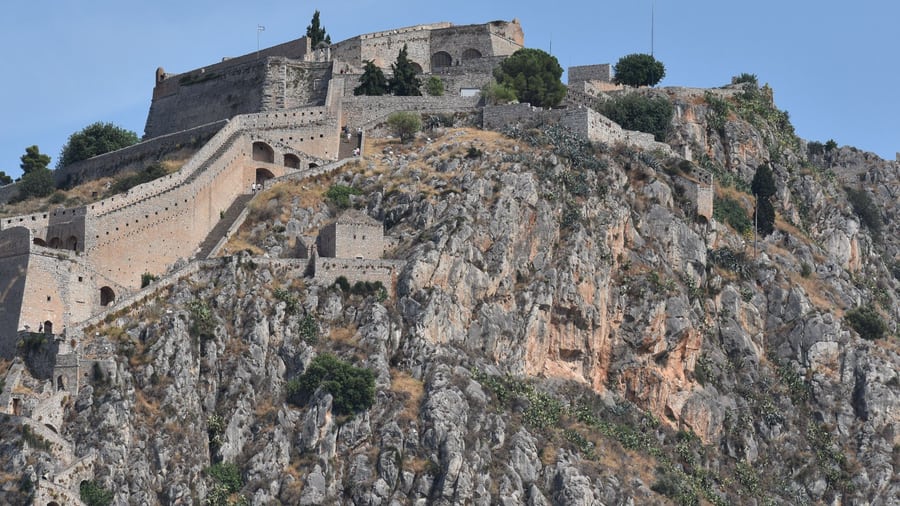
On a Nafplio day trip, Palamidi is the fortress that crowns the steep hill over the Acronauplia peninsula, and the hill is named after the Homeric hero Palamedes, son of Nauplius. The hill was the weak point in the defence of Nafplio, since an enemy there held a vantage point for bombardment, so the Venetians fortified it. Work began in 1711 under the engineers Antonio Giancix, the principal designer, and Pierre de la Salle.
Separate bastions stood at key points on the hill, and a wall joined them. Each bastion kept its own barracks, cisterns, gunpowder storerooms and food depots, so the defence continued from the others even when one fell. The Achilles bastion sits on the easiest point of the hill to reach, which made it the weak spot and earned it the name of an Achilles heel. The Ottomans stormed the fortress there in 1715, and the Greeks did the same in 1822.
Visitors enter through the central gate of the Epaminondas bastion, next to the car park, or climb the staircase from the town. The Greek state rebuilt that open staircase in the reign of King Otto, and the climb has a famous number of steps. It begins opposite Staikopoulos Park and the Grimani bastion. A Nafplio day trip that takes this route enters through the Robert bastion and passes into the Agios Andreas bastion.
On a Nafplio day trip, part of the fortress is a former prison, in use from the early years after liberation. The Miltiadis bastion housed long-term convicts, and the Agios Andreas bastion held those with shorter sentences. In 1834 Kolokotronis was jailed here on a charge of high treason and later pardoned. Tradition places his cell, a dark four-sided room, near the small church. Years earlier, tradition says, he rode his horse up the slope to celebrate the victory of 1822.
- Capture: Staikos Staikopoulos led the Greek forces that took the fortress on 30 November 1822.
- Agios Andreas: The church of Saint Gerard was rededicated to Saint Andrew because the fortress was freed on his feast day.
- Robert: This bastion honours the French philhellene Major François Robert, who fell at the siege of the Acropolis of Athens in 1827.
- Miltiadis: A Nafplio day trip sees walls 22 m high on this bastion, with a moat along two of its sides.
Palamidi ties the Venetian, Ottoman and Greek chapters of Nafplio together in one fortress. A Nafplio day trip that makes the climb reads those chapters in the bastions, the staircase and the prison rooms. It also links back to the old town below, where Kolokotronis later stood trial and where the Greek state first met in parliament.
What is Bourtzi on a Nafplio day trip?
A Nafplio day trip reaches Bourtzi, the Venetian water castle on an islet at the centre of the harbour. Antonio Gambello built it in 1471, and Brancaleone completed it. Later users made it a gun post, a government refuge, a home for the executioner and a hotel.
Every Nafplio day trip that reaches the harbour looks out to Bourtzi, a Venetian castle that stands alone on an islet. Antonio Gambello, an Italian architect from Bergamo, built it in 1471, and the engineer Brancaleone completed the work. The Venetians fitted the fortress with cannons. The name comes from the Ottoman Turkish word burc, which means tower, and earlier names for the castle were Kastelli and Passaz.
On a Nafplio day trip, the site shows how the Venetians guarded the port. In 1502 they changed the south-western defences into a separate rampart and piled up an artificial mound of boulders. A chain fixed to the mound ran to the town and kept hostile ships out of the harbour. After the Treaty of Karlowitz in 1699, they raised a sturdy tower and bastions with cannons, and a Nafplio day trip still sees that fortress dominating the entrance to the port.
On a Nafplio day trip, the later jobs of the castle trace the history of the town. In 1821 a force of 200 armed soldiers captured it, and its guns bombarded Nafplio and blocked a resupply of the besieged Turks from an English ship. The Greek government took refuge in the castle twice, in 1824 and again in 1827. In 1865 King George I ordered it disarmed, and it became the residence of the city’s executioner and a place of execution.
- Builder: Antonio Gambello began the castle in 1471, and Brancaleone completed it.
- Chain: A chain tied to a mound of boulders closed the harbour to hostile ships from 1502.
- Refuge: The Greek government sheltered in the castle in 1824 and again in 1827.
- Hotel: A hotel of 12 rooms and a restaurant ran in the castle from the 1930s until the Greek junta closed them.
The Greek National Tourism Organisation restored the castle in the 1930s, and it became one of the first tourist centres in Greece. The castle has since been restored as a tourist attraction for the city. From the waterfront, a Nafplio day trip sees the islet in the middle of the harbour, a bay that the old-town peninsula shelters and that human-made moles strengthen, while leisure ships fill the port in the tourist season.
What does a Nafplio day trip see at Akronafplia?
A Nafplio day trip sees Akronafplia, the oldest part of the town, where walls from before the classical age carry later Byzantine, Frankish, Venetian and Turkish work. The site was a town of its own until the thirteenth century, and a hotel complex now stands there.
Akronafplia is the oldest part of Nafplio. Until the thirteenth century, it was a town on its own, and its Turkish name means Inner Castle. Walls from before the classical age still stand there, and apart from these walls, little of the ancient settlement remains visible. A Nafplio day trip that looks for the earliest layer of the town therefore starts with this fortified site.
A Nafplio day trip finds that later rulers kept building on the site. Byzantines, Franks, Venetians and Turks all added to the fortifications. French crusaders of the Principality of Achaea took Nafplio in 1212, and the lordship of Argos and Nauplia was sold to the Republic of Venice in 1388. During the next 150 years, the Venetians expanded and fortified the lower city and added new works to Akronafplia. A Nafplio day trip reads Byzantine, Frankish and Venetian work in one set of walls.
The modern history of the site is different. Part of Akronafplia served as a prison. Then the Greek government decided that the view from its location was good for local tourism, and it built a hotel complex that still stands there. Tourism grew after the Greek Civil War, and Nafplio was one of the first areas on the mainland to develop mass tourism. A Nafplio day trip meets old stone and a modern hotel on the same ground.
- Age: Walls from before the classical age make Akronafplia the earliest fortified layer of the town.
- Rulers: Byzantines, Franks, Venetians and Turks each added to the fortifications.
- Prison: Part of the site served as a prison before the hotel complex was built.
Nafplio sits beside the Argolic Gulf, in the north-east of the Peloponnese, and much of the old town sits on a peninsula that juts into the gulf. The peninsula forms a naturally protected bay, which human-made moles strengthen. Marshes once almost isolated the city, and landfill since the 1970s has nearly doubled its land area. A Nafplio day trip beside this coast therefore covers a town whose land has grown in modern times.
Which museums does a Nafplio day trip visit?
A Nafplio day trip visits the Archaeological Museum of Nafplio in the old Venetian barracks, the Peloponnesian Folklore Foundation and the Nafplio branch of the War Museum. The archaeological museum holds the Dendra panoply, a Mycenaean suit of bronze armour from the late 15th century BCE.
The Archaeological Museum of Nafplio stands on the central square of the town and fills two floors of the old Venetian barracks. Its rooms hold finds from the Neolithic, Chalcolithic, Helladic, Mycenaean, Classical, Hellenistic and Roman periods, all from southern Argolis. On a Nafplio day trip, the oldest exhibits are Paleolithic clay hearths from the Kleisoura Gorge near Prosymna, dated between 32,000 and 21,000 BCE.
On a Nafplio day trip, Franchthi Cave appears through tools, shells, bones and jewellery. Archaeologists excavated the cave between 1967 and 1976, and its deposits form the longest recorded continuous occupation of any site in Greece. Obsidian blades point to Melos, about 150 km away, as a source. Later halls add a Tiryns wine cooler from 2700-2200 BCE, early Cycladic marble figurines, the Lady of Asine and Linear B tablets.
The Dendra panoply is a rare, almost complete set of Mycenaean armour. Swedish archaeologists found the beaten bronze cuirass at Dendra in the Argolid in 1960. The suit has 15 separate pieces of bronze sheet, held together with leather thongs, and it covers the wearer from neck to knees. A high bronze collar protects the neck. A Nafplio day trip sees the only complete panoply of this kind found to date.
A Nafplio day trip also reaches the Peloponnesian Folklore Foundation, a nonprofit museum that Ioanna Papantoniou founded in 1974 in memory of her father, Vasilis Papantoniou. Since 1981, it has occupied an early 20th century family house, and the same year it won the European Museum of the Year Award. Its collections hold about 50,000 items, including more than 27,000 items of popular Greek culture such as traditional costumes. In 1989, it founded the first Childhood Museum in Greece.
- Archaeological Museum: The building is the old Venetian barracks on the central square, and the finds come from southern Argolis.
- Dendra panoply: The 15 bronze pieces were found in 1960 and date to the end of the 15th century BCE.
- Folklore Foundation: The collections add 5,500 items on the history of fashion and a library of 10,000 titles.
- War Museum: The War Museum is based in Athens, and Nafplio is one of its branches.
The museums cover different layers of the region. The Archaeological Museum covers prehistory and the Mycenaean age, the Folklore Foundation covers costume and fashion, and the War Museum, the largest museum of military history in Greece, covers the armed past. A Nafplio day trip that links these collections to the harbour and the fortresses follows the story of the Argolid from Franchthi Cave to the costumes of the Greek islands.
What does a Nafplio day trip see on the road from Athens?
A Nafplio day trip sees the Corinth Canal, the plain of Argos and the town of Argos on the road from Athens. The route crosses the Isthmus of Corinth onto the Peloponnese and passes through Argos before it reaches Nafplio, the capital of the Argolis.
The coast road west from Athens ends at the Isthmus of Corinth, where a thin strip of land holds the Peloponnese to the mainland. A Nafplio day trip pauses at the canal there, because the cut links the Saronic Gulf with the Gulf of Corinth. A separate Corinth Canal tour covers the channel in depth. Herodes Atticus considered a canal in the 2nd century AD, and the Venetians weighed one in 1687, yet neither started work.
Past the isthmus, the road enters the plain of Argos, which covers about 250 square kilometres and has mountains to the west. The irrigated land around Nafplio grows oranges, lemons, peaches, apricots, olives and almonds, so a Nafplio day trip passes working farmland before it reaches any monument. People have lived in Argos without a break for 7,000 years, at least as a substantial village, and the town lies 11 kilometres from Nafplio, its historic harbour.
Argos is the largest city in the Argolis, with nearly twice the population of Nafplio. A Nafplio day trip sees the Larisa castle, whose Byzantine and Venetian ruins crown the highest hill of the town, and the site stayed fortified and in continuous use for nineteen centuries. The ancient theatre dates from the 3rd century BC and held 20,000 spectators. It replaced an older theatre of the 5th century BC.
- Corinth stop: In 1923 alone, 41,000 cubic metres of material fell into the canal, and clearing it took two years.
- Argive plain: Agriculture is the mainstay of the local economy around Argos.
- Larisa: The castle hill rises 289 metres and is the highest point in Argos.
The road from Athens forms the first chapter of a Nafplio day trip. It crosses the isthmus, runs over the farmland of the plain and reaches Argos, which once controlled Nafplio as its seaport. Athenian masons began long walls between Argos and Nauplion around 421 BC, and the Spartan king Agis II pulled them down before they were finished. A Nafplio day trip joins the same two towns by road.
Which ancient sites lie near a Nafplio day trip?
A Nafplio day trip lies close to four ancient sites: Tiryns, Lerna, Asine and the Argive Heraion. They run from a Neolithic settlement mound to a classical sanctuary of Hera, and all four stand around the Argolic Gulf and the plain of Argos.
Tiryns, a Mycenaean citadel of the Argolis, has Cyclopean walls that follow the whole hilltop. The wall bases survive along their full length and reach 7 metres in places, below an original height of 9 to 10 metres. Their thickness is 6 metres as a rule and rises to 17 metres where tunnels pass through them. A Nafplio day trip also sees the three springs that gave the citadel water during a siege.
Lerna lies south of Argos near the village of Mili on the Argolic Gulf. It is the lair of the Lernaean Hydra, the water snake that Heracles killed as the second of his labours. The strong springs remain, but the lake silted up into a malarial marsh, and the last remnants were drained in the nineteenth century. A Nafplio day trip therefore meets a landscape that has changed.
Asine stood on a rocky promontory called Kastraki or Paliokastro, near the modern village of Asine and Tolo. The peninsula measures 330 by 150 metres and rises 52 metres above the sea. Swedish archaeologists began work in 1922 and found a Cyclopean wall around the acropolis. A Nafplio day trip to Asine also meets a sanctuary of Apollo Pythaeus that dates from before 725 BC.
The Argive Heraion is a sanctuary of Hera on the lower hills below Mount Euboea, northeast of Argos and between Mycenae and Midea. The Argives built its Old Temple Terrace in the late 8th or early 7th century BCE. Thucydides records that the Old Temple burned down in 423 BC, after a priestess left a torch too close to the garlands. A new temple followed between 420 and 410 BCE, so a Nafplio day trip meets a site rebuilt in the classical age.
- Tiryns: Two of the three walls of the palace hall were built into an archaic temple of Hera.
- Lerna: The House of the Tiles, from 2500 to 2300 BC, had a roof of terracotta tiles, an early example of tile roofing.
- Argive Heraion: The sanctuary served as a shared place of worship for communities of the plain until 460 BCE.
Mycenae stands close to the Argive Heraion, and a separate post on the Mycenae and Epidaurus day trip covers it. Epidaurus also lies in the Argolis, and the same post covers it. The four sites above fit a Nafplio day trip because each lies near the town and adds a different age of the Argolis, from the Neolithic mound at Lerna to the sanctuary of the classical age.
Which beaches and villages does a Nafplio day trip reach?
A Nafplio day trip reaches the village of Tolo and its bay, the beach of Karathona and the monastery of Agia Moni near Nafplio. Tolo lies on the Argolic Gulf in Asini, and the spring of Kanathos adds an ancient story of Hera.
Tolo is a village on the Peloponnese in the municipal unit of Asini, in the Argolis. Its bay is part of the Argolic Gulf, and Homer wrote about it. In the 1680s the Venetian vice-admiral Francesco Morosini had orders to take Nafplio, and he chose the bay as his base because it was the safest place in the region. The army camped on the shore, so a Nafplio day trip reaches a bay with a military past.
Monuments of that period still stand. The small church of Zoodochos Pigi dates from 1688, the ruins of a fortress lie on the island of Daskaleio in the bay, and Romvi island holds fortifications, ruins of houses and reservoirs. After the Greek Revolution, refugees from Crete settled at Tolo, and the fishing village there took the name Tolon in 1916. A Nafplio day trip sees a resort that grew from that village.
Nafplio itself stands on the Argolic Gulf, and Karathona is the beach beside the town. Marshes almost cut the town off, and landfill since the 1970s has nearly doubled its land area. Together with the spring of Kanathos at Nauplia, the monastery of Agia Moni near Nafplio forms the quiet, religious side of a Nafplio day trip. Pausanias recorded the fountain in the 2nd century, and he wrote that Hera renewed her virginity each year by bathing there.
- Tolo: Tourism began there in the middle of the 20th century, and the village became a summer resort.
- Minoa: A city of that name was founded at the port in 1834, after Minos, the legendary king of Crete.
- Kanathos: According to the Argives, Hera bathed in the spring each year before her marriage rite with Zeus.
The coast gives a Nafplio day trip a change from fortress walls and ancient stone. Tolo supplies the bay and its Venetian story, Karathona supplies the shore beside the town, and Agia Moni with the Kanathos spring supplies the oldest myth of the area. Tolo lies in the municipal unit of Asini, which belongs to the municipality of Nafplio, so all three sit in one local area.
What history lies behind a Nafplio day trip?
A Nafplio day trip passes through layers of history that run from the ancient port of Nauplia through Byzantine, Frankish, Venetian and Ottoman rule to the years when the town stood as the first capital of newly independent Greece.
Ancient Nauplia was the port of Argos. It stood on a rocky peninsula joined to the mainland by a narrow isthmus. Tradition tied the name to Nauplius, a son of Poseidon, although the geographer Strabo thought the harbour gave the place its name. Argos conquered the town around the time of the Second Messenian War. By the 2nd century, when Pausanias wrote, the site stood deserted, with ruined temple walls, old forts and a fountain called Canathus.
The medieval town carried more than one name. Byzantine texts wrote Náfplion, Anáplion or Anáplia. French crusaders of the Principality of Achaea took the town in 1212, and it joined the lordship of Argos and Nauplia. Venice bought that lordship in 1388 and treated the town as one of its leading places in the Levant. Over the next 150 years the Venetians enlarged the lower city and added works to Acronauplia. Italian speakers named it Napoli di Romania, to tell it apart from Naples.
Venice held off the Ottomans twice, first against Mehmed the Conqueror and later against Suleiman the Magnificent. The town fell to the Ottomans in 1540. They renamed it Mora Yenişehri and made it the seat of a sanjak. The Venetians won it back in 1685 and made it the capital of their Kingdom of the Morea. They raised the castle of Palamidi, the last major Venetian construction overseas. Only 80 soldiers defended the town, so the Ottomans retook it in 1715.
During the Greek War of Independence, Nafplio stood as a major Ottoman stronghold and held out under siege for over a year, until starvation forced its surrender. Its strong fortifications then made it the base of the provisional government. After the assassination of Ioannis Kapodistrias in 1831, anarchy followed until King Otto arrived. Thousands lined the docks of Nafplio to see him land, among them Theodoros Kolokotronis and Alexandros Mavrokordatos. A Nafplio day trip therefore visits the first capital of the Kingdom of Greece.
- Acronauplia: Its walls date from pre-classical times, and Byzantines, Franks, Venetians and Turks all added to them.
- Crown: Otto became king of Greece at age 17 under the Convention of London in 1832.
- Arrival: The young king landed with 3,500 Bavarian troops and three Bavarian advisors.
- Athens: It became the capital in 1834 for historical and sentimental reasons, although it held only roughly 4,000 to 5,000 people.
The record shows why a Nafplio day trip reads like a short course in the political history of the Peloponnese. Walls, harbour works and a hilltop castle belong to different rulers, and each ruler left a mark on the same town. Travelers who know the order of those rulers read the streets and fortresses far more easily than visitors who arrive without it.
When is the best season for a Nafplio day trip?
A Nafplio day trip works in every season, because the town draws visitors all year round, yet spring and autumn give the easiest conditions for walking the fortresses. Summer brings dry, sunny days with hot air by day, and winter brings wet weather to the Argolis.
The Argolis lies on the drier eastern side of the Peloponnese, away from the wetter western coast. Local weather there follows the hot-summer Mediterranean pattern, with a sunny, dry summer and a wet winter. Nafplio itself is known for a mild and pleasant climate. That reputation makes a Nafplio day trip a favourite outing from Athens and other Greek cities, which send the largest group of its visitors.
Summer on the Argolic coast is dry and sunny, with hot air by day and pleasantly warm nights. The harbour also hosts a great number of leisure ships during the tourist season, and visitors arrive from Greece and from abroad. A summer Nafplio day trip therefore meets heat and company together, which makes an early start and long breaks in the old town sensible choices.
On a Nafplio day trip, the fortresses are where the season counts. Palamidi rises on a hill to the north of the old town, so reaching the castle means a climb. In the hot, sunny weather of high summer that climb asks more of a walker than the same route in mild spring or autumn air. Bourtzi, the fortress in the harbour, and the old walls of Acronauplia round out a walking day that suits cooler weather best.
- Spring: The climb to Palamidi and the walk along the harbour both fit the mild air that follows the wet winter.
- Summer: Dry, sunny days with hot air make water and shade breaks useful on the fortress hill.
- Autumn: Cooling air after the dry summer eases the same climb until the winter rains return.
- Winter: Rain can be persistent and any snow melts quickly, yet the town keeps drawing visitors.
Mild and pleasant weather explains why a Nafplio day trip suits all four seasons. The choice of month changes the pace of the day, not whether the trip works. Spring and autumn leave room for slow climbs, summer calls for an early start and breaks in the shade, and winter calls for plans that allow for rain. The fortress hill is the one stop where the weather decides the plan.
What do travelers ask about a Nafplio day trip?
A Nafplio day trip raises five practical questions: how to reach the town from Athens, whether it combines with Mycenae or Epidaurus, whether a private or group format fits better, how hard the Palamidi climb is and whether the old town suits children. The answers below stay factual.
How does a Nafplio day trip from Athens reach the town?
A Nafplio day trip from Athens travels by road to the Argolic Gulf. Public buses have linked the town with Athens since 1952, by way of Corinth, the Isthmus and Argos. Train service on the Argos branch was suspended in 2011, so travelers check its current status before they plan around it.
Can a Nafplio day trip combine Mycenae or Epidaurus?
A Nafplio day trip can combine with Mycenae or Epidaurus, because Nafplio is the capital of the Argolis. Both ancient sites belong to the history of the same regional unit. A separate Mycenae and Epidaurus trip covers them in depth, while this one centres on the town.
Does a private or a group Nafplio day trip fit better?
A private Nafplio day trip sets its own pace, while a group Nafplio day trip follows a fixed order of stops. The old town, the harbour and the fortress hill all belong to one town, so a private traveler can linger at whichever stop appeals. A small group suits visitors who prefer an expert-led route and company.
Is climbing Palamidi part of a Nafplio day trip?
A Nafplio day trip includes Palamidi when the traveler chooses the climb, because the castle rises on a hill to the north of the old town. The castle played a major role in the Greek War of Independence. The approach climbs the hill, so travelers who prefer an easier day look at the castle from the old town instead.
Does the old town suit children on a Nafplio day trip?
A Nafplio day trip suits children who enjoy walking, because the old town and the harbour sit side by side on the gulf. The fortress climb is the demanding part, so families with young children keep Palamidi for older ones and spend the rest of the day among the streets and the waterfront, preferably in mild weather.
Featured photo: Eric CB Cauchi, CC BY-SA 4.0, via Wikimedia Commons.