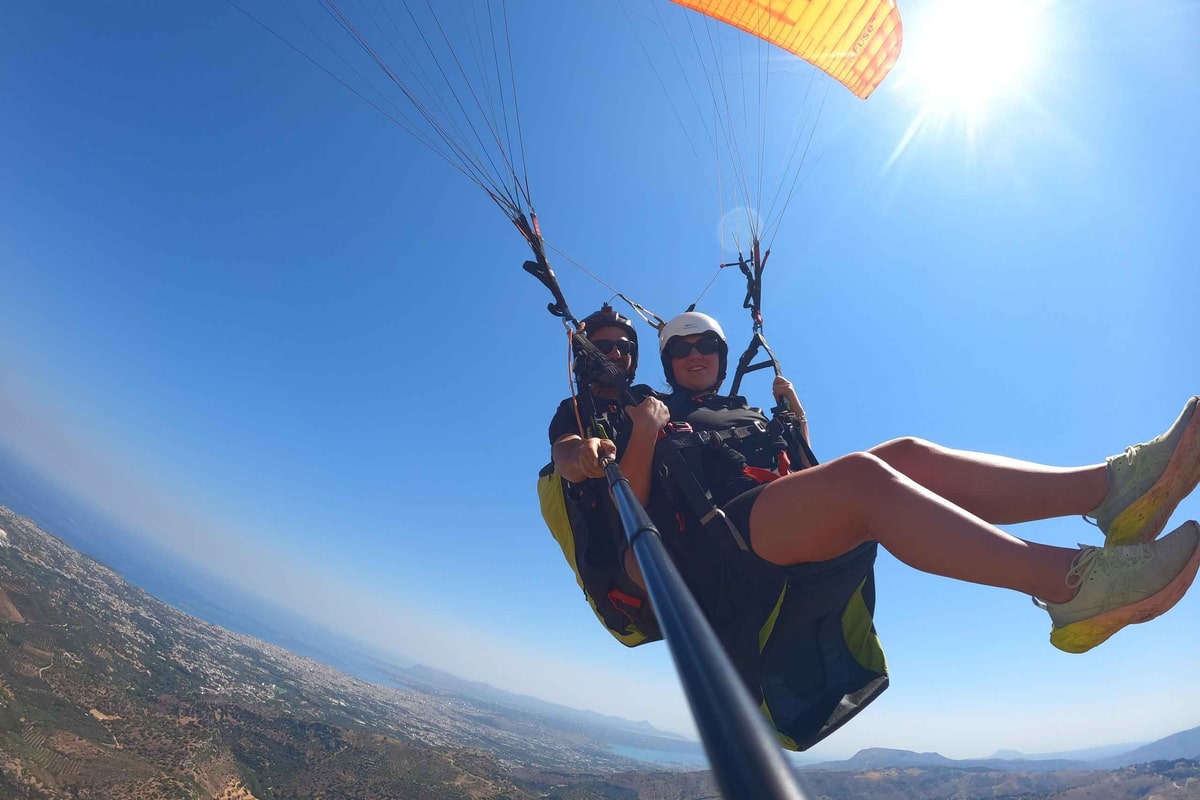
Crete paragliding lifts riders off a hillside under a soft fabric wing for a flight over the coast. A trained pilot steers a tandem flight while the guest sits in front. It is one of the air sports in Greece on Greece VIP.
This post covers what a Crete paragliding flight includes, where flights take off and what they see. It also covers how a wing stays up, safety for beginners and the history behind the sport. What to wear, the best season and common questions come last.
Each section ends with a Crete paragliding flight or outdoor trip that can be booked online.
What does a Crete paragliding flight include?
A Crete paragliding flight includes a fabric wing, a padded harness and a short launch. It also includes a calm glide and a soft landing. The wing, the lines and the seat are the main kit. The flight starts and ends on foot.
A paraglider is a light glider with no rigid frame. It is launched on foot. Unlike a skydiver, a Crete paragliding pilot never jumps at any point of the launch.
A Crete paragliding wing is made of non-porous fabric such as ripstop nylon. Air cannot pass through it. A modern wing can have a sharknose front edge, which adds stability.
The pilot hangs from lines that start at two sets of risers. Risers are short straps of webbing, about 40 cm long. Each one clips to the harness with a carabiner.
The lines of a Crete paragliding wing sit in rows. The rows are called A, B, C and D, counting from the front. A newer wing can cut the rows to three or even two, which reduces drag.
The lines are made of UHMW polythene or aramid, two strong synthetic materials. The thinnest common line is 0.66 mm across. It has a breaking strength of 56 kgf, a pull of 56 kilograms.
- Harness: Foam protectors sit under the seat and behind the back.
- Air cushion: Since 2015 the standard harness has been an inflatable type, filled through a one-way valve.
- Child safety: Kids’ tandem harnesses come with special child-proof locks.
- Packing: The complete kit fits into a rucksack.
Landing ends every Crete paragliding flight. The pilot loses height with a figure 8 over the landing zone. Then the pilot lines up into the wind. The final flare starts at around two metres. The pilot pulls the brake gently from 0% to 100% at touchdown.

Where do Crete paragliding flights take off?
Crete paragliding flights take off from hills, cliffs and slopes along the coast and inland. Each take-off works only with certain wind directions, so the wind decides the site. The island’s steep slopes and frequent winds make it a good place to fly.
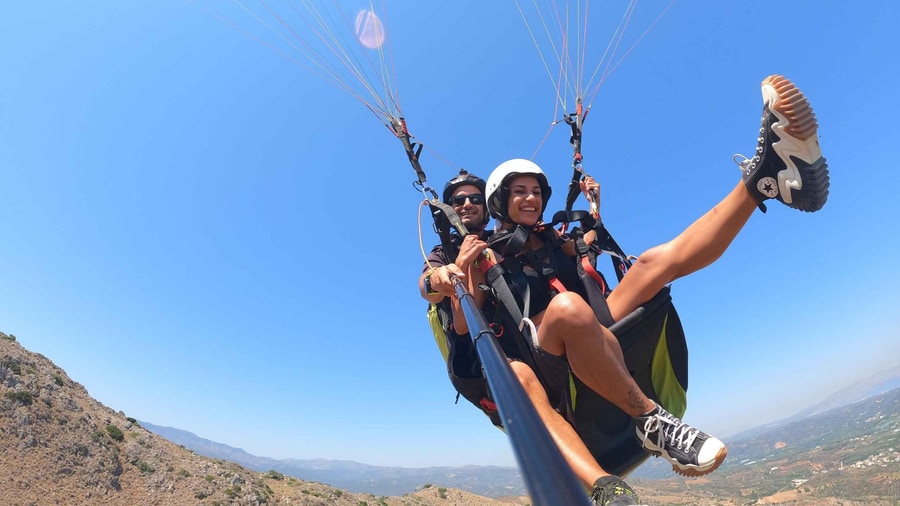
The Region of Crete runs an official sports tourism site. It says visitors, beginners included, can take a parapente flight under certified instructors. Parapente is another name for Crete paragliding.
A community-edited database of flying sites lists a Varypetro take-off for Crete paragliding at 508 m. It is rated good for north and north-west wind. Varypetro is a village 9 km south-west of Chania, with 548 residents in the 2011 census.
Falasarna has a hill take-off at 242 m, rated good for south-west, west and north-west wind. The entry describes a wide, clean take-off for every level. A gravel road of about a kilometre leads to it.
Falasarna Beach lies 59 km west of Chania. Western winds blow there, which makes it ideal for windsurfing. Travellers who like water can add kayak tours on Crete to a Crete paragliding trip.
Avdou has a take-off at 608 m, good for north and north-west wind. Vrysinas has one at 641 m, good for north wind. Vrysinas is also a mountain peak of 858 m south of Rethymno.
- Malia and Stalida: These north-coast take-offs sit at 168 m and 385 m.
- Milatos and Plaka Elounda: These north-coast take-offs sit at 240 m and 357 m.
- Kalamaki: This south-coast take-off at 49 m is an easy launch from a sand hill.
- Ballos Bay: This take-off at 149 m is narrow, with plenty of plants, but easy.
Wind direction ties these take-offs together. The Komos cliff launch at 55 m on the south coast needs a west wind. So the wind picks the site for every Crete paragliding day.
What does a Crete paragliding flight see from the air?
A Crete paragliding flight sees high mountains, long ranges, a deep sea and a large reservoir. The land below runs from the shore to high peaks. Which view a pilot gets depends on the take-off site and the wind.
Mount Agathias reaches 2,424 m, close to Psiloritis, the highest summit of the Mount Ida massif. A saddle at 2321 m joins the two peaks. A massif is a group of mountains.
Psiloritis Natural Park covers 1159 sq km. It stretches from the Psiloritis mountain and its northern foothills down to the Cretan Sea. Foothills are the low hills at the base of a mountain.
On a Crete paragliding day, the Dikti range shows lower peaks than Agathias. Madara reaches 1,783 m, Skafidaras 1,673 m and Katharo Tsivi 1,665 m. Sarakino reaches 1,588 m and Selena 1,559 m.
The Sitia Mountains are four ranges in eastern Crete. They run south-west to north-east, ending at the plain of Sitia. Sitia Nature Park was created in 2015 as a UNESCO Global Geopark. It covers all of Crete east of the Mochlos-Livari line.
Aposelemis Dam stands near the village of Potamies, 32 km south-east of Heraklion. The Crete paragliding view there includes a reservoir, which is a lake that a dam creates.
- Wall height: The dam is 61 m tall.
- Wall length: The dam is 660 m long.
- Lake size: The reservoir covers 1.6 sq km.
- Drainage: The reservoir drains an area of 143 sq km.
The sea completes the picture. Off north-eastern Crete, the Sea of Crete reaches a greatest depth near 3,293 m. Other maps show 2,591 m. Peaks, lakes and deep water all fill a Crete paragliding view.
How does a paraglider stay up on a Crete paragliding flight?
Crete paragliding works because rising air holds up a wing full of air. The wing glides forward and sinks slowly. It gains height when the air around it climbs faster than it sinks. Pilots look for thermals, ridges and clouds that give this lift.
A paraglider wing is two layers of fabric joined into a row of cells. Openings at the front edge let air flow in. This keeps the wing inflated on every Crete paragliding flight.
The glide ratio is 9.3 for recreational wings. Modern competition wings reach about 11.3. A glider in Crete paragliding sinks through the air. It climbs when the air around it rises faster than its sink rate.
The Sun warms the ground, and the ground warms the air above it. Warm air expands, becomes lighter and rises as a thermal. Thermals are easy to find over towns, freshly ploughed fields and asphalt roads.
A Crete paragliding pilot circles inside a thermal, around the core, where the air rises fastest. A ring of colder, sinking air surrounds the rising column.
A variometer is a small instrument that beeps. It beeps higher and faster during a climb and drones deeper as the descent grows. Modern ones sense a climb or sink of 1 cm per second.
- Ridge lift: Wind that hits a steep ridge or cliff is pushed upward.
- Sea breeze: Cold sea air meets warm land air, making lift in winds as light as 10 knots.
- Cumulus clouds: Puffy clouds mark the top of a rising column of warm, humid air.
- Cloud suck: Lift strengthens under a tall cumulus, up to 300 m below the cloud base.
Too much ridge wind risks blowing a pilot back over the slope. Paragliders have a top speed under 30 knots, so storm clouds are especially dangerous. These limits shape every Crete paragliding day.
How safe is Crete paragliding for beginners?
Crete paragliding is safest for beginners when training, gear and weather checks come first. A new pilot learns in steady, gentle wind and moves up through set stages of skill. A reserve parachute and a larger tandem wing add more protection.
Training comes first for beginners in Crete paragliding. Basic certification takes about 10 days of instruction in paragliding regions. The IPPI pilot card then sets five stages of skill, from ParaPro 1 to stage 5.
ParaPro 3 is the stage that normally allows solo flying without an instructor watching. An ideal beginner site for Crete paragliding has a steady wind of 1 to 4 m/s.
A reserve parachute is connected to the paragliding harness. Pilots rarely need to throw it. Even so, the reserve is a core piece of gear in Crete paragliding.
A reserve needs about 60 m of height to open. A full deployment to a stable descent uses 120 to 180 m. A wing failure just after takeoff or just before landing can be too low to save.
On modern recreational wings, a deflation normally recovers on its own. A deflation is when part of the wing folds in. Tandem wings carry a pilot and one passenger. They resist collapse better than solo wings.
- Weather: A pre-flight checklist starts with the weather.
- Pilot level: The checklist confirms the pilot holds a P4 or P5 certification.
- Operator licences: The checklist also confirms the operator’s licences.
- Wing loading: Total weight divided by wing area, such as 2.9 to 3.7 kg/m2.
Safe Crete paragliding rests on training, gear and weather. Pilot error and poor flying conditions together cause a large share of accidents. Beginners follow the stages and the checklist every time.
What history lies behind Crete paragliding?
Crete paragliding has two roots. One is an old Greek myth about flying on wings. The other is a modern slope sport from France. The myth tells of Daedalus and Icarus. The sport began when friends ran down a hill under a square parachute.
The story behind Crete paragliding starts with a name. Daidalos is Greek for a skilful craftsman. King Minos of Crete thought that Daedalus and Icarus had told the secrets of the maze-like labyrinth. He held them in a tower above the ocean.
Minos watched every ship and controlled the land routes. So Daedalus made wings from bird feathers, thread and beeswax. He warned against flying too high, where the Sun melts beeswax, and too low, where foam soaks feathers.
After father and son passed Samos, Delos and Lebynthos, Icarus climbed toward the Sun. The wax melted, and he fell into the sea and drowned. Long before Crete paragliding, this myth ended in a fall.
In June 1978, three friends from Mieussy in France read an article by Dan Poynter on slope soaring. They were Jean-Claude Bétemps, André Bohn and Gérard Bosson. They worked out that running down a slope fills a square parachute with air.
Bétemps launched from Pointe du Pertuiset and flew 100 m. Bohn followed and glided to the football pitch in the valley 1000 metres below. The new sport was named parapente, because pente is the French word for slope.
- Parasailing: In 1961 French engineer Pierre Lemongine added cutouts to a parachute so it can be steered.
- Ram-air wing: Domina Jalbert tested a square parachute in 1956 and filed US Patent 3131894 in 1963.
- Slope soaring: David Barish tested it on Hunter Mountain, New York, in September 1965 for ski resorts.
The word paragliding was coined in 1985 by Patrick Gilligan of Canada and Bertrand Dubuis of Switzerland. Crete paragliding joins an old Greek myth to a French sport.
What do flyers wear on a Crete paragliding flight?
Crete paragliding flyers wear a helmet, stiff-soled boots, a back protector, warm layers, gloves and sunglasses. Each piece has one job. The helmet shields the head and the boots support the ankles. Layers and gloves keep body heat in at height.
EN 966 is the European standard for helmets in air sports. Ground handling is wing practice on the ground. A stumble there puts the head at risk, so a helmet is always advisable for Crete paragliding.
One review of alpine summer sports links helmets to fewer face and head injuries. A review of hang gliding and paragliding adds that the head, trunk and legs need protection. Crete paragliding gear covers all three.
Mountain walking boots have stiff soles that give the ankles support on difficult rocky trails. A Crete paragliding flyer wears boots like these so the ankles stay steady on the ground.
A Swiss trauma centre study calls the spine the paraglider’s weak spot and asks for innovative back protectors. A back protector in the kit of a Crete paragliding flyer shields the spine.
Air cools by 6.50 °C for every kilometre of height in the ICAO standard atmosphere. A clinical review of cold injuries calls layered clothing the best way to react to weather changes.
- Gloves: A chamber test of flight to 3658 m cooled finger skin from 32.2 °C to 13.9 °C.
- Touchscreen gloves: Conductive material lets the wearer use a phone screen with the gloves on.
- Sunglasses: ISO 12312 is the international standard, and UV protection matters more as height grows.
- Polarised lenses: They suit aircraft pilots poorly, since LCD instrument screens that emit polarised light can dim.
Effort in flights up to 3073 m was low, at 1.7 metabolic equivalents. Low effort means little body heat, so warm layers matter. Warm fingers also work the brakes on a Crete paragliding wing. These hand controls steer the wing and set it up for landing.
When is the best season for Crete paragliding?
Crete paragliding has its best season from late spring to early autumn, with warm weather and light rain. Summer north winds grow stronger on the south coast, so wind speed matters each day. Winter brings far more rain.
Palaiochora lies on the south-west coast of Crete. It has a hot-summer Mediterranean climate, with hot dry summers and very mild winters. The weather station there records average daily highs of 33.1 °C in July and 32.9 °C in August.
June brings highs of 29.8 °C and September 29.4 °C. Autumn eases from 25.0 °C in October to 21.5 °C in November. These milder months suit Crete paragliding for flyers who prefer cooler air.
Rain stays low in the Crete paragliding season. Palaiochora averages 2.3 mm in June, 0.2 mm in July and 2.6 mm in August. The same dry days suit jeep safaris on Crete between flights.
Rain stays light in April and September too, with 19.9 mm and 17.8 mm. December and January are the wettest months, with 114.0 mm and 104.5 mm.
In summer, north winds cross the Aegean and meet the mountains of Crete. The mountains slow the air and turn it to the left. On the south coast, the wind then gains strength while the temperature rises.
- Mountain gap: A gap between Crete’s two highest mountains, Lefka Ori and Idi, channels the north wind.
- Gap exit: The flow is strongest here, and gusts reached 25 m/s on 24-25 August 2007.
- Force 7 and 8: These winds blow at 50-61 km/h and 62-74 km/h.
A wing flown with no brakes pulled is at its trim speed, which is 32-40 km/h. Force 7 and 8 winds blow faster than that. Crete paragliding therefore needs a close check of the wind each day.
What do travelers ask about Crete paragliding?
Crete paragliding questions cover launches, airsickness, cameras and gear weight. The wind decides between a forward and a reverse launch. Airsickness is a normal body response. Action cameras film the flight, and the whole kit is light enough to carry.
What is a forward launch in Crete paragliding?
A forward launch is used in low winds. The pilot runs forward with the wing behind, and the air pressure inflates the wing. It is easier, but the pilot cannot see the wing until it is overhead.
Why does Crete paragliding use a reverse launch in higher wind?
In higher winds, the pilot faces the wing to bring it up. Then the pilot turns around under it and runs. This makes it easier to inspect the wing and lines. If the pilot slips, the wind tugs the pilot toward the wing.
What causes airsickness on a Crete paragliding flight?
Airsickness is a normal response in healthy people. It happens when the nervous system gets conflicting messages from the inner ear, eyes and muscles. Pilots prone to it are advised to skip anti-motion-sickness drugs, which can cause drowsiness.
Can travelers film a Crete paragliding flight?
Action cameras are compact, rugged and waterproof at surface level. A helmet camera shows the flyer’s view. A second camera on the wing or wrist can look back at the flyer. Image stabilization reduces the motion-sick effect of phone video.
How heavy is the kit for Crete paragliding?
A paraglider wing weighs 3-7 kg, with an area of 20-35 m2 and a span of 8-12 m. The wing, harness, reserve, instruments and helmet together weigh 12-22 kg. Ultralight Hike & Fly kits can be lighter than 5 kg.
Featured photo: Chania tandem paragliding flight in Crete, via GetYourGuide.