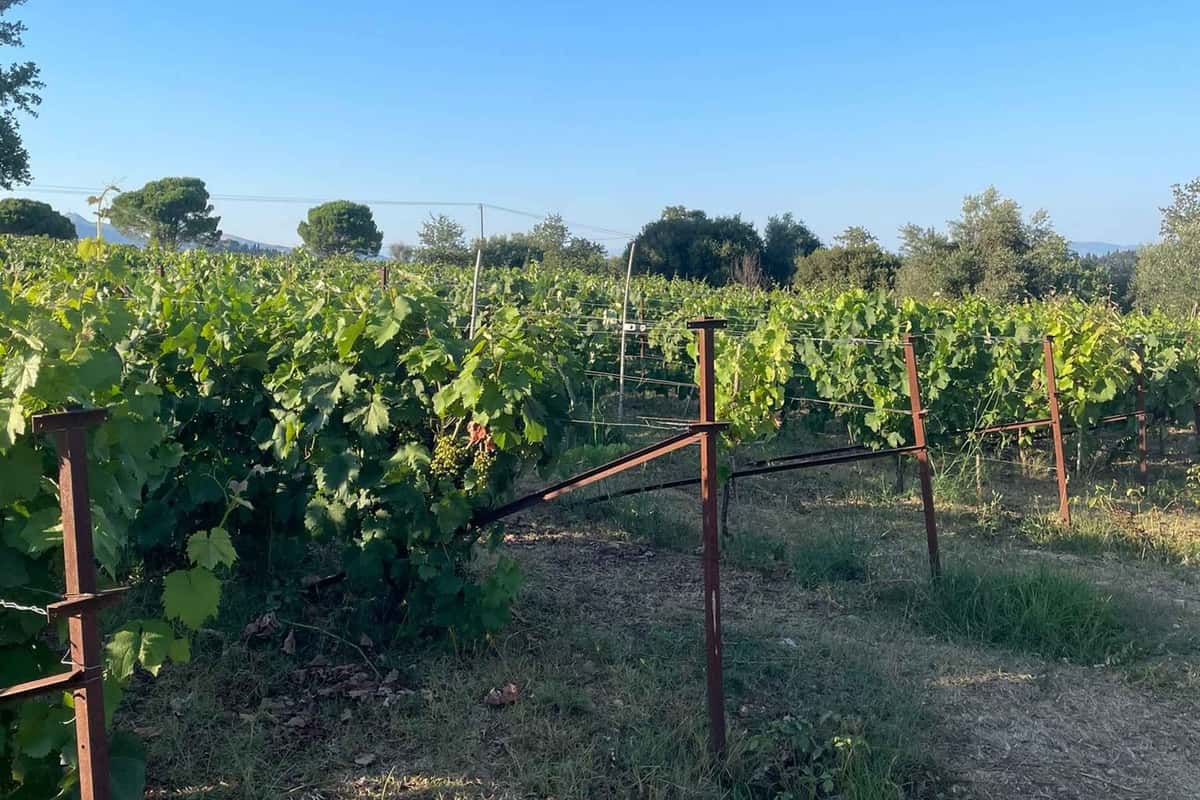
A Corfu wine tour visits vineyards and wineries on Corfu for a tasting of island wines. Small groups taste local grapes among olive groves and old estates. It is one of the winery visits in Greece on Greece VIP.
This post covers what a Corfu wine tour includes, the grapes and the vineyards. It also covers the PGI label, the Venetian past and other local drinks. Food pairing, history and how to read a wine label follow. The landscape, the villages and olive oil come next. The climate, the best season and common questions come last.
Each section ends with a Corfu wine tour or tasting that can be booked online.
What does a Corfu wine tour include?
A Corfu wine tour includes short lessons in how to taste wine and read its label. Wine writer Lambert-Gocs counted 1,800 hectares of vines on the island. The official Corfu tourism site lists nine wineries and wine estates in the countryside.
Two sciences meet on a Corfu wine tour. Oenology is the science of wine and winemaking. Viticulture is the science of growing and harvesting grapes.
A Corfu wine tour can follow a vertical tasting. It pours one wine from one winery in different vintages, or harvest years. The glasses show how each year changed the wine.
A horizontal tasting pours wines of the same vintage from different wineries. The glasses show each winery’s style. Travelers who also want local dishes can add food tours on Corfu.
A blind tasting hides the label and the shape of the bottle. A black glass can even hide the colour of the wine. A Corfu wine tour uses it to test the nose and tongue alone.
Wine warms in the mouth after a sip. Its smells then travel retro-nasally, up through the back of the mouth. They reach nearly five million nerve cells this way.
Decanting pours the clear wine into a decanter and leaves the sediment, the solid bits, in the bottle. Modern wines as a rule throw little sediment, though.
A Corfu wine tour also explains PGI, short for Protected Geographical Indication. A PGI District Wine zone tends to follow the borders of a former prefecture, an old county. Grape rules for District Wines are strict, so Greek producers sometimes pick a broader PGI name.
- Aroma: In professional tasting, aroma means the smells of the grape itself, typical of a young wine.
- Bouquet: Bouquet means the new smells that form as a wine ages.
- Finish: The finish is a wine’s aftertaste, the last note of each glass on a Corfu wine tour.
- Area Wines: PGI Area Wines are the strictest level, and Greece has 58 of them in 28 districts.
Certain PGI Area names belong to a single producer, the one whose local wine earned the name. A Corfu wine tour that explains such labels turns each glass into a short lesson.


Which grape varieties does a Corfu wine tour taste?
A Corfu wine tour tastes wine from two main grapes, Kakotrygis and Petrokoritho. Both come in red and white forms, so a red Kakotrygis grows beside the white one. The island’s vineyards also hold the white Kozanitis, Skopelitiko, Rozaki and Moschato.
Kakotrygis is the main white grape on a Corfu wine tour. It is a lively and productive grape. The vine grows with vigour and bears a large crop.
Petrokoritho is described as a black-orange variant of Korithi, a white grape. It grows on Corfu, Evia and Zakynthos. It also grows in Achaia and Messinia.
A Corfu wine tour meets Petrokoritho as a very lively and productive vine. Its must, the fresh juice before fermenting, has high quality and good acidity. The grape is recommended for planting in the Ionian Islands Vineyard District.
A three-year study tested twelve grape cultivars grown in Greece. It found Korithi mavro and Korithi lefko genetically different. Mavro means black and lefko means white. The two had long been taken for colour mutations of one grape.
Tsaousi is a grape of Egyptian origin. It grows mainly on Kefalonia, another Ionian island. On Corfu it appears only as scattered vines, a rare sight on a Corfu wine tour.
White Muscat is thought to come from Asia Minor. It copes even with poor, dry and calcareous soils, meaning chalky ground. Certain vines bear pink or reddish-brown berries. One vine can switch berry colour from one year to the next.
- Yield: White Muscat gives low yields, so each vine bears a small crop.
- Pests: The vine suffers from mildew and from the grape berry moth.
- Timing: It buds early in spring and ripens late in the season.
- Roman name: The Romans called the vines Apiane, after the bees, apis in Latin, that loved the grapes.
Natural compounds called monoterpenes, such as nerol, give Muscat its flowery smell. A Corfu wine tour with a Muscat glass lets tasters find that floral note.
Where are the vineyards on a Corfu wine tour?
A Corfu wine tour finds vineyards on the island’s flat farm land. The Ropa valley is the largest plain on Corfu. In the south, the Lefkimmi area has low olive hills. Its lowlands hold citrus and vineyards, and its wine is known across Corfu.
A Corfu wine tour crosses a plain that was once a marsh in central Corfu. The marsh was drained and is now flat farm land of 10,000 stremmata, a Greek land unit. Locals call it the Ropa valley or Ropa meadow.
The valley takes its name from Ropa, a settlement abolished in 1920. Ropa had 839 inhabitants. It belonged to the municipality of Parelioi, set up in 1866. Parelioi means “beside the marsh”, because its villages stood around it.
A Corfu wine tour on the plain passes the old marsh villages. Giannades, Marmaro and Kanakades lie to the north-west. Vatos and Kokkini lie to the south. Kouramaditika lies to the east, and its fields hold mainly vineyards and pasture.
A Corfu wine tour in the south reaches Lefkimmi. Unlike the rest of the island, this area is not mountainous. It stretches from Messongi and its river to Asprokavos, the southernmost point of Corfu.
A Corfu wine tour heading south-west can reach Halikounas, a seaside village at 28 metres. It lies 31 km south-south-west of Corfu Town by road through Perama.
In the north-east, a Corfu wine tour enters the former municipality of Thinali. Olives grow there even high on the mountain. Wine, walnuts and citrus are its other local products.
Corfu lies in the Ionian geological zone. It is the only Ionian island with flysch marls, layered sea sediments. They were laid down mainly from the Oligocene to the Lower Miocene.
- Marl: Marine marl, a soft limy clay of the Miocene to Pliocene, widely covers the island.
- Coquina: In places a hard shelly limestone called coquina tops that marl.
- Pantokrator: Pantokrator mountain and strips of the west coast stand on Triassic to Jurassic limestone and clay.
- Breccia: The island’s centre, south of that mountain, is partly Triassic breccia, a rock of broken stone.
Across the Ionian Islands, a red soil called terra rossa covers these rocks as a rule. A Corfu wine tour reads the island’s wine through this mix of rock and red earth.
What does the PGI Corfu label mean on a Corfu wine tour?
A Corfu wine tour meets PGI Corfu, a protected label for wines tied to one place. The zone dates from 1996 and covers the whole island in the northern Ionian Sea. The label allows only one style: dry white wine.
PGI Corfu permits just two grapes, Kakotrygis and Petrokoritho White. Kakotrygis grows nowhere else but Corfu, and island growers favour it over other vines. A Corfu wine tour finds it in the local whites.
The vineyards lie chiefly in the north and the south of the island. Smaller plots sit in the southwest, close to the Korissia lagoon. A Corfu wine tour can visit rows at both ends of Corfu.
A Corfu wine tour in the southwest enters a second, smaller zone, PGI Halikouna. It dates from 1995 and covers Agios Mattheos, in the municipality of Melitia. Its vines stand a short way from the lagoon wetlands and give dry white wine from Kakotrygis alone.
Greek PGI wines sit on three levels, ranked by zone size: Regional, District and Area Wines. Every PGI label fixes the borders of its zone and its grape mix. So a Corfu wine tour pours wine from a mapped area with set grapes.
Kefalonia’s Robola has carried a PDO, a protected name of origin, since 1982. Its 180 hectares climb from 175 to 800 metres, and the wine is pure Robola. The soil is so thin that Italians called it Vino di Sasso, stone wine.
- Mavrodaphne: PDO Mavrodaphne of Kefalonia is a sweet red, fortified with added spirit, of at least 51% Mavrodaphne.
- Ithaca link: Its blend adds Corinthian Black, and it alone among Kefalonia’s protected wines takes grapes from Ithaca.
- Muscat: PDO Muscat of Kefalonia uses only Paliki peninsula Muscat White, sweet from sun-dried grapes or fortified.
- Same start: Both Kefalonia sweet wines date their protected zones from 1971.
PGI Lefkada dates from 2000 and has three partly overlapping sub-zones, one for each wine colour. Its white grape Vardea is grown systematically only on Lefkada. A Corfu wine tour shows that each Ionian island guards its own grapes.
What did Venetian rule leave for a Corfu wine tour?
A Corfu wine tour crosses land shaped by Venice. Venetian rule began on 13 February 1386 and lasted until the Republic ended. That year the Council of Corfu, the island’s ruling body, voted to place Corfu under Venice.
A Corfu wine tour also meets an earlier Venetian claim. In 1207 Doge Pietro Ziani, the ruler of Venice, handed the island to ten Venetian nobles. They held it as a fief, a grant of land paid for with loyalty and taxes.
The Corfiots then chose five ambassadors to hand the island to the Venetian senate. The Council of Corfu stayed the strongest body on the island. A Corfu wine tour starts from this shared past.
On early Corfu, vineyards ruled the land and olives mattered little. That pattern held until about the 16th century. A Corfu wine tour follows the older of the two crops.
In the early 17th century, Venetian decrees and a form of subsidy changed the hills. Landowners gave up their vineyards for systematic olive growing. Travellers of the time wrote of an olive grove of impressive size.
Corfiots were urged to grow rich from olives. Yet they were barred from competing in trade with Venice. A Corfu wine tour shows how farming followed the rules of trade.
Raisins were the top export of the islands. Venice banned their free export because of fierce competition with the United Kingdom. It also charged foreign ships a heavy export tax, the nuova imposta, or new tax.
- Olive counts: Venetian counts for 1766–70 found 113,161 olive trees on Zante and 44,146 on Lefkada.
- Smaller islands: The same counts gave 38,516 trees on Kefalonia and 31,884 on Cythera.
- Island coin: A special coin read CORFU/CEFALONIA/ZANTE, with the winged lion of Saint Mark on the other side.
- Robola: Venetian merchants supposedly took Robola to Friuli as Ribolla, but DNA tests cast doubt on that.
In 1815 a treaty put the islands under British protection. It gave the Austrian Empire the same trading rights there as Britain. The islands then used their own coin, the obol, from 1818. A Corfu wine tour moves through all these layers of rule.
What other drinks does a Corfu wine tour pour?
A Corfu wine tour pours more than wine. Koum Kouat of Corfu is a sweet liqueur made from kumquats, small orange citrus fruit. It must hold at least 100 grams of sugar per litre. Tsitsibira, a ginger beer, is the island’s second drink.
The liqueur on a Corfu wine tour starts with cut fruit. It soaks for 12 to 36 hours, depending on ripeness. The best fruit is the ripest, dark orange kind. Its very thin peel holds fragrant oils in tiny glands.
Flowers, leaves and shoots of the kumquat tree can join the soak. The extract is then distilled, or heated so its spirit rises and is caught. The still runs at a low 75 to 85 °C, so the aromas are not lost.
The scent of the Koum Kouat on a Corfu wine tour comes from natural compounds. They include nonanol, decanol, limonene, linalool and geraniol. Greece’s Finance Ministry first recognised the drink on 17 July 1976. That decision gave the liqueur a Greek name of origin.
A 2003 Greek decision named three liqueurs after their home areas. They were Koum Kouat of Corfu, Kitro of Naxos and Masticha of Chios. Each is made and bottled in its own area. The EU also lists the Corfu liqueur as a protected Greek place name.
A Corfu wine tour can also pour tsitsibira. It is made from ginger, fresh lemon, sugar and water, fermented in the kettles of a local workshop. A second fermentation follows in the bottle, where it rests for five days.
When the British left in 1864, local makers got licences. They sold tsitsibira in the island’s coffee houses. The first tsitsibira workshop on Corfu opened in 1920.
- Arrival in America: Brewed ginger beer reached Canada and the United States around 1790.
- Alcohol limit: Ginger beer once held about 11% alcohol, and England limited it to 2% in 1855.
- Ginger beer plant: Home brewers still use this jelly-like colony of Saccharomyces florentinus yeast and Lactobacillus hilgardii bacteria.
- First record: Harry Marshall Ward described the plant in 1892, from samples he received in 1887.
Ginger beer tastes more strongly of ginger and less sweet than ginger ale. So a Corfu wine tour can end on two flavours, sweet kumquat and sharp ginger.
What food pairs with wine on a Corfu wine tour?
A Corfu wine tour pairs each glass with island food in the old way. For long ages there were no fixed pairing rules. Local dishes simply met local wines. Each region’s cooking and winemaking grew up side by side over time.
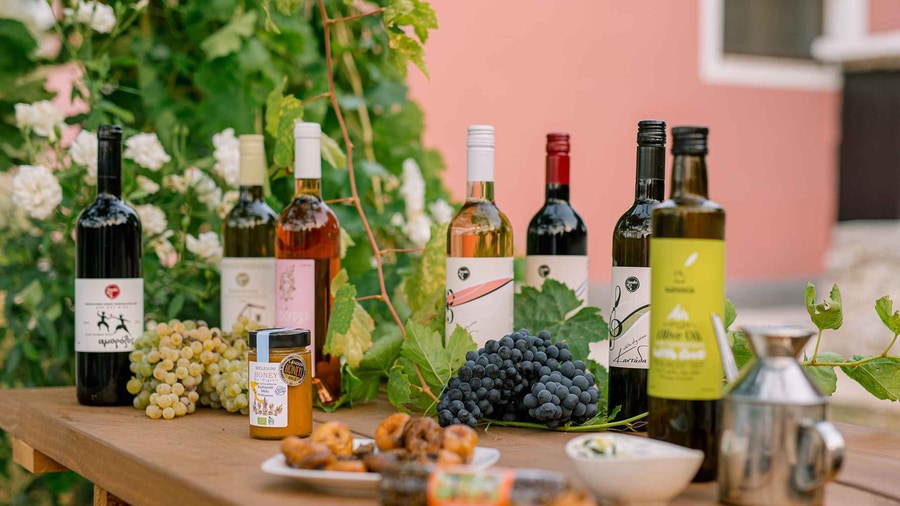
A sauce can lead the flavour of a dish, so the wine is matched to it. Poached fish, cooked gently in liquid, suits a light white. In a heavy cream sauce, the same fish can take a fuller white or a light red.
Tartness is the sour edge of a wine. A wine less tart than its dish can taste thin and weak. A wine too tart alone can seem softer beside a sour dish, as the two cancel out.
Alcohol can make spicy food burn hotter. A strong wine with a spicy dish brings a lot of burning heat. Salt and spice also make the alcohol feel hotter in the mouth. On a Corfu wine tour, a sweeter wine eases the burn of peppers.
Tannins are the drying, bitter compounds in wine. Fish oils can make tannic wines taste metallic or off. A bitter char from grilling or blackening plays well with them. On a Corfu wine tour, tannins also clean the mouth by binding to grease and oil.
British wine merchants had an old saying: buy on an apple and sell on cheese. Green apples make wine taste metallic and thin. Hard cheese softens tannins and makes wine taste fuller and fruitier. A Corfu wine tour can put this trick to the test.
- Tomatoes: Acid in tomatoes and salad dressing cancels part of a wine’s tartness, so its fruit shows.
- Meatless plates: With no protein in the food, tannins grab tongue proteins and dry the mouth.
- Parmesan: Hard aged cheeses such as Parmesan go with a nutty Sherry or a full, complex red.
- Kefalotyri: Aged a year or more, this Greek cheese turns drier and stronger and goes with ouzo.
The official Corfu tourism site suggests sykomaida, a Corfiot fig pie, with brandy. It also goes with cheese and cold cuts. A Corfu wine tour can close a tasting on this local treat.
What history lies behind a Corfu wine tour?
A Corfu wine tour follows a drink as old as the island’s olive oil. Thucydides, the ancient Greek historian, praised the local wine. It served as an offering poured for the dead. It also fuelled Greek feasts and celebrations.
In Homer’s tale of Odysseus, King Alcinous holds a long place. His palace, his welcome for the hero and his feasts fill books vi to xiii. His squire Pontonous serves the wine. These scenes give a Corfu wine tour an old story.
The same epic describes the king’s garden behind a hedge. It covers four ploughgates, an old measure of farmland. Its vineyard ripens cluster upon cluster all year round. The nymph Calypso leaves her grapes unpicked, but the king’s men harvest his.
The phrase “wine-dark sea” is oînops póntos in Greek. It joins the words for wine and face, so it means “wine-faced sea”. It appears five times in the Iliad and twelve times in the Odyssey. A Corfu wine tour by the coast recalls this rough, stormy image.
Laertes, the father of the hero, grew over 50 grape varieties in his vineyard. The Shield of Achilles shows a vineyard ringed by a trench and a fence. Its vines stand in rows on stakes.
In 691 AD, a Constantinople church council barred grape treaders from calling on Dionysus, the wine god. The council suggested “Kyrie eleison”, Greek for “Lord, have mercy”, instead.
During and after the crusades, Western Europeans prized costly Byzantine wines. Commandaria, a wine from Cyprus, was poured at the wedding of King Richard the Lionheart. A Corfu wine tour carries on that long Greek wine story.
- Water: Ancient Greeks almost always mixed wine with water, or with snow to serve it cold.
- Barbarians: In Greek eyes, only barbarians, or outsiders, drank wine unmixed.
- Three bowls: In a play of about 375 BC, Eubulus has the wine god mix three bowls.
- Bowl meanings: Sensible drinkers took one for health, one for love and pleasure, one for sleep.
Winegrowing on the Ionian Islands rose to fame under Venetian rule. Phylloxera, a tiny insect that feeds on vine roots, never struck these islands. So a wide range of grape varieties still grows on each one. A Corfu wine tour tastes that living past.
How does a Corfu wine tour read a wine label?
A Corfu wine tour teaches visitors to read the small print. EU rules set one bar for two label lines. A year or a single grape name needs at least 85% of the wine to match. Chile and South Africa set the year bar at 75%.
NV on a wine list means nonvintage. Such a wine tends to blend two or more years. The aim is to keep the same style year after year. A Corfu wine tour spots NV on menus.
Sweetness words on a label follow strict sugar limits. A dry wine holds up to 9 grams of sugar per litre, if enough acidity balances it. A medium dry wine holds up to 12 grams, or 18 grams with that balance.
A medium wine stops at 45 grams per litre. A sweet wine goes above that line. On a Corfu wine tour, these words help match a bottle to a dish.
Cava on a Greek label marks an aged reserve blend. White Cava ages for at least one year. Red Cava ages for at least two years. A Corfu wine tour reads this word as a sign of age.
Fining clears a wine before bottling. Since 30 June 2012, European labels must say when a wine was fined with casein or ovalbumin. Casein comes from milk and ovalbumin from egg. On a Corfu wine tour, visitors with milk or egg allergies can check this line.
- Standard bottle: It holds 0.75 litres, enough for six servings of 125 millilitres each.
- Demi: This half bottle holds 0.375 litres.
- Magnum: This large bottle holds 1.5 litres, twice the standard size.
In Greece, the PGI category, a protected place-of-origin name, covers the Local Wines. It also covers certain wines of Traditional Appellation. These terms help a Corfu wine tour place each bottle on the Greek wine map.
What landscape does a Corfu wine tour drive through?
A Corfu wine tour drives through green mountain slopes, olive groves and coastal wetlands. Roads climb past hill villages in the north and west. In the northeast, it reaches a protected coastal lake. In the south, old salt pans fill with birds.
A Corfu wine tour in the north drives below Mount Pantokrator, the ancient Istone. Its present name comes from a monastery near the summit. Ano Korakiana lies near its southwest foothills, at an average height of 170 metres.
A Corfu wine tour in the northwest can pass Liapades, on the sides of Kourkouli mountain. The village spreads down to the North Valley. In winter, its economy still rests on farming.
On the northeast coast, a Corfu wine tour can reach Lake Antiniotissa. This small lake holds brackish water, a mix of fresh water and sea water. It sits inside a protected Natura 2000 area of 188 hectares.
The name Antiniotissa translates as “the enemy of youth”. The lake was once a swamp full of malaria. As a result, no one lived in the area for centuries.
A Corfu wine tour heading south can stop at the Lefkimmi salt pans. They form a peninsula of about 2,000 stremmata north of Lefkimmi town. A stremma is the Greek unit for land area.
Salt making here began under Angevin rule in the 13th and 14th centuries. By the 16th century, the site held 80 salt basins with salt stores beside them. The pans made salt for the last time in 1988.
- Dunes: Sand dunes separate the lake from the sea, while orchards, olive groves and farmland lie inland.
- Fish: Twelve local villages own the lake and lease it to farm grey mullet, sea bass and eel.
- Birds: Over 180 bird species are recorded at the salt pans, and flamingo counts there have topped 3,000.
- Otters: A Corfu wine tour crosses an island where Eurasian otters still survive in lagoons and streams.
Freshwater terrapins and bullfrogs live in the wetland areas of Corfu too. A Corfu wine tour with a wetland stop adds the island’s wild side to its farm country.
Which villages does a Corfu wine tour stop in?
A Corfu wine tour stops in old inland villages of central and northern Corfu. Kanakades, Doukades and Agios Markos keep old churches and noble mansions. In the far south, the route also reaches Lefkimmi town, made of five joined villages.
A Corfu wine tour in the island’s centre can stop at Kouramades. The village stands 140 metres above sea level, about 10 km from Corfu town. Its neighbours are Kastellani, Kalafationes and Sinarades.
Kouramades first appears in records in the mid-13th century. It was then the seat of a dekarchia, a district set up by the Despotate of Epirus. In 2021 the village had 251 permanent residents.
A Corfu wine tour can also pass Agios Ioannis, a lowland village at about 41 metres. It sits in the centre of the island, about 8.5 km from Corfu town. In 2011 it had 598 residents.
Under Venetian rule, Kanakades was an important centre and a seat of feudal lords. Its fertile land made it the collecting point for local farm produce. A ruined fortified mansion on a steep rock above it housed the Barony of Marcello.
Doukades takes its name from its first settlers, who had the surname Doukas, meaning duke. A notary’s document from 1616 is its earliest written record. The village keeps the restored stone mansion of the Theotokis family.
A Corfu wine tour can visit Agios Markos, one of the oldest villages on Corfu. Its old site stands at 110 metres on Mount Koraki. It lies 17 km from Corfu town.
The village church of Agios Merkourios dates from 1075. Its Church of Christ the Pantocrator dates from 1577. A landslide in 1962 badly damaged the village.
- New village: After the landslide, residents moved to Kato, or Neos, Agios Markos on the plain of Ipsos.
- Protection: Kouramades, Doukades and Agios Markos all became traditional settlements, a protected status, in 1978.
- Monument: Agios Markos was also declared a historical monument in 1996.
- Pentachoro: Lefkimmi town carries the second name Pentachoro, as it joins five villages into one.
Lefkimmi’s five villages are Ringlades, Anaplades, Agioi Theodoroi, Potami and Melikia. In 1804, 1,300 Souliote refugees arrived there after Ali Pasha of Yanina drove them from their homeland.
How are olive oil and wine tasted together on a Corfu wine tour?
A Corfu wine tour tastes local olive oil beside the wine. Both show fruity and bitter notes. Corfu grows the Lianolia olive, and one southern district grows Koroneiki. Each sip is judged by smell, taste and the feeling in the throat.
Lianolia is an olive variety grown on Corfu and in Epirus. It also grows on the other Ionian Islands. It needs very moist soil and air to grow and fruit well.
The tree copes with moderate heat and slightly colder climates. It grows even on stony, fairly steep ground. Its weak point is the olive fly, a pest that harms the fruit.
On a Corfu wine tour, Lianolia oil smells fruity, with notes of cherry and cinnamon. Its taste is strongly pungent, a peppery bite, with a very bitter note. That bitter note is strongest in agourelaio, the early oil from green olives.
Lianolia oils on a Corfu wine tour carry a high level of phenolics, natural plant chemicals. In extra virgin oil, oleocanthal seems to cause the burn at the back of the throat.
In the south, a Corfu wine tour can taste Agios Mathaios Kerkyras oil. Its name is a PGI, or protected geographical indication, for virgin olive oil. The village sits on the eastern foothills of a 463-metre peak on Mount Gamilio.
The oil is pressed from Koroneiki olives. The area’s 25,000 Koroneiki trees make up 12.7% of its olive trees. Agios Mathaios is the northernmost point of Koroneiki growing in Greece.
- Land: The sloping groves have average fertility and one of Greece’s highest rainfall levels.
- Colour: The PGI oil is green to greenish yellow and very limpid, which means clear.
- Taste: Its fruity aroma is strongest when the oil is new, and its taste is bitter-sweet.
- Harvest: From around mid-November, pickers beat the branches with a pole as nets catch the falling olives.
Virgin olive oil is the grade just below extra virgin. It allows free acidity, a quality measure, of up to 2.0% and small flaws in taste. A Corfu wine tour that sets this oil beside local wine shows how both are judged.
What does the climate give a Corfu wine tour?
A Corfu wine tour shows how grapes ripen on a wet island. Rain falls on 122.4 days in an average year. The yearly total beats Ioannina, the wettest large city on the Greek mainland. Growers fight mildew, and the summer sun dries the vines.
The wet season starts soon after the harvest. November is the second wettest month, with 187.1 mm of rain on 14.7 rain days. A Corfu wine tour that month finds quiet vineyards and busy cellars.
Winter rain keeps falling while the pruned vines rest. January brings 135.8 mm on 14.8 rain days, and February 123.1 mm on 13.4. A Corfu wine tour in winter finds bare rows and wet soil.
A Corfu wine tour in summer meets dry weather. June averages 15.5 mm of rain on 4.8 rain days. Relative humidity averages 70.9% over the year. It peaks at 77.5% in November and drops to 61.7% in July and August.
Sunshine does the ripening. Corfu gets 2,545.7 hours of sun a year, with 364.5 hours in July and only 110.9 in December. Record highs reach 41.0 °C in June and 40.0 °C in August. April once fell to -0.2 °C.
Wet weather feeds downy mildew, the worst vine disease of humid summers. Rain splashes its spores into the canopy, where they swim to the leaf pores. Yellow oily spots show after 7 to 10 days. A Corfu wine tour in spring finds growers checking leaves.
- Infection rule: Downy mildew starts after 10 mm of rain at 10 °C or more within 24 hours.
- Bordeaux mixture: In 1882 Millardet sprayed copper sulfate and lime on vines and saw no mildew.
- Second fungus: Powdery mildew spreads in humid air without free water and slows above 30 °C.
- Grey rot: Botrytis cinerea rots wet bunches but becomes noble rot for sweet wines when dry days follow.
Travelers who want a second island for comparison can look at wine tours on Rhodes. A Corfu wine tour stays the clearest lesson in how rain and sun shape a glass.
When is the best season for a Corfu wine tour?
A Corfu wine tour fits September best. The month averages a 27.5 °C high and a 16.8 °C low, with 257.1 hours of sunshine. Rain returns on 7.4 days and adds up to 87.8 mm, so the air stays mild.
A Corfu wine tour in spring lands on flowering. Fruit set follows almost at once and fixes the possible size of the crop. Cold, wind and rain at flowering leave flowers unfertilised. Dry air, high heat and water stress also cut the share that sets fruit.
Nearly all vines carry both flower parts and pollinate themselves. Wind and insects play a small part. Each berry holds 1 to 4 seeds, and seed count sets berry size. A Corfu wine tour in early summer shows the young berries.
A Corfu wine tour follows the harvest, and harvest dates move with the weather. Heat, rain, hail and frost damage grapes and bring on disease, so growers watch the sky. Vineyards in Cyprus start picking as early as July, the earliest in the Northern Hemisphere.
Ripeness is measured, not guessed. Winemakers read sugar with a refractometer, a tool that gives degrees Brix. Acidity comes from titration, a chemical test. Tannin ripeness has no meter, so a taste decides it. A Corfu wine tour at harvest can watch these checks.
After picking, the vine keeps making sugar to store in its roots and trunk. Only then do the leaves turn yellow. October brings 140.4 mm of rain over 11.4 rain days, and sunshine drops to 188.9 hours. A Corfu wine tour in October catches that colour change.
- Latitude: Nearly all wine regions lie between 30° and 50°, and those nearer the equator pick earlier.
- June heat: The month averages a 28.2 °C high with 324.2 hours of sunshine.
- Machines: A harvesting machine picks 80 to 200 tons, against 1 to 2 for a human picker.
- Colour change: Berries on the sunny outer edge colour first and shaded bunches near the trunk turn last.
Spring shows the flowers, late summer the picking and October the colour. Each month gives a Corfu wine tour a different job to watch. Rain and sun fix the date.
What do travelers ask about a Corfu wine tour?
A Corfu wine tour raises the same questions. Travelers ask how much wine can fly home and what the sulfite line means. They ask why the bottle has a cork and how to store it at home. Customs rules, food law and cork science answer all four.
How much wine can a Corfu wine tour send home?
Bottles from a Corfu wine tour face two sets of rules. Inside the EU, excise duty, the alcohol tax, is paid where the wine is drunk. Anyone entering the EU from outside can bring 4 litres of still wine and 16 litres of beer.
Can a Corfu wine tour add spirits or sparkling bottles?
The EU allowance adds 2 litres of fortified or sparkling wine. A traveller can take 1 litre of spirits over 22% alcohol instead. Travellers under 17 get no duty-free alcohol. US federal rules allow one liter duty-free, so three liters of wine means duty on two.
Why does a Corfu wine tour label list sulfites?
Sulfites occur naturally in every wine, and winemakers add more to stop fermentation at the chosen moment. EU Regulation 1169/2011 calls sulfites above 10 mg per litre an allergen, so labels must declare them. White wines carry more than reds, and sweet wines more than dry ones.
Why does a Corfu wine tour bottle wear a cork?
Cork is the bark of the cork oak, Quercus suber. The bark comes off between late spring and late August. The tree must first reach 25 to 30 years of age. After that, growers strip the trunk every nine years. Natural cork seals about 80% of the 20 billion bottles filled yearly.
How is a bottle from a Corfu wine tour stored at home?
Three things affect stored wine: light, humidity and temperature. Experts such as Jancis Robinson advise a steady 10 to 15 °C. Reactions in wine double in speed with each 10 °C rise. Still wine lies on its side so the cork stays moist, while sparkling wine ages better upright.
Featured photo: Kavos wine tour and tasting at a local winery, via GetYourGuide.