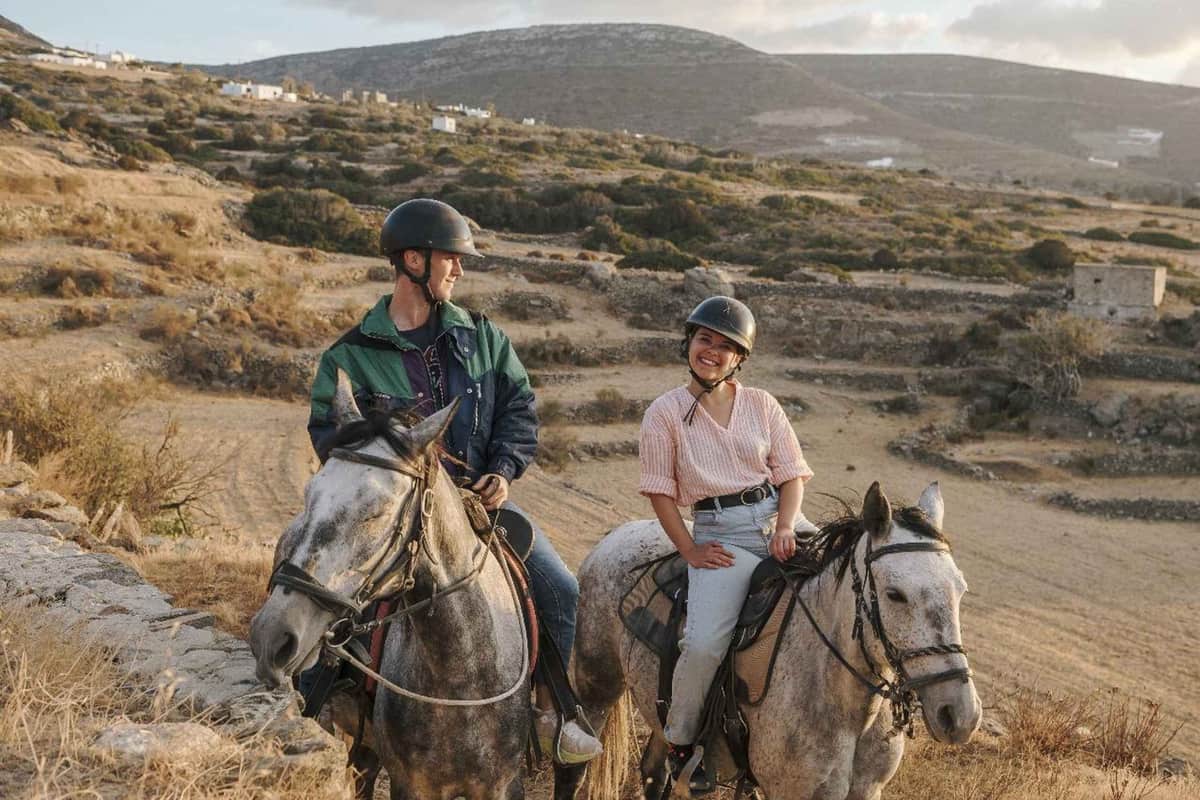
Paros horse riding takes small groups along country tracks, low hills and beaches. Paros is an island in the middle of the Cyclades. Rides pass dry stone walls, fields and the sea. It is one of the horseback trips in Greece on Greece VIP.
This post covers what a Paros horse riding tour includes, where it rides and rides on the beach. It also covers the nature on the way, safety for beginners and the history of horses and mules on Paros. What to wear, the best season and common questions come last.
Each section ends with a Paros horse riding trip or a nearby tour that can be booked online.
What does a Paros horse riding tour include?
A Paros horse riding tour puts each rider on a horse in tack. Tack is the gear put on a horse. It covers saddles, stirrups, bridles, halters, reins and bits. The horse then carries the rider along trails on the island.
Saddles fall into two big families, English saddles and Western saddles. A saddle rests on a tree, its wood or synthetic base. The tree spreads the rider’s weight on both sides of the horse’s spine.
A rider on a Paros horse riding tour sits in one of two saddle styles. An English saddle has no horn. It is held on by a girth. It is the saddle used in all Olympic and FEI riding disciplines except vaulting and reining.
A Western saddle has a horn on the front. The horn began with vaquero cowboys roping cattle. A cinch holds this saddle on, and a leather strap called a latigo ties the cinch.
The reins link rider and horse on every Paros horse riding tour. A bridle is a headstall, the set of straps around the head. It holds a bit in the horse’s mouth, with the reins fixed to the bit.
Horse height is told in hands, and a hand is split into quarters, not tenths. So 62 inches is 15.2 hands high, and 64 inches is 16.0 hands high.
- Halter: A halter has no bit and is used to lead or tie a horse.
- Hackamore: A hackamore steers with a heavy noseband instead of a bit.
- Split reins: Western riders use split reins that are not joined at the ends.
Tack words carry long histories. The word hackamore comes from the Spanish word jáquima. A rider who knows these terms follows the talk on any Paros horse riding tour more easily.


Where do Paros horse riding tours ride on the island?
Paros horse riding tours follow the island’s footpaths and old roads. The hiking trail network is about 35 km long and runs past old rural landmarks. Paths also link the main port with the island’s villages and its coast.
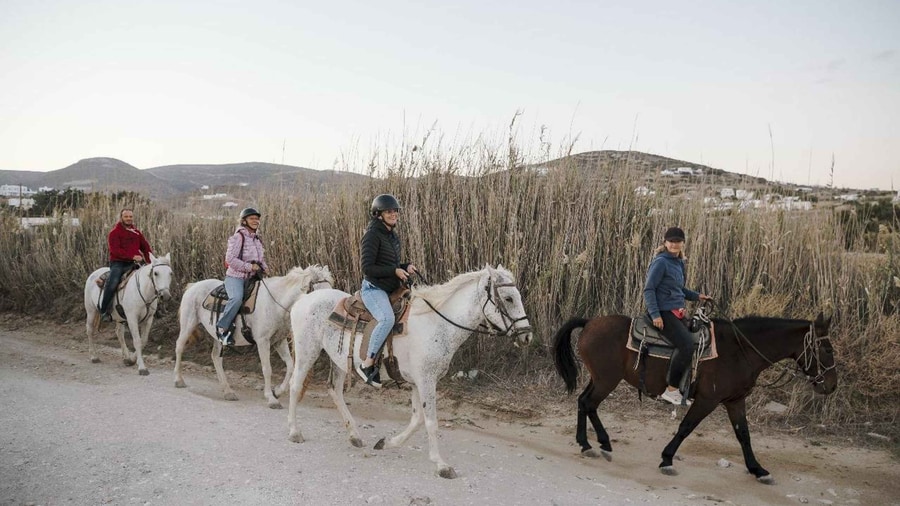
A Paros horse riding tour has a long village route to use. The walking route from Parikia to Piso Livadi is 19 km long and crosses four villages. Marpissa, the last village, stands 2 km from the port of Piso Livadi.
The route follows the Elytas river among plane trees. It then climbs to the Marathi plateau. Between Lefkes and Prodromos the old path passes olive groves, windmills, springs, wells and the river Heirolaka.
On that stretch the Byzantine road runs downhill, except for 150 to 200 m. It also suits mountain biking. Visitors who prefer an engine to a horse can try ATV tours on Paros.
The north coast around Naoussa has places worth a stop on a Paros horse riding tour. Xifara is a wide sandy beach 1.5 km east of Naoussa. Ampelas is a fishing village 4 km south-east of Naoussa.
Small Santa Maria Beach lies about 6 km north-east of Naoussa. The Santa Maria lagoon is a Natura 2000 site, an EU-protected nature area, 2 km east of Naoussa. It covers 20,000 square metres.
- Livadia: This beach lies about 1 km north of Parikia, in the middle of Parikia bay.
- Krios: Small boats link this beach with Parikia every day in the swimming season.
- Parasporos: This beach lies about 2.5 km from Parikia, below the main road to the south.
Together, the routes give any Paros horse riding tour a real choice of ground. Village roads, river paths and sea-edge tracks all sit on the same island. Each kind of ground asks a different pace from the horse.
Can a Paros horse riding tour ride on the beach?
A Paros horse riding tour looks for a beach with room to walk beside the water. Kolymbithres, on the north coast, has a sandy shore, 360 m long and 20 m wide on average. The shore faces south.
Weathering has shaped the granite rocks at Kolymbithres into hollows. The hollows fill with sea water and look like baptismal fonts, the stone bowls used in church baptisms.
Shelter from wind matters on a Paros horse riding tour at the shore. Kolymbithres is sheltered from the main winds and waves. Only northerly winds of low to medium strength reach it.
The seabed here slopes gently. The water is about 5 m deep at an average 160 m from the shore. Ministry officials found no tar, oil or foam and called the water clear.
The wider beaches give a Paros horse riding tour more room. Logaras is sandy, 350 m long and 30 m wide, and faces east. Golden Beach is sandy, 790 m long and 30 m wide, and faces south-east.
Small beaches also fit into a Paros horse riding tour. Faragas beach is sandy, 100 m long and 25 m wide, and faces south. Monastiri beach is sandy, 70 m long and 45 m wide, and faces east.
- Kolymbithres: The beach was recognised as a bathing beach in 1991 and has been monitored since.
- Faragas: The beach has been a recorded bathing beach since 2018.
- Monastiri: The beach lies under the monastery of Agios Ioannis Detis.
Four things decide how a Paros horse riding tour uses a beach: length, width, shelter and surface. Each beach on Paros has its own mix of the four.
What nature does a Paros horse riding trip pass?
Paros horse riding passes dry scrub hills, shady valleys, small rivers and rocky coast. Two protected Natura 2000 areas hold rare moths, reptiles and sea birds. The Valley of the Butterflies, about 7 km from Parikia, shows the wooded side of the island.
Nature lovers on a Paros horse riding trip meet dense shade in the valley. Cypress, ivy-covered plane trees and wild olive grow beside the monastery of Agios Arsenios.
The valley is a rare home for Jersey tiger moths. They are brown-black with yellowish edges and bright red wings. Paros horse riding in July meets them. They vanish in August and return in September.
The moths vanish in August because the females lay eggs and die. Caterpillars hatch in October and become moths in spring. A large moth population lives by the river, which is rare in Greece.
The Natura 2000 site Nisos Paros: Petaloudes covers 97.69 ha. It has a small river, rocky ground, low thyme scrub and dense Phoenician juniper. Paros horse riding in the area needs care around this protected land.
The biggest problem at the site is tourists taking butterflies away. Pesticides from nearby fields can also cut moth numbers. Every visitor, including a Paros horse riding group, shares the duty to leave the moths alone.
- Reptiles: The star lizard and Kotschy’s gecko have Greek and Bern Convention protection.
- Land animals: The site also lists the marginated tortoise, the four-lined snake and the nose-horned viper.
- Snail relative: Deroceras parium lives only in a very small area of Paros.
- Sea birds: A second site, Nisides Parou kai Notia Antiparos, guards Eleonora’s falcon and Audouin’s gull.
Limestone soil on Paros lets rain sink deep into the ground. The water fills underground basins that act as natural tanks. Paros horse riding therefore crosses land shaped by stone and hidden water.
How safe is Paros horse riding for beginners and children?
Paros horse riding is safe for beginners and children when handlers stay calm and read the horse. Horses show fear and anger with their eyes and teeth. Slow handling, a held lead line and well-fitted stirrups keep a new rider steady.
A Greek national registry study counted 21 equestrian injuries per 100,000 person-years for farming and riding combined. A person-year is one person followed for one year. Horse racing staff had a rate 160 times higher.
Horses have four basic sounds. These are the neigh or whinny, the nicker, the squeal and the snort. A Paros horse riding beginner learns them first, because each sound shows a mood.
A rider on a Paros horse riding trip watches the eyes. A horse that rolls its eyes so the white shows is afraid or angry. Bared teeth warn of a bite.
On Paros horse riding trips, horses read human body language and see people as predators. Rough handling can set off the urge to flee. The blind spot in front of a horse is a cone ending 90 to 120 cm ahead.
Calm handling matters for Paros horse riding with children too. A handler walks up to the left shoulder, moves slowly and talks to the horse. A young rider copies that quiet manner.
- Passing behind: A handler walks at an angle, speaks and touches the horse gently by the hindquarters.
- Leading: To change direction, the handler turns the horse away from the body.
- Lead line: The line stays in the right hand, 8 to 10 inches from the horse’s head.
- Stirrups: Their bottom reaches the rider’s ankle bone when the foot is out of them.
A horse that spooks at nothing can be reacting to a sound a person cannot hear. A national riding club in Australia takes members aged 3 to 80. For Paros horse riding, calm handling matters more than age.
What history ties horses and mules to Paros?
Paros horse riding follows old routes where mules and donkeys once carried loads and turned wheels. The island’s wheel wells and olive presses used animal power. Ancient marble quarries add a third strand to the island’s working past.
A kalderimi is a Greek paved mule track. It is made about 2 m wide so that two fully laden mules can pass each other. In parts of rural Greece, such tracks were the main roads until the 1960s or 1970s.
On Paros, mules and donkeys once turned the wheels of old wells to lift water. In olive presses, people and animals turned the large cone-shaped stone that crushed the olives.
A mule gets sure-footedness, toughness and endurance from its donkey father. Speed and agility come from its horse mother. The mule is thus part donkey and part horse.
Greece had 508,000 donkeys in 1955. In 2008 it had only 14,570, a drop of 97%. Researchers found the donkey changed from a pack animal into a companion animal. On the islands, it now serves tourist and leisure uses, like Paros horse riding.
The ancient quarries lie in the Marpissa mountain range. They sit on the banks of the Skarpathiotis ravine. Travellers of the 17th and 18th centuries recorded up to seven underground galleries.
- Survivors: The Quarry of the Nymphs and the Quarry of Pan survive, named by Andreas Kordellas.
- Size: The Quarry of the Nymphs is 190 m long and up to 4 m high.
- Open pits: Open-pit quarries were worked west of them at Lakkoi, Spilies and Thapsana.
- Roman rule: From the reign of Augustus, the quarries belonged to the Roman emperor.
The village of Marmara took its name from marble pieces found there. A Belgian firm built a railway to carry marble to Parikia port. It stopped over money problems. Paros horse riding today moves through land that mules and marble once worked.
What do riders wear on a Paros horse riding tour?
Paros horse riding gear protects the head, legs, hands, and feet. A helmet guards the head. Chaps or jodhpurs, which are made for riding, cover the legs. Gloves help with the reins, and ankle boots protect the feet.
Chaps are sturdy leather over-pants with no seat. Each is made of two separate legs that fasten to the waist with straps or a belt. Riders who pick chaps for Paros horse riding wear them over trousers.
Chaps were first meant to protect a rider from rain and mud, and from tears and injuries. The word is short for the Mexican Spanish chaparreras. That word is thought to come from chaparros, which means brush and shrub.
Western riders wear chaps to stick to the saddle and to protect their legs in brush. Chaps work the same way for horse riding on Rhodes, another Greek island.
Jodhpurs were adapted from the churidar, an ancient Indian trouser. It is tight around the calf and loose at the hips. In Paros horse riding, ankle-length jodhpurs allow short boots, since the snug leg guards the calf.
Pratap Singh was a younger son of the Maharaja, or ruler, of Jodhpur. He brought his polo team to Queen Victoria’s Diamond Jubilee in 1897. That visit made the style fashionable in Britain.
- Helmet: An equestrian helmet covers more of the head than a bicycle helmet.
- Gloves: Polo players wear gloves to protect their hands from working the reins and the mallet.
- Boots: A jodhpur boot has a rounded toe, a buckled strap, and a low heel.
- Air bag vest: In a fall, a cord to the saddle inflates it in 100 to 250 milliseconds.
On hard surfaces such as streets, riders wear a helmet and a body protector vest. That kit reduces injuries in a fall, and it suits Paros horse riding.
When is the best season for Paros horse riding?
Paros horse riding fits late spring well, when heat is lower and the island’s winds have not begun. The Paros municipality gives that advice for cyclists on the island. Horse riders face the same weather there, so the advice fits them too.
The station on nearby Naxos shows a wet winter for Paros horse riding. January has 67.9 mm of rain on 12.7 rain days. February has 56.3 mm of rain on 11.0 rain days.
The station on nearby Naxos shows an all-day average of 13.7 °C in December. The average high that month is 15.9 °C. February has an all-day average of 12.3 °C and an average high of 14.6 °C.
The station on nearby Naxos shows a drier spring for Paros horse riding. March has 9.5 rain days and an average high of 15.8 °C. Nights average 10.4 °C in March and 12.5 °C in April.
Summer is hot and damp. Records on nearby Naxos show highs of 37.2 °C in June and 36.0 °C in August. The station there reads humidity of 68.6 percent in July and 70.0 percent in August.
The station on nearby Naxos reads an average high of 18.8 °C in November. The average low is 13.7 °C. The month also has 52.3 mm of rain on 8.8 rain days.
- Spring highs: Record highs on nearby Naxos reach 30.5 °C in April.
- Warm lows: Average lows on nearby Naxos are 19.6 °C in June and 17.0 °C in October.
- Cool nights: Winter nights on nearby Naxos average 9.6 °C in January and 11.1 °C in December.
- Cold records: Record winter lows on nearby Naxos are 0.4 °C in January and 2.0 °C in December.
December adds 12.6 rain days at the station on nearby Naxos, so winter stays wet. Riders who want drier ground pick spring for Paros horse riding.
What do travelers ask about Paros horse riding?
Paros horse riding raises two kinds of questions. One is how travelers reach the island. The other is how the horses stay fit. Travelers arrive by plane or ferry. The horses rely on healthy hooves and enough rest between rides.
Which airport serves travelers who book Paros horse riding?
Paros National Airport carries the airport codes PAS and LGPA. It has one asphalt runway, numbered 17/35, that is 1,400 m long. A bus links the airport with Parikia, and taxis run to any place on the island.
Which ships carry visitors to Paros horse riding in winter?
Visitors can reach Paros by sea all year from Piraeus and Rafina. In winter, the island is mainly reached by ferry, because high-speed vessels do not sail in bad weather. Winter plans for Paros horse riding rely on ferries.
How does a horseshoe protect hooves in Paros horse riding?
A horseshoe protects the hoof from wear. It is nailed through the hoof wall, which has no feeling. The nails enter at the outside edge of the white line. They come out 15 to 20 mm up the wall.
How do hooves cope with the ground in Paros horse riding?
The hoof wall grows about 1 cm per month and wears down on rough ground. It is 6 to 12 mm thick or more, like a human fingernail. Domesticated horses need trimmed hooves and reset shoes every five to eight weeks.
Can horses rest on their feet during Paros horse riding days?
Muscles, tendons, and ligaments form a stay apparatus. It lets a horse stand with almost no muscle effort and doze on its feet. Horses spend four to fifteen hours a day in standing rest. REM sleep, a stage of sleep, needs lying down for an hour or two now and then.
Featured photo: Paros horseback riding tour at sunset, via GetYourGuide.