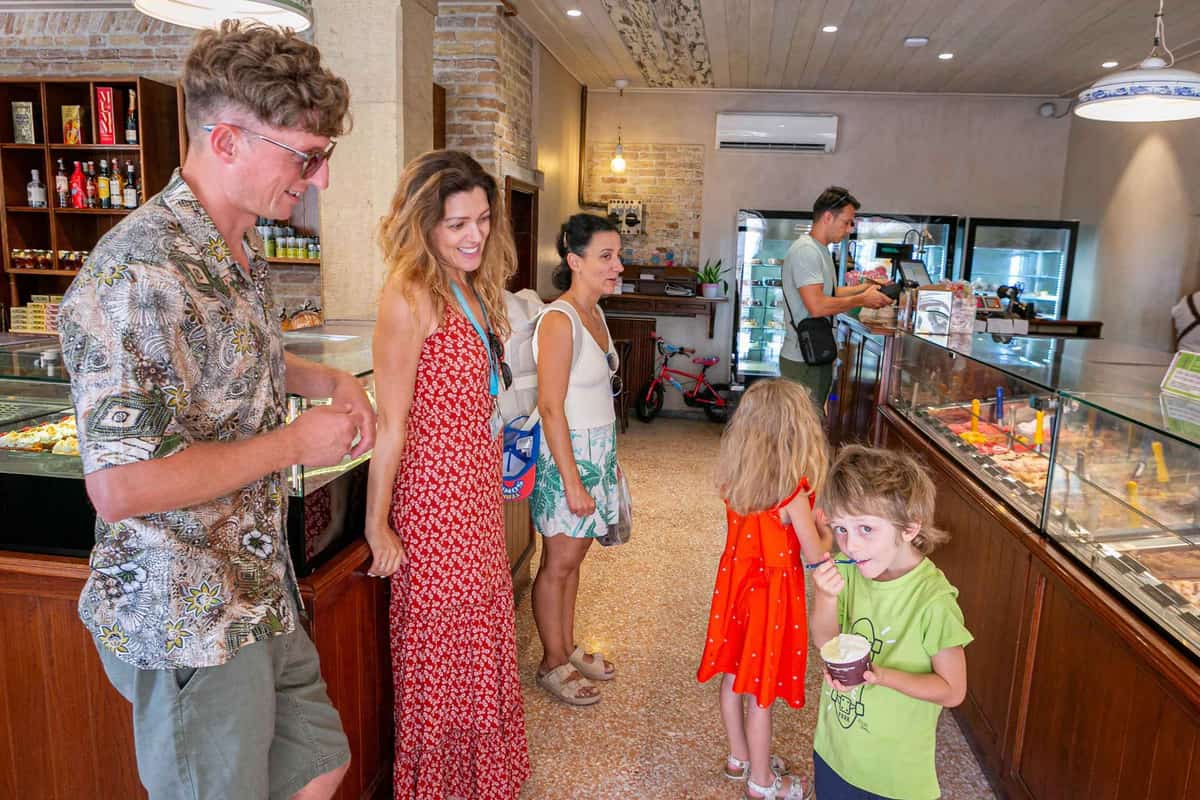
Each section below answers one question about a Corfu food tour. This Corfu food tour is one of the food tours in Greece on Greece VIP.
The first sections cover the Corfu food tour route through Corfu Town. Savoury dishes, kumquat, drinks and sweets come next. Street food, Easter traditions, meze customs and evening walks follow.
Other Greek islands, herbs and greens, olive oil and village food close the list. Each section ends with a Corfu food tour or tasting that can be booked online.
What does a Corfu food tour include?
A Corfu food tour includes a small-group tasting walk through Corfu Town. A tour leader runs the walk, which links a series of food stops in one outing. Each stop serves local dishes, drinks or sweets. Their flavours show Venetian, British and Greek influence.
A Corfu food tour treats the town itself as the dining room. The group walks from one tasting stop to the next. At each stop, the tour leader names every plate before anyone eats it.
This format gives a broad view of Corfiot cooking, the home food of Corfu. Travellers who want the monuments and history first can read the Corfu Old Town walking tour post. A Corfu food tour keeps the attention on the table instead.
The food itself records the past of the island. Corfu spent the years from 1386 to 1797 under the rule of Venice. Venetian delicacies, or fine foods, and Venetian recipes entered local cooking during that long period.
British touches season the table as well, according to the official Corfu tourism site. Greek identity still stays prominent. A Corfu food tour is a short course in how three food cultures met on one island.
- Group size: A small group keeps the pace relaxed.
- Food: Local dishes, drinks and sweets arrive at separate stops.
- Setting: The Corfu food tour route stays on foot inside Corfu Town.
The format suits first-time visitors who want Corfiot food explained at the table. A menu only lists names, while a Corfu food tour tells the story behind each plate. Each stop adds one more layer to that story.


Where does a Corfu food tour walk in Corfu Town?
A Corfu food tour walks through the narrow kantounia, or lanes, of the Old Town. It passes along the Liston and across the Spianada square. It also goes past the municipal market in the heart of town. UNESCO listed the Old Town in 2007.
The Old Town forms the backbone of a Corfu food tour. Its cobblestone streets, called kantounia, are lined with multi-storey buildings. The group therefore travels on foot, one lane after another, and its lanes suit walking.
The Old Town is the only large area in Greece with its historical street pattern almost intact. Its buildings date from the 17th, 18th and 19th centuries. A Corfu food tour weaves through this old street grid between tastings.
Beyond the lanes, the route reaches the Spianada, which is described as the largest square in Greece. Its name comes from a Venetian word for flat, open ground.
The Liston, a 150-metre pedestrian street closed to cars, runs along its western edge. The French commissioner Mathieu de Lesseps built it in 1807.
The Rue de Rivoli in Paris inspired the design of the Liston. A poem about the street calls it a crowded, relaxed place to sit and snack. That relaxed pace suits a Corfu food tour well.
The municipal market sits under the shadow of the Venetian castle. Dozens of local producers sell their goods there. They offer fresh fish and seafood, vegetables and other local products.
Traditional sweets and fresh herbs fill other counters at the market. A Corfu food tour that passes the stalls links them to the dishes tasted elsewhere on the route.
- Lanes: The kantounia connect the stops and set the pace.
- Promenade: The Liston walk runs under arcades, facing the open Spianada.
- Market: The municipal stalls place the ingredients of the local kitchen in full view.
Put together, a Corfu food tour links these four places in one compact walk through Corfu Town. Each place shows how the town eats, from the open square to the stall counter. Together they set the scene for the tasting.
Which savoury dishes does a Corfu food tour taste?
A Corfu food tour tastes savoury Corfiot dishes such as pastitsada, sofrito, bourdeto, savoro and noumboulo. They arrive as tasting portions. The group eats them and does not cook them. Venetian cooking left its mark on their names and methods.
Pastitsada leads the savoury line-up. The official Corfu tourism site calls it the top Corfiot favourite, served at formal dinners and celebrations. It is braised meat, slowly cooked in a spicy tomato sauce and served over pasta.
The name pastitsada comes from the Venetian word pastizzada. Sofrito follows with a white sauce of garlic, parsley, white wine and vinegar. The sauce covers thin slices of fried beef, served with rice or mashed potato.
Bourdeto is boiled sea scorpion, tope or codfish fillets in a red-hot pepper sauce. The sea scorpion is a spiny rock fish, and tope is a small shark. Lemon juice finishes the dish, and its name comes from the Venetian brodetto, which means broth.
Savoro is the Corfu fish dish marinated, or soaked, and cooked in vinegar. This method is known across the Ionian Islands.
Bianco completes the fish group with codfish or tope and potatoes. Its name is the Italian word for white.
A Corfu food tour sets such gentle dishes beside the hot ones. Together, the braises, fish and cured pork cover both the meat and the sea side of Corfiot cooking.
- Noumboulo: This Corfiot cured meat is pork tenderloin, salted, spiced and marinated in wine. It is smoked over herbs such as sage and myrtle, then eaten thinly sliced with fresh bread.
- Spice trade: Venetian ships stopped at the port of Corfu and brought spices within reach of locals.
- Flavour: The official site describes a rather aromatic cuisine of slow-cooking recipes that blend spices and herbs.
Travellers who want to learn to cook the classic braises can join the Corfu cooking class. A Corfu food tour stays focused on flavour, with every dish ready to taste.
What does a Corfu food tour taste made from kumquat?
A Corfu food tour tastes kumquat as a liqueur and as a spoon sweet. This small citrus fruit is native to southern China. On Corfu, it grows in the north of the island. The fruit holds a protected geographical indication, a legal label of origin.
The kumquat on a Corfu food tour table has a Chinese name. The Greek Ministry of Finance explains that kam kwat means golden orange. The species grown on the island is Fortunella margarita.
A British agronomist, or farm scientist, named Merlin is said to have brought it in 1860. Navel oranges arrived on the island with it. The tree stays small, about 2 to 2.5 metres tall.
Systematic planting began in 1924 on the Nymfes plain around Platonas, in the north of the island. The soil there is fertile, and the winter is mild.
Kumquat liqueur has been made from the local fruit since 1936. The ministry file calls it a trademark of the island. It is also a souvenir that visitors take home.
The rules for the liqueur are strict. The law allows no ingredient beyond fruit extract, alcohol, water, sweeteners, natural flavourings and colouring. Soaking the fruit, blending and bottling must all happen on Corfu.
The soaking mix holds at least 150 grams of fruit per litre. A bottle with the geographical indication holds at least 20 percent alcohol by volume. A Corfu food tour opens bottles of this kind.
- Fruit: The rind is sweet, the flesh is sour, and the fruit is eaten whole.
- Colour: The liqueur runs from yellowish to orange, and no other shade is allowed.
- Spoon sweets: Bergamot orange also thrives in the mild climate and goes into spoon sweets and liqueurs.
Legal protection explains why the name matters on a Corfu food tour. Greece granted the fruit this status in January 1994. European Regulation 1107/96 registered it.
On a Corfu food tour, the liqueur carries its own geographical indication as a spirit drink. A jar or bottle labelled Kumquat of Corfu points to the island, not to a generic recipe.
Which drinks does a Corfu food tour pour?
A Corfu food tour pours tsitsibira ginger beer, island wine and coffee. The ginger beer is a leftover of British rule. Part of the wine comes from native grape varieties. The coffee comes from cafes under an arched colonnade in the Old Town.

Tsitsibira is a sweet, fizzy soft drink. Britain held the Ionian Islands as a protectorate, a land under its protection, from 1815. Corfu was the seat of the Lord High Commissioner, the top British official.
The islands joined Greece in 1864. Brewed ginger beer itself began in Yorkshire, England, in the mid-18th century. A glass of tsitsibira on a Corfu food tour links an English recipe with a Greek island table.
Corfu has produced wine since ancient times. Greek wine making as a whole goes back 6,500 years. The main native grapes are the white Kakotrygis and the red Petrokoritho.
Robola from the island of Cephalonia also counts among the main varieties. So do white muscat from the Aegean and Mavrodaphne from Achaea. A wine stop on a Corfu food tour therefore mixes island grapes with grapes from other regions.
- Beer: Three breweries operate on Corfu.
- Tsipouro: This Greek grape brandy is strong, at 40 to 45 percent alcohol. It comes in shot glasses with small plates of nuts, cheese or olives.
- Frappé: This Greek iced coffee was invented in Thessaloniki in 1957.
Coffee closes the round in the cafes of the Liston. In Greece, spoon sweets, or fruit preserves, reach guests with coffee and a glass of cold water. A Corfu food tour that ends under the arcade finishes with a cup of Greek coffee.
Which sweets does a Corfu food tour taste?
A Corfu food tour tastes mandolato, pasteli, caramelised almonds and a sweet bread called fogatsa. Almonds, honey and sesame form the base of these sweets. The Venetian name of mandolato shows how long Italian influence shaped the pastry shelf of the island.
Mandolato is a form of pasteli made from crushed almonds, sugar, honey and vanilla. A Corfu food tour serves it as one of the Venetian recipes of the island. Pasteli and mandolato are both common sweets across the Ionian Islands.
The name matches mandorlato, a dessert from the Cologna Veneta area. It is made with honey, sugar, egg white and almonds. Its first written mention comes from a text by the Venetian writer Lodovico Dolce in 1540.
Pasteli is a honey bar of sesame, almonds or pistachios, named after the Italian pastello. It descends from a Byzantine sesame sweet called sesamous. The Greek historian Herodotus mentions sweet cakes of sesame and honey.
Fogatsa is a sweet bread similar to tsoureki, the holiday bread. A Corfu food tour with a pastry stop sets pasteli and fogatsa side by side.
Tsoureki is made with flour, milk, butter, eggs and sugar. Lemon zest, orange zest, mastic, a tree resin, or mahleb, a spice from cherry stones, season the dough.
- Mandoles: These are caramelised almonds.
- Colombina: This is a type of tsoureki. Its name means little dove in Italian.
- Bianceta: This dessert is listed among the foods of Corfu.
- Bolsevikos: This dessert is also listed among the foods of Corfu.
Greek honey comes mainly from the nectar of fruit and citrus trees, namely lemon, orange and bitter orange. Nectar is a sweet plant juice that bees collect and turn into honey. Thyme plants and pine trees supply nectar too.
Mandolato and pasteli both rest on this honey. That makes the Corfu food tour pastry round a taste of Greek nectar as much as Venetian recipes.
What street food and snacks does a Corfu food tour try?
A Corfu food tour tries Greek street food between the sit-down tastings. The snacks include koulouri sesame rings and savoury pies such as spanakopita and tiropita. Gyros, souvlaki and loukoumades join them. These snacks are eaten by hand, so the group keeps walking while it eats.
Koulouri is the simplest snack on a Corfu food tour. It is a ring of bread covered in sesame seeds. Bakers make it from flour, water, yeast and salt.
Greece still eats koulouri regularly. The Turkish name for the same bread is simit. Its ancestor, the kollikion, first appears in writing in the 9th century.
Constantine VII Porphyrogennitos wrote that first mention. He described a small ring-shaped bread sold in Constantinople. A Corfu food tour therefore hands over a snack with Byzantine roots.
Savoury pies come next on a Corfu food tour. Spanakopita takes its name from the Greek words for spinach and pie. Its filling mixes chopped spinach, feta or another white cheese, and egg.
Filo, a paper-thin pastry brushed with butter or olive oil, wraps the filling. The pie is served straight from the oven or at room temperature.
Tiropita means cheese pie. It is buttered filo around a cheese and egg mixture. It comes as a single wrapped pastry or as a large pie cut into portions.
Gyros and souvlaki bring grilled meat to a Corfu food tour. Gyros is meat cooked on a vertical rotisserie, a turning upright spit. In Greece, it is traditionally made with pork.
The name gyros comes from the Greek word for turn. Cooks slice the meat off in thin shavings. The shavings go into a pita, a flat bread, rolled up with tomato, onion, fried potatoes and tzatziki.
Souvlaki is small pieces of meat grilled on a skewer. Its name is a diminutive, or small form, of the medieval Greek souvla, meaning skewer.
In Athens and southern Greece, the skewer is called kalamaki. The word kalamaki means little reed in Greek. On a Corfu food tour, souvlaki carries a local touch: a special tomato sauce, plainly called red sauce.
Loukoumades finish the street food round on a Corfu food tour. These fried dough balls are a mainstay of Greek cooking and a popular street food. Their Greek name comes from the Arabic word luqma, which means morsel or bite.
Loukoumades come with honey, cinnamon, walnuts or chocolate sauce. They descend from enkrides, a dough fried in oil and eaten with honey in Ancient Greece. The writer Athenaeus described enkrides as cakes boiled in oil and seasoned in honey.
- Breakfast: A Greek breakfast table puts koulouri beside bougatsa, a filled filo pastry, tiropita and spanakopita.
- Skewers: Greek cooking on skewers dates to the Bronze Age. Homer’s Iliad mentions meat roasted on spits.
- Spit: The vertical spit was developed in 19th-century Bursa and reached Greece after the 1922-23 population exchange.
- Fast food: Souvlaki sold widely as fast food from the 1960s, after vendors from Boeotia introduced it.
Each snack carries a Greek, Byzantine or ancient story. A quick bite on a Corfu food tour thus becomes a short lesson in how Greece eats.
How do Corfu Easter traditions shape a Corfu food tour?
A Corfu food tour in Holy Week, the week before Easter, meets Corfu Easter traditions. The pot throwing happens on Holy Saturday. Lamb, magiritsa and red-dyed eggs mark the feast. The processions and fasting dishes of the week give a Corfu food tour a seasonal frame.
Easter in Corfu shows Venetian influence and blends Catholic and Orthodox traditions. The two churches have celebrated it together since the Venetian period.
A Corfu food tour in Holy Week meets the epitaph processions of Holy Friday. An epitaph is a decorated bier that stands for the tomb of Christ. That day, 33 epitaphs move through the town, one for each year of the life of Christ.
On Holy Saturday, the procession of Saint Spyridon starts. This custom dates from 1550, the year Corfu was saved from famine.
The pot throwing is a central Easter event of Corfu Town. At 11 in the morning on Holy Saturday, church bells ring for the First Resurrection. Residents then throw botides from windows and balconies.
Botides are clay jugs filled with water and tied with red ribbons. Red cloth decorates the windows, because red is considered the symbol of the island.
Breaking the jugs removes bad luck, so locals and visitors take the pieces home. Only Corfu celebrates this custom. A Corfu food tour held that morning sees it.
The pot throwing has roots in the Venetian years. Catholic Venetians smashed old pots on New Year’s Day to bring new goods into their homes. Orthodox Corfiots adopted the custom and moved it to Easter.
Another reading links the noise to the earthquake that followed the Resurrection. Philharmonic bands, the local wind bands, then play the march Oi Grekoi. Its title means The Greeks.
In the Pinia area, the mastela custom sets a water barrel in the street for coins and wishes. These layers of history sit beside the food on a Corfu food tour in Holy Week.
On a Corfu food tour, food follows the same calendar. Great Lent, the fasting season, lasts for the 40 days before Easter. Magiritsa breaks the fast.
This soup is made from the lamb offal, or inner organs, removed before the lamb is roasted. Cooks prepare it on Holy Saturday. It is eaten right after the midnight Divine Liturgy.
Whole lamb on the spit follows on Easter Sunday. Kokoretsi, intestines wrapped around seasoned offal and grilled, comes as an appetizer while the lamb roasts. A Corfu food tour in Holy Week tastes this order from fast to feast.
- Red eggs: Women dye eggs with onion skins and vinegar on the Thursday before Easter. The dark red stands for the blood of Christ.
- Egg cracking: Tsougrisma is the custom of cracking red eggs together while exchanging Easter greetings.
- Fasting pie: A fasting version of spanakopita, made without eggs or dairy, is eaten during Lent.
- Corfu dialect: The Byzantine word for wrapped intestines survives in the Corfu idiom, or local speech, as tsoilichourda.
A Corfu food tour in Holy Week lets travellers taste Corfu Easter traditions as well as watch them. The path runs from the first fasting dishes to the cracked red egg. That egg follows the Paschal Vigil, the night Easter service.
What meze and taverna customs does a Corfu food tour show?
A Corfu food tour shows the Greek habit of the shared table. Small meze plates arrive, and bread stays within reach. In a taverna, the meal slows down. These customs make the tour a lesson in company as much as in cooking.
A Corfu food tour follows the logic of meze. Meze is a selection of small dishes served as appetizers across the Eastern Mediterranean. The format is close to Spanish tapas and Italian stuzzichini, or small bites.
A meze can open a multi-course meal or form a whole meal by itself. In Greece, the plural mezedes covers small dishes that are hot or cold, spicy or savoury.
The word reached Greek from Turkish. Turkish borrowed it from the Persian maze, meaning taste or relish. A Corfu food tour built on small plates keeps that idea of tasting a little of everything.
Drinks and plates travel together in this tradition, so a Corfu food tour pairs them. Serving small dishes with alcohol dates back to medieval times.
The meze tradition began in the Byzantine Empire. It then developed in Ottoman Greek houses and tavernes. An ouzeri is a Greek tavern that serves ouzo, an anise-flavoured spirit, with mezedes.
Such places stand in all cities and towns around Greece. A plate that gathers a variety of small dishes is called a pikilia, meaning variety. A Corfu food tour that stops for a pikilia joins a custom of sipping ouzo slowly.
On a Corfu food tour, the taverna is the institution behind the meze table. It is a small Greek restaurant that serves Greek cuisine. The taverna is an integral part of Greek culture.
The name comes from the Latin taberna, meaning shop. That word itself derives from tabula, meaning table. Digs at the Agora of Athens, the ancient market, in the early 1970s found plates and mixing bowls.
The finds also included lidded casseroles and spits for broiling meat. Fish bones and the remains of oysters and mussels lay among them. A Corfu food tour that sits down in a taverna enters a format with deep roots.
On a Corfu food tour, bread, olive oil and dips form the base that the other plates join. Greek cuisine rests on three staples: wheat, olive oil and wine. Bread made of wheat is found everywhere.
A modern taverna menu lists loaf or flat bread next to dips such as tzatziki and melitzanosalata. Tzatziki is made of yogurt, garlic and cucumber, and melitzanosalata is an eggplant dip.
- Dips: Taramosalata, a fish roe dip, and fava spread are common features of a meze table. Greek fava is a smooth mash of yellow split peas.
- Cheese: Fried or grilled cheeses are called saganaki. The name comes from the small frying pan used to cook them.
- Seafood: Grilled octopus is one of the seafood dishes that a meze table can include.
- Sharing: In Cyprus and the Levant, where meze makes a whole meal, diners share dishes at will. Nobody is expected to finish every one.
Hospitality shapes the whole table. The ancient Greek custom of xenia, or guest friendship, expected hosts to give guests food and drink.
The official Corfu tourism site traces the value of food as human contact to Homer. He tells of the hospitality of the Phaeacians in the Odyssey.
A Corfu food tour carries that old idea into the modern taverna. There, a meal works as a way of sharing company.
What is an evening Corfu food tour like?
A Corfu food tour in the evening moves through Corfu Town after sunset. The old lanes are lit, and the air cools. The Greek dinner hour begins. The tastings follow the pace of the late tables of the town, so the meal builds slowly.
Corfu Town after dark keeps the fortified setting that shapes its days. Since the Middle Ages, the city has carried the name Kastropolis, meaning Castle City, for its two castles.
The Venetian citadel, or fortress, stands at the end of the peninsula. An artificial fosse, a dug moat, cuts it off from the town.
An evening Corfu food tour walks between these stone walls. The same streets that serve a daytime route look different once the lamps come on.
The Liston gives the evening walk a Venetian precedent. Former Venetian cities carry a square of that name. The name comes from a Venetian word for the evening promenade, or stroll.
The Corfu Liston is an esplanade, an open walkway, between the town and the citadel. Restaurants and European-style bistros, small casual restaurants, stand there.
An evening Corfu food tour that strolls along it between tastings repeats a habit built into the name. The walk becomes part of the meal, and the stops fall at the pace of a promenade.
The old lanes of an evening Corfu food tour carry history in their buildings. Heritage experts reviewed the Old Town for UNESCO, the cultural agency of the United Nations. They noted that about 70% of the pre-20th century buildings date from the British period.
The experts described the town fabric as mainly Neoclassical, a style based on ancient Greek and Roman forms. Houses from the Venetian time still stand in parts of the town, with traces of past splendour.
After dark, lamps and lit shop windows pick out these facades. An evening Corfu food tour passes them one by one at a walking pace.
The dinner hour sets the timetable. Greek tavernas fill late in the evening, and an evening Corfu food tour matches those hours.
Summer evenings add comfort to a Corfu food tour. Average daily lows reach 18.9 °C in July and 19.3 °C in August. The average July high is 31.2 °C.
The Hellenic National Meteorological Service, the national weather office of Greece, records these figures. The night air is cooler than the day, which suits a Corfu food tour on foot.
- Marina: The salt-water fosse below the citadel works as a marina called Contra-Fossa.
- Seashore: A promenade runs along the seashore towards the bay of Garitsa.
- Theatre: The first theatre and opera house of modern Greece began on Corfu. It was the Nobile Teatro di San Giacomo di Corfù.
How does a Corfu food tour compare with food tours on other Greek islands?
A Corfu food tour follows the Ionian kitchen, where Italian influence runs deep. Cretan cooking, by contrast, rests on plants and endemic wild herbs that grow only there. Zakynthos shares the Venetian past of Corfu. It adds currants, olive oil and citrus fruit to the same Ionian table.
Ionian cuisine is also called Heptanesean cuisine, after the Seven Islands. Wikipedia gives it a Venetian name: Cusina de le Isole Ionie. It groups the dishes of Cephalonia, Corfu, Othonoi, Lefkada and Zakynthos into one regional family.
A Corfu food tour therefore tastes one branch of a shared tradition. The official Corfu tourism site says the Italian influences of the island go beyond architecture. They reach deep into the cuisine.
The Corfu list includes poulenta, a cornmeal dish, and niokos, a type of orzo. It also lists bourou-bourou, a pasta soup, and pastitsio, a baked pasta. Orzo is a small pasta shaped like grains of rice.
Cretan cuisine tells a different story. Wikipedia describes its core as food from plants, with animal food at the edge.
Fresh and dried fruit and pulses, such as beans and lentils, were eaten in great amounts. So were endemic wild herbs, aromatic plants and rough cereals.
Olive oil was the main fat, used in salads and in cooking. Dairy arrived daily in low to moderate amounts, poultry and fish weekly, and red meat last of all.
That plant-led pattern stayed widespread until the 1960s. A Corfu food tour with pasta dishes on the table reads differently from it.
Zakynthos is the third largest of the Ionian Islands. The Venetians who ruled it gave it the nickname Fiore di Levante, meaning Flower of the East.
Its main farm products are olive oil, currants, grapes and citrus fruit. The Zante currant is a small, sweet, seedless grape native to the island. Zante is the Italian name of Zakynthos.
Both islands rest on olive oil and citrus fruit. A Corfu food tour and a Zakynthos tasting therefore share two basic ingredients. Currants set Zakynthos apart, a theme the Zakynthos food tour post follows on its own island.
Venice shaped Crete as well. Wikipedia records that the crusader leader Bonifacio of Montferrat sold the island to the Venetians after 1204. The settler wave of 1252 founded Canea, the modern Chania.
About 10,000 Venetians are thought to have moved to Crete in the first century of Venetian rule. This contact closely wove Cretan and Venetian cultures together.
A Corfu food tour and the Chania food tour both start in Venetian port towns. They then follow different island diets.
- Crete: Dakos, stamnagathi salad and snails with tomato sit on the Cretan list. Kreatotourta is a meat pie from western Crete.
- Zakynthos: Frigania, fritoura and rafiolia are the desserts that the Ionian list names for the island.
- Shared: Polpettes, meaning meatballs, link a Corfu food tour to Zakynthos, because both islands list them.
Greece is one of seven countries behind the UNESCO listing of the Mediterranean Diet in 2010. Hard data on its benefits came from population health studies in southern Italy and Crete. Each island offers its own reading of that diet, and a Corfu food tour offers the Ionian one.
Which herbs, greens and vegetables does a Corfu food tour taste?
A Corfu food tour tastes wild greens, Greek oregano, dill and tomato-based vegetable dishes. Island fruit such as lemon, loquat and strawberries joins them. The official Corfu tourism site names tsigarelli among the vegetarian dishes of the island. It is a wild greens stew with spices.
Wild greens lead the plant dishes on a Corfu food tour. The same official site also lists neratzosalata, a salad with bitter orange, onions and paprika.
Wikipedia describes tsigareli as cabbage with fresh tomato, red spicy peppers, potatoes and herbs such as dill. It calls it a dish found mainly on Corfu. A Corfu food tour that serves tsigareli tastes a dish that two sources describe in two ways.
Horta is the Greek name for edible greens. Wikipedia names the leaves in a horta salad: antidia (endives), vlita (amaranth greens) and myronia (wild chervil). Radikia (chicory), seskoula (chard) and asparagus join them.
The list shows that horta is a family of leaves, not one plant. A Corfu food tour that serves horta can place different greens on one table. Each green has its own Greek name.
Herbs lift the greens and braises of a Corfu food tour. Wikipedia says Greek cooking uses oregano, mint, cumin and bay laurel leaves more than other Mediterranean cuisines do.
Oregano is Origanum vulgare, a plant of the mint family native to the Mediterranean. Its Greek subspecies, or local form, hirtum, counts as the best all-purpose kitchen subspecies.
Oregano leaves taste stronger dried than fresh. Their essential oil holds over 60 compounds, led by carvacrol and thymol. On a Corfu food tour, oregano carries a name that came into English from Classical Greek.
Fruit grows well on the island. Wikipedia quotes Homer on the garden of King Alcinous. Wild olive, pear, pomegranate, apple, fig and grape vine grew there.
The entry notes that on Corfu the apple and the pear are very inferior, while the others thrive. It adds loquat and prickly pear to the fruit trees of Corfu, and the banana in places.
The official site adds that lemon trees scent the countryside. A Corfu food tour therefore closes the plant story with fruit.
- Vegetables: Wikipedia counts tomatoes, aubergine, potato, green beans, okra, green peppers and onions as key Greek vegetables. A Corfu food tour draws on them.
- Oregano: The dried, ground leaves flavour Greek salad. They also flavour the lemon-olive oil sauce served with fish or meat grills and casseroles.
- Strawberries: Corfiot strawberries are small, with an aroma the official site calls splendid. They are sold in only one month of the year.
- Sikomaida: Grape must and dried figs, flavoured with aniseed, pepper and ouzo, make this island dessert. Grape must is fresh grape juice that has not yet become wine.
More than 1800 plant species have been recorded on Corfu. Where farming leaves the land alone, high maquis, a tall dense scrub, is the main natural plant cover.
A Corfu food tour tastes only a small share of that plant world. Even so, its greens, herbs, vegetables and fruit give the meat and fish dishes a plant-based partner.
How does a Corfu food tour taste local olive oil?
A Corfu food tour tastes local olive oil where it is made. The groves and mills that fill the island host the tasting. Tasters judge fruitiness, bitterness and a peppery finish. They also check for defects that rule out the extra virgin grade.
Corfu has produced olive oil since ancient times, and olive trees dominate its landscape. In the Venetian period, groves were planted across the Ionian Islands. The reason was the importance of olive oil to the economy of Venice.
Records for 1766–70 count 1,905,917 olive trees on Corfu. The official Greek tourism site now gives 4.5 million.
A Corfu food tour can hold its tasting among these groves. Their 200-year-old trails still run beneath trees the Venetians planted.
A tasting on a Corfu food tour applies the standard for extra virgin oil. The oil must taste fruity and show no flaws, such as rancid, fusty, musty or winey notes. Its free acidity, a measure of fat breakdown, must be 0.8% or lower.
A peppery or bitter taste points to higher polyphenol content. Polyphenols are natural compounds found in plants. Tasters therefore read that taste as a trait of the oil, not a flaw.
- Variety: Lianolia is the local variety, with a thinner texture, milder flavour and finer aftertaste.
- Grade: Extra virgin oil is the highest grade, pressed cold by machine without solvents.
- Storage: A bottle from the tasting keeps best in dark glass at or below 15 °C.
The official Corfu tourism site lists olive mills open to visitors, and one holds a 1200-year-old olive tree. A Corfu food tour that stops at a mill links the oil to the place that pressed it. The groves behind the mill also supply black olives and soap.
What does a Corfu food tour find in the villages?
A Corfu food tour finds village food outside Corfu Town. Taverns in hill settlements serve local cheese, cured pork and country produce. The farms, groves and flocks of the island shape this table. Each village stop shows a different part of it.
Old Perithia lies in northeast Corfu, at the foot of Mount Pantokrator, the highest peak of the island. Its first written records date to the 14th century. It was declared a monument in 1996.
Livestock farming was an important industry there. Taverns serve visitors today, yet the 2021 census counted only 6 permanent residents. A Corfu food tour that reaches Old Perithia meets food from a herding village.
Other places show the farming base of the island. The village of Benitses focused on farming, especially olive oil production. It used water-powered millstones by the early 19th century.
Lefkimmi, the second largest settlement of Corfu, combines farming with beaches, restaurants and taverns. A Corfu food tour beyond the town therefore reaches working farm country as well as resorts.
- Cheese: Corfiote graviera is a variant of gruyere, and Corfu cheese is a variant of Grana.
- Butter: Corfu butter is made from ewe’s milk and has an intense flavour. A ewe is a female sheep.
- Cured pork: Noumboulo also takes orange peel, oregano and thyme, and salado is the local salami.
The official Corfu tourism site points to first-quality cheese from small producers. It also points to local fruits and vegetables. A Corfu food tour that leaves Corfu Town gathers dairy, cured pork and fresh produce in one route.
What do travelers ask about a Corfu food tour?
A Corfu food tour prompts five common traveler questions. They cover vegetarian meals, children, the best season and time of day, and walking. The fifth concerns a boat trip on the same holiday. Each answer stays general, since every operator sets its own menu, age rules and route.
Does a Corfu food tour cater to vegetarian and other dietary needs?
A Corfu food tour has meat-free ground to cover. Greek home cooking includes lathera, seasonal vegetables stewed with olive oil, herbs and tomato sauce. It also includes boiled horta dressed with olive oil and lemon juice.
Travelers with vegetarian, vegan or allergy needs tell the operator before booking. A vegan meal leaves out every animal food, even eggs, milk and honey. Meat dishes and cheese courses need a replacement for them.
Is a Corfu food tour suitable for children?
Family bookings depend on the age rules of each operator, shown on the booking page. The food offers easy choices, such as cheese, fresh fruit and bread with olive oil. Parents of young children tell the tour leader about allergies at the start.
What is the best season and time of day for a Corfu food tour?
The climate of Corfu brings hot, dry summers and mild to cool, very rainy winters. Average daily highs reach 31.5 °C in August. They are 19.1 °C in April and 23.2 °C in October.
A Corfu food tour in spring or autumn avoids the strongest heat. In summer, a morning start keeps the walking cooler.
How much walking does a Corfu food tour involve?
Walking on the tour depends on the route, and each booking page states the level. Certain Old Town lanes are too narrow for vehicles. Comfortable shoes with a firm sole suit their stone surface.
Can a Corfu food tour be combined with a boat trip?
A Corfu food tour and a boat trip fit into one holiday on the island. The tour covers the land, and the boat trip covers the coast.
The Corfu boat trip options include sea routes from the island. The island of Paxos lies about 15 km from the southern tip of Corfu. Travelers who book both give each its own day.
Featured photo: Corfu Old Town food and culture walking tour, via GetYourGuide.