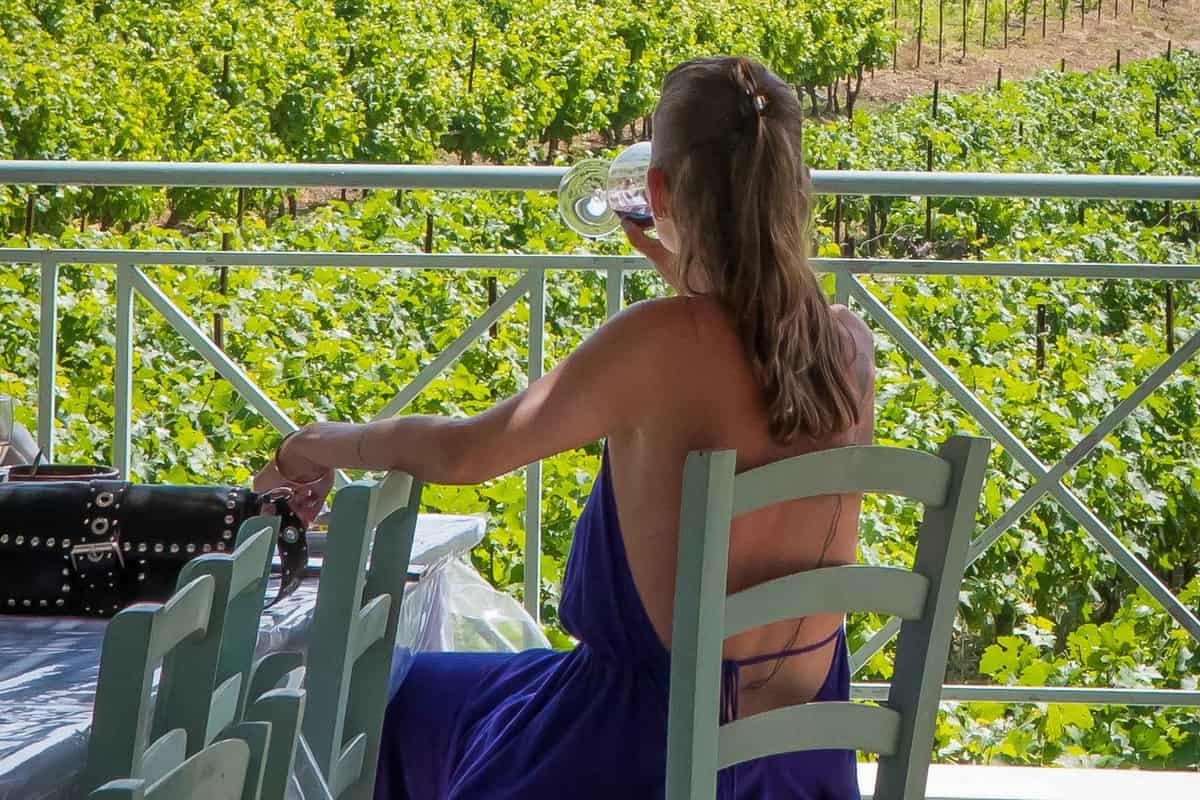
A Rhodes wine tour visits vineyards and wineries on Rhodes for a tasting of local wines. Small groups taste whites, reds and sweet wines beside the vines. It is one of the wine tasting trips in Greece on Greece VIP.
This post covers what a Rhodes wine tour includes, the grapes it tastes and the wine villages. It also covers the PDO label, how wine is made and the sweet and sparkling wines. History, food pairing and how to taste follow. The landscape, the best season and common questions come last.
Each section ends with a Rhodes wine tour or tasting that can be booked online.
What does a Rhodes wine tour include?
A Rhodes wine tour includes a drive into the main wine-growing zone. It covers the central-western part of the island. Each tasting comes as a flight, a row of wines side by side. Tasters score each glass on looks, smell, taste and an overall mark.
Thanks to its position, Rhodes was the gateway for vine growing. The craft entered Greece from the East through this island. A Rhodes wine tour therefore visits the first stop of the vine in Greece.
Phylloxera, a vine pest, did reach Rhodes. Yet the rough land of the island stopped it from spreading. As a result, old vines still grow on their own roots, above all high on Mount Attavyros.
Long sunshine and winter rain ripen the grapes on Rhodes. Through summer and into September, sea breezes cool the vines. The meltemi, a seasonal wind, adds to that cooling. The modern wineries of the island regularly win awards at major international contests.
Sweetness on a Rhodes wine tour comes down to residual sugar. This is the sugar left in a wine after fermentation stops. It is measured in grams per litre. Even the driest wines rarely drop below 1 gram per litre. Certain sugars, such as pentose, do not ferment.
A sparkling wine fermented in its own bottle needs 18 grams of sugar. That sugar builds the standard pressure of 6 bars. A Rhodes wine tour can pour sparkling wine made this way.
- Horizontal tasting: This format compares wines of one vintage, or harvest year.
- Vertical tasting: This format compares wines from a single winery.
- Charmat process: Cheaper sparkling wines use this method, because bottle fermentation takes heavy labour and costs more.
Spitting does not stop all the alcohol on a Rhodes wine tour. Wine soaks in through the skin inside the mouth. So twenty to twenty-five tastings that are spat out can still make a taster tipsy.




Which grape varieties does a Rhodes wine tour taste?
A Rhodes wine tour tastes Athiri, the main white grape, and Amorgiano, the main red one. White wine under the PDO Rhodes label, a protected name, holds at least 70% Athiri. Red holds at least 70% Amorgiano, the local name for Mandilaria.
The white grape has other names too. Athiri also goes by Athiri Aspro, Asprathiri, Asprathiro, Athiri Lefko and Athiri Leyko. In certain areas, it is blended with the Vilana and Ladikino grapes.
Athiri ripens early, and its acids drop sharply if the harvest comes too late. The vines grow with force and give heavy crops. Growers train them low as bushes, called goblets, or along wires, called Royat cordons.
On a Rhodes wine tour, Athiri pours with moderate alcohol and soft acidity. Its body, or weight on the tongue, is medium. These wines are meant to be drunk young, within two to three years of the harvest. Food tours on Rhodes add the local dishes.
Beyond Rhodes, Athiri goes into the PDO wines of Slopes of Meliton, Santorini, Handakas Candia and Malvasia Sitia. A Rhodes wine tour also pours Assyrtiko, a white grape that has adapted well to the local soil. It gives wines with minerality, a taste that recalls stone.
Muscat Blanc à Petits Grains, a white grape of Greek origin, also appears on a Rhodes wine tour. The French name means white Muscat with small grains. It refers to the small berries and tight clusters of the grape.
- Greek name: In Greece, the grape is simply called White Muscat, or Aspro Moschato.
- Ancient roots: Vine experts identify it with Anathelicon moschaton, a grape of the ancient Greeks.
- Skins: The grape loves sunlight, which turns its thick skins a freckled yellow-gold.
- Aromas: Its wines carry strong aromas of peach, tropical fruit and rose petals.
On Rhodes, Athiri grows at mid-to-high altitudes, while Amorgiano grows lower down. A Rhodes wine tour that climbs the slopes moves from red vines to white ones.
Where are the wine villages on a Rhodes wine tour?
A Rhodes wine tour heads to Embonas, a village 52 km southwest of Rhodes town. Its people mainly raise livestock or grow vines. The village has both modern and traditional wineries. Nearby hill villages such as Apollona and Kritinia round out the route.
Every August, Embonas holds a wine festival. The village is also known for a local grape called Mponiatiko. A Rhodes wine tour in that month can join the festival.
A Rhodes wine tour can climb above Embonas to the steep Charakaki vineyard. It covers under 100 stremmata, a Greek measure of land. Its Athiri vines look out over the Aegean Sea and the island of Halki.
One theory links the name Embonas to “amvonas”, a pulpit, from the old worship of Zeus. Another links it to “emvaino”, meaning to enter. The village only comes into view once a visitor is inside it.
A Rhodes wine tour also reaches Agios Isidoros, at 520 metres. This mountain village sits on the southern foothills of Attavyros. It takes its name from the church on its square. Lakki sits lower, at 207 metres, about 61 km southwest of Rhodes town.
Apollona is a large village on the south-central slopes of the mountain Profitis Ilias. It sits at an average of 330 metres, about 43 km southwest of Rhodes town. The name comes from the god Apollo, whose sanctuary is thought to have stood there.
- Kritinia: This village sits at 242 metres on a hillside between Mount Attavyros and the west coast.
- Monolithos: This village sits at 290 metres on the south-east slopes of Mount Akramytis.
- Residents: In 2021, Kritinia had 388 residents and Monolithos had 169.
Muscat vineyards on Rhodes are rare. They lie on small, isolated plots, without the size or spread of the Athiri and Amorgiano zones. A Rhodes wine tour finds them in scattered spots.
What does the PDO Rhodes label mean on a Rhodes wine tour?
A Rhodes wine tour pours wines under the PDO Rhodes label, an EU stamp of origin. PDO means protected designation of origin. The label ties each bottle to named villages and approved grapes. Strict cellar rules, set by Greek and EU law, apply too.
A Rhodes wine tour meets two EU names, both protected since 1981. One is Rodos, the Greek name for Rhodes. The other is Muscat of Rhodes, or Moschato Rodou.
PDO Rhodes allows five grapes: Athiri, Assyrtiko, Malagousia, Mandilaria and Mavrothiriko. The vineyard starts on the hills of Damatria, Theologos and Fanes. It wraps around Mount Attavyros, where vines climb to 650 metres.
Still PDO Rhodes comes white, red or rosé, each dry, medium-dry or medium-sweet. A dry white on a Rhodes wine tour needs 11% alcohol or more. Its sugar stays at 4 g per litre or less.
The official description gives dry white PDO Rhodes golden glints. Its aromas recall exotic fruit, white peach and apple. The red is bright purple, with dried red fruit and mastic resin.
Each year’s PDO Rhodes wines face an official tasting panel. A wine that fails cannot be sold under the Rhodes name. So every PDO glass on a Rhodes wine tour has passed that panel.
- Athiri: It must come from seven named villages, among them Apollona, Salakos and Siana.
- Other four grapes: They can also come from six more villages, such as Soroni.
- Muscat zone: It spans the former Rhodes municipality plus villages such as Archangelos, Afantou and Psinthos.
- Yield cap: White wine allows 10,000 kg of grapes per hectare, red and rosé 11,000 kg.
On a Rhodes wine tour, the PDO line on a label rewards a close look. It shows that the grapes, place and cellar work met written rules.
How is wine made on a Rhodes wine tour visit?
A Rhodes wine tour visit follows the grapes from vine to bottle. Workers pick the grapes, strip the stalks and crush the fruit. Yeast turns the sugar into alcohol in cool tanks. Selected wines then age in oak barrels and in bottle before sale.
The harvest in the PDO Rhodes zone starts around mid-August. It ends in the last ten days of September. A Rhodes wine tour in those weeks sees picking in full swing.
At a Rhodes wine tour winery, destemming pulls off the stalks. Stalks hold bitter tannin and can add a green bell pepper smell. Crushing gently splits the skins, and small traditional wineries sometimes tread grapes barefoot.
Red wine ferments on its skins, which add colour, flavour and tannin. For PDO Rhodes rosé, juice is drained off the skins after a short time. PDO white grapes are pressed before fermentation, but never in continuous, nonstop presses.
White juice first settles, then selected yeasts go in to lift its aroma. Over one to two weeks, yeast turns grape sugar into alcohol and carbon dioxide. PDO Rhodes favours up to 20 °C for white and rosé, 25 °C for red.
In malolactic fermentation, bacteria turn sharp malic acid into softer lactic acid. The majority of reds go through it, plus nearly one in five whites worldwide. In a Rhodes wine tour cellar, this stage can smell of buttered popcorn.
- Dry red: Dry red PDO Rhodes spends at least one year ageing in tanks.
- White Réserve: It ages a year, with 6 months or more in oak and 3 in bottle.
- Grande Réserve: This red ages 4 years, including 18 months in oak and 18 in bottle.
On a Rhodes wine tour, the barrel room explains why aged wine tastes richer. A 225-litre oak barrel loses 21 to 25 litres a year to evaporation. That loss concentrates the wine left inside.
What sweet and sparkling wines does a Rhodes wine tour pour?
A Rhodes wine tour pours sweet Muscat of Rhodes and sparkling PDO Rhodes. The Muscat comes as a liqueur wine or as wine from sun-dried grapes. The sparkling wine runs from dry brut to sweet doux. Each style has a legal sugar band.
Muscat of Rhodes draws on Trani Muscat, an Italian clone of White Muscat. It came from Trani, near Bari in Apulia, when Italy ruled the Dodecanese islands. The wine shines golden-yellow, with aromas of bitter orange peel, lemon peel and rose.
For naturally sweet Muscat on a Rhodes wine tour, grapes dry in sun or shade. Juice sugar must rise from at least 252 to at least 300 g per litre. All sugar and alcohol come from the grapes, with nothing added.
In vin doux naturel, a fortified style, strong alcohol goes into the fermenting juice. It equals 5% to 10% of the juice volume. Yeasts die at about 13 to 15% alcohol, so grape sugar stays.
Muscat vines on a Rhodes wine tour grow as short-pruned, cup-shaped goblet bushes. Irrigation, or added watering, is not allowed. Grand Cru, French for great growth, comes from plots capped at 5,300 kg per hectare.
On a Rhodes wine tour, the bubbles carry history. Rhodes pioneered sparkling wine in Greece and long stayed its only supplier. Sparkling PDO Rhodes needs at least 10% alcohol and 3.5 bar of bottle pressure.
In the traditional method, bottled base wine gets yeast and sugar and ferments again. Riddling gathers the spent yeast, called lees, in the bottle neck. Disgorging freezes the neck and pulls out the icy plug.
- Brut: This label allows up to 12 g of sugar per litre.
- Sec: Though French for dry, it holds 17 to 32 g per litre.
- Demi sec: This half-dry label holds 32 to 50 g per litre.
- Doux: The sweetest label holds more than 50 g of sugar per litre.
On a Rhodes wine tour, fortified Muscat of Rhodes stands apart at 15 to 22% alcohol. Small sips and water between glasses keep the mouth fresh.
What history lies behind a Rhodes wine tour?
A Rhodes wine tour follows a wine trade with deep ancient roots. Island potters stamped the clay jars that carried Rhodian wine across the ancient world. Centuries later, Italian settlers built new farm villages and stone wineries on the island.
A Rhodes wine tour rests on a very old trade. Jars from Rhodes grew popular from the 3rd century BC, thanks to strong local wine making. In that century, Rhodes and the rulers of Egypt formed the Rhodo-Egyptian alliance. It controlled trade across the Aegean.
Each Rhodian jar normally carried two stamps, one on each handle. One named the maker. The other named a magistrate, a city official who changed every year. This stamping ran between about 300 and 30 BC.
The story behind a Rhodes wine tour reaches far beyond the island. Handles of Rhodian jars have turned up from Spain to the Arabian Gulf. Others reached the Black Sea and Carthage. Alexandria alone has yielded over 100,000 stamped handles, and over 80,000 came from Rhodes.
One Rhodian jar maker, Sokrates, worked between at least 212 and 185 BC. His stamp shows his name beside a torch. A Rhodes wine tour that visits Lindos walks where his jars once landed. They also reached Delos, Pergamon and Jerusalem.
Because the stamps carry datable names, archaeologists fixed the Middle Stoa in Athens at 183 BC. A stoa is a covered walkway in the old market square, the Agora. The proof came from 1500 jar handles found in its fill.
- Clay: Potters used hard, pinkish clay with fine white and dull brown grains.
- Size: A standard jar of that age held 20 to 25 litres.
- Tax: One theory links the yearly magistrate stamp to a state licence and a tax.
- Poetry: The Roman poet Virgil praised the vine of Rhodes in the Georgics, his farming poem.
Under Italian rule, settlers founded farm villages such as Peveragno Rodio in 1929 and Campochiaro in 1935. An Italian company ran two wineries on the island. One stood at Drakidi, in Kamiros, with stone walls, wooden roofs and fermentation tanks.
What food pairs with wine on a Rhodes wine tour?
A Rhodes wine tour pairs island wine with island food. The official Greek tourism site suggests a white Athiri with seafood and an aged red Amorgiano with meat. Bread, zucchini balls and local sweets also share the table with the glass.
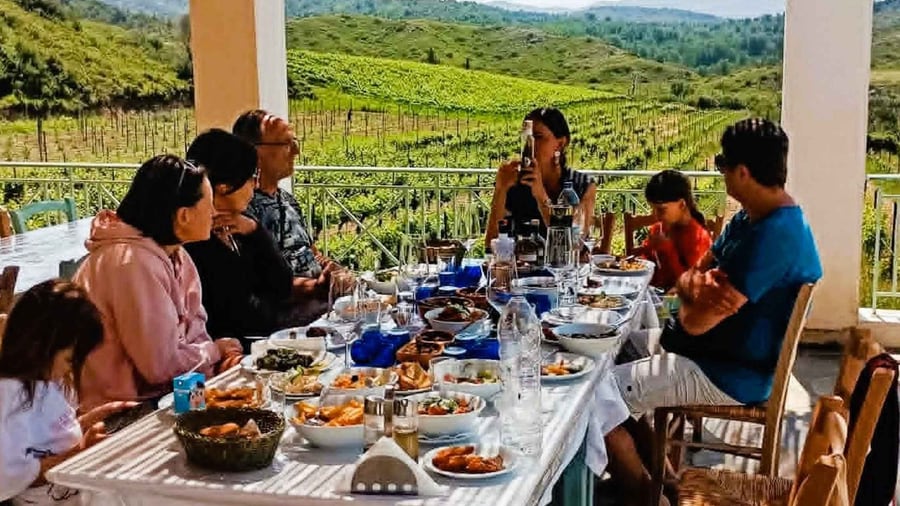
The food on a Rhodes wine tour took shape under Ottoman, Venetian and Italian influence. It kept its Mediterranean base through it all. The fertile soil of the island favours wheat and olives.
Zucchini balls rank among the classic dishes of the island. Escharitis is the local type of bread. Soft, fresh cheese goes best with dry or slightly sweet whites, light reds and rosés.
Island sweets include moschopougia, small pastries with nuts, and tahinopies, pies made with sesame paste. Kaisi is an apricot paste. Zvigoi are the Rhodian form of loukoumades, small fried dough balls.
Food and wine experts see balance as the basic rule of pairing. The weight of the dish needs to match the body of the wine. On a Rhodes wine tour, light plates take light wines, and rich plates take fuller ones.
Tannins cause the dry, rough feel that red wine leaves in the mouth. They bind to proteins in red meat and hard cheese, so the wine tastes softer. On a Rhodes wine tour, Greek reds meet a classic match in local lamb dishes.
- Desserts: A sweet wine works best when it is sweeter than the dish beside it.
- Spice: Spicy and sweet foods make the dry bite of tannins stronger.
- Acidity: Acid in wine cuts through fatty, oily, rich or salty food.
After the grape harvest in late September, Rhodes begins making souma, a strong grape spirit. The first souma of the year is tasted at a celebration of the local community. A Rhodes wine tour in autumn arrives right in this season.
How does a Rhodes wine tour taste wine properly?
A Rhodes wine tour tastes wine in five basic steps, known as the five S. Tasters see, swirl, sniff, sip and savor each glass. Each step shows a new side of the wine. Together they cover colour, smell, taste and feel.
On a Rhodes wine tour, the first step is simply to look. Colour is easiest to judge against a white background. Tasters hold the glass at an angle to see the shade clearly.
The swirl comes next on a Rhodes wine tour. It adds oxygen and frees more of the particles that carry smell. Sparkling wine is the exception, since a hard swirl lets its bubbles escape.
Tasters on a Rhodes wine tour hold the wine in the mouth for a short moment. Breathing in through rounded lips releases even more aroma. About 15 million smell receptors in the nose pick up these scents.
A typical wine has a pH between 2.9 and 3.9. The pH scale measures acidity, and a lower number means a more sour wine. Tartaric, malic and citric acid are the three main acids in wine grapes.
Body, the weight of wine in the mouth, depends mainly on alcohol. The streaks on the glass, called legs or tears, show alcohol, not sweetness or quality. The physicist James Thomson first explained these tears correctly in 1855.
- Temperature: Cooler wine stresses acidity and tannins and mutes aroma, while warmer wine does the opposite.
- Whites: Experts advise 7 to 10 °C for light whites and 6 to 8 °C for sweet wines.
- Reds: Medium and full-bodied reds are served at 15 to 18 °C.
- Glass: The ISO tasting glass holds about 215 ml but takes only a 50 ml pour.
Spitting out wine is not rude on a Rhodes wine tour. A spittoon, a small bowl for spat wine, tends to stand nearby. It lets tasters try each glass and stay clear-headed.
What landscape does a Rhodes wine tour drive through?
A Rhodes wine tour drives through Attavyros, the westernmost municipal unit, or council area, on the island. This district covers the central part of the west coast. The coast road also passes hill villages, an old castle and the ruins of an ancient city.
After Embonas, the largest towns of the district are Agios Isidoros and Kritinia. The first is a small town known for making wine. Locals call it “the Village”, and a Rhodes wine tour can stop there.
The name of the second town means “New Crete”, because families who fled Crete founded it. The castle above the village is called Kastellos. That old family tie pairs a Rhodes wine tour well with wine tours on Crete.
Further south, a Rhodes wine tour can carry on to the village of Monolithos. It lies 8 km south-east of Apolakkia and 28 km from Prasonisi.
Ancient Kamiros lies 3 km west of the modern village of Kalavarda. Mycenaean Greeks lived in the area in prehistoric times. An earthquake in 142 AD destroyed the city for a second time.
Alfred Biliotti and Auguste Salzmann dug the site’s acropolis, or upper city, between 1859 and 1864. The Italian Archaeological School began a planned, step-by-step dig there in 1928. A Rhodes wine tour can pause at the ruins between tastings.
- Height: Air cools by about 6.5 °C for every kilometre of height.
- Day and night: Wine regions at high altitude see the widest swing between day and night temperatures.
- Grapes: Daytime sun builds sugar, while the sharp drop at night keeps natural acids in balance.
- Frost: The old inland Maritsa airport on Rhodes has dropped as low as -4.0 °C.
Each stop on a Rhodes wine tour ties the glass to the ground. Hill towns, a castle, an ancient city and the sea share one western stretch.
When is the best season for a Rhodes wine tour?
A Rhodes wine tour fits best in late summer and early autumn. In those weeks the grapes change colour, swell with sugar and come in at harvest. A spring visit shows the vines waking instead, with fresh shoots, open buds and the first small flowers.
A vine year runs from bud break and flowering to fruit set and colour change. Harvest, leaf fall and rest follow. Bud break, when new buds open, begins around March in the Northern Hemisphere. It starts once daily temperatures pass 10 °C.
A vine pruned in winter “bleeds” from its cuts at bud break. It can lose up to 5 litres of water. About 4 weeks later in warm climates, shoots grow about 3 cm a day.
Flowering starts 40–80 days after bud break. Average daily temperatures then stay between 15 and 20 °C. On average, about 30 percent of the flowers are fertilised, and the share can reach 60.
Veraison is the official name for the change of colour in grape berries. It starts about 40–50 days after fruit set, from the end of July into August. Grapes on the sunny outer edge change first. Shaded ones near the trunk change last.
Within six days of veraison, berries swell fast with glucose and fructose, two natural sugars. Their acids fall. Sugar in a ripening berry can climb to around 25 percent. A late-summer Rhodes wine tour finds the fruit at this sweet stage.
- Leaf fall: After the harvest, the leaves turn yellow and drop after the first frost.
- Winter rest: The bare vine then rests through the cold months until the next bud break.
- October heat: Lindos, on the south-east coast, averages highs of 26.7 °C in October.
Each season gives a Rhodes wine tour a different view of the vine. Ripe colour marks the end of its year, and green shoots mark its start.
What do travelers ask about a Rhodes wine tour?
A Rhodes wine tour raises practical questions about alcohol, driving and taking bottles home. Clear rules answer each one. Standard drink sizes help count tastings. Drink-driving law is strict. Airline and border rules decide how bottles travel and how much wine enters a country.
How much alcohol does a Rhodes wine tour tasting hold?
More countries count a standard drink as 10 g of alcohol than any other amount. The WHO AUDIT questionnaire, a health survey on drinking, uses this measure. Red wines average 12.5% alcohol and sometimes reach 16%. A 750 ml bottle at 12% holds 9 UK units.
Can the driver taste wine on a Rhodes wine tour?
Drink-driving rules in Greece are strict. Driving above 0.11% blood alcohol, or 0.60 mg/L in the breath, is a serious offence. It can bring up to two years in prison. A Rhodes wine tour with a sober driver lets every adult taste in safety.
How do bottles from a Rhodes wine tour travel by plane?
Cabin liquids go in a clear plastic bag of up to 1 litre. No container in it can hold over 100 ml. Full wine bottles must therefore go in checked baggage. Sealed duty-free wine can fly in hand luggage, with its receipt, inside the red-bordered security bag.
How much wine from a Rhodes wine tour can cross a border?
Each EU country sets its own reference level for alcohol. For wine, that level cannot be lower than 90 litres, with only 60 litres sparkling. Travellers to Great Britain can bring 18 litres of still or sparkling wine without tax or duty. At 19 litres, tax and duty apply to all of it.
How does wine from a Rhodes wine tour keep after opening?
Bottled wine is best drunk within hours or days of opening. Bag-in-box wine keeps about 3–4 weeks once open. A vacuum stopper with a hand pump removes oxygen and adds extra days to an open bottle. Wine kept above 77 °F for long periods can spoil and taste raisiny or stewed.
Featured photo: Wines of Rhodes traditional wine tasting in the vineyards, via GetYourGuide.