

A corfu albania day trip crosses the narrow Corfu Channel by sea to the Albanian coast at Saranda. It is one of the day trips beside the Greek tours listed on Greece VIP.
This post covers the sea crossing, entry rules, Saranda, Butrint, the Blue Eye spring, Ksamil and Gjirokastra. Packing, weather and common questions come last.
What is a corfu albania day trip?
A corfu albania day trip is a one-day sea journey from Corfu across the Corfu Channel to the Albanian coast. Listings centre it on Saranda, and pair the town with Butrint National Park or the Blue Eye spring.
Saranda is a city on the Ionian Sea coast of Albania. The north-eastern edge of Corfu lies off its coast, so the town is the landing point. Saranda can serve as a base for excursions along the Albanian Riviera, and a corfu albania day trip uses it that way.
Near the city lie three notable sights. Butrint is an ancient archaeological site, the Blue Eye is a spring, and Ksamil is noted for its beaches and islets. Later sections of this page cover each stop in turn, from the town to the beaches.
Booking listings sell the outing both as a cruise and as a day trip. Pickup is marked as available on the listing for the Blue Eye and Saranda version. Travellers who want to stay on Corfu can read about an island tour instead.
- Start: Corfu island
- Landing: Saranda, Albania
- Sights: Butrint, Blue Eye
- Beaches: Ksamil islets
A corfu albania day trip links one Greek island with one Albanian coastal town and its nearby sights.


How does a corfu albania day trip cross the sea?
A corfu albania day trip crosses the Corfu Channel, a narrow passage that links the Adriatic Sea in the north with the Ionian Sea. Ferries run through it between Corfu and Saranda, and the channel also carries local and tourist traffic.
The Corfu Channel is a narrow body of water along the coasts of Albania and Greece. It separates both countries from the island of Corfu. Its northern end opens to the Adriatic Sea and its southern end to the Ionian Sea.
Corfu has both traditional ferries and high-speed ferries on its sea routes. Both types serve Igoumenitsa in Greece and Saranda in Albania, and the day trip follows the Saranda route. Traditional ferries also sail to Gaios on Paxos and as far as Patras.
Saranda has seen a steady increase in tourists in recent years, and cruise ships carry a share of them. The Port of Saranda has been expanding since 2012 to take cruise ships at its terminal. A corfu albania day trip therefore lands at a port that is growing for sea traffic.
- Waterway: Corfu Channel
- Seas: Adriatic and Ionian
- Boats: Traditional, high-speed ferries
- Landing: Saranda port
The sea leg of a corfu albania day trip is one crossing of a narrow channel.
Which documents does a corfu albania day trip need?
A corfu albania day trip is a border crossing, because Albania sits outside the Schengen Area and keeps its own entry rules. Visitors need a passport valid for at least 3 months, listed countries also accept an ID card, and non-exempt countries need an e-Visa.
Albania keeps its own visa policy, which is similar to the policy of the Schengen Area. Citizens of listed countries enter with an ID card in place of a passport, and the list names three card types: national, biometric and permanent.
Residence permits and earlier visas also count. Holders of a residence permit from a Schengen state, Cyprus, Ireland, the United Kingdom or the United States enter without a visa for up to 90 days in any 180-day period. A used multiple-entry Schengen C visa gives 90 days.
Citizens of countries outside the exempt list apply for an e-Visa, and processing can take weeks. Albania has also signed exemption agreements that have not yet entered into force. Rules change, so travellers check the Albanian foreign ministry before a corfu albania day trip.
- Passport: Valid 3 months
- ID card: Listed countries
- e-Visa: Non-exempt countries
- Residence: Schengen permit holders
Documents for a corfu albania day trip follow Albanian entry rules, which change, so travellers check them before booking.
What does a corfu albania day trip show in Saranda?
A corfu albania day trip shows Saranda as a harbour town on an arch-shaped bay, with a seaside promenade, shops, cafes and restaurants. Free time fits a stroll, a swim or lunch, and the town is named after a monastery.
Saranda lies in southwestern Albania, on an arch-shaped bay between the Gormarti and Berdeneshi Hills. The town belongs to the Albanian Riviera and is known for its deep blue Mediterranean waters. A corfu albania day trip arrives in this bay by ferry from Corfu.
One listing lets travellers explore the promenade, relax by the sea, shop in local stores or eat at a seaside restaurant. Another lists a stroll through the streets, a café stop, a swim and shopping before the return to Corfu.
Saranda is named after the Forty Saints, a Byzantine monastery. Italy financed harbour improvements from 1926 to 1939. The town is held to be the site of Albania’s first synagogue, built in the 4th or 5th century and replaced by a church in the 6th.
- Bay: Between two hills
- Name: Forty Saints monastery
- Free time: Promenade, shops, cafes
- Port: Expanded for cruise ships
A corfu albania day trip uses Saranda as its base for excursions along the Albanian Riviera.
What does a corfu albania day trip show at Butrint?
A corfu albania day trip shows Butrint, an ancient Greek and Roman city that joined the UNESCO World Heritage list in 1992. The ruins stand on a hill above the Vivari Channel, inside a national park of lake, lagoon and woodland.
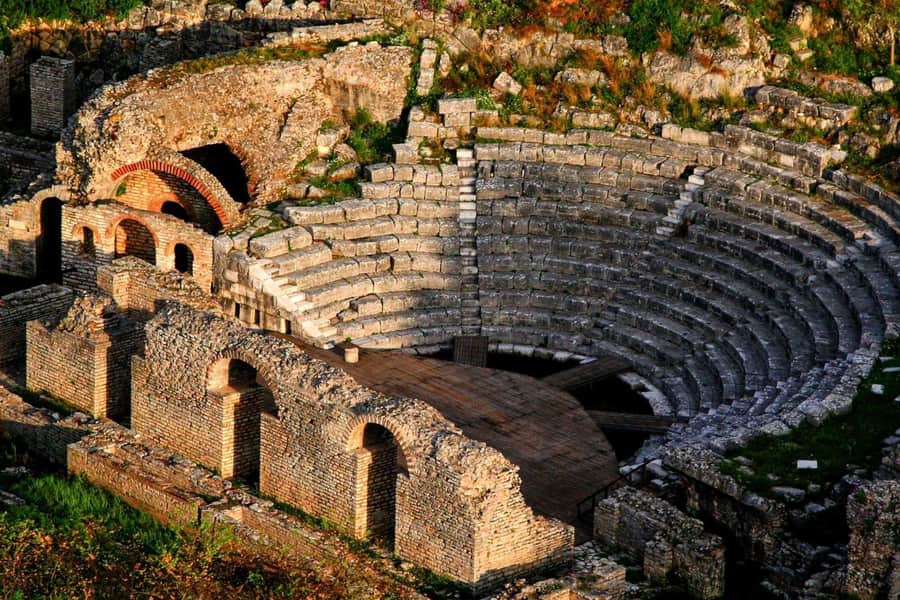
Butrint began as a settlement of the Chaonians, a Greek tribe, and became a Roman colony and a Byzantine bishopric. Venice bought the area in 1386, and by 1572 the local administration sat in a small triangular fortress. A corfu albania day trip crosses these layers.
The theatre lies below the acropolis and faces the Vivari Channel. Its stones carry an impressive number of inscriptions. The Lion Gate has a very narrow passage, made to admit the smallest possible group. A baptistery holds a large, complex mosaic from the 6th century.
Listings treat Butrint as an option. One lists the visit only when chosen at booking, with the theatre, Roman baths, the gymnasium, the Cyclopean walls and a museum in a Venetian castle. Another Ionian cruise from Corfu is the Paxos and Antipaxos cruise.
- Status: UNESCO site since 1992
- Setting: Hill above Vivari Channel
- Theatre: Below the acropolis
- Baptistery: Large 6th-century mosaic
A corfu albania day trip adds Butrint, with Greek, Roman, Byzantine and Venetian remains.
What is the Blue Eye on a corfu albania day trip?
A corfu albania day trip reaches the Blue Eye, a clear water spring in the village of Muzinë in southern Albania. Its blue water shows from a depth of more than fifty metres, and it feeds the Bistricë river.
Divers reached fifty metres, yet the true depth of the karst hole is still unclear. The source stands 152 metres above sea level and flows at 18,400 litres per second. The Bistricë river is 25 km long and ends in the Ionian Sea.
The area around the spring covers 1.8 square kilometres and is a Nature Monument, marked by oak and sycamore trees. The spring lies slightly west of Muzinë, and cars reach it from the village of Krongj. The source dried up for a time in summer 2004.
On a listed day trip, a coach takes travellers from Saranda to the spring, and a local train runs from the parking area to the entrance. The entrance fee is included. A corfu albania day trip then returns to Saranda for free time.
- Place: Muzinë, southern Albania
- Source: Bistricë river
- Depth: Over fifty metres visible
- Status: Nature Monument
The Blue Eye gives a corfu albania day trip a nature stop beside the ruins.
Which castles and old towns can a corfu albania day trip add?
A corfu albania day trip can add Lekuresi Castle, a ruined Ottoman fortress overlooking Saranda, and Gjirokastra, an inland stone town with a UNESCO World Heritage old town. The castle appears on Saranda tours, and Gjirokastra comes from separate listings.
Lekuresi Castle stands on a hill southeast of the Saranda town centre. A sultan built it in 1537 to defend against the Venetians. The plan is almost square, with two round towers at opposite corners. Its southern and eastern sides are the best preserved.
Wikipedia says the castle commands Saranda, Butrint and the Straits of Corfu. A Saranda tour listing adds the Ksamil islands and Corfu to the panorama. Listings differ on stops, so a corfu albania day trip adds the castle only where the listing names it.
Gjirokastra lies in a valley beside the Drino river. Flat dressed stones cover the roofs of the old houses, a style that earned the nickname City of Stone. The old town is a UNESCO World Heritage Site. Gjirokastra tour listings start in Saranda, Ksamil or Tirana.
- Castle: Ottoman, built 1537
- Town: Gjirokastra, UNESCO-listed
- Fortress: Open, military museum
- Bazaar: Ottoman, 17th-century origin
A corfu albania day trip reaches Saranda by sea, and the castle and Gjirokastra depend on the tour booked.
Which beaches does a corfu albania day trip reach?
A corfu albania day trip reaches the sea at Saranda, where one listing offers a swim during free time. The white sand beaches of Ksamil, south of the town, appear on Saranda tours that add the nearby islets.
Ksamil is a coastal village in southern Albania and part of Butrint National Park. It lies south of Saranda, off the road to Butrint, and was built in 1966. Wikipedia names the nearby Ksamil Islands as the main attractions, beside the white sand beaches.
The Corfu listings read give Saranda as free time. One lets travellers relax by the sea, shop in local stores or lunch at a seaside restaurant. The other offers the seaside promenade, a café, a swim or shopping before the return to Corfu.
A full-day Saranda listing adds the Ksamili Islands, with a swim after Lekuresi Castle, the Blue Eye and Butrint. Its packing list names comfortable shoes and a hat. Ksamil is not a stop on every corfu albania day trip, so travellers read the itinerary first.
- Village: Built in 1966
- Park: Part of Butrint
- Sand: White, at Ksamil
- Islets: Nearby Ksamil Islands
A corfu albania day trip can include a swim at Saranda, and the Ksamil beaches depend on the listing.
Who can join a corfu albania day trip?
A corfu albania day trip takes children and adults who carry a valid passport or national ID card. Children under 18 need both parents or an authorised adult. Group size, offered languages and walking needs all differ by listing.
Children under 18 must be with both parents or an authorised adult. A child with only one parent needs written authorisation from the other parent. Both Corfu listings read repeat this rule in their notes, so families check it before booking a corfu albania day trip.
A Saranda listing marks both Butrint and the Blue Eye as sightseeing walks. A Corfu Blue Eye listing includes a local train from the parking area to the entrance. One Corfu listing marks the trip as not suitable for people with mobility impairments.
Group sizes differ. The Corfu Blue Eye listing caps a standard group at 50 people, and a Saranda tour caps it at 30. Gjirokastra listings add small-group and private options. A Corfu old town walk can fill another day on the island.
- Children: Parents or adult
- Papers: Passport or ID
- Mobility: Check each listing
- Groups: Standard, small, private
Travellers check the age rule, the walking and the group type before they book a corfu albania day trip.
What do travellers bring on a corfu albania day trip?
A corfu albania day trip needs a valid passport or national ID card, comfortable shoes, sunglasses, a sun hat and cash. One listing adds a visa where required, because border control with passports or IDs happens at the Corfu port before the excursion starts.
The passport or ID card stays within reach, because the meeting point at the Corfu New Port holds the border control. Non-EU citizens subject to Schengen visa requirements also carry a valid visa or residence permit, as the listings word it.
One listing names comfortable shoes, sunglasses, a sun hat and comfortable clothes. The Butrint visit includes walls and a hilltop view over the lake and plains, so the shoes matter. Cruise passengers at Corfu can compare this day with a Corfu shore excursion.
Albania uses the lek, not the euro, and card payments are not accepted everywhere, so the listings recommend cash. Lunch is not included in the option without the Butrint tour, so cash covers a meal. One listing names a swim in Saranda, so swimwear joins the bag.
- Papers: Passport, ID card
- Sun cover: Hat, sunglasses
- Feet: Comfortable shoes
- Money: Cash in lek
Packing for a corfu albania day trip comes down to papers, sun cover, comfortable shoes and local cash.
How does the weather change a corfu albania day trip?
A corfu albania day trip changes with the season. Saranda has a hot-summer Mediterranean climate, and from October to April the sirocco wind makes rainy and warm conditions in Albania, so the hot, dry months feel different from the wet ones.
In the Albanian lowlands, summers are hot and dry, and rain becomes rarer. Summer temperatures average 33 degrees Celsius, with low humidity. A sea wind blows by day, and a land wind blows at night. Inland valleys reach very high daytime temperatures, but the nights are almost always cool.
Lowland winters are mild, with mostly high humidity and lots of rain. Lowland rainfall averages from 1,000 to more than 1,500 millimetres a year, with higher levels in the north, and nearly 95% of it falls in the winter.
Northerly and northeasterly winds blow much of the time in Albania. Thunderstorms in the mountains bring heavy local downpours and strong local winds. Travellers read the forecast on the morning of the crossing and read the cancellation terms before booking.
- Summer: Hot and dry
- Winter: Mild and rainy
- Sirocco: Rainy, warm air
- Night wind: Blows from land
Season and wind shape a corfu albania day trip, so travellers read the forecast and the booking terms together.
What do travellers ask about a corfu albania day trip?
A corfu albania day trip raises five common questions: booking ahead, the border check, the return to Corfu, children and a rough sea. The answers below come from the notes of two Corfu booking listings and from encyclopedia pages on Albania.
Do travellers book a corfu albania day trip ahead?
Yes, the trip is booked for a chosen date, and the listings show starting times after an availability check. Both offer free cancellation with a full refund when cancelled in advance, and both let travellers reserve now and pay later.
What is the border queue like on a corfu albania day trip?
Border control with passports or IDs happens at the meeting point in the Corfu New Port, before the excursion starts. The listings advise reaching the meeting point well before the start, and the check-in building lies a walk left of the main port entrance.
How does a corfu albania day trip return to Corfu?
The Blue Eye listing includes a round-trip boat transfer, so the sail back to Corfu is part of the day. Travellers meet again in Saranda after free time or lunch. The Butrint listing adds a walking tour of Saranda after lunch, before the sail back.
Can children join a corfu albania day trip?
Yes, children join and clear the border control with a passport or national ID card, like adults. The listings set an age rule at 18: children travel with both parents or an authorised adult, and a child with one parent carries written consent from the other.
What happens when the sea is rough on a corfu albania day trip?
The two listings set out cancellation terms but no wind rule for the crossing. Both offer free cancellation with a full refund when cancelled in advance. Travellers ask the operator before booking what happens to the trip when the sea is rough.