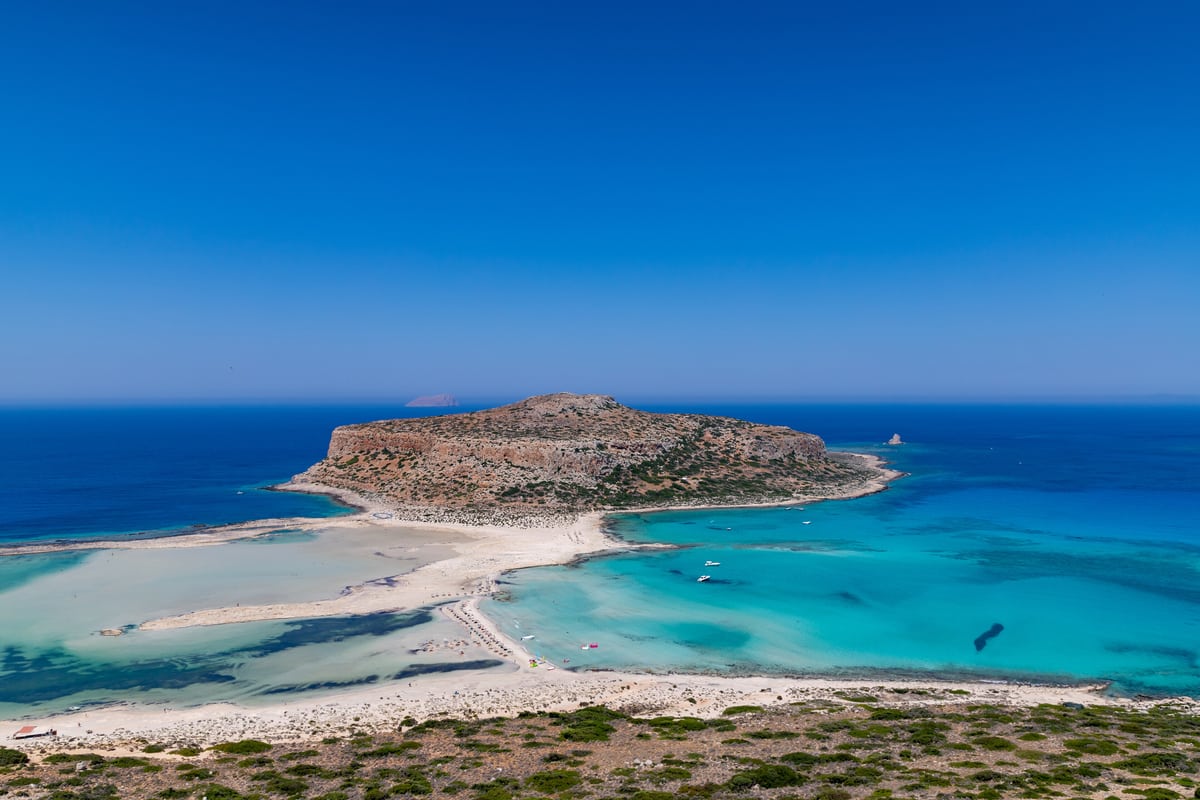
A Balos lagoon cruise sails from the port of Kissamos in western Crete to the island of Imeri Gramvousa and the shallow lagoon of Balos. This post covers what a Balos lagoon cruise includes, where it sails, Gramvousa, the lagoon, the start from Chania or Kissamos, the boats, how to protect the area and the best season. More Greece tours are listed on the Greece VIP homepage.
Each section ends with a Balos cruise that can be booked online.
What does a Balos lagoon cruise cover?
A Balos lagoon cruise covers the sea route from the port of Kissamos, along the Gramvousa peninsula in north-western Crete, to the island of Imeri Gramvousa and the Balos lagoon. All four places lie within the Chania regional unit.
Kissamos is a town and a municipality in the west of Crete. The town works as a port and a fishing harbour, and a regular ferry reaches it from the Peloponnese by way of Kythira. The present municipality was formed in 2011 by joining Kissamos, Inachori and Mythimna. A Balos lagoon cruise starts from this harbour and heads for the north-western corner of the island.
Past the harbour, the route follows the Gramvousa peninsula at the north-western end of Crete. Of the two peninsulas in this part of the island, Gramvousa is the more westerly one, and Rodopos is the other. Off the coast of the Gramvousa peninsula lie two small islands with no inhabitants. A Balos lagoon cruise passes this arm of land on the way out to the islands.
Imeri Gramvousa is one of the two islands off the peninsula. It holds the remains of a Venetian fort, along with the ruins of buildings left by Cretan insurgents. These insurgents had to live as pirates during the Greek War of Independence. Today Imeri Gramvousa is a popular tourist attraction. On a Balos lagoon cruise, the island adds a layer of history to the sea route.
The Balos lagoon lies in the water between Imeri Gramvousa and the coast of Crete. The cruise takes its name from this lagoon, although the route also covers the peninsula and the island. The municipal unit of Kissamos, which includes the Gramvousa peninsula, forms the far western part of the Chania regional unit and of Crete itself. A Balos lagoon cruise therefore travels to the western limit of the island.
- Islands: The two Gramvousa islands are Imeri Gramvousa and Agria Gramvousa.
- Neighbours: Kissamos borders Platanias to the east and Kantanos-Selino to the south.
- Old province: The former Kissamos Province covered the north-western corner of Crete until 2006.
- Area: The municipality of Kissamos covers about 341 square kilometres.
A Balos lagoon cruise links four places in one corner of Crete: the harbour of Kissamos, the Gramvousa peninsula, the island of Imeri Gramvousa and the Balos lagoon. The harbour is the starting point, the peninsula lines the route, and the island and the lagoon lie at the far end. Both islands fall under the municipality of Kissamos, whose head town is the port of departure.


Where does a Balos lagoon cruise sail?
A Balos lagoon cruise sails from the harbour of Kissamos along the Gramvousa peninsula, which forms the western part of Kissamos Bay, toward Cape Vouxa at its northern tip. From there it reaches Imeri Gramvousa and the Balos lagoon at Cape Tigani.
A Balos lagoon cruise leaves from Kissamos, a town that also goes by Kastelli Kissamou, or just Kastelli. The short name comes from a Venetian castle that once stood there. After the Venetian conquest of Crete in 1212, the town became the seat of a Latin Church diocese. The old Venetian governor’s palace now houses the town museum, and finds from the town include mosaics from Roman Kisamos, known in Latin as Cisamus.
The Gramvousa peninsula has carried other names. In ancient times it was called Corycus, or Korykos, and also Cimarus, or Kimaros, although the second name belonged more strictly to Cape Vouxa. Strabo wrote that Corycus was the point from which distances to the ports of the Peloponnese were measured. A Balos lagoon cruise passes this old measuring point on its way north.
Pliny called the islands off this headland the Corycae, the islands now known as Gramvousa. He gave the name Mount Corycus to the mass of rock that forms the point itself. Ptolemy mentions a town of the same name, and Juvenal writes of a Corycian vessel that came from it. The Florentine traveller Cristoforo Buondelmonti visited Crete in 1415 and found remains still standing. These sources place an ancient town on the coast that a Balos lagoon cruise follows.
Inside the Balos lagoon, an islet forms part of a cape that runs through the water. This is Cape Tigani, and tigani is the Greek word for frying pan. North of Balos, at the Korykon cape, lie the ruins of Agnion, a small ancient Roman city with a temple to the god Apollo. Both capes sit on the stretch of coast that a Balos lagoon cruise covers, so the route holds Roman ruins as well as Venetian ones.
- Cape Busa: Accounts of the Royal Navy squadron of 1828 call Cape Vouxa by the name Cape Busa.
- Old names: Gramvousa also appears as Grampousa, Akra, Cavo Buso, Cavo Bouza, Garabusa and Grabusa.
- Other islet: The municipal unit of Kissamos also takes in the islet of Pontikonisi.
- Villages: The same unit includes the villages of Sfinari, Koukounaras and Polirinia.
A Balos lagoon cruise runs from a town with Roman and Venetian roots, along a headland that ancient writers named and measured from, to the lagoon at Cape Tigani. Each stretch of the route carries a name with a past, from Kastelli and Corycus to Tigani and Agnion. The same coast later drew Venetian, Ottoman and British ships, as the story of Gramvousa shows.
What does a Balos lagoon cruise see on Gramvousa?
A Balos lagoon cruise sees Imeri Gramvousa, the tamer of the two Gramvousa islands. The island holds the ruins of a Venetian fortress and traces of a pirate base from the Greek War of Independence, and HMS Cambrian was wrecked off its coast in 1828.
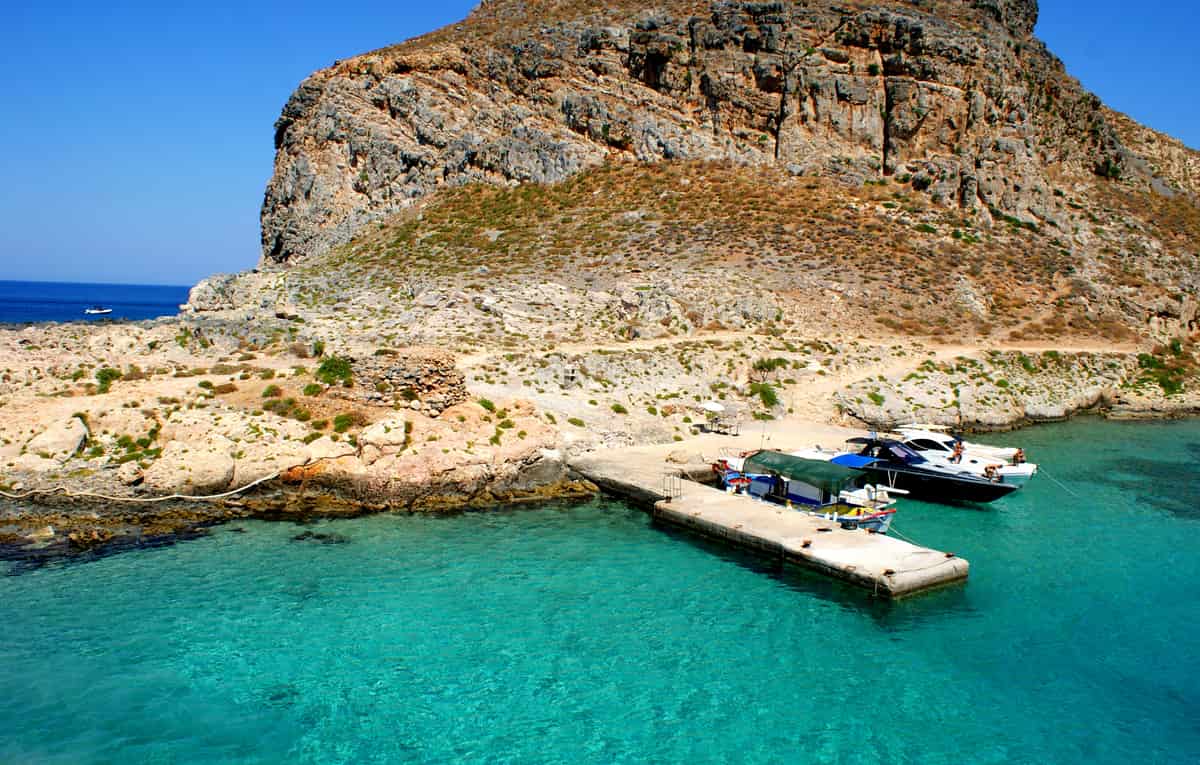
The name Imeri Gramvousa means Tame Gramvousa. Its neighbour, Agria Gramvousa, means Wild Gramvousa; it lies due north, is much less hospitable and has also been called False Gramvousa. On a Balos lagoon cruise, these names help tell the two islands apart. In ancient times the larger island was Korykos, a word for a leather bag. It later took the name Gramvousa in honour of Vousa, the wife of a pirate chief. She alone escaped capture when the pirates were removed by force.
The fort went up between 1579 and 1584, under Venetian rule, to defend Crete from the Ottoman Turks. Venice held it through the Cretan War, and the treaty of 16 September 1669, which gave Crete to the Ottomans, left Gramvousa, Souda and Spinalonga in Venetian hands. In 1691, during the Morean War, the Venetian commander betrayed Gramvousa to the Ottomans. He lived out his life in Constantinople under the nickname Captain Grambousas. The fort walls seen on a Balos lagoon cruise date from this Venetian era.
During the Greek War of Independence, three to four hundred Cretans who had fought in the Peloponnese returned to Crete. On 9 August 1825, led by Dimitrios Kallergis and Emmanouil Antoniadis and disguised as Turks, they captured the fort and made it their base. This opened the Gramvousa period. Besieged for more than two years, they turned to piracy, which hit Turkish-Egyptian and European shipping. They also built a school and a church, Panagia i Kleftrina, dedicated to the wives of the klephts, as the pirates were known.
In 1828 the governor of Greece, Ioannis Kapodistrias, sent Alexander Mavrocordatos with British and French ships to deal with the pirates, and every pirate ship at Gramvousa was destroyed. HMS Cambrian sailed in the squadron of Commodore Sir Thomas Staines. As the squadron left, the Isis struck Cambrian and drove her side onto the rocks of the narrow channel. She settled in shallow water, her crew left in order, and the swell broke her up. A Balos lagoon cruise reaches the same island waters where she was lost.
- The ship: HMS Cambrian was a 40-gun Royal Navy frigate, launched at Bursledon in 1797, that took part in the Battle of Navarino.
- The harbour: The squadron found 14 Greek vessels in the port, with an Austrian and an Ionian merchantman that the pirates had taken.
- The landing: On 5 January 1828, Hatzimichalis Dalianis landed at Gramvousa with 700 men on the orders of Kapodistrias.
- Later years: In the Cretan revolt of 1878, insurgents without artillery failed to take the fort at Gramvousa.
A Balos lagoon cruise links Imeri Gramvousa with four chapters of Cretan history: the Venetian fort built against the Ottomans, its betrayal in 1691, the base of insurgents who lived by piracy, and the loss of a Royal Navy frigate off its coast. The name of the island itself keeps the memory of Vousa, wife of a pirate chief.
What makes the lagoon on a Balos lagoon cruise special?
A Balos lagoon cruise reaches a lagoon that lies between an island and the coast of north-western Crete. An islet forms part of Cape Tigani, a cape that runs through the lagoon, and the ruins of the Roman city of Agnion stand to the north.
A Balos lagoon cruise heads for the far north-west of Crete, in the regional unit of Chania. The lagoon lies between the island of Gramvousa and the coast of Crete. The coast here belongs to the Gramvousa peninsula, which forms the western part of Kissamos Bay. Among the “three heads” of Crete, the headlands of the Chania regional unit, Gramvousa is the westernmost and rises to a peak of 725 m.
On a Balos lagoon cruise, the word lagoon has a plain meaning. A lagoon is shallow water held apart from the open sea by a thin strip of land, a reef or an island. Coastal lagoons take shape where the shore slopes gently, and that low slope is the reason for their shallow depth. They also appear on shores of mixed sand and gravel. The English word goes back to the Venetian laguna, the name for the waters around Venice.
Cape Tigani is the cape that runs through the lagoon, and an islet forms part of it. In Greek, tigani means “frying pan”. The Korykon cape, north of Balos, holds the remains of Agnion, a small city from Roman antiquity that had a temple to Apollo. A Balos lagoon cruise therefore pairs a natural lagoon with Roman remains close by. A printed map of the peninsula helps passengers match each name to the shape of the coast.
Plain preparation helps on the lagoon. Light water shoes protect feet on sand and stones. A hat, sun cream and drinking water cover the basics for time ashore. Swimmers follow the crew’s directions and keep clear of moving boats. Visitors leave shells, sand and plants where they lie and carry all litter back on board. These habits keep a Balos lagoon cruise simple and keep the lagoon clean for the next group.
- Position: The lagoon lies between the island of Gramvousa and the coast of north-western Crete.
- Cape Tigani: An islet forms part of this cape, and its Greek name means “frying pan”.
- Agnion: The remains of this small Roman city, with its temple to Apollo, lie at the Korykon cape.
- Water: A lagoon is shallow water held apart from the open sea by land, a reef or an island.
The lagoon on a Balos lagoon cruise stands out for a compact set of features. It is a lagoon, and lagoons are shallow by definition. Cape Tigani and its islet run through it, Gramvousa sits offshore, and Roman remains lie at the Korykon cape to the north. Water, sun cover and a camera are enough for the time ashore.
How does a Balos lagoon cruise start from Chania or Kissamos?
A Balos lagoon cruise from western Crete starts at the port of Kissamos, a town in the far west of the Chania regional unit. Visitors based in Chania travel 41 km west to the port along the A90 road on the north coast.
Kissamos, a town and municipality of western Crete, belongs to the Chania regional unit. Its other names, Kastelli Kissamou and plain Kastelli, recall a Venetian castle that once stood in the town. The modern town works as both a port and a fishing harbour, and a regular ferry reaches it from the Peloponnese through Kythira. For a Balos lagoon cruise, the link is direct, because the Gramvousa peninsula and the Gramvousa islets beside it fall within the municipal unit of Kissamos.
Chania, the capital of its regional unit, sits on the north-west coast of Crete, and the port of Kissamos lies 41 km to its west. The A90, the main road of the north coast, joins the two. Between Chania and Kissamos, the A90 doubles as part of the European route E65. Kissamos marks the western end of the whole road, which stretches about 310 km east to Sitia. A Balos lagoon cruise from Chania therefore begins on this road.
Chania International Airport, a gateway to western Crete, sits on the Akrotiri peninsula, 14 km from Chania. Visitors who stay further east face a longer road: Chania lies about 70 km west of Rethymno and 145 km west of Heraklion. The A90 passes near all three cities, so the trip to a Balos lagoon cruise from Rethymno or Heraklion runs west along the north coast to Chania and then on to Kissamos.
Chania has its own ports. Souda, about 7 km east of the city, serves as the port of Chania and has daily ferries to Piraeus. Kissamos port, for its part, has ferry links to Kythira, Antikythera and the Peloponnese. In Kissamos itself, a town museum fills the old Venetian governor’s palace, and digs in the town have brought to light Roman mosaics from the ancient city of Kisamos.
- Start port: Kissamos works as both a port and a fishing harbour in the far west of Crete.
- Distance: The port of Kissamos lies 41 km west of Chania.
- Road: The A90 joins Chania with Kissamos and doubles as part of the E65 on that stretch.
- Airport: Chania International Airport sits on the Akrotiri peninsula, 14 km from Chania.
In short, a Balos lagoon cruise begins in Kissamos for visitors who stay in the town, and with the 41 km road trip west for visitors based in Chania. The A90 carries the traffic from Rethymno and Heraklion as well. Clear plans for parking or transfers, a known meeting point at the port and an early start from the hotel keep the day calm.
Which boats run a Balos lagoon cruise?
A Balos lagoon cruise comes in four boat formats: large day ferries, catamarans, small boats and private boats. Each format trades group size against space, pace and privacy, so the choice depends on the size of the party and the day it wants.
Large day ferries carry the biggest groups on a Balos lagoon cruise. A ferry is a boat or ship that moves passengers across a stretch of water, and its design follows the route length, the number of passengers, the speed needed and the sea conditions. Larger vessels suit families, first-time visitors and anyone who wants a fixed plan with open deck space. Before booking, it helps to ask about the passenger limit, the shade on deck and the way ashore.
A catamaran rests on two hulls of the same size, set side by side. Because the hulls sit far apart, the boat resists rolling and tipping over, and its broad footprint can cut down leaning and wave motion when set against a boat with one hull. Compared with single-hull boats of the same length, catamarans tend to have a shallower draft. For passengers prone to seasickness, a catamaran is a sensible choice on a Balos lagoon cruise.
Small boats suit couples and small groups who want a quieter deck and a closer view of the coast. Kissamos is a fishing harbour as well as a port, so small craft are part of the scene there. The trade-off is less space, less shade and a rougher ride when the wind rises. A look at the forecast before a Balos lagoon cruise on a small boat makes sense.
Private boats serve one party at a time. A family or a group of friends sets its own pace and stops, within the limits of the skipper and the weather. Catamaran sizes run from small sailing craft up to large car ferries, so a private charter can be a catamaran too. For a private Balos lagoon cruise, the key questions are the passenger limit, the skipper’s plan for the day and the cover on board for sun and spray.
- Large day ferries: These carry the biggest groups and suit visitors who want a fixed plan and open deck space.
- Catamarans: Two hulls set far apart resist rolling, which helps passengers prone to seasickness.
- Small boats: These suit couples and small groups who want a quieter deck and a closer view of the coast.
- Private boats: These serve one party, which sets its own pace within the skipper’s limits.
No single format suits every visitor. A Balos lagoon cruise on a large ferry favours groups and fixed plans; a catamaran favours a steadier ride; a small boat favours a quieter deck; a private boat favours freedom of pace. A short list of questions on passenger numbers, shade, the way ashore and the weather plan settles the choice quickly for each party.
How do visitors protect Balos on a Balos lagoon cruise?
A Balos lagoon cruise enters a sensitive coastal area where threatened plants grow on sand and rocky shores. Visitors protect it by staying on paths, leaving plants, shells and sand in place, carrying all rubbish back on board and keeping clear of wildlife.
Two plants show why the area needs care. Anthemis glaberrima, a flowering plant of the Asteraceae family, grows only on the islets of Agria Gramvousa and Imeri Gramvousa, near the north-western tip of Crete. It lives on rocky shores and in the Mediterranean shrubland known in Greece as phrygana. In 1992, the Habitats Directive of the European Community named it a priority species. That status was meant to support Greek plans for Special Areas of Conservation within the Natura 2000 network of protected sites.
The second plant is Centaurea pumilio, a rare species that grows in sand. On Crete, it appears only on the beaches of Elafonisos and Falasarna and on the stretch from Tigani to Balos on the Gramvousa peninsula. The IUCN Red Data List places it among threatened plants, and its pink flowers open in spring. A Balos lagoon cruise brings passengers to this same shore, so visitors keep their feet on the paths and their hands off the flowers, even when the plants are not in bloom.
The sea around Crete holds threatened animals too. The endangered Mediterranean monk seal lives along almost all the coasts of Greece. Sea turtles also travel along the Cretan coast, including the green turtle and the loggerhead turtle, which are both threatened species. Loggerheads nest and hatch on north-coast beaches around Chania and Rethymno. Passengers on a Balos lagoon cruise who spot a seal or a turtle keep a wide distance, stay quiet, switch off any flash and never feed or touch the animal.
Visitor numbers add pressure. In 2023, 6.3 million visitors came to Crete, a figure that reflects overtourism pressure on coastal infrastructure. In the Journal of Sustainable Tourism, the researcher Helen Briassoulis argued that tourism pushes Crete to develop at an unhealthy rate. She linked tourist companies in the later phases of this growth to deforestation and pollution of the island’s natural resources. Each Balos lagoon cruise adds people to the same shore, so the habits of each passenger matter.
- Rubbish: Every bottle, wrapper and cigarette end returns to the boat and goes into a bin on land.
- Plants: Flowers and shrubs stay where they grow, and nobody picks them as souvenirs.
- Sand and shells: Sand and shells stay on the beach and never travel home in bags.
- Wildlife: Seals, turtles and birds get space, with no chasing, touching or feeding.
Small habits matter in a place this sensitive. A Balos lagoon cruise passes the only home of one plant and reaches one of just three Cretan sites of another. Visitors who carry their waste, keep to the paths and give wildlife space help the lagoon stay in the same state for the next boat. These steps need no special gear, no extra planning and no change to the day’s schedule.
When is the best season for a Balos lagoon cruise?
A Balos lagoon cruise suits the dry, sunny half of the year in western Crete. Around Chania, clear skies are an almost daily feature from April to October. July and August bring peak heat and frequent meltemi winds, while the shoulder months stay milder.
Crete sits mainly in the hot-summer Mediterranean climate zone, and its winters are fairly mild. Chania has sunny, dry summers and mild, rainy winters. Western Crete receives more rain than the eastern part of the island, but that rain falls in the cooler months. The Chania Airport weather station at Souda averages 126.4 mm of rain in January and only 1.4 mm in July. Snow and frost are rare near the coast. For a Balos lagoon cruise, the dry months are the ones that matter.
Strong heat waves above 38 °C are not common in Chania. The etesian winds, called meltemia, blow in from the Aegean Sea and moderate the summer air. In Greece’s Mediterranean climate zone, which includes low-lying Crete, coastal heat waves tend to stay mild because the cooler sea and the sea breeze temper them. Heat waves can still reach Chania as early as March, when hot south winds called Sirocco or Livas arrive with Saharan dust. Travelers on a Balos lagoon cruise plan for strong sun on any summer day.
The meltemi shapes conditions at sea. This dry north wind of the Aegean blows from late spring to mid-September and reaches its highest frequency in July and August. Over the Cretan Sea it arrives from the north-west. It peaks in the afternoon and tends to fade at night, yet it can rise to force 7 to 8 on the Beaufort scale in clear weather and without warning. At that strength, part of the yacht fleet and the bulk of inter-island ferries stay in port.
Rain and sunshine records show the contrast between seasons. The same station logs 0.2 rain days in July and 0.6 in August, against 7.8 in April and 9.8 in October. Sunshine totals 376.7 hours in July and still 281.9 hours in September. These figures, for 1971 to 2000, come from the Climate Atlas of the Hellenic National Meteorological Service. A Balos lagoon cruise in September keeps long sunny days, while April and October carry a higher chance of a wet day.
- April: The mean daily high at Souda is 19.9 °C, with 240.9 hours of sunshine.
- June: The mean daily high climbs to 29.0 °C, and rain falls on 1.4 days on average.
- July and August: Mean daily highs reach 30.5 °C and 30.0 °C, the warmest figures of the year.
- September: The mean daily high eases to 27.5 °C, with 15.2 mm of rain in the month.
- October: The mean daily high falls to 23.4 °C, and monthly rain rises to 61.5 mm.
The choice depends on each traveler’s priorities. July and August give the driest weather and the longest sunshine, with peak heat and frequent meltemi winds. June and September keep dry, sunny conditions with slightly lower highs. April and October are cooler and wetter. Before a Balos lagoon cruise, travelers check the wind forecast for the Cretan Sea, since a strong meltemi can stop boats from sailing. A spare day in the travel plan leaves room to rebook.
What do travelers ask about a Balos lagoon cruise?
A Balos lagoon cruise raises practical questions about children, swimming time, packing and local food. The answers depend on the shallow water of a lagoon, the strong summer sun of western Crete and each operator’s own schedule, which travelers confirm when they book.
Does a Balos lagoon cruise suit children?
A lagoon is a shallow body of water set apart from the larger sea by a narrow barrier of land, reef or islands. Shallow water suits young swimmers, but adults still watch them at all times. Crete has no land animals that are dangerous to humans. Parents bring hats, sun cream and drinking water for each child.
Does a Balos lagoon cruise include swimming time?
On a Balos lagoon cruise, swimming time depends on each operator’s plan, so travelers read the itinerary before booking. Swimmers stay inside any marked swimming areas, keep clear of boat lanes and follow crew directions. Non-swimmers wade near the beach. After a swim, a rinse with fresh water and a new layer of sun cream protect the skin.
What do visitors bring on a Balos lagoon cruise?
Visitors pack a hat, sunglasses, high-factor sun cream, a towel, swimwear and a refillable water bottle. Water shoes protect feet on hot sand and rocks. A light layer helps on deck when the afternoon wind picks up. A small bag for rubbish keeps the shore clean, and a charged phone holds the booking details for the Balos lagoon cruise.
What food can travelers try after a Balos lagoon cruise?
Cretan cuisine rests on plant foods, with olive oil as the main source of fat. Dishes include dakos salad, kalitsounia and antikristo lamb, and local drinks include tsikoudia and rakomelo. In Chania, the 1913 indoor market draws tourists and locals alike. Travelers who want a structured tasting after a Balos lagoon cruise can join a Chania food tour.
Featured photo: dronepicr, CC BY 2.0, via Wikimedia Commons.