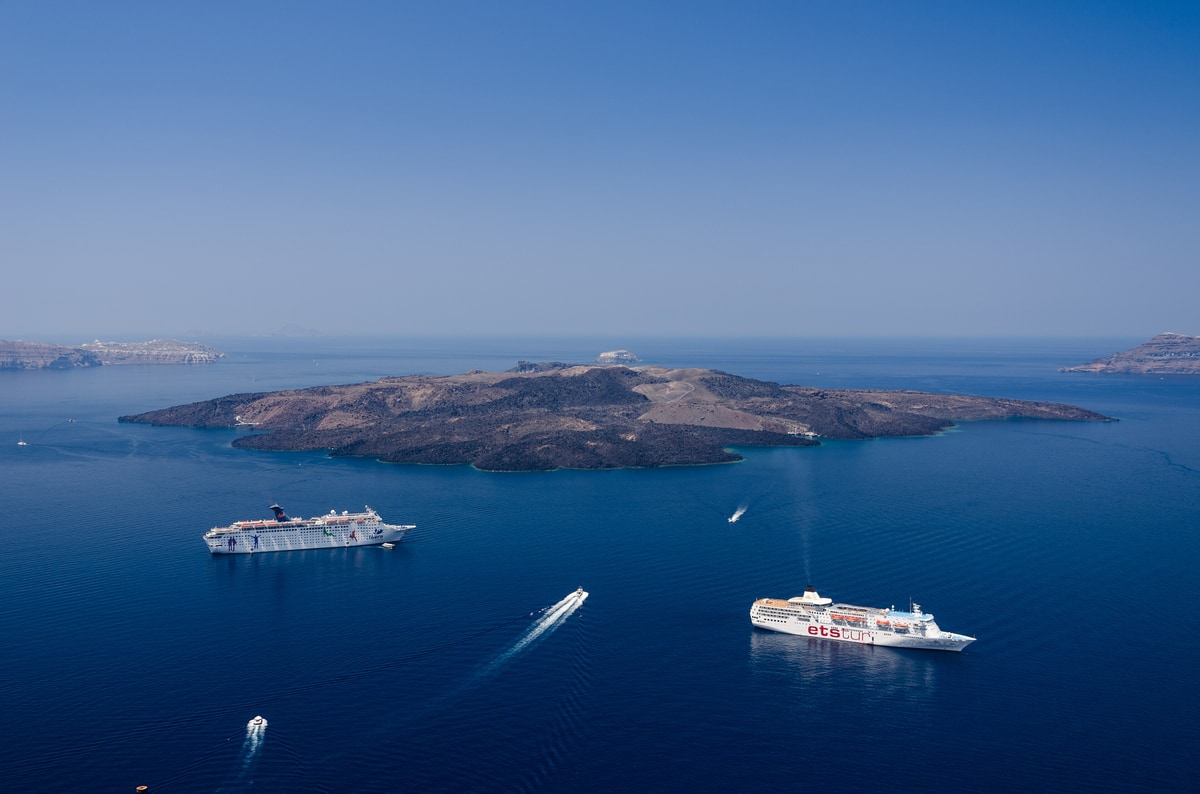
A Santorini catamaran cruise sails inside the caldera of Santorini, past the volcanic islands and along the beaches of the south coast. This post covers what a Santorini catamaran cruise includes, where it sails, the volcano, sunset cruises, the start ports, food on board and the best season. More Greece tours are listed on the Greece VIP homepage.
Each section ends with a catamaran cruise that can be booked online.
What does a Santorini catamaran cruise cover?
A Santorini catamaran cruise covers the flooded caldera, the volcanic islands of Nea Kameni and Palea Kameni at its centre, the south coast near Akrotiri with the Red Beach, and the sunset over the caldera, seen from the sea off Oia.
Santorini lies in the southern Aegean Sea as the southernmost island of the Cyclades. It is the largest member of a small, circular group of islands formed by the Santorini caldera, with Therasia and Aspronisi on the rim and the two Kameni islands in the middle. A Santorini catamaran cruise keeps to this ring of land and water, where the sea now fills the crater left by past eruptions.
The caldera measures about 12 by 7 kilometres. Steep cliffs 300 metres high wall it in on three sides, and the water inside reaches a maximum depth of 385 metres. The cliff face shows the layers of solidified lava stacked one above another. Whitewashed villages line the crest, with Fira, the capital, on the western edge of the island and Oia further north.
A catamaran is a boat with two parallel hulls of equal size. The wide gap between the hulls resists rolling and overturning, and catamarans tend to draw less water than single-hull boats of similar length. Their wide stance on the water can also reduce heeling and wave motion. On a Santorini catamaran cruise, these traits mean a steady deck between stops and access to shallow water near the beaches.
- Caldera: The sea fills a crater ringed by Santorini, Therasia and Aspronisi.
- Kameni islands: Nea Kameni and Palea Kameni, two small volcanic islands, sit near the centre.
- Akrotiri: The village close to the Red Beach lies 15 kilometres south of Fira.
- Oia: The village on the north-west edge of the island looks down on the caldera.
Each stop on a Santorini catamaran cruise traces back to one volcano. The cliffs, the dark Kameni islands and the red sand near Akrotiri all came from eruptions over hundreds of thousands of years. The pumice quarries of the island have stayed closed since 1986 to protect the caldera, which draws both volcanologists and tourists to this corner of the Aegean.


Where does a Santorini catamaran cruise sail?
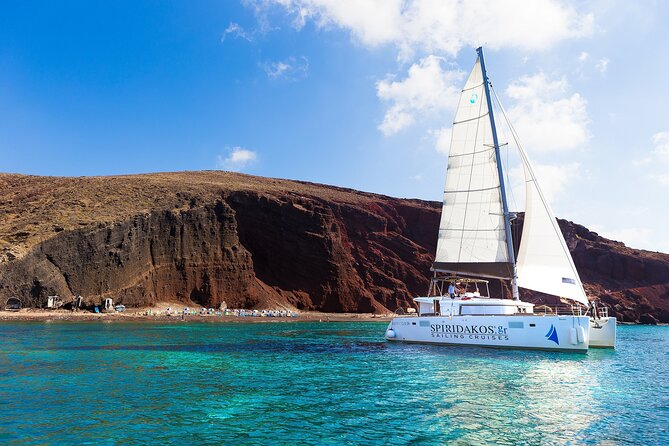
A Santorini catamaran cruise sails inside the caldera to Nea Kameni and the hot spring at Palea Kameni, along the south coast to the Red Beach near Akrotiri, and across the caldera to Therasia, an island of five villages on the outer rim.
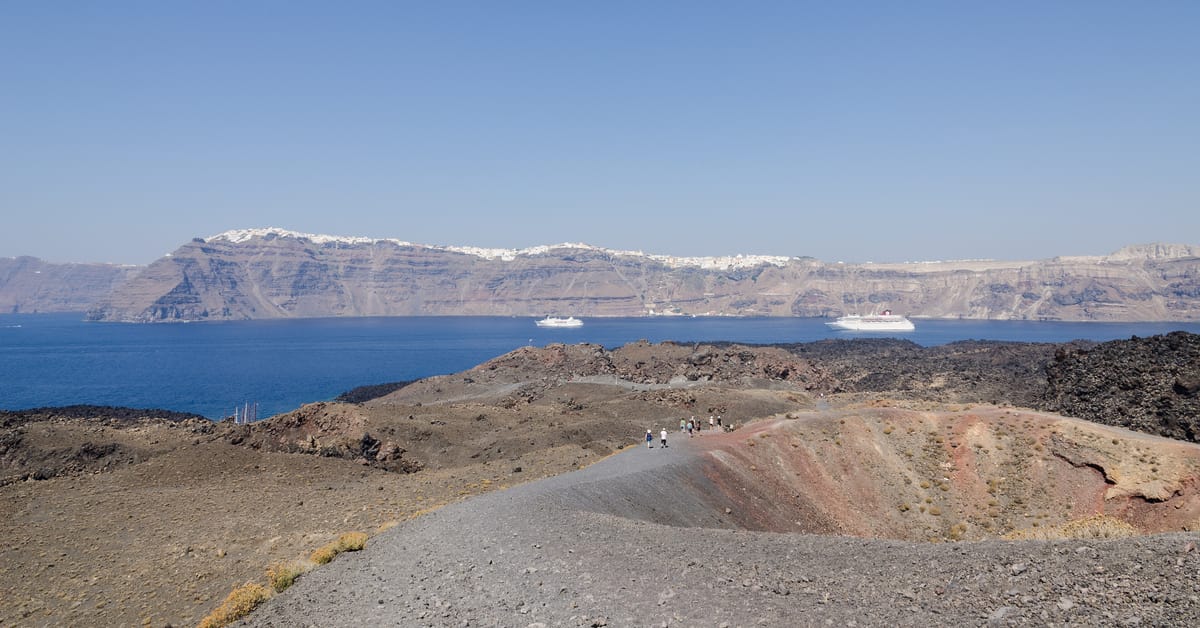
Nea Kameni, the “new burnt” island, is small, uninhabited and nearly round, about 2 kilometres across. Dozens of tourist boats visit it daily through the summer. A gravel path climbs to the top of its crater, 130 metres high, and walkers can loop all the way around the rim. One active sulfur vent bears the name Jorgo. A Santorini catamaran cruise passes close to its dark lava shore.
Palea Kameni, the “old burnt” island, lies south-west of Nea Kameni. It holds a hot spring whose water runs warmer than the sea around it. With no good harbour, pleasure boats tend to stay offshore, and visitors swim across from the water near Nea Kameni. A herd of goats lives among sparse succulent plants, and a small church stands on the island. A Santorini catamaran cruise anchors offshore for the swim to the warm water.
Outside the caldera, the land slopes down to smooth, shallow beaches whose colour depends on the rock layer exposed: the Red Beach, the Black Beach and the White Beach take their names this way. The Red Beach is reached from nearby Akrotiri, and its sand is crushed red and black volcanic rock. Landslides have closed parts of it since 2013, so a Santorini catamaran cruise views it from the sea.
- Kameni islands: Nea Kameni covers 3.4 square kilometres and Palea Kameni covers 0.5 square kilometres.
- Aspronisi: The uninhabited islet takes its name, “White Island”, from its white pumice.
- Darker beaches: The sea off the darker beaches is warmer, as the lava absorbs heat.
Therasia, also spelled Thirassia, lies north-west of Nea Kameni and is the second largest island of the group after Thera. It covers 9.3 square kilometres and had 249 residents at the 2021 census, 140 of them in Manolas. The island belongs to the municipal unit of Oia, and a Santorini catamaran cruise reaches its shore by crossing the open water of the caldera.
Why does a Santorini catamaran cruise pass the volcano?
A Santorini catamaran cruise passes the volcano because the whole bay is the volcano. The Minoan eruption, about 3,600 years ago, caused the collapse that shaped the present caldera, and the two Kameni islands later rose from the sea at its centre.
The Minoan eruption struck Thera, the ancient name of Santorini, around 1600 BC. It rated 7 on the Volcanic Explosivity Index and threw out 28 to 41 cubic kilometres of material, measured as dense-rock equivalent, which places it among the largest volcanic events in human history. Its eruption column rose 30 to 35 kilometres into the stratosphere, and pumice and ash buried the Bronze Age town at Akrotiri.
Santorini has lost its centre more than once. The pattern repeats: a large eruption empties the magma chamber, the centre caves in and the sea floods the basin, and new magma then builds a fresh volcano inside it. At least four overlapping calderas record this cycle: a southern one from about 180,000 years ago, the Skaros caldera from about 70,000 years ago, the Cape Riva caldera from about 21,000 years ago, and the present one that a Santorini catamaran cruise crosses.
Just before the Minoan eruption, the islands around the caldera almost closed the circle, leaving a single opening between Thera and Aspronisi. The eruption broke the ring in two more places, on either side of Therasia. Afterwards, new lava rose at the centre: the first Kameni island broke the sea surface in 197 BC, an undersea volcano breached the surface at Nea Kameni in 1707, and the last eruption ended in 1950.
- Tsunamis: Waves 35 to 150 metres high struck the north coast of Crete, 110 kilometres away.
- Anafi: Ash layers 3 metres deep have been found on Anafi, 27 kilometres to the east.
- Decade Volcano: The Santorini caldera is one of the world’s sixteen Decade Volcanoes.
These events explain what passengers see from the deck. A layer of white tephra up to 60 metres thick covers the old ground surface on Santorini, while the Kameni islands at the centre are made of dark lava. Only steam and carbon dioxide now escape from the active crater, and scientists watch it closely. On a Santorini catamaran cruise, the volcano is the route itself, not a side trip.
Which Santorini catamaran cruise suits the sunset?
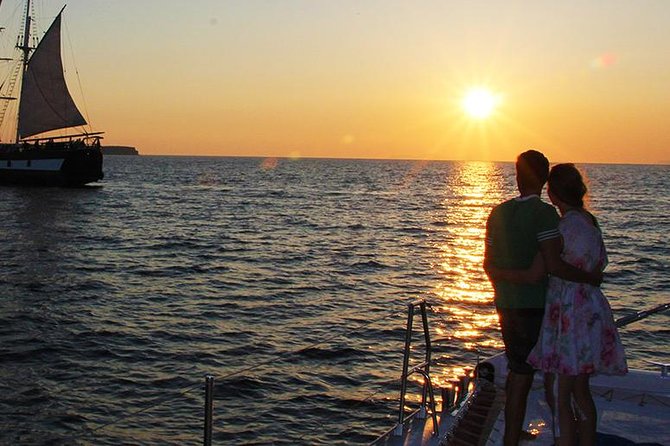
The Santorini catamaran cruise that suits the sunset is an evening sailing that ends in the water below Oia, the cliff-top village that looks out over the sunset above the caldera, so passengers see both the sun and the village from the deck.
Oia stretches for almost 2 kilometres along the northern edge of the caldera, between 70 and 100 metres above the sea. Its houses and restaurants sit in niches cut into the cliff on the seaward side, built one above the other. Sunlight also lasts longer here than in Fira, 11 kilometres away. From the water, a Santorini catamaran cruise takes in the whole cliff face at once.
Sunset viewing ranks among the main attractions of Oia. Each evening, crowds gather at the Sunset Serenade point to watch the last light tint the white houses and the caldera for a brief moment. Its lanes are very narrow, and they fill with people in the tourist season. A Santorini catamaran cruise keeps the sunset in view from the water, away from the crowded lanes.
Oia carries the nickname “Eagle’s Nest”, as Palea Kameni, Nea Kameni and Therasia are all in view from the village. At its highest point stands a ruined castle, once the seat of the Argyri family under the Venetians and also called Fort Londsa, with a full 360-degree view. An old windmill ranks among the best-known buildings in town. To the south-west lies the small island of Agios Nikolaos.
- Timing: An evening sailing places the boat off Oia as the sun goes down.
- Layers: A light jacket helps on deck once the sun has set.
- Camera: The sunset colour on the white houses fades fast, so a ready camera helps.
Plain advice applies to a sunset Santorini catamaran cruise. It helps to confirm in advance that the boat holds its position off Oia until the sun has set, rather than turning back before dark. A spot on the side of the deck that faces the cliffs gives the clearest view of the village as its colours change.
Where does a Santorini catamaran cruise start?
A Santorini catamaran cruise starts from one of the island’s harbours. Ammoudi is the old fishing port below Oia. Skala, the Old Port, sits below Fira. Athinios, the main ferry port, lies south of Fira, and Vlychada has a fishing port.
Two harbours lie below Oia. Ammoudi, on the western side of the village, is reached by steep stairs, and the descent from Oia counts 300 steps. It has tavernas, a pebble beach and a ferry link to Therasia. Armeni Bay, to the south-west, was once a boatbuilding centre and is reached on foot or by mule. Boats for round-the-island trips set out from Armeni, and caldera boat cruises leave from both Oia and Fira.
Fishing boats work from the port at Vlychada. Perissa lies 13 km south-east of Fira, near the Messa Vouno rock, with beaches on the Aegean. It keeps the remains of an Early Christian church of Saint Irene, the saint behind the name Santorini. Guests staying in the south confirm the departure harbour of a Santorini catamaran cruise before the day, since the island has more than one.
Athinios handles the island’s ferry traffic and lies about 10 km south of Fira. No other port on Santorini has regular passenger ferries, which run to Piraeus, the Cyclades, Crete and Rhodes. Multi-coloured volcanic cliffs ring the port, and a road zigzags up to the top. Below Fira, tour boats leave the Old Port at Skala for Nea Kameni and other spots around the island.
- Ammoudi: The full name of the harbour village is Ormos Ammoudi, also spelled Amoudi.
- Armeni Bay: The old boatyard trade has shrunk to small repairs on one wharf.
- Skala: A cable car, a zigzag footpath and mule rides link the Old Port with Fira.
- Athinios: Daily ferries to Piraeus run all year, with up to 5 direct crossings in summer.
The departure harbour shapes the start of a Santorini catamaran cruise. Those who walk down to Ammoudi allow time for the stairs. Those who arrive by ferry on the same day leave a margin between Athinios and the boat. Arriving early at the harbour named in the booking leaves room to board without a rush.
What food and drink come with a Santorini catamaran cruise?
A Santorini catamaran cruise menu varies by boat. Three island products are worth asking for: fava from Spanish vetchling, the Santorini cherry tomato, and dry white wine from Assyrtiko, a grape native to the island. All three grow on Santorini’s dry, volcanic land.
Greek fava is a thick, creamy paste of split peas, not of fava beans, despite the name. The peas are cooked with chopped onion, then mashed with garlic, lemon juice and oil. The dish is eaten warm or cold, or served as a dip like hummus. Fava Santorinis holds a protected designation of origin and uses the seeds of Spanish vetchling, which is grown only on Santorini and its neighbouring islands.
The Santorini cherry tomato is deep red, with firm flesh and a high seed content. Each fruit weighs 15 to 27 grams and tastes sweet and strongly acidic. Rain is scarce, so the plants rely on dew and on humidity of 71% through the year. Before 1950, Santorini was known as “tomato island”, and the old factory at Vlychada now tells that story as the Tomato Industrial Museum.
Assyrtiko is a white grape native to Santorini and grows in dry, ash-rich volcanic soil. Vines are trained low in basket shapes called kouloura, which shield the grapes from wind and sun. The grape keeps its acidity even when very ripe, and the island’s white wines are very dry, with citrus and mineral notes. Assyrtiko has a reputation as a food-friendly wine, and guests on a Santorini catamaran cruise ask the crew whether the white on board comes from it.
- Fava: The dish dates back to Byzantine cooking and was widely served in taverns.
- Cherry tomato: The Santorini variety has held a designation of origin since 13 June 2013.
- Santorini wine: Wine under the Santorini designation contains 75% or more Assyrtiko.
- Vinsanto: This sweet dessert wine comes from sun-dried Assyrtiko, Athiri and Aidani grapes.
Menus differ from boat to boat, so guests read what the booking includes before the day. Those with food allergies or a vegetarian diet tell the crew in advance. Water matters as much as wine under a hot sun, and guests prone to seasickness keep meals light. Those who want island produce ask whether the Santorini catamaran cruise menu includes fava, cherry tomatoes or local wine.
When is the best season for a Santorini catamaran cruise?
A Santorini catamaran cruise runs in a hot, dry summer, the main tourist season. The meltemi, a strong north wind, blows from late spring to mid-September and peaks in the afternoon, so guests who want calm water pick morning trips or dates outside that window.
The National Observatory of Athens classes the climate of Santorini as hot semi-arid with Mediterranean traits: dry summers and wetter winters. Rainfall averages around 270 mm a year, and the mean annual temperature is around 19 °C, with high temperatures in summer. Tourism, the island’s main industry, is busiest in the summer months, and a Santorini catamaran cruise in that period sails in dry weather.
The meltemi, or etesian wind, is a strong and dry northerly over the Aegean Sea. Its old Greek name comes from the word for ‘year’, because it returns each summer. It blows from late spring to mid-September. In the southern Aegean, where Santorini lies, it comes from the north-west. The weather it brings is fine and clear, and the northerly air cools the fierce summer heat.
The wind is at full strength in the afternoon and tends to ease at night, though at times it blows for days without a break. It rises without warning in clear weather and can reach force 7 to 8 on the Beaufort scale, strong enough to keep a share of yachts and inter-island ferries in port. On other days it gives the steady sailing wind that leisure sailors favour. Guests booking a Santorini catamaran cruise in high summer keep a spare day in case the crew moves the trip.
- Rain shadow: The island sits in a rain shadow between the mountains of Crete and the Peloponnese.
- Early morning: Fog is common at dawn and condenses on the ground as dew.
- Aegean weather: The meltemi is a dominant force in the weather of the Aegean basin.
The right season depends on how each guest weighs wind against heat. Those who dislike a lively sea book a morning departure in high summer or travel outside the meltemi period. A check of the weather forecast on the day before the trip leaves time to talk to the crew about any change of plan.
What do travelers ask about a Santorini catamaran cruise?
A Santorini catamaran cruise raises four practical questions: whether it suits children, whether a private boat is worth it, what to bring and how to reach the harbour. The short answers below draw on island facts and plain advice for a day at sea.
Does a Santorini catamaran cruise suit children?
Families judge this by age, comfort at sea and the time of day. The meltemi is at its strongest in the afternoon, so a morning Santorini catamaran cruise tends to suit young children better. Parents confirm that the boat carries child-size life jackets and has a shaded area, and they keep a close watch near the rails.
Is a private Santorini catamaran cruise worth it?
Santorini receives an estimated 2 million tourists a year, and a private charter keeps the deck to one group. The group sets its own pace and agrees stops with the skipper. Couples and families who want space gain from a private Santorini catamaran cruise, while solo travelers meet people on a shared boat.
What do guests bring on a Santorini catamaran cruise?
Guests pack a swimsuit, a towel, a hat, sunglasses and high-factor sun cream. Soft-soled shoes grip a wet deck better than sandals with hard soles. Drinking water, seasickness tablets for those who need them and a dry bag for phones complete the list. Sun protection comes first in the dry summer heat.
How do guests reach the harbour for a Santorini catamaran cruise?
Transfers depend on the booking, so guests confirm the pick-up point the day before. Without a transfer, buses run very frequently from the central bus station in Fira to almost every part of the island. Fira’s central square, Plateia Theotokopoulou, also has a taxi station. Guests give the driver the harbour name, not only the village name.
Featured photo: Norbert Nagel, CC BY-SA 3.0, via Wikimedia Commons.