A Delos tour crosses from Mykonos to Delos, the small Cycladic island that the ancient Greeks held sacred as the birthplace of Apollo and Artemis, and walks its archaeological site. This post covers what a Delos tour includes, the crossing, the myth, the history, the Delian League, the free port, the Sanctuary of Apollo, the Terrace of the Lions, the houses and mosaics, Rhenia, the museum, Mount Kynthos, the site rules and the best season. It is one of the best tours in Greece on Greece VIP.
Each section ends with a Delos tour that can be booked online.
What does a Delos tour include?
A Delos tour includes a short boat trip from Mykonos and a walk through the ruins of the ancient city on Delos, a small island near the centre of the Cyclades. Its archaeological site is on the UNESCO World Heritage List, and almost nobody lives there.
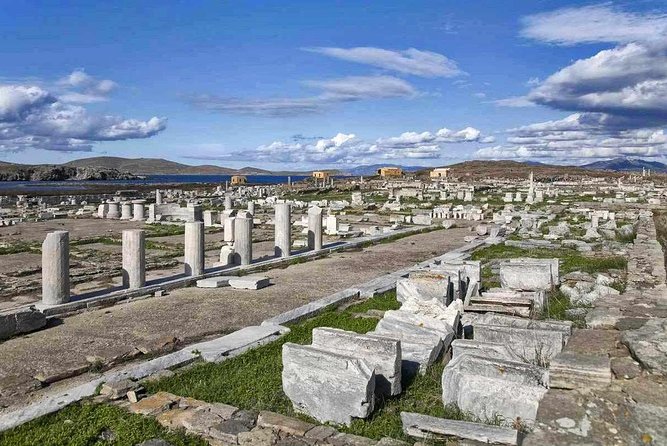
Delos, also spelled Dilos, is a small island close to Mykonos, near the middle of the Cyclades island group. Its area is only 3.43 square kilometres, or 1.32 square miles. Even so, it ranks among the leading mythological, historical and archaeological sites in Greece. A Delos tour covers a compact piece of land that holds a dense record of the ancient world, from temples and the Sacred Way to private houses and market squares.
Excavation on Delos is still in progress, and the dig ranks among the largest in the Mediterranean. The French School of Archaeology began its work on the island in 1873. Finds from the digs are displayed at the Archaeological Museum of Delos and at the National Archaeological Museum of Athens. Tourism on neighbouring Mykonos owes a great deal to these excavations. A Delos tour moves through the open-air ruins on foot.
Delos joined the UNESCO World Heritage List in 1990, and UNESCO gave three reasons for the listing. The first was the archaeological site itself, which presents the picture of a large and cosmopolitan port in the Mediterranean. The second was the influence of the island on the growth of Greek architecture. The third was its sacred importance throughout ancient Greece. Every Delos tour takes place on ground that UNESCO recognised for all three reasons.
Delos has almost no permanent population. The Greek census of 2001 recorded 14 inhabitants, and a count in 2011 gave 24. In local government, the island forms part of the municipality of Mykonos, its much larger neighbour. Mykonos, by contrast, counted 10,704 inhabitants at the 2021 census. With such a small population, a Delos tour centres on ancient remains rather than on a living town.
- Location: Delos lies next to Mykonos, close to the centre of the Cyclades.
- Size: The island covers just 3.43 square kilometres of land.
- World Heritage: UNESCO placed the site on its World Heritage List in 1990.
- Residents: A count in 2011 found only 24 people living on the island.
- Route: Each Delos tour crosses from Mykonos and explores the ruins on foot.
A Delos tour combines a short crossing from Mykonos with a walk through one of the largest excavated sites in the Mediterranean. The island is small, almost empty of people and listed by UNESCO, so the ruins are the whole focus of the visit. The ancient Greeks honoured Delos as the birthplace of the twin gods Apollo and Artemis, and ruins of their cult still stand on the island.

How does a Delos tour reach the island from Mykonos?
A Delos tour reaches the island by boat from Mykonos, which lies only 2 kilometres away across the water. Tour boats sail there on a regular basis. Delos itself has an ancient Sacred Harbour, next to the remains of a market square used by merchants.
Mykonos is the base for a Delos tour. It is a Greek island in the Cyclades, set between Tinos, Syros, Paros and Naxos, 150 kilometres east of Athens in the Aegean Sea. Ferries serve the island, and high-speed vessels arrive daily from Athens and nearby islands. Its airport lies 4 kilometres southeast of the main town, which stands on the west coast and is also called Chora. Delos falls within the Municipality of Mykonos.
The sea crossing to Delos is short. The distance between the two islands is only 2 kilometres, or 1.2 miles, so a Delos tour treats the boat ride as a brief hop rather than a long voyage. Tour boats run regularly from Mykonos to Delos, while smaller boats serve the beaches of Mykonos. The larger island carries the nickname “The Island of the Winds” because of the very strong winds that blow there.
On Delos, the ancient harbour is known as the Sacred Harbour. Three cone-shaped mounds can be seen from it, and they marked the landscape as sacred to a goddess, thought to be Athena. Next to the harbour lies the Hellenistic Agora of the Competaliasts, a market square whose stone paving keeps the postholes for market awnings. Two powerful merchant guilds from Italy set up statues and columns in this square. For a Delos tour, this harbour district shows the island as a place of trade as well as worship.
The short distance tied the two islands together in ancient times too. Delos produced no food, fibre or timber of its own, so all of it came in by ship. While a large population lived on Delos, Mykonos served as an important place for supplies and transit, even though it was itself a poor island with limited farmland. A Delos tour crosses the same narrow stretch of sea that once carried this trade.
- Starting point: A Delos tour sets out from Mykonos, the larger neighbouring island in the Cyclades.
- Distance: The sea gap between Mykonos and Delos is only 2 kilometres, or 1.2 miles.
- Boats: Tour boats sail from Mykonos to Delos on a regular basis.
- Harbour: The ancient Sacred Harbour lies beside the Agora of the Competaliasts.
Ancient Greeks had a saying about this trip. The Suda records the proverb of singing as if sailing into Delos, said of a person who was happy, light-hearted and enjoying himself. A Delos tour still reaches the island by sea, just as ancient visitors did. Around the Sacred Harbour, the merchant square and its guild monuments recall the large, cosmopolitan port that UNESCO describes.
Why is a Delos tour linked to Apollo and Artemis?
A Delos tour is linked to Apollo and Artemis because Greek myth names Delos as the place where the goddess Leto gave birth to the twin gods. Hera had ordered every land to refuse her, and only Delos, a floating island, took her in.
In Greek myth, Leto is the mother of Apollo and Artemis, and Zeus is their father. Leto was the daughter of the Titans Coeus and Phoebe. Hera, the wife of Zeus, was jealous, so she told every land to shun Leto and refuse her shelter, and she sent the serpent Python to hunt her. Leto travelled from place to place in search of somewhere to give birth. The search ended on Delos, the island that a Delos tour visits today.
Delos was no ordinary island. It was not joined to the mainland or fixed to the sea floor, so it counted as neither land nor island, and Hera’s ban did not reach it. One tradition says the island was once Asteria, Leto’s sister, who escaped Zeus by turning into a bird and then a wandering island. As thanks, four pillars held Delos in place, and the island became sacred to Apollo. Every Delos tour lands on the island that, in myth, once drifted on the sea.
The Homeric Hymn to Delian Apollo is the oldest surviving telling of the birth. It says Leto was in labour on Delos for nine days and nine nights, with the goddesses Dione, Rhea, Ichnaea, Themis and Amphitrite beside her. Eileithyia, goddess of childbirth, stayed on Olympus with Hera until Iris won her over with an amber necklace. Leto then gave birth holding a palm tree. Themis fed the baby Apollo nectar and ambrosia, and when he began to walk, the island filled with gold.
Artemis has a more tangled birth story. The Homeric Hymn places her birth on Ortygia, not Delos. The Bibliotheca says Leto bore Artemis first on Delos, and the newborn goddess then acted as midwife for Apollo. Callimachus calls Artemis the elder twin. Hyginus tells how Poseidon hid Ortygia under a dome of waves, and that island was later called Delos. By the time of the Odyssey, Delos was already famous as the birthplace of both twins, which is why a Delos tour links the island with both gods.
- Older sanctity: Delos was revered as a holy site for a thousand years before Olympian myth made it the twins’ birthplace.
- Birth spot: The Sanctuary of Apollo beside the Sacred Lake was said to mark the place where the god was born.
- Cult rank: Delos and Delphi were the two cult sites of Apollo with influence across the Greek world.
- Sacred palm: The palm tree was sacred to Apollo because he was born under one on Delos.
- Festival: The Delia, a festival of Apollo, was held on Delos every four years.
The myth also ties Delos to Mykonos. Anius, the son of Apollo and Rhoeo, a princess of Naxos, was born on Delos. Apollo raised the boy, who grew up to serve as the god’s priest and to rule Delos as king. Mykonos is said to take its name from the son of Anius, its first ruler. A Delos tour from Mykonos therefore links two islands that share a family line in Greek myth, with Apollo at its head.
What is the history behind a Delos tour?
A Delos tour follows a history that begins with stone huts from the third millennium BC. The island grew into a holy sanctuary and a pilgrimage site for the Ionians, and Athens carried out a series of purifications to keep the sacred ground pure.
The story on a Delos tour starts in prehistory. Remains of ancient stone huts show that people lived on the island from the third millennium BC. The historian Thucydides wrote that the first inhabitants were Carians who lived by piracy, and that King Minos of Crete later drove them out. By the time the Odyssey was written, the island was already famous as the birthplace of Apollo and Artemis. Semos of Delos, a writer from the island, produced 8 books on its history.
Visitors on a Delos tour also learn how the island became a religious centre. Delos was a holy sanctuary for a millennium before Olympian myth placed the birth of the twins there. Three conical mounds, visible from the Sacred Harbour, marked ground held sacred to a goddess, thought to be Athena. Between 900 BC and 100 AD, the island was a major cult centre where Leto, the mother of the twins, and the god Dionysus were honoured.
Delos began as a pilgrimage site for the Ionians and later gained Panhellenic religious standing. Athens then carried out a number of purifications to make the island ritually fit for worship, and a Delos tour sets them out in order. The first took place in the 6th century BC under the tyrant Pisistratus. He had every grave in sight of the temple opened and the remains carried across to a neighbouring island.
A Delos tour then turns to the island-wide purification of the fifth century BC. In the sixth year of the Peloponnesian War, on the orders of the Delphic Oracle, every dead body was cleared from the island. A new decree followed that banned burials and births on Delos. It protected the sacred status of the island and kept it neutral in trade, since inheritance gave nobody a claim to ownership. Only the tombs of the Hyperborean Maidens stayed, because a hero cult surrounded them.
- Delian games: Right after the island-wide purification, the first five-yearly festival of the Delian games was held on Delos.
- Adramyttium: Four years later, every inhabitant of the island was moved to Adramyttium in Asia, a further purification step on the Delos tour timeline.
- Delos Mysteries: The ancient author Iamblichus wrote that Delos had its own Mysteries, similar to the Eleusinian Mysteries.
- Proverb: The Suda records a Greek saying that compared a happy, carefree person to someone singing while sailing into Delos.
These early chapters set the scene for the rest of a Delos tour. Prehistoric huts gave way to a sanctuary with Panhellenic standing, and Athens shaped its religious life through purifications and a ban on burials and births. The next stage is political. After the Persian Wars, Delos became the meeting place of a new Greek alliance, and its temple held the congresses of that alliance.
How did the Delian League shape a Delos tour?
A Delos tour shows how the island became the meeting place of the Delian League, founded in 478 BC. Allied congresses met in the sanctuary of Apollo, and the common treasury stayed on Delos until 454 BC, when Pericles moved it to Athens.
The alliance grew out of the Persian Wars. After the Greek victory at Plataea and the capture of Byzantion, Sparta stepped back from the fight, and Athens took the lead. A congress then met on the holy island of Delos to form a new alliance and carry on the war against Persia. That meeting gave the league its modern name, and the Delos tour story of the alliance begins there. Writers of the time used a plainer label: “the Athenians and their Allies”.
Members chose between sending armed forces and paying a tax into a joint treasury, and the majority chose the tax. They swore to treat the same states as friends and enemies, and they dropped iron ingots into the sea as a sign that the pact was permanent. The league counted between 150 and 330 city-states. On a Delos tour, the sanctuary of Apollo is the setting for this story, since the congresses met inside it.
From the start, Athens supplied the largest share of the military power of the league. More and more allies paid their dues in cash, and Athens used the money to strengthen its own fleet. The island of Naxos was the first member to try to leave, around 471 BC, and it was defeated. Thasos broke away in 465 BC and was forced back in after a siege of more than two years. A Delos tour uses these revolts to show how the alliance became the Athenian Empire.
A key event came in 454 BC, when Pericles moved the treasury from Delos to Athens. The stated reason was safety from Persia, after the defeat of an Athenian force in Egypt. Plutarch reports that rivals of Pericles saw the transfer as a grab for money to pay for costly building projects. Pericles began the Parthenon on the Acropolis with tribute from the league. Visitors who add Athens to a Delos tour can use Acropolis tickets to see the temple that this money helped to build.
- Aristides: The Athenian politician Aristides spent the rest of his life on league affairs, including work on the tax for new members.
- Foreign quarter: While the congresses met in the temple, a separate quarter of Delos was kept for foreigners and the shrines of foreign gods.
- Cimon: Under Cimon, the league drove the remaining Persian forces out of the Aegean, and Persia stopped being a major threat for fifty years.
- Dissolution: The Delos tour story of the league ends in 404 BC, when the alliance was dissolved at the close of the Peloponnesian War under Lysander.
The league years gave Delos a political role beside its religious one. The island hosted the congresses and held the funds of an alliance of city-states based around the Aegean Sea. After the treasury left for Athens, the sanctuary remained a cult centre, and the next chapter of a Delos tour jumps ahead to Roman rule, when the island became a busy free port.
Why did Delos become a free port on a Delos tour?
A Delos tour explains that Rome made Delos a free port in 166 BC, partly to hurt the trade of Rhodes. The island grew into a major market, but attacks by the forces of Mithridates VI in 88 and 69 BC sharply reduced its wealth.
Strabo wrote that the Romans turned Delos into a free port in 166 BC. Part of the aim was to damage Rhodes, which faced Roman hostility at the time. After the Roman victory in the Third Macedonian War, in 167 or 166 BC, the Roman Republic handed Delos to Athens. The Athenians expelled the majority of the original inhabitants. On a Delos tour, this is where the commercial chapter begins.
Roman traders came to Delos to buy tens of thousands of slaves. Cilician pirates had seized them, or they had been captured in the wars that followed the break-up of the Seleucid Empire. The island became the centre of the slave trade and held the largest slave market in the wider region. A Delos tour covers this side of the port along with its temples and houses.
The Roman destruction of Corinth in 146 BC let Delos take over part of the role of Corinth as the leading trading centre of Greece. In the Hellenistic period, a Phoenician colony on the island ran wide trade links. In the late 2nd century BC, Berytian merchants, shipmasters and warehousemen met in their own clubhouse, the Establishment of the Poseidoniasts. Visitors on a Delos tour can look for postholes for market awnings in the stone paving of the Agora of the Competaliasts.
War cut the boom short. Forces of Mithridates VI of Pontus assaulted Delos in 88 and 69 BC, during the Mithridatic Wars with Rome. The first attack came in the same year that the king ordered the massacre of Roman and Italian settlers in Anatolian cities, an episode known as the Asiatic Vespers. A Delos tour notes the reversal, since an Athenian priest had dedicated a heroon to the same king on Delos in 102/1 BC.
- Decline: After the attacks, the trade, building work and population of Delos all fell sharply.
- Puteoli: Before the end of the first century BC, Puteoli replaced Delos as the chief hub of Italian trade with the east.
- Cult centre: In the same period, the island also entered a sharp decline as a place of worship.
- Pausanias: Writing in the second century AD, Pausanias said that only custodians of the sanctuaries lived on Delos.
- Abandonment: The island was abandoned around the eighth century AD, which closes the history told on a Delos tour.
The free port years explain the merchant clubhouse and market squares seen on a Delos tour. The island grew no food, fibre or timber of its own, so all of it was imported, and cisterns, wells and an aqueduct stretched a limited water supply. When the raids came and trade moved to Puteoli, the population fell and the port lost its central role.
What does the Sanctuary of Apollo show on a Delos tour?
A Delos tour enters the Sanctuary of Apollo through the Propylaia gate and passes three temples of Apollo, the Keraton altar, five treasuries, the base of the Naxian Colossus and long stoas that frame the sacred ground on its north and south sides.
The Delos tour route to the sanctuary begins at the Agora of the Competaliasts, a market square beside the Sacred Harbour with two small temples of Hermes, the Greek god of trade. From there the Sacred Way leads between two porticos to the Propylaia, the main gate of the sanctuary. Just inside the gate, on the right, stand the Oikos of the Naxians and the massive marble base that once carried a colossal Apollo.
That base carried the Colossus of the Naxians, a kouros of Naxian marble about 9 metres high, set up around 600 BC. The figure left a quarry near Melanes on Naxos and crossed to Delos by ship, at a weight of about 30 tonnes. Its head and upper legs are lost. On a Delos tour, parts of the torso remain on the site, a hand is in the local museum, and the left foot is in the British Museum.
Further north, a Delos tour reaches the three temples of Apollo. They face the Keraton, the oldest and holiest altar, which Apollo himself built, according to legend. The largest is the Temple of the Delians, also called the Great Temple. The Delian League paid for it, and work began in 476 BC. Building stopped in 454 BC, when the treasury moved to Athens, and resumed after 314 BC, yet the final decoration was never finished. Five treasuries in the sanctuary held precious offerings from cities.
The Great Temple was a Doric building with 6 columns on each short side and 13 on each long side, on foundations of about 30 by 13 metres. Its column drums were never fluted along the full shaft, so the stones show an unfinished stage of Greek building work. The temple was largely destroyed in the Mithridatic Wars. Today a Delos tour sees its lower foundations, the stylobate and broken columns.
- Stoa of Antigonos: Antigonos Gonatas, king of Macedonia, dedicated this two-aisled portico on the north edge around 250 BC.
- Southern stoas: The Stoa of Philip, the South Stoa and the Oblique Stoa lie south of the sanctuary.
- Civic buildings: The Bouleuterion, Prytaneion and Ekklesiasterion hosted the assemblies of deputies, officials and citizens.
- Monument with the Bulls: A Delos tour sees this long building, which housed a warship dedicated by King Demetrius Poliorketes.
Just outside the north edge, behind the Stoa of Antigonos, a Delos tour reaches the Minoan Fountain, a public well cut into the rock and dedicated to the Minoan Nymphs. Nine steps lead down to the water, and the spring still fills. Opposite the east end of the same stoa stands a monument to Dionysus, a phallus on a tall base carved with reliefs, set up around 300 BC after a theatre victory.
What is the Terrace of the Lions on a Delos tour?
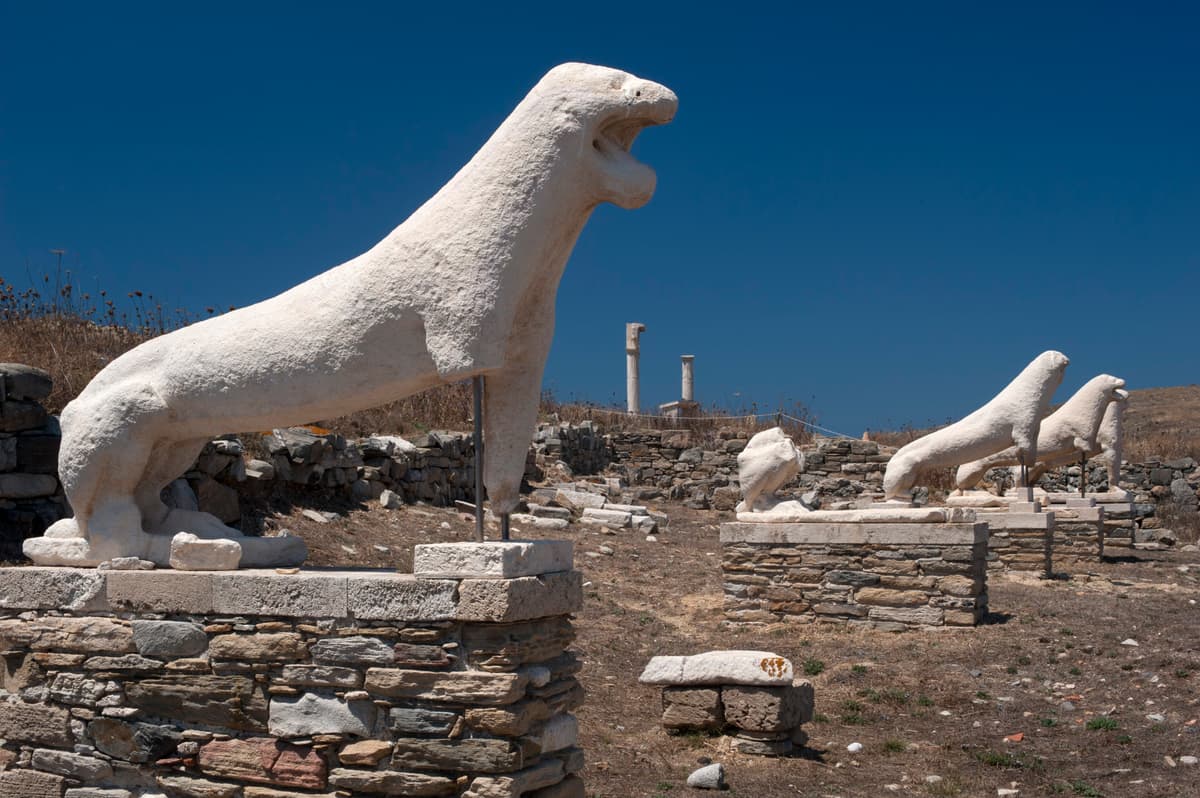
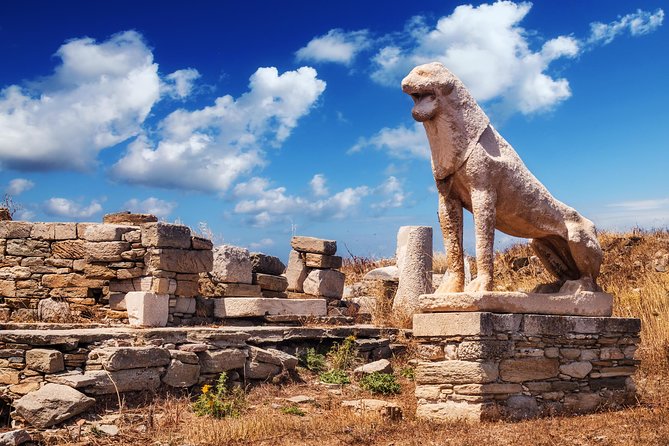
The Delos tour stop at the Terrace of the Lions shows marble lions that Naxos dedicated to Apollo shortly before 600 BC. Seven of the original lions remain; the originals are kept in the Archaeological Museum of Delos, and copies stand on the site.
The Terrace of the Lions lies on the road north of the sanctuary, past the Letoon, a 6th-century BC temple of Leto, mother of the twin gods. The lions sit on the left of the road, with the Sacred Lake on the right. A Delos tour follows their line along the old Sacred Way. The row formed a monumental avenue, comparable to the avenues of sphinxes in Egypt.
The dedication dates to the end of the 7th century BC, shortly before 600 BC. At first the terrace held between 9 and 12 lions. The Ministry of Culture suggests that the animals lined the east side of an avenue. That avenue took people who landed at the archaic port to the north entrance of the sanctuary. On a Delos tour, the surviving lions still mark this old approach to the god.
Today only seven of the original lions remain. The original statues now stand inside the Archaeological Museum of Delos, and copies take their place outside on the site. A Delos tour therefore meets the lions twice: first as copies along the terrace, then as archaic originals in the museum. The museum also holds a Greek sphinx. One lion from the row was taken away from the island and now stands in Venice.
That lion is a lioness. Alvise Pasqualigo brought it from Delos to Venice before December 1684. In 1716 Domenico Pasqualigo, an official of the Arsenal, gave it to mark the defence of Corfu against an Ottoman siege, and it was placed in front of the Arsenal. Its body is Naxian marble of the late 7th century BC, while the head is a Baroque addition. The base carries the inscription ANNO CORCYRAE LIBERATAE.
- Pose: On a Delos tour, each lion squats on its haunches and snarls, a marble guardian set along the Sacred Way.
- Sacred Lake: The round lake beside the lions was filled in 1925 during a malaria epidemic and is now kept dry.
- Agora of the Italians: Behind the Letoon stands the largest building of Delos, a market for Italian businessmen built around 100 BC.
- Poseidoniasts: The large building northwest of the lions was the clubhouse of merchants, shipowners and bankers from Beirut.
For a Delos tour, the Terrace of the Lions links the sanctuary with the northern quarter of the ancient town. The copies outside show the setting along the road, and the originals in the museum show the archaic carving at close range. Together with the colossal Apollo, the lions record the gifts of Naxos to Apollo in the archaic period.
Which houses and mosaics does a Delos tour show?
A Delos tour shows the Theatre Quarter, the marble theatre and wealthy private houses with mosaic floors, such as the House of Dionysus and the House of the Dolphins. The majority of these mosaics date to the late 2nd and early 1st centuries BC.
The residential quarters of Delos grew fast after the island became a free port. Merchants, bankers and shipowners settled there, and craftsmen built them luxurious homes with statues, wall paintings and mosaic floors. On a Delos tour, the Lake House shows the standard plan of the late 2nd century BC. Rooms open onto a square courtyard with porticoes, and a cistern below stored rainwater. Reception rooms, the kitchen and slave rooms filled the ground floor, while the owners lived upstairs.
Past the Xenon, an ancient inn with a huge cistern, a Delos tour reaches the marble theatre, which has its own large cistern. The theatre replaced an older one, and the rebuilding began shortly after 300 BC. Beyond it lies the Theatre Quarter, one of the oldest residential areas of the city. Its narrow streets bend at odd angles, and the houses have irregular plans, such as trapezoids, around open courtyards without columns. Certain houses here had neither murals nor mosaics.
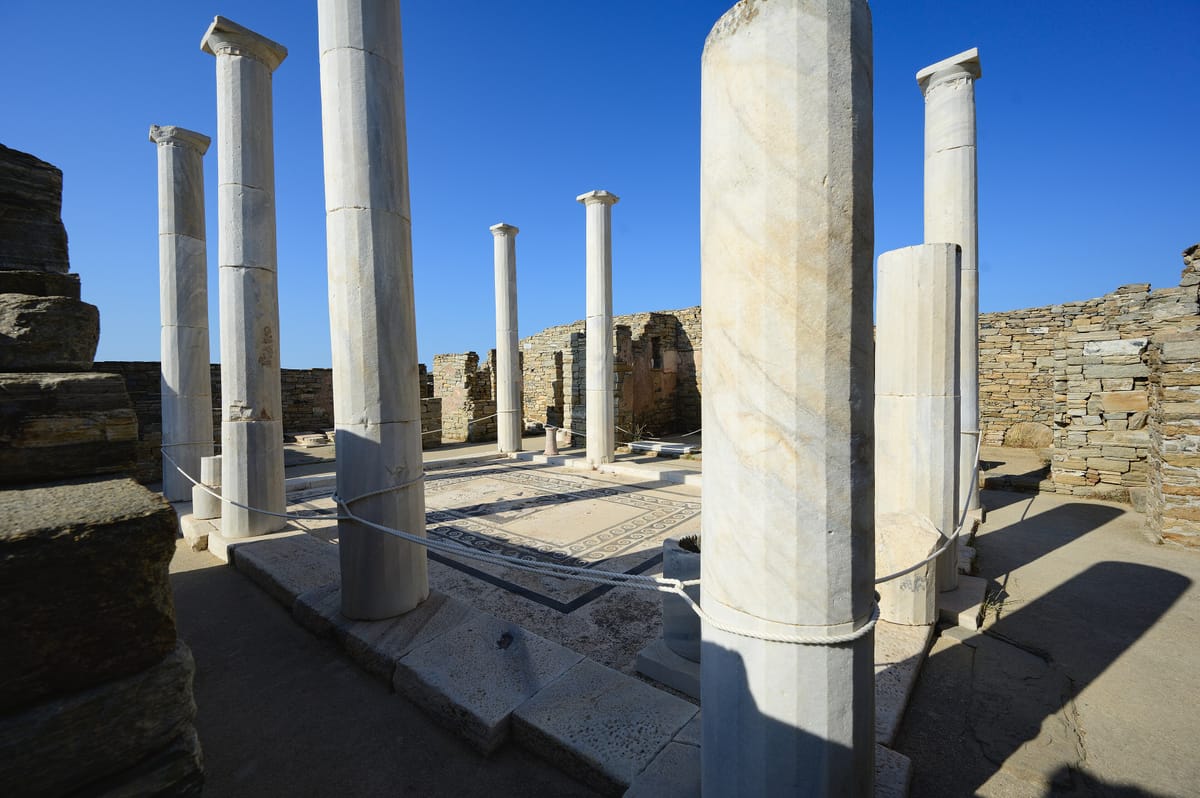
The House of Dionysus is a luxurious private house named after a floor mosaic of the god riding a tiger. The scholar Katherine Dunbabin ranks it among the finest examples of opus vermiculatum. Its tesserae of glass, faience, terracotta and natural stone measure about one millimetre square, which gives sharp detail and rich colour. Here Dionysus has wings, a sign that he appears as a daimon rather than a god. A Delos tour finds this house inside the Theatre Quarter.
A Delos tour also covers the House of the Dolphins, named after the mosaic in its peristyle courtyard. A circle sits inside a square, and in each corner tiny winged figures ride pairs of dolphins. They carry the emblems of Greek gods: the thyrsus, the caduceus and the trident, while the fourth is lost to damage. Griffins and floral garlands surround a central rosette. Asclepiades of Arados in Phoenicia signed the work, one of only two signed mosaics on Delos.
- House of the Masks: Theatre masks on ivy scrolls give this house its name, and one floor shows Dionysus riding a leopard.
- House of the Trident: A black dolphin around a red anchor and black tridents points to owners tied to the sea.
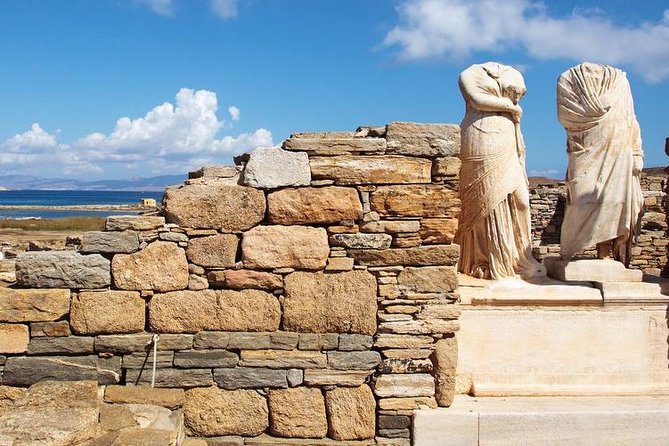
- House of Cleopatra: On a Delos tour, headless statues of the owners still greet visitors at this house.
- Tanit mosaic: The Phoenician owner of the House of the Dolphins placed a floor mosaic of the goddess Tanit in his vestibule.
Philippe Bruneau, a French archaeologist, studied the 354 mosaics that survive from Delos. Delos supplies about half of all surviving tessellated Greek mosaics from the Hellenistic period. Only 25 houses have tessellated floors, and only eight have figured scenes in the finer vermiculatum style. Production ended around 69 BC, after the wars with Pontus cut the population. On a Delos tour, these floors record Hellenistic home life at first hand.
Why does a Delos tour stop at Rhenia?
A Delos tour stops at Rhenia because this island, just west of Delos, took in the dead of the sacred island. Its southern half was the necropolis of Delos, and after the Athenian purification of 426 BCE, births and deaths on Delos moved to Rhenia.
Rhenia, also written Rineia or Rhenea, is a Greek island in the Cyclades. It sits just west of Delos and further southwest of Mykonos, and both islands belong to the municipality of Mykonos. Rhenia covers 14 square kilometres, while Delos covers only 3.43 square kilometres. A small community lived on Rhenia until the 1980s, but the island is now uninhabited. Seen from the ruins on a Delos tour, Rhenia is the empty island across the water to the west.
In ancient times the island had three names: Rheneia, Rhenaia and Rhene. It was a member of the Delian League. In the 6th century BC, Polycrates, the tyrant of Samos, subdued Rhenia and dedicated it to the Delian Apollo. With that act, the larger island came under the god of its smaller neighbour. Rome later took the island into its empire. A Delos tour that explains Rhenia therefore begins with Apollo and his sanctuary, not with the island itself.
Athens ran a series of purifications to keep Delos ritually pure for the gods. The first came in the 6th century BC under the tyrant Pisistratus, who had every grave within sight of the temple dug up and the remains carried to a neighbouring island. A full purge followed in 426 BCE, the sixth year of the Peloponnesian War. On instruction from the Delphic Oracle, the Athenians emptied the graves of Delos and banned burials. A Delos tour reads Rhenia through these acts.
A decree then banned both births and deaths on Delos. Women near childbirth and the dying were taken across to Rhenia. The ban had two aims. It protected the sacred status of the island, and it kept Delos neutral in trade, since inheritance gave no family a claim of ownership. Only the two tombs of the Hyperborean Maidens stayed, protected by a hero cult. The southern half of Rhenia served as the necropolis of Delos, so a Delos tour covers both shores.
- Altars: Surviving altars on Rhenia, like others on Delos, are decorated with bulls’ heads and festoons.
- Festival: Right after the purge of 426 BCE, Delos held the first quinquennial festival of the Delian games.
- Exile: Four years after the purge, the whole population of Delos was sent to Adramyttium in Asia as a further act of purification.
A Delos tour that stops at Rhenia completes the picture of the sacred island. Delos kept the god, the temples and the festival. Rhenia took the graves, along with the births and deaths that the decree pushed off Delos. The larger island served the smaller one, by order of Athens and on the word of the Delphic Oracle. For a Delos tour, the empty island to the west is the other half of the Delos story.
What is in the Archaeological Museum on a Delos tour?
A Delos tour reaches the Archaeological Museum of Delos, which stands on the ancient site itself. Its nine rooms hold statues, reliefs, pottery, figurines, jewelry and mosaics found on the island, from a Mycenaean ivory plaque to marble portraits of a couple who lived there.
The French School at Athens began excavating Delos in 1872, in a large-scale project that still continues. As the finds grew, the Archaeological Society of Athens put up a museum on the site in 1904 to house them. The building began with five rooms. An expansion in 1931 and a second one in 1972 brought the total to nine rooms. The objects shown on a Delos tour of the museum come from the ancient site around it.
Six of the nine rooms display statues and reliefs from Delos. Two rooms hold pottery, and one shows objects from everyday life in ancient Greece. The pottery spans the 25th to the 1st century BC, while the clay figurines, jewelry and mosaics date to the 2nd and 1st centuries BC. This spread of dates lets a Delos tour follow the island from its early settlement to the extensive trade of its Hellenistic period.
On a Delos tour, one noted piece is an ivory plaque from 1400–1200 BC. It shows a Mycenaean soldier with a shield, a spear and a helmet made from wild boar teeth. The plaque came from the Artemision, with gold, ivory and bronze items. The archaic finds include the torso of a 6th-century BC kouros and the triangular base of another kouros from the Sanctuary of Apollo, dated to the 7th century BC. Its inscription names Euthycartides the Naxian as its maker and dedicator.
A Delos tour of the galleries also takes in a Corinthian alabastron, a small flask for perfumed oil. It shows Potnia Theron, the lady of the beasts and protector of hunting, between two swans, and was found in the Heraion with similar Corinthian vases from the end of the 7th century BC. An archaic statue of a woman from the Sanctuary of Apollo dates to 580 BC. A 5th-century marble statue shows Boreas seizing the Athenian princess Oreitheia.
- Lions: The museum keeps the original marble lions, while copies stand outside on the site.
- Portraits: The statues of Dioskourides and his wife Kleopatra date from 138 BC and were unearthed at their former home.
- Wall painting: A fresco from the outer wall of a house in the Skardana Quarter shows Heracles, two boxers and a man playing a flute or trumpet.
- Actors: Statues of two actors dressed as Paposilenoi, which once flanked the Dionysus statue at the Stoivadeion, are kept here.
A Delos tour that includes the museum ties its objects to places outside. The kouros base and the archaic woman come from the Sanctuary of Apollo, and the alabastron from the Heraion. Not every find stayed on the island. A large share is on display in Athens, at the National Archaeological Museum, so a Delos tour sees only part of the record.
Why does a Delos tour climb Mount Kynthos?
A Delos tour climbs Mount Kynthos because the 113-metre granite hill holds a sanctuary of Zeus on its summit and temple remains on the path up. The top also gives a wide view across the inner islands of the Cyclades.
Mount Kynthos, also spelled Cynthus, stands on Delos and carries a Pre-Greek name. The hill is a bare granite rock that rises to 113 metres, or 371 feet. In ancient times it seems to have served as the acropolis of the town, inside a ring wall. Two flights of steps once led to the summit, one on the north side and one on the west. A Delos tour climbs it for its shrines, its ruins and its view.
The hill also gave two gods their titles. In myth, Leto gave birth to Apollo and Artemis on Delos, and the twins took bynames from Kynthos: Cynthius for Apollo and Cynthia for Artemis. Cynthia later became a female given name still used in English-speaking countries. The same byname passed to Selene, the moon goddess, because of her close link with Artemis, and to Diana, the Roman counterpart of Artemis. A Delos tour on the summit stands at the source of those names.
At the top, a Delos tour reaches the sanctuary of Zeus that crowns the summit. Foundations of a large Ionic building also survive there. Fragments of white marble architecture lie along the sides of the hill. On the western side stands an ancient gate whose roof is two rough stones leaning against each other. The angle between them is so wide that the roof rises only 1.27 metres above a span of 4.93 metres.
A small valley leads toward the summit past the ruins of ancient houses. Above them, at the foot of the peak, a wall of white marble seems to mark the cell of a temple. An altar there bears a dedication to Isis by her priest Ctesippus, son of Ctesippus of Chius. A second inscription fragment names Sarapis, and Spon and Wheler found a third nearby that named Isis, Anubis, Harpocrates and the Dioscuri. The marble remains thus point to a temple of Isis.
- Theatre: The theatre stood at the western foot of Kynthos, facing Rhenia, and measured 57 metres across with its projections.
- Stoa: Below the theatre, on the shore, lie the ruins of a stoa whose columns were granite.
- Shafts: A pierced shaft 1.27 metres wide lies among the Isis remains, and a second, 1.73 metres wide, lies half-way up the peak.
The view gives a Delos tour its widest frame. Kynthos counts as the nominal centre of the Cyclades archipelago, and its summit looks over the innermost islands: Mykonos, Naxos, Paros, Syros and Rhenia. Delos lies close to the centre of the same group, so the hill shows the sacred island among its neighbours. For a Delos tour, Kynthos joins myth, shrines and the map of the Cyclades in one place.
Which rules apply on a Delos tour?
A Delos tour enters a protected archaeological site under the Ephorate of Antiquities of Cyclades, a service of the Greek Ministry of Culture and Sports. Greek law on the protection of antiquities governs every visit, and the official notice asks visitors not to swim off the island.
Greek law frames every Delos tour. The Ministry of Culture page on Delos states that visits fall under Law 4858/2021, which ratified the code of legislation for the protection of antiquities and of cultural heritage in general. A second ministry decision, published in the Government Gazette, deals with access to and use of monuments, archaeological sites and historical sites. Each visitor therefore follows national heritage law from the first step ashore. The same official page also lists a set of short practical notices for visitors on the island.
The Ephorate manages both the archaeological site and the Delos museum, and its website presents the two together on one page. Each Delos tour thus crosses ground run by the state heritage service. The Greek Archaeological Council of the ministry gave unanimous approval to the first contemporary art installation on Delos, SIGHT by Antony Gormley, which in 2019 placed 29 iron sculptures on the archaeological site. It marked the first time an artist took over the site since the island was inhabited more than 5,000 years ago.
Archaeologists still work on the island a Delos tour visits, and the excavations rank among the largest in the Mediterranean. The French School at Athens, founded in 1846 and the oldest foreign institute in Athens, counts Delos among its archaeological projects. Digging began in the late 19th century and, according to the ministry page, is still in progress. It has uncovered the Sanctuary and much of the Hellenistic town. Caretakers also keep the sacred lake dry on purpose, to stop the spread of mosquitoes that carry malaria.
UNESCO added Delos to the World Heritage List in 1990 for three reasons. It cited the site’s picture of a large cosmopolitan Mediterranean port, its influence on Greek architecture and its sacred standing across ancient Greece. The Ministry of Culture page on Delos calls the island a World Cultural Site since 1990, and the Ephorate describes it today as an organized archaeological site with more than 180,000 visitors each year. A Delos tour therefore visits a place that holds both national legal protection and a UNESCO listing.
- Swimming: The ministry notice asks visitors not to swim along the coast of Delos.
- Water: Water vending machines stand at the port and at the museum.
- Animals: Assistance dogs and therapy animals can enter once their owners show the relevant documents.
- Access: Wide ramps and an adapted bathroom serve visitors with limited mobility.
In short, a Delos tour moves through ground protected by national law. Law 4858/2021 and the ministry’s access rules set the frame, the Ephorate of Antiquities of Cyclades looks after both the ruins and the museum, and excavation work is still in progress. The posted notices stay short and clear for every visitor on the island: no swimming along the coast, assistance animals with their documents, and water from machines at the port and the museum.
When is the best season for a Delos tour?
A Delos tour meets the driest weather from April to September, because the rainy season on nearby Mykonos lasts from October until March. Summer days are dry and sunny, while the strong north wind called the meltemi blows from late spring to mid-September each year.
The Cyclades have a dry and mild climate, and higher ground records lower temperatures but rarely sees wintry weather. Delos lies near Mykonos, so the Mykonos climate notes describe the weather on a Delos tour as well. The National Observatory of Athens classes that climate as hot semi-arid because overall rainfall is low, even though it shares traits with the Mediterranean type and feels the strong influence of the Aegean Sea. The rain shadow of the Pindus mountain range dries out the westerly winds, which keeps rain totals down.
Temperatures on Mykonos follow a clear yearly cycle. Average daytime highs reach around 27 °C in summer and drop to around 15 °C in winter. Summer nights stay above 24 °C, while winter nights average 11 °C. The rainy season runs from October until March, yet winters stay mild and wet with plenty of sunny days, even in mid-winter. Plants grow from around mid-autumn until the start of summer, so a spring Delos tour finds green ground among the ruins, while a summer visit meets dry ground.
The meltemi, also known as the etesian wind, shapes summer weather. These strong, dry north winds of the Aegean blow from late spring to mid-September and dominate the weather of the Aegean Basin, so they are the main weather factor for a summer Delos tour. In the central Aegean, where Delos sits, they blow from the north. A deep continental low over southwest Asia drives them, and they bring fine, clear weather while tempering the fierce summer heat. The name etesian comes from the Greek word etos, meaning year.
Wind strength matters on a Delos tour, since tour boats cross to the island from Mykonos. The meltemi is strongest in the afternoon and tends to drop at night, but at times it blows for days without a break. It can rise without warning under clear skies and reach force 7 to 8 on the Beaufort scale. Winds of that force keep the majority of ferries between the islands, and a share of the yachts, in port. Mykonos even carries the nickname The Island of the Winds because of the very strong winds that blow there.
- Spring: The rains end after March, and plants keep growing until the start of summer.
- Summer: Daytime highs near 27 °C meet the dry meltemi, which blows until mid-September.
- Autumn: The meltemi fades after mid-September, and the rainy season returns in October.
- Winter: Highs around 15 °C and nights near 11 °C come with rain but also sunny days.
- Afternoons: The meltemi peaks in the afternoon, so morning crossings meet calmer air.
For calm water and mild heat, the gaps between the seasons suit a Delos tour best: April, after the rains and before the meltemi, and the second half of September, after the wind and before the October rains. Summer stays the peak season, since Mykonos ranks as the second top summer destination in Greece and its airport takes international flights during the summer months. A winter visit falls inside the rainy season but still meets mild, sunny days.
What do travelers ask about a Delos tour?
A Delos tour raises four common questions: whether anyone lives on the island, which island group it belongs to, how its size compares with Mykonos and which islands lie nearby. Census counts, area figures and the geography of the Cyclades answer each of them.
Does anyone live on the island a Delos tour visits?
Yes, but only a handful of people. A Delos tour finds a near-empty island. The 2001 Greek census counted 14 inhabitants on Delos, and the 2011 figures showed 24. The island is part of the municipality of Mykonos. In the second century AD, Pausanias already described Delos as empty apart from a small group of custodians of the sanctuaries.
In which island group does a Delos tour take place?
Delos belongs to the Cyclades, an archipelago in the Aegean Sea southeast of the Greek mainland. The group counts about 220 islands; Naxos is the largest, and Syros has the largest population. The name Cyclades refers to the islands that form a circle around sacred Delos, so a Delos tour reaches the island that the circle surrounds.
Is the island on a Delos tour larger than Mykonos?
No. Delos covers only 3.43 square kilometers, while Mykonos covers 85.5 square kilometers and rises to 341 meters at its highest point. The municipality of Mykonos, with a total area of 105.183 square kilometers, includes Delos, Rineia and a group of uninhabited islets. A Delos tour therefore crosses from a large island to a small one.
Which islands lie near the route of a Delos tour?
Delos lies near Mykonos, close to the center of the Cyclades archipelago in the Aegean. Mykonos sits between Tinos, Syros, Paros and Naxos, and Andros, Delos and Mykonos are the closest islands to Tinos. From the cathedral of Ano Syros, the view takes in Tinos, Delos, Mykonos, Paros, Andros and Naxos, the islands that surround a Delos tour.
Featured photo: Ggia, CC BY-SA 3.0, via Wikimedia Commons.