
A Santorini wine tour visits the vineyards and old wine villages of Santorini, where vines grow in volcanic soil, trained low in basket shapes against the wind. This post covers what a Santorini wine tour includes, the grapes, the basket vines, Vinsanto, the volcanic soil, the history, the wine villages, the canavas, the food, the changes after 1956, the wine styles, the harvest and the best season. It is one of the best tours in Greece on Greece VIP.
Each section ends with a Santorini wine tour that can be booked online.
What does a Santorini wine tour include?
A Santorini wine tour covers the wine region of the southernmost Cyclades island, where about 1,200 hectares are under vine. It explains the protected designations of origin, the basket-trained vines and Assyrtiko, the main white grape behind the dry and sweet wines of the island.
Santorini, officially Thira or Thera, is a Greek island in the southern Aegean Sea, about 200 km southeast of the mainland. It is the southernmost island of the Cyclades, with an area of about 73 square kilometres. The archipelago is also a Greek wine region, and wine has been made there since ancient times. A Santorini wine tour moves across this small volcanic island, where tourism is the primary industry and agriculture, including a wine industry, still forms part of the economy.
Every Santorini wine tour takes place inside a legal frame. The wines of the island are standardised and protected by two designations of origin, “Santorini” and “Vinsanto”. Greece set its appellation laws through legislation in 1971 and 1972. The national system defines P.D.O. wines as appellations of origin of superior quality and P.G.I. wines as quality wines of origin. It lists Santorini among the Aegean Islands appellations, beside Lemnos, Paros, Rhodes and Samos. A bottle with the island name has to follow fixed rules on grapes.
Three wines hold a classified status on the island: Santorini, Nykteri and Vinsanto. A wine labelled Santorini must contain 75% or more Assyrtiko, and the remaining share comes from Athiri, Aidani or both. It is a bone-dry white with high acidity, flavours of lemon and stone fruits and a clear mineral taste. Producers leave it unoaked as a rule, though a small portion receives oak. On a Santorini wine tour, this dry white is the bottle that carries the name of the island on its label.
The vineyard area is small. About 1,200 hectares, or 3,000 acres, are under vine, and a constant struggle with the tourism industry puts this land at risk of shrinking further. Hot and dry conditions give the soil a very low productivity, so the yield per hectare is only 10 to 20% of the yields common in France or California. The climate is Mediterranean, with warm temperatures, low rainfall and high humidity during the growing season. A Santorini wine tour therefore deals with small harvests from poor ground.
- Region: The wine region of a Santorini wine tour covers the archipelago of Santorini in the southern Cyclades.
- Designations: “Santorini” and “Vinsanto” are the designations of origin that protect the wines of the island.
- Classified wines: Santorini, Nykteri and Vinsanto are the three classified wines of the island.
- Main grape: Assyrtiko is the flagship white grape on every Santorini wine tour.
- Vineyard area: About 1,200 hectares of land are under vine on the island.
White wines from Santorini are extremely dry, with a strong citrus scent and mineral and iodide salt aromas that come from the ashy volcanic soil. Barrel ageing gives certain whites a slight frankincense aroma. A Santorini wine tour links these flavours to the conditions behind them: one leading grape, a strict origin law, a low yield per hectare and a small vineyard area under pressure from tourism.



Which grapes does a Santorini wine tour taste?
A Santorini wine tour tastes wines from five local grapes. Assyrtiko leads, Athiri and Aidani serve as white blending partners, and Mandilaria and Mavrotragano are the red varieties. The island is known above all for its indigenous whites, while the reds are auxiliary plantings.
Assyrtiko is a white grape indigenous to Santorini and the flagship variety of the island. It grows in the arid, volcanic-ash-rich soil of Santorini and of other Aegean islands such as Paros, and it is also found in Chalkidiki. The clusters are large, with transparent yellow-gold skin and juicy flesh. On Santorini, a large share of the Assyrtiko vineyards are old and own-rooted. The small wine industry of the island is based on this grape, so it sits at the centre of every Santorini wine tour.
The grape is high in acid, with citrus and mineral nuances. In the volcanic soil of Santorini, Assyrtiko does not lose its acidity even when very ripe. Its character is compared to Riesling, and its full-bodied wines, with an average of 13.5% alcohol, have given it the nickname “white grape in red’s clothing”. Santorini examples are low-yielding and concentrated, with a briny salinity. Throughout Greece the grape makes both dry and sweet wines, and a Santorini wine tour presents both sides of it.
Athiri is a white grape with lower acid and a lemon character, and it ranks among the oldest Greek varieties. It originated on Santorini and is now planted in Macedonia, Attica and Rhodes. Aidani, also spelled Aidini or Aedani, is a white grape grown mainly on Santorini and on other Aegean isles. It has a floral aroma and works as a blending partner with grapes such as Athiri in dry wines. On a Santorini wine tour, both grapes appear inside blends, where they make up the share left after Assyrtiko.
Mandilaria is a red grape grown throughout the Greek Isles, also known as amorgiano. It gives deeply coloured, light-bodied wines that can be very tannic. Mavrotragano ranks among the oldest red varieties of Greece. It is native to the Cyclades and was first grown on the volcanic soils of Santorini. Low yields and sensitivity to drought brought it close to extinction, until local growers revived it with special pruning and cultivation methods. A Santorini wine tour that includes reds turns to these two grapes.
- Assyrtiko: The flagship white grape keeps high acidity even when very ripe and gives citrus and mineral flavours.
- Athiri: This lower-acid white grape with a lemon character originated on Santorini.
- Aidani: This white grape with a floral aroma serves as a blending partner in dry wines.
- Mandilaria: This red grape gives deeply coloured, light-bodied wines and works as a blending component.
- Mavrotragano: This old red grape of the Cyclades now makes complex dry reds and expressive rosés for the Santorini wine tour glass.
Mavrotragano wines on a Santorini wine tour show deep colour, firm tannins and moderate acidity, with aromas of ripe forest fruits, spices, coffee and a mineral note. Reds can age 10 to 15 years and rosés around 3 years, and the wines hold Protected Geographical Indication status in the European Union. The varieties grow side by side, and growers can stay unsure which grape is which until harvest, a detail visible on a Santorini wine tour.
Why are vines trained as baskets on a Santorini wine tour?
A Santorini wine tour shows vines trained as low baskets, called kouloura, for three reasons the sources give: protection from strong winds, shade from harsh sun and the use of dew, the main source of moisture on an island with low rainfall.
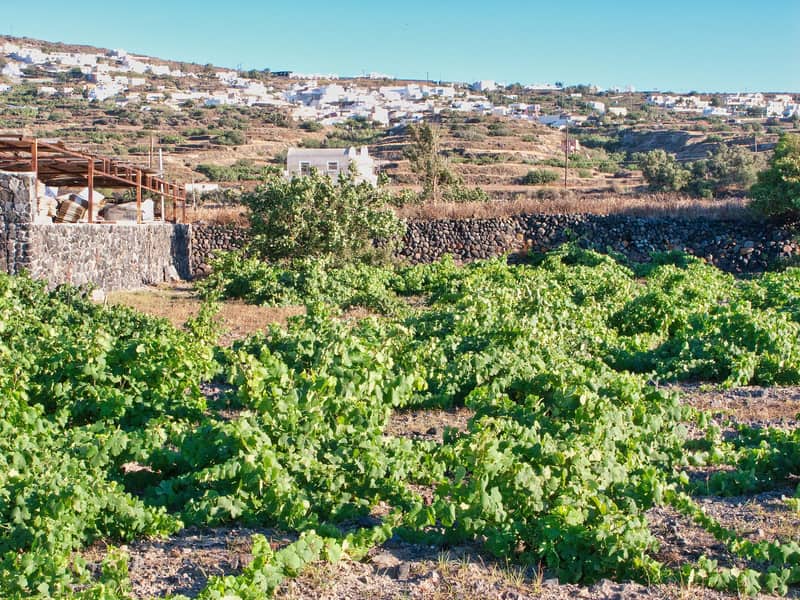
The training system is called kouloura, spelled koulara in certain sources. Growers keep the vine low to the ground as a bush. As the canes grow, they are woven into a ring, like a basket, with the grape bunches facing toward the inside. A visitor on a Santorini wine tour sees these low circles scattered over the fields instead of tall vines on wires. The vines grow haphazardly on small plots of land, and passers-by who do not know the method can mistake them for wild bushes.
Wind is the first reason. Santorini lies in the Aegean Sea, and strong winds off the sea can damage the vines and grapes if they are not trained low to the ground. Inside the basket, the leaves and the woven canes form a wall around the bunches. The grapes hang in the centre of the ring, out of the direct path of the wind. A Santorini wine tour through these arid and windswept vineyards shows how close to the ground the fruit sits.
Sun is the second reason. The leaves and the vine itself shade the grapes from harsh sunlight. Dew is the third. The island lies in a rain shadow between the mountains of Crete and the Peloponnese, with no rivers and only one spring. Islanders therefore grew non-irrigated crops such as vines and olives, which survive on the moisture of early-morning fog that condenses on the ground as dew. On a Santorini wine tour, the wide gaps between vines reflect this, since dew is their principal source of moisture.
The porous calcareous subsoils hold humidity from the air and release it as moisture at night. Roots reach deep into the ash-rich volcanic soil in search of water. At the age of 75, a vine carries layer upon layer of woven canes and can fail to give enough nutrients or yield. Growers then cut it at the roots and connect a new vine to the old rootstock, which keeps the deep roots in use for the next Santorini wine tour season.
- Wind: The woven ring seen on a Santorini wine tour shields the grapes from strong winds that damage vines trained high.
- Sun: The leaves and canes of the basket shade the bunches from harsh sunlight.
- Dew: Low vines planted far apart draw on dew, their principal source of moisture.
- Renewal: An old basket vine is cut at its roots and a new vine is joined to the rootstock.
A comparative study of kouloura and VSP training on Santorini reported that the basket form kept a less-stressed vine water status and offered better protection during heatwaves and strong winds. The old method answers each local limit at once: wind, sun, scarce rain and poor soil. For a visitor on a Santorini wine tour, the basket vines explain why the island harvests small yields of concentrated grapes.
What is Vinsanto on a Santorini wine tour?
A Santorini wine tour presents Vinsanto as the sweet dessert wine of the island. It is made from late-harvested grapes, led by Assyrtiko, that dry in the sun after picking. No sugar is added, and the wine ages in oak barrels for at least 24 months.
On a Santorini wine tour, Vinsanto stands apart from the dry white wines of the island. It follows the passito style, which means the grapes are dried in the sun after the harvest and only then pressed. Greek uses the word liastos, meaning “sun-dried”, for this kind of wine, and Greece and Cyprus are named as the original home of the style. The island label also appears as Visanto, a spelling used to set the wine apart from the Tuscan sweet wine called Vin Santo.
The rules for the name are strict. A wine labelled Vinsanto must contain at least 51% Assyrtiko, and the remaining 49% comes from Athiri and Aidani, along with small amounts of other white grapes grown on the island. No chaptalization takes place, so the sweetness comes only from the natural sugars and acids of the fruit. The finished wine must reach at least 9% alcohol by volume. These rules explain why a Santorini wine tour treats Vinsanto as a protected local wine rather than a loose style.
The making starts with late-harvested grapes, which are dried in the sun for 12 to 14 days until they become raisins. The dried fruit is then crushed and fermented, and the young wine goes into oak barrels for a minimum of 24 months. The top cuvées stay in barrel far longer, for up to twenty or twenty-five years. This slow cellar work is a core subject on any Santorini wine tour that covers the sweet wines.
In the glass on a Santorini wine tour, Vinsanto ranges from golden-orange to dark amber. Its flavours include dried apricots, golden raisins and sweet spice over a mineral base, and wines with long barrel ageing add notes of nuts, figs, honey and tea. The high acidity of Assyrtiko balances the sugar, so the wine can be paired with a variety of foods. In 2002 the European Union named Santorini as the place of origin of Vinsanto, which gave the island exclusive rights to the name on its sweet wines.
- Grapes: The blend holds at least 51% Assyrtiko, with Athiri, Aidani and small amounts of other local white grapes.
- Drying: Late-harvested grapes dry in the sun for 12 to 14 days before crushing.
- Ageing: The wine rests in oak barrels for at least 24 months, and the top cuvées for up to twenty-five years.
- Mezzo: This related sun-dried wine sits outside the official classes, and its name means “less sweet”.
Vinsanto connects the farming of the island with its long trade history. The sun-dried grapes give the sweetness, the high acid of Assyrtiko gives the balance, and the years in oak give the colour. A Santorini wine tour with a Vinsanto tasting shows how a single grape, Assyrtiko, leads both the bone-dry white wines and this deep amber dessert wine. Under EU rules, the name Vinsanto belongs to the sweet wines of Santorini alone.
How does volcanic soil shape a Santorini wine tour?
A Santorini wine tour crosses vineyards of volcanic ash and rock that hold no clay. That soil kept out phylloxera, the insect that ruined European vineyards in the late 19th century, so the island still farms ungrafted vines with roots centuries old.
The vineyard soils of Santorini are very poor. They consist of volcanic ash and rocks, the product of eruptions that include one of the largest in recorded history, about 3,600 years ago, which left a caldera ringed by deep ash deposits. Below the ash lie porous calcareous subsoils. These hold humidity from the air and release it as moisture at night, when the vines can use it. A Santorini wine tour shows this ash soil at close range in the vineyards.
Water is scarce. The island lies in a rain shadow between the mountains of Crete and the Peloponnese, has no rivers and has only one spring. For this reason islanders developed crops without irrigation, such as vines and olives, which survive on dew from the early-morning fog. The vines stand far apart, because dew is their main source of moisture, and their roots reach deep into the ash in search of water during the long, dry summers. Every Santorini wine tour passes through these dry-farmed vineyards.
Phylloxera is a sap-sucking insect related to aphids and native to eastern North America. It feeds on the roots of grapevines and gradually cuts off the flow of water and nutrients. The pest reached Europe after botanists in Victorian England collected American vine specimens in the 1850s. In 1863 the first vines began to fail in the southern Rhône region of France. Estimates put the losses at between two-thirds and nine-tenths of all European vineyards, a loss that a Santorini wine tour sets against the island record.
Santorini escaped the epidemic. Its volcanic soils contain none of the clay that the insect needs to survive, so the island vines needed no replacement. Elsewhere, the only lasting answer was grafting onto resistant American rootstock. On Santorini, Assyrtiko vineyards include old, ungrafted vines growing on their own roots. Local winemakers credit the well-drained soil and its chemistry, though it remains unclear whether the resistance comes from the vine itself or from the volcanic ash. Either way, a Santorini wine tour shows vines never grafted.
- Soil: The ground on a Santorini wine tour is volcanic ash and rock with no clay, over porous calcareous subsoils.
- Phylloxera: The insect needs clay to survive, so the island vineyards stayed free of it.
- Old roots: Vine roots on the island are centuries old and reach deep into the calcareous soil for moisture.
- Renewal: At the age of 75, a vine is clipped at its roots and a new vine is joined to the old rootstock.
- Yield: The yield per hectare is only 10 to 20% of the yields common in France or California.
The soil shapes the taste as well as the survival of the vines. White wines from the island are extremely dry, with citrus and mineral notes and iodide salt aromas that come from the ashy ground, and Assyrtiko keeps its acidity even when very ripe. For this reason a Santorini wine tour treats the soil as part of the wine itself. Across Europe grafted vines are the rule, while on a Santorini wine tour the roots in the ground are the original ones.
What is the history behind a Santorini wine tour?
A Santorini wine tour follows a trade that began in ancient times. Wine was made on the island in Greek and Roman times, became famous across Europe under Venetian influence in the Middle Ages, and reached Russia as church wine under the Ottomans.
Wine-making in Greece reaches back about 6,500 years, and Greece is home to the second oldest known grape wine remains in the world. The method of drying grapes for sweet wine is old as well: the poet Hesiod described raisin wines in mainland Greece around 800 BC. On Santorini, wine was produced in Greek and Roman times, when the island carried the name Thera. A Santorini wine tour therefore touches a craft with deep roots in the Aegean.
The wine became famous in the Middle Ages. Crusaders took the island from the Byzantine Empire, a Venetian noble family then held it, and it later became part of the Duchy of Naxos, a Venetian maritime state. The geographer al-Idrisi first recorded the name Santorini around 1154; it comes from Saint Irene. With its wide trade network and control of the sea, Venice carried Santorini wines across the Mediterranean and Europe. A Santorini wine tour still meets that Italian influence in the name Vinsanto.
Santorini wine was prized because it survived month-long sea voyages, helped by its sweetness and high alcohol. When the Ottoman Turks took control, they did not stop the trade. One explanation is that the poor soil and the cliffs falling straight to the sea made other cash crops hard to grow. The Ottomans also encouraged a sweet dessert wine from dried grapes, the wine a Santorini wine tour now pours as Vinsanto.
The Russian chapter completes the Santorini wine tour story. The Russian Orthodox Church adopted Santorini wine as its official Eucharistic wine, and the Ottomans let island producers trade freely with Russia even during the frequent wars between the two empires. In the early 19th century the island made red and white wines. The best red, Santorin, was a dry claret close to port, the white Nykteri was the best known, and Vino Santo was called the “king”. Exports reached 45,000 to 50,000 barrels a year.
- Antiquity: Wine was made on the island in Greek and Roman times, the oldest layer of the Santorini wine tour story.
- Venetian era: Venetian trade carried Santorini wine across the Mediterranean and Europe.
- Ottoman era: The trade went on, and the sweet wine was widely exported to Russia for church use.
- 1821: In April 1821 the island sent 100 barrels of wine to the Greek fleet.
- Mid-19th century: Santorini traded heavily with foreign countries and exported all of its wine production to Russia.
Across these centuries, wine gave Santorini its link with distant markets. Sweetness and strength let the wine survive long voyages, and church use in Russia kept the trade open in times of war. A Santorini wine tour today stands on the same volcanic ground that once supplied Venetian ships and Russian churches. The protected names Vinsanto and Santorini, both met on a Santorini wine tour, carry that long record into the present.
Which villages does a Santorini wine tour pass?
A Santorini wine tour passes inland villages of the municipality of Thera, such as Pyrgos Kallistis, Megalochori, Exo Gonia, Mesaria and Episkopi Gonias. All five are local subdivisions of the municipality, and Pyrgos and Episkopi Gonias stand 6 to 7 km from the capital, Fira.
The municipality of Thera covers every settlement on Santorini and Therasia. It was formed in the 2011 local government reform, when the former Oia and Thera municipalities merged. Besides the Oia community, it holds 12 local subdivisions on Santorini itself. Five of them carry the village names that come up on a Santorini wine tour: Pyrgos Kallistis, Megalochori, Exo Gonia, Mesaria and Episkopis Gonia. The other seven are Akrotiri, Emporio, Imerovigli, Karterados, Thera, Vothon and Vourvoulos. Thera is the seat of the municipality.
Pyrgos Kallistis, or simply Pyrgos, takes its name from the Greek for “Beauty Tower”. The 2021 census counted 1,078 residents. It stands about 7 km from Fira and rises in tiers on a hill, with views over the island in almost every direction. The ruins of a Venetian castle, the Kasteli, crown the hilltop; it was once the seat of island rule. Narrow, maze-like lanes, fortified walls and hidden passages mark its medieval layout. A Santorini wine tour that stops here reaches a village little changed by tourism.
Episkopi Gonias, also called Mesa Gonia, lies 6 km southeast of Fira on the lower slopes of Profitis Ilias, the highest mountain on the island. The 2021 census recorded 187 people. Its name comes from the Panagia Episkopi, a Byzantine church about 600 m to the southeast. An old inscription credits Emperor Alexios I Komnenos with the order to build it at the end of the 11th century. The church served as the seat of the Orthodox diocese of Santorini until 1207, and again from 1537 to 1827.
A Santorini wine tour that reaches Mesaria, spelled Messaria in other sources, passes a wine museum set inside a cave near the village. The same village saw the start of a tomato processing business in 1915. Exo Gonia takes its water from the desalination plant at Aghia Paraskevi, together with Messaria, Mesa Gonia, Kamari and Monolithos. Megalochori draws water from the Exo Gialos plant, along with Pyrgos and Fira. In 2019, a privately run interactive museum on the Atlantis myth opened in Megalochori.
- Pyrgos Kallistis: One of the five fortified casteli of the island, with the ruins of its Venetian castle still on the hilltop.
- Episkopi Gonias: A Santorini wine tour here comes within 600 m of the 11th-century Panagia Episkopi church.
- Mesaria: The village is home to a wine museum set in a cave.
- Emporio: This village sits 12 km from Fira near the Profitis Ilias mountains and keeps the old Goulas castle.
The villages on a Santorini wine tour share a past shaped by pirates. In the 15th and 16th centuries, raiders plundered harvests across the Cyclades, so islanders built their homes on the highest and hardest-to-reach points. Houses stood close together, and outer walls without openings formed a ring of defence. Pyrgos and Emporio both held castles of that era. A Santorini wine tour through these villages joins the vineyards with that fortified history.
What are canavas on a Santorini wine tour?
A Santorini wine tour reaches the canavas, or Kánava wineries: rooms dug sideways or downwards into pumice. Islanders used these spaces, known as hypóskapha, to store produce and mainly to cellar wine, because the air-filled pumice keeps them cool in summer and warm in winter.
The hypóskapha are the main feature of the old architecture of Santorini. Builders extended houses sideways or downward into the soft pumice around them. The rest of the house followed the Cycladic pattern: low, cube-shaped homes of local stone, washed white or coloured with volcanic ashes. A Santorini wine tour that enters a canava steps into one of these dug-out rooms. The island has used such rooms both as living quarters and as stores for its harvest, and the canava is the wine version of that tradition.
The pumice holds a great deal of air, and that air works as insulation. As a result, the rooms stay cool through the hot summer and keep their warmth in winter. These steady conditions made the hypóskapha prized storage for farm produce, and wine cellaring was the main use named for them. The Wikipedia article on Santorini calls these cellars the Kánava wineries of Santorini. On a Santorini wine tour, the word canava therefore points to this type of rock-cut cellar rather than to a modern building.
Underground space mattered on Santorini for more than wine. The island lies in a rain shadow between the mountains of Crete and the Peloponnese. It has no rivers and only one spring, and its soil is largely volcanic ash. Islanders therefore led rain from roofs and courtyards into underground cisterns. For the same reason they grew crops that need no irrigation, such as olives and the vines seen on a Santorini wine tour. These plants survive on the dew left by early-morning fog.
Old ways of making wine come up on a Santorini wine tour as well. Nykteri, whose name refers to working the night away, was picked before sunrise, then pressed and drawn off within the first day. This kept the juice low in colour and limited its contact with air. Sweet wine came from grapes dried in the sun after harvest. Greek wine as a whole began as a household or communal craft, and Greece holds the earliest evidence of crushed grapes in the world.
- Hypóskapha: These are rooms dug sideways or downwards into pumice as extensions of houses.
- Kánava: This is the name for the wine cellars of Santorini set in such rooms.
- Pumice: Air trapped in the stone keeps a canava on a Santorini wine tour cool in summer and warm in winter.
- Night pressing: Nykteri grapes were picked before sunrise and pressed within the first day.
The canavas tie the wine of the island to its volcanic rock. Cycladic craftsmen once used pumice from Santorini to give a fine finish to marble work. In the mid-1930s, an overview of the Greek economy noted the wine production of the island and listed pozzolana, or volcanic ash, among its mineral resources. A Santorini wine tour that visits a canava shows the same material put to use as a cool cellar for the harvest.
Which foods go with a Santorini wine tour?
A Santorini wine tour sets the island’s wines beside its farm products: fava made from Spanish vetchling, the Santorini cherry tomato, tomato fritters and capers. Assyrtiko goes with grilled fish and meats, while Vinsanto pairs with a wide range of foods.
Fava Santorinis holds a protected designation of origin. Ordinary Greek fava uses split peas; this version uses seeds of Spanish vetchling, Lathyrus clymenum. The plant grows as a crop only on Santorini and neighbouring islands, and residents have cultivated it for 3,500 years. Its seeds turned up in jars in the Akrotiri ruins, dated to about 1600 BCE. Cooks mix the cooked seeds with chopped onion into a purée and serve it with olive oil and lemon juice, a dish fit for a Santorini wine tour table.
The fava served on a Santorini wine tour depends on conditions the volcanic explosions left behind: volcanic ash, a cellular soil, and a mix of sea humidity and drought. When the weather is good, farmers reap about 800 kg of beans per hectare. The crop is fragile. Strong winds can blow the flowers away before they yield the pea, and drought or a sudden heat wave can ruin a field almost at once. The seeds carry 25% protein and 26% dietary fibre, with very little fat.
The Santorini tomato is a cherry tomato variety with a deep red colour, firm flesh and a high seed content. Each fruit weighs 15 to 27 grams and ripens in 80 to 90 days. The island gets less than 370 mm of rain a year, so the plants rely on dew and a humidity of 71%. The soil holds no natural nitrogen, and fertilisers are not the norm. The tomato on a Santorini wine tour plate has had a protected designation of origin since 13 June 2013.
Tomato growing has a long record on the island. Regular cultivation of the variety began in 1875, and by the 1900s farmers harvested 20,000 acres. Before a volcanic eruption in 1950, Santorini was known as “tomato island”, and nine factories worked until the late 1950s. A former paste factory in Vlychada, founded in 1945 and closed in 1981, reopened in 2014 as an industrial museum. Tomatokeftedes, fried balls of tomato, flour, parsley, onion and mint, reach a Santorini wine tour table as an appetiser.
- Fava Santorinis: This protected purée of Spanish vetchling seeds comes with chopped onion, olive oil and lemon juice.
- Cherry tomatoes: The Santorini tomato tastes sweet and strongly acidic and relies on dew and sea humidity.
- Tomatokeftedes: These fried tomato balls are a Santorini wine tour appetiser that favours tomatoes grown on the island.
- Capers: The town of Oia trades capers along with honey, wine and fava beans.
- Melitinia: This Santorini dessert combines sweet cheese, sugar, eggs and a hint of mastic.
Wine and food belong together in Greek cooking, which rests on the triad of wheat, olive oil and wine. On a Santorini wine tour, Assyrtiko, a high-acid grape with citrus and mineral notes, suits grilled fish and meats. Vinsanto counts as a dessert wine, yet the high acid of the island grapes balances its sugar, so it pairs with a wide range of foods. Caper salad, known in Greek cooking as kaparosalata, rounds out the table.
How did the 1956 earthquake change a Santorini wine tour?
A Santorini wine tour crosses an island marked by the earthquake of 9 July 1956, the largest in Greece in the 20th century. It destroyed 529 houses and killed 53 people, and from 1960 a gradual flow of foreign visitors began to reshape the island economy.
The main shock struck at 05:11 local time on 9 July 1956, about 30 km south of Amorgos and about 50 km from Santorini. Thirteen minutes later an aftershock of magnitude 7.2 began close to Anafi, and this second shock is believed to have caused the bulk of the damage and deaths on Santorini. A tsunami followed and reached an estimated 3 metres at Perissa. A Santorini wine tour today crosses an island where 35% of the houses collapsed that day.
On Santorini the shaking killed 53 people and injured 100 more. In total, 529 houses were destroyed, 1,482 were badly damaged and 1,750 were lightly damaged, while almost all public buildings were lost. The heaviest damage hit the west side along the edge of the caldera, above all at Oia, where parts of the ground fell into the sea. One newly built hotel came through intact and served as a temporary hospital. The caldera villages that a Santorini wine tour passes today took the hardest blow.
Prime Minister Konstantinos Karamanlis declared Santorini a place of large-scale local disaster and inspected the island on 14 July. With no airport on the island, the military dropped food, tents and supplies from the air, and camps for the homeless were set up on the outskirts of Fira. The damage pushed the bulk of the population into extreme poverty, and large numbers left, settling mainly in Athens and Piraeus. A Santorini wine tour passes villages that lost a large share of their people in these years.
Before 1960 the island economy rested on crops and trade. From 1960 the flow of foreign visitors grew step by step, and tourism is now the primary industry, with an estimated 2 million visitors a year. Viticulture is still the leading branch of farming, yet it has shrunk as tourism expanded. About 1,200 hectares remain under vine, and the pull of tourism puts even that area at risk. A Santorini wine tour sits right on this balance.
- Tsunami: Across the Aegean the wave reached a maximum run-up of 30 m, and underwater landslides set off by the shaking are seen as its main cause.
- Caldera homes: The underground dwellings along the caldera ridge had to be evacuated because unstable soil there caused the worst damage.
- House colours: Facades on a Santorini wine tour route now return to volcanic ash colours, following the island style as it stood until 1956.
- Water: Large numbers of cisterns fell out of use after 1956, and the growth of tourism later led to desalination plants, the first built at Oia in 1992.
A Santorini wine tour is, in this sense, a visit to the island that took shape after 1956. Houses, water supply and the size of the population all changed in the decades after the earthquake. Tourism replaced crops and trade as the main source of income, and the vineyard area has come under pressure from it. Viticulture still leads island farming, and each Santorini wine tour passes through the vineyards that remain.
Which wine styles does a Santorini wine tour pour?
A Santorini wine tour pours the island’s classified dry whites, Santorini and the oak-aged Nykteri, beside red and rosé wines from Mavrotragano and Mandilaria. The less sweet Mezzo, made from sun-dried grapes, adds a further style outside the official classification.
Nykteri is one of the three classified wines of the island, next to Santorini and Vinsanto. Its Greek name means “working the night away”. Growers once picked the grapes in the dark to escape the heat, which kept colour extraction and contact with air low, and the grapes were pressed and drawn off within the first day. Plenty of producers still harvest at night, while others now pick in daylight. A Santorini wine tour that pours Nykteri serves a style named after this night work.
The rules for Nykteri ask for at least 75% Assyrtiko, with Athiri and Aidani allowed in the balance. After winemaking in steel or oak, the wine must rest in oak for at least three months. The result is bone-dry, with high acid, a mineral edge and flavours of citrus and stone fruit. The plain dry white called Santorini follows the same 75% Assyrtiko rule but is unoaked as a rule. On a Santorini wine tour, the two sit side by side and show how oak changes island Assyrtiko.
Mavrotragano is one of the oldest red grapes of Greece. Native to the Cyclades, it first grew on the volcanic soils of Santorini. Low yields and weakness against drought brought it close to extinction, until local growers revived it with special pruning and cultivation methods. Once a grape for sweet wine, it now gives complex dry reds and expressive rosés with deep colour, firm tannins and moderate acidity. A Santorini wine tour pours it with aromas of forest fruit, spice, coffee and a mineral note.
Mandilaria is a red grape grown across the Greek islands, also known as Amorgiano. It works as a blending grape and gives deeply coloured wines with a light body. On Santorini it goes into blended and rosé wines next to white grapes such as Athiri, Aidani and Assyrtiko. Red wine has deep roots here: in the early 19th century the best red was a dry claret called Santorin, close in style to port. A Santorini wine tour links that record to the reds of today.
- Santorini: The dry white named after the island holds at least 75% Assyrtiko and tastes bone-dry, with lemon, stone fruit and mineral notes.
- Old Nykteri: In the early 19th century the night wine came in two forms, the stronger and richer Kalliste and the lighter Elia.
- Mavrotragano: The red holds Protected Geographical Indication status under EU rules and can age 10 to 15 years as a red and around 3 years as a rosé.
- Blends: Mavrotragano joins Mandilaria, Xinomavro, Syrah and Kotsifali in blended reds.
- Mezzo: This sweet wine, whose name means “less sweet”, sits outside the classification and adds dry grape must to the juice of sun-dried grapes.
A Santorini wine tour therefore covers more than one white wine. The classified range runs from the bone-dry Santorini to the oak-aged Nykteri, the reds come from Mavrotragano and Mandilaria, alone or blended, and rosés come from the same red grapes. Mezzo adds a sweet wine outside the rules. Beside Vinsanto, every style poured on a Santorini wine tour comes from the same volcanic vineyards and the same low, wind-trained vines.
How does the harvest work on a Santorini wine tour?
A Santorini wine tour in mid-August arrives at harvest time on the island. Pickers work low basket vines that hold mixed varieties, yields stay far below those of France or California, and part of the crop is dried in the sun for sweet wine.
On Santorini the grape harvest takes place in mid-August. Grape varieties frequently grow together in the same plot, and growers frequently cannot tell which grapes are which until the harvest arrives. The vines are trained into low baskets called koulara, with the bunches facing the inside of the ring, so the fruit stays shielded from wind and sun until it is cut. A Santorini wine tour at this time of year reaches the island while this work is under way.
The growing season is warm, with low rainfall but high humidity. The island lies in a rain shadow between the mountains of Crete and the Peloponnese, and its vines are not irrigated. They live on the scant moisture of early-morning fog that settles on the ground as dew, and they are planted far apart because dew is their main water source. The grapes that reach the press during a Santorini wine tour ripen under these dry conditions.
Yields are low. The hot, dry conditions leave the soil with very low productivity, and the yield per hectare is only 10 to 20% of the levels common in France or California. Old vines add to the problem: at the age of 75 a vine is woven into layers and risks failing to give high enough yields, so it is cut at the roots and a new vine is joined to the old rootstock. A Santorini wine tour sees a thin crop from each basket.
Part of the crop does not go straight to the press. For Vinsanto, grapes are picked late and dried in the sun after the harvest, in the passito style. Mezzo also starts from sun-dried grapes. Vinsanto gets no added sugar, so its sweetness and acid come only from the grapes, which makes the late pick and the drying the core of the process. Mavrotragano, too, served in the past for sweet wine. On a Santorini wine tour, these late, sun-dried grapes close the harvest cycle of the year.
- Timing: The grape harvest on Santorini takes place in mid-August, the window in which a Santorini wine tour meets the picking.
- Mixed plots: Varieties grow together, and growers frequently learn which grape is which only at harvest.
- Ripe acidity: Assyrtiko does not lose its acidity even when very ripe on the volcanic soil of Santorini.
- Pirates: In the 15th and 16th centuries, pirates plundered harvests across the Cyclades, and islanders built their villages on high, hard-to-reach points.
The harvest closes the vineyard year on the island. The grapes ripen without irrigation, hang inside low baskets, come from mixed plots and give a thin crop. Part of that crop becomes dry white wine such as Nykteri, and part is dried in the sun for sweet wine. A Santorini wine tour in mid-August stands at the point where all of this comes together, from the cut bunch to the drying grapes.
When is the best season for a Santorini wine tour?
A Santorini wine tour fits the dry months best, because the island has a hot semi-arid climate with dry summers and wetter winters. The meltemi, a dry north wind, blows from late spring into early autumn and tempers the summer heat on the island.
The National Observatory of Athens places Santorini in the hot semi-arid climate type, Köppen BSh, with Mediterranean traits. Those traits are dry summers and relatively wetter winters. Average yearly rainfall on the island is around 270 mm, and the average yearly temperature is around 19 °C. The same hot semi-arid type covers the bulk of the Cyclades, and Schoinoussa, a small island of the group, is the driest area in Greece. For a Santorini wine tour, these numbers set the scene: low rain, strong sun and long dry spells. Mild winters also place the Cyclades in plant hardiness zone 11a, a band based on the lowest temperatures of the year.
Summer is the main visitor season. Tourism is the primary industry of Santorini, particularly in the summer months, and an estimated 2 million tourists visit each year. In the Mediterranean climate zone of Greece, summer weather is sunny and dry, and any rain falls as showers or thunderstorms. Days are hot and nights stay warm. Heatwaves on the coast are milder, since the cooler sea and the sea breeze moderate the temperature. A Santorini wine tour in July or August therefore meets dry roads, clear skies and busy villages. A morning start or an evening tasting avoids the strongest heat of the day, and indoor cellars give shade between vineyard stops.
The meltemi shapes the Santorini summer. Also known as the etesian wind, it is a strong, dry north wind of the Aegean Sea that returns each year from late spring into early autumn, with its highest frequency in July and August. Etesian takes its name from etos, the Greek word for year. The modern Greek name meltemi is said to come from the Italian mal tempo, meaning bad weather. The wind is strongest in the afternoon and can ease at night, though it also blows for days without a break. Etesian weather is fine and clear, and the northerly air tempers the fierce summer heat. On a Santorini wine tour, this wind keeps vineyard visits cooler, since the etesians hold Aegean temperatures below those of the Greek mainland.
The wind also matters for travel plans. The meltemi rises in clear weather without warning and can blow at force 7 to 8 on the Beaufort scale. At that strength, the bulk of inter-island ferries and a share of yachts cannot sail. Very windy days are a feature of the Cyclades in summer, and the gap between day and night temperatures in the Aegean stays smaller than in the Ionian Sea. A Santorini wine tour runs on land, so a day with a strong north wind still works for vineyard walks and cellar tastings. Plans at sea depend on the forecast, while leisure sailors value the meltemi as a steady sailing wind on calmer days.
- Climate: Santorini has a hot semi-arid climate with Mediterranean traits, dry summers and relatively wetter winters.
- Rain and heat: Average yearly rainfall is around 270 mm, and the average yearly temperature is around 19 °C.
- Meltemi: The dry north wind of the Aegean returns each summer and reaches its highest frequency in July and August.
- Sea conditions: At force 7 to 8, the meltemi keeps the bulk of inter-island ferries in port.
- Visitors: Tourism is the primary industry of the island, particularly in the summer months.
Winter is the wetter half of the year on Santorini. Across Greece, winter rain can be persistent, while any snow that falls does not last long. The meltemi season ends by early autumn, and the north wind does not return until the next summer. A Santorini wine tour outside the summer months meets quieter villages and cooler air, but also more rain. The choice comes down to a trade: dry, windy summer days with more visitors, or wetter winter days outside the meltemi season.
What do travelers ask about a Santorini wine tour?
A Santorini wine tour raises questions beyond the glass. Travelers ask which island group Santorini belongs to, how to reach it by air and sea, what the caldera is, and whether a wine day pairs with a catamaran cruise on another day.
Which island group does a Santorini wine tour take place in?
A Santorini wine tour takes place in the Cyclades, an archipelago in the Aegean Sea, southeast of the Greek mainland. Santorini, officially Thira or Thera, is the southernmost member of the group and lies about 200 km southeast of the mainland. The Cyclades hold about 220 islands, and the name refers to the circle the islands form around the sacred island of Delos. Naxos is the largest island of the group, while Syros has the largest population. The islands are peaks of a submerged mountain terrain, except for two volcanic islands, Milos and Santorini. Wine is among the farm products of the Cyclades, and a Santorini wine tour shows that crop on the southernmost island of the group.
How do travelers reach the island for a Santorini wine tour?
Travelers on a Santorini wine tour arrive by air or by sea. Santorini is one of the small number of Cyclades islands with a major airport, which lies about 6 km southeast of central Thera and has a main runway of 2,125 m. Charter flights add to scheduled services in summer. By sea, ferries link Santorini with Piraeus every day all year, with up to 5 direct crossings in summer, and also with other Cyclades islands. The island has two ports: Athinios, the ferry port, and Skala, the old port, where cruise ships anchor offshore. From the central bus station in Fira, buses reach almost all parts of the island, including the villages on a Santorini wine tour.
What is the caldera seen on a Santorini wine tour?
The caldera seen on a Santorini wine tour is a large, largely submerged volcanic caldera in the southern Aegean, 120 km north of Crete. It measures about 12 by 7 km, with steep cliffs 300 m high on three sides and a maximum depth of 385 m. The current caldera formed about 3,600 years ago during the Minoan eruption, one of the largest eruptions in recorded history. Two small volcanic islands, Nea Kameni and Palea Kameni, sit near its centre. The caldera is one of the world’s sixteen Decade Volcanoes, and the island’s pumice quarries closed in 1986 to preserve it.
Can a Santorini wine tour pair with a catamaran cruise on another day?
A Santorini wine tour on land pairs with a Santorini catamaran cruise on a separate day. Tour boats leave from Skala, the old port, for Nea Kameni and other points in the caldera. Splitting the two keeps the vineyards for one day and the sea for another. The meltemi matters here: the wind can reach force 7 to 8 and rises in clear weather without warning, so a calm day suits the boat. A windy day still suits a Santorini wine tour, since the route runs on roads, not water.
Featured photo: LBM1948, CC BY-SA 4.0, via Wikimedia Commons.