An Aegina day trip crosses the Saronic Gulf from Athens to Aegina, a green island with a Doric temple on a pine hill, a ruined medieval town, a lively harbour and groves of pistachio trees. This post covers what an Aegina day trip includes, how to get there, Aegina town, the Temple of Aphaia, Kolona, Paleochora, Agios Nektarios, the pistachios, Perdika, Agistri, the coast, ancient Aegina, the first capital of modern Greece, Mount Oros and the best season. It is one of the best tours in Greece on Greece VIP.
Each section ends with an Aegina day trip that can be booked online.
What does an Aegina day trip include?
An Aegina day trip takes visitors from Athens to Aegina, an island of the Saronic Gulf 27 km away. The day combines a ferry crossing with a bus or taxi tour of the main sights, or a boat trip with swim stops along the coast.
Every Aegina day trip works within the limits of a small island. Aegina is one of the Saronic Islands and lies in the Saronic Gulf, 27 km from Athens. The island is roughly triangular. Its width from east to west is about 15 km, its length from north to south is 10 km, and it covers 87.41 km2. An extinct volcano forms two-thirds of Aegina, so the south is rugged and mountainous, while the north and west hold stony but fertile plains.
The municipality of Aegina covers the island and its offshore islets, and it has five communities: Aegina, Kypseli, Mesagros, Perdika and Vathy. The town of Aegina is the regional capital. It occupies the island’s northwestern end and counted 6,976 residents in 2021, more than any other community. Portes is a fishing village on the east coast. Regular buses link the town with places such as Agia Marina, which gives an Aegina day trip a simple way to move around.
An Aegina day trip comes in two forms. The first crosses by ferry from Piraeus and continues by bus or taxi, linking the capital, the ancient temple, the monastery of Saint Nektarios and the pistachio country. The second is a boat trip with swim stops, which suits an island whose beaches are a popular tourist attraction. Aegina is also a popular vacation place in the summer months, and Athenians own second houses there.
- Distance: Aegina lies 27 km from Athens across the Saronic Gulf.
- Size: The island covers 87.41 km2 and is roughly triangular.
- Main town: Aegina is the regional capital, placed at the island’s northwestern end.
- Villages: Perdika, Kypseli, Mesagros and Vathy are the other communities, and Portes is a fishing village on the east coast.
An Aegina day trip fits the island well because the sights sit close together. The Temple of Aphaia, the monastery of Saint Nektarios, the pistachio groves and the capital all lie on an island about 15 km wide. Whether the day uses a ferry and a bus tour or a boat with swim stops, it starts and ends in Athens. The sections below take each stop in turn.


How does an Aegina day trip get to the island?
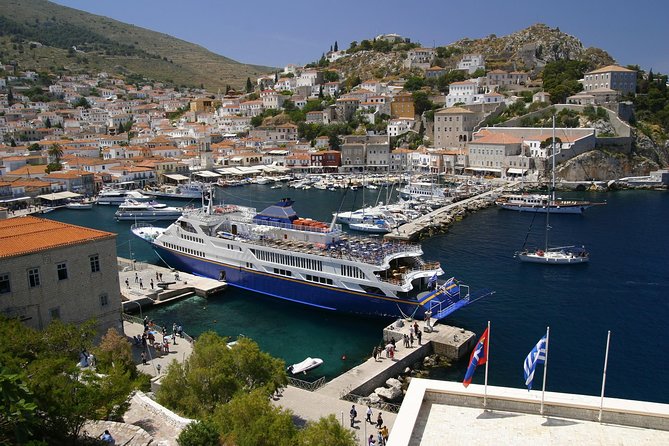
An Aegina day trip reaches the island by sea from Piraeus, the chief port of Athens. Hydrofoil ferries and regular ferries both serve the route, and the hydrofoil is the faster of the two. Piraeus also sends ferries to the other Saronic Islands.
An Aegina day trip from Athens begins at the Port of Piraeus. Athens’ main seaport, it sits on the Saronic Gulf and is the biggest port in Greece. The port has served Athens since ancient times, and it is the largest passenger port in Europe. Crete, the Cyclades, the Dodecanese and the northern Aegean islands all have ferry links from the harbour, along with the Saronic Islands.
A metro station sits beside the port at Piraeus. It marks the southern end of Athens Metro Line 1 and joins Line 3, so the journey to the quay can start with a rail ride. The suburban railway station lies just north of the metro station. Public buses also connect Piraeus with central Athens and the southern coastal zone, which gives every Aegina day trip more than one way to reach the ferry.
Two vessel types serve the crossing. Hydrofoil ferries from Piraeus are the faster choice, and the regular ferry is the slower one. Both cross the Saronic Gulf to an island 27 km from Athens. Once ashore, regular bus services carry passengers from Aegina town to destinations such as Agia Marina, which lets an Aegina day trip continue by public bus.
The Saronic Islands are an archipelago of the Saronic Gulf, close to the mainland of Greece. The main inhabited islands are Salamis, Aegina, Agistri and Poros, and Hydra and Dokos are sometimes counted as well. The group has regular ferry links with Piraeus and the Peloponnese. A Hydra Poros Aegina cruise links three of these islands in one route, while an Aegina day trip stays on a single island.
- Departure port: Piraeus is the main seaport of Athens and the biggest port in Greece.
- Vessels: Hydrofoil ferries are faster than the regular ferry on the same route.
- Rail link: A metro station sits beside the port.
- Nearby islands: Salamis, Agistri and Poros are the other main inhabited Saronic Islands.
An Aegina day trip is a short sea crossing from a large, well-connected port. The metro reaches the quay, the ferries leave for the Saronic Islands, and buses run on the island. Because Aegina sits in the same gulf as Piraeus, the whole outing stays close to Athens. This simple layout makes an Aegina day trip a practical way to leave the capital for a day.
What does an Aegina day trip see in Aegina town?
An Aegina day trip sees the regional capital at the island’s northwestern end, with its 19th-century Neoclassical buildings, a statue of Ioannis Kapodistrias in the principal square and the Tower of Markellos, a watch tower that later housed a temporary government.
The town of Aegina is the regional capital, and the community of Aegina counted 6,976 residents in 2021, the largest of the five in the municipality. The island’s buildings are examples of Neoclassical architecture with a strong folk element, built in the 19th century. The capital is the largest community, so an Aegina day trip meets that style here.
A statue in the principal square commemorates Ioannis Kapodistrias, the first administrator of the free Greek state. During the Greek War of Independence, Aegina served as an administrative centre for the revolutionary authorities. In 1828 and 1829, Kapodistrias built an orphanage, a large building for children orphaned by the war. It later held schools, vocational workshops, a library and a printing office.
The Tower of Markellos is one of the landmarks listed for Aegina. It is thought to date from the second Venetian occupation, between 1687 and 1714, when it served as a watch tower in anticipation of a Turkish siege. After 1714 it stood abandoned, until the revolutionary leader Spyros Markellos bought it as his residence in around 1802. From 1826 to 1828 it was the headquarters of the temporary government of the embryonic Greek state.
- Regional capital: The town of Aegina is placed at the island’s northwestern end.
- Architecture: Neoclassical buildings with a strong folk element date from the 19th century.
- Statue: The principal square holds a statue of Ioannis Kapodistrias.
- Tower: The Tower of Markellos housed the temporary government of the new Greek state from 1826 to 1828.
An Aegina day trip in the capital works as a short lesson in the history of modern Greece. The statue recalls the first administrator of the new state, the orphanage recalls the war that created it, and the Tower of Markellos recalls the temporary government. The 19th-century buildings give the setting. The Municipality of Aegina owns the tower today, and buses from the town serve the rest of the island.
Why does an Aegina day trip climb to the Temple of Aphaia?
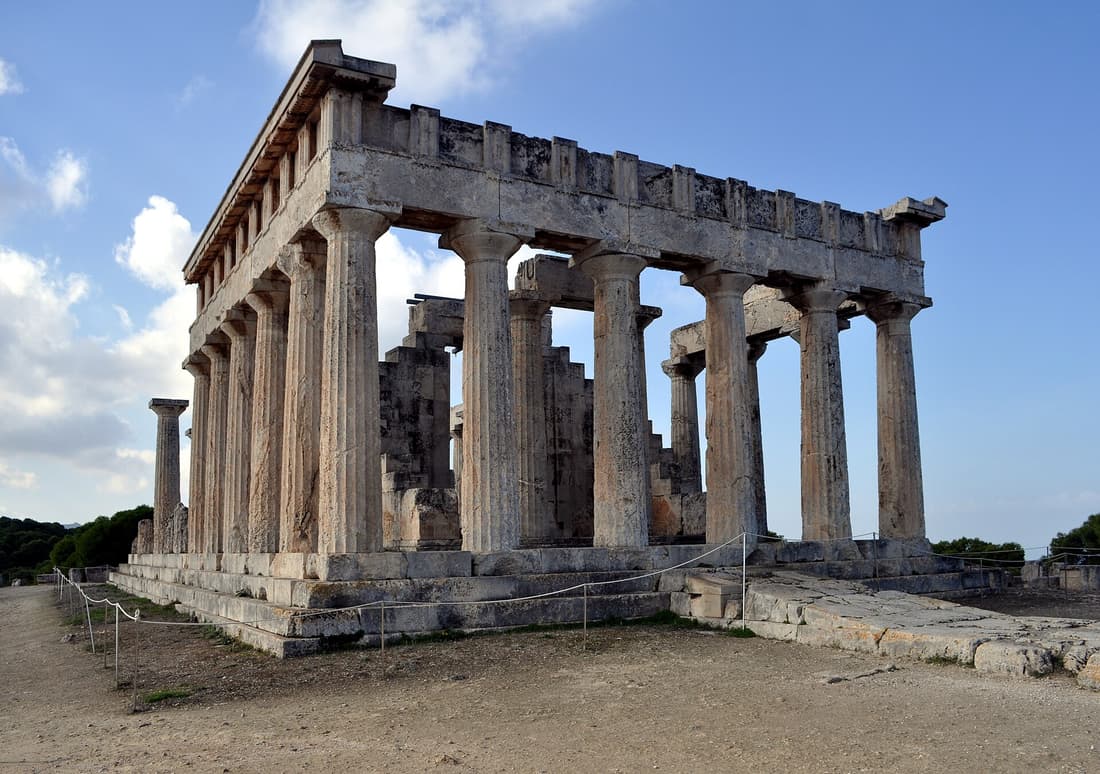
An Aegina day trip climbs to the Temple of Aphaia because the Doric temple of about 500 BC stands on a hilltop in the northeast of the island. It forms one corner of a holy triangle with the Parthenon and the temple at Sounion.
The sanctuary of Aphaia occupies a hilltop about 160 m high at the northeast point of Aegina. The temple seen there today dates to around 500 BC. An older temple of around 570 BC stood on the same hill and burned down around 510 BC. Builders cleared the remains and used the debris to fill a terrace of about 40 by 80 m, which carries the new building. An Aegina day trip therefore visits a temple raised on the ruins of its predecessor.
The temple on an Aegina day trip is a Doric building with six columns across each end and twelve along each side, set on a platform of 15.5 by 30.5 m. All but three of the outer columns were cut from a single block. Inside, the cella held two rows of five columns, and a second level of columns rose above them to the roof. Sphinx figures decorated the roof corners, and the antefixes and roof tiles were marble.
Accounts of the island place the temple on an equilateral holy triangle of temples. The other two corners are the Parthenon on the Acropolis of Athens and the temple of Poseidon at Sounion. The building was once called the Temple of Jupiter Panhellenius, before its dedication to Aphaia was recognised. Neoclassical and Romantic artists, J. M. W. Turner among them, favoured it. An Aegina day trip thus connects the island to the same set of sacred sites as Athens and Sounion.
- Date: The temple on an Aegina day trip dates to around 500 BC, and dates between 510 and 470 BC have been proposed.
- Older temple: Fragments of the temple of around 570 BC lie in the terrace fill, and abundant traces of paint remain on the buried pieces.
- Restoration: Parts of the entablature and a number of columns were restored between 1956 and 1960.
+
The Temple of Aphaia anchors the ancient-history side of an Aegina day trip. Its date near 500 BC, its six-by-twelve column plan and its corner of the holy triangle explain the climb to the hill. A visitor stands on a platform built from the debris of an older temple. The sculptures that filled its gables are covered in the next section.
Who was Aphaia on an Aegina day trip?
An Aegina day trip meets Aphaia, a goddess worshipped almost exclusively at one sanctuary on the island. She began as early as the 14th century BC as a deity of fertility and the farming cycle. Later Greeks identified her with Athena and Artemis.
Aphaia was a local goddess tied to fertility and the agricultural cycle. The hilltop on Aegina has yielded Late Bronze Age figurines, including a large share of female figures known as kourotrophoi. Small pottery chariots and thrones and miniature vessels were found there too. The finds point to worship from the 14th century BC onward, and one view sees a Minoan link. An inscription from the mid-7th century BC records a house built for Aphaia by a priest.
Pausanias, writing in the 2nd century AD, tied Aphaia to the Cretan story of Britomartis. She was dear to Artemis and fled King Minos by leaping into fishing nets, and Artemis made her a goddess. On an Aegina day trip, the name Aphaia is the local form of a goddess known on Crete as Diktynna of the Nets. Pindar wrote an ode for Aphaia at the request of the Aeginetans.
The gables of the later temple carried marble groups with Athena at the centre of each. The theme was the greatness of Aegina, told through local heroes in two Trojan wars: one led by Heracles against Laomedon, the other by Agamemnon against Priam. The east gable shows the first war, with Telamon beside Heracles. The west gable shows the war told by Homer, with Ajax prominent. An Aegina day trip meets the island’s own heroes in these scenes.
- Where they are: The east and west pediment groups are on display in the Glyptothek of Munich.
- Restoration: The Danish sculptor Bertel Thorvaldsen restored the marbles there.
- Removal: The fallen fragments were removed in 1811 and sold the following year to Crown Prince Ludwig of Bavaria, soon to be King Ludwig I.
- On Aegina: An Aegina day trip reaches the fragments that remain in the museums at Aegina and on the site itself.
+
The goddess and her sculptures are linked, and an Aegina day trip follows both. Aphaia is the island’s own deity, with a cult older than the temple. The gable groups left for Bavaria, and a number of fragments stay on Aegina. Part of the east gable was destroyed in the Persian Wars and replaced by a new battle scene, again with Athena at the centre.
What does an Aegina day trip see at Kolona?
An Aegina day trip sees at Kolona one standing column of the Doric Temple of Apollo, the temple foundations and a prehistoric settlement beneath them. The Archaeological Museum of Aegina adds the objects dug from the island’s soil.
On an Aegina day trip, Kolona is the ancient acropolis north of Aegina town, which held the sanctuary of Apollo and a Byzantine settlement. The Doric temple of Apollo had six by eleven columns and went up at the end of the 6th century BC, when Aegina rivalled Athens as a trading centre. The foundations and one column of the rear building survive. Venetian sailors used the temple columns as a point of orientation, and the name Colona comes from them.
Excavations from the 19th century onward showed that the partly preserved Archaic and Hellenistic remains rest on prehistoric buildings with at least ten building phases. Kolonna was the key Early Bronze Age settlement on the island, a fortified site built of stone. Its main links ran to the Greek mainland, with influences from the Cyclades and Crete. An Aegina day trip crosses layers of time on one hill.
The Archaeological Museum of Aegina was founded on 21 October 1828 by Ioannis Kapodistrias, the first governor of independent Greece. Its exhibits fill three rooms and include vessels, pottery, alabasters, statuettes, inscriptions, coins and weapons. An etched carnelian bead of Harappan type points to ancient trade with Mesopotamia and the Indus Valley. The building is a stone structure on one floor around a central patio.
- Column: An Aegina day trip finds the foundations and one column of the rear building preserved.
- Acropolis: The temple and its related buildings dominate the ancient acropolis on the hill.
- Dye workshop: Excavations at Cape Kolonna revealed a purple dye workshop from the 16th century BC.
- Aegina Treasure: The famous Aegina Treasure, dated between 1700 and 1500 BC, is now in the British Museum.
Kolona adds the earlier layers of island history to an Aegina day trip. The single column marks the sanctuary of Apollo, the excavated ground shows a prehistoric settlement with ten or more building phases, and the museum shows what the soil gave up. Together they cover the long span from the Bronze Age to the first years of independent Greece.
What does an Aegina day trip see at Paleochora?
An Aegina day trip sees Paleochora, also spelled Paliachora, an abandoned town in the island’s interior. It was the main settlement in Byzantine and Venetian times. More than 35 churches survive there, with wall paintings dating to the 17th and 18th centuries or earlier.
Paleochora began as a refuge. The island flourished in the early 9th century, but Arab raids from Crete hit it hard. A large raid around 830 sent much of the population to the Greek mainland. Part of the population sought safety in the island’s hinterland instead and founded Paliachora there. An Aegina day trip that visits the site follows that same move, away from the coast and into the interior.
Raiders did not stop with the 9th century. The 12th-century bishop of Athens, Michael Choniates, wrote that Aegina had become a pirate base by his time. Benedict of Peterborough’s account of Greece in 1191 names Aegina, Salamis and Makronisos as pirate strongholds. Against that record, a settlement set back from the shore reads as a place of safety, and the Aegina day trip route inland follows the logic of its first settlers.
Aegina became Venetian in 1451, and corsair raids continued under Venetian rule. In October 1537 the Ottoman admiral Hayreddin Barbarossa invaded. On the fourth day Paliachora was captured, though the Latin church of St George was spared. Barbarossa had the adult male population massacred and took away 6,000 women and children as slaves. Today the town stands abandoned, and every Aegina day trip that reaches it walks among its churches.
- Setting: The town sits in the island’s interior, which an Aegina day trip crosses to reach it.
- Nickname: It is known as “the Mystras of Aegina”.
- Churches: More than 35 churches survive on the site.
- St George: The church of St George the Catholic carries an inscription over its entrance that is tied to the 1533 inquiry into the island’s rectors.
An Aegina day trip gets a medieval counterpart to the ancient temple at Paleochora. The site is a town of churches, and its story of refuge, capture and resettlement runs from the 9th century to the 16th. The same trip then turns to the monastery of Saint Nektarios, a far more recent chapter.
Why does an Aegina day trip visit the monastery of Saint Nektarios?
An Aegina day trip visits the Holy Trinity Monastery because Nektarios founded it in 1904 at the request of nuns and spent his last years there. He is a renowned saint of the Eastern Orthodox Church, and the monastery is the island’s pilgrimage site.
An Aegina day trip reaches the end of a long road. Saint Nektarios, also spelled Nectarios, was born Anastasios Kephalas on 1 October 1846 in Selymbria, to a poor family. At 14 he moved to Constantinople to work and study, and at 20 he took a teaching post on Chios. In 1876 he became a monk at the Monastery of Nea Moni, and three years later he was ordained a deacon and took the name Nectarios.
He graduated from the University of Athens in 1885 and went to Alexandria, where he was ordained a priest. In 1889 he was consecrated Metropolitan bishop of Pentapolis. His popularity stirred jealousy among colleagues, and he was suspended without explanation after a year. He returned to Greece in 1891, preached for three years, and then directed the Rizarios Ecclesiastical School in Athens for fifteen years. Each stage of that career led toward the monastery that an Aegina day trip visits.
In 1904 he established the Holy Trinity Monastery on Aegina at the request of nuns. In December 1908 he left the school and withdrew to the convent, where he lived as a monk. He wrote, published, preached and heard confessions. He also tended the gardens, carried stones and helped build the monastery buildings with his own funds. Each Aegina day trip that stops here sees the work of those years.
- Founding: Nektarios established the Holy Trinity Monastery in 1904 at the request of nuns.
- Death and burial: He died on 8 November 1920, at 74, and his friend Savvas of Kalymnos buried him at the convent.
- Sainthood: The Patriarch of Constantinople glorified him as a saint on 20 April 1961.
- Feast day: The Church marks his feast every year on 9 November.
Pilgrims come because the Church honours Nektarios as a patron saint of people who suffer from diseases such as cancer, heart trouble, joint pain, epilepsy and arthritis. Multitudes from all parts of Greece and Egypt attended his funeral. In 1998 the Patriarchate of Alexandria, which had expelled him, restored his ecclesiastical order. For an Aegina day trip, the monastery is the living centre of the island’s faith, not a ruin.
What are Aegina pistachios on an Aegina day trip?
An Aegina day trip meets Aegina pistachios, sold under the name Fistiki Aeginis, which became a Protected Designation of Origin in 1996. The island’s dry climate and volcanic soil give the nut its reputation, and the tree has displaced the rest of the farming there.
Pistachio production reached the island in the 19th century and succeeded. In 1896 the physician Nikolaos Peroglou introduced systematic cultivation, and it soon became popular among the islanders. By 1950 the crop had displaced the rest of the farming, helped by phylloxera, which threatened the vineyards at that time. In the early 1960s the first pistachio peeling factory opened in the Plakakia area. An Aegina day trip therefore passes through a landscape shaped by one crop.
The pistachio tree, Pistacia vera, belongs to the cashew family and grows up to 10 metres tall. Male and female flowers grow on separate trees, and one male tree produces enough pollen for 8 to 12 female trees. The tree needs a sunny position and well-drained soil, tolerates salty soil, and needs long, hot summers to ripen its fruit. On an Aegina day trip, the dry island and its volcanic ground explain why the orchards do well.
A young tree takes around 7 to 10 years to reach significant production, and the crop is alternate-bearing, so the harvest is heavier every second year. When the fruit ripens, the shell turns from green to yellow or red and splits partly open with an audible pop. In Greece, harvesting equipment shakes the drupes off the tree. After hulling and drying, the nuts are sorted, then roasted or processed into kernels. The orchards an Aegina day trip passes follow that cycle.
- Protected name: “Fistiki Aeginis” became a Protected Designation of Origin in 1996.
- Soil and climate: Drought and volcanic soil are credited for the quality of the nut.
- Output: Production on the island is estimated at 2,700 tons per year.
- Products: The kernels are eaten whole, fresh or roasted and salted, and also go into butter, paste, ice cream, halva and baklava.
- Festival: The Pistachio Festival, called “Fistiki Fest”, takes place every year in mid-September.
The pistachio tree is native to Iran and Central Asia, and the Romans introduced it to Europe in the first century AD. On Aegina the crop is a 19th-century arrival that made the island famous across the world. An Aegina day trip in mid-September also meets the Pistachio Festival, and half of the island’s growers belong to the island’s producers’ cooperative.
What does an Aegina day trip see in Perdika?
An Aegina day trip reaches Perdika in the southwest of the island, a community of 847 people in the 2021 figures. Albanian settlers made their home there after the island was repopulated in 1579, and the municipality counts offshore islets alongside the main island.
Perdika lies in the southwest of Aegina. Aegina town, the regional capital, stands at the northwestern end, so a stop in Perdika carries an Aegina day trip from the north-west of the island to the south-west. The 2021 figures list Perdika as one of five communities in the municipality. With 847 people, it is the smallest of the five, and each of the other four communities holds more residents.
The village has a dated beginning. The island was repopulated in 1579 by Greeks from the mainland and a small number of Albanians. The Albanians settled in the southwest, in the village of Perdika, and in time they merged into the Greek population. The name therefore marks one chapter in the resettlement of the island, and an Aegina day trip that reaches it adds that chapter to the picture of temples and ruins.
The municipality of Aegina is more than one island. Its official makeup is the island itself plus a handful of offshore islets, and it forms part of the Islands regional unit of the Attica region. Perdika belongs to this single municipality. An Aegina day trip that visits the southwest therefore stays inside the same municipality as the capital in the northwest.
- Location: Perdika is in the southwest of the island, while Aegina town is at the northwestern end.
- Population: The 2021 figures give Perdika 847 people, the lowest total of the five communities.
- Origin: Albanians settled in the village after the repopulation of 1579 and later merged into the Greek population.
- Municipality: The island of Aegina and its offshore islets form one municipality in the Islands regional unit.
Perdika adds a dated settlement story and a population figure to the list of Aegina sights. In the southwest, it marks the far end of the route from the northwestern capital. What an Aegina day trip finds in Perdika, then, is a small community with a documented origin in 1579, set inside a municipality that reaches beyond the main island to its offshore islets.
What is Agistri on an Aegina day trip?
An Aegina day trip can extend to Agistri, a small pine-covered island in the Saronic Gulf that lies very close to Aegina. The island has three settlements, Milos, Skala and Limenaria, and counted 1,131 inhabitants in 2021. Its Greek name means fishing hook.
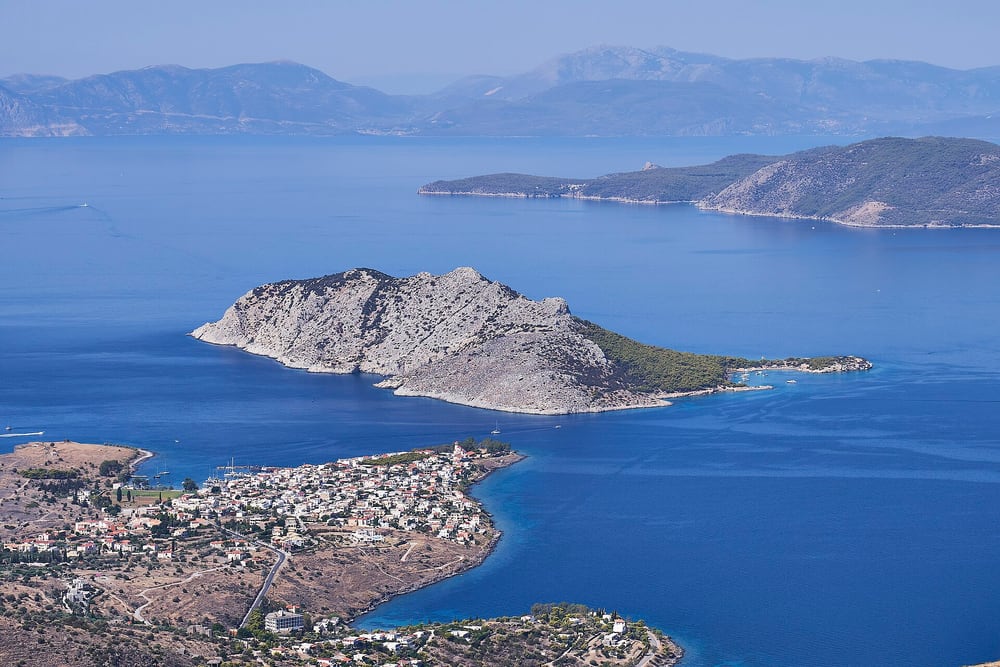
Agistri is a small populated island and a municipality of its own, listed in the Islands regional unit. It covers 13.367 square kilometres of land, against 87.41 for Aegina. English texts spell the name Agistri, Angistri or Agkistri. The two islands also share an administrative past. The province of Aegina, created in 1833, covered the territory of both modern municipalities until 2006, so an Aegina day trip that adds Agistri stays within the old province.
Agistri has three settlements. Milos, also called Megalochori, is the main village, and the majority of the island’s people live there. Skala, linked to Milos by a coastal road, holds the larger share of the tourist facilities and hotels. Limenaria is a very small village on the other side of the island, with very little tourism. On an Aegina day trip, the three places differ clearly in size and in how much tourism each one sees.
Agistri belongs to the Saronic Islands group, and pine forest fills the center of the island. Wild cyclamen, thyme, caper bushes and thistles grow among the plants, and chukar partridges live there. Swifts nest along the rocky eastern coast. Peafowl that were introduced to the island now live wild. In 2011 the Prefecture of Piraeus and the National Technical University of Athens recognized Agistri as a green island.
The link to Aegina is short and runs by sea. Boats cross from Aegina, among them small water taxis, and the port of Piraeus is connected to Agistri by boat as well. Because the two islands sit so close together, an Aegina day trip that adds Agistri relies on this crossing, and the beaches of the smaller island become part of the same outing.
- West coast: Aponissos and Dragonera are the beaches named on the western side.
- North: The beaches of Megalochori and Skala lie in the north.
- South: Mariza is the beach named in the south.
- East coast: Skliri and Halikiada lie on the east, and Halikiada is popular for naturism.
Tourism is the primary industry of Agistri, with hotels and restaurants in both Skala and Megalochori. A bus and taxis handle local transport, and agriculture also forms part of the economy. Free camping has a long history on the island, but tents are no longer allowed in the forest because of the fire hazard. That is the Agistri an Aegina day trip meets: a small, forested island whose primary industry is tourism.
Which beaches and villages does an Aegina day trip pass on the coast?
An Aegina day trip passes villages such as Agia Marina, a destination of the regular bus services from Aegina town, and Portes, a fishing village on the east coast. The island’s description calls its beaches a popular tourist attraction and lists five communities in all.
Agia Marina is the example that the island description gives for the regular bus services running from Aegina town to destinations throughout the island. That detail matters on an Aegina day trip, because the bus services link the capital with places across the whole island, not only with its immediate surroundings. Agia Marina therefore works as a named stop on the island’s bus map.
The east coast holds Portes, which the island description calls a fishing village. Beaches add a second reason to travel the shore, since the same description counts them as a popular tourist attraction. The sea matters to the island’s economy as well: the sponge fisheries are described as economically important. An Aegina day trip along the shore meets that working side of the coast as well as the leisure side.
The land behind the shore changes around the island. The northern and western sides are stony but fertile plains, where grain, cotton, vines, almonds, olives and figs grow. The southern part is volcanic, rugged and mountainous, and largely barren. An Aegina day trip that follows the coast therefore moves between farmland and bare volcanic ground, and the character of each village follows the land around it.
- Agia Marina: The island description names it as a destination of the regular bus services from Aegina town.
- Portes: The same description calls it a fishing village on the east coast.
- Vathy: The 2021 figures give this community 1,449 people.
- Kypseli: The 2021 figures give this community 2,166 people.
- Mesagros: The 2021 figures give this community 1,473 people.
Agia Marina and Portes are the named stops, and Vathy, Kypseli and Mesagros fill in the rest of the island’s community map. An Aegina day trip that follows these names passes farmland in the north and west and bare volcanic ground in the south, with the beaches as a popular reason to stop along the way.
What history does an Aegina day trip recall of ancient Aegina?
An Aegina day trip recalls an island that traded across the Mediterranean, struck early coins stamped with a sea turtle, rivalled Athens for decades and won the prize of valour at Salamis. It then lost its independence, first to Athens and later to the Macedonians and the Romans.
Aegina lies between Attica and the Peloponnese, a position that made it a trading place long before the classical age. An ancient writer, Ephorus, is the authority for the claim that Pheidon of Argos founded a mint on the island, and modern experts contest it. The Aeginetic weight standard of about 12.2 grams spread through the Greek world in the 7th century BC. An Aegina day trip puts that story in a small island with a large trading reach.
Aegina was one of the three principal Greek states trading at Naucratis in Egypt. In the early 5th century BC, the island also seems to have served as an entrepôt for the Pontic grain trade. Unlike Corinth and Miletus, it founded no colonies. Athens began to compete with its sea power around the start of the 6th century BC, and Solon passed laws that limited Aeginetan commerce in Attica. That began a rivalry that runs through an Aegina day trip.
In 491 BC, Aegina gave Persia the symbols of submission, earth and water. The Spartan king Cleomenes then seized ten leading citizens and left them at Athens as hostages. The war with Athens that followed, from 488 to 481 BC, is a core chapter of an Aegina day trip, and Athens built 200 triremes for it. At Salamis, the prize of valour went to Aegina rather than Athens, and its ships appear to have done as much as the Athenian ones to destroy the Persian fleet.
- Coins: Staters showing a sea turtle were struck up to the end of the 5th century BC.
- Salamis: The glory won there was paid for by the loss of trade and the decay of the fleet.
- Siege: Around 456 BC, Aegina surrendered to Athens after a siege and became a subject ally.
- Exile: In 431 BC, Athens expelled the Aeginetans and set up a cleruchy on the island.
The loss of trade ended the rise of the island. After the Peloponnesian War, the Spartan commander Lysander returned the scattered remnants of the old population. Aegina then came under the Macedonians, the Achaeans, Attalus of Pergamum and, after 133 BC, the Romans. An Aegina day trip meets this long arc of independence, rivalry and decline in the story of one small island.
Why was Aegina the first capital of modern Greece for an Aegina day trip?
An Aegina day trip follows the first Greek authorities of the 1820s. The revolutionary government sat in the Tower of Markellos in 1826–28, and Ioannis Kapodistrias, the first governor, reached Aegina on 8 January 1828 and founded national institutions there.
During the Greek War of Independence, Aegina became an administrative centre for the revolutionary authorities. The Tower of Markellos holds that story. It is a watch tower that the revolutionary leader Spyros Markellos bought as his residence around 1802. In 1826–28 it served as the headquarters of the temporary government of the embryonic Greek state. An Aegina day trip passes a tower that moved from a watch post to a seat of government.
The Third National Assembly at Troezen elected Ioannis Kapodistrias the first head of state of independent Greece in 1827. He landed at Nafplion on 7 January 1828 and arrived in Aegina on 8 January 1828. He governed until 1831 and is recognised as the founder of the modern Greek state. A statue in the principal square of Aegina town, passed on an Aegina day trip, commemorates the first administrator of free modern Greece.
One history names Nafplion as the first capital of Greece, so the role of Aegina lies in the first institutions more than in the title. Between 1828 and 1829, Kapodistrias had a large building raised as a home for children orphaned by the war. It also held schools, vocational workshops and the National Conservatory for Choir and Orchestra. An Aegina day trip passes the building that locals call The Prison, which later held political prisoners under the Junta.
- Tower: The Tower of Markellos was the base of the temporary government in 1826–28.
- Arrival: Kapodistrias landed at Nafplion on 7 January 1828 and reached Aegina the next day.
- Library and museum: The building raised in 1828–29 also housed the National Public Library and the National Archaeological Museum.
- Reforms: His government founded the Panellinion, a Senate, the first Hellenic Military Academy, hospitals and schools.
Kapodistrias was assassinated at the Church of Saint Spyridon in Nafplion on 27 September 1831. His younger brother Augustinos succeeded him as governor and ruled for six months, and King Otto then received the throne of the new kingdom. In 2007, Aegina joined Nafplion, Corfu, Koper-Capodistria and Famagusta in the Ioannis Kapodistrias Network. An Aegina day trip covers the early years of that state on the island itself.
What does an Aegina day trip see on Mount Oros?
An Aegina day trip sees Mount Oros, the conical peak that rises 531 metres in the south and marks the highest point of the island, in a rugged volcanic landscape. The ancient temple of Zeus Hellanios is recorded near the village of Pachia Rachi.
Two-thirds of Aegina is an extinct volcano. The northern and western sides are stony but fertile plains, while the southern volcanic part is rugged, mountainous and largely barren. Mount Oros is the conical highest rise of that southern part, at 531 metres. The Panhellenian ridge stretches north across the island, with narrow fertile valleys on either side. An Aegina day trip therefore moves from farmland in the north to volcanic rock in the south.
The island is roughly triangular, about 15 km from east to west and 10 km from north to south, with an area of 87.41 square kilometres. Its climate is hot and semi-arid, with an average annual temperature of around 20.0 °C and less than 340 mm of rain a year. These figures set the scene for an Aegina day trip in the south.
The temple of Zeus Hellanios stands near the village of Pachia Rachi. A 13th-century Byzantine church was built on the ruins of the ancient temple, which dates from the 4th century BC. The church stairs, parts of the original walls and loose stones remain. An Aegina day trip also recalls a myth: Zeus took Aegina to the island of Oenone, where she bore his son Aeacus, and the island took her name.
- Peak: Mount Oros reaches 531 metres in the south of the island.
- Temple: The ancient temple of Zeus Hellanios dates to the 4th century BC.
- Refuge: A Mycenaean refuge from the end of the Late Bronze Age was found at Mount Ellanio.
The past of the south runs deeper than the temple. At Mount Ellanio, a Mycenaean refuge has been found that dates to the end of the Late Bronze Age. Myth adds another layer: Zeus changed ants into the warriors known as the Myrmidons, who gathered and trained on Aegina and later served under Achilles. An Aegina day trip to the south of the island covers geology, cult and legend in one landscape.
When is the best season for an Aegina day trip?
An Aegina day trip fits every season, and the trade-off is heat against rain. Summer is hot and dry and draws Athenian holidaymakers to the island. Spring and autumn run milder. Rain peaks from November to January, when highs sit between about 14 and 20 °C.
Aegina has a hot semi-arid climate, coded BSh in the Köppen system, with an average annual temperature of around 20.0 °C and less than 340 mm of rain in a year. Climate records place the island in the same semi-arid group as Hydra, Piraeus and much of the Athens Riviera. The seasons then divide by temperature and by the timing of the little rain that falls. Each month therefore gives an Aegina day trip a different mix of sun, heat and showers, and the monthly records of the island show how sharp that difference becomes.
Summer sets the highest temperatures. Climate records for Aegina show an average high of 33.8 °C in July and 33.5 °C in August, with mean temperatures of 29.1 °C and 29.3 °C and August nights holding a mean low of 25.0 °C. The August record high stands at 43.4 °C. Aegina is also a popular vacation place in the summer months, and Athenians own second houses there, so an Aegina day trip in July or August shares the island with holidaymakers as well as heat.
Rain follows a clear pattern across the calendar. July receives 4.7 mm and August 6.8 mm, the lowest totals of the twelve months. September brings 45.8 mm, and November adds 55.9 mm, the highest monthly total. December and January record 50.7 mm and 50.8 mm, while spring falls from 25.2 mm in March to 18.0 mm in April. A winter outing meets more rain than a summer outing, and the January record low of -0.4 °C shows that the cold stays close to freezing point at its worst.
The sea moderates the heat. Coastal heatwaves tend to stay mild, since the relatively cooler sea and the sea breeze hold temperatures down. The etesians, also called meltemia, blow from late spring to October and peak in frequency in July and August, which keeps the Aegean cooler than the Ionian Sea or mainland Greece. The sea route of an Aegina day trip crosses the Saronic Gulf, which lies between the Attica and Argolis peninsulas, forms part of the Aegean Sea and has partial shelter from the summer meltemi behind the Attic mainland.
- Spring: Highs rise from 17.2 °C in March to 21.4 °C in April, and rain totals fall as the weeks warm.
- Summer: Highs reach 30.8 °C in June, 33.8 °C in July and 33.5 °C in August.
- Autumn: Highs fall from 29.1 °C in September to 24.0 °C in October and 19.9 °C in November.
- Winter: Highs stay between 14.1 °C and 15.6 °C from December to February.
Each season gives an Aegina day trip a different shape. Summer brings the strongest heat, the driest weeks and the island’s popular vacation period, while spring and autumn sit between the extremes and winter carries the rain. The island lies 27 km from Athens in the Saronic Gulf, so the choice of season depends on weather rather than on distance. The best season is the one where the traveler accepts the least unwelcome weather, and the figures above mark each trade-off.
What do travelers ask about an Aegina day trip?
An Aegina day trip raises questions about the island’s size, its population, its administration and its fit with other Athens-area tours. Aegina covers 87.41 km2 in the Saronic Gulf, lies 27 km from Athens, and belongs to the Islands regional unit of the Attica region.
How large is the island, and how big is its population, on an Aegina day trip?
Aegina is roughly triangular, about 15 km from east to west and 10 km from north to south, with an area of 87.41 km2. An extinct volcano forms two-thirds of the island, and the south is rugged. The municipality counts 12,911 residents in 2021, and the town of Aegina, the largest of five communities, holds 6,976 of them.
Which municipality and regional unit does an Aegina day trip reach?
The municipality of Aegina covers the island and its offshore islets, so an Aegina day trip stays inside one municipality. It belongs to the Islands regional unit of the Attica region. Five communities make it up: Aegina, Kypseli, Mesagros, Perdika and Vathy. The regional capital is the town of Aegina, at the northwestern end of the island.
Can an Aegina day trip pair with a Cape Sounion tour on another day?
Seen on separate days, the outings stay relaxed. Cape Sounion is the promontory at the southernmost tip of the Attica peninsula, 69.5 km southeast of Athens in the Athens Riviera, in East Attica, and it shares the hot semi-arid climate of Aegina, with hot, dry summers. A Cape Sounion tour adds the mainland headland to an Aegina day trip.
Can an Aegina day trip pair with an Acropolis tour on another day?
Each outing fills its own day. The Acropolis is an ancient citadel on a rocky outcrop above the city of Athens, and the Parthenon is its best-known building. The Athens urban area lies on the north coast of the Saronic Gulf, the same gulf as Aegina. An Acropolis tour adds the city side to an Aegina day trip.
Featured photo: Pawel Szubert, CC BY-SA 3.0, via Wikimedia Commons.