
A Crete olive oil tour is one of the food and wine tours in Greece on Greece VIP. It traces the long history of olive oil on the island. It also covers olive types, ancient trees and oil making.
A Crete olive oil tour also meets the protected oils of Crete. It shows how a tasting works and when the best season falls. Each section ends with a tour or tasting to book online.
What does a Crete olive oil tour include?
A Crete olive oil tour includes a walk between olive rows. It also visits a working mill or a family estate. It ends with a tasting of Cretan extra virgin olive oil. Crete is the largest island in Greece, with olive groves across its countryside.
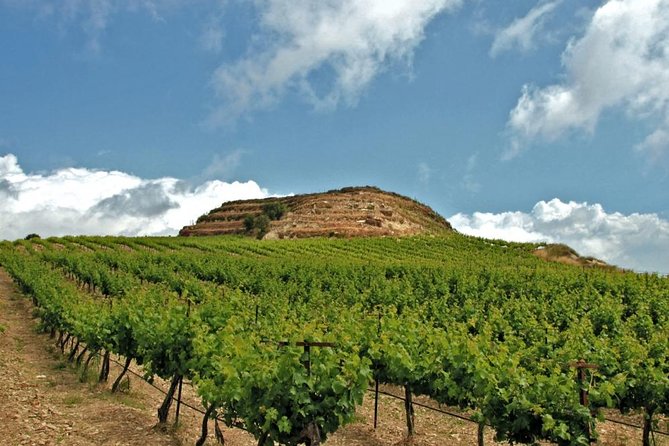
Olive growing and wine making share the same dry Cretan landscape. So a Crete wine tour sits naturally beside a Crete olive oil tour. Twenty per cent of Greek wine comes from Crete, much of it from the Peza area.
Olive groves matter a great deal to the island’s economy, alongside its vineyards. Their trees stand on hillsides, plains and terraces, the flat steps cut into slopes. Agriculture, meaning farming, still plays an important role on the island.
The second part of a Crete olive oil tour moves to the mill or a small estate. An estate is a farm with its own land and buildings. The mill equipment stands in plain view there. The smell of crushed fruit fills the air.
The tasting follows at a table set with oils from the island. Olive oil was the main fat in the traditional Cretan diet, the island’s old way of eating. People used it both raw in salads and in cooking.
- Grove walk: The walk crosses open ground, with time to look at the fruit.
- Mill or estate: Staff explain how the island’s crop is handled after picking.
- Tasting: Bread or raw greens carry each sample of oil.
- Setting: Crete is the fifth largest island in the Mediterranean Sea, so routes cross different soils and slopes.
A Crete olive oil tour joins the grove, the press and the table into one story. Each stop answers a different question about the bottle. The route suits travellers who want the island’s farming side, beyond its beaches and towns.



How old is olive oil in Crete on a Crete olive oil tour?
A Crete olive oil tour traces olive growing on the island to the Bronze Age. As early as 3000 BC, olives were grown commercially in Crete. The trade is linked to the wealth of the Minoan civilisation. Large storage jars survive in the palace storerooms.
Olive trees were native to Crete, meaning they grew there naturally. So the island’s record starts with the tree itself. The Minoans, the island’s Bronze Age people, used the fruit in ways later Greek cooking kept. Bronze, a mix of copper and tin, gave the Bronze Age its name.
A Crete olive oil tour treats that early farming as the first chapter. Linear B, an early script written on clay tablets, records orchards of figs, olives and grapes.
The tablets list these among the crops processed for secondary products, meaning goods made from the harvest. On a Crete olive oil tour, the palace at Knossos shows how the trade was organised.
Officials used the writing on clay to record what arrived and what left. The same records name livestock and craft work. Storage, recording and redistribution, or sharing goods back out, stood at the centre of that administration.
- Knossos magazines: The palace had extensive storerooms, called magazines, above all in the west wing.
- Pithoi: Those rooms held large clay jars for oil, grain, wine and other goods.
- Size: A pithos stood about as tall as a person, too heavy to handle when full.
- Shipping: In the Bronze Age palace economy, such jars stored or carried oil and wine for distribution.
A Crete olive oil tour links that palace work to the modern bottle. The palaces turned farm work into trade. Later centuries brought new presses and new markets, but the tree stayed in the same ground.
Which olive varieties does a Crete olive oil tour see?
A Crete olive oil tour sees Koroneiki, the main oil variety of Greece. It also meets Tsounati and Mastoidis, two linked Greek cultivars, meaning farmed tree types. The choice of tree in each grove shapes the oil, from the fruit to the bottle.
Koroneiki is used mainly for oil production. Its fruit is small, but it gives a high quality oil yield. Oil yield is the amount of oil the fruit gives. The plant is not easy to cultivate, and the small fruit slows the picking.
Growers keep the variety because its oil holds its quality. The tree grows on slopes across the island and in other countries, from Albania to Australia. A Crete olive oil tour meets it in row after row.
Greek growing areas hold other cultivars as well. So one grove can carry oil varieties beside table varieties, the olives grown for eating. The names for trees shift from one district to the next.
A Crete olive oil tour listens for the local word for each tree. Koroneiki fills the greater part of the island’s plantings. Tsounati and Mastoidis keep older names alive in the same ground.
- Koroneiki: This oil variety covers 50 to 60 per cent of the olive farmland in Greece.
- Local names: On Crete, Koroneiki also appears as Kritikia and Ladolia.
- Tsounati: Botanical lists link Tsounati and Mastoidis as names for the same cultivar.
- Mastoidis: The same lists describe Mastoidis as a table olive cultivar similar to Tsounati.
A Crete olive oil tour uses the trees to explain the oil. It sets a single-variety oil, made from one olive type, beside a blended one. A blended oil mixes two or more olive types. The label on each bottle names the variety inside.
What are the ancient olive trees of a Crete olive oil tour?
A Crete olive oil tour brings visitors to monumental olive trees. Above all, it visits the olive tree of Vouves in the Chania regional unit. The tree still bears fruit. Its hollow trunk holds a long record of the island’s farming.
The olive tree of Vouves stands in the village of Ano Vouves. The village lies in the municipal unit of Kolymvari, a local district. The tree counts among the oldest olive trees in the world.
Its exact age cannot be fixed. The heartwood, the inner core of the trunk, has been lost. Radioisotope dating, a lab test that uses natural radiation to measure age, is not possible either.
Tree ring analysis, which counts the yearly growth rings in the wood, shows at least 2,000 years. Other research has estimated 4,000 years. Two cemeteries from the Geometric period, an era of ancient Greece, were found near the tree.
A Crete olive oil tour stops here for the site’s age. Olive trees can live for over 1,000 years. Old specimens, meaning single old trees, stand in the farm land of the island.
Archaeological evidence, meaning old remains, found around the Finix olive supports the claim that it is ancient. Trees of that age remain in working groves. Growers there prune, or cut back, the branches and take the fruit.
Even a hollow trunk can stay in production for centuries on end. A Crete olive oil tour treats old trees as monuments of the crop.
- Trunk: The Vouves trunk has a perimeter of 12.5 m and a diameter of 4.6 m.
- Status: The tree was declared a protected natural monument in 1997.
- Olympic link: Its branches made the victors’ wreaths at the 2004 Athens and 2008 Beijing Olympics.
- Museum: A museum opened in October 2009 in a nearby 19th-century house. It shows tools of olive cultivation.
A Crete olive oil tour gives the old trees a place in the day. Standing beside one adds a scale that a mill or a bottle cannot carry. The same ground has been worked for a very long time.
How is olive oil made on a Crete olive oil tour?
A Crete olive oil tour follows the crop from the tree to the mill. In the Mediterranean, olives are picked in autumn. Pickers shake the tree or its branches to bring the fruit down. At the mill, the fruit is crushed into a paste.
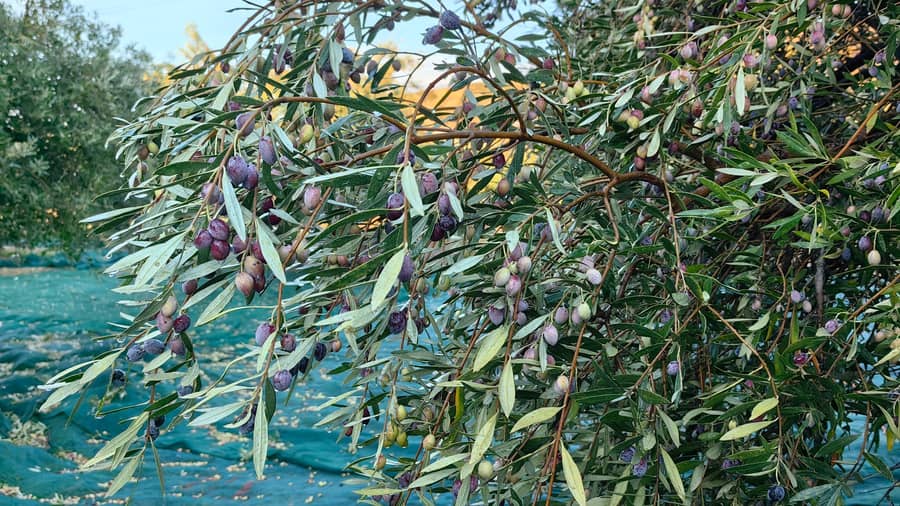
Hand picking stays in use where the ground is steep and machines cannot enter. Parts of Greece keep to that method. Fruit left standing too long loses quality.
Its free acidity, a sign that the oil is breaking down, rises when the harvest is delayed. The olive holds its oil in the flesh, called the pericarp. This part is between 60 and 70 per cent oil.
A tree gives around 1.5 to 2.2 kilograms of oil in a year. So a Crete olive oil tour measures the harvest tree by tree.
In a traditional mill, the paste stays under the millstones until it turns smooth. Millstones are heavy round stones that grind the fruit. Modern mills move the paste into a malaxer, a tank where it is stirred slowly.
A horizontal centrifuge called a decanter then separates the phases. This fast-spinning machine splits the oil from the rest of the paste. A Crete olive oil tour follows that sequence step by step.
Cold extraction means the process adds no heat to the paste. That protects the compounds that give the oil its bite. European rules set the temperature of malaxation and extraction below 27 °C.
- Extra virgin: This top grade of virgin oil comes from cold mechanical extraction, with no solvents or refining.
- Acidity: The grade holds no more than 0.8 per cent free acidity.
- Taste: The oil is judged to have a superior taste, with fruitiness and no defined sensory defects.
A Crete olive oil tour ends at the mill, where the season’s work becomes oil. Picking, crushing and separation follow one another, and each step marks the taste. The definition of extra virgin oil sets the standard for producers on the island.
Which protected olive oils does a Crete olive oil tour taste?
A Crete olive oil tour meets protected extra virgin oils. The European Union keeps their names in its register. They include Sitia Lasithiou Kritis, Kolymvari Chanion Kritis and Apokoronas Chanion Kritis. Others are Viannos Irakliou Kritis, Peza Irakliou Kritis, Archanes Irakliou Kritis, Messara, Selino Kritis and Chania Kritis.
A Crete olive oil tour in the east meets different names from one in the west. Sitia Lasithiou Kritis is pressed only from Koroneiki olives. Its colour is bright green or yellowy green.
Its official tasting medians, the middle scores of the panel, place fruitiness at 3 or higher. Bitterness and pungency sit at 5 or lower. This profile comes from limestone soil, low summer humidity and long hours of sunshine. Humidity is the amount of water held in the air.
Messara, on the southern side of the Heraklion prefecture, uses Koroneiki olives alone. Prefecture is the older Greek term for a regional unit. A Crete olive oil tour that reaches that plain tastes its oil. The oil’s fruitiness, pungency and bitterness are fixed in its official specification.
Chania Kritis is a protected geographical indication, a label tied to a place, in western Crete. It blends Koroneiki and Tsounati olives into a green-yellow oil. The oil has a fruity aroma and a balanced bittersweet taste. Bittersweet means bitter and sweet notes come through together.
- Western group: Kolymvari Chanion Kritis, Apokoronas Chanion Kritis and Selino Kritis sit in the Chania regional unit.
- Central group: Peza Irakliou Kritis, Archanes Irakliou Kritis and Viannos Irakliou Kritis belong to the Heraklion regional unit.
- Eastern group: Sitia Lasithiou Kritis takes the Lasithi name and covers the eastern end of Crete.
Protection under the register has real consequences for buyers. A registered name can only go on oil made inside its area. The oil must come from the listed olives and follow the rules of the specification.
A Crete olive oil tour that crosses two regions shows how far apart the names sit. It also shows how differently one olive variety performs from place to place.
How does a tasting work on a Crete olive oil tour?
A Crete olive oil tour tasting follows an official method made for the trade. Coded glasses hold a warm sample. A trained panel scores three positive attributes: fruitiness, bitterness and pungency. Each is scored one by one, rather than as one single overall mark.
A Crete olive oil tour that joins a working session sees the panel at work. Its tasters are selected and trained for this work. Each glass stays covered until the moment of tasting.
The taster then rotates, or gently turns, the glass to wet its inside surface. The official grade comes from panel medians, not from single opinions.
Fruitiness carries the smell and taste of fresh olives. Bitterness comes from polyphenols, natural compounds that also give the oil its own aroma. A peppery or bitter note points to a higher polyphenol content.
Pungency is the biting feeling of a young oil. It is felt in the mouth and above all in the throat. A Crete olive oil tour scores all three.
- Coded glasses: Each glass carries a number, so tasters judge the oil, not the bottle’s promise.
- Warm samples: Oil is held at 28 °C, so aromas rise without any cooked note.
- Bread: Across the Mediterranean, olive oil comes with bread, a plain base for the samples.
The room, the glass and an empty palate, meaning a clean mouth, keep the three attributes apart. The same order applies in a hillside grove and a coastal press.
A Crete cooking class covers the kitchen side of the island. It works the oil into dough, vegetables and sauces. A Crete olive oil tour supplies the tasting that comes first.
When is the best season for a Crete olive oil tour?
A Crete olive oil tour fits two windows. The first is the flowering weeks of April, when the trees carry blossom. The second is the pressing season, which opens in October. Then fresh oil reaches the mills and the new crop is worked.
In the Messara plain, the last twenty days of April bring around 18 °C and humidity near 60%. These conditions suit flowering and pollination, when pollen moves between flowers. About 22 °C follows as the fruit sets, meaning small olives begin to form.
Blooming lasts 5 to 6 days in hot weather. In cooler districts, it lasts up to 2 weeks. So a Crete olive oil tour set on blossom needs flexible dates.
Growers take the fruit as it turns from yellowy green to inky purple. In the Messara area, hand-held beating machines bring the olives down. Beaters are needed because the small Koroneiki fruit does not fall from the tree under vibration.
A Crete olive oil tour in that plain sees the machinery at work. Snow lies on the mountains from November to April. Around Sitia, rain falls mainly from October to March.
- April: Olive trees carry small white flowers on the previous year’s growth.
- October: The olives reach their best oil content.
- Winter: Rain reaches the west of the island first, where Chania receives more than the east.
The eastern side stays mild through the winter, so groves and mills keep working. A Crete olive oil tour in November meets full presses. A visit earlier in the year finds quiet machinery.
What do travelers ask about a Crete olive oil tour?
A Crete olive oil tour raises practical questions. They cover children, sample sizes, bottles carried home and pairings with wine or food. The answers rest on the island’s registered oils and the official tasting method. The seasonal work of the groves shapes them too.
Can children join a Crete olive oil tour?
Olive oil is a food, so the tasting involves no alcohol. It can include cooked dishes too. A Crete olive oil tour therefore suits families as well as adults.
The Mediterranean diet covers farming, cooking and the sharing of meals. UNESCO, the United Nations body for culture, added it to its heritage list in 2013. The diet brings together people of all ages.
How much oil is tasted on a Crete olive oil tour?
A Crete olive oil tour pours 14 to 16 ml of oil into each standard glass. That amount coats the base without filling it.
Tasters take the sample in a small sip. They draw air through the mouth in short breaths, one after another. A slice of apple and water clear the palate between samples.
Can oil bought on a Crete olive oil tour be kept at home?
A bottle keeps better in a dark glass container at or below 15 °C. Long storage reduces its polyphenols. A Crete olive oil tour that ends at a producer also explains the label.
On the label, an alphanumeric code, made of letters and numbers, carries the container number. It also shows the last two digits of the production year.
Can a Crete olive oil tour be paired with a wine tour?
Yes, a Crete olive oil tour and a wine visit share the same roads. Wine from Crete reached northern Europe in the medieval period, the Middle Ages. Kotsifali, Liatiko and Mandilaria are grape types that grow on the island.
Can a Crete olive oil tour be combined with a food tour?
Dakos shows how the island eats. This dish is a soaked barley rusk, a hard dried bread. Tomato, cheese, oregano and olive oil go on top.
Cretan cooking rests on plant foods and seasonal produce with little processing. The island’s cheeses include mizithra, anthotyros and kefalotyri. Mizithra and anthotyros are soft white cheeses, and kefalotyri is hard and salty. A Chania food tour sets those dishes beside the oils that season them.
Can a Crete olive oil tour suit vegetarians and vegans?
A Crete olive oil tour suits vegetarians and vegans well. Its tasting itself is plain oil, bread, olives and vegetables, with no animal foods.
Cheese and cured meat appear on a number of tasting plates. Travelers who avoid them can ask for a plate of bread, tomatoes, olives and greens instead.
Does a Crete olive oil tour run in the rain?
A Crete olive oil tour runs in light rain. The mill and the tasting room are indoors, and the grove walk is short.
Heavy rain turns the paths between the trees muddy, so closed shoes help. The grove visit can then be shortened. The tasting stays the same.
Featured photo: Dietmar Rabich, CC BY-SA 4.0, via Wikimedia Commons.