
A Crete buggy safari drives open off-road buggies in a convoy along the dirt tracks behind the north coast of the largest Greek island, through olive groves and dry hills, to viewpoints above the sea, old monasteries and quiet villages. This post covers what a Crete buggy safari includes, how a buggy works, where tours start, the hills near Hersonissos and Malia, the Rodopou peninsula, the country near Rethymno, the licence rules, safety and the best season. It is one of the adventure tours in Greece on Greece VIP.
Each section ends with a Crete buggy safari or off-road tour that can be booked online.
What does a Crete buggy safari include?
A Crete buggy safari is a small-group off-road drive in open buggies that follow a tour leader along dirt tracks, farm lanes and gravel roads, with stops for viewpoints, photos and short walks before the return leg to the base.
The format suits travellers who want to cover rough ground without walking it. A dune buggy is a recreational off-road vehicle with large wheels and wide tires, designed for sand, beaches and dirt, so a Crete buggy safari machine handles stony tracks and dry river beds that a normal car cannot. Seats are open and harnesses hold the two occupants.
A Crete buggy safari route mixes fast gravel sections with slow technical climbs. Stops come at viewpoints above the coast, at old chapels and at springs where bottles can be refilled. On hill routes the two occupants change places at the halfway point, so both people spend time at the wheel. The convoy rule counts more than speed: no buggy passes the leader.
- Machines: open-frame buggies with two seats, a roll cage and a rear engine.
- Ground: dirt tracks, farm lanes and gravel roads off the coastal highway.
- Stops: coastal viewpoints, chapel courtyards and village squares along the loop.
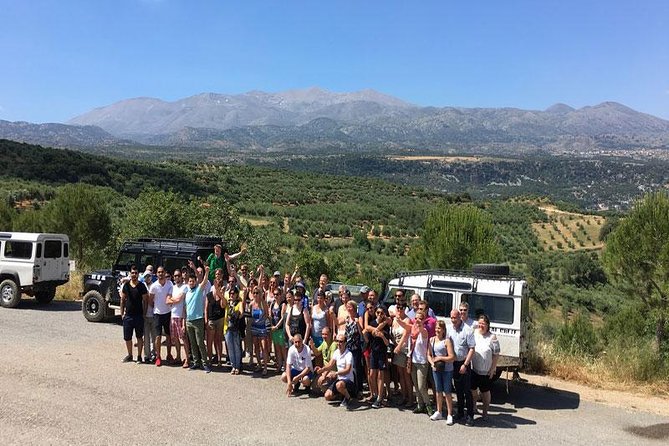
A Crete buggy safari group stays small because the leader watches every vehicle from the front. Fuel and water come with the booking, and the meeting point is normally the base or a hotel car park on the coast. Travellers who prefer a closed vehicle and mountain roads can compare the Crete jeep safari, which uses different terrain and different machines.


How does a buggy work on a Crete buggy safari?
A Crete buggy safari uses a dune buggy, a light open vehicle with a tubular frame, a roll cage and two seats. The design follows the Meyers Manx, the fiberglass kit car that Bruce Meyers built in 1964 on a shortened chassis of a small rear-engined car.
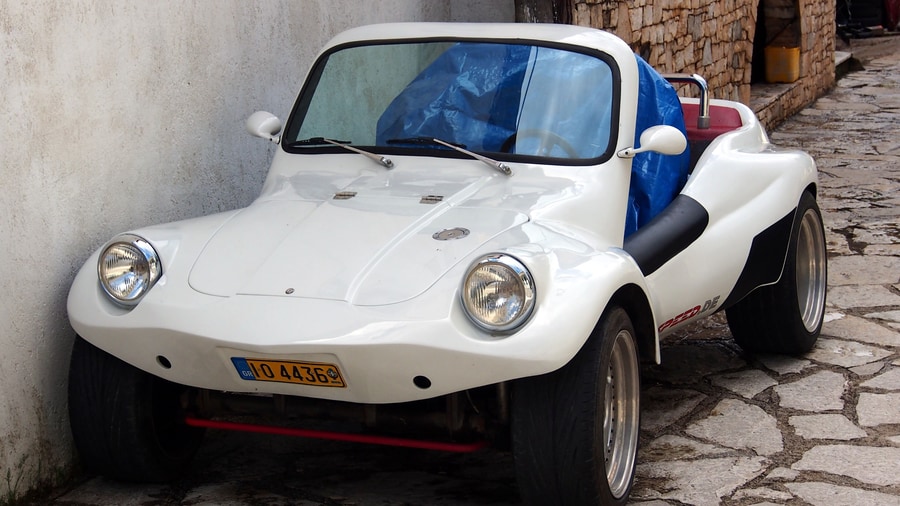
The engine sits behind the seats, which improves traction. A Crete buggy safari machine uses an air-cooled unit, so there is no radiator or water system to fail, and the simple suspension copes with ruts. Fiberglass bodies became the standard shape of the modern buggy, and the Manx wheelbase is 36 centimetres shorter than that of the car it came from.
Grip comes from wide, low-pressure tires rather than from four-wheel drive. On a Crete buggy safari, drive to two wheels still climbs dry slopes well, because the rear engine presses the driven axle down. Drivers use a low gear on steep gravel and keep momentum on loose stone, and the cage protects the cabin if the machine tips on a rutted descent.
- Frame: a light open structure with a roll cage above the seats.
- Engine: an air-cooled unit mounted behind the two seats.
- Tires: wide, low-pressure tires that spread the weight.
Steering is direct and the brakes work hardest on descents, so drivers leave a wide gap on downhill sections. A buggy is not a road car: the machine is built for sand, beaches and dirt, and its open body leaves wind, dust and sun free to reach the occupants from every side.
Where does a Crete buggy safari start?
A Crete buggy safari leaves from resorts and towns on the north coast, including Hersonissos, Malia, Sisi, Chania and Rethymno. Hersonissos lies about 25 kilometres east of Heraklion, and Sisi stands 6 kilometres east of Malia on the same shore.
The north coast holds the greater part of the island’s holiday settlements, from Chania in the west to Malia in the centre. A Crete buggy safari base in Hersonissos sits inside the Heraklion regional unit, where the older village of Upper Hersonissos stands inland above the harbour. Roads from these towns reach olive terraces and gravel lanes within a short drive.
Chania lies about 70 kilometres west of Rethymno and 145 kilometres west of Heraklion, while Rethymno holds more than 35,000 residents. Heraklion is the capital of Crete. A Crete buggy safari that starts in the west therefore uses different tracks from one that starts in the east, and pick-up points follow the coast road, at a marina or a hotel on the shore.
- East: Hersonissos, Malia and Sisi serve the Heraklion and Lasithi coasts.
- Centre: Rethymno stands between the two larger cities on the north shore.
- West: Chania and the villages along the Gulf of Chania.
Bases sit close to the road network so that buggies reach unpaved ground without a long transfer through towns. Vehicles leave the coast in a line and return the same way at the end of the loop. Drivers meet the tour leader at the base for a briefing, a check of documents and a short talk on the route.
What does a Crete buggy safari see near Hersonissos and Malia?
A Crete buggy safari behind Hersonissos and Malia climbs into low hills above the coast, where olive groves and terraces cover the slopes. The Minoan palace of Malia stands 3 kilometres east of the town centre and covers a floor area of 7,500 square metres.
The land rises quickly from the shore. Hersonissos lies at an elevation of 28 metres, and the old settlement of Upper Hersonissos sits higher inland, so a Crete buggy safari gains height within minutes of leaving the beach road. Olive trees, cypress and low scrub cover the slopes, and stone walls mark the edges of small fields worked by the villages behind the resorts.
The palace belongs to the Minoan period and was occupied from the third millennium BC until about 1250 BC. Its central court measures 48 metres by 23 metres, and the ruins include a kernos stone and storage rooms that held jars for grain and olive oil. The site lies 1,200 metres from the coast and is listed by UNESCO as a World Heritage Site.
- Hills: the slopes above Hersonissos, with terraces and grazing land.
- Villages: Mochos and Krasi sit inland inside the Malia municipal unit.
- Ruins: the Minoan palace of Malia and the settlement around it.
Tracks stay on farm lanes where permission exists, because olive groves are working land. Drivers on a Crete buggy safari keep to the marked line and give way to agricultural vehicles, which use the same lanes through the harvest. The loop returns to the coast before the light fades, and the leader stops the group above the bay for a last view over the water.
What does a Crete buggy safari see on the Rodopou peninsula?
A Crete buggy safari on the Rodopou peninsula runs west of Chania, between the Gulf of Kissamos and the Gulf of Chania. Kolymvari stands at the southeastern end of the peninsula, and the Monastery of Gonia lies one kilometre north of the town.
The peninsula is rocky and thinly settled. The municipal unit around Kolymvari covers 149.99 square kilometres and takes in the uninhabited and barren Rodopou peninsula, so a Crete buggy safari runs through open country with wide spacing between turns. Olive groves and low scrub cover the slopes, and gravel replaces the surfaced road near the western tip of the headland.
The Monastery of Gonia began in the ninth century and was rebuilt between 1618 and 1634 as a fortress monastery. It was first founded at Menies, on the ruins of an ancient temple of Artemis Britomartis, and Ottoman bombardments damaged it during the 1867 revolt. A Crete buggy safari stop beside the wall shows a cannonball lodged there from that attack.
- Views: open water on both gulfs of the peninsula.
- Shore: rocky beaches rather than sand along the Kolymvari stretch.
- Landmark: the Monastery of Gonia, one kilometre north of Kolymvari.
Fuel and water stops are limited here, so buggy groups carry supplies for the whole loop. Wind picks up on the exposed ridge in the afternoon, and dust hangs over the gravel in dry weather. Drivers keep well back from the edge on the seaward side, where the ground falls away towards the coves below the road.
What does a Crete buggy safari see near Rethymno?
A Crete buggy safari from Rethymno heads inland to the Arkadi Monastery, 23 kilometres southeast of the city on a fertile plateau. The monastery stands at 500 metres above sea level and is enclosed by a thick, high wall that covers an area of 5,200 square metres.
The inland roads climb through vineyards, olive groves and stands of pine and cypress. The plateau is ringed by hills, and its western side drops into the Arkadi gorge, which runs towards Stavromenos. A Crete buggy safari crew uses the gravel lanes that link the villages around the monastery, including Amnatos, three kilometres to the north, and the higher ground towards Mount Ida.
The present church at Arkadi dates from the sixteenth century and mixes Roman and Baroque elements. The monastery became a national sanctuary after the Cretan revolt against Ottoman rule in 1866, when 943 people took refuge inside the walls, the greater part of them women and children. A gunpowder explosion ended the siege, and the event is commemorated on 8 November.
- Ground: farm lanes and gravel tracks across the hinterland.
- History: the fortified monastery and its walled courtyard.
- Landscape: the Arkadi gorge on the western edge of the plateau.
Rethymno itself began as a Venetian commercial station between Heraklion and Chania, and the old town was almost entirely built by the Republic of Venice. A Crete buggy safari route leaves that built-up area and works the agricultural land beyond it, where traffic is light and junctions are simple. Groups return to the coast road in the late afternoon.
What licence does a Crete buggy safari need?
A Crete buggy safari needs a valid driving licence, because Greek law requires one for every type of motorised vehicle. A car licence in category B can be obtained from the age of 18, and the light motorcycle class A1 from the same age.
Greece issues licences through the Ministry of Infrastructure and Transport, and candidates pass a theory test and a road test. Category B covers cars and light vehicles with a maximum gross weight of 3,500 kilograms and up to eight passengers besides the driver. Mopeds of up to 50 cc carry a lower age limit of 16, and the A1 class reaches 125 cc.
Drivers from outside the European Union need an International Driving Permit unless their country holds a mutual recognition agreement with Greece or the European Union. The recognition list includes Switzerland, Serbia, Albania, the United States, Canada, Australia, Japan, South Africa and South Korea. A Crete buggy safari operator checks the licence class that fits the buggy in use before a group sets off.
- Category B: cars and light vehicles up to 3,500 kilograms, from age 18.
- Category A1: light motorcycles up to 125 cc, from age 18.
- Visitors: an International Driving Permit from outside the European Union.
On a Crete buggy safari the licence card travels with the driver on the route, and a photograph on a phone does not replace it in every case. Groups set off only when each driver holds a valid document for the machine in use. Stronger motorcycles need higher categories: A2 from age 20 and the unlimited A class from age 24, or from 22 after two years on A2.
How does a Crete buggy safari stay safe?
A Crete buggy safari stays safe through helmets, protective eyewear, gloves and boots, plus water for the heat. Drivers keep a wide gap in the convoy, follow the tour leader and slow down on loose stone and steep descents.
Buggies have no roof and no side windows, so dust, sun and wind reach the occupants. A scarf or face covering over the nose and mouth keeps track dust away from the lungs, and goggles protect the eyes. On a Crete buggy safari, water bottles are refilled at the stops and long sleeves reduce sunburn on exposed arms and shoulders.
Machine makers recommend a helmet built to road standards, protective eyewear, gloves and riding boots for off-road conditions. Fatal accidents in open off-road machines happen when the vehicle rolls over, and the fitted roll bars prop a rolled buggy up. Tires matched to the ground help as well, and the leader sets a pace that keeps every vehicle in sight.
- Head: a helmet built to road standards for every occupant.
- Eyes: goggles or glasses against dust and grit.
- Body: long sleeves, gloves and closed boots.
On a Crete buggy safari the convoy order is part of the plan: faster drivers stay behind the leader, junctions are held until the last vehicle arrives, and the group keeps together over blind crests. Drivers who feel tired hand the wheel to a passenger at a stop rather than push on. Dust clouds hide rocks, so a long following distance is standard practice.
When is the best season for a Crete buggy safari?
A Crete buggy safari works best in spring and autumn, when the ground is firm and the heat is mild. Crete has a hot-summer Mediterranean climate, with dry summers and rain that falls in winter, and the mountains hold snow between November and April.
Crete straddles two climatic zones, the Mediterranean and the semi-arid, so the low coasts stay warm while the higher ground is cooler. Southern Crete records more sunshine than any other part of the country, with more than 3,257 hours a year. Tracks above the north coast dry out after winter rain, which leaves firm gravel for a Crete buggy safari in spring and autumn.
Summer brings dry, dusty trails and strong sun, and the Sisi weather station on the north coast recorded 35.1 °C on 4 November 2023. Winter is mild on the coast but wetter in the west, where the Chania province takes more rain. Buggy groups watch the weather in the days before a drive and change the route when a gully holds water.
- Spring: firm tracks, mild air and wildflowers above the coast.
- Autumn: warm sea, cooler evenings and dry gravel after the first rains.
- Summer: early starts for dust, heat and hard ground.
Travellers who plan a day off the tracks can compare the Crete boat trip options on the same coast. A Crete buggy safari booking and a sea trip are swapped at short notice when the forecast turns, because boats and buggies both depend on the weather on the day of the trip.
What do travelers ask about a Crete buggy safari?
A Crete buggy safari raises the same practical questions again and again: previous driving experience, seats for passengers, rules for children, clothing for dust and heat, and the difference between an open buggy and a closed jeep on the same island.
Does a Crete buggy safari need driving experience?
No previous off-road experience is needed. The controls are simple, the leader explains the route before departure, and the first stretch is slow while drivers get used to the steering and the brakes. Practice happens on the machine itself, in the order that the group travels along the lane.
Can passengers ride on a Crete buggy safari?
Passengers travel in the second seat of the same vehicle, and on longer loops the occupants change places so that each person drives part of the route. A licensed driver sits behind the wheel throughout. Single travellers are paired with another driver when the vehicle has an empty seat.
Are children allowed on a Crete buggy safari?
Children and adolescents have the highest injury rates in off-road machines, so families check the age policy of the operator before booking. Young travellers ride as passengers beside an adult, and the operator decides whether a child takes part at all. Head protection is fitted to the size of the occupant.
What do travelers wear on a Crete buggy safari?
Closed shoes, long trousers and a long-sleeved top are the base layer, with a scarf for the dust and goggles for the eyes. A hat and sunscreen help on exposed sections, and a light jacket suits the evening return. Loose clothing that can catch on the frame stays at the base.
How does a Crete buggy safari differ from a jeep trip?
A buggy is an open, low machine with two seats in a light frame, which gives the occupants wind, dust and a direct view of the ground. A jeep carries a roofed cabin with room for a larger group. Buggy routes favour gravel lanes and dry terraces, while jeep routes reach higher ground.
Featured photo: Carole Raddato, CC BY-SA 2.0, via Wikimedia Commons.