An ancient Olympia tour visits the sanctuary of Zeus at Olympia in the western Peloponnese, the site of the ancient Olympic Games, with its stadium, temples and museum. This post covers what an ancient Olympia tour includes, the games, the stadium, the temples of Zeus and Hera, the other buildings, the museum, the route to the site and the best season. It is one of the best tours in Greece on Greece VIP.
Each section ends with an Olympia tour or ticket that can be booked online.
What does an ancient Olympia tour cover?
An ancient Olympia tour covers the sanctuary of Zeus at Olympia, in the region of Elis in the western Peloponnese. This Panhellenic religious centre hosted the ancient Olympic Games for centuries, and its ruins now appear on the UNESCO World Heritage List.
An ancient Olympia tour takes place in the valley of the Alpheios River, in the western Peloponnese. The ruins lie between the river to the south and Mount Kronos to the north, while the Kladeos, a tributary of the Alpheios, runs along the west side. The Gulf of Kyparissia is around 18 km away. Despite the name, Olympia is far from Mount Olympus, the northern peak linked with the twelve Olympian gods.
At the heart of the site lies the Altis, the sacred precinct of Zeus, where other gods also received worship. Its name comes from an Elean word for “the grove”, after the olive and plane trees that covered it. The precinct was an irregular four-sided area, over 183 m on each side and walled except on the north, where Mount Kronos closed it. The Altis forms the religious core of every ancient Olympia tour.
The site once held over 760 significant buildings, and ruins of a large number survive. The Greek traveller Pausanias recorded over 70 temples, plus treasuries, altars and statues. Unlike Delphi, where monuments were packed inside the sacred boundary, Olympia spread past its wall into the zones used for the games. Each ancient Olympia tour therefore covers ground on both sides of the old wall.
Floods from the Alpheios and the Kladeos and landslips from Mount Kronos later buried the sanctuary in mud and sand, and newer research also points to tsunamis. The English antiquarian Richard Chandler found the site again in 1766. French scholars of the Expedition Scientifique de Morée dug there in 1829 and identified the Temple of Zeus. The German Archaeological Institute started systematic digs in 1875 and the work continues, so an ancient Olympia tour passes ground still under study.
- Modern town: The ruins sit beside Archaia Olympia, a small town whose name means “Ancient Olympia”.
- World Heritage: UNESCO inscribed the Archaeological Site of Olympia in 1989 as a cultural property.
- Protected area: The listed property covers 105.6 hectares, plus a buffer zone of 1,458.18 hectares.
- Coubertin monument: Pierre de Coubertin, founder of the International Olympic Committee, has a monument at ancient Olympia that holds his heart.
Seeing the full site involves extensive walking, since the ruins spread from the Altis east to the stadium and west to the training buildings. Visitors cross a bridge to reach the main gate, and digs remain active in parts of the grounds. Each zone has its own role, and an ancient Olympia tour links them so the sacred and athletic sides read as one place.


How did the Olympic Games shape an ancient Olympia tour?
An ancient Olympia tour follows the story of the ancient Olympic Games, traditionally dated to 776 BC and held every four years in honour of Zeus. The program grew from one foot race to twenty-three contests, and a sacred truce protected travellers.
Tradition sets the first games in 776 BC, the date Aristotle gave, and archaeology supports a start in the 8th century BC. Coroebus of Elis, a stadion winner, is named as the first champion. The festival returned every four years, and that cycle, the Olympiad, became a unit of time. Historians named each Olympiad after its stadion winner, a custom an ancient Olympia tour explains beside the old racecourse.
An ancient Olympia tour traces how the program grew. The first thirteen games had one event, the stade sprint. The diaulos, a two-stade race, joined in 724 BC, and the long dolichos followed at the next Olympiad. Wrestling and the pentathlon entered in 708 BC, boxing in 688 BC and the four-horse chariot race in 680 BC. The pankration, a mix of boxing and wrestling, began in 648 BC, and the hoplitodromos, a race in armour, in 520 BC.
The sacred truce, or ekecheiria, is another theme of an ancient Olympia tour. Tradition credits King Iphitos of Elis, Kleosthenes of Pisa and Lykourgos of Sparta with setting it up in 776 BC. Three runners called spondophoroi carried the news from Elis to the competing cities. While the truce lasted, no army was allowed into Olympia, and legal disputes and the death penalty were banned. It protected travel to the games but did not end every war in Greece.
Only freeborn Greek men competed as athletes, yet women won as owners of chariot teams, and Cynisca of Sparta became the first female Olympic victor. Officials called Hellanodikai checked each competitor’s city and Greek identity. Winners received wreaths of olive leaves. On the middle day of the festival, 100 oxen were sacrificed to Zeus. For that reason, an ancient Olympia tour treats worship and sport as two halves of one event.
- Youth contests: Events for young athletes appear in the records from 632 BC.
- Program limit: No single Olympiad featured more than twenty of the contests.
- Nero: The emperor fell from his chariot at Olympia in AD 67 but still claimed victory, and the judges later declared his Olympiad void.
- Last games: The last recorded festival took place in AD 393, though finds show that games went on after that date.
Competing legends explain how the games began. One credits Pelops, who beat King Oenomaus of Pisa in a chariot race and gave his name to the Peloponnese. In another, told by Pindar, Heracles founded the festival to honour his father, Zeus. Both stories feature on an ancient Olympia tour, since the Greeks rooted their games in religion and the worship of the gods.
What does the stadium show on an ancient Olympia tour?
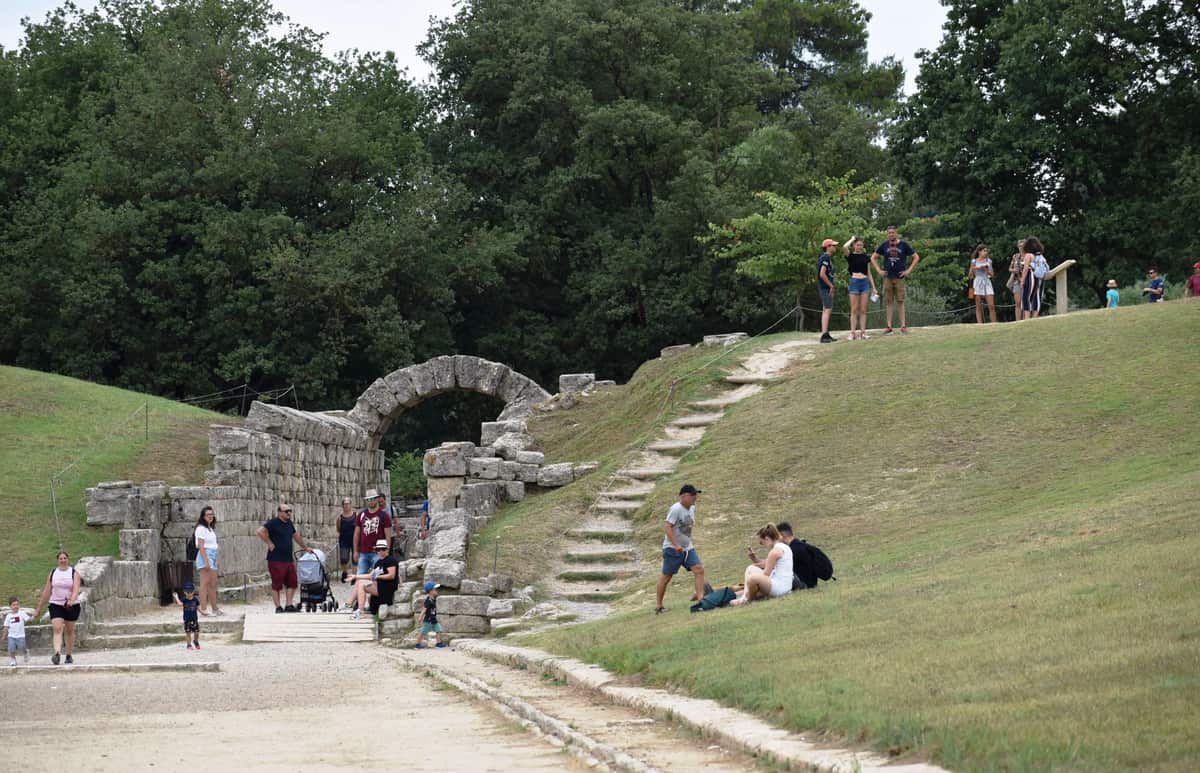
An ancient Olympia tour reaches the stadium east of the sanctuary of Zeus through the same vaulted passage the athletes used. The stadium measures 212.54 m long and 30 to 34 m wide, and spectators sat on its sloping side banks.
The stadium lies east of the Echo Stoa, outside the Altis, but it did not start there. The first stadium, built around 560 BC, was a simple track, and the original course reached well inside the later east wall of the precinct. Around 500 BC, builders moved it slightly east and gave it sloping sides for the crowd. The version seen on an ancient Olympia tour dates from the Classical period.
Athletes and judges entered the field through the Crypt, a narrow vaulted tunnel, and their entry marked the opening of the games. A vaulted archway, built in 200 BC, links the stadium entrance to the sanctuary. On an ancient Olympia tour, this passage forms the threshold between the sacred precinct and the sports ground. In front of it stand 16 stone pedestals, the bases of the Zanes, bronze statues of Zeus paid for by fines on athletes who broke the rules.
Runners raced on hard-packed clay, which gave them traction. Curbs laid across the ground mark the start and finish lines, and a white block at one end lined up the athletes so each ran the same distance. Ancient geographers used the length of this field as a unit of distance, the stadion. The stade sprint covered just over 192 metres, and visitors on an ancient Olympia tour learn that the word stadium comes from the stadion race.
Spectators watched from the sloping sides of the field. During the festival, rich and poor alike slept in tents, since the site had no permanent lodgings for them. Emil Kunze and Alfred Mallwitz excavated the north wall of the stadium between 1952 and 1966. Pottery sherds from the Final Neolithic period, the fourth millennium BC, came to light on its north bank. These finds show visitors on an ancient Olympia tour that the ground was in use long before the games.
- Zanes name: The local dialect formed the word Zanes as a plural of Zeus.
- Public warning: Each pedestal carried a short text naming the offender, in full view of athletes entering the stadium.
- First fine: The first Zanes went up after Eupolos from Thessaly bribed three opponents in the boxing event.
- Running lanes: Runners in the diaulos are thought to have used lanes marked with lime or gypsum, turning at posts called kampteres.
The stadium returned to Olympic use without any intentional change to its ancient ground. At the 2004 Athens Olympics it hosted the men’s and women’s shot put, an event chosen because it caused the least disruption at a sensitive site. Temporary stands are easy to put up and take down. An ancient Olympia tour therefore crosses a field that keeps its ancient form.
Which temples does an ancient Olympia tour visit?
An ancient Olympia tour visits the two main temples of the Altis. The Temple of Zeus once held the gold and ivory statue of Zeus by Phidias, one of the Seven Wonders. The older Temple of Hera is where the Olympic flame is lit today.
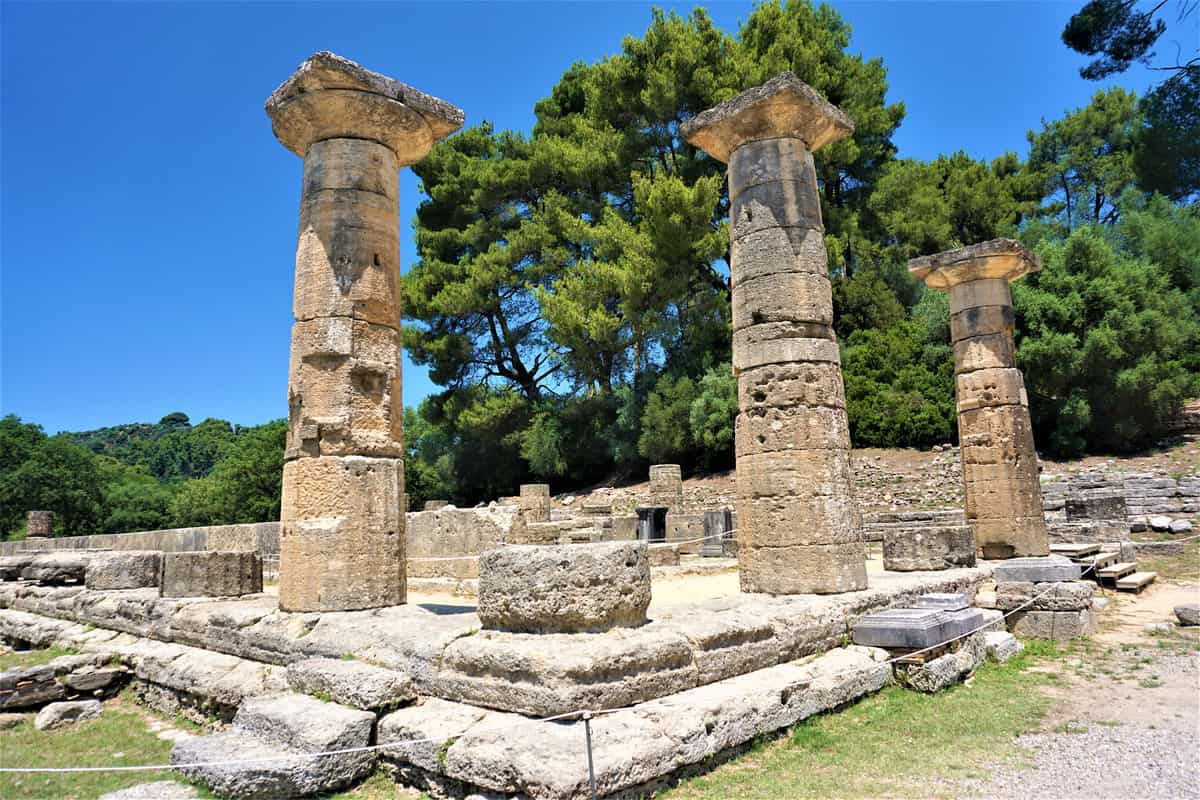
The Temple of Zeus, built between about 472 and 456 BC, is the larger of the two temples on an ancient Olympia tour. It is the textbook case of a fully developed classical Doric temple. The builders used a local poros stone of poor quality and coated it with a thin layer of stucco to look like marble. The roof tiles were Pentelic marble, cut so thin that light passed through them.
In the second century AD, Pausanias put its height to the pediment at 20.7 m, its breadth at 29.0 m and its length at 70.1 m. A ramp on the east side led up to it. The outer columns stood six by thirteen on a platform of three unequal steps. Of its 102 lion-head waterspouts, 39 survive, and an ancient Olympia tour notes that their mixed styles reveal Roman roof repairs.
The temple held the Statue of Zeus, made by Phidias around 435 BC and counted among the Seven Wonders. The seated god, about 12.4 m tall, had ivory plates and gold panels over a wooden frame. Strabo remarked that the god, if he stood up, had no room under the roof. Nothing of the statue survives, so an ancient Olympia tour tells its story inside the temple ruins.
An ancient Olympia tour also reaches the Temple of Hera, or Heraion, the oldest temple on the site. It went up in about 580 BC in the north of the Altis and is one of the earliest Doric temples in Greece. Hera and Zeus shared it until Zeus received a temple of his own. It measures 19 by 50 m, with 6 by 16 columns. In 173 AD, one column in the rear chamber was still oak.
- Olive oil: The statue of Zeus was kept coated in olive oil to protect its ivory from the damp of the Altis grove.
- Gilded shields: The Roman general Mummius dedicated 21 gilded shields on the Temple of Zeus after he sacked Corinth in 146 BC.
- Altar of Hera: The Olympic flame has been lit at this altar, east of the Temple of Hera, since 1936.
Together, the two temples span the Archaic and classical ages of the sanctuary, since the Heraion is about a century older than the Temple of Zeus. The Heraion also ties an ancient Olympia tour to the modern Games. In front of it, sunlight in a parabolic mirror lights the Olympic flame, and a torch then carries the flame to the host city of the Games.
Which buildings does an ancient Olympia tour pass?
An ancient Olympia tour passes the Philippeion, the treasuries, the palaestra, the gymnasium, the Leonidaion and the workshop of Phidias. These buildings sit around the temples, with the treasuries to the north and the athletic and guest buildings to the west.
The north side of the sanctuary holds the treasuries, which went up during the 6th century BC and stood for the Greek city-states. An ancient Olympia tour also passes the Prytaneion, built on the northwest side in 470 BC. The Metroon went up south of the treasuries around 400 BC. To the east, the Echo Stoa followed around 350 BC and cut off the sanctuary from the area of the games and the stadium.
An ancient Olympia tour stops at the Philippeion, a round tholos of limestone and marble. The Athenian sculptor Leochares made it to mark the victory of Philip II at Chaeronea in 338 BC. Work began under Philip and ended under Alexander the Great after Philip died in 336 BC. Eighteen Ionic columns ring the outside, with nine engaged Corinthian columns inside, and the building is 15 metres across. It was the only structure in the Altis built for humans, not gods.
On the west side, an ancient Olympia tour reaches the athletic and guest buildings. The Leonidaion, built around 300 BC to house important visitors, was the largest building on the site. It carries the name of the architect Leonidas of Naxos, who designed and paid for it. Its four Ionic colonnades held 138 columns. As the games grew in importance, the palaestra was added in the 3rd century BC and the gymnasium in the 2nd century BC.
Close to the Temple of Zeus lies the workshop of Phidias, where the sculptor made the statue of Zeus. Digs in the 1950s uncovered tools for working gold and ivory, ivory chips, precious stones and terracotta moulds. The moulds served to shape glass for the robe of Zeus. The finds confirmed a date in the third quarter of the 5th century BC for the statue. The building later became a Christian basilica, and its remains lie on the route of an ancient Olympia tour.
- Royal statues: Gold and ivory statues of Philip II, Alexander the Great and their family stood in the Philippeion, and none survive.
- Restoration: Partial restoration of the Philippeion took place from 2004 to 2005, after parts held in Berlin returned.
- Leonidaion end: An earthquake destroyed the Leonidaion in the late third century AD, and its stones went into a wall built against the Herules.
The buildings around the temples honoured a royal family and served athletes and visitors. Between 1952 and 1966, Emil Kunze and the architect Alfred Mallwitz excavated the workshop of Phidias and the Leonidaion. Earlier German teams had dug out the Philippeion, the treasuries and the palaestra. An ancient Olympia tour passes the results of this work on its way around the Altis.
What is in the museum on an ancient Olympia tour?
An ancient Olympia tour includes the Archaeological Museum of Olympia, which holds finds from the sanctuary and the area around it. Its best-known pieces are the Hermes of Praxiteles, the Nike of Paionios and the sculptures from the Temple of Zeus.
The museum falls under the Ministry of Culture and Sports and counts among the principal museums of Greece. Its original building opened in 1888 as the first museum in Greece outside Athens. Today the main building has twelve exhibition rooms, arranged by theme and by age. The collection runs from prehistory to the period of Roman rule. On an ancient Olympia tour, visitors also see a bronze collection that ranks among the leading ones in the world.
The museum displays the pediments of the Temple of Zeus, carved from Parian marble in the Severe style. They are now credited to an artist known as the Olympia Master and his studio. The east pediment shows the chariot race between Pelops and Oenomaus. The west pediment shows Theseus and the Lapiths fighting the Centaurs, while Apollo points towards the human side. An ancient Olympia tour then turns to the metopes, which showed the twelve labours of Heracles.
The Hermes of Praxiteles shows the god Hermes holding the infant Dionysus. Ernst Curtius uncovered its body in 1877 in the ruins of the Temple of Hera, under a thick clay layer that protected it. It is carved from a block of Parian marble, and Hermes measures about 2.1 m. On an ancient Olympia tour, the link to Praxiteles comes with a caveat, since it rests on a short remark by Pausanias and art historians still argue over it.
An ancient Olympia tour also takes in the Nike of Paionios, made by Paeonius of Mende between 425 and 420 BC. It marked a victory in the fight between Athens and Sparta over the island of Sphacteria. The marble goddess once stood on a triangular pillar 6 metres high near the Temple of Zeus. The figure alone measures 198 cm, and an eagle flies below her feet. The face, wings, forearms and neck are lost.
- Phidias oenochoe: Among the principal pieces is an oenochoe that belonged to Phidias, the sculptor of the statue of Zeus.
- Olympic medals: Since the Athens Games of 2004, the front of every Summer Olympics medal has shown the Nike of Paionios.
- Old museum: The original building of 1888 has housed a museum about the history of the ancient Olympic Games since 2004.
The museum and the ruins tell one story. The first German excavation, which began in 1875, recorded 14,000 objects. Its finds included the Hermes, the Nike and the sculptures from the Temple of Zeus. An ancient Olympia tour that reaches the museum sees these works indoors, close to the temples and buildings where they were found.
How does an ancient Olympia tour reach the site?
An ancient Olympia tour reaches the site by sea, rail or road. Cruise ships call at Katakolo on the Ionian coast, trains run from Pyrgos to a terminus in the modern village, and National Road 74 links Pyrgos with Olympia and the ruins.
Katakolo is the sea gate for an ancient Olympia tour. The village stands on a headland above the Ionian Sea, and that headland divides the Gulf of Kyparissia from the open Ionian. Katakolo belongs to the municipality of Pyrgos in western Elis and lies 11 km west of the city. Cruise ships make the harbour a popular call, and passengers use the stop to visit the site of Olympia. A railway station in the village links Katakolo with Pyrgos and with Olympia.
The sea route to Olympia is ancient. In antiquity, the natural harbour for the sanctuary lay at Agios Andreas, a small village northwest of Katakolo. The sunken city of Pheia, the old port of Olympia, sits beyond the mountain of Ichthys, now called Agios Andreas, within walking distance of the modern harbour. Katakolo also has a lighthouse built in 1865, a Museum of Ancient Greek Technology, a market of more than sixty shops and the ruins of the medieval castle of Pontikokastro.
Pyrgos is the land hub for an ancient Olympia tour. The city is the capital of the regional unit of Elis and stands in the middle of a plain, 4 km from the Ionian Sea and 16 km west of Olympia. Its train station has regular services to Katakolo and Olympia. Its bus terminal runs regional routes across Elis and intercity routes to Athens, Patras, Kalamata, Ioannina and Thessaloniki. National Road 9 joins Pyrgos with Patras and Kyparissia.
The modern village of Archaia Olympia, whose name means Ancient Olympia, sits next to the ruins and services the site to its southeast. An ancient Olympia tour by rail ends at the village station, the eastern terminus of the line from Pyrgos, about 300 m east of the town centre. The Kladeos River marks the western edge of the site, and visitors cross a bridge to reach the main gate. The highway passes north of the ruins, which lie around 18 km from the Gulf of Kyparissia.
- By sea: Cruise ships call at Katakolo, 11 km west of Pyrgos, where a railway station links the port with Olympia.
- By rail: Regular passenger trains run on the branch line from Pyrgos to Olympia, while the Patras to Kalamata line has been suspended since January 2011.
- By road: The A5 motorway arrives from Ioannina and Patras, and National Road 74 runs from Pyrgos through Olympia to Tripoli.
- By air: Elis has only a military airport near Andravida, so passenger flights use Araxos, about 60 km north-east of Pyrgos, or Kalamata, about 120 km south.
The Peloponnese joins the mainland at the Isthmus of Corinth, where bridges cross the Corinth Canal, so an ancient Olympia tour from Athens enters the peninsula there before heading west to Elis. Near the northern tip of the peninsula, the Rio–Antirrio bridge links the western Peloponnese with western Greece. Inside Elis, Katakolo, Pyrgos and Archaia Olympia form the final chain of an ancient Olympia tour, from the coast to the ruins.
When is the best season for an ancient Olympia tour?
An ancient Olympia tour suits spring and early autumn best, the stretches between the hot, dry summers of Elis and the late-autumn peak in rainfall. Winters on the coast stay mild but wet, while snow covers the mountains of the interior.
Elis has a Mediterranean climate with hot, sunny summers, and readings above 40 °C are on record there. Pyrgos and Katakolo, the two gateways to the site, both fall in the hot-summer Mediterranean class, coded Csa in the Köppen system. Summers on this coast are hot and dry, and winters are mild but rainy. For an ancient Olympia tour, that pattern sets the main choice: heat in summer or rain in the cooler half of the year.
Annual precipitation at Pyrgos comes to nearly 900 mm, a sizeable total like much of Western Greece, and it peaks in late autumn. Across the Peloponnese, the west coast gets more rain than the drier east, and Elis is more humid than the eastern side of the peninsula. The wet season has shaped the site itself: in classical antiquity, the Kladeos was diverted near Olympia to prevent winter floods. An ancient Olympia tour in late autumn falls in the wettest part of the year.
Summer heat weighs on an ancient Olympia tour because the ruins spread over a wide area. The sanctuary extends beyond its boundary wall, above all in the zones built for the games, and seeing the whole site takes extensive walking. Trees now grow across parts of the grounds, mainly pink-flowering Judas trees, while olive and plane trees are common in the area. Aleppo pine covered the Kronion until the fires of 2007–2009, and the name Altis comes from an Elean word for the grove.
Late summer has its own risk. In August 2007, enormous forest fires in Elis killed 45 people and burned 8,500 hectares of forest, and the site of Olympia came under serious threat but suffered no damage. Winter brings the opposite: the mountainous interior of Elis turns colder, and snow covers its mountains, while the coast stays mild but rainy. An ancient Olympia tour in winter therefore pairs snow on the inland heights with rain and mild temperatures around Pyrgos.
- Summer: Elis is hot, dry and sunny, and its record readings pass 40 °C.
- Late autumn: Rain reaches its yearly peak at Pyrgos, where the annual total nears 900 mm.
- Winter: The coast stays mild and rainy, though frost struck crops around Manolada in February 2008.
- Spring and early autumn: These seasons fall between the summer heat and the late-autumn rain peak.
Taken together, the climate records point to the middle seasons. An ancient Olympia tour in spring or early autumn misses both the peak heat of summer in Elis and the late-autumn rain peak at Pyrgos. The same hot-summer Mediterranean pattern, Köppen Csa, covers the greater part of the Peloponnese, while the Gulf of Corinth is classed as hot semi-arid.
What do travelers ask about an ancient Olympia tour?
An ancient Olympia tour raises four recurring questions: where the flame for the modern Olympic Games is lit, which two rivers frame the ruins, who first excavated the buried sanctuary, and how the trip combines with Delphi on a separate day.
Does an ancient Olympia tour pass the spot where the Olympic flame is lit?
Yes. The modern Olympic flame is lit in front of the Temple of Hera, weeks or months before each opening ceremony. Sunlight focused by a parabolic mirror kindles the fire, and an actress playing the high priestess hands the first torch and an olive branch to the opening runner. The first torch-lighting ceremony took place on 20 July 1936.
Which rivers run past the ruins on an ancient Olympia tour?
Two. The Alfeios, or Alpheus, runs past the south side of the ruins, with Mount Kronos on the north. It rises on the northern slopes of Mount Taygetus, turns west near Olympia and enters the Ionian Sea south of Pyrgos. The Kladeos, a tributary, forms the western border. In myth, Heracles rerouted the Alpheus to clean the Augean Stables.
Who excavated the ruins seen on an ancient Olympia tour?
The English antiquarian Richard Chandler rediscovered the site in 1766. A French scientific expedition dug first, in 1829, and fixed the location of the Temple of Zeus. The first major excavation began in 1875, funded by the German government after Ernst Curtius secured exclusive access. The German Archaeological Institute at Athens has overseen the work since the 1870s.
Can an ancient Olympia tour pair with a Delphi day trip from Athens?
Yes, on a separate day. Delphi sits on the southwestern slope of Mount Parnassus in central Greece and was the seat of the Pythia, the major oracle of the ancient world. Like Olympia, it was a Panhellenic sanctuary, with the Pythian Games held every four years from 586 BC. A Delphi day trip from Athens covers that second sanctuary.
Featured photo: Annatsach, CC BY-SA 4.0, via Wikimedia Commons.