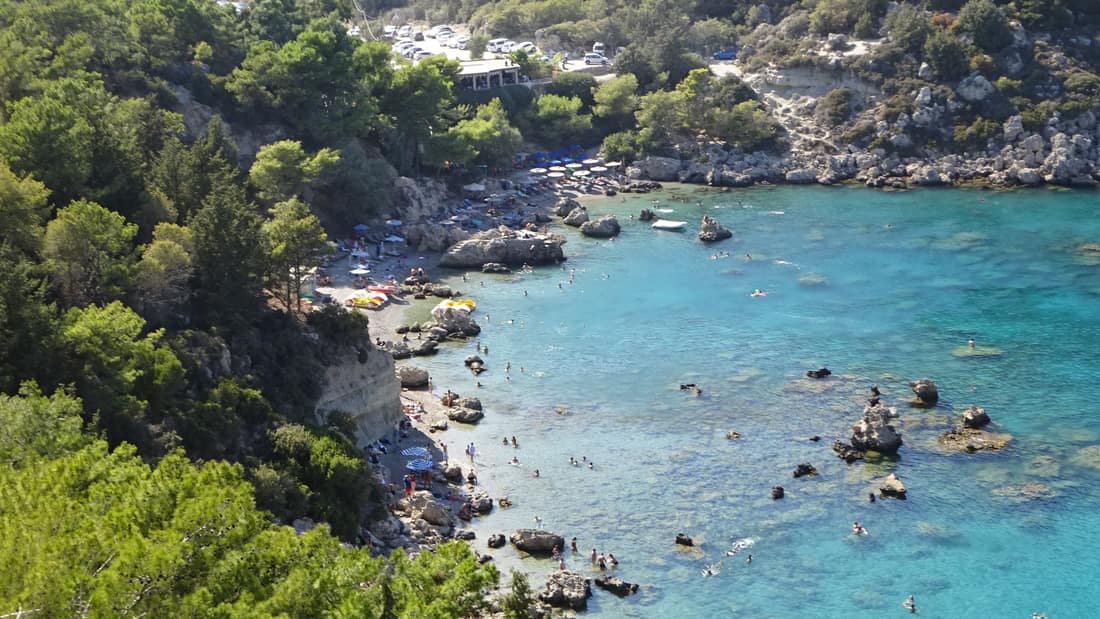
A Rhodes snorkeling tour swims the clear water off the largest island of the Dodecanese, from the rocky coves of Kallithea and Anthony Quinn Bay to the sheltered bays below Lindos, the meeting of two seas at Prasonisi and the islands across the strait. This post covers what a Rhodes snorkeling tour includes, where tours leave from, each bay, the marine life, the gear, safety, beginners, how snorkeling compares with diving and the best season. It is one of the sea tours in Greece on Greece VIP.
Each section ends with a Rhodes snorkeling tour or swimming cruise that can be booked online.
What does a Rhodes snorkeling tour include?
A Rhodes snorkeling tour includes boat and shore snorkeling, the mask, snorkel and fins used for surface swimming, and stops along the coasts of Rhodes where the Aegean and the Mediterranean meet. Groups float above rocky ground and Posidonia meadows.
Rhodes is the largest of the Dodecanese islands and the ninth largest island in the Mediterranean Sea. It is 79.7 km long and 38 km across at its widest, with a coastline of about 220 km. The island sits 363 km east-southeast of the Greek mainland and 18 km from the southern shore of Turkey. Every Rhodes snorkeling tour works the eastern shore, where limestone bedrock forms rocky shores and small coves.
Snorkeling is swimming face down while breathing through a shaped tube, with a mask for vision and fins for propulsion. A Rhodes snorkeling tour carries that surface skill to open water and keeps snorkelers at the top of the water column, above boulders, reefs and seagrass. A swimmer sees the bottom from above, breathes without lifting the head and covers ground with a slow kick. Days on the water combine easily with other boat trips around Rhodes.
- Boat stops: the vessel anchors over rocky ground so snorkelers step straight from the deck into deep, clear water.
- Shore stops: gentle entry from a beach lets a beginner start close to the sand and build confidence.
- Gear: mask, snorkel and fins are issued before the first stop, and a flotation vest is offered to every swimmer.
A place on a Rhodes snorkeling tour suits travellers who want the underwater scenery of the Aegean without a long course. The day mixes short boat runs with long spells in the water, and the crew reads the weather before each move. A Rhodes snorkeling tour stays in sheltered corners of the coast where the wind has less grip on the surface. The plan stays flexible through the day.


Where does a Rhodes snorkeling tour leave from?
A Rhodes snorkeling tour leaves from the Mandraki harbour in Rhodes Town, from the bay at Lindos on the east coast, and from the resort waterfronts at Faliraki, Pefkos and Kolympia. Every Rhodes snorkeling tour departure point opens onto sheltered water and a short boat run.
Rhodes Town sits at the northern tip of the island and holds the ancient and modern commercial harbours, so its quays are the natural base for a Rhodes snorkeling tour. The Mandraki was the military harbour of the medieval city and was guarded by a tower raised at the end of the natural mole. The main airport lies 14 km to the southwest of the city in Paradisi. Vessels of different sizes share the same basin, and the wider harbour takes the larger craft.
East-coast resorts add their own jetties and slipways. Lindos lies on the east coast, about 40 km south of Rhodes Town, in a large bay. Faliraki has a fishing harbour where day cruisers leave for Lindos, Rhodes Town and the beaches. Pefkos is a beach resort 4 km southwest of Lindos and 43 km from the capital. Kolympia is the resort settlement of the Afantou municipal unit, just south of Faliraki.
- Rhodes Town: the widest choice of boats, with the harbour a short walk from the medieval walls.
- Lindos and Pefkos: southern departures that shorten the run to the bays below the acropolis.
- Faliraki and Kolympia: central east-coast bases between the town and the southern resorts.
Departures cluster along the east coast, where the water is calmest through the season, so a Rhodes snorkeling tour starts within a short drive of the main resorts. Early sailings find flatter water before the afternoon breeze builds. A Rhodes snorkeling tour that begins in the north can still reach the southern bays, but the run home is longer. The choice of base decides the first bay.
Which east-coast bays does a Rhodes snorkeling tour visit?
A Rhodes snorkeling tour visits bays on the east coast, among them Faliraki Bay, the shore below the Tsambika monastery, and the water off Kolympia and Afantou. Each bay opens eastward to the Aegean and lies within a short run of the next.
Faliraki Bay carries a stretch of sand about 5 km long and has held twelve Blue Flag awards, a mark given for clean water and beach management. South of it, the beach at Afantou ranks among the longest on the island. The coast road, Greek National Road 95, was realigned around the Tsambika monastery, which stands halfway between Kolympia and Archangelos. A Rhodes snorkeling tour treats the road only as a marker, because the bays are read from the water.
A Rhodes snorkeling tour works this line of bays from the water rather than from the sand. The bays are shallow near the shore, and the seabed falls away over rock and seagrass further out, so daylight reaches the bottom close in. Wind direction decides the order of the stops, because a bay open to the north wind loses its calm first and regains it last. The order of the stops follows the wind rather than the map.
- Faliraki Bay: long beach, sheltered mornings and easy shore entry for a first snorkeling stop.
- Tsambika coast: the monastery on the headland above, with quieter water below the road.
- Afantou and Kolympia: a broad sandy front on the route between the town and the south.
The order of the stops changes with the breeze, so a Rhodes snorkeling tour keeps two or three bays in reserve. A Rhodes snorkeling tour that finds one bay choppy moves to the next within minutes. Groups stay close to the vessel, and the last stop of the day lies closest to the harbour. The route is set on the morning of the sail.
What does a Rhodes snorkeling tour see at Kallithea Springs?
A Rhodes snorkeling tour sees the Kallithea thermal baths, the spa complex on the northeastern coast of the island, and the bay beside it, where rocky shores and clear water make an easy entry for surface swimming and snorkeling.
Kallithea is a municipal unit on the northeastern part of the island, just south of Rhodes City, with a land area of 109.75 square kilometres and a population of 10,416 at the 2021 census. Faliraki belongs to the same municipal unit. Kalithea Bay lies on the coast between Rhodes City and Faliraki. An unopposed landing took place in the bay during the Battle of Rhodes in 1912.
The Kallithea Thermal baths rank among the works of an Italian architect who moved to the Dodecanese in 1927, a group of islands that Italy had held since the early twentieth century. Kalythies, Koskinou and Psinthos belong to the same municipal unit. The Italian period also left public buildings along the north coast of Rhodes. Posidonia grows best in clean water and is a marker for a lack of pollution.
- The spa: the Kallithea thermal baths, raised during the Italian period on the northeastern coast.
- The cove: rock shelves that step into deeper water and suit a slow surface swim.
- Clear water: Posidonia grows best in clean water and marks a bay free of pollution.
Snorkeling at Kallithea works best in the morning, when the bay lies in calm air and the sunlight reaches the shallow ground. A Rhodes snorkeling tour treats the site as a measured stop rather than a long swim, because the stop sits close to Rhodes Town. A Rhodes snorkeling tour then returns north to Rhodes Town or continues south along the coast.
Why does a Rhodes snorkeling tour stop at Anthony Quinn Bay?
A Rhodes snorkeling tour stops at Anthony Quinn Bay because the inlet carries the name of the actor who bought land there while The Guns of Navarone was filmed on Rhodes, and because the stop lies 4.3 km south of Faliraki on the east coast.
Anthony Quinn Bay sits between the resort strip at Faliraki and the quieter shore to the south. The actor bought land during the filming of The Guns of Navarone, a film released in 1961, and later received additional land from the local government in gratitude for making the island famous. The place carries his name, although the same land was reclaimed by the Greek government in 1984 under a change in property law.
The film unit worked on Rhodes during 1960, and further scenes were shot on the Maltese island of Gozo and on Tino in the Ligurian Sea. A Rhodes snorkeling tour uses the bay as a short, protected stop on the run between Rhodes Town and the southern resorts. The bay lies close to the coast road that runs south from Faliraki along the east coast.
- The location: an east-coast bay 4.3 km south of Faliraki, on the road towards Lindos.
- The name: a film link that turned a quiet cove into a known landmark on the east coast.
- The stop: a short break on the run between Rhodes Town and the southern resorts.
The bay fills quickly in high summer, so small groups arrive earlier in the day. A Rhodes snorkeling tour keeps the visit short and leaves the anchorage to larger craft. From there a Rhodes snorkeling tour continues south towards Lindos or turns back along the coast road. Either way the water stays shallow for the last swim of the morning.
What does a Rhodes snorkeling tour see near Lindos?
A Rhodes snorkeling tour sees Saint Paul’s Bay beside Lindos, where the village meets the water, and the acropolis of Lindos above it, where the Temple of Athena Lindia has stood since about 300 BC on a citadel fortified across the centuries.
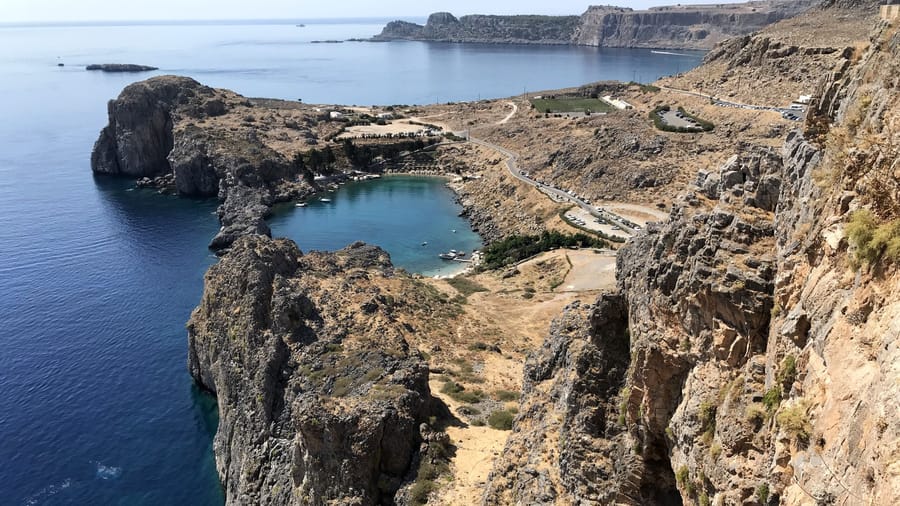
Lindos lies on the east coast of Rhodes and faces the fishing village and small resort of Charaki across the water. The municipal unit covers 178.9 square kilometres and holds 4,496 residents, while the community of Lindos counts 1,096 residents. Excavations at Lindos were carried out in the years 1900 to 1914. Above the modern village, the acropolis rises as a natural citadel with views over the surrounding harbours and coastline.
The Temple of Athena Lindia dates from about 300 BC and stands on the site of an earlier temple. Below it, a Hellenistic stoa once ran 87 metres with 42 columns, and a rock-cut relief of a Rhodian warship dates from about 180 BC. The Castle of the Knights of St John was raised on the summit before 1317, and the church of St John followed in the 13th or 14th century. A tour of Lindos and its bay pairs neatly with a morning in the water.
- Saint Paul’s Bay: the inlet beside the village of Lindos, on the east coast of the island.
- The acropolis: a natural citadel with columns, walls and a castle above the village.
- The village: a fishing village and small resort with fine beaches below the acropolis.
Lindos lies in a large bay, so a Rhodes snorkeling tour finds room to swim away from the village. A Rhodes snorkeling tour then crosses the shallow ground near the shore, where daylight reaches the bottom and the village stands above. The climb to the acropolis fits the afternoon, once the group is back on land. Both sit within a short walk of each other.
Does a Rhodes snorkeling tour reach Prasonisi?
A Rhodes snorkeling tour does not reach Prasonisi on a normal coastal run. The cape lies 92 km from Rhodes Town at the southern end of the island, where the Aegean and the Mediterranean sit on either side of a shifting sandbar.
In summer, when water levels fall, the cape becomes a peninsula joined to Rhodes by a tombolo of sand, and in winter it turns back into an island. The tombolo itself depends on sand carried by wave currents and can erode from the southeast. The sandbar is not a fixed formation and reshapes through the seasons. A lighthouse stands at the southernmost tip of the cape.
Prasonisi is listed within Natura 2000 as a protected area. The winds there are steady and predictable, not gusty, and hold a constant direction at set hours, which made the cape a destination for windsurfing and kitesurfing. The Aegean side carries waves suited to advanced riders, while the Mediterranean side stays flat and busy in July and August. The loggerhead turtle once laid eggs on the sand, but this now happens rarely.
- Distance: a long drive from the northern resorts, better treated as a separate day out.
- The two seas: waves on the Aegean flank, flat water on the Mediterranean flank.
- Protection: a Natura 2000 site where vehicle traffic on the sandbar is restricted.
A Rhodes snorkeling tour stays with the sheltered east coast and leaves the far south to a separate journey. A Rhodes snorkeling tour that wants flat water at the cape works the Mediterranean side, where the surface is calmer for a surface swim. Wind direction decides whether the day is comfortable or testing, and a calm forecast decides the sailing. The far south suits a separate day.
Which marine life does a Rhodes snorkeling tour see?
A Rhodes snorkeling tour sees the fish of the Aegean around rocky ground along the east coast, the common octopus, the purple sea urchin, the loggerhead turtle and Posidonia meadows. A surface swimmer stays above the seagrass and the animals that shelter in it.
The loggerhead sea turtle grows to about 90 cm in carapace length and weighs about 135 kg as an adult, and it is the world’s largest hard-shelled turtle. It lives throughout the Mediterranean Sea and beyond, and females come ashore only to lay eggs. The species is omnivorous and feeds mainly on animals that live on the sea floor. Young turtles face predators, and the eggs are especially vulnerable on land.
The common octopus reaches 25 cm in mantle length with arms up to 1 m long, lives for one to two years and weighs up to 9 kg. It hunts at dusk and takes crabs, lobsters and bivalve molluscs, and it changes colour to blend with its surroundings. The purple sea urchin carries a flattened test up to seven cm across and long purple spines, grazes on algae and seagrass, and gathers just below the low water mark.
- Loggerhead turtle: a large surface breather that a quiet swimmer can meet over seagrass.
- Octopus: a shy hunter of rocky ground that slips into a crevice when approached.
- Purple sea urchin: a spiny grazer of shallow rock, best watched and never touched.
Posidonia oceanica is a seagrass found only in the Mediterranean Sea, where it covers about 38,000 square kilometres of the basin. Its ribbon-like leaves reach about 45 cm and grow in meadows from shallow water down to 35 m. A Rhodes snorkeling tour crosses these meadows, which shelter young fish and keep the water clear along the route.
Does a Rhodes snorkeling tour visit Symi or other islands?
A Rhodes snorkeling tour stays with the coast of Rhodes itself, while a separate island crossing reaches Symi and Chalki in the Dodecanese. Symi lies about 24 km north of Rhodes across open water that stays deep and exposed for the whole crossing.
Symi is mountainous and covers 58.1 square kilometres, and its highest point reaches 617 m. The coastline alternates between rocky cliffs, beaches and isolated coves. Its harbour town, called Symi, has a lower town at the water, known as Yialos, and an upper town called Ano Symi. The permanent population was 2,603, and the summer figure rises to about 6,000 visitors and residents. Pedi, Nimborio, Marathounda and Panormitis are the other settlements.
The economy of Symi was built on shipbuilding and sponges, and the island once held the largest sponge fishing fleet in the world. Chalki lies about nine km west of Rhodes and covers twenty-eight square kilometres, with 475 residents and one village, Emporio. A ruined medieval castle of the Knights of St John overlooks the old town. Drinking water arrives from Rhodes. A Symi day trip from Rhodes places a boat crossing beside the coastal snorkeling days.
- Symi: a harbour town with houses on the slopes and coves along a rocky coast.
- Chalki: a small island with one village, a castle ruin and quiet water close inshore.
- The crossings: open-water passages that demand settled weather and a calm forecast.
A Rhodes snorkeling tour stays close to the island shore for good reason, because the water there is sheltered and the returns are short. A Rhodes snorkeling tour works the bays near Lindos, Faliraki and Rhodes Town, while the island crossings belong to a longer day. Open water decides the plan for the day.
Which gear does a Rhodes snorkeling tour use?
A Rhodes snorkeling tour uses a mask, a snorkel, fins and a flotation vest. The mask gives clear vision under water, the snorkel lets a swimmer breathe at the surface, the fins supply propulsion, and the vest keeps a tired swimmer afloat.
Snorkeling equipment is simple and needs no training to use. The snorkel is a shaped tube that lets the swimmer breathe ambient air while the face stays in the water. A diving mask or swimming goggles restore vision, and swimfins make movement through the water far more efficient than kicking bare feet. Snorkeling allows a swimmer to watch the underwater world without the equipment and training that scuba diving requires.
Exposure protection matters as well, because a snorkeler stays in the water for long stretches. A wetsuit, a dive skin or a rash vest guards against cold, sunburn and stings, and a rash guard with sun protection covers the back and upper legs. An inflatable snorkel vest, a form of buoyancy aid, holds a swimmer at the surface but blocks descent below it. A weightbelt, worn only by freedivers, offsets the float of a wetsuit.
- Mask: a sealed window over the eyes and nose, chosen for a close fit without leaks.
- Snorkel: a tube with a mouthpiece that allows breathing while the face is down.
- Fins: blade-shaped footwear that turns a gentle kick into steady forward travel.
- Vest: an inflatable jacket that floats a swimmer and can be deflated to descend.
Gear is checked before entry, and a loose mask or a torn fin strap is replaced on deck. A Rhodes snorkeling tour fits each swimmer with equipment at the start of the day and keeps spares aboard. Swimwear, a towel and drinking water remain the swimmer’s own kit, and a Rhodes snorkeling tour supplies the rest. Spares travel aboard.
How does a Rhodes snorkeling tour stay safe?
A Rhodes snorkeling tour stays safe by pairing swimmers, keeping the group close to the vessel and watching sun, boats, jellyfish and sea urchins. A snorkeler floats face down with only the tube above the surface for long spells.
The greatest danger to a snorkeler comes from inshore and leisure craft such as jet skis and speed boats, because those vessels work the same water. Sailboats and sailboards add a further risk, since quiet propulsion gives no warning of approach. A snorkeler can surface beneath a hull. Bright clothing and a towed dive flag help a boat operator to spot a group from a distance.
Sun exposure is the other constant factor. A snorkeler’s back, ankles and the rear of the thighs stay in the sunlight for long periods and burn without being noticed in time, even when the skin lies just below the surface. Covering the body with a rash vest or a wetsuit and using waterproof sunblock reduces the damage. Dehydration and cramps follow long sessions in the water, so drinking well before entry matters.
- The buddy rule: couples stay within sight of each other and check each other’s condition.
- Boat traffic: groups stay close to the vessel and away from channels used by fast craft.
- Jellyfish: stinging cells on the tentacles inject venom on contact, so a swarm is given a wide berth.
- Sea urchins: sharp spines on shallow rock reward care, and fins cover the feet.
Breathing technique closes the list. A swimmer who hyperventilates before a dive can lose consciousness under water, a risk reduced by slow, normal breathing and by a buddy who watches. A Rhodes snorkeling tour briefs these points before entry, and a Rhodes snorkeling tour keeps the depth shallow enough for a fast return to the surface. Water, sun cream and a hat travel aboard a Rhodes snorkeling tour.
Can beginners and children join a Rhodes snorkeling tour?
A Rhodes snorkeling tour welcomes beginners and children when they are at ease in the water, and a flotation vest supports anyone new to surface swimming. The activity appeals across ages because it demands little effort, and a Rhodes snorkeling tour keeps the first swim short.
Snorkeling needs no course and no certificate, which separates it from diving. The swimmer lies face down and breathes through a tube, moving with light kicks in calm water. An inflatable vest keeps the body high in the water and is inflated for a beginner, then deflated for a swimmer who wants to dip below the surface. The vest is bright yellow or orange and carries an inflation device.
Young swimmers gain the greatest benefit from a shallow start. Posidonia meadows begin in water only a metre deep, and the purple sea urchin lives just below the low water mark, so the first sights of a Rhodes snorkeling tour sit within a short swim of the beach. A Rhodes snorkeling tour places beginners at the front of the group, near the shore, where the bottom is visible from above. The crew keeps the children inside the sheltered line of the bay.
- Swimming ability: comfort in the water matters more than speed or stamina.
- Flotation: the inflatable vest holds a tired swimmer at the surface.
- Shallow coves: sheltered bays along the east coast give a gentle first entry.
- Group size: a small group lets the crew watch each swimmer closely.
Families choose the calmer morning hours, when the surface is flat and the light is clear. A Rhodes snorkeling tour keeps the children’s stops short and returns to the vessel for breaks, water and shade. A Rhodes snorkeling tour finishes with a swim in the shallowest bay of the route, which keeps the last memory easy, and the crew stays in the water with the group.
How does a Rhodes snorkeling tour compare with scuba diving on Rhodes?
A Rhodes snorkeling tour keeps the swimmer at the surface with a held breath, while scuba diving uses a carried supply of breathing gas and requires training. Snorkeling needs mask, snorkel and fins alone, with no class or paperwork before the first swim.
A snorkeler breathes ambient air through a tube and stays in the top layer of the water. A scuba diver carries a supply of breathing gas and manages weight, trim and buoyancy with dedicated equipment, which adds a diving suit, ballast weights and a buoyancy compensator to the kit list. A tank hangs on the diver’s back and a regulator delivers gas at each breath. Divers learn their skills from diving instructors who are affiliated to certification organisations.
Training matters because the risks differ. Divers are taught never to hold the breath while ascending and to equalise pressure in the ears, and training organisations ask for a minimum level of fitness and health before a course. A snorkeler without a course swims freely at the surface. A person who wants to test the underwater world first, or who dislikes the idea of a course, can begin with an introduction to scuba diving elsewhere in Greece before deciding.
- Surface swimming: the snorkeler stays high in the water and surfaces at will.
- Carried gas: the scuba diver breathes from a tank through a regulator.
- Certification: scuba courses are run by instructors linked to training bodies.
- Access: snorkeling needs only a handful of gear items and no paperwork.
On Rhodes the two activities share the same coastline and the same coves, including the bays below Lindos and the rock at Anthony Quinn Bay. A Rhodes snorkeling tour suits a first visit, a family day or a short stay. A Rhodes snorkeling tour also serves as a warm-up before deeper water, since the surface swim builds comfort with a mask and fins.
What does a Rhodes snorkeling tour see off Rhodes Town?
A Rhodes snorkeling tour off Rhodes Town swims in the same Aegean waters that the Aquarium of Rhodes displays. The aquarium, also called the Hydrobiological Station, shows the sea animals of Rhodes and the Dodecanese inside an Art Deco building from the 1930s.
The Aquarium of Rhodes works as a research centre, an aquarium and a museum, and the Hellenic Centre for Marine Research runs it today. The station was built in the 1930s, when Italy ruled the island, and began work in 1937 as the Royal Biological Research Institute of Rhodes. Its first researchers studied the hydrology, the sponges and the fisheries of the Aegean, the same sea that a Rhodes snorkeling tour covers.
Greece took the island back in 1947, and the station then ran as part of the Hellenic Hydrobiological Institute. It has carried the name Hydrobiological Station of Rhodes since 1963. An exhibition area joined the north side of the building in 1971 and 1972. In the basement, a corridor made to look like an underwater cave passes tanks that hold about 80,000 litres of filtered seawater, which is also the setting of every Rhodes snorkeling tour.
The displays show sea anemones, octopuses, sea urchins, corals, crabs, lobsters, sharks and fish found in Rhodes and the surrounding Dodecanese islands. A 2000-year-old skeleton of a Mediterranean monk seal came from a grave at an archaeological site at the port of Rhodes. A freshwater tank holds the Rhodes minnow, a threatened species found only on Rhodes. A separate facility cares for injured sea turtles and seals.
- Architect: the Italian Armando Bernabiti designed the Art Deco building.
- Construction: the work on the station ran from 1934 to 1935.
- Water: the Aegean Sea borders Rhodes City to the north, the east and the west, so a Rhodes snorkeling tour stays inside that sea.
A Rhodes snorkeling tour covers the open water along the town, and the station names the animals recorded in the waters of Rhodes and the Dodecanese. The Aquarium of Rhodes and the sea outside it give two views of one coast. The monk seal skeleton from the port of Rhodes ties the harbour to that same sea.
When is the best season for a Rhodes snorkeling tour?
A Rhodes snorkeling tour works best from late spring to early autumn, when the sea is warm and the days are long and clear. The island lies in the South Aegean, where summer is dry and the wind is steady.
The island records a mean daily maximum of 15.4 degrees Celsius in January and 30.7 degrees in August. The Mediterranean Sea reaches a maximum temperature of about 28 degrees Celsius and falls to a minimum of about 12 degrees Celsius in the cold season.
The etesian winds, known in Greek as the meltemia, blow across the Aegean from late spring through mid-September. They are strong and dry, they arrive in clear weather and they reach force 7 or 8 on the Beaufort scale at times. The wind is at its strongest in the afternoon and eases at night. In the southern Aegean it blows from the northwest. Boats plan their runs around the strongest hours.
- Late spring: quiet mornings and a sea that is warming after winter.
- High summer: the warmest water but a strong afternoon breeze.
- Early autumn: warm sea and shorter daylight hours than July.
- Winter: the coldest months, when the Mediterranean falls to its lowest temperature.
A morning start is the simplest answer to the wind, and an early return avoids the roughest hours of the afternoon. A Rhodes snorkeling tour that follows the east coast finds shelter from the northwest breeze in the bays. A Rhodes snorkeling tour held in mid-summer benefits from the warm sea, which holds the warmest water of the year.
What do travelers ask about a Rhodes snorkeling tour?
A Rhodes snorkeling tour raises questions about non-swimmers, personal gear, seasickness, underwater photographs and the chance to pair the water with the medieval town. Families and lone travellers ask the same things, and each answer rests on the water and the weather.
Can non-swimmers take a Rhodes snorkeling tour?
A Rhodes snorkeling tour welcomes weak swimmers when a flotation vest is worn, because the vest holds the body at the surface and lets the swimmer rest between strokes. The mask and snorkel remove the need to lift the head for air. A person who cannot swim at all stays aboard and watches the group from the deck.
Is own gear needed for a Rhodes snorkeling tour?
A Rhodes snorkeling tour supplies mask, snorkel, fins and a vest, so no purchase is needed before the day. Personal gear helps a swimmer who wears prescription lenses or who prefers a known mask, since a familiar seal prevents leaks. Mask and fins are the two items that repeat swimmers prefer to carry.
What about seasickness on a Rhodes snorkeling tour?
Seasickness comes from the rocking motion of a craft and is at its worst below decks, where the senses lose contact with the movement of the boat. A Rhodes snorkeling tour keeps passengers on deck, in the open air and in sight of the horizon. The adjustment to a boat’s motion at sea is known as gaining sea legs.
Are underwater photos taken on a Rhodes snorkeling tour?
A Rhodes snorkeling tour can carry a camera for the group, and swimmers with a housing for a phone or a compact camera can take their own. Water absorbs red and orange light quickly, so submerged scenes turn blue-green. Getting close to the subject and using a flash restores the lost colour.
Can a Rhodes snorkeling tour be combined with Rhodes Old Town?
A Rhodes snorkeling tour fits easily beside a visit to the medieval city, which has been a UNESCO World Heritage Site since 1988. The citadel was built by the Knights Hospitaller and ranks among the best-preserved medieval towns in Europe. The Colossus of Rhodes is believed to have stood near the harbour entrance.
Featured photo: Pjotr Mahhonin, CC BY-SA 4.0, via Wikimedia Commons.