An Athens cooking class teaches the classics of the Greek table in the capital, from a morning at the Central Market to moussaka, filo pies, feta and olive oil, honey-soaked desserts and a glass of local wine or ouzo with the meal. This post covers what an Athens cooking class includes, where classes are held, the market, the dishes, the pies, the cheeses, the olive oil, the desserts, the drinks, the history of Greek food and the best season. It is one of the cooking classes in Greece on Greece VIP.
Each section ends with an Athens cooking class that can be booked online.
What does an Athens cooking class include?
An Athens cooking class brings market ingredients, practical cooking tasks, and a shared meal into one Greek food activity. A menu can focus on home-style dishes, pies, sweets, or regional flavors. A tour leader explains each cooking step.
An Athens cooking class can begin with ingredient selection and continue at a kitchen table. Participants wash produce, chop herbs, season fillings, and assemble a dish before it reaches the heat. Greek cuisine includes vegetable dishes, cheese, olive oil, bread, pulses, fish, and meat, so one menu can show how these elements work together during a single session at the table.
The shared meal is the point where prepared dishes return to the table. An Athens cooking class can place salad, pies, cooked vegetables, and dessert beside one another, reflecting communal eating in Mediterranean food traditions. UNESCO describes the Mediterranean Diet as a set of skills, knowledge, rituals, and traditions concerning crops, harvesting, fishing, conservation, processing, cooking, and food sharing at one table.
- Shopping: Fresh ingredients form the starting point.
- Cooking: Hands-on tasks build each dish.
- Meal: The menu ends at one table.
An Athens cooking class suits travelers seeking a direct encounter with Greek food rather than a restaurant order alone. A compact menu leaves room for preparation, tasting, and conversation around ingredients. Fresh produce and simple technique carry more weight than elaborate presentation, and the finished dishes are eaten together at the end.


Where is an Athens cooking class held?
An Athens cooking class is held in central neighborhoods and domestic-style cooking spaces near the historic core. Plaka, Psyrri, Koukaki, and Monastiraki give the activity an urban setting. Home kitchens and terraces near the Acropolis frame the meal.
Plaka sits below the Acropolis and covers the residential area of the ancient town of Athens. A kitchen in this district places food preparation near archaeological streets and the older urban fabric of the city. Koukaki lies southeast of central Athens and borders Plaka and Makrygianni. Akropoli Metro serves the neighborhood, so the Acropolis stays within easy reach of a home kitchen.
Psyrri is one of the oldest quarters of Athens, and the quarter is known for restaurants, bars, and live music tavernas. Monastiraki is a neighborhood in the old town of Athens, centered on Monastiraki Square and the Church of the Pantanassa, with shopping streets including Pandrossou Street and Adrianou Street. Older streets and small squares shape the walk for an Athens cooking class.
- Plaka: This district lies below the Acropolis.
- Koukaki: Akropoli Metro serves the neighborhood.
- Psyrri: Athinas Street crosses this quarter.
An Athens cooking class gains context from these close-set districts. A private kitchen gives cooks a work surface and an intimate table, while a terrace adds an open-air setting near the Acropolis. Markets, transit, and historic streets sit within the same part of the capital, so food preparation becomes part of a wider day in Athens.
Why does an Athens cooking class start at the Central Market?
An Athens cooking class can start at the Central Market because ingredients reveal Greek cooking before any pan heats. Varvakeios Municipal Market stands on Athinas Street. Produce, fish, meat, and herbs turn a shopping stop into a menu introduction.
Athinas Street runs from Ermou Street north to Omonoia Square through Psyrri. The Varvakeios Municipal Market stands in the middle of this downtown Athens street and is described as the city’s oldest market. Metro Line 1 runs underneath Athinas Street for its entire length, and the Modern Agora lies east of the street, with Athens City Hall on its western side.
Market shopping gives a tour leader a clear way to explain seasonality, cuts of meat, whole fish, pulses, greens, and herbs. An Athens cooking class can carry selected items from the stalls to the kitchen and use them in a meal. Ingredient choice then clarifies the balance of a finished dish and the role of each seasoning. Season drives the choice.
- Athinas Street: The market stands here.
- Psyrri: The street passes through this quarter.
- Market: It is Athens’s oldest market.
An Athens cooking class built around the Central Market makes the ingredient stage visible. Fish, meat, and produce have distinct uses in Greek kitchen work, and a market visit supplies a clear point of comparison before chopping and seasoning begin. It also anchors the activity in the middle of central Athens.
Which dishes does an Athens cooking class teach?
An Athens cooking class can teach dishes that show Greek home cooking across vegetables, pastry, grilled meat, dairy, and herbs. Moussaka, gemista, dolmades, souvlaki, horiatiki, and tzatziki each use different methods. Together they show baking, stuffing, and grilling.
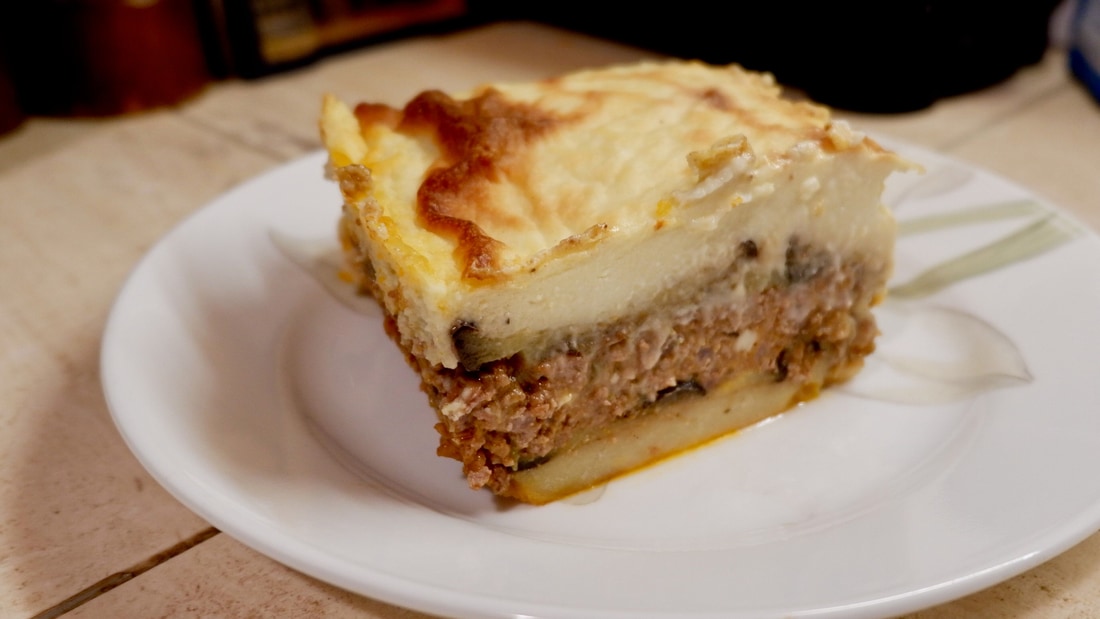
Moussaka is a baked dish based on layers of eggplant or potato and ground meat, with a milk-based sauce on top. Nikolaos Tselementes created the modern version with béchamel sauce. Gemista refers to stuffed vegetables in Greek cuisine, and dolmades belong to the family of stuffed dishes that use vegetables or leaves as wrappers. Both dishes reward patient preparation.
Souvlaki consists of small pieces of meat grilled on a skewer. Horiatiki is the Greek salad of tomatoes, cucumber, onion, olives, feta, oregano, and olive oil. Tzatziki is a dip made from salted strained yogurt mixed with cucumber, garlic, salt, olive oil, vinegar or lemon juice, and herbs. Cold and hot dishes share one table. Each preparation suits part of the meal.
- Moussaka: Layered baking shapes this dish.
- Gemista: Vegetables hold the filling.
- Tzatziki: Strained yogurt forms the base.
An Athens cooking class does not need one fixed menu to explain these dishes. Each recipe presents a different kitchen skill, from filling a tomato to balancing garlic with yogurt. A mixed menu also shows the contrast between a baked dish, a fresh salad, grilled meat, and a cool dip.
How does an Athens cooking class make Greek pies?
An Athens cooking class makes Greek pies by working with filo pastry, a thin dough used in filled dishes. Spanakopita uses spinach and feta, tiropita uses cheese, and hortopita uses wild greens. Filling and baking turn them into pies.

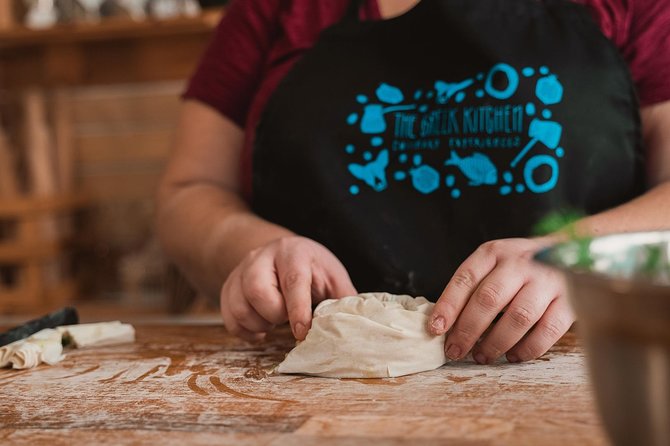
Filo is an unleavened dough that is rolled into very thin sheets. It is used in Greek, Balkan, and Middle Eastern cooking and appears in both savory pies and sweets. Flouring between layers keeps the sheets apart. An Athens cooking class can show how gentle handling preserves each sheet before a filling is added. Dough is stretched by hand or by mechanical rollers.
Spanakopita is a Greek spinach pie whose filling includes spinach and feta, and tiropita is a cheese pie. Both pies use the same thin sheets, and the filling decides the character of each baked pie. Hortopita is similar to spanakopita but uses wild greens, and nettle leaves serve as one filling for it. Both pies reward careful folding and steady hands.
- Filo: Thin sheets create the layers.
- Spanakopita: Spinach and feta fill this pie.
- Tiropita: Cheese fills this pastry.
An Athens cooking class gives pastry work a clear rhythm: prepare the filling, separate the sheets, shape the pie, and bake it. Spanakopita and tiropita show two familiar fillings, while hortopita extends the idea through greens. Crisp layers depend on careful assembly as much as on careful seasoning of the filling.
Which Greek cheeses does an Athens cooking class use?
An Athens cooking class can use feta, graviera, kefalotyri, manouri, and mizithra to show distinct cheese styles. Feta brings a brined, crumbly texture, while others bring firm, soft, or fresh forms. Their roles range from salad to grating.
Feta is a Greek white brined cheese made from sheep’s milk or a mixture of sheep and goat’s milk. Since 2002, feta has held protected designation of origin status in the European Union, which limits the name to traditional production in defined parts of Greece. An Athens cooking class can crumble feta into horiatiki or fold it into a spanakopita filling.
Graviera is a hard Greek cheese, while kefalotyri is a hard salty cheese made from sheep’s milk or goat’s milk, or both. Manouri is a Greek semi-soft fresh white whey cheese, and mizithra is a Greek whey cheese. These names distinguish aged, fresh, brined, and whey cheese on one table. Firm and fresh forms cover different tasks. Salt levels also differ.
- Feta: European Union protection covers this name.
- Graviera: This is a hard Greek cheese.
- Manouri: This is fresh whey cheese.
An Athens cooking class can make cheese selection part of recipe logic. Feta fits a salad or pie because its brined character remains clear against vegetables and pastry. A firm cheese can be grated, while a fresh whey cheese brings a softer result. The comparison adds depth to a staple of Greek meals.
Which olive oil does an Athens cooking class use?
An Athens cooking class uses Greek olive oil to season salads, enrich fillings, and support cooking. Koroneiki is a Greek olive cultivar used for oil production, while Kalamata olives are table olives. Extra virgin oil meets set criteria.
Olive oil is a major part of Greek food culture, and Greece ranks among the world’s large producers. The olive tree reached Greece in the third millennium before the common era, and evidence records olive cultivation in Crete by the second millennium before the common era. The oil dresses salads, separates pie layers, and enriches vegetables. An Athens cooking class can note how pressing shapes the result.
Koroneiki is a Greek cultivar used primarily for olive oil production and covers 50 to 60 percent of the olive acreage in Greece. Kalamata olives are large, dark purple table olives named after Kalamata in the southern Peloponnese and preserved in wine vinegar or olive oil. Table olives and pressed oil serve separate roles. Both appear on a Greek table.
- Koroneiki: This cultivar supplies olive oil.
- Kalamata: These olives are table olives.
- Extra virgin: This grade meets set criteria.
An Athens cooking class uses olive oil as more than a finishing detail. It carries herbs across a salad, helps filo layers separate, and softens cooked vegetables. The ingredient also links the modern kitchen with a long Greek agricultural history. Cultivar and table olives clarify its place in the meal.
Which desserts does an Athens cooking class bake?
An Athens cooking class can bake baklava and galaktoboureko, fry loukoumades, and serve Greek yogurt with honey. These desserts use pastry, syrup, dairy, dough, and nuts in different forms. Texture changes through layering, frying, and chilling. Results differ.
Baklava is a layered pastry dessert made with filo pastry, chopped nuts, and syrup or honey. Its sheets form a crisp structure around a nut filling before syrup is added. An Athens cooking class can connect this sweet pastry work with the filo methods used for savory pies, since one dough serves both. Nuts and syrup carry the sweet contrast.
Loukoumades are Greek doughnuts made from fried dough and coated with honey or sugar syrup. Galaktoboureko is a Greek dessert of semolina custard baked in filo and covered with syrup. Greek yogurt is strained yogurt, and honey is a food made by bees from flower nectar. These desserts compare fried dough, custard, pastry, and dairy. Each dessert needs a final step.
- Baklava: Nuts and filo form layers.
- Loukoumades: Fried dough receives sweet coating.
- Galaktoboureko: Custard sits inside filo pastry.
An Athens cooking class can finish with a dessert that fits the season and the kitchen’s pace. Baklava rewards orderly layering, while loukoumades turn small pieces of dough into a warm sweet course. Galaktoboureko adds custard technique, and yogurt with honey offers a simpler finish. Sweet courses close the shared meal.
Which wine and spirits does an Athens cooking class pour?
An Athens cooking class can pour Attica wine based on Savatiano, plus retsina, ouzo, or tsipouro alongside a shared meal. Savatiano is closely associated with Attica near Athens. Retsina uses pine resin, while ouzo and tsipouro are spirits.
Savatiano is a white Greek wine grape planted across central Greece, particularly in Attica near Athens. It is used primarily in retsina and has resistance to drought. Retsina is Greek white or rosé wine flavored with Aleppo pine resin. A local grape and this resin-flavored wine place the meal in Attica. Dry conditions suit this grape, and vineyards near Athens supply the fruit.
Ouzo is a Greek anise-flavored spirit, and Greece obtained exclusive European Union use of the name in 2006. Tsipouro is an unaged Greek brandy made from grape pomace or wine and contains 40 to 45 percent alcohol by volume. The related Athens food tour adds another route into local flavors. Small pours keep the focus on food.
- Savatiano: Attica grows this white grape.
- Retsina: Pine resin flavors this wine.
- Ouzo: Anise flavors this Greek spirit.
An Athens cooking class can use drinks to place a meal in its regional setting. Savatiano ties the table to Attica, and retsina carries a defined resin flavor. Ouzo and tsipouro open a separate discussion about distillation and grape products. Each pour forms part of a composed shared Greek meal.
How does an Athens cooking class reflect Greek food history?
An Athens cooking class reflects Greek food history through ancient ingredients, Byzantine and Ottoman influences, later cookbook writing, and shared Mediterranean customs. The class can connect a dish with this long food record. UNESCO listed the diet in 2010.
Ancient Greek cuisine used cereals, olives, olive oil, wine, fish, pulses, vegetables, fruit, and honey, and it rested on the Mediterranean triad of cereals, olives, and grapes. Byzantine cuisine continued local ancient Greek, ancient Roman, and Mediterranean cooking, while Ottoman cuisine formed across the Ottoman Empire. Recipes changed across eras and trade routes. Byzantine trade brought grains, fruits, vegetables, and spices.
Nikolaos Tselementes was a Greek cook and cookbook author who published a cookery book in 1930, and he created the modern version of moussaka with béchamel sauce. The Mediterranean Diet is associated with simple but varied cooking methods, communal meals, and regular physical activity. The surname Tselementes is used in Greece as a synonym for a cookbook. The Crete cooking class offers a further regional setting.
- Ancient Greece: Olives and wine were staples.
- Byzantium: Eastern Roman cooking shaped food.
- Tselementes: His writing influenced modern cuisine.
An Athens cooking class presents history through active kitchen work. A dish can carry ingredients with ancient roots, a pastry style shared across eastern Mediterranean cooking, and a modern sauce shaped by cookbook culture. UNESCO’s recognition places food beyond recipes alone, including harvesting, processing, cooking, and the sharing of a meal.
Which herbs and spices does an Athens cooking class use?
An Athens cooking class uses oregano, thyme, mint, dill, and bay leaf, plus cinnamon and cloves in meat dishes. Two regional products add depth: red saffron from Kozani and mastic resin from Chios, each protected by a European Union designation.
Greek oregano, the subspecies hirtum, is a common source of cultivars and is considered the best all-purpose culinary subspecies. In Greece, dried and ground leaves go into the lemon-olive oil sauce that accompanies fish or meat grills and casseroles. An Athens cooking class can also pair oregano with thyme in a creamy feta sauce with garlic, olive oil, and lemon juice.
Greek recipes, especially in the northern parts of the country, use sweet spices together with meat, such as cinnamon, allspice, and cloves in stews. Soutzoukakia Smyrneika, oblong beef meatballs made with cumin and cinnamon, simmer in a rich tomato sauce. An Athens cooking class can set these spices beside tomato and meat so sweet and savory notes meet in one pot.
An Athens cooking class can present Krokos Kozanis, the saffron of Kozani in Western Macedonia. The town of Krokos, south of the city of Kozani, is famous globally for high-quality saffron, and the product holds protected designation of origin status. No other region of Greece produces red saffron. Greek traders brought the plant from Austria to Kozani in the 17th century.
Mastic is the dried resin of the evergreen shrub Pistacia lentiscus. Grown on the Aegean island of Chios, it is known as the tears of Chios. The flavor is bitter at first, then turns refreshing, similar to pine and cedar. In Greece, mastic goes into liqueurs, breads, cheese, desserts, and a spoon sweet called the submarine. Masticha Chiou holds a protected designation of origin.
- Mint: Lahanodolmades, baked cabbage rolls, carry mint and parsley.
- Dill: Prasorizo, a dish of leek and rice, takes dill.
- Bay leaf: Stifado, a casserole with baby onions, includes bay leaf.
An Athens cooking class ties each herb and spice to a named dish. Oregano and thyme season sauces, mint, dill, and bay leaf flavor rolls, rice, and casseroles, cinnamon and cloves go into stews and meatballs, and saffron from Kozani and mastic from Chios mark two protected regional products of Greece.
When is the best season for an Athens cooking class?
An Athens cooking class works across the calendar because Athens has a hot-summer Mediterranean climate and Greek cooking follows produce. Spring greens, summer tomatoes, autumn grapes, and winter pulses give each menu direction. Lent and Easter bring customs.
Athens has a hot-summer Mediterranean climate, with a mean annual temperature of 19.2 degrees Celsius at the National Observatory of Athens station near the city center. Warm-season ingredients fit salads and stuffed vegetables, while cooler days suit pies and pulses. Each period gives the kitchen a different starting point. A rain shadow from the Pindus range keeps the basin dry.
Great Lent is the fasting period before Pascha in the Eastern Orthodox Church, and Clean Monday marks its start. This period brings vegetable dishes, pulses, olives, bread, and seafood into focus. An Athens cooking class can follow the calendar through seasonal produce and these fasting customs, then return to ordinary cooking after the feast. Bread and pulses fill the fasting table.
- Spring: Greens suit pie fillings.
- Summer: Tomatoes fit stuffed vegetable dishes.
- Lent: Fasting precedes Pascha.
An Athens cooking class has no single required season. The best fit depends on whether the desired menu centers on fresh vegetables, pastry, sweets, or a holiday tradition. Athens’s climate supports a year-round city setting, and seasonal produce changes the ingredients on hand. Each period suits a different Greek meal.
What do travelers ask about an Athens cooking class?
An Athens cooking class raises practical questions about vegetarian food, children, recipes, dietary needs, and pairing cooking with sightseeing. Clear planning keeps the activity focused on its menu and setting. The answers connect these topics with Greek dishes.
Does an Athens cooking class include vegetarian food?
An Athens cooking class can center on vegetarian dishes such as horiatiki, spanakopita, tiropita, gemista, and tzatziki. A meat-free menu still involves chopping, filling, folding pastry, and sharing a meal. The list shows how a full Greek table can work without meat.
Can children join an Athens cooking class?
An Athens cooking class can give children supervised tasks such as washing produce, mixing a filling, or folding pastry. The activity works best when each task matches the child’s age and kitchen safety needs. A family menu keeps the shared meal central.
Does an Athens cooking class provide recipes?
An Athens cooking class can record the dish names, ingredients, and preparation sequence used at the kitchen table. This helps participants repeat the sequence later. Recipes for moussaka, gemista, filo pies, salad, and tzatziki use a clear order of work from preparation to seasoning.
Can an Athens cooking class handle dietary needs?
A menu can be adapted when dietary needs are communicated before cooking begins. Greek dishes use ingredients such as pastry, dairy, nuts, fish, meat, olive oil, vegetables, and herbs. Clear notice lets the kitchen select a suitable dish for the table.
Can an Athens cooking class pair with sightseeing?
An Athens cooking class pairs with sightseeing because the old town of Athens holds Monastiraki Square and the Church of the Pantanassa, and the Acropolis stands above the city center. A food activity fits an urban walk nearby. The cooking portion returns to ingredients and a shared Greek meal.
Featured photo: Key West Wedding Photography, CC BY 2.0, via Wikimedia Commons.