
A Crete wine tour visits the vineyards and wine villages of Crete, from the Peza and Archanes hills south of Heraklion to Sitia in the east and the slopes around Chania in the west, where native grapes have been pressed since Minoan times. This post covers what a Crete wine tour includes, the native grape varieties, Peza, Archanes, Dafnes, Sitia, Chania and west Crete, the Minoan wine press at Vathypetro, the history of Cretan wine, food pairings, tsikoudia, olive oil tastings and the best season. It is one of the Greece tours on Greece VIP.
Each section ends with a Crete wine tour that can be booked online.
What does a Crete wine tour include?
A Crete wine tour covers vineyards, cellars and tastings on Greece’s largest island, where wine has been made since the Minoans of the Bronze Age. Each Crete wine tour follows the island’s wine areas from Chania in the west to Sitia in the east.
Crete is the largest island in Greece and the fifth largest in the Mediterranean Sea. It spans 260 km from west to east, so a Crete wine tour focuses on one or two wine areas at a time. The island makes 20% of Greek wine, mostly in the Peza region. Cretan winemaking is also old, because the Minoans were certainly making wine by the Bronze Age.
Crete has four regional units, which run from west to east as Chania, Rethymno, Heraklion and Lasithi. In Chania, the red Romeiko grape thrives around Kissamos. Vidiano grows mainly around Rethymno and then around Heraklion, and Kotsifali grows mainly in the Heraklion unit. The named appellations are Peza, Archanes, Dafnes and Sitia, and Sitia belongs to Lasithi, the easternmost unit. This spread is why a Crete wine tour from Chania to Sitia tastes such a wide range of styles.
Soil and climate set Crete apart from the volcanic vineyards of Santorini. A Santorini wine tour crosses a volcanic terroir, while a Crete wine tour moves over limestone land in the mountain ranges, from dense clay to sandy loam. Summers are hot and sunny, and winters are mild and rainy. Hot winds arrive from North Africa, and the Aegean Sea sends cooling breezes from the north.
- Half-day tour: Stays inside one wine area and pairs a vineyard visit with a tasting.
- Full-day tour: Links two wine areas, for example Rethymno and Heraklion, where Vidiano grows.
- Private tour: Lets one group set the route, the grapes and the pace.
- Tour with food: Serves Cretan dishes beside each wine at the table.
A Crete wine tour joins geography, grapes and history in one route. The format sets how much ground the tour covers, and the wine area sets which grapes appear in the glass. The sections below name the native grapes and then turn to the Peza area, where Crete makes the main share of its wine.
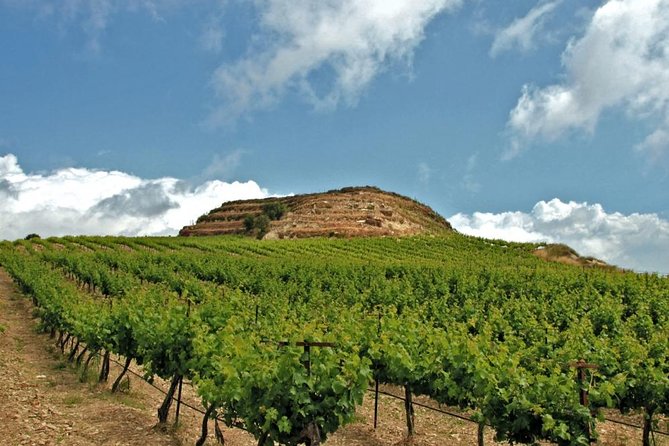


Which grape varieties does a Crete wine tour taste?
A Crete wine tour tastes native grapes, led by the whites Vidiano, Vilana and Thrapsathiri and the reds Kotsifali, Mandilaria, Liatiko and Romeiko. Each variety differs in colour, acidity and aroma, so one Crete wine tour covers a wide range of Cretan wine styles.
Vidiano is a white grape indigenous to Crete. Its wine shows complex aromas of peach, apricot, melon, honey and herbs, with moderate acidity. The grape is difficult to cultivate, so plantings stay small, mostly in Rethymno and then around Heraklion. Vidiano thrives in dry, well-drained, calcareous soil of modest fertility. A Crete wine tour that visits Rethymno or Heraklion is the natural place to taste it.
Vilana is a white grape planted primarily in Crete, and it is also difficult to cultivate. Its delicate wines are rarely seen outside Greece, and the grape also goes by the names Belana and Velana. Thrapsathiri abounds on the island, resists drought, ripens late and gives very aromatic wine with soft acidity. In the past growers blended it with Vilana, but it is now increasingly bottled alone. Vidiano is genetically close to both, so the three whites form a family of related wines.
Kotsifali is a red grape indigenous to Crete, grown mainly in the Heraklion regional unit. Alone, it gives a moderately red wine with high alcohol and rich flavor. Blended with Mandilaria, it gives a ruby dry wine with pleasant taste and aroma that needs minimal aging. Mandilaria grows on Crete and Rhodes, carries deep colour and firm tannin, and blends with other grapes to soften the mouthfeel. Both grapes belong on any Crete wine tour that tastes reds.
Liatiko is an old red grape with pale red colour, moderate acidity and rich aromas and sugars. It matures in July, and one explanation links its name to the Greek word for July. Blended with Mandilaria and Kotsifali, it made Malvasia, a very alcoholic sweet red that Venetian traders exported in the Middle Ages. Romeiko is a red grape of Chania, where it thrives around Kissamos. Its vines ripen late and give high yields, and the grape also makes the traditional marouvas wine, which resembles sherry.
- Vidiano: The berries ripen early, have thick skin and show moderate resistance to downy mildew.
- Thrapsathiri: Growers once treated it as a clone of Athiri, but DNA analysis shows a distinct variety.
- Kotsifali: The grape also grows sporadically on the Cyclades.
- Liatiko: Experts discount a family link with the Italian variety Aleatico despite the similar name.
- Romeiko: The name comes from Romios, the word for modern Greeks, which means a Roman citizen of the former Byzantine Empire.
Together, these grapes cover white and red, dry and sweet, light and tannic styles. Each area of the island favours its own varieties, with Romeiko in Chania, Vidiano around Rethymno and Heraklion, and Kotsifali in the Heraklion unit. A Crete wine tour that crosses two units therefore tastes a different set of grapes at each stop.
What is the Peza wine area on a Crete wine tour?
A Crete wine tour reaches the Peza wine area, one of four named Cretan appellations beside Archanes, Dafnes and Sitia. Crete makes 20% of Greek wine, mostly in Peza, so the area carries the main share of the island’s output.

An appellation names a wine area and assures buyers of its origin. Greek legislation established its appellation laws in 1971 and 1972. The system defines the protected designation of origin, or PDO, as an appellation of origin of superior quality. Peza appears among the main Greek appellations listed under Crete. A Crete wine tour in Peza therefore tastes wine whose origin the law defines.
Peza matters because of volume. Crete produces 20% of Greek wine, and it is made mostly in the Peza region. A Crete wine tour of Peza therefore shows winemaking at working scale, from vineyard to cellar to tasting table. Archanes, Dafnes and Sitia complete the set of four Cretan appellations, and each adds a separate area to the island’s wine map.
A Crete wine tour near Heraklion meets the grapes that grow in that regional unit. Kotsifali is mainly grown there, and blended with Mandilaria it gives a ruby dry red that needs minimal aging. Vidiano grows around Heraklion as well, after Rethymno. Soil helps: calcisol soils in the mountain ranges let vine roots grow deep and reach water and mineral resources.
- Tier: The PDO is defined as an appellation of origin of superior quality.
- Neighbours: Archanes, Dafnes and Sitia are the other three Cretan appellations.
- Location: Peza is listed under Crete among the main wine-growing appellations of Greece.
- Legal base: Appellation laws date from 1971 and 1972.
Peza is the volume centre of Cretan wine, and the other three appellations add range around it. A Crete wine tour that includes Peza shows how Greek appellation law, native grapes and the island’s climate fit together. The other appellations then show how each area changes the glass. Together they turn a Crete wine tour from a single tasting into a map of the island.
What does a Crete wine tour see at Archanes?
A Crete wine tour at Archanes reaches a village in the Heraklion regional unit that gives its name to one of four Crete wine appellations. Mount Juktas rises above the town, and Minoan roads and palace remains surround it. Grapes and olives drive the local farm economy.
Archanes is a former municipality in the Heraklion regional unit. Since the 2011 local government reform it has been a municipal unit inside Archanes-Asterousia. Greek wine references list Archanes among the Crete appellations, beside Dafnes, Peza and Sitia, and name Protected Designation of Origin as one category of the national appellation system. A Crete wine tour here visits a named wine zone, not only a farming village.
The local economy revolves around grape and olive processing and marketing. The two crops together make up 96% of the farm products of the area. A farming cooperative set up in 1931 is one of the oldest in Greece. A quarter of the wine output goes to Germany, France and the Netherlands, and the rest is largely sold at home. A Crete wine tour sees this trade at its source.
Mount Juktas rises 811 metres above the town of Archanes, south of Heraklion. It counts as a major peak sanctuary of the Minoan world. Archaeologists found clay figurines, stone horns, stone altars, bronze double axes and Linear A inscriptions there. A Greek Orthodox chapel stands about a kilometre south of the sanctuary along the ridge, and people from the plains below bring flowers to it in procession every year.
Archanes was a hub of the region in Minoan times. Ancient roads ran from it to Juktas, Anemospilia and Xeri Kara. Excavation has gone on since 1966. At Tourkoyeitonia in the centre, diggers found a palace site with ashlar blocks, frescoes, wooden columns and carved altars. A Crete wine tour in the town therefore stands inside the area of an ancient Minoan settlement.
- Appellation: Greek wine references list Archanes among the Crete wine regions.
- Mountain: Mount Juktas stands 811 metres above the town and holds a Minoan peak sanctuary.
- Palace site: Tourkoyeitonia has been excavated since 1964.
For a Crete wine tour, Archanes packs three subjects into one small area: a listed wine appellation, a mountain with a Minoan peak sanctuary, and a town built over an ancient settlement. Vineyards, olive groves and excavated stone share the same landscape, so one stop covers farming, religion and archaeology together.
What does a Crete wine tour see around Dafnes and the Heraklion wine country?
A Crete wine tour around Dafnes visits a ridge village 18 km southwest of Heraklion, known since the 13th century for sweet red wine made from the Liatiko grape. The wider Heraklion regional unit adds farmland, mountains, eight municipalities and the Minoan palaces of Knossos and Phaistos.
Dafnes lies 18 km southwest of Heraklion, at an altitude of 320 metres. The village sits on a ridge in the eastern foothills of Mount Psiloritis, immediately east of Greek National Road 97. It is an agricultural centre that produces sultanas, grapes, wine, spirits, vegetables and olive oil. A Crete wine tour here also finds the Dafnes name on the list of Crete appellations.
Since the 13th century Dafnes has been known for rich, sweet red wines made from Liatiko. The grape is an old red variety of Crete. Its berries are pale red, moderate in acidity and rich in aromas and sugars. Liatiko matures in July, and one explanation ties its name to the Greek word for “of July”. In the Middle Ages it went into blends with Mandilaria and Kotsifali that made Malvasia, a strong sweet red that Venetian traders exported widely.
The central plaza of Dafnes is shaded by large eucalyptus trees and ringed by cafes and kafenia. It is also the main site of the Dafnes Wine Festival, which is normally held in July. Greek wine references describe Liatiko as carrying flavours of red fruit and spices, and as at its best when made sweet. That description tells a Crete wine tour what to expect from the local glass.
Dafnes is one village inside the Heraklion regional unit, one of the four regional units of Crete, with the city of Heraklion as its capital. Farmland fills the central and northern parts, the coast and the valleys, while mountains dominate the rest, notably the south. The white Vidiano grape grows on a small scale, chiefly around Rethymno and Heraklion, which gives a Crete wine tour a second grape to follow.
- Village: Dafnes stands at 320 metres on a ridge below Mount Psiloritis.
- Grape: Liatiko is the red variety behind the sweet Dafnes wines.
- Festival: The Dafnes Wine Festival is normally held on the central plaza in July.
Around Dafnes, a Crete wine tour links one grape, one ridge village and a large regional unit. Liatiko supplies the wine story, the plaza supplies village life, and the Heraklion regional unit supplies the setting of farmland, high mountains and Minoan palace sites. Eight municipalities share its territory, and the palaces of Knossos and Phaistos lie inside its borders.
What does a Crete wine tour see at Sitia?
A Crete wine tour at Sitia reaches the eastern end of the island’s wine map, where a port town, a Venetian fortress and the Lasithi countryside surround one of four Crete appellations. The grape names come from Cretan wine references, which cover the island as a whole.
Greek wine references list Sitia as one of four Crete appellations, together with Archanes, Dafnes and Peza. The town of Sitia is a port in Lasithi, east of Agios Nikolaos and northeast of Ierapetra, and its municipality covers 627 square kilometres. The references give no grape list for the Sitia appellation, so a Crete wine tour here relies on the general Cretan varieties.
Among the reds, Liatiko is native to Crete, Kotsifali is mainly grown on the island, and Mandilaria is mainly cultivated on Rhodes and Crete. Mandilaria wine can be very tannic and is frequently blended with other grapes to soften the mouthfeel. Vidiano is a white grape indigenous to Crete, with aromas of peach, apricot, melon, honey and herbs. These names form the vocabulary of any Crete wine tour in the east.
The town of Sitia has 11,166 inhabitants and a port on the Sea of Crete. A Crete wine tour here meets a place that has not experienced the effects of mass tourism, even though a long beach runs along the road to Vai. The Venetians expanded and fortified the town after they acquired Crete in 1204. The Kazarma, the old fortress overlooking the harbour, is the main remnant of that period.
Lasithi is the easternmost regional unit of Crete, so a Crete wine tour in Sitia works in the east of the island. The Lasithi Plateau, at the foot of Mount Dikti, is famous for its windmills, and Vai is known for its date palm forest. Sitia has a hot-summer Mediterranean climate, with hot, dry summers and mild, rainy winters. The Richtis Gorge and the Gorge of the Dead at Kato Zakros lie in the same municipality.
- Appellation: Sitia is one of four Crete wine appellations in the Greek system.
- Fortress: The Kazarma overlooks the harbour as the main Venetian remnant.
- Countryside: Lasithi holds the Lasithi Plateau, the Vai palm forest and Minoan ruins at Zakros and Gournia.
The Sitia designation closes the eastern end of a Crete wine tour. The appellation sits in the east of the island, the town keeps its Venetian fortress, and the Lasithi countryside adds a plateau, gorges, a palm forest and Minoan ruins. The grape facts apply across Crete, so the east fits into the same wine story as Archanes and Dafnes.
What does a Crete wine tour see around Chania and west Crete?
A Crete wine tour in the west covers the Chania regional unit, which fills the far western quarter of Crete. It follows the Romeiko grape through the vineyards of the unit, Apokoronas and Kissamos, with the White Mountains forming the backdrop.
Romeiko is a red grape variety indigenous to Greece. Its name comes from Romios, the word for a modern Greek, which literally means a Roman as a citizen of the former Byzantine Empire. The vine grows on Cycladic islands and on Crete. It grows prominently in the Chania region and above all in Kissamos, where it thrives. A Crete wine tour in the west therefore begins with a grape that carries a Byzantine name.
Romeiko vineyards are late maturing and high-yielding. Their grapes give a high-Baumé must, which producers mix with other varieties to make red, rosé and white wines. The grape also goes into marouvas, a traditional wine that resembles sherry. Greek wine references list Romeiko among the red grapes of Crete and place it above all in the Chania region. One grape can fill three colours of glass on a Crete wine tour.
The Chania unit grew out of a prefecture created while Crete was an autonomous state, and the Kallikratis reform of 2011 gave it its present form. Apokoronas sits on the north coast, east of Chania town, with Cape Drapanon rising on its edge. The Kiliaris river, called Pyknos in antiquity, crosses it. Kissamos fills the far west. A Crete wine tour links these two districts by the coast road.
Limestone peaks make up the White Mountains, which Greek maps call Lefka Ori. Snow caps them into late spring. Mount Pachnes, at 2,453 metres, is the highest peak of the range and the second highest on Crete. Mount Agkathes reaches 1,511 metres in the east, and Mount Agios Dikaios reaches 1,182 metres in the far west. Rivers from these slopes reach the north coast, and the Tavronitis, Keritis, Koiliaris and Almiros are among them.
- Grape: Romeiko, a red variety indigenous to Greece, thrives around Chania and in Kissamos.
- Unit: The Chania regional unit borders only Rethymno and has the Cretan Sea to its north.
- Plain: Apokoronas stretches from the White Mountains foothills to the north coast.
- Peak: Mount Pachnes in the White Mountains stands 2,453 metres above sea level.
A Crete wine tour in the west rests on one grape and one landscape. Romeiko supplies the wine, and the Chania regional unit supplies the setting, from the Apokoronas coast to Kissamos at the far end of the island. The White Mountains frame both. Each stop on a Crete wine tour here joins a taste in the glass to a place on the map.
Why does a Crete wine tour stop at Vathypetro?
A Crete wine tour stops at Vathypetro because the site holds wine presses among the oldest in the world. The archaeological site lies four kilometres south of the town of Archanes, and its Minoan villa shows wine and olive work on a Bronze Age estate.
Vathypetro is an archaeological site on Crete, four kilometres south of the town of Archanes. The Greek archaeologist Spyridon Marinatos began the excavations in 1949. The estate has a manor house, or villa, which played a prominent role in the rural region around Archanes. Archanes is one of the appellations of Crete, so a Crete wine tour that stops in the town adds the site to the same route.
A group of buildings, courtyards and workshop spaces makes up the complex. Beside the individual houses stand the Minoan wine press, a factory for processing olives, a Minoan kiln with its ceramics and the remains of an ancient pottery workshop. The layout shows a farm estate that handled wine, oil and clay goods in one place. A Crete wine tour reads the press as part of that daily farm routine.
Wine had a place in Minoan Crete beyond one estate. The Minoans built a Bronze Age society on Crete and grew grapes, figs and olives. Linear B tablets point to the weight of orchards of figs, olives and grapes in making secondary products. Historians place the fermenting of wine within the palace economies, where wine served as a trade commodity and as an item of domestic consumption.
- Site: Vathypetro lies four kilometres south of the town of Archanes, an appellation of Crete.
- Dig: The Greek archaeologist Spyridon Marinatos opened the excavations in 1949.
- Press: The Minoan wine press stands beside the houses of the estate, next to an olive-processing factory.
- Trade: The Minoans exported agricultural products and luxury crafts in exchange for raw metals.
Vathypetro gives a Crete wine tour its oldest chapter. The press beside a Minoan villa shows that grape processing sat inside the routine of a Bronze Age estate, next to olives and pottery. Evidence of Greek wine goes back 6,500 years, and Vathypetro sits inside that long line. Later stops on a Crete wine tour pick up the story in the Venetian and modern periods.
What history lies behind a Crete wine tour?
A Crete wine tour covers a history that begins with Venetian Candia and its trade in sweet malmsey wine. The Ottomans took Candia in 1669, phylloxera damaged Malvasia vineyards in the late 19th century, and Greek appellation laws followed in 1971 and 1972.
The Byzantine Empire held Crete until 1204, when the Fourth Crusade broke the empire apart. On 12 August 1204 the Venetians acquired the island from Boniface of Montferrat, and they had secured it by 1212. The colony became the Kingdom of Candia, named after its capital, which is modern Heraklion. It exported mainly wheat and sweet malmsey wine, with timber and cheese in smaller amounts. A Crete wine tour opens its story here.
The name Malvasia comes from the Italian name for Monemvasia, a Byzantine fortress port in southern Greece. Venetians dealt so heavily in Malvasia wine that the wine-shops of Venice were called malvasie. Malmsey ranked among the three major wines exported from Greece in medieval times, and wine shipped from Crete fetched high prices in northern Europe. The Italian variety Malvasia Bianca di Candia means white malmsey of Crete.
Clashes between Venice and the Ottomans started once Constantinople fell in 1453. In June 1538 the admiral Hayreddin Barbarossa captured Apokoronas and besieged Chania without success. The Ottoman conquest of Cyprus in 1571 left Crete as the last major Venetian overseas possession. In the Cretan War, from 1645 to 1669, the Ottomans overran the island, and the last Venetian outposts fell in 1715. Crete joined Greece in 1913.
Phylloxera, a vine pest, devastated the vineyards of Madeira in the late 19th century. Malvasia de Sitges, grown in Catalonia, had been widely exported until the pest arrived. Greece set up a Wine Institute in 1937, and its first Cabernet Sauvignon vineyard was planted in 1963. Appellation laws followed in 1971 and 1972, and the Cretan appellations now include Archanes, Dafnes, Peza and Sitia. A Crete wine tour covers all of these steps.
- Rule: Venice ruled Crete as the Kingdom of Candia until the Cretan War ended in 1669.
- Blend: Liatiko, Mandilaria and Kotsifali went into Malvasia, a sweet red wine that Venetians exported widely.
- Cuttings: Venetian merchants carried Malvasia cuttings from Greece to Istria.
- Laws: Greek law created the appellation system in 1971 and 1972.
The history behind a Crete wine tour runs from the Fourth Crusade to the appellation laws of the 1970s. Venetian Candia sold sweet malmsey abroad, and Ottoman rule followed in 1669. The twentieth century brought the Wine Institute, new vineyards and the legal system of origin names. Each period leaves a trace in what a Crete wine tour pours and explains.
What food does a Crete wine tour pair with the wine?
A Crete wine tour pairs the wine with plain Cretan dishes: dakos, graviera and other Cretan cheeses, olive oil, wild greens and snails. The menu follows the old island pattern, in which plant food led the diet and red wine stood beside the meal.
Cretan cuisine sets the plan for the food on a Crete wine tour. Its traditional core was plant food, taken from the local area in season and processed little or not at all. Pulses, fruit, rough cereals and wild herbs formed the base. Poultry and fish reached the table weekly, while red meat stayed rare. The island also used alcohol in moderate amounts, mainly red wine, and it accompanied meals.
Dakos is a Cretan version of the horiatiki, the Greek salad. It is built on paximadi, a barley rusk that water or olive oil softens, and the rusk takes garlic and sea salt as seasoning. Tomatoes, feta or mizithra and dried oregano go on top. Its second name, koukouvagia, means owl, and its third, kouloukopsomo, joins the Greek words for pup and bread. A Crete wine tour can serve dakos as a plain starter beside the glass.
Graviera is a hard cheese that Greece makes in four main places: Crete, Lesbos, Naxos and Amfilochia. Each wheel carries the crisscross pattern of its draining cloth on the rind. The Naxos kind is mostly cow’s milk, while the Cretan kind comes from sheep’s milk. On a Crete wine tour, thin slices of Cretan graviera sit on the board next to the wine.
- Dakos: A soaked rusk, tomato, soft cheese and oregano open the tasting table.
- Cheese: Graviera also goes into casseroles, and it can be shaved into salads.
- Greens: Wild greens such as stamnagathi sit on the appetizer list of Cretan cuisine.
- Snails: A Crete wine tour menu lists two snail dishes: one fries the snails with rosemary and vinegar, and the other cooks them with tomato.
A tasting plate is a short lesson in Cretan food. Each dish comes from the same plant-led kitchen, so a rusk, a cheese, an oil, a green and a snail share one logic. For a closer look at Cretan food in western Crete, a Chania food tour includes market stalls and kitchens. A Crete wine tour keeps its plates plain, and the wine stays the main subject.
What is tsikoudia on a Crete wine tour?
A Crete wine tour meets tsikoudia as the grape pomace spirit of Crete, a fragrant brandy distilled from the pressed grapes left over once the wine is made. Home distillers make it in the autumn, and Cretan hosts serve it chilled after a meal as a courtesy.
Tsikoudia is the brandy of Crete. It belongs to the family of pomace spirits, which come from the grape remains left in the press, so it shares a cellar with the wine. Its Greek name is the word for terebinth. In the east of the island, people say raki instead. The two names point to one spirit, and a Crete wine tour can use either name.
Tsipouro from mainland Greece is a similar spirit. Further afield, the family includes Spanish orujo, Italian grappa, French marc, Georgian chacha, Turkish rakı, Albanian rakia and Hungarian törköly. Tsikoudia keeps to one distillation and adds nothing, which leaves more of the grape in the glass. Because villagers make it at home, strength and character differ from one producer to the next.
Distilling is an autumn job. The kazani is the main pot of a traditional still, the vessel that takes the fermented pomace. The Cypriot spirit zivania uses the same word for its still pot, and its stills resemble those used for tsikoudia on Crete. On Crete, the work runs without a pause from late October into the first days of November.
Tsikoudia is also a gesture of welcome. When a Cretan restaurant clears the table, a cold glass of it commonly follows at no charge, with fruit or a sweet beside it. The spirit comes from a freezer, so it arrives chilled, and the glass is a courtesy of the house. A Crete wine tour carries that custom into the tasting by ending the table with a small glass.
- Origin: Tsikoudia comes from pomace, the grape remains left in the press.
- Method: The spirit goes through a single distillation, with no spices or other flavourings added.
- Serving: Tsikoudia is served chilled, as a free digestif at the end of a Crete wine tour meal.
Tsikoudia shows where the grape goes after the wine is made. The remains of the press become a spirit, village distillers run it each autumn, and hosts give it away at the end of a meal. A Crete wine tour that includes tsikoudia follows the whole path of the grape on the island, from the vineyard and the cellar to the kazani and the table.
Which olive oil tastings can a Crete wine tour add?
A Crete wine tour can add olive oil tastings based on Chania Kritis PGI, the protected extra virgin oil of western Crete, and on the ancient olive tree of Vouves. Each tasting sets the oil beside the wine, so fruit, bitterness and pepper can be compared.
Olive growing on Crete became particularly intense after the palace period and played an important role in the island’s economy. Two EU labels now mark oils tied to a place: protected designation of origin and protected geographical indication. They cover oils whose quality comes from their place of origin and their way of production. A Crete wine tour can add a tasting of an oil that carries one of them.
Chania Kritis PGI is an extra virgin oil from western Crete, and its label applies to the Chania prefecture. It carries two olive varieties, Koroneiki and Tsounati. Koroneiki also goes by local names on Crete, among them Kritikia, Ladolia and Lianolia. Dakos names Koroneiki, Lianes and Tsounates among its olives, so a Crete wine tour can taste the same fruit in the oil and in the salad.
The olive tree of Vouves is hard to date. Its heartwood has been lost, so radioisotopes cannot be used. Tree ring analysis shows at least 2,000 years, and scientists from the University of Crete estimate 4,000. Two cemeteries from the Geometric Period lie near the tree. Its trunk measures 12.5 metres around and 4.6 metres across. The tree still bears olives, grafted with the Tsounati cultivar. A Crete wine tour in the west can add the tree as a stop.
A tasting sets oil next to wine so that the two can be compared. The taste of the oil depends on how ripe the olives are when picked, as the fruit turns from green to violet and then black. Polyphenols give the oil a slightly bitter taste, and a peppery note tells tasters that polyphenols run high. A Crete wine tour tasting serves the oil raw, beside the wine.
- Oil: Extra virgin olive oil is judged for fruitiness and for the absence of defects.
- Unfiltered: Fresh unfiltered oil looks slightly cloudy, and labels that say so point to a different taste.
- Museum: A museum of olive cultivation opened in October 2009 in a nearby 19th-century house, with traditional tools on display.
Olive oil tastings add the plant that feeds the Cretan table to a wine route. The protected oil of Chania shows how place shapes an oil, and the tree of Vouves shows how old an olive tree on the island can be. A Crete wine tour that includes both ties the wine of Crete to its oil, its food and its land.
When is the best season for a Crete wine tour?
A Crete wine tour fits the harvest months and the dry, sunny months best. The island has hot, sunny summers and mild, rainy winters, and the grape harvest in the Northern Hemisphere runs from August to October. Spring is the calmer alternative, with no grapes on the vines.
The climate sets the vineyard year, and every Crete wine tour follows that year. Crete falls mainly in the Csa class, a Mediterranean climate with a hot summer, and its winter is fairly mild. The weather brings hot, sunny summers and mild, rainy winters. Limestone soil, hot winds from North Africa and cooling breezes off the Aegean Sea complete the picture. These conditions split the year into a sunny half and a rainy half.
The weather changes across the island, so the season for a Crete wine tour changes with the area. The south coast, with the Mesara Plain and the Asterousia Mountains, has significantly more sunny days and higher temperatures through the year. The Chania province in the west gets more rain than the east, and erosion hits its soil harder. A hot semi-arid climate, class BSh, covers parts of the south and east.
The grape harvest closes the summer. Across the Northern Hemisphere, picking runs from August to October, and the bulk of it comes in late August to early October. Warmer regions pick earlier, and Crete lies south of almost the rest of Greece. Ripeness decides the date, measured by sugar, acid and tannin levels, and heat, rain or hail can damage the crop. Late-harvest grapes are picked throughout the autumn. In late October and early November, village distillers turn the pressed grape skins into tsikoudia.
Spring is the calmer alternative. It lies between the rainy winter and the hot summer, and no grapes hang on the vines yet, since picking runs from August to October. A spring Crete wine tour therefore centres on the cellar and the wine of the previous harvest. Among weather stations, Crete also holds the European highs for four months: October, November, January and February, so the shoulder seasons stay warm.
- Climate: The island falls mainly in the hot-summer Mediterranean class, and winters are fairly mild.
- Harvest: Grapes come off the vines between August and October in the Northern Hemisphere.
- Rain: The Chania province in the west gets more rain than the east.
- Snow: Snowfall is common on the mountains between November and April, but rare in low-lying areas.
The best time for a Crete wine tour depends on what the day is meant to show. The harvest weeks bring the grapes to the cellar, spring brings the finished wine, and the dry, sunny months suit the vineyard rows. Winter stays mild, with rain on the plains and snow on the peaks. The booking page of each tour shows which dates are open, so the season can be matched to the tour.
What do travelers ask about a Crete wine tour?
A Crete wine tour raises practical questions about transport, Minoan sites, regions, wine labels, children and bottles. The answers below rest on the geography and the wine rules of the island, and the tour page holds the detail that changes between departures.
Does a Crete wine tour include a driver?
The island is long. Crete covers 260 km from west to east, and the A90 road along the north coast links Chania, Heraklion and Sitia. Tasting and driving do not mix, so the tour page states whether a driver or a transfer belongs to the day. Escorted transport keeps the wheel out of the traveler’s hands.
Can a Crete wine tour combine with a Minoan site?
Yes, because the island’s wine and its Bronze Age past share the same ground. Knossos, the largest Minoan centre, sits within the southern periphery of Heraklion. Archanes is both a wine appellation and the site of an ancient Minoan settlement in central Crete. A tour in that area can pair a cellar with an archaeological stop.
Is a Crete wine tour better from Heraklion or Chania?
Both cities serve a Crete wine tour, and they lie 145 km apart. Heraklion is the largest city on the island, with the primary airport, and the Archanes area belongs to its regional unit. Chania in the west receives more rain, and Romeiko, a red grape, is prominent around it. The choice follows the wine area wanted.
Which wines does a Crete wine tour pour?
Four Cretan appellations supply the pour: Archanes, Dafnes, Peza and Sitia. Vidiano is a white grape native to the island, and Liatiko is a native red. Labels marked P.D.O. name a protected origin, so the appellation on the bottle tells where the grapes grew and which area to look for.
Can children join a Crete wine tour?
Wine is alcoholic, so the tasting itself is for adults. Children can still join the outdoor parts of a Crete wine tour: the vineyards, the harvest weeks and the olive groves, since viticulture and olive groves are both significant on Crete. Each tour sets its own age rule, so the tour page is the place to check.
Can bottles from a Crete wine tour go home?
Cretan wine has travelled for centuries. In the 2nd century AD, Crete exported a sweet wine called protropos to Italy, and in late medieval Europe, vino di Candia was a highly valued name. Bottles bought on a Crete wine tour can follow that path, but the airline and the customs rules of the home country set the limits.
Does a Crete wine tour reach eastern Crete?
The east is within reach, because Sitia is one of the four Cretan appellations. Sitia is a port town in Lasithi, east of Agios Nikolaos, and the A90 runs there from Heraklion. The town has not experienced the effects of mass tourism, and the Minoan palace of Petras lies in its Petras neighbourhood.
Featured photo: Jules Verne Times Two, CC BY-SA 4.0, via Wikimedia Commons.