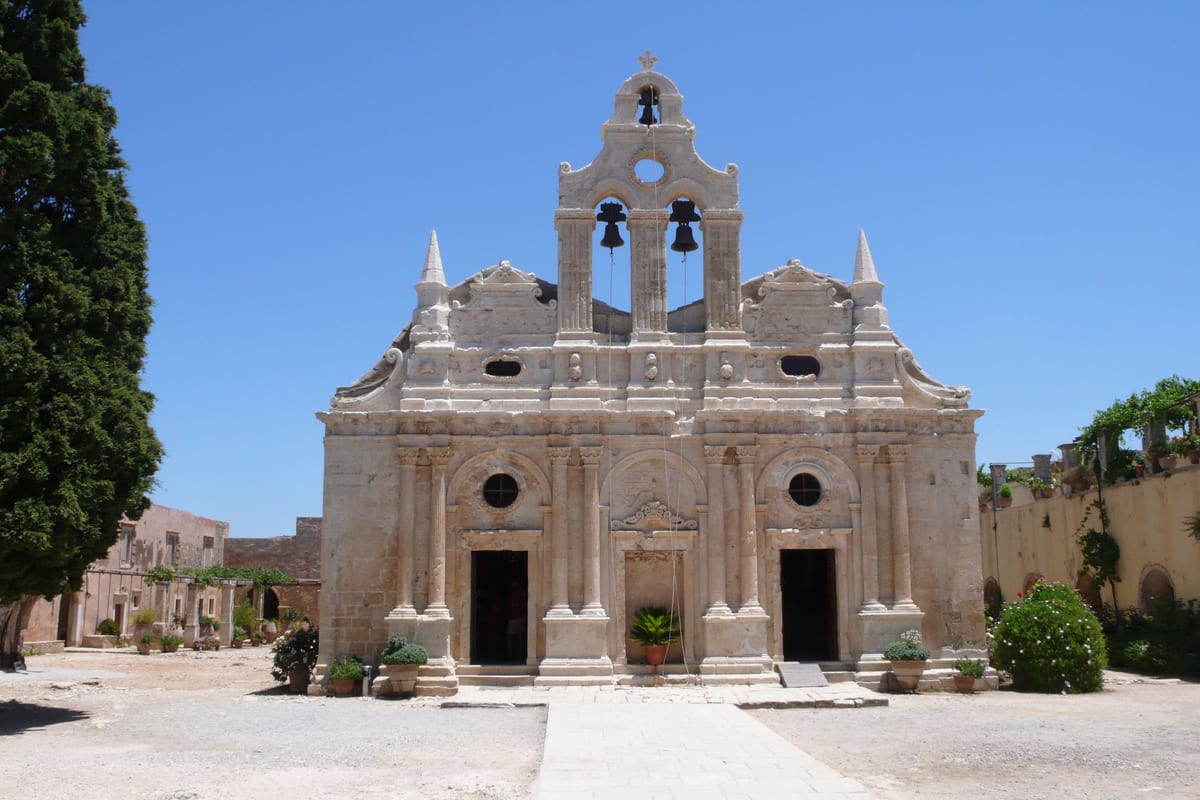
A Crete bike tour rides the roads and trails of Crete, from the towns of the north coast to the mountain plateaus and gorges. It is one of the Greece tours on Greece VIP.
This post covers what a Crete bike tour includes, where it starts and the bikes it uses. It also covers the routes, the climbs, the plateaus, the villages, the history and the gorges. Nature, wildlife, roads, weather, the best season and common questions come last.
Each section ends with a Crete bike tour or a nearby tour that can be booked online.
What does a Crete bike tour include?
A Crete bike tour comes as an e-bike day ride, mountain-bike outing, plateau descent or multi-day trip. Each format supplies the bike. A support vehicle offers lifts on self-led trips. Multi-day trips move luggage from hotel to hotel.
A Heraklion e-bike food ride caps its group at six riders. Riders must be 12 or older and at least 1.5 m tall. Rain cancels the ride.
A mountain-bike Crete bike tour from Rethymno includes transfers from and to the rider’s lodging. Its single-track program demands advanced riding skills, bike control and good fitness.
A minibus lifts riders and bikes from Chania to Omalos for one plateau-descent Crete bike tour. The ride to Palaiochora drops 1,834 m and climbs 800 m.
An escorted e-bike round trip from Heraklion takes two to eight riders. Each e-bike carries panniers. One stretch goes by minibus. It does not suit children.
One self-led Crete bike tour supplies a road or hybrid bike and GPS unit. Unlike bike tours in Athens, its drive-bike version moves riders by car.
- Weight: The food ride limits riders to 103 kg.
- Batteries: Spare batteries travel with the escorted e-bike round trip.
- Minivan: Drive-bike groups of four or more get a minivan.
Mountain-bike packages from Rethymno let riders choose any three or five listed rides.


Where does a Crete bike tour start?
A Crete bike tour starts from city bases such as Heraklion, Chania and Rethymno. Coastal towns like Hersonissos, Malia and Agios Nikolaos also host starts. Kissamos lies in the west of Crete, and Plakias sits on the south coast.
Heraklion is the largest city of all the Greek islands. Its airport handled 8,066,000 passengers in 2022.
A multi-day e-bike Crete bike tour passes through Plakias on its coastal stage. The village belongs to the municipality of Agios Vasileios.
One Heraklion e-bike food tour collects riders from hotels in Hersonissos, Malia, Stalida and Gouves. Malia belongs to the Hersonissos municipality.
A Crete bike tour from Agios Nikolaos rides into the Kroustas forest on e-bikes.
- Kissamos: An e-bike ride from Kissamos covers about 42 km.
- Height: Kissamos e-bikes fit riders of 150 to 190 cm.
- Rethymno: The town sits 17 m above sea level.
Ferries from Kavonisi port at Kissamos sail to Kythira, Gytheio and Piraeus.
What bikes does a Crete bike tour use?
A Crete bike tour uses pedal-assist e-bikes, mountain bikes or road bikes. The Greek Highway Code recommends an approved, fastened helmet but does not require one. It also asks for a white or yellow front light, plus side and pedal reflectors.
EU Regulation 168/2013 places pedal cycles with motors up to 1,000 W in class L1e-A. Greek law files this class under mopeds.
Other two-wheel mopeds form EU class L1e-B. That class caps design speed at 45 km/h and power at 4,000 W. The regulation replaced Directive 2002/24/EC on 1 January 2016.
Mountain bike frames include rigid, hardtail and full-suspension designs. A hardtail pairs a front suspension fork with a rigid rear. Fork travel now reaches up to 200 mm.
Road bikes use dropped handlebars that lower the rider and cut air drag. Their narrow, smooth tyres run at high pressure. Endurance models give a more upright position.
On a Crete bike tour, Greek law bans headphones linked to radios or similar devices while moving. A phone stays legal in motion only in a dedicated holder.
- Exemption: Daytime mountain and racing bikes need no lights.
- Children: Under-12 riders on roads need a companion aged 16-plus.
- Wheels: 29-inch mountain-bike wheels go by the name 29ers.
On a Crete bike tour, Greek law allows a child in an approved seat.
Which routes does a Crete bike tour ride?
A Crete bike tour rides plateau loops, valley circuits and coastal roads across the island. The easy Lasithi Plateau loop runs 22.5 km with 200 m of climbing. Road passes in the west and centre link both coasts.
Cyclists on tours of the Lasithi Plateau follow a circular road through 18 villages. A road loop over the Selia pass climbs 1,730 m in 99.3 km.
Near Archanes, the track up Mount Juktas climbs 274 m in 4.1 km at 6.7 percent. Seven hairpins lead to 778 m on a partly gravel surface.
In Apokoronas, a Crete bike tour rides a 15.2 km loop to Almyrida beach, climbing 280 m. A Georgioupoli harbour loop covers 44.7 km and gains 700 m.
A Crete bike tour in the Amari valley follows a 79.8 km round trip from Agia Fotini. It climbs 2,539 m and tops out at 734 m.
A paved road runs nearly 17 km from Kissamos to Falasarna beach. Leaving the beach, a Crete bike tour climbs 213 m in 4.1 km to Platanos.
- Sitia mountains: The Ziros pass climbs 670 m from Xerokampos.
- Ierapetra: A climb east of town gains 1,470 m.
- Archanes: A loop from Agia Varvara climbs 950 m.
A multi-stage ride from Agios Nikolaos to Rethymno covers 765.3 km and climbs 15,561 m.
How hard are the climbs on a Crete bike tour?
A Crete bike tour meets average grades of 3.2 percent toward Anogia and 9.6 percent at Kallikratis. The Kallikratis road packs 27 switchbacks into roughly 5 km. The Skinakas observatory road tops out at 1,737 m, Crete’s highest paved road.
From Malia, the climb to the 894 m Ambelos pass runs 17.2 km and gains 965 m. Its final 5 km rise at roughly 8 to 9 percent.
A Crete bike tour from Vrises climbs 788 m in 18.8 km to the 821 m Imbros pass. From Chora Sfakion, the south side gains 709 m.
From Heraklion, the climb to Anogia runs 22.5 km and gains 722 m. Real climbing starts near Tylissos, and the final kilometres past Sisarcha are the hardest.
A Crete bike tour from Anogia climbs 1,007 m in 19.8 km toward Nida and Skinakas. Its upper part was resurfaced from the Nida turn-off to the summit.
Above Livadia, a dead-end road climbs 12.2 km at 8.3 percent to the Lakos Migerou refuge. It ends at 1,579 m, with a steepest 100 m of 18.8 percent.
- Spili: The Soros pass climb gains 443 m.
- Kotsifou: The road from Plakias to Kanevos climbs 458 m.
- Kaminaki pass: This narrow paved road peaks at 1,264 m.
From Kallikratis, the Asfendos pass climb runs 11.3 km up to 1,104 m.
Which plateaus does a Crete bike tour cross?
A Crete bike tour crosses high plains at Lasithi, Katharo, Nida, Gious Kampos, Askifou and Omalos. Paved roads reach Gious Kampos from Spili, Kissos and Gerakari. That plain covers about 2.5 square kilometres at an average height of 750 m.
The Lasithi Plateau lies about 25 km south of Malia. Drainage channels divide its farmland into 193 squares. The Diktaia running games have used its circular road since 1980.
The narrow paved road from Kritsa to Katharo climbs 870 m in 13.1 km through holm oak forest. A dirt track continues to Malles and Selakano.
A Crete bike tour on Nida rides west of the Skinakas summit. A dirt track links the plateau with Gergeri, and the Idaean Cave lies 1.1 km away.
Kares is the first of four Askifou settlements on the road from Chania. Before it, the road peaks at Xylodema, past the Krapi plateau and Katre straits.
Omalos village counted 22 residents in 2021. From Fournes, a Crete bike tour climbs 1,057 m in 20.8 km to reach the plain.
- Ambelos pass: Its 24 stone windmills form Greece’s largest cluster.
- Askifou: Kastro rises to 2,218 m to the west.
- Gious Kampos: It lies about 31 km southeast of Rethymno.
The 1,033 m Selia pass forms the eastern road onto the Lasithi Plateau.
Which villages does a Crete bike tour pass?
A Crete bike tour passes hill villages such as Margarites, Spili, Zaros, Vamos and Gavalochori. Vamos stands at about 190 m, while Spili rises to 430 m. Each village still keeps an old craft, church, fountain, school or mill.
A Crete bike tour visits Margarites, about 27 km from Rethymno at about 300 m. It is western Crete’s largest pottery centre, with 268 residents in 2021.
Until the mid-1970s, workshops at Livadi, south of Margarites, made everyday pots each summer. In 1333, the village was the base of a revolt against Venice.
Spili, a Crete bike tour stop, lies about 25 km from Rethymno. The village had 578 residents in 2021. Its fountain pours spring water through 25 lion-head spouts.
Zaros stands at 340 m on the southern foothills of Psiloritis. Its community had 1,756 residents in 2021. The village is known for bottled water from Lake Votomos.
On a Crete bike tour, Vamos lies about 25 km from Chania. Its restored old school dates from 1863. The 2021 census counted 612 people in Gavalochori.
- Margarites frescoes: Agios Ioannis Theologos church was painted in 1383.
- Zaros mills: Its mills have worked since the 16th century.
- Gavalochori lace: Women there still make silk kopaneli bobbin lace.
Gavalochori also keeps a restored 17th-century olive mill and wells from the Venetian era.
What history lines a Crete bike tour?
A Crete bike tour passes the Minoan palace at Malia and ancient Gortyn. Aptera, a Venetian aqueduct and Battle of Crete sites line other cycling roads. Italians began digging Gortyn in 1884, the French at Malia in 1922.
A Crete bike tour east of Heraklion reaches the Minoan palace of Malia, just outside Malia town. The town lies about 34 km east of Heraklion.
Its storage rooms held pithos jars up to 2 m tall.
A Crete bike tour across the Messara valley meets Gortyn, 45 km from Heraklion. Its 5th-century BCE law code survives in 12 columns of about 600 lines.
Trajan built the Odeon at Gortyn.
Aptera stands on a hilltop about 150 m high, 13 km east of Chania. Its theatre seated about 3,700 and faces the Lefka Ori seen on Samaria Gorge hikes.
- Venetian aqueduct: It opened in 1628 and ran 15 km.
- Kandanos: German troops razed the village on 3 June 1941.
Arkadi Monastery’s church was begun around 1562, and its facade clock reads 1587.
Which gorges does a Crete bike tour pass?
A Crete bike tour passes the Topolia, Kotsifou, Patsos, Prasses and Richtis gorges. Paved roads reach all five, from Chania in the west to Lasithi in the east. Kotsifou runs 1,800 m in length, while Prasses stretches 6 km.
A Crete bike tour follows the Elafonisi road via Elos along the Topolia gorge. The gorge lies 45 km from Chania. Its vertical walls reach 300 m.
The Tyflos river rises on Mount Dikaios and flows through the gorge. Agia Sofia cave sits just above the main road, with an entrance 25 m wide.
A Crete bike tour enters Kotsifou on the Sellia to Angouseliana road. The gorge lies west of Mount Kouroupa. It starts 10 m wide and widens to 600 m.
Patsos stands at roughly 490 m, about 30 km south of Rethymno. Its gorge water collects in the Potami dam. Prasses gorge carries the dam’s overflow to Platanias.
Richtis gorge starts at Exo Mouliana, on the Agios Nikolaos to Sitia national road. It ends at Richtis beach, east of Kalavros.
- Topolia protection: A 7,351.95 ha Natura 2000 area covers it.
- Kotsifou walls: Its near-vertical sides rise to 600 m.
- Patsos cave: Saint Anthony’s cave was sacred to Kraneos Hermes.
Richtis has a waterfall over 20 m high and the 19th-century Lachanas bridge.
What nature does a Crete bike tour cross?
A Crete bike tour crosses the Psiloritis and Sitia geoparks and Natura 2000 land. Crete counts 54 Natura 2000 sites covering about 141,318 hectares. Routes also reach an old oak forest, endemic trees and wild palm groves by the sea.
A Crete bike tour enters the Psiloritis geopark, a European Geoparks Network member since 2001. It spans 1,159 square kilometres of Rethymno and Heraklion, with headquarters in Anogeia.
The Sitia geopark dates from 2015 and covers 713.5 square kilometres, the whole Sitia municipality. Its rocks keep Pleistocene fossils of deer, hippopotamus and elephant species.
Mount Idi’s Natura 2000 site spans 39,913 hectares, from 281 to 2,452 metres. The Rouvas forest inside it holds holm oak, maple, cypress, pine and plane trees.
Rouvas also shelters the endemic Zelkova abelicea, locally called abelitsia. This Near Threatened tree grows 3 to 5 metres tall, at altitudes of 850 to 1,800 metres.
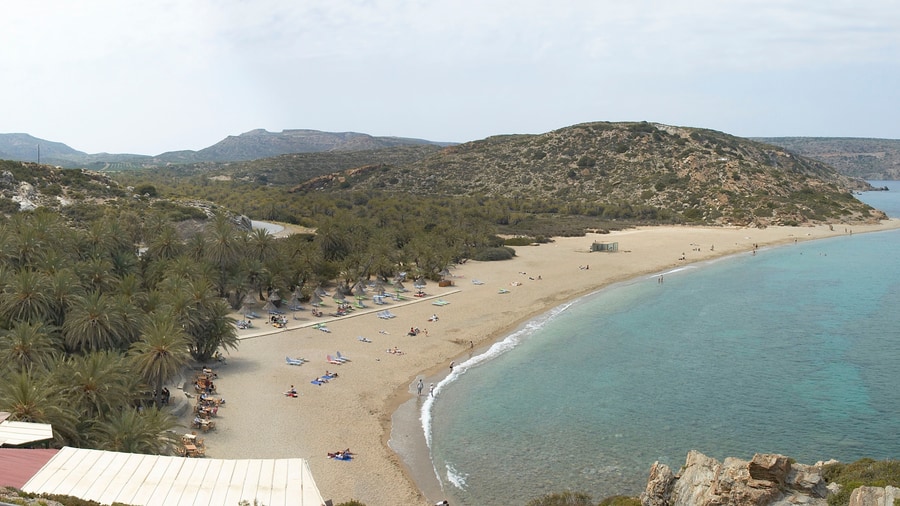
A Crete bike tour reaches the Vai palm forest, now 20 hectares. Before 1957 it covered 300 hectares. Its palm, Phoenix theophrasti, grows up to 15 metres.
- Longest cave: Tafkoura, in Psiloritis, is mapped for 6.5 kilometres.
- Dikti site: GR4320002 covers 34,007 hectares, including the Lasithi plateau.
- Mountain endemic: Polygonum idaeum grows only on Psiloritis and Dikti.
Natura codes GR4320006 and GR4320009 protect Vai’s northeast peninsula from Cape Plaka.
What wildlife does a Crete bike tour see?
A Crete bike tour on mountain roads sees griffon vultures, bearded vultures and eagles. Crete holds 70 to 80 percent of Greece’s breeding griffons. Endemic land animals include the Cretan shrew, the Cretan frog and the Cretan wall lizard.
A Crete bike tour rides below griffon colonies. A 1996–2002 island survey counted 141 breeding pairs.
Bearded vultures share the mountains crossed by jeep safaris on Crete. An EU LIFE project counted 4 pairs and 18 birds in 14 territories averaging 350 square kilometres.
A later count puts Crete at 6 to 7 breeding pairs. The birds’ diet is 70 to 90 percent bone, cracked by drops from 50 to 150 metres.
Golden eagles seen on a Crete bike tour cluster in Lefka Ori, Idi and Dikti. A four-year study counted 16 breeding pairs on Crete, about 60 birds.
Bonelli’s eagles number 20 to 25 breeding pairs on Crete. Their wingspan reaches 145 to 165 centimetres, and they hunt crows, pigeons and partridges in mid-altitude mountains.
- Cretan shrew: Endangered, it survives on only three mountains.
- Spiny mouse: Acomys minous feeds at night on grass and seeds.
- Wall lizard: Podarcis cretensis was split from Podarcis erhardii in 2008.
By rivers, a Crete bike tour can meet the endangered Cretan frog.
What roads does a Crete bike tour use?
A Crete bike tour uses ordinary roads, since Greek rules bar bicycles from motorways and expressways. Riders keep near the right edge, never two abreast. Crete’s road deaths fell from 107 in 2007 to 34 in 2023, ELSTAT data show.
National Road 90 runs for 327.3 kilometres, with one lane each way. It carries the E65 west of Chania and the E75 east of it.
The A90 motorway will replace it. By 2019, 51 kilometres had four lanes, a median and emergency lane. Its Heraklion to Chania section is due in 2031.
Medians cut deaths between Linoperama and Giofyros from 23 in 1999–2001 to 2 in 2002–2005. ELSTAT counted 466 accidents on Crete in 2007 and 167 in 2023.
Where a cycle lane exists, riders on a Crete bike tour must use it. Their bikes also need a red rear reflector.
- Bicycle deaths: Greek roads saw 10 bicycle deaths in 2023.
- EuroVelo 8: The 7,350-kilometre route enters Greece via Epirus, skipping Crete.
ELSTAT recorded 646 road deaths across Greece in 2023, against 1,612 in 2007.
How does the weather shape a Crete bike tour?
A Crete bike tour gets cooler with height. July at Anogia, 811 m, averaged 24.7 °C in the last full year. Spili, at 405 m, averaged 27.6 °C. Four mountain stations logged no July rain.
National Observatory of Athens stations sit at Spili, 405 m, and Anogia, 811 m. Over their last full year, July averaged 27.6 °C and 24.7 °C respectively.
The station at Tzermiado sits at 820 m on the Lasithi plateau. Its July lows averaged just 12.3 °C that year, against daily highs of 28.5 °C.
Askyfou logged 1,302.6 mm of rain that year, including 462.6 mm in February. Tzermiado took 692.4 mm, and all four stayed dry in July.
Spili’s station hit 39.7 °C on 23 July that year, its highest reading. In July 2023, Crete’s average highs ran 2.8 °C above normal, Greece’s largest gap.
A Crete bike tour in mid-April gets 13 hours 7 minutes of daylight near Anogia. Mid-October gives 11 hours 22 minutes, and mid-November 10 hours 22 minutes.
- March record: Lasithi hit 33.7 °C, Greece’s highest March reading.
- Frost: Tzermiado fell to −2.9 °C that February.
At Anogia, mid-October daylight runs 1 hour 46 minutes shorter than in mid-April.
When is the best season for a Crete bike tour?
Crete bike tour season runs from mid-March to mid-November at one mountain-bike club on the island. Big amateur events have run in April and October. The Tour of Crete covers about 650 km in six stages on consecutive days.
The non-competitive Tour of Crete began in 2016 for amateur riders. Its route climbs about 12,000 m from Heraklion and back, with feed stations and medical support.
The tour’s fifth edition ran from 17 to 22 October 2021, with riders from 15 countries. That edition crossed about 600 km and climbed to the Katharo plateau.
In April 2014, Chania hosted the Cretan Amateurs Cycling Tour, a UCI World Cycling Tour qualifier. Its last stage was a 119 km loop, after an 81 km circuit.
At Tzermiado, April highs averaged 16.2 °C in the last full year. Spili’s October highs averaged 23.7 °C, while Anogia logged just 10.6 mm of October rain.
Greece’s hunting season opens on 20 August and closes at the end of February. Hunters then share the countryside with cyclists and quad safaris on Crete.
- Spring rain: Anogia logged 108.4 mm in April.
- Olive harvest: Runs from November through January.
- Autumn frost: Tzermiado dipped to −0.5 °C on 31 October.
That same club spends November to March building mountain-bike trails for all riders.
What do travelers ask about a Crete bike tour?
Crete bike tour questions cover ferries, buses, water and medical care. The sea route from Athens runs about 272 km, or 147 nautical miles, to Chania. To Heraklion, it stretches about 319 km, or 172 nautical miles.
Can a bicycle travel on a ferry for a Crete bike tour?
Ferries with a garage carry bicycles, and Greek lines accept them when garage space allows. Dolphin vessels and high-speed ferries without a garage can refuse boarding. One booking site lists eight Athens to Heraklion ships that accept bicycles.
Can a KTEL bus carry a bicycle on a Crete bike tour?
The KTEL network of Heraklion and Lasithi carries a bicycle only when it folds up. Passenger bags ride in the bus luggage compartment, and hand luggage goes in the overhead racks. Its central stations take card payment for tickets.
Where does a Crete bike tour find water on mountain routes?
Zaros, in the Psiloritis geopark, has springs among Crete’s largest freshwater sources. Part of that water forms the lake at Votomos, where the E4 trail starts. In Gergeri, a fault forces groundwater up, and restored fountains join local Water Routes.
What medical care serves a Crete bike tour in mountain villages?
The health centre in Anogia covers the northern mountain area of Mylopotamos and Monofatsi. That area holds 11 villages and more than 9,000 residents. In the Heraklion countryside, Agia Varvara and Arkalochori run rural health centres with emergency departments.