An Athens bike tour covers the centre of the city on a bicycle or an e-bike, riding the car-free streets around the Acropolis, past the ancient sites and the National Garden, through the old neighbourhoods and down to the sea. This post covers what an Athens bike tour includes, the route through the centre, the ancient sites seen from the saddle, the National Garden, the ride to the coast, why e-bikes suit the hills of Athens, the neighbourhoods and the best season. It is one of the city tours in Greece on Greece VIP.
Each section ends with an Athens bike tour that can be booked online.
What does an Athens bike tour include?
An Athens bike tour covers the historic centre by bicycle or e-bike with an expert tour leader. The route follows car-free streets around the ancient sites and adds stops at monuments and parks, so one ride joins the main sites.
Athens already treats the bicycle as part of its outdoor life. Trails criss-cross the city and its surroundings, giving access to nature on foot and on bicycle, and four large mountains bound the basin. Residents hike and mountain-bike on all four. An Athens bike tour brings the same habit into the centre, where the ancient sites lie within reach of one another.
The car-free streets are the main reason to ride here. Dionysiou Areopagitou Street took its present shape in 1955, when the architect Dimitris Pikionis redesigned it, and it was pedestrianised in 2003. Plaka went through the opposite phase. From the 1950s until the 1970s, a rise in motor cars and a tourist boom degraded the old quarter under the Acropolis.
An Athens bike tour differs from an Athens walking tour in range. A walk stays among the lanes below the Acropolis, while a ride reaches Thiseio and the Kerameikos in the northwest and the Panathenaic Stadium in the east. A tour leader sets the pace and names each monument at the stops, with a bicycle or an e-bike for every rider.
- Name: The walkway honours Dionysius the Areopagite, patron saint of Athens.
- Old quarter: Plaka is known as the Neighborhood of the Gods.
- Equipment: Riders choose a bicycle or an e-bike.
In short, an Athens bike tour pairs the ancient centre with the quiet streets laid out around it. The ride shows the Acropolis area, the old quarters and the sites of the east and west. The sections below follow the route, then name the ancient sites that an Athens bike tour passes.


Which route does an Athens bike tour follow through the centre?
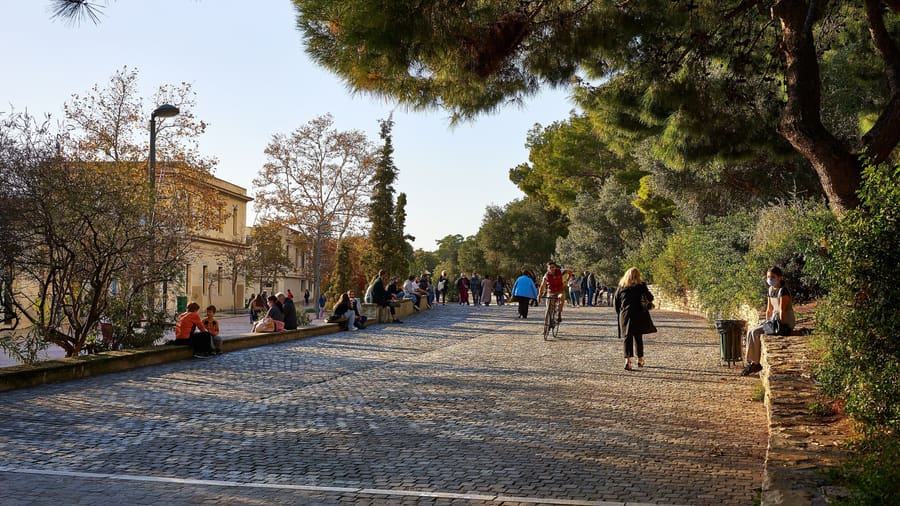
An Athens bike tour follows the pedestrian walkway of Dionysiou Areopagitou Street along the south slope of the Acropolis, continues on Apostolou Pavlou Street to Thiseio, and returns by the edge of Plaka. The loop stays on car-free streets.
Dionysiou Areopagitou Street runs from east to west. It starts at Amalias Avenue near the Arch of Hadrian and ends near Philopappos Hill, where it continues as Apostolou Pavlou Avenue. The street lies in the Makrygianni district, beside the south slope of the Acropolis. An Athens bike tour can ride it from one end to the other with the hill alongside.
After Makrygianni Street the north side opens onto the archaeological site of the Acropolis, and the entrance to the ancient Theatre of Dionysus lies near that junction. The south side holds the Acropolis Museum. Near the western end is the entrance to the Odeon of Herodes Atticus, and the foundations of the house of Proclus lie in the middle of the street.
Apostolou Pavlou is a pedestrianised street that meets Dionysiou Areopagitou Street. Together they form the main pedestrian zone from Thiseio to the Acropolis around the Agora. Thiseio lies northwest of the Acropolis, surrounded by the Agora, the Kerameikos and the Pnyx. Its name comes from the Temple of Hephaestus, mistakenly called the Thiseion after Theseus. An Athens bike tour then turns to Thiseio.
- Plaka: Adrianou Street divides it into Ano Plaka and Kato Plaka.
- Churches: Agia Marina and Agios Athanasios Kourkouris stand in Thiseio.
- Pnyx: The hill, considered the birthplace of democracy, is visible from Thiseio.
The loop closes along the edge of Plaka, the oldest district of Athens, inhabited from the Neolithic to the present day. Plaka lies on the northeast slope of the Acropolis. An Athens bike tour keeps to its edge, so the old quarter forms the backdrop to the last stretch of the route.
Which ancient sites does an Athens bike tour pass?
An Athens bike tour passes the Temple of Olympian Zeus, Hadrian’s Arch, the Panathenaic Stadium and the Kerameikos cemetery. The four sites lie on different sides of the old centre, linking Roman Athens with the burial ground of the classical city.
The Temple of Olympian Zeus began as a tyrants’ project. Around 520 BC the sons of Peisistratus, Hippias and Hipparchos, planned a temple to surpass the famous temples at Samos and Ephesus. The work stopped when Hippias was expelled in 510 BC. Aristotle later cited the unfinished temple in his Politics to show how tyrants kept the people busy with great works.
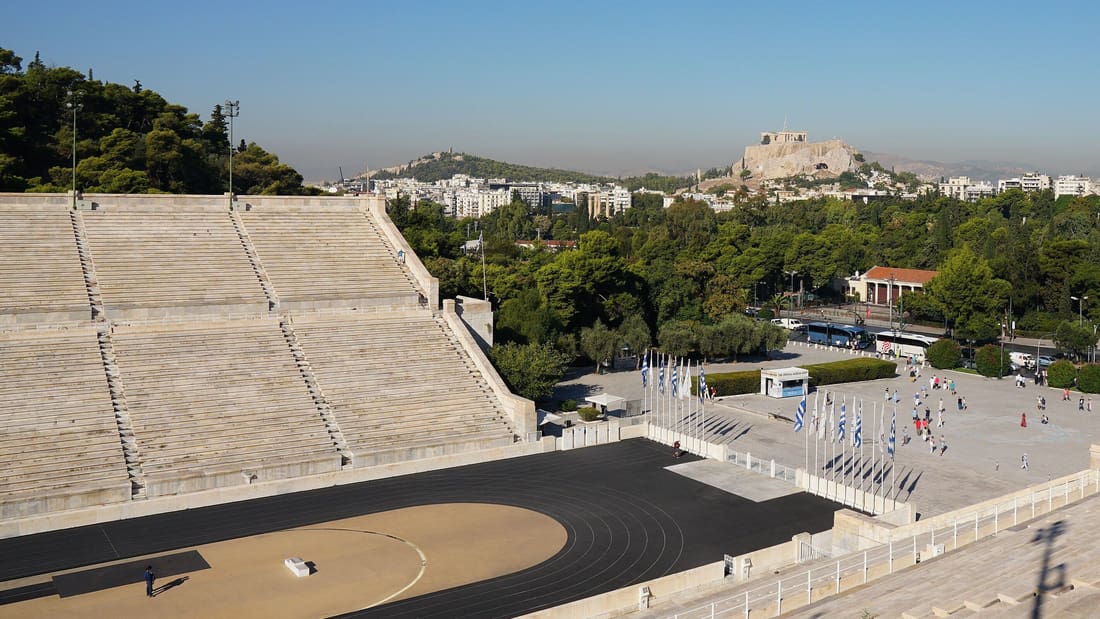
The Panathenaic Stadium fills a natural ravine between the hills of Agra and Ardittos. The Ilissos river ran in front of its entrance until the 1950s and now flows beneath Vasileos Konstantinou Avenue. Owls in relief decorated the seats, as symbols of the goddess Athena. The stadium hosted the Zappas Olympics in 1870 and 1875, an early revival of the ancient games.
The Kerameikos was the potters’ quarter of ancient Athens and also an important cemetery. After the Persian sack, the city wall of 478 BC took in the funerary sculptures, and state graves beside the Dipylon Gate held statesmen such as Pericles and Cleisthenes. A decree of 317 BC banned lavish tombs. An Athens bike tour reaches the site in the west.
- Hadrian’s Arch, Acropolis side: The text names the ancient city of Theseus.
- Hadrian’s Arch, temple side: The text names the city of Hadrian, not Theseus.
- Hadrian’s Arch, masonry: Clamps joined the marble blocks, without cement or mortar.
In short, an Athens bike tour passes four sites with four different stories. The arch once spanned the road between the centre and the temple complex, and Stuart and Revett made the earliest and only complete architectural study of it in 1751-53. The route links all four in a single ride.
What does an Athens bike tour show in the National Garden?
An Athens bike tour shows the National Garden, the Zappeion and Syntagma Square with the Parliament as one cluster in the centre. The park lies behind the Parliament, the Zappeion closes its southern end, and the square faces the building.
The National Garden was the Royal Garden until 1974. The King and Queen kept the fenced upper garden behind the Old Palace as a private refuge, and the public entered in the afternoons. The designer imported peacocks, ducks and turtles, but the dry climate killed off a number of plants. An Athens bike tour passes the park between Kolonaki and Pangrati.
An Athens bike tour passes the Zappeion at the southern end of the garden. In 1869 the Greek Parliament allocated 80,000 square metres of public land for it, and the cornerstone followed in 1874. The benefactor, Evangelis Zappas, died before it opened, so his cousin Konstantinos was nominated to complete it. The head of Zappas is “buried” inside a wall.
Syntagma Square was designed in the early 19th century as one of the two central squares of modern Athens, at what was then the eastern edge of the city. Omonoia Square was the second. In the summer of 1900, films were projected outdoors in its cafés. The Parliament is not open to the public, so the ride views it from outside.
- Roman villa: The garden holds a Roman villa with a mosaic.
- Olympics: The Zappeion was the main fencing hall in 1896.
- Metro: Lines 2 and 3 meet beneath Syntagma Square.
The garden holds one oddity of Greek history. A pet monkey bit King Alexander there on 30 September 1920, and he died of sepsis three weeks later, bringing his father, Constantine I, back to the throne. An Athens bike tour can pass the garden with that story, then roll on to the square.
Can an Athens bike tour ride to the sea?
An Athens bike tour can ride to the sea along the Faliro coast, past a seafront promenade and the Stavros Niarchos Foundation Cultural Center beside Phalerum Bay. The coast road then runs south through the towns of the Athens Riviera.
An Athens bike tour that reaches the Faliro shore meets the ancient deme of Phaleron. Remains of conglomerate blocks on the heights of Old Phaleron are thought to belong to the Phaleric Wall that Thucydides recorded. In Ottoman times the harbour was Porto Vecchio, the old port, and in 1674 the English consul Jean Giraud called the place Three Towers.
Renzo Piano designed the Stavros Niarchos Foundation Cultural Center to rise out of the ground like a dislodged piece of the Earth’s crust. The roof is suspended with dampers to increase its resilience in hurricanes. Plans began in 1998, the foundation chose Piano in 2008, and construction started in 2012. In November 2016 former President Barack Obama spoke there on democracy.
South of Faliro the coast road enters the Athens Riviera. The Riviera Tower, a skyscraper of 200 metres with 50 floors, is under construction at Elliniko and will be the tallest building in Greece. An Athens bike tour covers only the first stretch of this shore, because the full coast from Piraeus to Sounio and Lavrio belongs to an Athens Riviera tour.
- Promenade: A seaside promenade and a marina line the Faliro coast.
- Tram: Tram Line 3 serves the southern coastal area.
- Residents: Palaio Faliro had 64,863 inhabitants at the 2021 census.
Greeks from Istanbul settled in Palaio Faliro, especially after 1974, and now form an active community. In January 2005 a marble torso of a young man, 1.8 metres tall, was found in the Pikrodafni streambed. It copies a classical original of the 4th century BC. An Athens bike tour passes this seafront town.
Why does an Athens bike tour use electric bikes?
An Athens bike tour uses electric bikes because Athens has hot summers and hills at the Acropolis rock, Philopappos Hill and Lycabettus. A pedal-assist motor adds power only while the rider pedals, so the slopes need little effort.
The e-bike of an Athens bike tour uses pedal assist: pedalling regulates the motor, which augments the effort of the rider. A sensor detects pedalling speed, force, or both. Under the EU standard, assistance above 6 km/h engages only while the rider pedals, the motor cuts out at 25 km/h, and continuous power stays at 250 W or less.
Athens sprawls across the Attica Basin, which four large mountains bound: Aigaleo, Parnitha, Pentelicus and Hymettus. Parnitha, the tallest of them, reaches 1,413 metres, and residents hike and mountain-bike on all four. Inside the basin, Lycabettus, Philopappos hill, the Pnyx and Ardettos hill are planted with pines and other trees, like a small forest rather than a city park.
Mount Lycabettus is a Cretaceous limestone hill, and its summit, 277 metres above sea level, is the highest point in central Athens. A funicular railway climbs it from Aristippou Street in Kolonaki. Myth says Athena dropped the limestone mountain she carried from the Pallene peninsula for the Acropolis. On an Athens bike tour, this is the slope the motor handles.
- Riders: E-bikes adapt to weaker, older, disabled and inexperienced riders.
- Class: The EU classes a pedelec as a bicycle.
- Throttle: Power-on-demand bikes use a throttle; a pedelec needs pedalling.
Summer heat adds to every climb in Athens. Pedelecs raise average speeds, especially when the rider climbs or faces a headwind, and they expand the areas and groups capable of regular cycling. The motor takes the load on the slopes of Lycabettus and Philopappos, which is why an Athens bike tour uses it.
Which neighbourhoods does an Athens bike tour cross?
An Athens bike tour crosses three neighbourhoods of old Athens: Psyrri, a gentrified quarter of restaurants, bars and live music tavernas; Gazi, built around the old gasworks that became Technopolis; and Thiseio, beside Kerameikos, the ancient potters’ quarter and cemetery.
Psyrri is one of the oldest quarters of Athens, known in English as Psyri, Psiri, Psyrri or Psirri. Its central square, Heroes Square, carried the nickname Plateia of Heroes in the last quarter of the 19th century, a derisive reference to the koutsavakides, who used it as their hangout. An Athens bike tour crosses this square on the way to Gazi.
Gazi surrounds the old gasworks, founded in 1857, and was once called Gazochori and Fotaerio. In the mid-20th century, small dwellings with large gardens appeared around the plant, and crate makers mainly lived there. Garages, paint shops, tinsmiths and spare parts shops followed. Since the start of the 21st century, cafeterias, restaurants and night clubs have made Gazi an entertainment district.
Technopolis is an industrial museum and a major cultural venue in the former gasworks. It has operated since 1999 on a site of about 30,000 m2 and honours the composer Manos Hatzidakis. Eight of its buildings carry the names of Greek poets. A museum for the opera singer Maria Callas fills the second floor of the Angelos Sikelianos building.
- Kerameikos: The potters’ quarter served as a cemetery from the 3rd millennium BC.
- Thiseio: Its name refers to the Temple of Hephaestus, mistakenly known as Thiseion.
- Metro: Kerameikos station on Line 3 is adjacent to Technopolis.
Thiseio lies northwest of the Acropolis, surrounded by the Agora, Kerameikos and the Pnyx. Pedestrian streets join it to the neighbouring districts, and the footpaths of Ermou connect it with Gazi. An Athens bike tour joins these districts into one route, from the bars of Psyrri to the ancient cemetery of Kerameikos.
When is the best season for an Athens bike tour?
An Athens bike tour meets a hot-summer Mediterranean climate (Köppen type Csa), with a very hot, dry summer and a cool, wet winter. Spring and autumn sit between these extremes and give the mildest riding conditions of the year.
Summer in Athens is warmer than in Seoul, Melbourne, Buenos Aires and Cape Town, cities as close to the Equator or closer. Districts more affected by the urban heat island have higher mean annual temperatures than the station near the centre. Until 2021, Elefsina in the west held the record for the highest temperature in Europe, 48.0 °C on 10 July 1977.
The weather station at Gazi records annual precipitation of 460 mm, with December averaging around 80 mm, and August has been a very hot and dry month in the last decade. Snowstorms blanketed the urban area on 16 February 2021 and 24 January 2022, though snowfall in Athens is relatively uncommon. Ice and mud reduce the traction of a bicycle wheel.
The climate shifts across the metropolitan area. Elliniko in the south lies in the transition between Mediterranean and hot semi-arid climate, and the Saronic Gulf moderates temperature swings there. Piraeus, the extreme case of this transition, receives just 331.9 millimetres per year. Kifissia in the north stands at a higher elevation, with moderately lower temperatures and slightly more precipitation year-round.
- Fog: Fog is rare in the centre but more frequent near Mount Hymettus.
- Dusk: Avoiding cycling at or around dusk reduces serious bike accidents.
- Station: Greece’s oldest working weather station has stood on the Hill of the Nymphs since 1890.
In the Mediterranean zone of Greece, winter rain is persistent, and snow that falls does not last long. Heatwaves in coastal areas are quite mild, because the sea breeze and the relatively cooler sea moderate temperatures. Low-lying areas of Attica belong to this zone, so an Athens bike tour along the coast meets milder summer heat.
What do travelers ask about an Athens bike tour?
An Athens bike tour runs through a city centre where the Daktylios scheme admits cars to a small inner area by plate number and date, and Dionysiou Areopagitou Street has been pedestrianised since 2003, beside the south slope of the Acropolis.
Do helmets matter on an Athens bike tour?
A bicycle helmet is designed to absorb impacts to the head of a cyclist. In the European Union the applicable standards are EN 1078 and EN 1080. A helmet must fit the rider properly, and evidence shows that helmets reduce the severity of head injuries.
Can children ride on an Athens bike tour?
Cycling covers balance bikes and tricycles, and people ride bicycles for recreation at all ages. In one study of children and adolescents aged 4 to 18 years, 96% had incorrectly fitted helmets, so the fit of a helmet matters for young riders.
Is fitness needed for an Athens bike tour?
Cycling requires a basic level of fitness for moderate to long distances. The choice to cycle depends on personal fitness, the length and steepness of the route, and the weather. Cycling is also a low-impact exercise that spares the knees and other joints.
How does traffic affect an Athens bike tour?
Lorries and other heavy vehicles are always banned from the inner Daktylios, and the outer Daktylios applies only in times of extreme congestion or high pollution. Cyclists avoid opening car doors by riding outside the door zone, never right next to parked cars.
Can an Athens bike tour include the Acropolis?
The Acropolis stands on a flattish-topped rock that rises 150 m above sea level, with the Propylaea as its gate at the western end. The Theatre of Dionysus and the Odeon of Herodes Atticus have entrances on Dionysiou Areopagitou Street, which passes the Acropolis Museum.
Featured photo: George E. Koronaios, CC BY-SA 4.0, via Wikimedia Commons.