
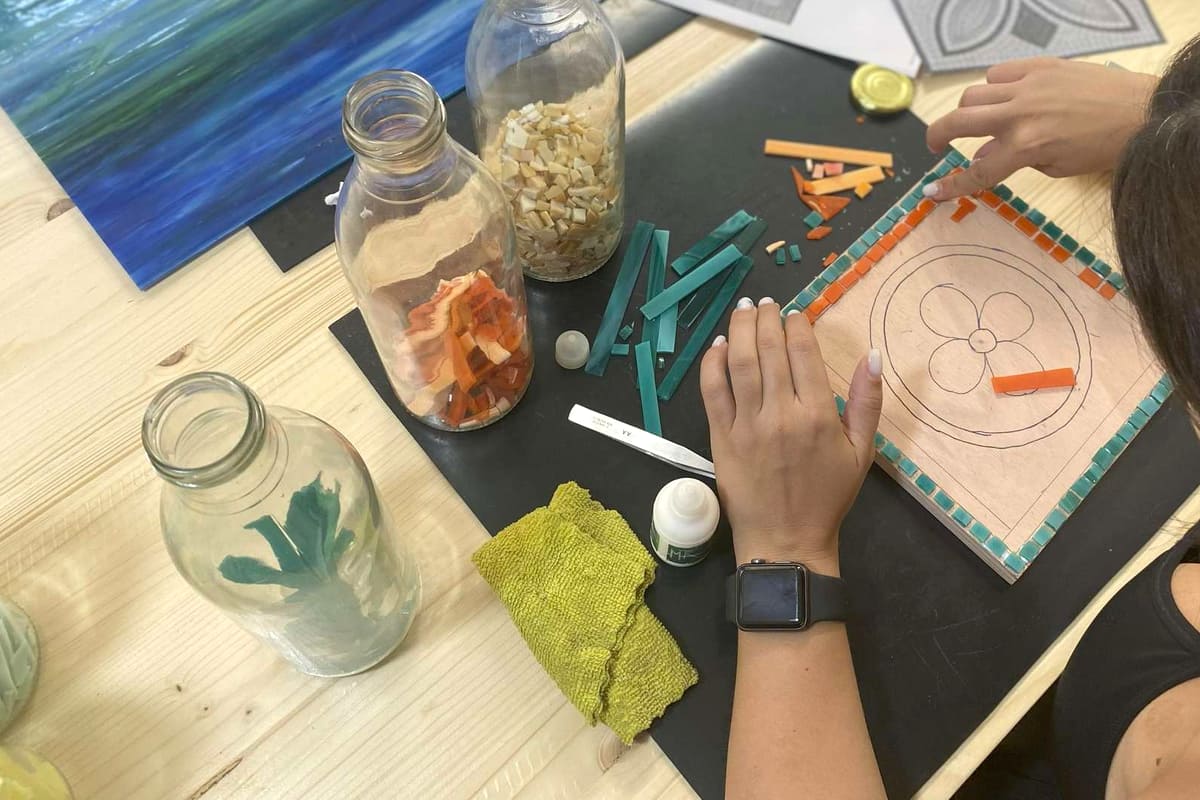
A Thessaloniki mosaic workshop puts coloured tiles in your hands and an artist at your side in the old Upper Town. Where other Greek tours show you art, this class lets you make a piece yourself.
Below are the magnet and glass classes, the studio, the tools, who takes part, the months to visit and how booking works. Questions that come up before a visit are answered at the end.
What does a thessaloniki mosaic workshop involve?
A thessaloniki mosaic workshop is a hands-on class where travellers build their own mosaic with a local artist and carry the finished piece home. Listings differ on the object: one makes a souvenir magnet, while the other makes a glass mosaic artwork.
A mosaic is a picture or pattern built from small bits of stone, glass or ceramic in different colours. Plaster or mortar holds the pieces, and the work covers a surface.
No earlier experience is needed for either class. Instructors speak English, Greek and Polish, the studios are wheelchair accessible, and both let travellers cancel for free to get a full refund.
- Format: Hands-on class
- Teacher: Local artist
- Languages: English, Greek, Polish
- Experience: None needed
A thessaloniki mosaic workshop ends with a handmade mosaic that each traveller keeps as a souvenir.


Where does a thessaloniki mosaic workshop take place?
A thessaloniki mosaic workshop takes place in Ano Poli, the Upper Town of Thessaloniki. This old quarter sits around the city’s acropolis, north of the centre. Both listings use one shared studio address in this district, close to the historic Byzantine Bath.
The Upper Town keeps Byzantine and Ottoman street design that the Great Fire of 1917 destroyed elsewhere in the city. Its lanes are small and stone-paved, with old squares and traditional houses.
The Byzantine Bath comes from the late 12th or early 13th century. UNESCO listed it as a World Heritage Site in 1988, alongside the city’s other early Christian and Byzantine monuments.
- District: Ano Poli
- Landmark: Byzantine Bath
- Houses: Traditional style
- Status: UNESCO site
A thessaloniki mosaic workshop in Ano Poli places travellers inside the old town of Thessaloniki.
How does a thessaloniki mosaic workshop work?
A thessaloniki mosaic workshop starts with a welcome and a short introduction to the technique. Travellers then pick their materials, place and glue each piece, and leave with the finished mosaic. Listings differ on the extra steps, group size and refreshments.
In the glass class, travellers choose a pattern, a wooden base colour and glass pieces. They compose the design, glue the glass down, then grout the gaps to finish it.
The magnet class supplies a base, tiles and glue, with mint and citrus water and a loukoumi sweet. Visitors who enjoy hands-on classes can also try a Thessaloniki cocktail workshop.
- Start: Welcome drink
- Step: Choose materials
- Finish: Grout gaps
- End: Take home
Each thessaloniki mosaic workshop closes as travellers carry their own handmade piece out of the small studio.
What materials does a thessaloniki mosaic workshop use?
A thessaloniki mosaic workshop includes all materials: a base, tiles or glass pieces and glue, plus grouting supplies in the longer class. In that class, makers pick a wooden base from a range of colours for their artwork.
A tessera is a single tile in a mosaic. Early mosaics used coloured pebbles, cut stone tesserae appeared by around 200 BC, and later makers produced tesserae from coloured glass.
Tiling grout is cement-based. It fills the spaces between tiles and secures them to the base. Sanded grout holds finely ground silica sand, while unsanded grout leaves a smoother surface.
- Smalti: opaque kiln-fired glass
- Soda-lime: around 70% silica
- Metal salts: add colour
- Millefiori: round Murano tesserae
A thessaloniki mosaic workshop covers all materials, from base to glue, before the first tile is placed.
Why do Byzantine mosaics shape a thessaloniki mosaic workshop?
A thessaloniki mosaic workshop sits in the former second city of the Byzantine Empire, where fifteen early Christian and Byzantine monuments joined the UNESCO World Heritage List in 1988 and helped Byzantine art and architecture grow across the empire.
Hagios Demetrios holds six surviving mosaic panels made before the Byzantine Iconoclasm began in 730. The Church of the Acheiropoietos, dated to the 5th century, keeps fragments of decorative mosaics.
The Rotunda ranks as an early Christian monument of the Eastern Roman Empire. Hagia Sophia’s dome mosaic shows the Ascension. See the Thessaloniki walking tour post for the city on foot.
- Rotunda: Galerius commissioned
- Demetrios: patron saint’s church
- Hagia Sophia: 7th century
- Acheiropoietos: dedicated to Mary
These monuments explain why a thessaloniki mosaic workshop fits a city so closely tied to Byzantine art.
What do travellers make at a thessaloniki mosaic workshop?
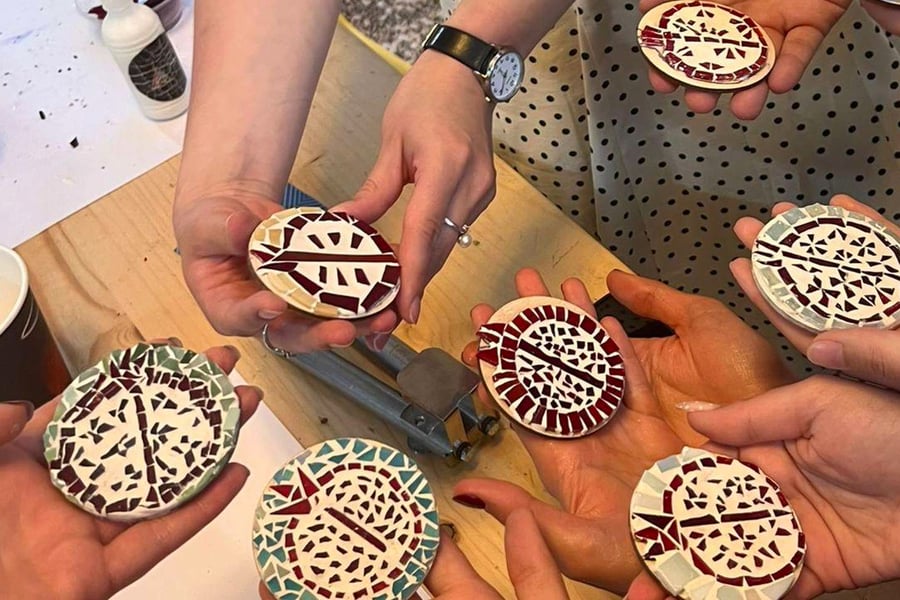
A thessaloniki mosaic workshop lets travellers make a handmade mosaic souvenir magnet in the express class or a unique glass mosaic piece on a wooden base in the longer class. Each finished piece goes home as a souvenir.
A fridge magnet is a small magnet joined to a decorative ornament, and magnets are popular souvenirs. In the express class, makers select tiles to craft a handmade mosaic magnet.
In the longer class, makers choose a pattern, a wooden base and glass pieces, then glue the glass and grout the gaps. Travel-ready packaging protects the finished piece in transit.
- Express: mosaic magnet
- Longer: glass mosaic piece
- Express size: fits luggage
- Souvenir: handmade, both classes
Each thessaloniki mosaic workshop class ends with a handmade piece that travellers carry home as a souvenir.
How old is the art behind a thessaloniki mosaic workshop?
A thessaloniki mosaic workshop passes on an art with very old roots. The earliest known mosaics, made of coloured stones, shells and ivory, come from a temple at Abra in Mesopotamia and date to the second half of the 3rd millennium BC.
Pebble mosaics from the Bronze Age were found at Tiryns. The Macedonian palace-city of Aegae holds mosaics from the 4th century BC. Patterns and pictures spread across classical Greece and Rome.
From the 4th century, early Christian basilicas received wall and ceiling mosaics. Byzantine mosaic art thrived between the 6th and 15th centuries. The empire itself lasted until 1453, when Constantinople fell.
- Tesserae: small cubes
- Pebbles: floor reinforcement
- Technique: opus tessellatum
- Figures: 3rd century BC
Travellers in a thessaloniki mosaic workshop use a craft that Greek and Roman makers practised long ago.
Which season suits a thessaloniki mosaic workshop?
A thessaloniki mosaic workshop takes place in a studio, so weather matters little. Summers are hot, with July and August averaging around 28 °C in downtown Thessaloniki, while January is the coldest month at an average of 8 °C.
Winters are cool, with cold nights. Snow arrives nearly every winter, yet the cover is short-lived. January and February bring winds averaging about 11 km/h.
Highs tend to climb past 30 °C in summer but rarely pass 40 °C. Breezes off the Thermaic gulf temper the heat, and summer rain comes mainly with thunderstorms.
- Record low: −14 °C
- Record high: 44 °C
- Frost days: 32 yearly
- Fog days: 17 yearly
Spring, summer, autumn or winter, a thessaloniki mosaic workshop stays an indoor activity.
What else in Thessaloniki pairs with a thessaloniki mosaic workshop?
A thessaloniki mosaic workshop pairs with the Museum of Byzantine Culture, the White Tower, Aristotelous Square and the Walls of Thessaloniki. Each adds local history to a hands-on craft session, from Byzantine finds to a waterfront tower and a main square.
The Museum of Byzantine Culture opened in 1994. Its first room covers the early Christian church, where poorer churches had mosaic floors. See the Thessaloniki hop-on hop-off post for more.
The White Tower, a waterfront monument, is the symbol of the city. The Walls of Thessaloniki date from the early Byzantine period, and the Heptapyrgion citadel lies inside the acropolis.
- Square: Hébrard, 1918
- Tower height: 34 m
- Walls: 4 km originally
- Heptapyrgion: Seven Towers
A thessaloniki mosaic workshop and these four sights together make a varied day of history and hands-on craft.
Who can join a thessaloniki mosaic workshop?
A thessaloniki mosaic workshop welcomes beginners, since one class requires no prior experience and the other teaches the basics. Instructors work in English, Greek and Polish, and both classes are wheelchair accessible. Group and age limits differ, so each listing sets its own rules.
Listings differ on size and age. The magnet class admits up to 10 participants and excludes children under 8, while the glass class admits up to 6 and excludes children under 12.
The glass class asks travellers to report allergies or dietary limits beforehand, since it serves a snack and a drink. Comfortable clothes are the only item the magnet class names.
- Experience: Beginners welcome
- Group: 6 or 10
- Ages: Limits differ
- Bring: Comfortable clothes
Solo travellers and families with older children can join a thessaloniki mosaic workshop within the listed age limits.
How do travellers book a thessaloniki mosaic workshop?
A thessaloniki mosaic workshop is booked ahead through an online listing, which shows availability and the starting times. Both listings offer reserve now, pay later, so travellers hold a spot and pay nothing at the time of booking.
Free cancellation applies in both listings when notice comes a day ahead or earlier. A full refund follows, so changing plans costs the traveller nothing in that case.
Both listings use one meeting studio in Ano Poli, the Upper Town, and the finished piece goes home with the traveller. Visitors can add a Thessaloniki food tour to the same trip.
- Booking: Ahead online
- Payment: Reserve, pay later
- Cancel: Free, day ahead
- Materials: All included
Early booking of a thessaloniki mosaic workshop holds a spot, while the free cancellation window protects changing plans.
What do travellers ask about a thessaloniki mosaic workshop?
A thessaloniki mosaic workshop brings five common questions: whether experience is needed, what is included, how big the group is, whether children can join, and what travellers take home. The short answers below note where the two listings differ.
Is experience needed for a thessaloniki mosaic workshop?
Beginners can join. The glass class states that no prior experience is required, and the magnet class teaches the basics of mosaics. A professional artist teaches the steps in both.
What does a thessaloniki mosaic workshop include?
The magnet class includes a base, tiles and glue, plus infused water and a sweet. The glass class provides glass, adhesives, grouting supplies and a wooden base, plus a drink and a snack.
How big is a group at a thessaloniki mosaic workshop?
Both classes keep groups small. One listing caps the group at 10 people and the other at 6, giving each person more attention from the artist. Listings differ on the exact cap.
Can children join a thessaloniki mosaic workshop?
Yes, within limits. The magnet class is described as kid-friendly yet bars children under 8, while the glass class bars children under 12. Parents compare these limits before choosing a class.
What do travellers take home from a thessaloniki mosaic workshop?
Each traveller keeps the handmade piece: a magnet from one class and a glass mosaic on a wooden base from the other. Travel-ready packaging helps the glass artwork arrive safely at the next destination.