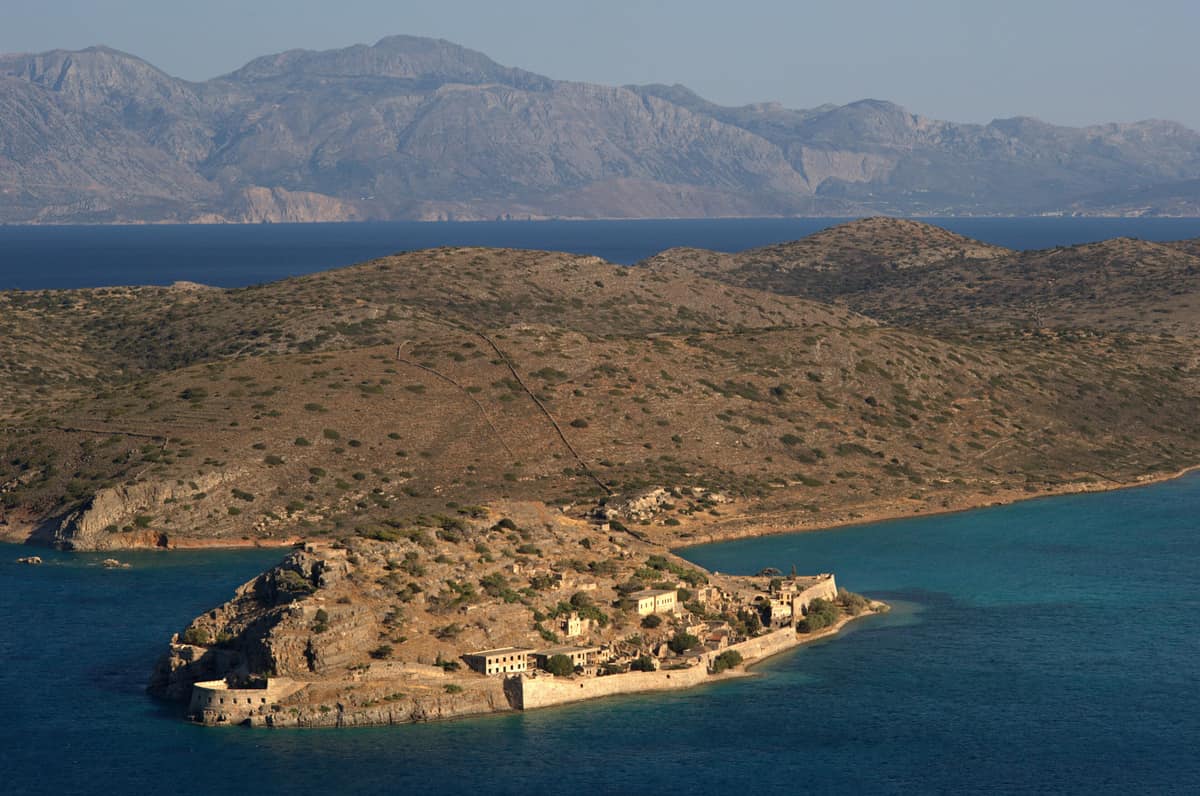
A Spinalonga tour crosses to the small island of Spinalonga in the Gulf of Elounda in eastern Crete, with its Venetian fortress and the houses of the former leper colony. This post covers what a Spinalonga tour includes, the history, what visitors see on the island, the novel that made it famous, where the boats start, the sights around Mirabello Bay and the best season. More Greece tours are listed on the Greece VIP homepage.
Each section ends with a Spinalonga tour that can be booked online.
What does a Spinalonga tour cover?
A Spinalonga tour covers a small rocky islet in the Gulf of Elounda, off north-eastern Crete. The islet holds a Venetian fortress and the houses and streets of a former leper colony. It has had no residents since 1962.
Spinalonga sits at the northern mouth of the Gulf of Elounda, in the municipality of Agios Nikolaos in Lasithi. Around 750 metres of water separate it from the village of Plaka to the west. A narrow strip of sea divides it from Kolokitha island to the south, and the east faces the open Sea of Crete. The island covers 85,000 square metres, with steep cliffs on its north side.
A larger Spinalonga peninsula lies close by, and the shared name causes confusion. A Spinalonga tour heads for the small island, not the peninsula. Venetian records trace the name to the Greek phrase “stin Elounda”, meaning “to Elounda”. The Venetians did not understand it and turned it into spina longa, or “long thorn”. Another view links the name to the spine-like shape of the land seen from Elounda.
The island served as a fortress for centuries under Venetian rule. After that, Muslim families seeking safety from persecution settled there. In the early 20th century it turned into a leper colony, known locally as “the island of the living dead”. A Spinalonga tour therefore moves through three periods on one small rock. Visitor numbers put it sixth among sites in all of Greece.
- Location: A Spinalonga tour reaches the islet next to Plaka, in the area of Kalydon.
- Plants: Fig, cypress, olive and pine trees grow there, with non-native prickly pears.
- Status: The island became an archaeological site in 1976 and opened formally to the public in 2000.
The Greek government applied to UNESCO in 2014 for World Heritage status for the island. The bid pointed to architecture from different eras and to the human tragedy of the leper colony. Those two themes shape every Spinalonga tour. The islet receives hundreds of thousands of visitors each year, and only the Palace of Knossos draws more in Crete.


What is the history behind a Spinalonga tour?
A Spinalonga tour traces four eras on one islet: ancient defences, a Venetian sea fortress begun in 1579, an Ottoman settlement after 1715, and a leper colony that ran from October 1904 until the patients left for good in 1957.
The story behind a Spinalonga tour begins in antiquity, when defences here guarded the port of Olous. Venice, ruler of Crete from 1210, fortified the island against pirates and the Turkish threat after the Fall of Constantinople in 1453. The fort carried 35 cannons. When the rest of Crete fell to the Ottomans in the Cretan War of 1645 to 1669, Spinalonga stayed Venetian, with Gramvousa and Souda.
The Ottoman chapter of a Spinalonga tour starts in 1715, when the island passed to the Ottomans by agreement. The deal promised the inhabitants safe passage to Corfu, but the Ottomans killed and enslaved them instead. By 1830, 80 Muslim families lived on Spinalonga, and more arrived after the revolution of 1866. The majority left after the Ottoman defeat in 1898, and a small group of traffickers stayed until 1903.
In 1903 the Cretan state ordered the isolation of leprosy patients on Spinalonga, following the ideas of the Danish dermatologist Edvard Ehlers. The first 251 patients arrived in October 1904. Their names were struck from the registries of their home towns. The colony was a place of isolation, not treatment. Conditions began to improve from 1925, when Dr. Grammatikakis arrived. The law student Remoundakis, who arrived in 1936, founded the Brotherhood of the Sick.
- 1913: Patients from the rest of Greece began to arrive, not only Cretans.
- 1941: Under the Axis occupation, lost supplies from the mainland led to deaths from malnutrition.
- 1955: The isolation rule was formally dropped, though the colony kept running.
The Greek director Líla Kourkoulákou filmed the documentary The Island of Silence on Spinalonga. The film showed the real patients and was screened at the Venice Film Festival. Its controversy helped close the colony. In 1957 the patients moved to the Agia Varvara station in Attica. That ending frames every Spinalonga tour: a fortress built to keep enemies out, later used to keep the sick in.
What does a Spinalonga tour see on the island?
A Spinalonga tour shows Venetian walls along the coast and on the hilltop, the southern entrance where patients landed, the market buildings and houses of the former leper colony, the cemetery and its ossuary, and a path that circles the island.

The walls seen on a Spinalonga tour follow a plan by the engineer Genese Bressani, whom Venice hired in 1578. He placed blockhouses on the highest points of the north and south and ran a ring of walls along the coast. In 1584 Venice added works at the top of the hill. Builders used stone from Spinalonga itself, plus stone from Olouda and Kolokitha island.
Patients landed at the southern dock. Certain accounts call this entrance “Dante’s Gate” and say it bore an inscription about endless pain. The story still comes up at times on a Spinalonga tour, but no historical evidence supports it. The ethnographer Maurice Born knew of only one similar inscription, “Boulevard of Pain”, on the northwestern side. Two real inscriptions record the 1579 foundation: one above the main gate and one at the base of the north rampart.
The first patients settled in the lowlands. They tore down the Ottoman-era Muslim homes and reused the materials for their own houses. Residents relied on collected rainwater and on food and water shipped from the mainland. Later, a gift from two benefactors in Crete paid for two new buildings with 24 rooms each. A café opened too, with a donated record player for music.
- Market buildings: A Spinalonga tour passes market buildings that a third phase of funding maintained in 2018.
- Cemetery: In 2013 the bones of the dead were moved to an ossuary beside the cemetery, with new plaques.
- Perimeter path: In 1938 the Brotherhood won approval to cut a wall section and build a path around the island.
The church story centres on Saint Panteleimon. Iakovos Jiritas built a church named after the saint in 1709, but war destroyed it six years later. The patients later named their Brotherhood after the same saint. The priest Chrysathos Katsouloyiannakis, the last resident, stayed until 1962 to hold Orthodox memorial rites for the buried dead. On a Spinalonga tour, the cemetery marks the end of that story.
Which novel made the Spinalonga tour famous?
The Spinalonga tour gained wide fame through The Island, a historical novel by Victoria Hislop published in 2005. It tells of a family tied to the leper colony, won Newcomer of the Year at the 2007 British Book Awards, and became a Greek TV series.
The novel is set on Spinalonga and in Plaka, the village that faces it across the bay. Alexis Fielding, aged 25, knows very little of her family history. Her mother, Sofia, was raised in Plaka, moved to London and refuses to discuss the past. Alexis travels to Crete for the first time and meets Fotini, an old friend of Sofia. Fotini tells her the story of Eleni, Alexis’s great-grandmother, and of a family broken by tragedy, war and passion.
The book was translated into 25 languages and sold millions of copies. The ethnographer Maurice Born says the Greek state changed its view of the island in 2005, from covering up the past to welcoming visitors. The novel gets the credit, though its account is romanticised and contains errors. A UNESCO study in 2016 found that 22% of visitors took a Spinalonga tour because of the media adaptations, and a further 40% had read or watched them.
Mega Channel produced To Nisi, a Greek series of 26 episodes based on the book. It premiered on 11 October 2010 and drew an estimated 3.88 million viewers, a record for a Greek series. Thodoris Papadoulakis directed it, and Mirella Papaeconomou adapted the script, adding stories and characters with Hislop’s permission. Filming ran from December 2009 to December 2010, entirely on location in Crete.
- Locations: The crew filmed on Spinalonga itself, including scenes at the port where the boat from Plaka arrives.
- Sets: Stage director Antonis Halkias and his colleagues designed the village sets for 1939 to 1957.
- Ratings: The second episode beat the premiere’s record with an estimated 4.02 million viewers.
Hislop had offers from Hollywood for the film rights. She chose instead to grant them to Mega Channel in return for a degree of artistic control, and she took part in the whole production with ideas, suggestions and observations. The theme song, “Ise Esi O Anthropos Mou”, is sung by Andriana Babali. A Spinalonga tour now passes the same island streets that appeared on screen.
Where does a Spinalonga tour start?
A Spinalonga tour starts from one of three towns on the north-east coast of Crete: Plaka, Elounda or Agios Nikolaos. Tourist boats leave all three for the island on a regular basis. Plaka sits closest, with about 750 meters of water between the village and Spinalonga.
Plaka is a small fishing village in Lasithi, part of the community of Vrouchas in the municipality of Agios Nikolaos. It neighbors the town of Elounda and overlooks both the island and the Spinalonga Peninsula. Tourist boats leave Plaka for Spinalonga every day, and the one-way passage takes about ten minutes. A Spinalonga tour from this village spends the least time at sea, which suits travelers prone to seasickness.
Elounda is a small town on the northern coast of Crete and part of the same municipality. It is the closest major town to Spinalonga, and Plaka lies 5 kilometers north of its main square. Tourist boats leave from Elounda as well, which makes the town a practical base for a Spinalonga tour. In the early 20th century, lepers on the way to the colony stopped in Elounda before the crossing.
Agios Nikolaos is the capital of the Lasithi regional unit and lies east of Heraklion. In 2021, 13,605 people lived in the town itself. Dorian settlers from Lato moved here in the late Bronze Age for easy access to the harbor. The road from Agios Nikolaos to Elounda runs about 12 kilometers along the shore and rises over a small mountain. Boats from this harbor set out on Mirabello Bay, which the town overlooks.
- Plaka: Daily boats cover the roughly 750 meters to the island in about ten minutes.
- Elounda: The closest major town to the island lies 5 kilometers south of Plaka.
- Agios Nikolaos: Boats leave the harbor of the Lasithi capital on Mirabello Bay.
- Road link: A shore road of about 12 kilometers joins Agios Nikolaos and Elounda.
The best start for a Spinalonga tour depends on where travelers stay. Guests in Plaka or Elounda can walk to the boats, while those in Agios Nikolaos gain a longer ride with views of the coast. Travelers coming from farther west can reach any of the three towns by road and pick the harbor that fits the plan for the day.
What else does a Spinalonga tour see around Mirabello Bay?
A Spinalonga tour around Mirabello Bay can add Agios Nikolaos and its round Lake Voulismeni, the town of Elounda, and the Spinalonga Peninsula, which faces the islet of Kolokytha. Mirabello Bay itself is the largest bay of the Greek islands and the fifth largest in the Mediterranean.
Agios Nikolaos overlooks Mirabello Bay, and its name means Saint Nicholas, the patron saint of sailors. Lake Voulismeni sits at the center of the town. The circular lake is 137 meters across and 48.8 meters deep, and soldiers of the French Army dug the channel that joins it to the harbor in 1907. Legend says the goddess Athena bathed here, and the town gathers around the lake for fireworks at midnight as Orthodox Easter begins.
Elounda groups seven villages and an uninhabited island area, and Schisma, the largest village by population, is seen as the town center. Seaside luxury resorts bring VIP visitors. In the 1930s, Imperial Airways flying boats landed on the enclosed water between Elounda and the peninsula. The road from Agios Nikolaos shows the whole of Mirabello Bay on a clear day, which adds interest to a Spinalonga tour by road.
South of the island lies the Spinalonga Peninsula, also called Kalydon or “large Spinalonga”. A road reaches it across a causeway and a stone bridge that the French army built in 1897, past three former windmill towers. Flamingos live on old salt-drying areas along the coast. The peninsula is sometimes mistaken for Kolokytha because of its Kolokita beach, but that name belongs to the islet 850 meters to the east.
- Town sights: Agios Nikolaos adds small town beaches, the islet of Agioi Pantes and an archaeological museum.
- Lake view: A small park above Lake Voulismeni gives a panoramic view of the water.
- Bay history: The coast of Mirabello Bay saw early copper working around 3000 BC.
- Church of St Luke: This church stands on a hill in the south-east of the peninsula.
A Spinalonga tour that adds these stops gives a wider view of the bay than the island alone. Travelers can ask in advance which towns the plan includes, whether there is free time at Lake Voulismeni, and whether the route crosses the causeway to the peninsula. This helps match the day to personal interests.
When is the best season for a Spinalonga tour?
A Spinalonga tour works well in spring and autumn, when average highs in Agios Nikolaos range from 18 to 29 °C and rain is modest. Summer highs average above 31 °C in July and August with almost no rain, while winter stays mild but wet.
Crete falls mainly in the hot-summer Mediterranean climate type, while parts of the south and east have a hot semi-arid climate. Winter on the island is fairly mild. Snow is common on the mountains between November and April but rare in low-lying areas. Agios Nikolaos, the main town near Spinalonga, has very mild, rainy winters and hot, dry summers. Near the sea, the air can feel quite humid, which matters for a Spinalonga tour in the heat.
Spring brings steady warming. In Agios Nikolaos, the average high climbs from 18.2 °C in March to 21.1 °C in April, while monthly rain drops from 44 mm to 23 mm. Autumn follows the same pattern in reverse, with average highs of 28.9 °C in September, 24.7 °C in October and 21.2 °C in November. September sees only 10 mm of rain, so a Spinalonga tour then pairs warm weather with dry days.
Summer is the hottest and driest season, with July and August highs of 31.4 °C and 31.6 °C and just 2 mm of rain in each month. The etesian winds, or meltemia, blow from late spring to October and peak in July and August. Winter stays mild, with a January high of 15.7 °C, but January brings 112 mm of rain. Crete also holds European heat records for October, November, January and February.
- Spring: April averages a 21.1 °C high, a 14.4 °C low and 23 mm of rain.
- Summer: August is the warmest month, with a 31.6 °C high and a 25.5 °C low.
- Autumn: October averages a 24.7 °C high and 31 mm of rain.
- Winter: December brings 94 mm of rain and a 17.2 °C high.
For a Spinalonga tour in summer, an early boat, a hat, sun cream and water make the walk around the fortress easier. In spring and autumn, a light jacket helps on the boat, where the wind can feel cool. Winter visits need a back-up day in the plan in case of heavy rain, since December and January are the wettest months.
What do travelers ask about a Spinalonga tour?
A Spinalonga tour raises practical questions about starting from Heraklion, using public buses, stopping for a swim and traveling with children. The answers below rest on facts about the roads, the bay and the island, plus plain advice for planning the day.
Can a Spinalonga tour start from Heraklion?
Yes. Heraklion lies 64 kilometers from Agios Nikolaos, so a road transfer links the city with the boats. Heraklion International Airport links the area with Europe. Knossos, the largest center of the Minoan civilization, sits about 5 kilometers south of the Heraklion center, and travelers based in the city can book tickets for Knossos for another day.
Can a Spinalonga tour be done by public bus?
Yes, in part. KTEL buses run from Elounda to Plaka and Agios Nikolaos throughout the day. A traveler can ride the bus to one of these harbors and board a tourist boat to the island. An escorted Spinalonga tour removes the need to match bus times with boat departures, which helps on a tight schedule.
Does a Spinalonga tour include a swim stop?
That depends on the program, so travelers can check the plan in advance and pack swimwear. Kolokita beach on the Spinalonga Peninsula looks across a partly enclosed bay to the islet of Kolokytha. Parts of the ancient city of Olous lie under the water of the bay of Elounda and can still be seen when diving.
Does a Spinalonga tour suit children?
Yes, with planning. The island is largely rocky, so closed shoes, hats and water help young walkers. The story of the leper colony is sad, and parents can explain it in simple words before the visit. A start from Plaka keeps the boat ride short, which suits children who feel unwell at sea.
Featured photo: Ggia, CC BY-SA 3.0, via Wikimedia Commons.