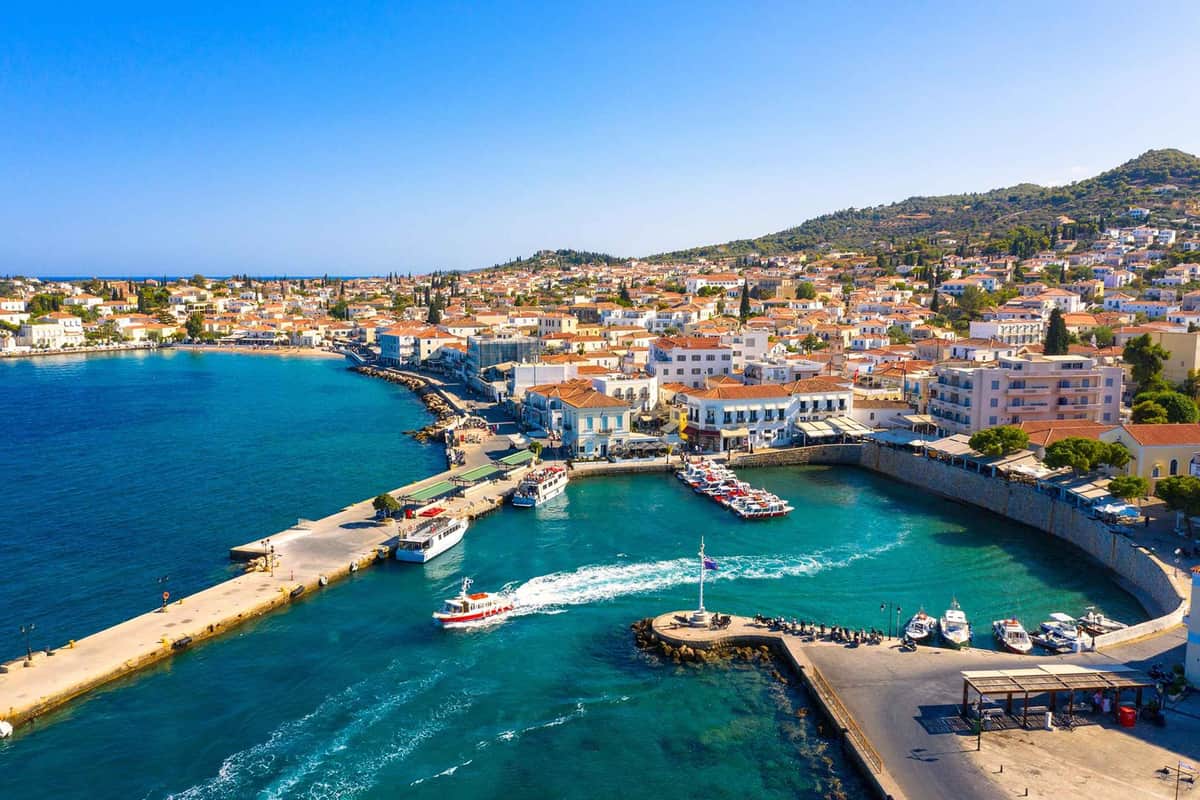
A Spetses day trip goes from Athens to a pine-covered island at the mouth of the Argolic Gulf. Horse carriages, scooters and water taxis do the work that cars do elsewhere. It is one of the island day trips from Athens on Greece VIP.
This post covers how a Spetses day trip works, from the ferry and the car rules to the town sights. It also covers the beaches, a boat trip around the island and local food. Combos with Hydra and Poros, the best season and common questions come last.
Each section ends with a Spetses day trip or cruise that can be booked online.
What does a Spetses day trip include?
A Spetses day trip includes a sea crossing from the mainland to a pine-covered island. Visitors walk the main town and its old quarter and see museums of its seafaring past. Then come a look at the harbours, a swim and a return before night.
A Spetses day trip heads for an island in the region of Attica. Spetses counts among the Saronic Islands. It forms an independent municipality in the Islands regional unit.
The same municipality takes in Spetsopoula, Falkonera and Velopoula, three islets with no residents. The outing follows the shape of a Hydra day trip: one island, one town and two crossings. Yet the landscape and the streets on arrival differ.
Pine trees explain the ancient name of the island. In ancient times it was called Pityussa. This Greek name means a place full of pine trees.
The modern name came later, from the Medieval and Modern Greek noun spétses. The word means spices or herbs. It goes back to the Italian and Venetian word spezie.
Spetses town is the only large settlement on the island. So a Spetses day trip spends its hours there. The older core sits in the area of Kastelli.
There, a wall added to the natural protection of the terrain. Arvanites took refuge there in the 18th century. This came after the Ottoman conquest of the nearby mainland and the expulsion of the Venetians.
Within that century, the island became one of the strongest naval and trading powers at sea. It played a leading part in the Greek War of Independence. Its museums keep the memory of that struggle.
Museums, harbours and beaches complete a Spetses day trip. The harbours support a lively sailing culture. Swimming spots lie within reach of the town, for a dip before the boat home.
Holiday visitors on the island are largely Greek. They come from a higher economic class. A Spetses day trip shares the waterfront with these holidaymakers.
- Early settlement: the first Hellenic settlement found on the island dates to the 3rd millennium BC.
- Island of aromas: one account links the island’s name to Venetian rule and the phrase isola di spezie.
- Arts: galleries, theatres and a programme of cultural events add a creative side to the island.
A Spetses day trip brings woodland, history and the sea together in one outing. The pine cover marks the island from a distance. The old quarter shows how refugees used the terrain for protection.
Then the harbours and beaches set the pace of the afternoon. A ferry or a boat at each end of the day frames the visit.


How does a Spetses day trip reach the island from Athens?
A Spetses day trip reaches the island in two ways. Ferries and high-speed hydrofoils sail from Piraeus, the port of Athens. Drivers head into the Peloponnese to Kosta on the mainland coast, then take a ferry, boat or helicopter.
A Spetses day trip by sea begins at Piraeus, eight kilometres south-west of the Athens city centre. The port lies on the east coast of the Saronic Gulf.
Metro Lines 1 and 3, the tram, the suburban railway, buses and trolleybuses all serve the port city. So travellers reach the quays without a car.
Piraeus counts as the fifth-largest passenger port in Europe and has three natural harbours. The central harbour was known in ancient times by the name Kantharos.
The ferries and hydrofoils from Piraeus arrive at the island regularly. A Spetses day trip can choose a conventional vessel or a faster craft. Either way, the sea route leaves the Saronic waters behind.
The route ends at the entrance to the Argolic Gulf, where Spetses lies. This second gulf opens off the east coast of the Peloponnese. It measures about 50 kilometres in length and 30 kilometres in width.
A Spetses day trip by road follows the Attiki Odos motorway and the Athens-Corinth National Road. It then takes the Corinth-Epidavros road. From there it runs south through Kranidi and Porto Heli to Kosta.
From Kosta, a ferry, a boat or a helicopter covers the final stretch. Porto Heli, a summer resort town on the same route, also has ferry links. Spetses lies 6 kilometres south of it.
So drivers have two coastal points from which to make the crossing. The link at Kosta is older than any ferry. People first lived on Spetses in the Mesolithic Age, the Middle Stone Age, around 8000 BC.
In that period, an isthmus, a narrow strip of land, linked the island to Argolida. It reached the mainland at the point now named Kosta.
Around 2300 BC, at least three natural harbours on the island sheltered ships. These ships carried goods to and from the gulf. So a Spetses day trip from the mainland side crosses water that was once dry land.
- Argo-Saronic: the two gulfs on a Spetses day trip by sea are sometimes grouped under this name.
- Kranidi: the road route passes through the seat of the municipality of Ermionida.
- Nafplio: the main port of the gulf stands at its north-western end, 40 kilometres from Porto Heli.
A Spetses day trip from the capital has two doors. The sea door opens at the city’s port and suits travellers who come without a car.
The road door runs across the mainland and ends with a short crossing. Both lead to the same island town. The choice rests on where the day starts.
Why does a Spetses day trip see hardly any cars?
A Spetses day trip sees hardly any cars because private cars are banned within the town limits. People move on foot, by horse-drawn carriage, by bicycle or on mopeds and motorcycles. Taxis and delivery vehicles handle the rest of the traffic.
This one short rule shapes a Spetses day trip. Only taxis and delivery vehicles are permitted in the downtown area. So the motor traffic near the waterfront is hired rides and goods on the move.
The Greek tourism authority treats the absence of cars as part of the island’s atmosphere. Visitors from the city notice the change as soon as they step ashore.
Horse-drawn carriages are among the main modes of transport on a Spetses day trip. The national tourism authority lists them as a highlight of the island. It says a carriage adds a timeless quality to a visit.
A ride trades speed for the sound of hooves. Passengers see the streets at the pace of a horse. For travellers with children or tired legs, a carriage turns a transfer into part of the sightseeing.
Two wheels extend a Spetses day trip beyond walking range. Bicycles, mopeds and motorcycles complete the list of everyday transport, each suited to a different distance.
Outside the centre, public buses serve beaches further from town. Taxis remain part of the permitted traffic. A visit to a far bay pairs a walk with a bus or taxi, never a private car.
Walking carries a Spetses day trip through the narrow streets of the town. Traditional houses line the way, and pedestrians meet no traffic queues. Pine-clad routes run beyond the houses.
On these paths, walkers move between shade and sea views at their own pace. Free of cars, the lanes stay open for strollers, prams and carriages alike.
A Spetses day trip on foot sets its own route through town. It stops wherever a narrow lane or a sea view invites a pause.
- Private cars: none are allowed within town limits, so a Spetses day trip skips parking searches.
- Carriages: horse-drawn carriages carry passengers at the pace of a horse.
- Buses: public buses link the town with beaches further out.
- Taxis: taxis and delivery vehicles are the only motor traffic allowed downtown.
A Spetses day trip gains a calm setting from the car rule. With private cars kept out, the streets belong to walkers, carriages and bicycles.
The noise of engines gives way to voices and hooves. Visitors who arrive from the city step into a slower rhythm. The day moves at the pace of a walk.
What does a Spetses day trip see at the Dapia harbour?
A Spetses day trip sees Dapia as the busy main harbour of the town. Old cannons stand on the front pier. Historic buildings face the water. A bronze statue of the island’s naval heroine rises on the main dock.
A Spetses day trip starts its walk at Dapia, the central harbour of the town. The Municipality of Spetses calls the area the heart of the island’s modern life. The quay, or harbour front, fits that description.
Cafe tables face the moored boats, and a steady flow of people moves along the seafront. Residents, sailors and visitors share the same strip of waterfront. The main sights of this part of town stand within a short stroll of the quay.
The old cannons are the clearest link between the harbour and the island’s naval past. A Spetses day trip finds them at the water’s edge. Before the revolution, the Spetsiotes built a powerful trading fleet in the Mediterranean.
Once the fight against the Ottomans began, those merchant ships turned into a war fleet. They joined raids on the Turkish coast. They also took part in the naval battles of Samos in 1824 and Kafireas.
Dapia mixes the modern harbour with older landmarks, and a Spetses day trip passes both. The Church of Agios Antonios, built in 1815, stands among the historic buildings by the harbour. It predates the revolution by just six years.
The Kapodistrias Building is the second historic landmark listed at Dapia. Together, the two buildings show that the busiest part of town keeps older layers of its story. Those layers sit close to the shoreline.
The bronze statue of Laskarina Bouboulina is the main landmark of the waterfront. A Spetses day trip reaches it on Dapia Square. The figure is life-sized, so it greets every arrival by sea.
The sculptor was Natalia Mela-Konstantinidou. Her work honours Bouboulina as the female symbol of the island’s revolt. Behind the statue, a grand seafront hotel that opened in 1914 completes the scene.
- Bouboulina Museum: The heroine’s family mansion stands a short walk from Dapia Square.
- Spetses Museum: It lies close to Dapia, so a Spetses day trip pairs both museums with the harbour.
- Old Harbour: Next, a Spetses day trip walks an inner road from Dapia to the old port.
Dapia rewards a slow pace more than a quick photo stop. A Spetses day trip that starts with the cannons, church and statue gains context for the museums.
Both museums nearby tell the story of the same fleet and the same heroine. The harbour then serves as the natural return point of a Spetses day trip.
What does a Spetses day trip learn at the Bouboulina Museum?
A Spetses day trip learns at the Bouboulina Museum how a widowed shipowner built a warship. Laskarina Bouboulina joined the Greek War of Independence and was honoured as an admiral. Her descendants saved the family mansion, with its weapons, letters, furniture and carved Florentine ceiling.
Laskarina Bouboulina was born in Constantinople in 1771. Her father was Stavrianos Pinotsis, a captain from Hydra. The Ottomans jailed him for his part in the Orlov revolt, an uprising against their rule.
Her family moved to Spetses when she was four years old. A Spetses day trip to her mansion begins with this family background. Both of her husbands were sea captains.
The first was Dimitrios Yiannouzas, and the second was Dimitrios Bouboulis. Both men drowned while fighting Algerian pirates. Her surname comes from the second.
After Bouboulis died in 1811, she took over his fortune and trading business. She also bought shares in other Spetsiot ships. Then she ordered a vessel larger than Ottoman rules allowed.
The Ottoman admiral Hussein came to check the ship. She bribed him to report it as a trade ship. That vessel was the Agamemnon, the first warship of modern Greece, armed with 18 cannons.
A Spetses day trip sees paintings and models of warships in the mansion. Bouboulina also joined the Filiki Etaireia. This secret society prepared Greece for revolution.
On 4 April 1821, she sailed her warship to Nafplion. She placed the city under a naval blockade, cutting it off by sea. Next she blockaded Monemvasia, whose garrison of soldiers surrendered on 25 July.
Her son Yiannis was killed in battle outside Argos. A Spetses day trip learns about these events in the rooms. Documents and letters of the revolution sit there beside her personal items.
Her life ended in 1825, after her son Georgios eloped with Eugenia Koutsi. Armed members of the Koutsis family came to her house. She was shot while facing them from the balcony.
Days after her death, a Russian delegation arrived. It brought the honorary rank of Admiral of the Russian Navy, granted by Tsar Alexander I.
In 2018, the Hellenic Navy named her Rear Admiral. A Spetses day trip ends the visit with this contrast between private tragedy and public honour.
- Founding: Filippos Demertzis-Bouboulis, a fifth-generation descendant, opened the museum in 1991 to save the mansion from collapse.
- Ceiling: A carved wooden ceiling from Florence crowns the grand hall.
- Collections: Old books, porcelain, maps, embroidery, busts and Byzantine icons date from the 17th to 20th centuries.
- Visitors: The museum has welcomed more than 800,000 people, about 200,000 of them students.
The house is 300 years old, so the building predates the revolution it now explains. A Spetses day trip that stops here leaves with a clear picture of her life.
One Spetsiot woman put her fortune into ships and organised a fleet. She then became the first woman admiral in world naval history.
What does a Spetses day trip find in the Spetses Museum?
A Spetses day trip finds the Spetses Museum in the mansion of Hatzigiannis Mexis, the island’s first governor. Its rooms cover more than 4,000 years of local history. They run from ancient pottery to War of Independence relics, including Bouboulina’s bones.
Hatzigiannis Mexis was a shipowner born on Spetses around 1754. He died there in 1844. When the revolution came, he sent four well-equipped vessels of his own to the fleet.
Other ships in which he held shares also took part. He later sat as a delegate in the First National Assembly at Epidaurus. He also served as a senator.
A Spetses day trip meets his name first, since the museum fills his former home. The mansion went up between 1795 and 1798. Its plan follows the shape of the Greek letter Π, with high arches.
The building has been a protected historical monument since 1924. In 1938, the last heirs of the family donated it to the Greek state. They were Kalomira Mexis and Niketa Thermisioti-Katsina.
The museum began to operate soon after. A Spetses day trip enters a building that was more than two decades old when the revolution began.
The ground floor holds finds from the shipwreck of Point Iria. That wreck dates from before the Mycenaean age. The upper floors display ceramic vases from the Early Helladic and Classical periods.
Funeral stelae, or carved grave stones, stand there too. Sculptures and coins from the Roman and Byzantine periods follow. A collection of post-Byzantine and Russian icons and other religious objects comes next.
For a Spetses day trip, these rooms open the story of the area. That story starts long before the golden age of the sea captains.
The revolution section holds the flag of the uprising, weapons and portraits of fighters. It also holds documents and nautical instruments, the tools sailors used to navigate.
Here a Spetses day trip reaches the bones of Laskarina Bouboulina. They rest in an ossuary, a small burial chest, in the same section as the flag.
The display places the heroine beside the island’s other fighters. It sits inside the house of a fellow shipowner who also sent his ships to war. Her ossuary turns the visit from a history lesson into a moment of respect.
- Folk life: Island costumes, objects of daily use, wood carvings and embroideries fill the upper rooms.
- Trade goods: Spetsiot sailors brought Eastern and European ceramics home from voyages in the late 18th century.
- Building: The mansion has stone walls, an inner courtyard and wooden floors.
- Archive: The island’s historical archive shares the mansion, and a Spetses day trip passes it too.
The Spetses Museum completes the history thread that begins at the harbour. A Spetses day trip sees the cannons, the heroine’s home and finally her ossuary.
This walk across town follows her story from start to end. The ancient finds and folk objects add the wider frame. They place the war years inside the long life of the island.
What does a Spetses day trip see at the Old Harbour?
A Spetses day trip reaches the Old Harbour, called Palio Limani in Greek. Wooden boats take shape there in working boatyards. A pine wood surrounds the lighthouse and holds an open-air sculpture exhibition. The bars where island nightlife gathers line the same waterfront.
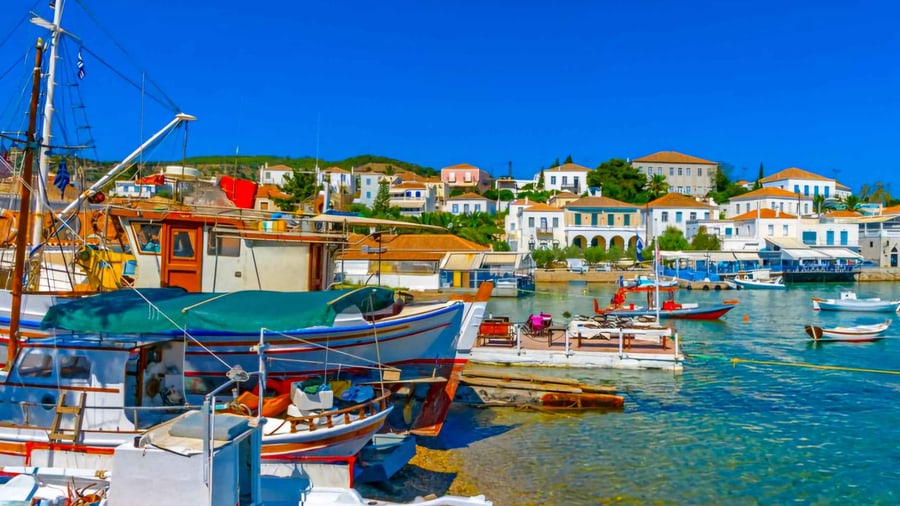
Working boatyards give a Spetses day trip its clearest link to the island’s past at sea. The municipality says traditional wooden shipbuilding yards still work at the Old Harbour.
New boats are built and old ones repaired there. The work is easiest to see in the summer months. Local authorities call the yards a living part of the island’s sea tradition.
The yards also enter their own vessels in a classic yacht regatta. A regatta is a sailing race. Spetses holds it each year with the support of the municipality.
The lighthouse stands in the pine-covered part of the harbour. Here a Spetses day trip finds an early chapter in the story of Greek sea travel.
The Lighthouse Service of the Hellenic Navy records that two new lights began to work in 1831. One stood on the left side of the port of Kea. The other stood on Spetses.
The same service builds, supplies, repairs, maintains and runs the whole national lighthouse network. Its duties stretch from proposals for new lights to the closure of old ones.
The pines around the lighthouse also hold an open-air exhibition of sculptures by Natalia Mela. She was a Greek sculptor who lived from 1923 to 2019.
The municipality notes that she spent almost all her summers on the island. Wikipedia records that she first worked in stone and later turned to metal.
Her goats, bulls and other animals stand under the trees. A mermaid figure welcomes boats into the harbour. On a Spetses day trip, the exhibition adds modern Greek art to a harbour walk.
The mood of the harbour changes after dark. The municipality states that island nightlife gathers mainly at the Old Harbour. Still, an evening can start with a drink in the town.
A Spetses day trip can last into the evening. The waterfront bars close to the boatyards then offer a final drink. The same waterfront joins craft work by day and social life at night.
- Boatyards: Craftsmen build and repair wooden boats beside the water.
- Lighthouse: The light stands among pines and belongs to the national network run by the navy.
- Sculptures: Animal figures and a mermaid fill an open-air exhibition under the trees.
- Evenings: The quay holds the main cluster of bars for a Spetses day trip that runs late.
A Spetses day trip that skips the Old Harbour misses the island’s working side. The boatyards show a craft still in use. The lighthouse recalls the early years of the national light network.
The sculptures add modern art to the shore. One walk along the water joins all three. The bars then give the visit a natural end after sunset.
What is the Armata festival on a Spetses day trip?
A Spetses day trip in September can catch the Armata, the island’s festival. It marks a sea battle from the Greek War of Independence. A week of events ends on the second Saturday of the month. Then a replica Ottoman flagship burns in the harbour at dusk.
The festival recalls the Battle of Spetses, a series of sea clashes in the Argolic Gulf. They took place from 8 to 13 September 1822 in the Old Style, the older calendar. English Wikipedia describes it as a contest between the Greek fleet and the Ottoman navy.
An Ottoman force of 84 vessels sailed under Kara Mehmet Pasha. Its orders were to destroy the Greek forces at Hydra and Spetses. A Spetses day trip in September falls in the same weeks as the original battle.
Admiral Andreas Miaoulis split his 56 ships and 16 fireships into three groups called squadrons. Fireships were boats set on fire and steered into enemy ships. The Ottoman fleet pulled back after failed attempts to break through.
The clash counts as a Greek victory. Wikipedia credits the retreat to Kosmas Barbatsis (1792-1887). He steered his fireship at the Ottoman flagship, the fleet’s lead ship, and forced it to flee.
The municipality adds that crews from other islands, Psara among them, joined the island fleet. Together they stopped an Ottoman attempt to retake Nafplion. Each autumn a Spetses day trip can see this story acted out on the water.
The Greek National Tourism Organisation describes a full week of events before the main night. It lists concerts, traditional dances, theatre, exhibitions and activities for all ages.
The high point is a partly made-up re-enactment, where people act out the battle again. Fireworks, flares and a live narration of the war’s events fill the evening.
Local craftsmen build the model of the Ottoman flagship that goes up in flames. A Spetses day trip earlier in the week still finds concerts and shows.
The festival also has a religious side. The Church of Panagia Armata shares its name with the festival. Panagia is a Greek name for the Virgin Mary.
The church is dedicated to her symbolic act of stepping in to help during the battle. The tourism organisation suggests a visit to the church during the Armata.
The municipality lists the church among the island’s monuments of religious architecture. A Spetses day trip that adds the church sees faith and naval memory meet.
- Main night: A model flagship burns while a narrator retells the battle to a Spetses day trip crowd.
- Festival week: Concerts, dances, plays and exhibitions fill the days before the finale.
- History: The event honours a sea victory that protected a key Greek gain on the mainland.
- Church: The Virgin of the Armata church links a Spetses day trip to the battle.
Once a year, the island acts out its own history in public. The Armata is that moment. The narration, the fireworks and the burning ship turn a sea battle into a shared evening.
A Spetses day trip in early autumn gains a festival on top of the usual sights. Summer visitors still find the church and the story in place.
Why does a Spetses day trip visit the monastery of Agios Nikolaos?
A Spetses day trip visits the monastery of Agios Nikolaos for its church high above the harbour. The church is tied to the start of the Greek revolution. It also keeps a traditional pebbled courtyard. A tall marble bell tower rises over the old port.
The church sits on raised ground above the boatyard inlet, a small bay. The municipality says it began as a monastery in 1700. It now serves as a grand church rather than a working monastery.
Its patron is Saint Nicholas, the saint who protects sailors. Wikipedia notes that Greeks also honour him as the patron saint of all of Greece. A Spetses day trip finds this fitting for an island that made its name at sea.
The key date for a Spetses day trip here is 3 April 1821. The municipality records a formal blessing at the church that day. It marked the start of the revolution.
English Wikipedia adds that Spetses was the first Greek island to raise the flag of the revolution. It did so on the morning of the same day. The island’s fleet of merchant ships then played a key role in the struggle that followed.
The bell tower was built in 1805 with marble from Tinos. Tinos is an island in the Cyclades group, and marble is among its mineral resources. The municipality gives the tower’s height as 10 metres on a base of 6 metres.
That makes a broad base for a tower of this size. Around it, the courtyard is paved with pebbles in the traditional island way. On a Spetses day trip, the courtyard and tower show stone and pebble work together.
- Courtyard: The church keeps a traditional pebbled courtyard.
- Bell tower: Island marble forms the tower that greets a Spetses day trip from above.
- Revolution: The blessing that opened the island’s part in the uprising took place here.
- Dedication: The church honours the saint who protects sailors on every Spetses day trip by sea.
A Spetses day trip climbs to Agios Nikolaos from the harbour below. The climb links the waterfront with the island’s role in Greek history. The church holds the story of the revolution in one site.
The tower shows imported island marble, and the courtyard keeps a traditional craft in view. Together they make the monastery a calm final stop above the busy waterfront.
Why does a Spetses day trip pass the Anargyrios and Korgialenios School?
A Spetses day trip passes the Anargyrios and Korgialenios School because three stories meet there. The seafront complex stands west of the town. A benefactor came home rich from America. A model boarding school for boys opened, and an English novelist taught there.
Two benefactors share the name of the school. Sotirios Anargyros came from an old Spetses shipping family. He left for the United States in 1868.
He returned in 1899 as a rich tobacco tycoon. Marinos Korgialenios is the second name. His will founded the public library of Argostoli in 1924.
A Spetses day trip that walks west from the harbour meets the result of their vision. It is a wide, spread-out group of school buildings by the sea.
The school opened in 1928 and ran as a boarding school until 1983. The municipality describes a school for boys from wealthy families. It followed the pattern of elite English schools.
It drew politicians, royals and the Athenian social elite. Former Prime Minister Georgios Rallis studied there, and so did the composer Iannis Xenakis. Xenakis arrived in 1932 and sang in the boys’ choir.
A Spetses day trip passes a place that shaped Greek public life. In 1951 the English writer John Fowles became English master here. He turned down an offer from a school in England to take the job.
He stayed until 1953. Then he and the other masters lost their jobs for trying to bring in reforms. On the island he met his future wife, Elizabeth Christy, and gathered the experiences behind a novel.
A Spetses day trip crosses real literary ground, since the island and school stand behind the fiction. That novel, The Magus, came out in 1965. A revised edition followed in 1977.
In the book the island becomes Phraxos, and the school becomes the Lord Byron School. The book also uses the Villa Bourani, a real house on the south side.
The house stands above a popular public beach and is still in private hands. The 1968 film version was shot on Mallorca. So a Spetses day trip sees the true setting that the screen left out.
- Theatre: A Spetses day trip can spot an ancient-style outdoor theatre with 1,100 seats on the next hill.
- Library: The school keeps a library of about 5,000 Greek and international titles.
- Status: The complex is an officially protected site facing Ligoneri Beach.
- Founder’s house: Neith, the founder’s neoclassical home from 1904, has belonged to the school since 1929.
Today the foundation manages the estate. It uses the buildings for international conferences, research meetings and cultural events. An easy walk west along the shore links the town and the school grounds.
A Spetses day trip that takes this walk finds three stories in one place. They are a returning emigrant, a boarding school and a famous novel.
What does a Spetses day trip see in the captains’ mansions?
A Spetses day trip sees in the captains’ mansions the wealth of a merchant fleet. That fleet traded across the Mediterranean and beyond. The money shows in stone houses, neoclassical fronts, gardens and balconies. Pebbled courtyards spread over the slopes of the town.
The mansions grew out of trade. In 1774 newcomers from the facing Peloponnese coast resettled the island. Its people rebuilt a strong merchant fleet that sailed under the Russian flag.
Island ships traded from the Black Sea to the Atlantic. During the Napoleonic Wars, trade bans called embargoes brought large profits. A Spetses day trip reads that money in houses that spread beyond the old walled village of Kastelli.
Captains and shipowners led life on the island. Georgios Panou and Vasilios Lazarou turned their trade into political weight. The Lazarou family carried the nickname Orlof.
The captains grew so rich that they kept gold hidden in wells. During the revolt against Ottoman rule, they spent that gold to fund the war of liberation.
A Spetses day trip passes the homes of these families. They were built when the island ranked among the strongest naval powers of the Aegean.
The Region of Attica counts a large number of neoclassical mansions in the town. Of its buildings, 60 are listed monuments. A ministry decision listed them.
The decision says their architecture and form record island culture from the end of the 18th century. On a Spetses day trip, the houses climb sloping ground on the north-east side. Others line the shore, and grand homes sit high on the hill above the sea.
The details reward a slow walk. The narrow lanes show neoclassical house fronts, elegant balconies, bright flowers and courtyards paved with pebbles. Along the shore toward the Old Harbour, the captains’ houses sit in large gardens.
Detailed stone patterns fill these gardens. The Town Hall keeps a garden with Spetses pebble mosaics, made in the same local craft. A Spetses day trip that leaves the main harbour finds these patterns in yards, gardens and lanes.
- Golden age: The island economy flourished from the 17th to the 19th century.
- Decline: Trade and seafaring fell sharply after 1860.
- Town plan: The town has no strict street plan; the size of its buildings gives it order.
- Protection: A Spetses day trip enters a recognised historic site and traditional settlement.
The mansions remain the clearest record of the shipowners who made the island rich. A Spetses day trip walks slowly through the upper lanes, then down toward the water.
On the way, it shows how sea trade, local craft and neoclassical taste came together. All of this sits in one small town on the Argolic Gulf.
Which west coast beaches does a Spetses day trip reach?
A Spetses day trip reaches the far side of the island by bus or boat. There, long pebble and sand beaches sit in quiet bays. Pine forest runs down to the water. A sea cave opens beside the longest beach on the island.
A public bus links the town beach of Agios Mamas with Agia Paraskevi, Agioi Anargyroi and Xylokeriza. A daily boat from Dapia serves the remote beaches. A Spetses day trip can mix both routes, going out by bus and back by boat.
The Region of Attica places Agioi Anargyroi in the south-west, 10 km from Dapia. It can also be reached by bicycle or motorbike. Xylokeriza lies just before it on the uninhabited side, with small white pebbles below a bus stop.
Agioi Anargyroi is the longest beach on the island, with a mix of sand and small pebbles. Beside it lies Bekiris Cave, reached by a short walk along the shore or by swimming. Light enters through the rock, and a small sandy beach waits at the back.
During the War of Independence, the cave sheltered women and children from raids. Legend says a drink from its spring keeps love alive for ever. A Spetses day trip pairs the swim with the cave.
Agia Paraskevi has a small church and large pebbles. Its pines grow right to the edge of the sea. The municipality notes that it is widely rated the finest beach on the island.
Past it, Tsakonas sits in a remote bay that needs a hike or a private boat. Zogeria has a sandy main beach in a small bay ringed by pines. A Spetses day trip that wants shade and calm water picks one of these coves.
The green slopes behind these beaches have a clear origin. The school foundation’s pine forest covers about half of the island. The benefactor behind the school had young pine trees planted on the hills.
Today those hills make the island one of the best-wooded in the southern Aegean. A Spetses day trip to these bays swims below those wooded hills.
- Quiet coves: Kouzounas and Vrellos offer calmer swims in natural scenery.
- Stone age: Flint from the Mesolithic, or Middle Stone, Age was found near Zogeria.
- Lookouts: Stone lookout posts stood at Zogeria during the Peloponnesian War.
- Old finds: A Spetses day trip to Agioi Anargyroi visits an area with late Mycenaean artefacts.
The west coast shows the wilder face of the island. Buildings stand far apart, the pine is thick and the water is clear over pebbles. A Spetses day trip can ride the bus out in the morning and swim in one bay.
The trip then walks on to the cave and returns to town. It brings back a full picture of an island that holds far more than its harbour.
Which town beaches does a Spetses day trip use for a swim?
A Spetses day trip finds three swimming spots close to the main town. Agios Mamas is in the town centre. Kaiki and Agia Marina lie a short walk away. The island sits at the entrance to the Argolic Gulf, off the east coast of the Peloponnese.
The closest swim on a Spetses day trip is Agios Mamas, a beach inside the town centre. Swimmers reach it on foot from any street, with no bus or boat needed. For a longer ride out, public buses run from the town to beaches further along the coast.
Kaiki beach lies 1 kilometre northwest of the town. In the past it went by the name College beach. The short distance lets a Spetses day trip fit in a morning swim there before the town sights.
Agia Marina, 2 kilometres south of the town, adds deep history to a Spetses day trip. Archaeologists found the first Hellenic settlement on the island here, dated to the 3rd millennium BC. Late Mycenaean finds from the 12th to 13th century BC turned up here as well.
Every swim on a Spetses day trip takes place in the Argolic Gulf. The gulf is an arm of the Aegean Sea. Its main port, Nafplio, stands at the far northwestern end.
Strong swimmers find a long tradition behind a Spetses day trip. Two island residents, Dimitrios Drivas and Ioannis Malokinis, swam at the 1896 Summer Olympics. Today the island hosts the Spetses Mini Marathon.
The event includes open-water races of 2.5 and 5 kilometres, plus a children’s race of 1,000 metres. Over 3,000 athletes take part across all its sports. World record attempts in free-diving also take place in the waters around the island.
- Water-sports: Kaiki and Agia Marina are the two town beaches with water-sports on offer.
- Water colour: the beaches are known for clear turquoise water ringed by dense vegetation.
- Access: the beaches are easy to reach either on foot or by water taxi.
- Swim kit: a Spetses day trip goes smoothly with swimwear, a towel and sun cream.
One swim gives a Spetses day trip a cool break between the town sights and the boat home. A late afternoon swim leaves the morning free for the museums and old mansions. A day bag with swim gear lets visitors switch from a stroll to the sea at any hour.
What does a Spetses day trip see on a boat trip around the island?
A Spetses day trip by sea passes pine-covered hills and quiet coves. It also passes the private islet of Spetsopoula to the southeast. Water taxis and wooden caiques work the coast. Walking trails ring the whole island for visitors who stay on land.
A water taxi lets a Spetses day trip move along the coast. Such boats run on demand, like a road taxi, not on a fixed timetable like a water bus. On-demand water taxis are common in harbours and marinas.
There they give access to boats and waterfront spots beyond the land routes. Around Spetses, certain local coves can be reached only by boat. So a Spetses day trip by water taxi sees shoreline that walkers miss.
The caique is the traditional fishing boat of the Aegean and Ionian seas. It suits a Spetses day trip along the shore. Builders shape it from pine wood on the foreshore, the strip between the tides.
It has its widest beam far aft, toward the back, and a long, sharp bow. A short mast and a bowsprit complete the rig. A bowsprit is a pole that sticks out past the bow.
Caiques once served for fishing and trawling, which means dragging a net behind the boat. They now also work as short excursion vessels in the summer tourist trade.
To the southeast, a Spetses day trip by boat reaches Spetsopoula, a small islet. It covers about 2 square kilometres and lies 90 kilometres from Athens. The 2011 census found nobody living there, down from 8 residents in 2001.
The geographer Pausanias recorded its ancient name, Aristera. Shipping magnate Stavros Niarchos bought the islet in 1962. His descendants still own it, so it stays in private hands.
A Spetses day trip on land can circle the island as well. Trails encircle Spetses and total about 25 to 30 kilometres in length.
Beyond the town, the island holds only small places such as Ligoneri, Kouzounos and Moni Agion Panton. Moni Agion Panton means the Monastery of All Saints.
- Islet name: the modern name Spetsopoula means small Spetses, after its larger neighbour.
- Deck kit: a hat, sun cream and a light layer for the breeze suit a Spetses day trip.
A Spetses day trip that adds a boat ride sees the island from the water. That is how its seafaring families once saw it. Visitors can agree a route with the skipper, or captain, at the quay.
The route can run from a single cove to a wider loop past the islets. Calm water and a clear sky give the sharpest views of the pines and the shore.
Which local food does a Spetses day trip taste?
A Spetses day trip tastes fish à la spetsiota, the island’s signature baked fish. It also tastes small almond sweets called amygdalota. Fresh seafood and local thyme honey round out the menu. So do the pistachios of Aegina, another Saronic island.
The trademark dish of a Spetses day trip is fish à la spetsiota, or Spetses-style fish. Cooks bake fresh fish slowly in the oven with tomato, garlic and herbs. Island taverns serve fish and seafood landed fresh each day by the local fishing boats.
Almond sweets are the second taste of a Spetses day trip. Across the Aegean islands, above all the Cyclades, they top the list of local treats.
Greek tourism authorities name Spetses among four islands whose amygdalota carry the widest fame. The other three are Andros, Mykonos and Hydra. Admirers rate the Spetses ones as the best almond sweets anywhere.
The Spetses recipe uses honey, semolina and cinnamon. Semolina is a coarse flour made from wheat. A drizzle of rosewater, water flavoured with rose petals, gives each piece its scent.
In the classic island recipe, amygdalota take a finger or pear shape. They start as ground blanched almonds kneaded with rosewater and sugar. Blanched almonds have had their skins removed.
They are baked, left to cool and then dusted with caster sugar. Each one is small enough to eat in a single bite. That makes a Spetses day trip snack easy to carry.
Other regions call them rozethes, ergolavoi or troufes. The label Greek macaroons also appears, though the sweets contain no coconut. A macaroon is a small, chewy cookie.
A Spetses day trip can also pick up the local thyme honey. Visitors are urged not to miss it. Spoon sweets turn up on the islands and the mainland alike.
In-season fruit, unripe nuts and certain vegetables are boiled in syrup and kept in jars all year. The name comes from serving them by the spoonful.
Among the Saronic islands, Aegina grows pistachios sold as Fistiki Aeginis. This name has been a Protected Designation of Origin since 1996. The physician Nikolaos Peroglou began systematic pistachio growing there in 1896.
- Spice name: the Venetians called the island Spezia for its place on a major spice trade route.
- Spoon sweet fruits: popular choices include sour cherry, bitter orange, quince, bergamot and fig.
- Other flavours: amygdalota elsewhere can take honey and orange flower water in place of rosewater.
- Wider family: similar almond cookies appear across the cuisines of the eastern Mediterranean.
One sit-down meal and one sweet stop give a Spetses day trip both signature island tastes. Lunch at a table by the water suits the baked fish.
A small box of almond sweets makes a light gift for the ferry home. The two tastes round off a day split between the harbour, the beaches and the sea.
How does a Spetses day trip combine with Hydra and Poros?
A Spetses day trip combines with Hydra and Poros. The three islands sit along one stretch of sea off the Argolid coast. Ferries link their harbours in a chain. Their shared seafaring past turns a single sailing into one connected story.
A Spetses day trip that adds Hydra and Poros links three islands with one sea-going past. Trade with the Levant, the eastern Mediterranean shore, came to depend on ships from Hydra. Those ships still faced rivals from Spetses and Psara.
Seamen from Hydra and Spetses spoke Albanian. They formed the core of the Greek fleet in the War of Independence. Poros also lived from shipping and trade. Yet its fleet never matched the fame of its two neighbours and rarely joined sea battles.
The sea route of a Spetses day trip runs along the Argolid coast. There, mainland ports face the islands. Porto Heli is a summer resort town on a bay of the Argolic Gulf. It lies 6 km north of Spetses.
Ferries connect Porto Heli with Spetses, Hydra, Poros, Ermioni and Piraeus. Ermioni is a small port town in southeastern Argolis. It faces Hydra and Dokos across the water and has its own ferry to Piraeus.
The municipality of Poros also takes in a strip of the Peloponnese coast near Thermisia and Hydra. The Peloponnese is the large peninsula of southern Greece.
On a three-island Spetses day trip, Hydra brings a strong name. In 2007 a panel of 522 travel experts rated it the highest of any Greek island. They placed it 11th of 111 islands worldwide. This was for keeping its integrity of place, or true local character.
Its ties with the Argolid coast are ancient. Farmers and herders resettled Hydra in the 8th century BCE, possibly sailing from Ermioni. The ancient historian Herodotus reports that toward the 6th century BCE the island belonged to Ermioni. That port town sold it to Samos.
Poros, an island rich in plants and trees, completes a Spetses day trip across the three harbours. Its roads and tourist facilities have made it a favoured resort for short holidays.
The Holy Monastery of Zoodochos Pigi was founded in 1720. Its Greek name means Life-Giving Spring. It stands on a pine-covered slope 4 km east of the main town.
At the edge of the town lie the carved-stone ruins of a Russian naval supply station. These ruins gained protection as architectural monuments in 1989.
- Shared roots: A Spetses day trip and a Hydra stop both meet islands where Arvanite communities still live.
- Literary Poros: Giorgos Seferis, Kosmas Politis and Kostis Palamas all wrote about the island.
- Venetian Poros: Under Venetian rule the island counted about 15,000 inhabitants and governed Methana and Epidaurus.
- Halieis: The ancient city near Porto Heli, which Pausanias called Halike, was excavated by Michael H. Jameson.
A Spetses day trip and a three-island sailing cover different stretches of the same water. The Argolid shore links Spetses with Hydra and Poros. The Saronic Gulf, near Athens, also holds Aegina.
Travellers who want all three Saronic stops on another date can book a Hydra, Poros and Aegina cruise. That keeps Spetses for a day of its own.
When is the best season for a Spetses day trip?
A Spetses day trip finds its best season between June and October. Summer brings heat and a steady wind from the north. A June regatta fills the strait with sails. September brings the naval festival, and autumn keeps a long record of visits.
The weather on a Spetses day trip follows the Mediterranean pattern. Its code in the Köppen climate system is Csa. This is the main climate type of Greece.
During summer the weather is mostly sunny and dry. The rain that falls comes as showers or thunderstorms. Spetses sits at the entrance of the Argolic Gulf. The mountains around the gulf protect it from the strong summer meltemi wind.
Summer is the busiest stretch for a Spetses day trip. Yet the main holiday season of Athenians on the island lasts only two months. The etesian winds of the Aegean shape those weeks.
These winds bring fine, clear weather, and their flow from the north cools the summer heat. In the southern Aegean they turn to blow from the northwest. Leisure sailors favour them as a good, steady wind. The breeze tends to drop at night.
September opens the festival season of a Spetses day trip. The island then holds its yearly naval memorial event in the harbour. Autumn also has a long record as a visiting season.
Around the turn of the 20th century, wealthy Athenians reached Spetses between August and October. They came to hunt turtledoves and quail, birds that migrate between Africa and Europe. On the mainland, the Porto Heli yacht marina has become a popular winter port for pleasure boats.
Early summer puts sails on the water for a Spetses day trip. In June a classic yacht regatta holds a weekend of races. The races start and finish in the strait between Spetses and Kosta.
Vintage yachts built before 1947 compete with classic yachts built between 1948 and 1974. Traditional caiques, or wooden fishing boats, and open boats race in their own classes.
A record fleet of 75 yachts took part in 2015, the year of the regatta’s 5th anniversary. Island officials back such events to stretch the season beyond its short summer peak.
- Name: The winds take their name from the Greek etos, meaning year, as they return each year.
- No winter twin: Unlike a true monsoon, the meltemi is dry and has no opposite wind in winter.
- Long spells: The etesian winds sometimes blow for days without a break.
- Sudden onset: The same winds can rise without warning in clear weather.
Season choice for a Spetses day trip comes down to heat, wind and events. High summer brings the fullest harbour and steady winds from the north. The weeks outside the short peak leave more room in the lanes and on the quay.
What do travelers ask about a Spetses day trip?
A Spetses day trip raises five common questions. Travellers ask whether one day is enough and how to move around without a car. They also ask about children, swimming and other day trips from Athens. The answers rest on island records.
Is one day enough for a Spetses day trip?
One day suits a Spetses day trip that centres on the town of Spetses. The smaller settlements and the outer coast take more time.
The island holds a yearly running race around its shore. Its long course measures 25 km, cut from an original 26 km. So a single visit covers the town well and the wider island in part.
How does a Spetses day trip get around without a car?
A Spetses day trip moves on foot through the town. Public buses carry visitors to the beaches further outside it. Water taxis wait for hire in the new port.
Horse-drawn carriages, bicycles and mopeds, or light motorbikes, complete the list of common ways to move. So a day without a car still reaches the outer shore.
Does a Spetses day trip suit children?
A Spetses day trip suits families, and the island already plays a part in a family film. Fishtales, a comedy, was shot on Spetses in summer 2006. It follows a widowed professor who travels there with his 12-year-old daughter and meets a mermaid.
Young swimmers also have a race of their own. The island’s open-water programme, with races held in the sea, includes a children’s 1000 m event.
Where does swimming fit on a Spetses day trip?
Swimming fits easily into a Spetses day trip. The open-water races of the island’s mini marathon drew more than 600 swimmers by 2013. That made it the largest such event in Europe.
Can a Spetses day trip combine with other day trips from Athens?
A Spetses day trip works best as a stand-alone outing. Other trips from the capital fit on separate dates. Nafplio is the main port of the Argolic Gulf, at its northwestern end.
From 1827 to 1834 it served as the first official capital of the modern Greek state. The wider list of day trips from Athens adds mainland sites to a stay with islands.
Featured photo: Spetses full day trip from Athens with swimming, via GetYourGuide.