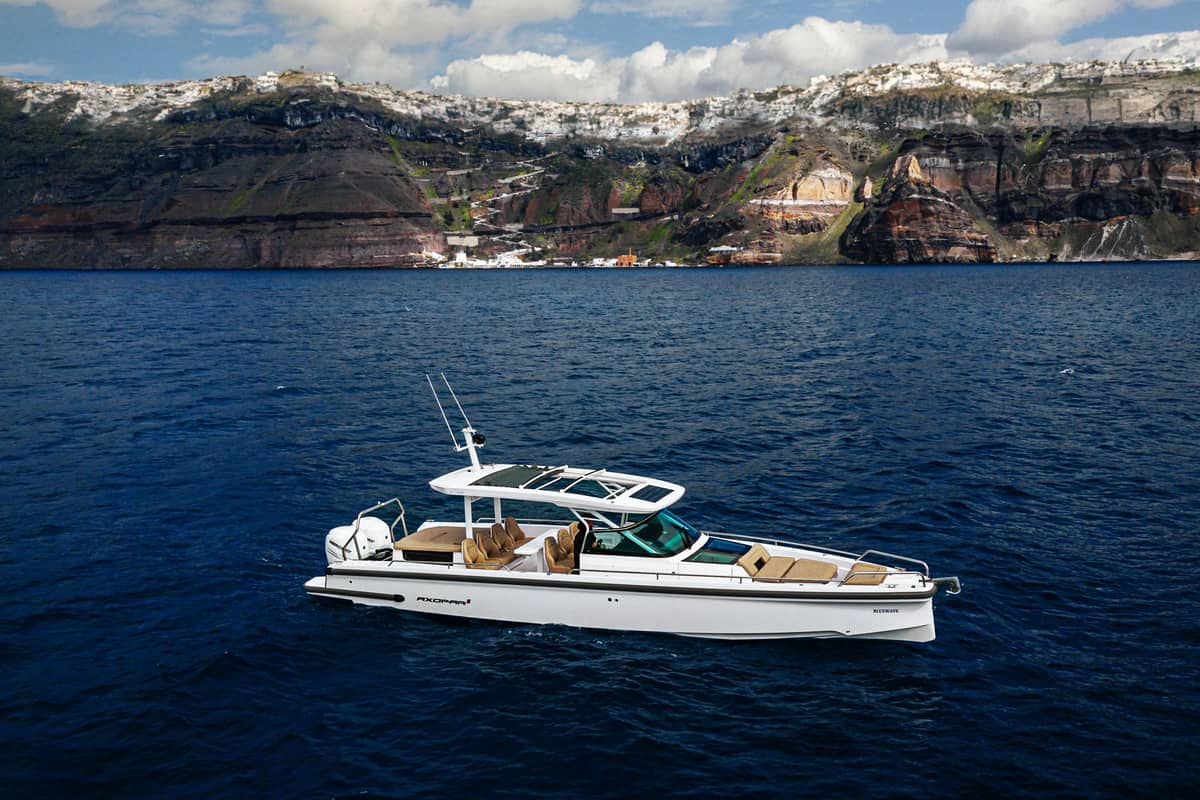
A Santorini yacht cruise sails the flooded volcano crater of Santorini on a private or shared yacht. Guests swim, eat on board and watch the cliffs from the water. It is one of the private yacht tours in Greece on Greece VIP.
This post covers what a Santorini yacht cruise includes, where cruises leave from and which boats sail. It also covers the caldera, the swim stops and Thirasia. Food on board, the best season and common questions come last.
Each section ends with a Santorini yacht cruise or a nearby sea tour that can be booked online.
What does a Santorini yacht cruise include?
A Santorini yacht cruise includes a boat, a crew and the gear that keeps everyone safe. A skipper leads the trip on small yachts. Cabins, a salon and a bathroom sit below deck. Instruments on board help the crew plan the route.
On a Santorini yacht cruise, the person in charge is the skipper. The word comes from the Middle Dutch scipper, from scip, meaning ship. On private small yachts, skipper is used more than captain.
The boatswain, or bosun, is the highest rate of the deck crew. A rate is a sailor’s rank. The bosun looks after the parts of the hull. This sailor also supervises the other deck crew.
A cruising yacht has at least two cabins: a main salon and a forward stateroom. On smaller yachts, the salon has fold-out beds for crew or passengers. It also holds a dining area with a folding built-in table.
The head is the yacht’s bathroom. Its marine toilet sends waste into a holding tank. A desalination water maker turns sea water into fresh water for the tanks. Greece has more than 2,000 vessels for hire, including boats for catamaran cruises around the caldera.
- Navigation station: This desk on board lets the crew plan the route.
- Depth sounder: This tool shows how deep the water is under the yacht.
- Anemometer and compass: An anemometer measures wind speed, and a compass shows direction.
- GPS and radar: GPS finds the yacht, a chartplotter shows it, and radar shows other boats.
Every Santorini yacht cruise depends on this mix of crew and gear. Yachts of 24 m and below can be built of fibreglass. Larger yachts tend to use steel, aluminium or composite plastic.


Where do Santorini yacht cruises leave from?
A Santorini yacht cruise leaves from one of the island’s small ports or bays. Vlychada is a fishing shelter 10 km from Fira. Fira bay and Ammoudi bay are two more harbours. The Municipal Port Fund of Thira manages these ports and shelters.
Small boat shelters stand at Armeni, Monolithos, Exo Gialos, Vourvoulos, Pori and Mavri Petra. A boat shelter is a small protected harbour. On Thirasia, shelters stand at Korfos and Riva.
Vlychada lies 6 km from the airport. Two breakwaters protect it. A breakwater is a sea wall that blocks waves. One is 380m long and the other 130m. Its piers and quays run 980m, with 700m of useful length.
Fira bay served the town until the port of Athinios was built. Today it is the gateway for cruise ship passengers. The bay has no breakwater, because the sea is too deep for one. It stays safe in all weathers.
Since 2014, launches have carried cruise passengers from Fira bay to Ammoudi bay. A launch is a small motor boat. A Santorini yacht cruise that reaches Ammoudi enters a bay of no more than 15 acres.
- Vlychada central basin: Medium vessels use this basin, which is about 4.00m deep.
- Vlychada Basin A: Small fishing boats dock here, in water about 1.00m deep north and 3.00m south.
- Fira bay size: The bay covers no more than 26 acres, with 297.00 m of useful pier.
- Athinios: Ships here run to Piraeus, Rafina, the Cyclades, Crete and the Dodecanese.
Each port gives a Santorini yacht cruise a different start. Building A at Vlychada holds cold rooms, an ice room, a port authority office and a canteen.
Which boats sail on a Santorini yacht cruise?
A Santorini yacht cruise can sail on a sailing yacht or a motor yacht. It can also use a motorsailer or a wooden gulet. Each boat moves in its own way. Sail plans differ in masts and sail shape.
The sloop is a classic sailing boat. Its name comes from the Dutch sloep, which first meant an open rowing boat. A Bermuda rig sets a triangular sail behind the mast.
The Bermuda rig was developed in Bermuda in the 17th century. It is also called the Marconi rig. A cutter has one mast and two or more front sails.
A gulet is a wooden sailing boat with two or three masts. Gulets range from 14 to 35 metres long. Diesel engines now power almost all of them. The writer called the Fisherman of Halicarnassus coined the term blue cruise.
A motorsailer can run on its sails or its engine, each on its own. Its sail-to-engine power ratio runs from 30/70 to 70/30. The deep vee hull, a V-shaped bottom, appears in about 75% of modern power boats.
- Small sailing yachts: These boats are shorter than 33 ft.
- Near-shore yachts: These boats run from 33 to 45 ft long.
- Offshore yachts: These boats are longer than 45 ft.
- Motor yachts: They range from 33 to 130 ft before they count as superyachts.
Motor yacht styles include the cruiser, the sports cruiser, the lobster yacht and the trawler. A schooner carries sails on two or more masts. Each design gives a Santorini yacht cruise a different feel on the water.
What does a Santorini yacht cruise see in the caldera?
A Santorini yacht cruise sees cliffs, castle ruins and a young volcano. The boat passes below Imerovigli and the rock of Skaros. Then it reaches Nea Kameni, the dark island in the middle. Each place tells a story of fire and people.
Imerovigli stands about 300 m above the sea. It sits at the highest point of the caldera rim, 3 km north-west of Fira. Its name joins the Greek words for day and watch. A small daytime tower once warned islanders of pirates.
Below the village rises Skaros, once a castle town. A movable wooden bridge guarded its entrance. The castle was never captured during Venetian rule. Its residents were called kastrinoi, which means castle people.
A Santorini yacht cruise passes the chapel of Panagia Theoskepasti. It stands on a rock edge at the front of Skaros. The writer Ilias Venezis wrote a short story about it.
Locals call Nea Kameni the volcano. A white island once rose 200 m west of Mikri Kameni. A black island appeared north of it. Then the two joined.
- Aphroessa: This islet rose in February 1866 and took the name of a navy steamship.
- Photography: The 1866 committee used photos to study the eruption, a first anywhere.
- Daphne: The 1925 islet was named after the first warship to reach the eruption.
- Liatsikas dome: The 1950 eruption built it, named after the geologist N. Liatsikas.
The eruptions that followed Aphroessa tripled the size of Nea Kameni. About 50 summer houses and two small churches sank. Jules Verne came to watch, and a Santorini yacht cruise passes the same shores.
Which swim stops does a Santorini yacht cruise make?
A Santorini yacht cruise makes swim stops at warm springs and quiet bays. Palea Kameni offers hot, yellow water. Thirasia has deep, clear coves. The Akrotiri coast in the south adds more beaches. Each stop shows a different side of the volcano island.
At Palea Kameni, thermal springs rich in sulphur and iron bubble up. The water reaches 35°C. In summer, swimmers bathe in water turned yellow by sulphur, a natural mineral.
Hot springs also rise along the coasts of Nea Kameni. A narrow channel runs between the two Kameni islands. Bright green water flows through it. A Santorini yacht cruise passes through this strip of colour.
Riva beach lies on the north part of Thirasia. Its shore and seabed are rocky. It is 60 m long and 10 m wide on average. Tamarisk trees grow along its 750 m bay.
The water at Riva is deep from the first metres. The 5 m depth line lies about 60 m from shore. Boats from Ammoudi bay in Oia reach this quiet beach. The church of Agia Eirini stands on the hilltop above.
- Ammoudi: This rocky beach below Oia is only 8 m long and faces south.
- Depth: At Ammoudi, the 5 m depth line lies about 30 m from shore.
- Space: Ammoudi has no shade, and its profile puts the bather limit at 50.
- Shelter: Limnionari, south of the Akrotiri lighthouse, gives refuge from north winds.
Riva has been an official bathing water since 1999. On a Santorini yacht cruise, the south coast adds more choices. Almyra beach lies on the Akrotiri coast near the Red Beach and the White Beach.
What does Thirassia add to a Santorini yacht cruise?
A Santorini yacht cruise to Thirasia adds quiet villages and deep history. The island sits across the caldera from the main island. It holds Bronze Age sites, cave houses and old churches. Life there moves at a slow pace.
In myth, King Thiras gave the island to his youngest daughter, Thirasia. She was to build a grand palace there. Pliny, a Roman writer, said the island broke away from Thera after an earthquake in 237 BC.
Kimisi, on the south-east tip, holds an Early and Middle Bronze Age settlement. A Late Bronze Age town was found in the old Alafouzos quarries. A burned olive shrub dates the Minoan eruption to the mid-16th century BCE.
A Santorini yacht cruise lands at Korfos, a shore for swimming and fishing. It has cafés, traditional tavernas and fishermen’s shelters. A winding path of 270 steps climbs to Manolas. Donkeys can carry visitors up.
In 1866 the mines of Thirasia and Thera were in full work. They shipped Theran earth, a volcanic soil, to Egypt for the Suez Canal. In 1397 the Duke of Naxos is thought to have granted the island to his son Marco.
- Potamos: This village sits in a ravine, 60 m up, with houses cut into rock.
- Agrilia: It was the largest and oldest village until 1928.
- Kanaves: These old wineries made Agrilia known, along with its cave houses.
- Panagia Trypiti: This traditional Cycladic monastery stands 3 km south of Manolas.
Thirasia has 21 churches and small chapels in all. Agios Konstantinos in Manolas dates from 1874. Profitis Ilias, west of Kera, stands at 270 metres. These quiet places end a Santorini yacht cruise.
What food does a Santorini yacht cruise serve?
A Santorini yacht cruise menu draws on crops from island soil. Fava Santorinis, made from small split seeds, leads the list. Cherry tomatoes, white eggplant and capers join it. Local Assyrtiko and Vino Santo wines share the same farming roots.
Fava Santorinis comes from the plant Lathyrus clymenum, called arakas by islanders. The botanist Rechinger identified it in 1943. Its seeds are dried, husked and split into yellowish flat discs about 2 mm across.
These small seeds cook very quickly in little water. The result is soft and light, with a slightly sweet taste. The PDO file, an EU protection record, lists 63% carbohydrate and 20% protein. Fava Santorinis gained that protection in 2010.
The plant twines and holds nitrogen from the air. So it copes with strong winds and poor soil. Outside Santorini and nearby islands, it grows only wild. Islanders age the seeds with island soil in dug-out stores, safe from pests.
Tomato farming on Santorini spread after wine sales to Russia collapsed. The October Revolution caused that collapse. By 1922, tomatoes earned five times as much as wine. Such crops fill plates on sailing tours on Santorini.
- Cherry tomato: It holds 14-18 mg of vitamin C per 100 g, above Gs 67 tomatoes.
- Low yield: It gives around 500 kilos per stremma, a Greek land unit, against about 10 tonnes inland.
- White eggplant: Greek cooks single out this white aubergine, also called garden eggs or Casper.
Capers add salt to a Santorini yacht cruise plate. Canned pickled capers hold 2350 mg of sodium per 100 g. In the early 19th century, Vino Santo came in dark red and amber kinds.
When is the best season for a Santorini yacht cruise?
A Santorini yacht cruise works best from March to the end of spring for calm seas. The island is best sheltered from wind then, with a little rain. Summer brings the longest evenings. Autumn stays warm, while winter sunsets come early.
The month after April has a daily mean temperature of 20.1 °C. March is cooler, with a daily high of 16.1 °C and 44.9 mm of rain. The EU protection file records 202 days of sunshine a year.
June gives a Santorini yacht cruise the longest light. On the solstice, sunrise comes at 06:01 and sunset at 20:39. Civil twilight, the glow after sunset, ends at 21:10. On 15 July, the sun sets at 20:36.
The same file notes northerly winds all year and virtually no frost. At force 7 on the Beaufort wind scale, the sea heaps up. Foam from breaking waves then blows in streaks along the wind.
The sirocco, called sirókos in Greek, picks up moisture over the sea. It brings warm, wet weather to southern Europe. Each spell lasts from half a day to a stretch of days.
- Spring: The sun sets at 19:52 on 15 April and at 20:18 one month later.
- Late summer: Sunset falls at 20:09 on 15 August and 19:26 on 15 September.
- Autumn: On 15 October, still on summer time, the sun sets at 18:43.
Winter is short on light for a Santorini yacht cruise. On the December solstice, the sun sets at 17:06. The record low is -0.4 °C, set in February. November has reached 30.3 °C.
What do travelers ask about a Santorini yacht cruise?
A Santorini yacht cruise raises practical questions before boarding. Travelers ask about seasickness, deck shoes and mooring. They also ask about deck grip and charter costs. Clear facts on each topic help plan a calm day at sea.
How can travelers avoid seasickness on a Santorini yacht cruise?
Habituation, meaning slow getting used to motion, works best against motion sickness. It takes significant time, and the military uses it for pilots. Lying on one’s back also helps. Smells do not appear to change the rate of motion sickness.
Which medicines help on a Santorini yacht cruise?
First-generation antihistamines, an older group of allergy drugs, work against motion sickness. Examples are meclizine, cyclizine and cinnarizine. Second-generation antihistamines have not been found useful. Promethazine with ephedrine is known as “the Coast Guard cocktail.” Ephedrine counters the sleepiness of promethazine.
What shoes suit a Santorini yacht cruise?
Boat shoes have siping, a pattern of thin cuts in the soles, to grip a wet deck. They are traditionally worn without socks. Paul A. Sperry invented the modern boat shoe in 1935. He saw his dog run over ice without slipping.
Are decks slippery on a Santorini yacht cruise?
Teak decks are non-slip when wet. Teak wears into its softer summer growth bands first. Growth bands are the rings in the wood. That wear forms a natural non-slip surface. For this reason, sanding a teak deck only damages it.
How does a Santorini yacht cruise boat moor in port?
In a Mediterranean mooring, the vessel sets an anchor off the pier. It then approaches the pier at a right angle. Two lines run to the pier. Each vessel takes up only its width, not its length, so more boats fit.
What extra costs come with a Santorini yacht cruise charter?
The advance provisioning allowance, or APA, is an advance payment. It covers fuel, food, drinks, port and mooring fees. The captain manages it and refunds any unused part. It sits around 20-25% of the base fee for sailing yachts. Motor yachts reach 30-35%.
Featured photo: The Fastest All Inclusive Private Motor Yacht in Santorini, via GetYourGuide.