
A Santorini sailing tour crosses the caldera and the coasts of the island under sail, on a sailing yacht or a sailing catamaran, with swimming stops, a meal on board and the cliffs of Fira and Oia above the water. This post covers what a Santorini sailing tour includes, how a sailing yacht works, the meltemi wind, the seafaring past of Oia, the caldera from the sea, the south and west coast, the marinas and the best season. It is one of the sailing trips in Greece on Greece VIP.
Each section ends with a Santorini sailing tour or cruise that can be booked online.
What does a Santorini sailing tour include?
A Santorini sailing tour is a trip under sail on a sailing yacht or a sailing catamaran. The vessel crosses the caldera, anchors for swimming stops, serves a meal on board and carries a working crew that handles the sails.
The boat leaves the harbour under engine, and once clear of the entrance the sails go up and the engine is silenced. The crossing runs inside the flooded basin of the caldera, a mostly submerged volcanic caldera in the southern Aegean Sea about 120 km north of Crete. The island is the southernmost member of the Cyclades. A Santorini sailing tour moves at the pace of the breeze rather than to a fixed timetable.
The boats used are either monohulls or sailing catamarans, and both types carry a trained crew. The skipper sets the course and watches the weather, while deck hands handle the lines, the sails and the anchor. Under sail, a Santorini sailing tour is quiet, since the engine is off and the only sounds come from water moving past the hull.
- Sails: the boat travels under canvas, and the engine is used for harbour work and flat calm.
- Swimming stops: the boat anchors in sheltered water inside the caldera, and swimmers enter from the stern.
- Meals: food is cooked and served on deck while a Santorini sailing tour lies at anchor.
- On board: guests stay clear of the boom and the sheets when the boat turns, and the crew gives the word before each manoeuvre.
For passengers who want the caldera seen from the water rather than from the rim, a trip under sail is the slower and quieter option. Travellers who prefer two hulls can compare the Santorini catamaran cruise choices, while a Santorini sailing tour keeps the older approach of canvas and wind. Both leave the harbour in the morning, and both return with the same view of the cliffs.



How does a sailing yacht work on a Santorini sailing tour?
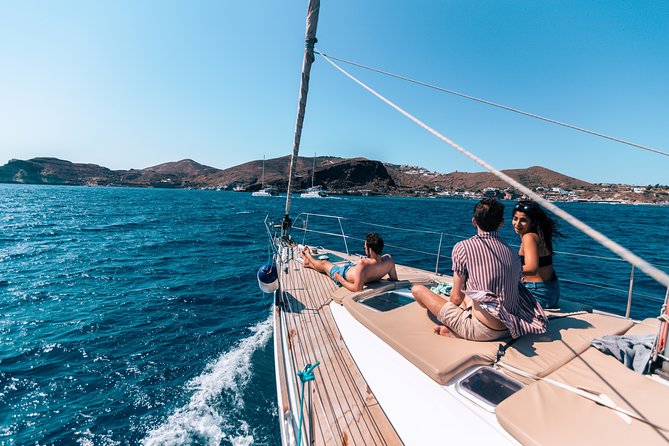
A Santorini sailing tour uses a yacht with one hull or a catamaran with two, driven by a mainsail and a jib, and steered by a skipper who chooses the course and the trim for each point of sail.
The boats used on a Santorini sailing tour are either monohulls or catamarans. A monohull carries one hull with a deep keel that holds ballast, which keeps the boat upright when it leans. A catamaran has two parallel hulls of equal size joined by a deck, and the wide distance between them resists rolling and overturning, so no ballast is needed. Catamarans also draw less water than monohulls of the same length, heel less and rock less.
A Santorini sailing tour sets a mainsail on the main mast, with the foot of the sail along a boom, and a jib, which is a triangular sail that sets ahead of the mast. Halyards raise and tighten the sails, and sheets control the angle of each sail to the wind. The two sails are trimmed to work as a pair, so that air flows from the jib across the back of the mainsail.
- Tacking: the bow turns through the wind from one side to the other, and the crew swaps the sheets as it passes.
- Reaching: with the wind on the side, at 90 degrees the boat is on a beam reach, and at 135 degrees on a broad reach.
- Running: with the wind directly behind, the boat runs downwind and the sails are eased out.
- Keel and rudder: the keel resists sideways drift while the rudder steers the boat.
The skipper holds command of the boat and answers for its safe navigation and for everyone on board. That duty covers the route, the trim of the sails, the reading of the weather, the handling of the boat in harbour and the crew. Skippers of this kind work to a licence, and that professional care is what makes a Santorini sailing tour different from a simple boat ride.
How does the wind shape a Santorini sailing tour?
A Santorini sailing tour sails in the meltemi, the strong, dry north wind of the Aegean Sea that blows through the warm months, arrives without warning and turns a calm morning into a hard afternoon for the crew.
The meltemi is the local name for the etesian winds, the dry north winds that dominate the weather of the Aegean basin in summer. In the northern Aegean they blow from the north-east or the north, in the central Aegean from the north, and in the southern Aegean from the north-west, so the Cyclades take the wind over open water, and a Santorini sailing tour feels that breeze first.
The wind has a daily rhythm. It is at its strongest in the afternoon and dies down at night, though a spell of etesian wind sometimes lasts for days without a break. Such gusts arrive in clear weather and can reach force 7 or 8 on the Beaufort scale, which is enough to keep yachts and inter-island ferries in port. A steady meltemi, by contrast, is the even sailing wind that a Santorini sailing tour looks for.
- Season: the etesian winds blow through the warm half of the year, from late spring into early autumn.
- Weather: the northerly wind tempers the fierce summer heat of the region.
- Origin: the winds are driven by a deep area of low pressure centred over south-west Asia.
- Name: the Greek word meltemia is the plural of meltemi, and the same winds are also called etesians.
The wind decides how a day on the water unfolds, and the crew plans around it. A passage that lies to windward is worked in tacks, while a run back with the wind behind is quick and quiet. For passengers, the meltemi is the reason the boat keeps moving, and working with that wind is the whole point of a Santorini sailing tour.
What seafaring past does a Santorini sailing tour recall?
A Santorini sailing tour recalls the mariners of Oia, a town that grew rich on its merchant fleet, and the Naval Maritime Museum of Oia, which holds seamen’s chests, mastheads, historic photographs and a library of letters from the age of sail.
The history behind a Santorini sailing tour lies in Oia, which reached the peak of its prosperity in the late nineteenth and early twentieth centuries. Its wealth rested on a merchant fleet that carried trade across the eastern Mediterranean, in particular on the route between Alexandria and Russia. A wharf in the bay of Armeni served the sailing ships of the town.
In 1890 the town counted about 2,500 residents and about 130 sailing ships. The arrival of steam and the concentration of shipping at Piraeus ended the trade, and the seagoing business of the town collapsed. Emigration took families to the mainland and to other ports, and the wind-powered merchant fleet that had given the village its name as a seafaring town disappeared.
- Captains’ houses: two-storey houses occupy the highest part of the village.
- Mansions: wealthy ship captains of the late nineteenth century built neo-classical homes.
- Ship models: the museum shows models of old and new Thiran ships beside charts with English labels.
- Mariners’ quarters: the cave houses on the edge of the caldera were used by the crew of the ships, and a Santorini sailing tour passes below them.
The past is close at hand on a boat under sail, because the cliffs, the deep water and the summer wind that once filled the sails of the Oia fleet are still in place. The houses that the trade paid for stand on the ridge, and the maritime collection keeps the record of the vessels themselves. A Santorini sailing tour is a way of reading that history from the water.
What does a Santorini sailing tour see in the caldera?
A Santorini sailing tour crosses a flooded caldera about 12 by 7 km across, with steep cliffs 300 m high on three sides, a maximum depth of 385 m, and the ruined fortress of Skaros on the western rim.
The basin that a Santorini sailing tour crosses was formed by repeated construction of shield volcanoes followed by caldera collapse, which left deep water ringed by high ground. The highest point of the caldera stands at 367 m. The inner coast is a sheer precipice, so the boat sails in the shadow of the wall for much of the crossing, and the water below the hull drops away sharply.
Skaros is a large rock promontory that a Santorini sailing tour passes, created by the volcanic activity of the caldera and since reshaped by erosion and earthquakes. It was fortified in the early thirteenth century, and the fortress on the rock was completed in 1207. The settlement that grew around it became the largest on the island, and its ruins are still visible from the water.
- Cliff layers: the walls exhibit the layers of solidified lava stacked on top of each other.
- Towns on the crest: the main towns sit on the top of the rim above the caldera.
- Kameni islands: Nea Kameni and Palea Kameni lie near the centre of the caldera, and a boat under sail passes them without landing.
- Cape Skaros: in nautical use the promontory is called Cape Skaros.
From the water the rim looks continuous, a line of villages above a wall of dark rock. The boat works across the basin where the water is deepest. For passengers, the caldera is the reason to be under sail rather than under power, since a sailing boat crosses it slowly enough for the rock and the water to be read.
What does a Santorini sailing tour see on the south and west coast?
A Santorini sailing tour sees the Akrotiri lighthouse on the westmost tip of the island, the uninhabited islet of Aspronisi inside the caldera ring, the volcanic Christiana islands to the south-west, and the dark lava beaches of the south coast.
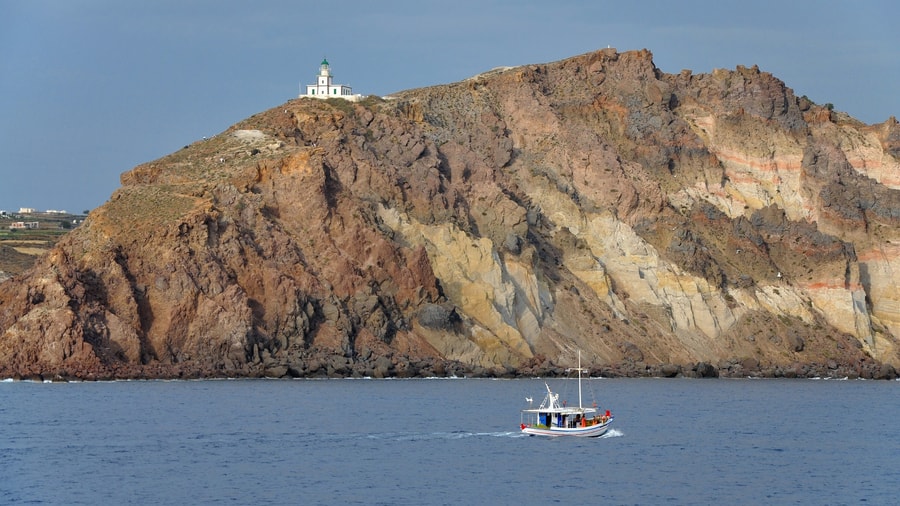
A Santorini sailing tour passes Akrotiri, which stands south of Fira on the slopes of a hill above the caldera cliffs. West of the village, on the westmost point of Santorini, the Akrotiri lighthouse dates from 1892 and counts among the oldest lighthouses in Greece. A French company built the tower, and the Greek Navy recommissioned it in 1945. The ruins of the Castle of Akrotiri, a former Venetian castle, sit in the village centre.
Aspronisi lies inside the flooded caldera, and the islet measures 650 metres by 200 metres. Its top is a flat plateau of white pumice over black lava rock, and steep cliffs make landings difficult. Two pebble beaches and a small anchorage sit on the shore, while the caldera around the islet measures about 12 by 7 km and reaches a maximum depth of 385 m. A Santorini sailing tour holds a course close to Aspronisi to see the pale pumice from the water.
A Santorini sailing tour that turns south-west meets the Christiana islands, a volcanic group about 16 km from Santorini with a total area of about 2.35 square km. Residents left the islands in the 1890s, and the group has stayed unfarmed, so artificial pesticides and fertilizers are absent from the ecosystem. Christiani holds remains of a Neolithic settlement, and the group is privately owned, with public access restricted.
- Akrotiri lighthouse: The tower is famed for its sunset views, and it stood dark for part of the Second World War.
- Aspronisi: The islet has no residents and acts as a nesting ground for migratory birds.
- South coast beaches: Red Beach, Black Beach and White Beach take their colour from solidified lava, and the water at the darker beaches is significantly warmer.
- Caldera wall: The wall drops more than 300 m at its highest point, and the villages sit on the crest.
The western and southern shore gathers the landmarks within one line of sight, from the lighthouse tower to the pale islet and the distant volcanic group. A Santorini sailing tour that follows this coast stays close to the cliffs, where the caldera wall rises in layers of solidified lava. Villages sit above the waterline, and the flooded floor of the caldera stays hidden.
Where does a Santorini sailing tour leave from?
A Santorini sailing tour leaves from the Vlychada fishing shelter on the south coast, from Ammoudi below Oia in the north-west, or from Athinios, the only port of Santorini with regular passenger ferry sailings and the main gate for vehicles and visitors.
Vlychada sits on the south coast, where the fishing shelter is the only well-protected anchorage on Thira and a boat can stay through a storm or wait unattended. The shelter serves sailing boats with mooring, cable ties, water, electricity, toilets and wireless internet, and it lifts and launches boats seven days a week. Berths take vessels up to 20 m long and 3 m deep. A Santorini sailing tour uses this basin as a starting point for the south coast.
Ammoudi lies in a bay below Oia, on the western side of the town, and 300 steps link the port to the village on the cliff. The harbour has no pier or breakwater, because the sea depths rule out protective work, so the bay lies open to west-north-west and south-south-west winds. Fishing boats anchor in the bay, where the eastern part takes up to 30 boats. A Santorini sailing tour that starts here meets the caldera wall at once.
Steep, multi-coloured volcanic cliffs surround the Athinios harbour, and a road climbs to the top in zigzags. Conventional ferries with a draft of 6.7 m and high-speed ferries with a draft of 3.5 m use the quays, and the harbour links the island with Piraeus, the Cyclades, Crete and Rhodes. A Santorini sailing tour can also start here, since the port lies on the inner face of the caldera wall.
- Thirasia traffic: Ammoudi carries the transport and cargo needs of Thirasia through scheduled ships.
- Ammoudi shore: A pebble beach lies beside the harbour below Oia.
- Vlychada shore: White volcanic rocks of the south coast stand beside the fishing shelter, and a modern marina sits at Vlychada.
- Port zones: Twelve port zones lie on Santorini and Thirasia, including Athinios, Ammoudi and Vlychada.
Each departure point gives a different first mile. Vlychada opens onto the south coast and the open sea, Ammoudi sits directly under the Oia cliff, and Athinios lies on the inner wall of the caldera. A Santorini sailing tour that begins at one port can hold the caldera close or run out to the open sea, depending on the wind of the day.
How does a Santorini sailing tour compare with a catamaran cruise or a motor boat?
A Santorini sailing tour moves under wind power for at least part of the day, so the pace follows the breeze, while a motor catamaran cruise keeps a fixed timetable and a motor boat covers more ground. Each suits a different kind of day on the water.
The difference starts with the sound. When the skipper raises the sails and cuts the engine, a Santorini sailing tour goes quiet apart from the water along the hull and the wind in the rigging. A monohull heels a little as it picks up speed, a sailing catamaran stays level, and guests can help trim a sheet or take the helm under the eye of the crew. That hands-on part has no place on a motor trip.
A motor boat or a speedboat reaches more places in the same time, because it does not depend on the wind. It suits travelers who want the volcano, the hot springs, Thirasia and the beaches of the south coast in one outing. The large motor and sailing catamarans in between offer wide decks, shade and room for a bigger group, and they keep to a set route around the caldera. A speedboat also suits travelers with a ferry or flight to catch, who want the sea without a full day on board.
The choice also shapes the company on board. A private sailing yacht carries one group, a small-group sailing trip mixes a handful of strangers, and a large catamaran carries a crowd. Couples and families looking for quiet pick the first two, while groups of friends who want music and space on deck pick the larger boats. A private trip also lets the skipper change the plan with the wind, swapping one cove for another when the breeze shifts.
- Sailing yacht: wind power, a slower pace and a chance to help the crew with the sails.
- Sailing catamaran: two hulls, a level deck and room to lie in the sun between swims.
- Motor catamaran: a set caldera route, shade on deck and space for a large group.
- Speedboat: more stops in less time, with less of the open-sea feeling.
Travelers who want the classic caldera loop with lunch can look at the Santorini boat tour options, while those who want the sails up pick a Santorini sailing tour. Both leave from the same coasts, so the decision comes down to pace, group size and how much of the day passes under wind power.
When is the best season for a Santorini sailing tour?
A Santorini sailing tour fits the months from spring to autumn, when air and sea temperatures rise and the etesian winds give a steady sailing breeze, while winter brings rain and cold water; the shoulder months sit at the edges of that window.
Santorini has a hot semi-arid climate with Mediterranean features, dry summers and wetter winters. Average annual rainfall reaches about 270 mm, and the average annual temperature is about 19 °C. January is the coolest month of the year, with a mean daily high of 14.3 °C, while the lightest rain falls in the middle of summer. A Santorini sailing tour in high summer works with the driest and hottest weeks of the island year.
The surface water of the Aegean reaches 19 to 24 °C in summer and falls to 8 to 13 °C in winter. The etesian winds, called the meltemi in Greek, blow from late spring to the middle of September. They are strongest in the afternoon, quieter at night, and can reach force 7 to 8 on the Beaufort scale, which is dangerous for sailors and halts inter-island ferry sailings. A Santorini sailing tour in those weeks uses winds that give leisure crews a steady, dry sailing breeze.
A Santorini sailing tour in spring or autumn meets the mildest air of the year. In April the daily high averages 19.6 °C and rain totals 12.1 mm, and June lifts the average high to 27.9 °C with 3.6 mm of rain. September still averages 27.2 °C and takes 3.0 mm of rain, so the sea holds its warmth after the peak weeks, while October cools to 22.8 °C with 15.1 mm.
- Peak heat: July and August lead the year with mean daily highs of 30.1 °C and 30.2 °C.
- Driest month: July records 0.03 mm of rain, the lowest monthly total of the year.
- Wettest months: December and January bring 54.6 mm and 52.7 mm.
A Santorini sailing tour suits April, June, September and October, when the air stays mild and the sea keeps its summer warmth, and it suits the warmest weeks of July and August when steady wind matters more than cool air. The island leads Greece as a cruise destination, with around 900,000 visitors arriving by sea each year, and ferry sailings and cruise calls multiply in the summer months.
What do travelers ask about a Santorini sailing tour?
A Santorini sailing tour raises five common questions: how seasickness affects guests, whether children can join, the difference between private and shared sailing, how the basics of sailing are learned, and what happens when the sun goes down.
Can a Santorini sailing tour cause seasickness?
Motion sickness follows a mismatch between felt motion and expected motion. About one-third of people are highly susceptible, and around 80% of the general population reacts in moderate or severe form. Symptoms include nausea, vomiting, cold sweat, headache and dizziness. Keeping the head still and watching the horizon cut the effect, and susceptibility falls with age.
Can children join a Santorini sailing tour?
Life jackets built for children carry understraps between the legs and a headrest flap with a grab handle, which holds a small wearer in place and eases rescue from the water. A flotation device keeps the head and mouth above the surface without swimming or treading water. A Santorini sailing tour fits buoyancy aids sized by body weight.
Is a private or a shared Santorini sailing tour better?
Charter practice separates three kinds of hire. A bareboat charter supplies the yacht alone and the client skippers it, a skippered charter adds a professional skipper, and a crewed charter adds a captain with a crew that can include a chef, an engineer, a deckhand and a steward. Bareboat companies ask for a licence that proves competence.
Can guests learn to sail on a Santorini sailing tour?
Basic sailing turns on the point of sail, the angle between course and wind. An arc of about 45 degrees on either side of the wind is a no-go zone, where sails produce no power. Close-hauled sits near 45 degrees and a beam reach at 90 degrees. A Santorini sailing tour shows those angles as the yacht changes course.
What happens on a Santorini sailing tour at sunset?
On the equinoxes the sun sets due west, and through the Northern Hemisphere it sets to the north-west in spring and summer and to the south-west in autumn and winter, so the western water of the caldera holds the light. A sunset sailing trip follows that light along the western side of the island.
Featured photo: Jean Housen, CC BY-SA 4.0, via Wikimedia Commons.