
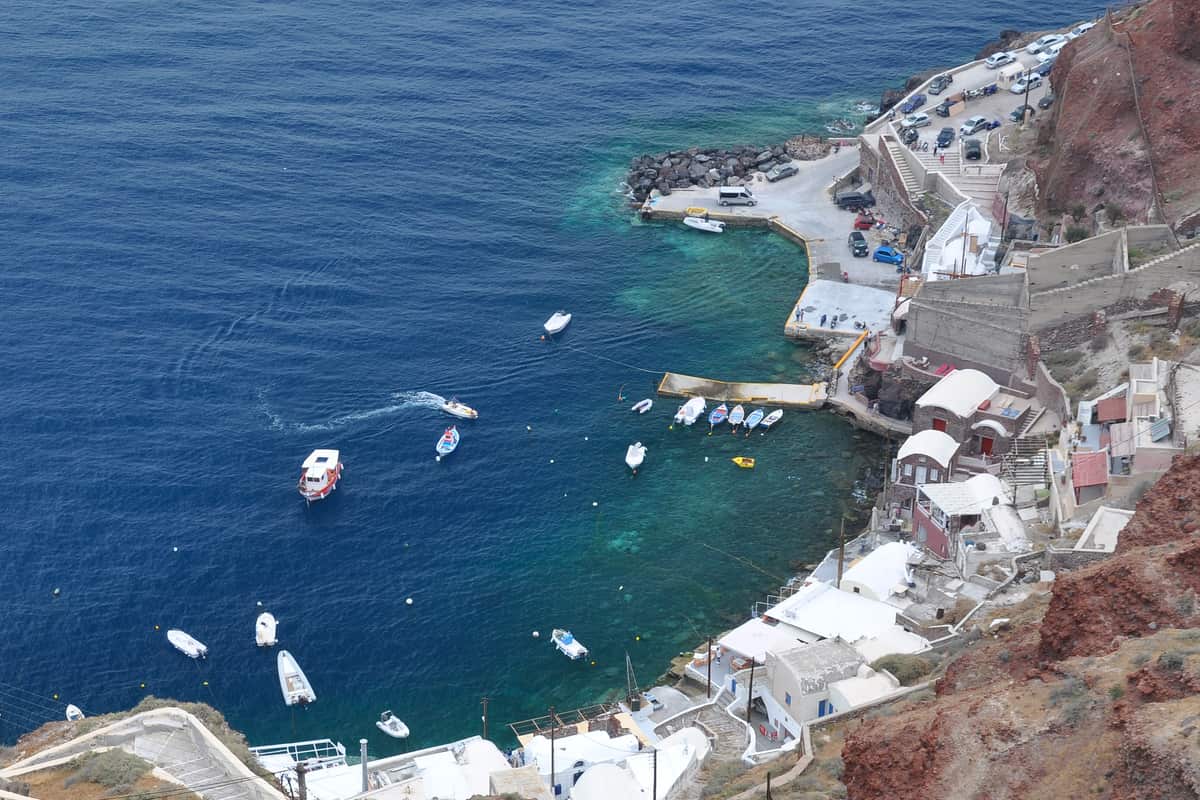
A Santorini fishing trip takes guests out on a local boat from the island’s small harbours into the caldera and the open Aegean, with lines and nets and a fish meal on board. It is one of the Greece tours on Greece VIP.
This post covers what a Santorini fishing trip includes, where it starts and the waters it covers. It also covers the fish, the fishing methods and the rules. Wind and sea, the best season and common questions come last.
Each section ends with a Santorini fishing trip or a nearby sea trip that can be booked online.
What does a Santorini fishing trip include?
A Santorini fishing trip comes in four kinds. A traditional boat trip serves a fish lunch, while a sunset trip ends with dinner. Private fishing cruises and catamaran cruises with grilled fish make up the other two. Fishing boats supply rods, lines, hooks and fresh bait.
The traditional Santorini fishing trip uses a wooden boat with a cabin, a kitchen and a toilet. The crew teaches old fishing techniques, and guests can help or watch. The catch is cooked on board.
On a sunset Santorini fishing trip, guests watch the crew haul in shrimp nets set the day before. Greek music plays, and local drinks flow without limit. Guests can then help in the kitchen before dinner.
A private fishing cruise serves fresh fish, fried seafood or fish soup with grilled vegetables and salads. Local wine, beer and soft drinks are free on board. The traditional trip adds snacks and a local drink.
The catamaran version of a Santorini fishing trip grills fish or meat for up to 16 guests. Like other boat trips in Santorini, this catamaran route stops to swim. Its stops are Mesa Pigadia and the volcano.
- Group size: Shared fishing trips cap groups at 8 or 10 guests.
- Pickup: Minivans collect guests from hotels up to an hour early.
- Ages: The traditional trip is not advised for children under 9.
The sunset crew asks each guest to bring a passport or ID card.


Where does a Santorini fishing trip start?
A Santorini fishing trip leaves from the Vlychada fishing shelter or from Ammoudi bay. Ammoudi bay also goes by the name Agios Nikolaos. Small boats leave Akrotiri for White Beach and Red Beach. A wooden caique carries passengers between Kamari and Perissa.
Vlychada holds about 46,000 square metres of water. The central basin covers 21,272 square metres; two side basins cover 2,254 and 3,576. Two sunken ancient harbour walls lie off the approach, so boats follow a fixed line in.
Guests for a sunset Santorini fishing trip meet at the Vlychada harbour ATM 15 minutes before departure. Local boats land their catch there in the morning, and waterfront tavernas serve the fish that evening.
Ammoudi’s main wharf runs 30 metres, and fishing boats tie up at a 20-metre pier. The bay also has a ramp for lifting and launching boats. Its piers and wharves add up to 250 metres.
At the old port of Fira, a jetty shelters 1,100 square metres of water where fishing boats moor. Athinios, 7 km from the airport, gained longer quays between 2006 and 2008.
- Vlychada: The island’s amateur fishing club is based here.
- Fira old port: The bay stays safe in all weathers.
- Athinios: A ground-floor building houses the boatmen’s club.
Behind the Athinios quays sit a waiting room, restaurants, shops and an outdoor car park.
Which waters does a Santorini fishing trip cover?
A Santorini fishing trip covers the flooded caldera and the open sea off the south coast. Boats from Vlychada follow the coast to Indian Rock and the Akrotiri lighthouse. Farther out to sea lie the Christiana islets and their deep basin.
The Kameni volcano splits the caldera floor into a northern and a southern basin. The southern basin reaches 290 metres deep. A U-shaped channel, 3 km long and 1 km wide, opens the caldera to the north-west.
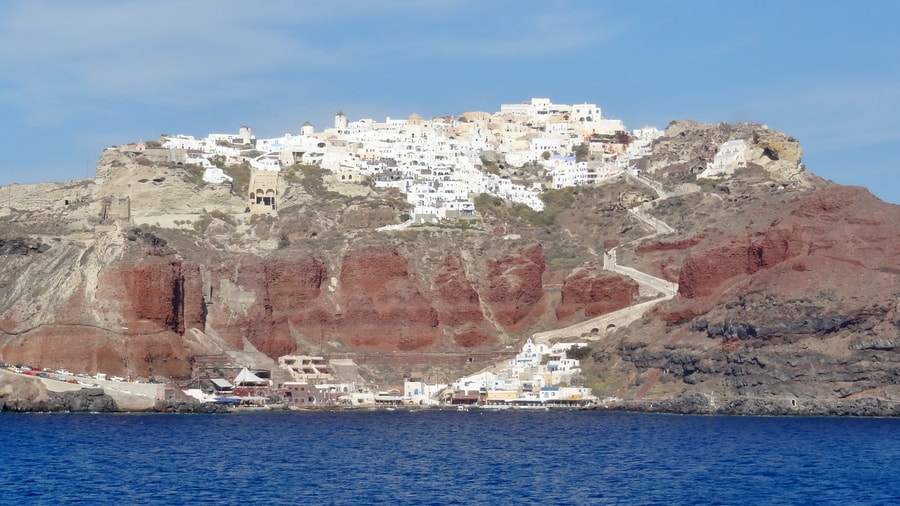
A private Santorini fishing trip from Ammoudi heads for the lagoon around the volcano. Below Nea Kameni and Palea Kameni, this volcano rises nearly 470 metres from base to top. Its base spreads over about 21 square km.
From Ammoudi, Thirassia lies about one mile away. Aspronisi rises to about 70 metres, and its oval shape runs from north-east to south-west. The submerged outer rim of the caldera links it to Thirassia and Santorini.
On the south coast, a Santorini fishing trip passes sea caves between White Beach and Red Beach. Indian Rock, a face-shaped lava rock, is reachable only by boat. At Mesa Pigadia, the seabed mixes sand with rocks.
- Christiana Basin: A drill site there lies under 514 metres of water.
- Christiana cone: It rises about 500 metres from the basin floor.
- Undersea domes: Three domes sit about 10 km east of Christiani.
More than 80 percent of the Christiana volcano lies hidden under the sea.
What fish does a Santorini fishing trip catch?
A Santorini fishing trip lands medium-sized rockfish and breams along the south coast. Bigger barracuda bite now and then. Red mullet, groupers, amberjack and lionfish also come aboard. Bonito, lizardfish and skipjack tuna join the catch in season.
Red mullet on a Santorini fishing trip belong to two goatfish species. The striped red mullet shows red and brown stripes. The common red mullet is rose-pink and finds prey on the seabed with sensory chin barbels.
The devil firefish is the lionfish common in the eastern Mediterranean. It grows to 35 cm, with thin dark bars on a reddish, tan or grey body.
Dusky groupers can reach 150 cm and live up to 50 years. They turn male between ages 9 and 16. Adults defend reef territories, a habitat seen when scuba diving in Santorini.
Greater amberjack, a target on a Santorini fishing trip, hold records of 190 cm and 80.6 kg. A dark stripe crosses each eye. European barracuda, the largest Mediterranean barracuda, carry 20 or 22 dark bands across the back.
- Lionfish route: It entered the Mediterranean through the Suez Canal.
- White seabream: Silvery-grey adults carry nine vertical bars.
- Amberjack depth: Larger adults keep between 18 and 72 m.
Amberjack and barracuda hunt other fish, while white seabream also eat algae and sea urchins.
Which methods does a Santorini fishing trip use?
A Santorini fishing trip uses nets, creels, longlines, hand lines, trolling lines and rods. The first stop is to pick up the nets, which depend on the weather. Guests then bait hooks, fish with rods and lift fish from the nets.
On one Santorini fishing trip, the crew lays 1 km of nets and 15 creels. The creels target shrimp and octopus. A trammel net hangs a slack, fine-mesh layer between two taut, wide-mesh layers.
A hand line is held in the hands, without a rod. Its bait is fished still, trolled or jigged up and down. Bottom rigs tie a sinker to the line end, with the hook just above it.
The kaiki takes its name from the Ottoman Turkish word kayık, not from kayak. Hulls are painted white to reflect strong sunlight, with bright upper planks. One private Santorini fishing trip sails a 52-foot wooden boat.
Captains on one Santorini fishing trip teach parents and children over 10 to bait hooks. Guests take fish out of the nets and put the young ones back in the sea.
- Longline: Hooks hang from short branch lines called snoods.
- Trolling: Outriggers let a boat troll multiple lines without tangling.
- Creels: Smooth-ended funnels lead animals into the inner chamber.
Crews warn that certain fish are dangerous, and guests must ask before touching one.
What rules apply to a Santorini fishing trip?
A Santorini fishing trip follows Greek law and EU rules on gear, fish sizes, seasons and protected species. Leisure fishers cannot use gillnets, trammel nets, towed nets or purse seines. Spearguns are banned from sunset to dawn and with scuba gear.
Greek law caps recreational longlines at 150 hooks per fisher. A boat carries no more than 300 hooks, whatever the number of fishers aboard. Each fisher sets up to two traps with mesh sides over 40 mm.
EU minimum sizes decide which fish stay aboard a Santorini fishing trip. Two-banded and sharpsnout seabream need 18 cm, red sea-bream 33 cm and wreckfish 45 cm. Each fish is measured from snout tip to tail fin end.
Greek law halts recreational longlines and spearfishing for one full spring month each year. Bottom trawling stops each year from June to September in Greek seas. Purse seiners stop from 15 December to the end of February.
A Santorini fishing trip cannot keep species listed in Annex IV of the EU Habitats Directive. Deliberate capture of a fan mussel is illegal. Date shells stay fully banned, since harvesting them breaks the rock they bore into.
- Mesh: Bottom-set gillnets need meshes of at least 16 mm.
- Net length: One fisher sets no more than 4,000 m of net.
- Net height: Trammel nets stand no higher than 4 m.
Professional towed gear is banned within 3 nautical miles, and trawl nets above Posidonia beds.
How do wind and sea shape a Santorini fishing trip?
A Santorini fishing trip faces north winds in eleven of twelve months, as Thira logged last year. Wind at the National Observatory of Athens station there averaged 10.9 km/h. Its top gust reached 82.1 km/h on 5 December. November was calmest, at 8.6 km/h.
June last year was the windiest summer month at Thira, averaging 12.6 km/h. July and August followed at 11.8 and 11.7 km/h. This year, July averaged 13.0 km/h, and a gust hit 57.9 km/h on 5 July.
Around Santorini, sea water averages 16.3 to 16.5°C in February, the coldest month. On a Santorini fishing trip in June, it averages 22.6 to 22.8°C. October still holds 22.1 to 22.3°C, and December cools to 17.4 to 17.6°C.
For a Santorini fishing trip, August last year brought waves averaging 0.82 m, with a 1.58 m peak. January this year averaged 1.71 m and peaked at 3.82 m. February this year saw waves of 4.46 m.
This summer brought 56 strong meltemi days to the Aegean, the second-highest count in 18 years. The longest spell ran from 30 July to 16 August. On 30 July, waves north of Santorini peaked at 1.82 m.
- Exposed north: Last summer, 77.8% of waves came from north-west to north-east.
- Lee south: Sudden clear-sky squalls there have wrecked small boats.
- Winter shift: Winds in January this year came chiefly from the south-south-west.
Outside the Santorini fishing trip season, winds this January and February averaged 14.9 km/h.
When is the best season for a Santorini fishing trip?
A Santorini fishing trip runs from 1 April to 31 October on one public listing. The sea is warmest in August, at 25.5 to 25.7°C. That month also brought 471,663 passengers through Santorini airport this year, up from 465,850 last year.
Another morning Santorini fishing trip on the same listing closes earlier, on 28 October. A private trip on a separate listing runs from April to October. A family trip lists start times on all seven days.
For a Santorini fishing trip, July follows August at 25.1 to 25.3°C, and September holds 24.4 to 24.6°C. In August last year, the sea off Santorini averaged 25.98°C. In August this year, it averaged 25.17°C.
Santorini airport handled 360,697 passengers in September this year, against 360,515 last year. October last year dropped to 236,881 passengers. In January this year, the airport saw just 22,218 passengers, all on domestic flights.
On 1 August last year, daylight for a Santorini fishing trip lasted 13 hours 59 minutes. By 1 October, it shrank to 11 hours 49 minutes. Evenings then leave time for food tours in Santorini.
- Swim season: June to October rank as the best swimming months.
- Warmest hour: The sea off Santorini hit 27.8°C last August.
- Flight count: Santorini airport handled 3,570 flights in August this year.
On 1 November last year, Santorini had 10 hours 40 minutes of daylight.
What do travelers ask about a Santorini fishing trip?
A Santorini fishing trip on one booking listing runs with no group minimum. Vegetarian or kids’ meals need a request at least one day ahead. Fishing gear, snorkelling masks, first aid, snacks and drinks come on board.
Does a Santorini fishing trip need a fishing licence?
One listed Santorini fishing trip includes a professional fishing licence in the booking. A bill sent to the Greek Parliament in September last year proposed a register of recreational anglers. Under that bill, joining stays free until the end of this year.
Does a Santorini fishing trip cause seasickness?
Motion sickness rarely affects children under 2, but risk peaks between ages 7 and 12. Women are more prone to it than men. Alcohol, smoking and lack of sleep make it worse.
Can children join a Santorini fishing trip?
A private family Santorini fishing trip accepts children over 8, and every guest needs swimming skills. Another private trip sets its minimum age at 3 years.
What do travelers pack for a Santorini fishing trip?
One listing asks for comfortable shoes, a change of clothes and a light jacket. Guests can also bring their own fishing rod.
What happens when weather cancels a Santorini fishing trip?
One Santorini fishing trip refunds guests in full up to 24 hours before departure. If the operator cancels for unsafe weather, a full refund follows. Another listing allows free cancellation up to 3 days before, then keeps the full payment.