
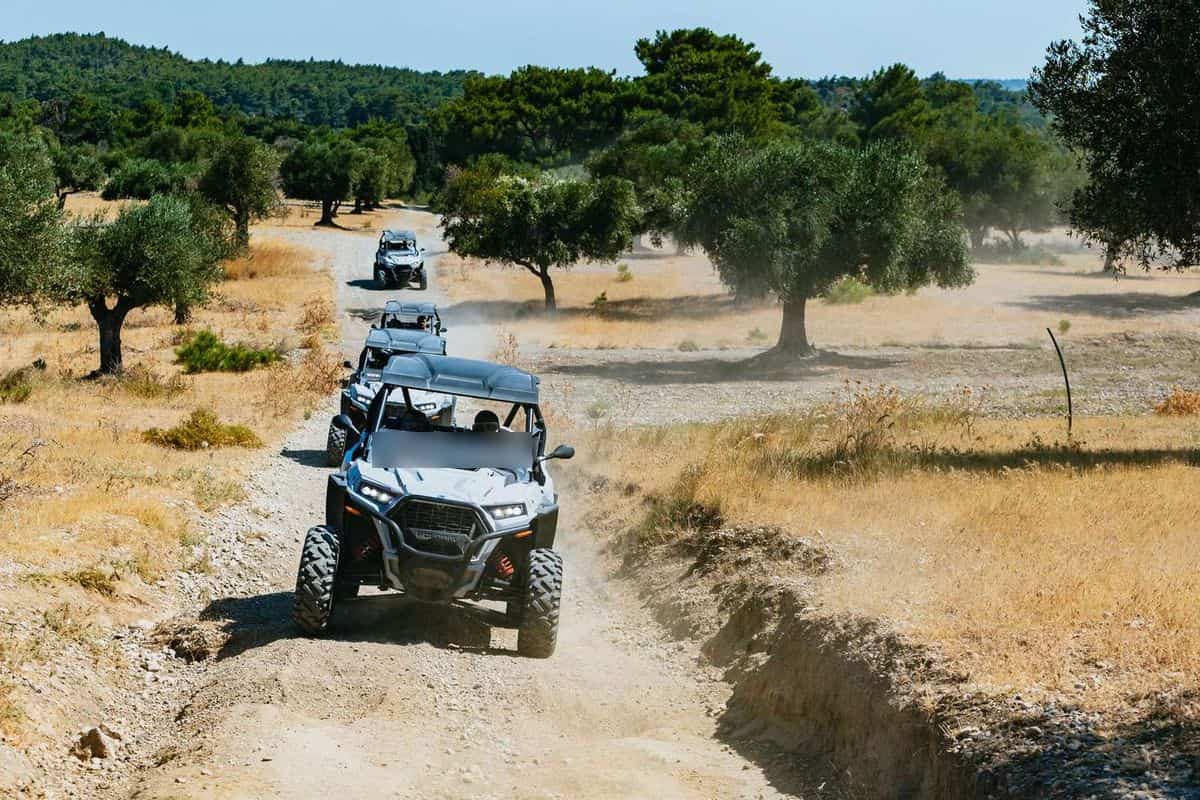
A Rhodes buggy safari drives off-road buggies along the dirt tracks, olive groves and pine hills of Rhodes, the largest of the Dodecanese islands. It is one of the Greek tours on Greece VIP.
This post covers what a Rhodes buggy safari includes, where it starts and the routes it drives. It also covers the villages, the nature and the landmarks on the way. The rules, the best season and common questions come last.
Each section ends with a Rhodes buggy safari or a nearby island tour that can be booked online.
What does a Rhodes buggy safari include?
A Rhodes buggy safari starts with a safety briefing and a driving lesson from a tour leader. Fuel comes included on the Maritsa route. A village stop there serves honey, souma, olive oil and fruit. Kolymbia routes serve water and soft drinks.
Maritsa buggies are two-seaters, sold one seat at a time. A solo driver shares with another guest or buys the empty seat. A lead vehicle with a driver carries guests on request.
An Ialysos desk rents a four-seat 1300cc buggy. One Rhodes buggy safari base in Kolymbia runs quad safaris, the machines behind ATV tours on Rhodes. Kiotari quads carry one or two riders.
A later Rhodes buggy safari from Maritsa ends at sunset. A Monolithos sunset run from Kolymbia adds night off-road driving with a flashlight.
The Prasonisi run adds a taverna lunch, and that Rhodes buggy safari ends with a beach swim. Kiotari quads stop at Agios Georgios Bay.
- Pickup: The Faliraki buggy desk collects hotel guests on request.
- Prasonisi: Each guest drives a separate buggy on that run.
- Kolymbia base: It sells four separate buggy safari routes.
On the Prasonisi run, a handful of buggies drive together in each group.


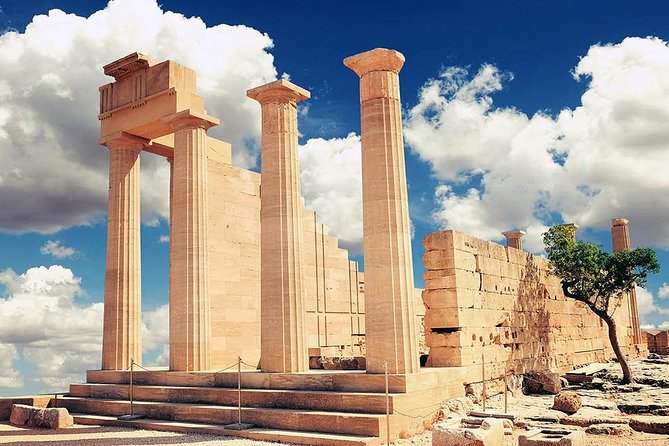
Where does a Rhodes buggy safari start?
A Rhodes buggy safari starts at a petrol station near Maritsa, a village between Kremasti and Psinthos. Other loops start near Soroni or Theologos. Longer routes leave from a base on the Eucalyptus Road in Kolymbia, on the east coast.
Maritsa belongs to the Petaloudes municipal unit, which counted 15,086 people in 2021. The airport sits less than 3 km west of nearby Kremasti.
Soroni, the seat of the Kameiros municipal unit, had 1,265 residents in 2021. The village stands near both beach and mountain. A Rhodes buggy safari meets at a petrol station cafeteria there.
A Rhodes buggy safari also starts near Theologos, 40 m above sea level. Soroni lies on the village’s southwest side. Theologos counted 606 residents in 2021, or 809 with neighbouring Epano Kalamonas.
Kolymbia sits 10 m above sea level. It lies about 5 km south of Afantou and 5 km north of Archangelos. A 2 km eucalyptus-lined road links the coastal settlement to the national road.
- Transfers: Paid pickups cover Rhodes town, the port and Fanes.
- Kameiros: Soroni’s municipal unit counted 4,401 residents in 2021.
- Self-arrival: Kremasti guests arrive by taxi or rental car.
The Kolymbia base offers no hotel transfer, so guests make their own way there.
Which routes does a Rhodes buggy safari drive?
A Rhodes buggy safari drives dusty trails, rugged paths and mountain tracks away from main roads. The Maritsa route covers up to 80 km of these tracks. Kolymbia routes cross forests, olive groves, hills and rocky ground.
A Rhodes buggy safari from Theologos follows beaten tracks to a viewpoint over the Aegean Sea. It continues inland to Archipoli village, and a final off-road stretch returns toward Theologos.
The Kremasti loop mixes paved and dirt roads at a top speed of 40 km/h. Around Maritsa, the tracks include dusty gravel, dry riverbeds strewn with rubble, and steep climbs and descents.
One Rhodes buggy safari runs along the west coast, then inland through villages on 4×4 tracks. From Kolymbia, the Archangelos coast route climbs into the mountains and returns to the shore.
The Prasonisi run crosses mountains, valleys, remote trails and river beds. Kiotari quad routes run 85 percent off-road, over goat trails and mountain paths. Faliraki quads add steep rocky inclines and dense forest.
- Monasteries: Kolymbia routes pass historic monasteries, churches and the coast.
- Faliraki: Quads cross sandy beaches, olive groves and rocky paths.
- Monolithos: The sunset route includes a hike up to the castle.
The Soroni Rhodes buggy safari keeps largely off-road, past lush nature and panoramic views.
Which villages does a Rhodes buggy safari pass?
A Rhodes buggy safari passes villages such as Psinthos, Archipoli, Eleousa, Salakos, Kalavarda, Damatria, Maritsa and Kalythies. Psinthos sits at 280 m and had 729 residents in 2021. Kalavarda lies 40 m above the sea. Salakos keeps a church with 14th-century roots.
Psinthos saw the last battle between Ottoman and Italian forces on Rhodes in 1912. The Ottomans lost about 200 men; the Italians lost nine. The Ottomans then surrendered Rhodes to Italy.
A Rhodes buggy safari climbs to Archipoli, at 190 m on the north edge of Mount Koutsoutis. That peak rises to 570 m. Saint Nektarios Monastery, east of Archipoli, dates from 1970.
In 1422, Salakos passed as a fief to Antonio of the Genoese Cattaneo family. Stones from a small Knights’ fort later formed a one-room mosque. It stayed in use until the 1950s.
Maritsa, another village on a Rhodes buggy safari, counted 1,841 residents in 2021. Its church of Agios Georgios dates from the 15th century. Its Agios Nikolaos church keeps 15th-century wall paintings.
- Kalythies: Its first written record dates from 1474, as Calathies.
- Damatria: Its name is linked to a Demeter sanctuary.
- Eleousa: Residents rose from 228 in 2011 to 238 in 2021.
The name Kalavarda possibly comes from Vardas, a Byzantine official with large estates.
What nature lines a Rhodes buggy safari?
A Rhodes buggy safari runs through pine forest, maquis and olive groves, partly on Natura 2000 land. Site GR4210006 in central Rhodes covers 11,414 hectares, from 51 to 706 m. Its mammals include fallow deer, stone martens and Blasius’s horseshoe bats.
Fallow deer reached Rhodes from the Balkans about 7,000 years ago, moved by people. A 2005 study found the Rhodian herd genetically distinct from all others. It called their conservation urgent.
Jersey tiger moths along a Rhodes buggy safari have wings spanning 52 to 65 mm. In 1992, the EU made this moth a priority species, the only butterfly or moth so listed.
Profitis Ilias, a stop on jeep safaris on Rhodes, holds one of the island’s largest forests. Its maquis mixes mastic, kermes oak and juniper. Its orchids include Orchis italica and Cephalanthera longifolia.
A Rhodes buggy safari crosses the only land in the EU where Oriental sweetgum grows wild. The orchid Comperia comperiana, endangered across Greece and Europe, grows in the same protected zone.
- Amphibians: Rhodes has three species, among them the green toad.
- Reptiles: The island holds 23 confirmed reptile species.
- Insects: Rhodes counts 2,652 insect species and subspecies.
The Argyros River near Kalavarda rises on Profitis Ilias and shelters the endangered gizani fish.
Which landmarks does a Rhodes buggy safari reach?
A Rhodes buggy safari reaches Tsambika, Seven Springs, Eleousa, Filerimos, Kalithea Springs and Profitis Ilias. At Tsambika, a climb of 292 steps leads to the upper monastery. At Seven Springs, Italian builders and local workers finished a dam and tunnel in 1931.
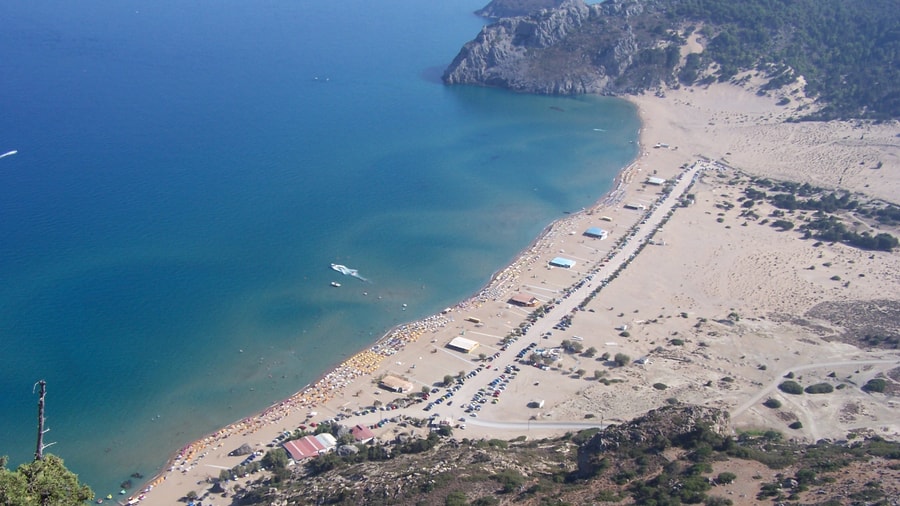
The upper church at Tsambika dates from the 14th century and has one room. Its floor is paved with pebbles, and its carved wooden screen seems older than the 17th century.
A Rhodes buggy safari passes Tsambika, where childless women climb barefoot to pray for a child. Its icon was first kept at Kykkos Monastery in Cyprus. Monks burned its back to confirm its identity.
At Eleousa, Italian builders set a church, school, shops, cinema and medical rooms around a rectangular square. The church, once Roman Catholic, is now Greek Orthodox. The settlers came from Trentino.
A Rhodes buggy safari heads to Kalithea Springs, which Italians opened in July 1929. The spa follows the Moorish style, with pebble mosaics. Its gardens hold palms, pines, flowers and exotic plants.
- Fountoukli: This late Byzantine church stands 2 km from Eleousa.
- Filerimos: Its name means one who loves solitude.
- Profitis Ilias: Its Italian hotel gained a tennis court in 1930.
The lake at Seven Springs runs 200 m long and 10 to 50 m wide.
What rules apply to a Rhodes buggy safari?
A Rhodes buggy safari falls under the Greek road traffic code. The code bans driving under the influence of drugs. One Rhodes listing sets the driver minimum at 21, with two years of licence. Another accepts drivers from age 18 with two years of driving experience.
Seat belts are mandatory in Greece. An unbelted driver on a Rhodes buggy safari faces 5 penalty points. The same offence also brings a 30-day licence withdrawal under the Greek rules.
On fire-risk days of category 3, 4 or 5, a regional governor can act. The governor can close Natura areas, forests, parks and groves. It does not cover traffic along the road network.
Rhodes buggy safari listings include public liability insurance for the riders on board. Damage caused by the driver’s own fault is charged to that driver.
- Tour leaders: One listing lets leaders stop any unsafe driver.
- Ban scope: People and vehicles both fall under a fire ban.
- Medicines: The code also bans medicines that affect driving ability.
On 23 July this year, the Rhodes regional unit stood at category 4 fire risk.
When is the best season for a Rhodes buggy safari?
A Rhodes buggy safari season runs from April to October under one listing. Another runs from April to November. High season brings three daily runs, one at sunset. No rain fell at the National Observatory station on Rhodes from June to August this year.
The National Observatory of Athens station on Rhodes stands at 95 m. July this year averaged 27.7 °C there. The top reading so far this year was 36.8 °C, on 28 August.
Mean wind peaked at 13.9 km/h in August this year. One Rhodes buggy safari listing tells riders to come ready to get dusty. Rear buggies in a convoy take the heaviest dust.
On 14 October this year, the station logged 272.2 mm of rain in one day. In October last year, the month brought 15.4 mm there. April this year brought 75.8 mm of rain.
On 1 October, Rhodes town gets about 11 hours 52 minutes of daylight. On 31 October, daylight for buggy tracks and boat trips on Rhodes lasts about 10 hours 46 minutes.
- July: Rhodes airport handled 1,330,023 passengers this year.
- Last July: The airport handled 1,260,477 passengers.
- September: Passengers reached 1,131,276 this year, up 4.4% on last year.
Last year, the station’s hottest reading was 36.3 °C, recorded on 26 July.
What do travelers ask about a Rhodes buggy safari?
Travelers on a Rhodes buggy safari share each buggy in pairs, one driver and one passenger. Hotel transfer is excluded from that package. Another listing caps each session at 8 people.
What do travelers wear on a Rhodes buggy safari?
One Rhodes buggy safari listing bans sandals and slippers but includes goggles. Another lists a swimsuit, towel, sunglasses, hat, sunblock and water to bring. A reviewer says neck gaiters are supplied if missing.
Can passengers switch drivers on a Rhodes buggy safari?
Each traveler on one Rhodes buggy safari can take the wheel or ride as passenger. A reviewer of that ride reports switching drivers en route. Buggies also swap convoy positions at stops.
Can children ride as passengers on a Rhodes buggy safari?
Children from age 8 can ride as passengers under three Rhodes buggy safari listings. Another sets its age range at 8 to 75. A reviewer rode with children aged 10 and 15.
Who is a Rhodes buggy safari not suitable for?
One Rhodes buggy safari listing marks the ride not recommended for pregnant travelers. The same applies to travelers with back problems. Greek seat belt rules list pregnant women among the exempt groups.
What happens when weather cancels a Rhodes buggy safari?
Cancelling at least 24 hours ahead brings a full refund. Poor weather means a new date or a full refund. Another listing moves weather-hit rides to a new date without a refund.