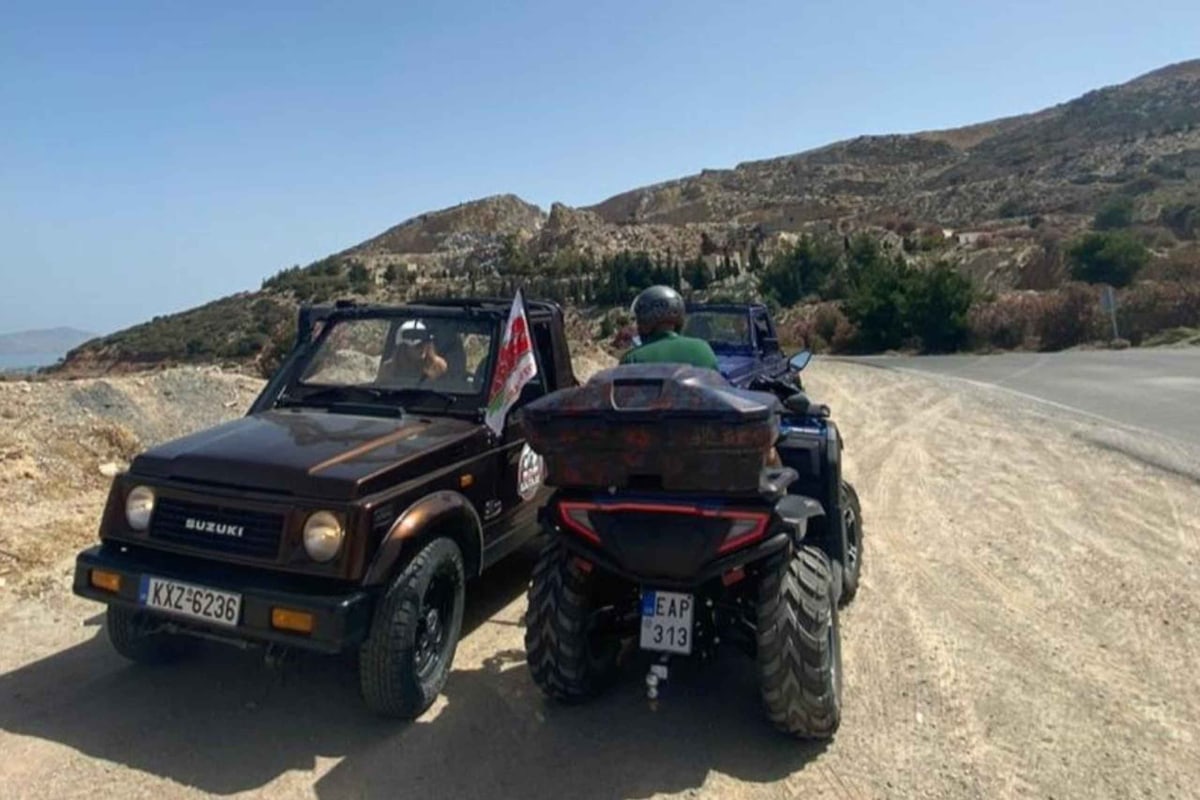
A Kos ATV tour explores Kos on a quad bike, a four-wheeled motorbike. Small groups ride dirt tracks over hills, through villages and down to quiet beaches. It is one of the quad and ATV trips in Greece on Greece VIP.
This post covers what a Kos ATV tour includes, where it rides and the villages it passes. It also covers the nature on the way, safety for beginners and the history beside the tracks. What to wear, the best season and common questions come last.
Each section ends with a Kos ATV tour or off-road trip that can be booked online.
What does a Kos ATV tour include?
A Kos ATV tour includes a quad ride on paved roads and dirt tracks. A tour leader gives a safety talk first. The ride stops at villages, capes and viewpoints. Kos covers 295.3 square kilometres of hills, coast and farmland.
Kos lies 338 km, or 210 miles, from Athens. Cape Skandari, also called Skandarion, marks its north-east end. Cape Drekanon marks the west, and a Kos ATV tour rides between them.
Irakleides, the western council area of Kos, covers 160.538 square kilometres. That is 55.3% of the island, the largest of three areas. A Kos ATV tour has plenty of room here.
Kos has a well-built road network, and its villages are easy to reach. Trails let hikers and mountain bikers reach remote corners. A Kos ATV tour mixes both kinds of ground.
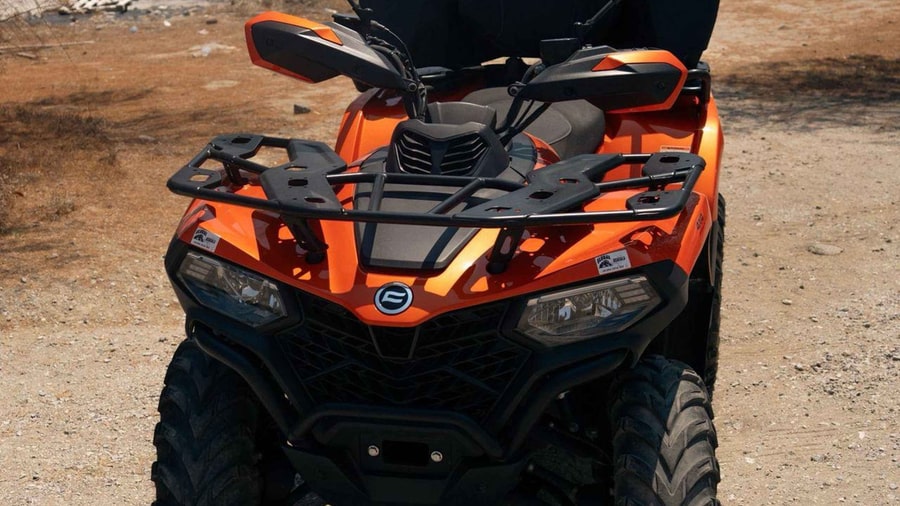
Rental offices across Kos hire out cars, motorbikes, bicycles and buggies. An ATV rider sits and steers like a motorcyclist, but extra wheels add stability at slow speeds. The same machines run ATV tours on Rhodes.
The first sit-on, three-wheeled ATV came out in 1969. In 1973 its maker trademarked the name “All Terrain Cycle”, or ATC. The first mass-produced four-wheeled ATV followed in 1982.
- Four-wheel drive: A 1986 model opened the era of ATVs that drive all four wheels.
- Top speed: Sport ATVs reach about 80 mph and big utility ATVs about 70 mph.
- Side-by-side: Its other names include utility task vehicle (UTV) and recreational off-highway vehicle (ROV).
- Sandrail: This buggy-like machine for open sand is a frame of welded steel tubes.
Summer heat on Kos reaches 35°C in July and August. A Kos ATV tour in those months calls for sun cream and water at each stop.


Where does a Kos ATV tour ride on the island?
A Kos ATV tour rides the slopes of Mount Dikaios and the pine forest of Plaka. It also reaches the Alykes salt lake and the Kefalos peninsula in the west. Dirt tracks and quiet farm roads link these spots with the beaches.
Mount Dikaios rises within 2 km of the sea on its south side. On its north side, the coast lies 6-7 km away. A Kos ATV tour climbs this wider northern slope.
On the mountain, volcanic rock meets limestone and marble. Metal deposits leave colourful patches in places. Lagoudi-Zia, 14 km south-west of Kos town, is the highest lived-in spot on Kos, at 240 metres.
A 2.5 km paved road west of Antimachia leads to the pine forest of Plaka. Dozens of peacocks roam there, one of them all white. The chapel of Agios Ioannis Prodromos stands on its south side.
Kefalos lies 16 km from Hippocrates, the island’s international airport. The small harbour of Limnionas lies about 5 km away, on the peninsula’s north side. A Kos ATV tour can reach Agios Theologos, a remote beach on the western tip.
A Kos ATV tour takes a flat back road to Tigaki from Faros street in Lambi. Tigaki lies 7 km north of Asfendiou. Until 1989 the Alykes lake made sea salt, and each summer it dries to white.
- Marmari: It lies 15 km west of Kos town and 4 km north of Pyli.
- Mastichari: It lies about 3 km north of Antimachia and 22 km from Kos town.
- Neromana: This lake 1.5 km north-east of Pyli was built in the 1920s against water shortage.
- Aspri Petra: This cave sits at 257 metres on Mount Zini at Kefalos.
A Kos ATV tour links these spots into one loop. Mountain, pine forest, salt flat and coast all fit into a single ride on the island.
Which villages does a Kos ATV tour pass?
A Kos ATV tour passes hill villages, farm villages on the plain and seaside settlements. Lagoudi, Zia, Asfendiou, Pyli, Antimachia, Kefalos and Kardamena are the main stops. Each one adds a church, a view, a feast or a local story to the ride.
A Kos ATV tour reaches Lagoudi-Zia, two settlements counted as one village. It had 151 residents in 2011. From Zia, riders see the whole island and the coast of Asia Minor.
The chapel of Profitis Ilias tops a small hill near Zia. Lagoudi became a settlement in 1961. Its church, Panagia Lagoudiani, has a white-blue dome and a courtyard feast on 8 September.
Lagoudi also holds the chapel of Agios Ioannis Theologos, ringed by Byzantine fort ruins. It was built by Osios Christodoulos, born in Nicaea in 1021. Osios is a Greek title for a holy person.
Asfendiou locals were once called “katsounades”, after the katsounas, a pocket knife they carried. A Kos ATV tour also rolls through Pyli, officially named Pylio. The same census counted 2469 permanent residents there.
Pyli sits at 70 metres among olive trees and vegetable gardens. It splits into Upper, or Old, Pyli and Lower Pyli. Nearby Psoriaris hill holds remains of an ancient holy site of Demeter and Persephone.
Antimachia stands in the centre of Kos, 23 km from Kos town. Local myth names it after Antimachos, a son of Heracles. Its 19th-century windmill is one of a handful in Greece that still fully work.
- Kefalos: The main story says its name comes from the area’s shape, like a bearded vulture’s head.
- Palatia: About 3 km south of Kefalos, it holds a 5th-century BC temple and a Hellenistic theatre.
- Kardamena: Settled in 1865, it is the youngest village on Kos, with 6 km of sandy coast.
- Carnival: Pyli hosts the Kos carnival and a horse race for St George on 23 April.
A Kos ATV tour strings these villages together on one ride. Each shows a different side of Kos, from hill chapels to farm plains and sandy shores.
What nature does a Kos ATV tour see?
A Kos ATV tour sees pine woods, wetlands and rocky slopes. The island’s east sits inside the protected Natura site GR4210008. It runs from Cape Louros across the Dikaios mountain range. Its land part covers 8332.59 hectares, out of 10138.28 in total.
A Kos ATV tour on these mountains passes woods of Pinus brutia. This is a type of pine. The slopes hold low, spiny scrub called phrygana, inland cliffs, chasms and small gorges.
A second site, GR4210027, protects 435.59 hectares of wetland for breeding and migrating waterbirds. One part is the Psalidi wetland, about 4 km south-east of Kos town. Two streams meet the coast there, forming 85 to 100 hectares of marsh.
The other part is the Alykes salt lake, between Tigaki and Marmari. Reedbeds, wild canes, rushes and tamarisk trees ring its marshy ground. Pelicans, herons, water turtles and water snakes live there.
Pink flamingos and ruddy shelducks stop at the lake in autumn and spring. Kos is one of the rare places in Europe where the ruddy shelduck breeds.
Male peacocks under one year old have almost no tail feathers. Their full tail grows only from 3 years of age. So a short-tailed male seen on a Kos ATV tour is still a young bird.
- Raptors: Bonelli’s eagle, a large bird of prey, breeds on Mount Dikaios.
- Migrants: A Kos ATV tour in spring meets bee-eaters, rollers and cattle egrets.
- Orchids: Ophrys bombyliflora, Ophrys fusca and Ophrys tenthredinifera stand out among local plants.
- Comfrey: Symphytum anatolicum, a herb, lives only on Lesvos, Kos, Samos, Ikaria and western Anatolia.
Fire, overgrazing and growing tourism are the main threats to this land. A Kos ATV tour that stays on open tracks spares the scrub and the nesting birds.
How safe is a Kos ATV tour for beginners?
A Kos ATV tour stays safer when beginners learn body position and steady speed. The US Consumer Product Safety Commission names three dangers of off-highway vehicles like quads. They are overturning, collisions and riders thrown from the seat.
In the US, off-highway vehicles are linked to more than 800 deaths a year on average. Emergency rooms treat an estimated 100,000 injuries each year. A Kos ATV tour uses the same kind of machine.
From 2018 through 2020, 2,448 deaths were linked to these vehicles. ATVs made up more than two-thirds of them. Over five years, ATVs were behind 92 percent of all such injuries.
The long seat of a quad lets the rider shift body weight forward or back. This skill is called active riding. On a slow turn, weight goes on the outside footrest as the body leans in.
On a climb, a Kos ATV tour rider leans forward at a steady speed. On a descent, weight slides back, and a low gear saves the brakes. Across a slope, weight stays on the uphill side.
A sudden burst of speed can flip a quad backwards. This can happen even on flat, grippy ground. Being thrown off or trapped underneath are main causes of serious or fatal harm.
- Controls: Brakes give a straight stop, and the throttle runs smoothly at any steering angle.
- Feet: Both feet stay on the footrests, never on the ground.
- Helmet: Hard hats, forestry helmets and bike helmets do not suit a Kos ATV tour.
- Straps: A lap strap blocks the body moves that keep a quad balanced.
A Kos ATV tour suits a calm beginner who learns these basics first. Slow starts, steady speed and good body position cut the main risks.
What history does a Kos ATV tour pass?
A Kos ATV tour passes ancient ruins, knight castles and earthquake scars. The Asklepieion is a sanctuary of the healing god Asclepius. It stands on three terraces on a hillside. Its oldest part is a large altar from the mid-4th century BC.
Sons of the sculptor Praxiteles decorated that altar. The third terrace holds the god’s large temple in the plain Doric style. It dates from the first half of the 2nd century BC.
Near the harbour, a Kos ATV tour passes the Castle of the Knights, or Nerantzia. The name means bitter orange trees. Such trees covered Kos in the late 14th and early 15th centuries.
Its oldest surviving building is a round tower. It shows the crests of knight leaders De Lastic (1437-1454) and De Milly (1454-1461). D’Aubusson began the outer wall around 1495, and Del Carretto finished it in 1514.
An earthquake hit at 01:31 on 21 July 2017, 7 km below ground. It measured 6.6 on the magnitude scale and killed 2 people on Kos. It injured more than 120 and badly damaged the Defterdar Mosque and a 14th-century castle.
A Kos ATV tour can reach the castle of Antimachia, a triangle pointing east. On 3 June 1457, an Ottoman fleet of 156 ships and 16,000 troops attacked Kos. Just 15 knights and 300 people, largely unarmed, held the castle, and only 15 of the 300 died.
- Apollo: A small 2nd-century AD temple to this god keeps seven restored columns.
- Reused stone: The harbour castle walls hold parts of the ancient city and the Asklepieion.
- Blast: A gunpowder accident on March 17, 1816, wrecked much of the harbour castle.
- Hippocrates: Tradition says he died in Thessaly at 104 or even 109.
A Kos ATV tour can link sacred ground, knight walls and quake damage on one route. Each stop shows a different age of the island.
What do riders wear on a Kos ATV tour?
A Kos ATV tour calls for an approved helmet, eye cover, riding gloves and closed boots. Light clothes help riders cope with the summer heat. Each rider also needs a bottle of water, because hot days drain the body fast.
The helmet comes first on a Kos ATV tour. Approved helmets follow UN Regulation 22, the European rule for motorcycle and moped helmets. It was first issued in 1972. Its first version set a maximum helmet weight of 1 kg.
Each approved helmet carries a label. The code E23 on that label means Greece gave the approval. The same label warns the owner to replace the helmet after a violent impact.
A chin bar adds real protection on a Kos ATV tour. One study found that 35% of all crashes hit the chin-bar area hard. The foam liner crushes in a crash, so the head stops more slowly.
Tinted lenses come in filter categories. Category 2 lenses pass 18–43% of light and are the ones recommended for daytime driving. Category 4 lenses let through only 3–8% of light. They are not for use on the road.
Heat is the other concern. The island’s weather station records average highs of 30.4 °C in July and 31 °C in August. A 5–8% drop in body water can bring tiredness and dizziness.
- Chin strap: An unfastened strap leaves a helmet with little or no protection, so a snug fit matters.
- Side vision: Sunglasses with deep side arms can block side vision and are not recommended for driving.
- Gloves: Under EN 13594:2015, only Level 2 riding gloves must protect the knuckles.
- Boots: CE-labelled riding boots show a motorcycle icon and four numbers, where 2 beats 1.
Thirst is a fair signal in daily life. Exercise and hot weather can call for extra water. A full water bottle belongs on every Kos ATV tour.
When is the best season for a Kos ATV tour?
A Kos ATV tour runs best in late spring, June or September. These months are warm and nearly dry at the island’s weather station. July and August bring the strongest heat. The winter months bring heavy rain and dull skies.
Season planning for a Kos ATV tour starts with local weather data. The Kos station belongs to the National Observatory of Athens. It stands at the Kos Sewage Plant, 37 m above sea level.
Summer is hot and dry. July and August record 0 mm of rain on average. Both months get 9 hours of sunshine a day. August has the warmest nights, with an average low of 24 °C.
September averages 7 hours of sunshine a day and just 2 rain days. October highs still average 25.7 °C, but rain returns with 36.3 mm. Humidity is lowest that month, at 67 percent.
Winter is the wet season. January is the wettest month, with 214.7 mm of rain. Its highs reach 14.3 °C and its lows 9 °C. December brings 175.6 mm and the highest count of rain days, at 14.
February is the dullest month, with 2 hours of sunshine a day. Humidity peaks then, at 84 percent. November already brings 106 mm of rain, with highs of 21.1 °C.
- April: Highs average 20 °C and lows 12.9 °C, with 40.6 mm of rain.
- Late spring: The last spring month brings highs of 25 °C and only 7.2 mm of rain.
- June: Highs average 28.5 °C and lows 20.9 °C, with 13.8 mm of rain.
- September: Highs match June, while lows reach 22.2 °C and rain totals only 5.2 mm.
Late spring and early autumn give a Kos ATV tour warm air and dry tracks. The same months suit wider island tours of Kos as well. Midsummer rides go better with an early start and light clothes.
What do travelers ask about a Kos ATV tour?
A Kos ATV tour raises questions about arrival, road rules and the vehicle itself. Travelers ask how to reach the island and which side of the road to use. Speed limits and the EU class of a quad come up as well.
How do travelers fly in for a Kos ATV tour?
Kos International Airport serves arrivals for the island. It carries the IATA code KGS and the ICAO code LGKO. Scheduled flights link it with Athens and Rhodes all year. Charter flights land mainly from April to October.
Can travelers reach a Kos ATV tour by sea?
Yes, travelers can reach a Kos ATV tour by sea. Kos is the main ferry destination from the Turkish port of Bodrum, 20 km away across the Aegean. Piraeus, the port of the capital, lies 200 nautical miles away.
Which side of the road does a Kos ATV tour use?
Traffic on Kos keeps to the right. Greece fixed this rule in its traffic code in 1926. Before that, an unofficial habit of driving on the left existed. Road signs appear in two languages, Greek and English.
What speed limits apply on a Kos ATV tour?
Towns have a default limit of 30 km/h. Town roads with two or more lanes allow 50 km/h. Rural roads allow 90 km/h. Expressways allow 110 km/h and motorways 130 km/h.
How does the EU class the quad on a Kos ATV tour?
The quad on a Kos ATV tour is a quadricycle under EU rules. The EU created this vehicle group in 1992. Light quads fall under L6e and heavy ones under L7e. The all-terrain quad is category L7e-B1, and the side-by-side buggy is L7e-B2.
Featured photo: Kos jeep or quad off-road tour with drinks and lunch, via GetYourGuide.