

The Pozar thermal baths are hot springs and waterfalls at the foot of Mount Voras in northern Greece. They are one of the Greek tours listed on Greece VIP.
This post covers the springs, the pools, the water, the day trips, the history, the caves, Edessa, Almopia and the reviews. Weather, the best season and common questions come last.
Each section ends with a tour from Thessaloniki that can be booked online.
What are the Pozar thermal baths?
The Pozar thermal baths are hot springs at the foot of Mount Voras in northern Greece. Their water rises at 37 °C and runs in waterfalls along a river gorge.
The baths lie 13 km west of Aridaia and 32 km north of Edessa. Their official name is Loutra Loutrakiou, after the village of Loutraki 3 km away.
The name Pozar comes from a Slavic word for fire or heat. The operator reads it as po and zar, meaning under the fire.
The spa sits in the valley of the Agios Nikolaos stream. Its older name, Toplitsa, means roughly hot river.
Since 2019 the baths have been a certified spa treatment unit.
- Water: 37 °C at the source.
- Setting: The foot of Mount Voras.
- Distance: 13 km west of Aridaia.
The Pozar thermal baths draw visitors from across northern Greece, above all in the cooler months.


What pools and waterfalls do the Pozar thermal baths have?
The Pozar thermal baths have hot waterfalls, a large outdoor pool and two indoor centres. The waterfalls and the outdoor pool need no booking.
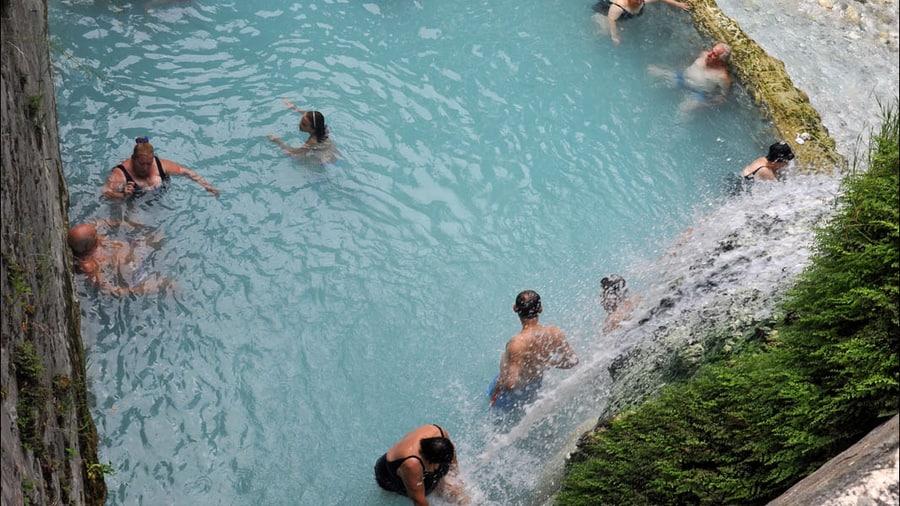
The large outdoor pool runs all year on thermal water. It suits healing, exercise and play for all ages.
Paths beyond the pool lead into the canyon to the large waterfall. It drops 22 m at an altitude of 400 m.
The newer indoor centre holds 11 private pools with artificial waterfalls, each for up to 6 people. Guests book them for 30-minute slots.
The old centre holds two pools for 12 and two hammam pools for 6. These also run by appointment.
- Outdoor: Waterfalls and a large pool, no booking.
- Indoor: 11 private pools in the newer centre.
- Hammam: Two hammam pools in the old centre.
The Pozar thermal baths let guests choose between open-air falls and private indoor pools.
What is in the water at the Pozar thermal baths?
The water at the Pozar thermal baths is a weakly alkaline sodium chloride water with radium. It is drinkable, and visitors use it for therapy and relaxation.
The main spring in the hydrotherapy centre runs at 37.2 °C. A spring in the square runs at 36.4 °C, and a cold spring beside it at 15 °C.
The operator lists potassium, sodium, lithium and manganese among the minerals.
Tradition credits the water with help for rheumatism, skin conditions and back pain. The Thessaloniki day trip adds circulation, breathing and kidney problems.
The day trip bars pregnant women from the baths. Children under 15 must come with an adult.
- Main spring: 37.2 °C.
- Square spring: 36.4 °C.
- Cold spring: 15 °C.
Guests who want ancient Macedon on another day can compare the Vergina day trips.
How do tours reach the Pozar thermal baths?
Tours reach the Pozar thermal baths on day trips from Thessaloniki, 112.6 km away by road. The trip with the largest review count pairs the baths with Edessa.
That day trip holds 1,542 reviews and scores 4.8 out of 5. It meets at Aristotelous Square or by the Venizelos statue on Egnatia Street.
An English-speaking escort leads the day. Lunch comes in a village next to Pozar, with time at the local market.
Entry to the baths and towel rental are optional extras. Guests can also bring their own towel or bathrobe.
From Edessa the drive runs 34.0 km, and from Aridaia 12.6 km.
- Thessaloniki: 112.6 km by road.
- Edessa: 34.0 km.
- Aridaia: 12.6 km.
A day trip to the Pozar thermal baths spends a fair share of the day on the road.
What history do the Pozar thermal baths hold?
The Pozar thermal baths have served bathers since ancient times. Finds and stories link them to the age of Alexander the Great and to Roman and Byzantine times.
Tradition says Macedonian kings rested here after battles. A legend claims soldiers boiled their long sarissa spears in the hot water to harden them.
The Almopes, a Paeonian tribe, gave the region its name. Macedon’s king expelled them in the 5th century BC and joined Almopia to Lower Macedonia.
In the Middle Ages the area was called Moglena, from a Slavic word for fog. Basil II took it in 1015.
Loutraki took over the baths in 1985, Aridaia in 2000 and Almopia in 2010.
- Ottoman name: The valley was Karadjova, the Black Valley.
- 1015: Basil II takes Moglena.
- 1985: Local management begins.
The Pozar thermal baths join a long story of bathing with modern spa buildings.
What caves and trails surround the Pozar thermal baths?
The gorge above the Pozar thermal baths holds about 15 rock shelters and caves. Together they form the first speleological park in Greece.
The key site is the Cavern, 50 m deep. Digs by the Aristotle University of Thessaloniki found fossils that show life here since the Neolithic Age.
The best find is part of the fossil skull of a brown bear, 10,000 years old.
Hiking and climbing routes lead up the gorge and end at the start of a canyon.
Inside the spa stands a small folklore museum. A chapel honours St. Panteleimon, the patron of healing.
At the entrance, a market of local products sells honey, jams, peppers, mountain herbs, cheese and pasta.
- Caves: About 15 shelters in the gorge.
- Fossil: A 10,000-year-old bear skull.
- Market: Local honey, jams and peppers.
Guests who want mountain trails on another trip can compare the Mount Olympus day trips.
What does a Pozar thermal baths day trip add in Edessa?
A Pozar thermal baths day trip adds free time at the Edessa waterfalls. The town stands 34.0 km south of the baths by road.
Edessa has twelve waterfalls, and four of them are easy to see. They formed after a strong earthquake in the 14th century.
The Great Waterfall drops 70 m, with a cave of stalactites at its base. The forked Lamda waterfall nearby feeds two small lakes.
The water comes from the Agra-Nisi wetland and flows through the Edessaios river.
The falls park covers over 100,000 m², with a 1.1 km path on the rock. Since 2003 the falls have been lit in rainbow colours at night.
At the end of the 19th century, five large textile factories used the falls for free power. Gardens and paths around them were finished in 1953.
- Falls: Twelve in all, four easy to see.
- Height: 70 m for the Great Waterfall.
- Lights: Rainbow colours at night since 2003.
One reviewer found the time at the falls a little short.
What is Almopia around the Pozar thermal baths?
Almopia is the valley district around the Pozar thermal baths, with Aridaia as its seat. The municipality covers 985.817 km² in the Pella regional unit.
Mount Voras rises above it, topped by Kaimaktsalan at 2,524 m. The range runs along the border with North Macedonia.
The Kaimaktsalan ski centre lies 38.9 km from the baths by road and belongs to the municipality.
Near Aridaia stand the Byzantine castle of Chrysi, from the 8th century, and the monastery of Saint Hilarion.
A Greek battalion entered Aridaia on 4 November 1912. Refugees from Asia Minor later helped the town grow.
A cherry-picking event in Almopia ends with local chefs cooking cherry dishes.
- Seat: Aridaia.
- Peak: Kaimaktsalan, 2,524 m.
- Castle: Chrysi, from the 8th century.
Visitors pair the Pozar thermal baths with the Kaimaktsalan ski centre in winter.
What do reviewers say about the Pozar thermal baths?
Reviewers praise the warm pools, the waterfalls and the escorts on a Pozar thermal baths day trip. The main wish is for more time at the baths.
The Thessaloniki day trip scores 4.8 from 1,542 reviews. The review summary praises knowledgeable escorts and relaxing baths.
One group arrived early and stayed longer in each pool than the official 30-minute slot.
Another reviewer called the bath special and the restaurant food excellent.
A third praised the punctual, clean, air-conditioned coach and the careful drivers.
One escort spoke English slowly for the group.
- Praise: Escorts and warm water.
- Wish: More time at Pozar.
- Tip: Bring a towel or rent one.
Guests based in Thessaloniki can compare the Thessaloniki walking tours.
How does weather shape a visit to the Pozar thermal baths?
Weather at the Pozar thermal baths swings from frosty winters to hot summers. The Aridaia station logged −9.0 °C on 2 January this year.
That station stands 123 m up, 12.6 km by road from the baths. The large waterfall at the baths sits at about 400 m.
Summer heat is strong. August averaged a 35.0 °C high this year, and July 34.1 °C.
Last July averaged 35.8 °C and peaked at 41.8 °C on 25 July.
Winter is cold. January averaged a 9.7 °C high this year, and last February dropped to −7.7 °C on 20 February.
Rain falls mainly from autumn to winter. Last November logged 138.2 mm, and this February 117.0 mm.
- Coldest: −9.0 °C on 2 January this year.
- Hottest: 41.8 °C on 25 July last year.
- Gusts: 98.2 km/h on 18 February this year.
The Pozar thermal baths in winter offer 37 °C water against frosty air.
When is the best season for the Pozar thermal baths?
The Pozar thermal baths are a popular trip in the cooler months, when warm water meets cold air. Autumn and spring bring mild days for the drive and the gorge walks.
This October has averaged a 23.3 °C high, with only 10.0 mm of rain. The morning of 5 October dropped to 1.1 °C.
Last October averaged 19.4 °C and brought 92.8 mm of rain, 44.2 mm of it on 2 October.
Spring warms fast. March averaged 16.5 °C this year, and April 20.4 °C.
March stayed almost dry, with 6.2 mm of rain. April brought 66.2 mm.
September keeps the summer warmth. It averaged 29.4 °C this year and peaked at 35.8 °C on 6 September.
- Winter: 37 °C water in frosty weather.
- Spring: April averaged 20.4 °C this year.
- Autumn: Last September brought 21.4 mm of rain.
In high summer, the air at Aridaia gets nearly as hot as the 37 °C water.
What do travelers ask about the Pozar thermal baths?
Travelers ask about booking, towels, children, pregnancy and the water temperature. Free cancellation runs up to 24 hours ahead on the Thessaloniki day trip.
Do the Pozar thermal baths need a booking?
Not for the waterfalls and the outdoor pool. The indoor pools run by appointment.
Can guests drink the water?
Yes. The hot thermal water is drinkable.
Can children enter?
Yes. Children under 15 need an adult with them.
Can pregnant women bathe?
No. The day trip bars pregnant women.
How hot is the water?
About 37 °C at the main springs.
Are towels available?
Yes. Guests rent them at the baths or bring their own.
Guests who want a second day out of Thessaloniki can compare the Meteora day trips from Thessaloniki.