
A Mykonos cooking class takes travelers away from the beaches to a farm or family kitchen. There they cook island dishes and Greek classics by hand and eat them together. It is one of the cooking classes in Greece on Greece VIP.
Each section ends with a Mykonos cooking class or farm experience. Each one can be booked online.
What does a Mykonos cooking class include?
A Mykonos cooking class includes hands-on cooking at the stove with an instructor. The menu mixes dishes of the island with Greek classics known across the country. Cooks work in a small group. The class ends with a shared meal.
A Mykonos cooking class turns a holiday meal into a lesson. Mykonos is a Greek island in the Cyclades, a group of islands in the Aegean Sea. The class takes place on the island itself.
A Mykonos food tour tastes dishes that other people prepared. A Mykonos cooking class hands the work to the visitor instead. The visitor prepares each dish from raw ingredients, the uncooked foods that make up a dish.
Tourists are believed to rate food as highly as climate, accommodation and scenery. Cooking classes form a growing branch of culinary tourism, which means travel for the sake of food. Unlike dining out, which is common among tourists, a class puts the visitor behind the stove.
Foreign visitors tend to focus on the food of the country they visit. So a Mykonos cooking class centres on Greek cooking. The group cooks the whole menu in one session.
- Instructor: An instructor explains each step and answers questions.
- Group size: Every cook in a Mykonos cooking class gets room at the stove.
- Table: The cooks eat the dishes they made themselves.
A Mykonos cooking class also has a cross-cultural side, which means a meeting between people from different cultures. This side matters as much as the cooking itself.
Hosts and visitors both gain from sharing their daily life and food. So the class gives a traveler more than recipes: a way to meet the island through its food.


Which Mykonian dishes does a Mykonos cooking class teach?
A Mykonos cooking class teaches dishes from the island’s list of local specialities. The list names the omelette, lazarakia spice bread, baklava and kremmydopita, an onion pie. Each dish calls for a different hand skill, from frying and shaping to layering and soaking.
The omelette, called omeletta, is a dish of eggs. The cook fries them in butter or oil in a frying pan. Its standard form uses chicken eggs.
In a Mykonos cooking class, the cook beats whole eggs or just the egg whites in a bowl. A little milk, cream or water goes in too.
The filling can be chives, a mild herb of the onion family. It can also be vegetables, cheese or onions. Whatever goes in decides the character of the dish.
Lazarakia are small, sweet spice breads. Orthodox Christians in Greece and Cyprus make them on Lazarus Saturday. That day begins Holy Week, the week before Easter.
In a Mykonos cooking class, the cook shapes each loaf like a man wrapped in a burial cloth. Cloves, dried flower buds used as a spice, are pressed into the dough to form the eyes.
Lazarakia are a fasting bread. The dough holds sweet spices but no eggs or dairy products, such as milk and butter. So the loaves get a brush of olive oil to make them shine.
- Layers: Baklava stacks filo, thin pastry sheets, with melted butter between them. Chopped nuts go in partway, and the cook cuts it before baking.
- Syrup: Sugar, honey, water, cinnamon and citrus juice make the syrup that soaks the baked pastry.
- Nuts: Greek baklava uses walnuts more than pistachios, with cinnamon added.
Greek baklava is said to carry 33 layers of dough. Each layer stands for one year in the life of Jesus. A Mykonos cooking class that cooks all three dishes covers egg, bread and dessert in one meal.
Which Greek classics does a Mykonos cooking class cook?
A Mykonos cooking class cooks Greek classics such as gemista, pastitsio, tzatziki and Greek salad. Each dish adds a new skill to the lesson. Cooks stuff vegetables, layer pasta and mix a yogurt dip. They also arrange a salad for the table.
The Greek word gemista means “filled with”. The classic version bakes bell peppers and tomatoes stuffed with rice, ground beef or both. Onions, mint, parsley and olive oil go in with the filling.
Pastitsio is a baked pasta dish from the Ionian Islands. Its name comes from the Venetian pasticcio, a large family of baked savory, or salty, pies. A Mykonos cooking class bakes both gemista and pastitsio in the oven.
Greek tzatziki starts with strained yogurt, which can come from sheep or goat milk. Straining drains off the liquid and leaves the yogurt thick. Dill, mint and parsley go in, with vinegar for a sour edge.
A Mykonos cooking class serves tzatziki as a meze, a small dish that starts a meal. Cooks pair it with pita, a flat round bread, or with olives, or with fried eggplant and zucchini.
Lemon juice and green bell pepper are common additions to Greek salad. Caper berries, the fruit of the caper bush, join them, especially on the Cyclades islands. A Mykonos cooking class leaves the salad unmixed until serving.
- Gemista: Stuffed zucchini hold rice and sometimes meat, and cook on the stovetop or in the oven.
- Pastitsio: Tube-shaped pasta such as bucatini forms the bottom layer. Ground beef with cinnamon and cloves fills the middle, and béchamel, a white sauce, covers the top.
- Tzatziki: A version with purslane, a leafy green, can carry the name glistrida me yiaourti.
- Greek salad: Diners share one plate and can dip bread in the leftover juice and oil.
The four dishes of a Mykonos cooking class can form one Greek meal. Pastitsio can serve as its main course, the central dish, with a salad. Gemista join the meal as a side dish.
Which local products does a Mykonos cooking class use?
A Mykonos cooking class uses local products from the island and the wider Cyclades. The list holds island cheeses, thyme honey, capers, olive oil and garden vegetables. Each product is simple and strong in flavour. Each one earns a clear place in the dishes cooked in class.
Cheese comes first in a Mykonos cooking class. Kopanisti is the cheese that carries the name of the island. It is made from cow, sheep or goat’s milk, or a mixture of them.
The Cyclades list of local specialities adds Manoura Sifnou, Armexia, Malaxia, Chloro and San Michali. Fresh mizithra gets no salt. So it tastes almost sweet and milky.
Cooks in a Mykonos cooking class serve mizithra as a dessert with honey. It also goes on the table as a meze with olives and tomato. Or cooks bake it in little cheese pies.
Honey, capers and olive oil follow the cheese in a Mykonos cooking class. Greek honey comes mainly from nectar. That nectar comes from fruit trees, citrus trees, thyme and pine.
Pickers cut caper buds in the morning, and capers can also be gathered from wild plants. Brined capers, kept in salty water, carry a lot of salt. So cooks taste a dish before adding more.
Extra virgin olive oil is the highest grade. It comes from cold mechanical extraction, a pressing by machine without heat or chemical solvents. It holds no more than 0.8% free acidity, a measure of oil quality.
- Whey cheese: Xynotyri is a sour whey cheese of sheep’s or goat’s milk, cured in reed baskets.
- Olives: The fruit of the olive tree is widely eaten as well as pressed.
- Vegetables: The Greek garden gives peas, cauliflower, spinach and leeks.
The product list of a Mykonos cooking class is short and bold. Cheese brings salt, and honey brings sweetness. Capers bring brine, and olive oil joins them on the plate.
The instructor shows how to balance those tastes in a simple dish. Garden vegetables add freshness to the table. Olives and cheese on the side finish the plate.
Where does a Mykonos cooking class take place?
A Mykonos cooking class takes place on a family farm or in a village house. Both stand in the countryside of the island. Other classes meet in Chora, the main town. Others meet in Ano Mera, one of the villages of the island.
The countryside is the home of the farm-based Mykonos cooking class. A farm class meets at a family house with a yard, a garden and animals around it. The cooking starts where the food grows.
The island holds a great number of churches. For a long time, islanders had to build a church on their land before a house. So churches mark the family land that a Mykonos cooking class visits.
Chora gives a Mykonos cooking class a town setting. The census counted 10,704 people living on the island in 2021. The larger share of them lived in Chora.
Above the town, the Agricultural Museum keeps old tools and machinery inside a windmill. The museum shows the farming past behind the dishes of the island.
A Mykonos cooking class in Chora trades the farmyard for a town kitchen. The same island dishes stay on the menu, from the cheese to the sweets.
- Farm: A farm class starts outdoors, among the garden rows and the animals.
- Family house: A home kitchen gives the class the feel of a meal in a Greek household.
- Ano Mera: The village monastery gave free land for a kindergarten, a primary school and a square.
Each setting gives a Mykonos cooking class its own mood. Travelers who want the whole path from garden row to table book a farm-based Mykonos cooking class. Travelers who want a base in town choose Chora.
How does a farm-based Mykonos cooking class work?
A Mykonos cooking class on a farm follows a fixed order. A welcome comes first, then picking vegetables and herbs in the garden. Next, the group meets the farm animals and cooks step by step with an instructor. Everyone then sits down together to eat the meal.
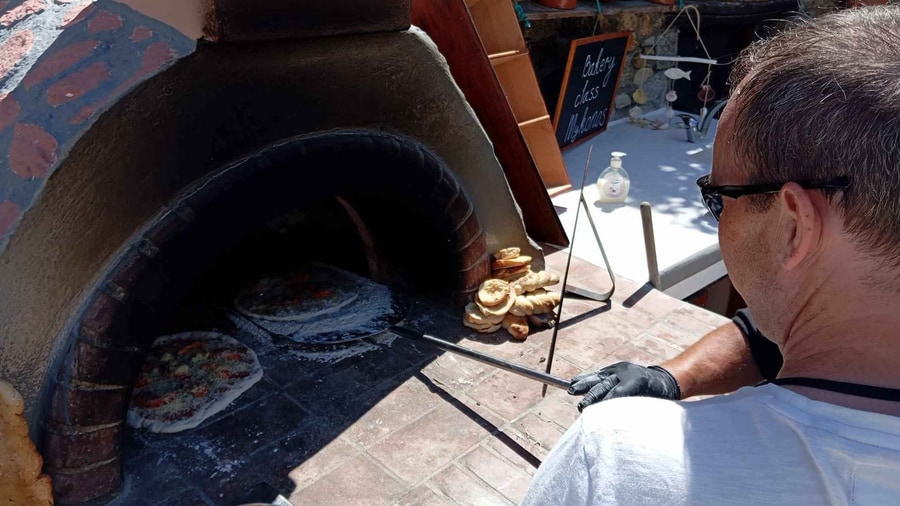
The garden comes first in a farm-based Mykonos cooking class. A kitchen garden grows on private land next to the house. So the cook reaches the vegetables and herbs quickly.
The group cuts only what the dishes need and leaves the rest to grow. The basket goes straight to the kitchen. The farm animals are the next stop.
Goats, sheep and hens live on the same land. The instructor explains how milk from the goats and sheep and eggs from the hens reach the pot.
The wood-fired oven stands at the center of the cooking. In the past, a masonry oven of brick or stone did all the baking. Wood was its traditional fuel.
After the group prepares the ingredients, the instructor leads each step of the cooking. A farm-based Mykonos cooking class bakes its dishes by the plaki method.
The plaki method uses a roasting tin, olive oil, tomatoes, vegetables and herbs. The cooks watch the fire and slide the tin in when the oven is ready.
- Welcome: The host greets the group at the farm and starts the day in the yard.
- Preparing: The instructor shows how to trim, slice and season the harvest.
- Cooking: Each cook takes a task, and the oven or the stove finishes the dish.
- Eating: The finished dishes reach the table, and the group eats them together.
Eating is the last step of a farm-based Mykonos cooking class. Bread, vegetables and cheese join the cooked dishes on the same table.
The instructor answers questions over the meal. The cooks leave knowing how each dish was built, from the garden row to the plate.
How does a Mykonos cooking class reflect Cycladic island cooking?
A Mykonos cooking class reflects Cycladic island cooking through food that a dry, windy island can grow. Pulses, barley and tomatoes grow on winter rain, dew and sea air. The dishes show how scarce water and strong wind shaped the Cycladic kitchen.
Rain sets the limit on Mykonos. Two of the seasonal streams were turned into reservoirs, or storage lakes.
The island also makes 4,500 cubic metres of water a day from sea water. It uses reverse osmosis, a filter that removes the salt.
Dry farming grows crops without irrigation, or added water. The crops live on the moisture that winter rain leaves in the soil. A Mykonos cooking class starts from that scarcity.
Pulses, the dried seeds of beans, peas and lentils, suit a dry island. Fava Santorinis is made from Lathyrus clymenum, a legume, a plant of the pea family. People on Santorini and nearby islands have grown it for 3,500 years.
Cooks mash the beans into a purée with chopped onion, olive oil and lemon juice. Strong winds can blow the flowers of the plant away. So the crop is fragile.
Pulses and wild lentils began to be grown in Greece in 6,000 BCE. So these dishes draw on a long tradition.
- Terraces: Terraces are flat surfaces cut into hills to grow crops.
- Tomatoes: Santorini tomatoes live on under 370 mm of rain, dew and 71% humidity.
- Barley: Linear B tablets, ancient clay records, list barley rations for workers at Knossos and Pylos.
Water, wind and slope set the menu of the Cyclades. The local dishes answer with beans, grain, tomatoes and olive oil. A Mykonos cooking class that follows these dishes cooks by one rule.
The rule of the Cycladic kitchen is to use what the land gives. The cooks learn the logic of a dry island along with its recipes.
When is the best season for a Mykonos cooking class?
A Mykonos cooking class meets average daily highs of 22.6 °C in late spring. October brings 22.0 °C, while July reaches 27.8 °C. The best season depends on the traveler’s wish. The choice is milder days, dry summer sun or the harvest.
Rain follows the same calendar. The National Observatory of Athens keeps monthly figures for it. January is the wettest month, at 66.1 mm, and February follows at 58.0 mm.
Late spring gets 5.9 mm and October 24.3 mm. July gets 0.1 mm, and August gets 1.3 mm. So a summer class meets a dry island, and an October class meets a wetter one.
The meltemi wind blows over this dry Aegean summer. Its other name, etesian, comes from the Greek word etos, meaning year. Its modern Greek name is linked to the Italian mal tempo, meaning bad weather.
A deep continental depression, a wide area of low air pressure over southwest Asia, drives the wind. The heat still reached a record 37.8 °C in June and July. So a summer Mykonos cooking class meets wind and heat together.
- Artichokes: Harvests peak in spring and again in mid-autumn.
- Almonds: Trees flower in early spring, and fruit ripens in autumn.
- Figs: Fresh figs are in season from early August to early October.
- Grapes: The harvest runs from early September until early November.
A Mykonos cooking class in late spring or October meets milder days and the harvest. July brings the highest heat of the year.
What do travelers ask about a Mykonos cooking class?
A Mykonos cooking class raises five practical questions. Travelers ask which diets the menu can meet and whether children can join. They ask whether cooking experience is needed and how to reach a farm outside Chora. They also ask how to add an island tour.
Does a Mykonos cooking class suit vegetarians and other diets?
Greek fasting food gives a Mykonos cooking class a base for vegetarian menus. Great Lent, the fasting weeks before Easter, keeps meat, fish, eggs and dairy products off the table.
The lazarakia spice breads fit such a menu as well. Travelers with allergies or strict diets tell the organiser before booking.
Can children join a Mykonos cooking class?
Sweets give young cooks a clear job in a Mykonos cooking class. Pasteli is a baked bar of sesame seeds and honey. Greek cuisine traces it to ancient Greece.
Herodotus, an ancient Greek historian, mentions sweet cakes of sesame and honey. Families check the age limits on the booking page before choosing a class.
Is cooking experience needed for a Mykonos cooking class?
The dishes of the Cyclades rest on short lists of foods. Fasolada is a soup of dry white beans, olive oil and vegetables. Fakes is a lentil soup.
Greek cuisine traces both soups to ancient Greece. A beginner in a Mykonos cooking class can start with dishes of this kind.
How do travelers reach a Mykonos cooking class on a farm outside Chora?
A Mykonos cooking class on a farm outside Chora means a ride across the island. Taxis, buses and boats are available. The old port depot, a bus station, runs buses to Tourlos, the New Port, and Agios Stefanos.
The Fabrika depot stands at the town entrance. Its buses run to Ornos, Agios Yannis, Plati Gialos, Psarou, Paraga and Paradise Beach.
Can a Mykonos cooking class combine with a tour of the island?
A Mykonos cooking class fits beside a Mykonos island tour on another day. The Agricultural Museum, also called the Bonis Mill, stands in Ano Myloi. Armenistis Lighthouse stands in Fanari, 6.5 km from Chora, and still works as a lighthouse.
Featured photo: Mykonos traditional cooking class with the locals, via GetYourGuide.