
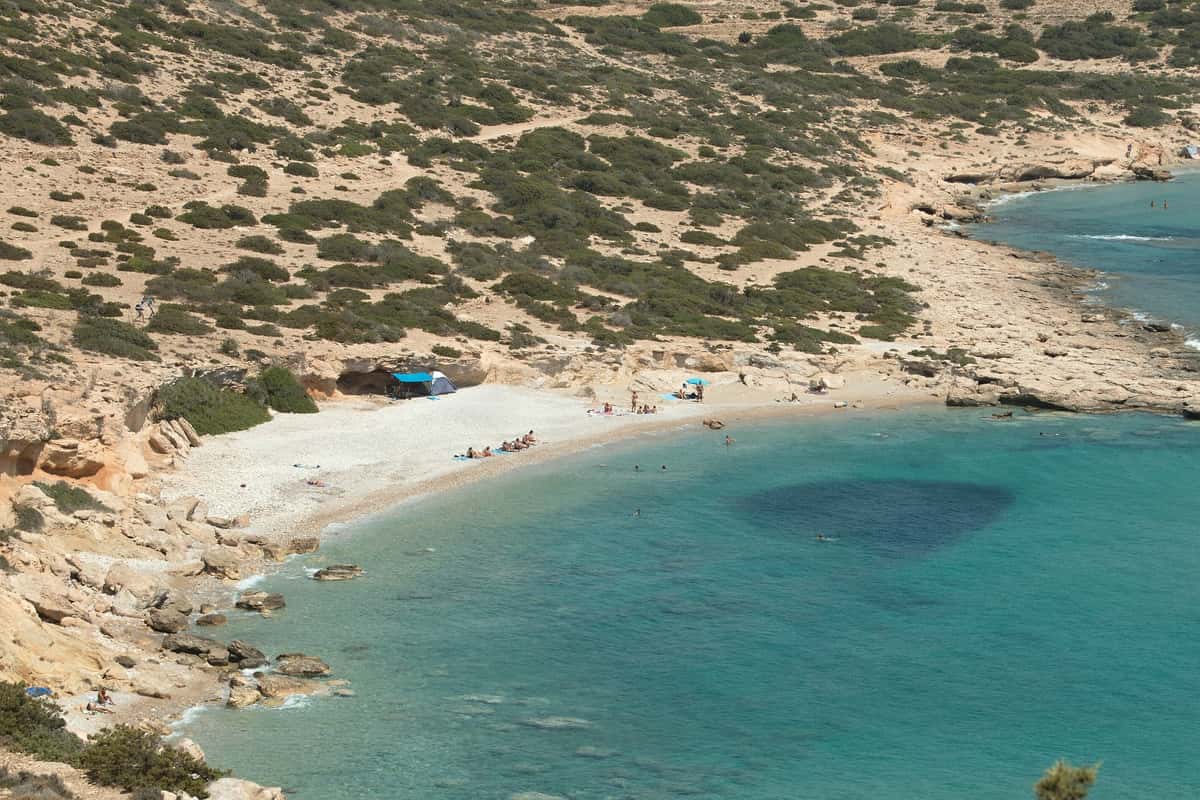
A Koufonisia cruise sails to Pano Koufonisi and Kato Koufonisi, two small islands of the Small Cyclades south-east of Naxos, known for their pale rock coves and clear turquoise water. This post covers what a Koufonisia cruise includes, where the boats leave from, Pano Koufonisi and its beaches, Kato Koufonisi, Keros, the other Small Cyclades, fishing and island life, the history, the cruise or ferry choice and the best season. It is one of the Greece tours on Greece VIP.
Each section ends with a Koufonisia cruise that can be booked online.
What does a Koufonisia cruise include?
A Koufonisia cruise is a sea trip to Pano and Kato Koufonisi, two small islands of the Cyclades south-east of Naxos. The main kinds are day cruises from Naxos or Paros, cruises with swim stops and private boats hired for a chosen route.
Koufonisia is a small island complex and a former community in the Cyclades. The 2011 local government reform placed it inside the Municipality of Naxos and Lesser Cyclades, where it works as a municipal unit of 26.025 square kilometres. Two of its three main islands are the stops of a Koufonisia cruise: Pano Koufonisi, meaning Upper, and Kato Koufonisi, meaning Lower.
The first kind is the day cruise. A boat leaves Naxos or Paros, sails to Koufonisia and returns to the same harbour. Kato Koufonisi lies next to Pano Koufonisi, Schoinoussa and Keros, so one Koufonisia cruise can reach both Koufonisi islands without a long second crossing. The Lesser Cyclades have become a popular tourist destination, and Koufonisi itself is called an increasingly popular one.
The second kind adds swim stops, when the boat anchors off the coast and passengers enter the water. At Kato Koufonisi, fish and tourist boats are the only vessels that anchor in the small port. The third kind is the private boat, which sets its own route and its own stops. Small boats suit the islands, since the fishermen in their caiques are the characteristic picture of Koufonisi.
- Day cruises: The boat leaves Naxos or Paros and reaches both islands in one outing.
- Swim stops: These cruises add time on the water to the island visits.
- Private boats: The route and the stops follow the wishes of the group on board.
Each kind of Koufonisia cruise suits a different plan for the day. The wider choice of Naxos trips, from coastal outings to sunset cruises and crossings to other islands, is set out in the Naxos boat trip post. A Koufonisia cruise narrows that choice to one destination and builds the whole day around two islands of the Small Cyclades.


Where does a Koufonisia cruise leave from?
A Koufonisia cruise leaves from Naxos or Paros, two neighbouring islands of the Cyclades. The Small Cyclades lie south-east of Naxos, Paros lies west of Naxos, and Amorgos, the easternmost island of the Cyclades, marks the far side of the route.
Naxos is the largest island of the Cyclades. Its capital, Chora, also called Naxos City, holds 8,897 of the 20,578 people on the island in the 2021 census, and a Koufonisia cruise sets out from that main town. Koufonisia belongs to the same municipality as Naxos, so the cruise runs toward a municipal unit that the island administers.
Paros lies west of Naxos in the central Aegean Sea. A Koufonisia cruise from Paros first crosses the strait between the two islands, where a constant strong wind blows and windsurfers favour the water. On the north side of Paros, the bay of Naoussa gives boat traffic a natural harbour, so boats find shelter on the Paros side as well.
The ferry links of the Small Cyclades have a long history. In the years after the Second World War, residents reached the other Greek islands and the mainland on a ship that called at Heraclia every eight days. One doctor served all of the Lesser Cyclades, and bad weather stopped him from travelling to Koufonisia. A modern Koufonisia cruise crosses the same sea.
Amorgos is the easternmost island of the Cyclades and the nearest to the Dodecanese. Its municipality covers 126.346 square kilometres with 16 neighbouring islets, and the 2021 census counted 1,961 residents. The island is accessible only by boat, its geographical features prevent mass tourism, and its main tourist accommodation sits in Katapola, Aegiali and Chora. A Koufonisia cruise finds its destination west-northwest of Amorgos.
- Naxos: The capital Chora is the departure town on the largest island of the Cyclades.
- Paros: Boats cross the windy strait between Paros and Naxos on the way.
- Amorgos: The island stands to the east and is reached only by boat.
The departure port decides the first part of a Koufonisia cruise. From Naxos, the boat heads straight for the Small Cyclades to the south-east. From Paros, it crosses the strait first. Amorgos gives the route its far reference point to the east, while the old ship route to Heraclia shows how long the small islands have relied on the sea.
What does a Koufonisia cruise see at Pano Koufonisi?
A Koufonisia cruise sees Pano Koufonisi, the inhabited island of the two, with its village of Chora on the south-west coast, its harbour with a white windmill on the east side and its churches of Agios Georgios, Agios Nikolaos and Profitis Ilias.
Pano Koufonisi is the inhabited island of the pair. Its Greek names include Epano, Pano and Ano, all meaning Upper, and people shorten it to Koufonisi. The census counted 399 residents in 2011, the largest population of any island in the Small Cyclades, and 391 in 2021. A Koufonisia cruise therefore reaches a settlement with a port, unlike the almost empty island beside it.
The settlement of Chora lies on the south-west coast of the island and holds examples of Cycladic architecture. The outer walls of the houses and of every other building are painted white and blue to match the blue of the Aegean Sea. A traditional house of Koufonisia had three rooms, a bedroom, a kitchen and a large living room, under a roof built from reeds, wood and earth.
The harbour is the first sight on arrival. A white windmill stands on the east side of the port, and passengers on a Koufonisia cruise see it as they come in. The church of the Virgin Mary ranks among the main sights of Koufonisi, and Agios Georgios, Agios Nikolaos and Profitis Ilias are the other churches that the sights list names.
- Area: The island covers 5.8 square kilometres.
- Sights: The list names the ports, the fishing shelter, the windmills and the churches.
- Patron saint: Saint George is the patron saint of the island.
Pano Koufonisi gives a Koufonisia cruise its settled side, with a village, a harbour, a windmill and churches. The beaches of the island and the neighbouring islands have their own sections below, so this stop covers the part of the cruise spent among houses, boats and white walls on the inhabited island.
Which beaches does a Koufonisia cruise reach on Pano Koufonisi?
A Koufonisia cruise reaches the beaches of Pano Koufonisi, an island of 5.8 square kilometres. Greek Wikipedia counts five notable beaches there and names four: Pori, Foinikas, Charokopou and Platia Pounta. The village of Chora stands on the south-west coast.
The Greek-language article on Koufonisia describes the beaches of Pano Koufonisi in a single passage. It counts five notable beaches and singles out Pori and Foinikas as the finest. For a Koufonisia cruise, these two are the names that the article places first, ahead of every other beach on the island. Four names appear in all, and the fifth beach stays unnamed in that text.
Charokopou and Platia Pounta are the other two named beaches, and the same article says that they draw the largest crowds. A Koufonisia cruise to these two reaches the beaches where the visitors gather. Chora, with its examples of Cycladic architecture, lies on the south-west coast. At the east side of the port, a white windmill is the landmark that visitors see on arrival.
The shore also holds older remains. Excavations on the east shore brought to light finds from Hellenistic and Roman times. Greek Wikipedia adds that the present village appears to stand on a large Roman settlement that reached the small cove of Loutra. Chamber tombs from the first years of Cycladic civilisation were found at Agrilia and near Pano Milos and Loutra.
- Pori and Foinikas: Greek Wikipedia names these two as the finest of the five beaches.
- Charokopou and Platia Pounta: These two beaches draw the largest crowds on the island.
- Main beach: Events are held there during the procession of the epitaph at Easter.
- Loutra: A Koufonisia cruise passes the small cove where the old Roman settlement ended.
Pano Koufonisi gives a Koufonisia cruise four named beaches and a coast with remains from the Cycladic, Hellenistic and Roman periods. Pori and Foinikas rank highest in the Greek article, Charokopou and Platia Pounta draw the crowds, and Loutra marks the Roman edge. Across a narrow channel lies the quieter island of Kato Koufonisi.
What is Kato Koufonisi on a Koufonisia cruise?
A Koufonisia cruise reaches Kato Koufonisi, the lower island of the group and a place that is almost uninhabited. Only fishing boats and tourist boats anchor in its small port, and the church of Panagia, a small building on a jetty, rests on ancient ruins.
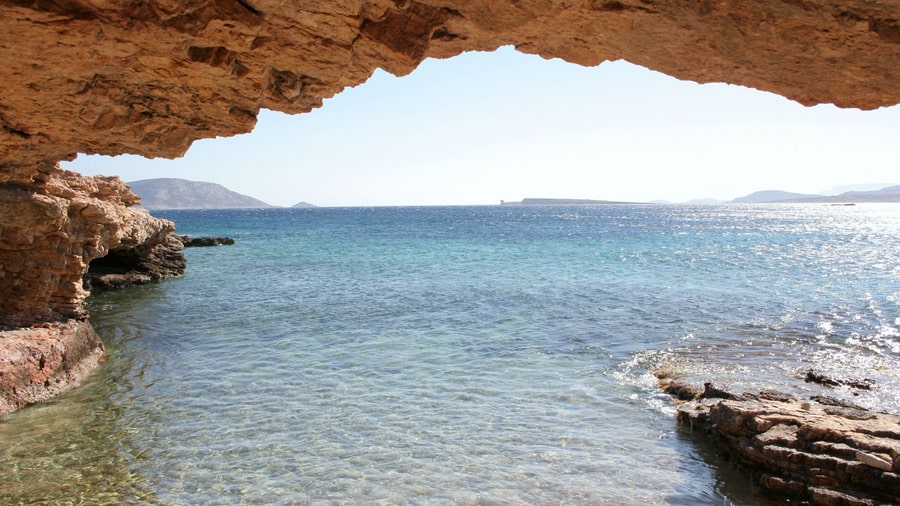
Kato Koufonisi counts as a main island of Koufonisia, with Pano Koufonisi and Keros. Kato means lower, and Pano means upper. Greek Wikipedia gives the strait between the two Koufonisi islands as 200 metres wide. English Wikipedia places Kato Koufonisi next to Pano Koufonisi, Schoinoussa and Keros, so a Koufonisia cruise crosses the narrow strait to an almost empty neighbouring island.
The island has an area of 4.3 square kilometres, out of 26.025 for the whole municipal unit of Koufonisia. Greek Wikipedia explains why it is nearly empty. A settlement of ten families once stood there. Today the island holds only fishermen’s houses, and people live there mainly in summer. English Wikipedia calls the buildings on the island rural houses.
The distinctive sight of the island is the small church of Panagia. Builders placed it over ancient ruins, on a jetty, so the church stands at the edge of the water. On 15 August the celebration of Panagia is held at the church, and after the service the people offer food. A Koufonisia cruise that anchors in the small port sees the building from the water.
- Name: Kato means lower, and the island sits across the strait from Pano, the upper island.
- Strait: The channel between the two Koufonisi islands is 200 metres wide.
- Past: A settlement of ten families once stood on the island.
- Port: A Koufonisia cruise anchors in a port that takes only fishing boats and tourist boats.
Kato Koufonisi also belongs to a wider community. Greek Wikipedia lists the two Koufonisi islands, Keros and nine smaller islets scattered around the larger islands. A Koufonisia cruise past Kato Koufonisi therefore sees the near edge of a cluster that extends beyond the three main islands. Keros, the largest island of the community by area, comes next.
What is Keros on a Koufonisia cruise?
A Koufonisia cruise passes Keros, the uninhabited island beside Kato Koufonisi and a protected archaeological site. A very large deposit of broken Cycladic figurines, known as the Keros Hoard, was found there, and landing on the island is now forbidden.
Keros is not a landing point. English Wikipedia states that it is now forbidden to land there, and it describes the island as a protected archaeological site of the Cycladic civilisation. Residents of Pano Koufonisi add an image: at night the outline of the empty island resembles a female Cycladic statuette lying down. A Koufonisia cruise sees Keros from the water, as a shape rather than a stop.
The Keros Hoard is linked to the west coast. From 2006 to 2008 the Cambridge Keros Project, co-directed by Colin Renfrew, excavated at Kavos, the area believed to be the source of the hoard. The finds include figurines, vessels and other objects made of marble. Every piece was broken before it was left there, and joining fragments are missing, which shows that only part of the broken material was deposited at Kavos.
Studies of the pottery and other material from Kavos show that the pieces came from more than one source. The preliminary report on the 2006 and 2007 seasons describes Daskalio and Kavos together as an Early Cycladic stronghold and ritual centre. A Koufonisia cruise therefore passes the Kavos coast of Keros and the islet of Daskalio, the two places that the Cambridge project excavated.
- Figurines: Cycladic figurines are flat, schematic female figures of uncertain purpose, carved from pure white marble.
- Harp player: A male harp player from Keros, dated about 2600 to 2300 BC, is held in the National Archaeological Museum, Athens.
- Daskalio: Excavations in 2018 on the nearby islet found terraced walls built with 1,000 tons of stone.
- Dating: Activity at Daskalio dates to 2750 to 2300 BC, before any identified worship of gods in the Aegean.
A Koufonisia cruise therefore passes the island that helped name a phase of Cycladic culture. Keros and Syros named the Keros-Syros culture of about 2700 to 2300 BC, a time when the use of metal became widespread. Specialist studies of geology, metallurgy and plant and animal remains followed the excavation of Daskalio.
Which other Small Cyclades can a Koufonisia cruise add?
A Koufonisia cruise can add Iraklia, Schoinoussa and Donoussa on longer routes, because the three islands belong to the same Lesser Cyclades group as Koufonisia. Each has its own villages, port and history, so each stop adds a different layer to the day.
On Iraklia, a Koufonisia cruise reaches the island that holds the biggest caves in the Cyclades. Rock paintings called Bousoules were painted about 5,000 years ago, and they possibly served as orientation marks. In modern times the Hozoviotissa Monastery on Amorgos owned the island. Absentee landlords later pastured goats there, so travellers came to know it as the goat island.
Schoinoussa has three settlements: Chora, the capital, Mesaria, and Mersini, which is the port of the island. The origin of the name is not certain. One view derives it from the ancient name Echinousa, and another from a Venetian nobleman called Schinoza. A Koufonisia cruise that stops here reaches an island with ancient Greek and Roman ruins, a Byzantine church and a small medieval castle.
Donoussa lies 16 km east of Naxos and about 25 km north of Amorgos. Its main settlement is Donousa, and the other villages are Mersini, Kalotaritissa and Charavgi. The climate is hot and semi-arid, and the temperature over the whole year averages 19.2°C. A Koufonisia cruise that adds it also reaches the island that history links with Dionysus, who took Ariadne from Naxos to hide her from Theseus.
- Iraklia: The island had 148 inhabitants at the 2021 census, and its chora is Panagia.
- Schoinoussa: The island had 229 inhabitants and ranks fourth in size among the Lesser Cyclades.
- Donoussa: The island had 213 inhabitants, and its highest point stands at 385 metres.
A longer Koufonisia cruise therefore links four inhabited islands of one municipality, Naxos and Lesser Cyclades. Iraklia is the stop for caves, Schoinoussa for ruins and Donoussa for a port town with taverns, cafes, bakeries and mini markets. Each island added to the route brings a different village and a different past.
How do fishing and island life shape a Koufonisia cruise?
A Koufonisia cruise reaches a working fishing island, because Pano Koufonisi keeps a fishing fleet among the biggest in Greece for its size. Fishing is the main occupation of the locals, and the harbour, the caiques and the feasts all follow from it.
The fishermen in their small boats, called caiques, give Pano Koufonisi its characteristic picture. The piscatorial shelter is listed among the sights. East of the port, a white windmill is the first landmark that arriving visitors see. The island covers 5.8 square kilometres, and it is the smallest and densest in population of its group. A Koufonisia cruise therefore arrives at a working fishing harbour.
Tourism has joined fishing in recent years, and a Koufonisia cruise reaches an increasingly popular destination. The chora, the main settlement, lies on the southwest coast and holds examples of Cycladic architecture. Houses and other buildings are painted white and blue to match the Aegean Sea. The traditional house had three rooms: a bedroom, a kitchen and a living room. The roof, called steosa, was made of reeds, wood, earth and kontarida.
The calendar of Koufonisia follows the church and the sea. Saint George is the patron saint, and on his name day, 23 April, a procession carries his icon over streets covered in rose petals. A feast follows in the village square, and all the taverns of the island take part. On the last Saturday of June the feast of the fisherman brings traditional dances, island songs and fresh fish.
- Residents: Pano Koufonisi had 391 residents in 2021.
- Municipal unit: The whole Koufonisia unit covers 26.025 square kilometres.
- Churches: Agios Georgios, Agios Nikolaos and Profitis Ilias are listed among the sights.
- Easter: On Good Friday the port is floodlit by torches, and fireworks fill the sky at Easter.
Feasts continue through the year. A big celebration is held on 20 July for Prophet Elias, and the older residents sing the Christmas carols. During the Epitaph procession fireworks light the sky, and events take place on the main beach. A Koufonisia cruise reaches an island where the church calendar and the fishing calendar run side by side.
What history lies behind a Koufonisia cruise?
A Koufonisia cruise passes islands with a record that runs from prehistoric settlement through Hellenistic and Roman times to the Venetian and Turkish era and the Greek state of 1830. Excavations show that Koufonisia has been inhabited since prehistoric times.
Excavations in Epano Mili brought to light evidence from the first years of Cycladic civilization. One of the key finds is a fryer-shaped vessel with a nine-ray star on it, exhibited in the museum of Naxos. Cycladic frying pans are a known type of find, and their original function remains unknown. Pans found by archaeologists show a ship, which points to the weight of seafaring for Cycladic peoples. A Koufonisia cruise sails the same sea.
Cycladic culture was a Bronze Age culture dated from c. 3100 BC to c. 1000 BC, and it is best known for flat female figurines carved from the pure white marble of the islands. Excavations on the east shore uncovered remains from Hellenistic and Roman times. The Venetians and the Turks later dominated the Cyclades, and they fought for control of the Aegean Sea, mainly in the 17th century. A Koufonisia cruise therefore crosses waters that these powers contested.
The Axis occupation from 1941 to 1945 brought difficult times to the islands that a Koufonisia cruise visits today. After the war the island had 1000 inhabitants, but men left to work as grummets and a large share of the inhabitants migrated to Athens. Residents travelled by caique and by a ship that called at Iraklia every eight days. The Lesser Cyclades had only one doctor, and in bad weather he was unable to travel to Koufonisia.
- Chronology: The Cycladic sequence has Early, Middle and Late phases.
- Crete: Pottery finds at Knossos show Cycladic influence between 3400 and 2200 BC.
- Boats: Late Cycladic boat models show crews of twenty-five oarsmen.
The place of the islands in the Cyclades follows from this record. Koufonisia followed the fate of the rest of the Cyclades, as the record up to the Greek state of 1830 shows. When the palace culture of Crete arose, the Cyclades became relatively less significant, yet the finds show that the small islands were settled long before. A Koufonisia cruise sails through that shared past.
How does a Koufonisia cruise compare with the ferry?
A Koufonisia cruise is a round trip among the islands with swimming at anchor, while a ferry or fast boat is point-to-point transport between ports. The cruise makes the Small Cyclades the destination. The ferry joins ports along the line from Naxos to Amorgos.
Koufonisia lies south-southeast of Naxos and west-northwest of Amorgos, between those two islands. The group belongs to the Lesser East Cyclades, also called the Small Cyclades, a complex of 32 islands and rocks. Four of them have residents. A ferry or fast boat treats these islands as stops on a line, while a Koufonisia cruise treats them as the whole outing.
The Koufonisia article records how links worked after the Second World War. Residents travelled to the other Greek islands and the mainland by small boats called caiques and by a ship that went to Heraclia. One doctor served the whole of the Lesser Cyclades, and in bad weather he was unable to travel to Koufonisia. Those details show how much depended on sea conditions.
Kato Koufonisi shows the difference. The Koufonisia article states that only fish and tourist boats anchor in its small port, so a regular ferry does not call there. One explanation of the name Koufonisia is Koufos Limin, meaning lee port, where ships can anchor. A day cruise stops in sheltered water for swimming, and a crossing stops only at its destination port.
- Route shape: A day cruise returns to its starting port, and a crossing ends at a different island.
- Stops: A cruise anchors for swimming, while a crossing stops only at harbours.
- Shelter: Pirates once used the channel between Pano and Kato Koufonisi as a safe shelter.
Ferries and fast boats answer one question: how to get from one island to another. A Koufonisia cruise answers another: how to see Pano Koufonisi, Kato Koufonisi and the water between them from a boat. Both depend on the same stretch of the Aegean, so both follow the weather. The next section covers the months of the calmest sea.
When is the best season for a Koufonisia cruise?
A Koufonisia cruise meets its calmest water outside the Etesian window, which runs from late spring to mid-September. Inside that window the meltemi blows north winds, and force 7 to 8 can stop yachts and inter-island ferries. The weeks before and after fall outside it.
The Cyclades have a dry and mild climate, and the Etesian article adds that Etesian weather is ordinarily fine and clear. The northerly winds temper the fierce summer heat of the region at times. Lower temperatures are recorded at higher elevations, where wintry weather is not usual. Koufonisia belongs to this island group, so that dry, mild climate frames any Koufonisia cruise.
The meltemi is the Greek name for the Etesian winds, the strong, dry north winds of the Aegean Sea. They blow periodically from late spring to mid-September and are a dominant weather influence in the Aegean Basin. Their strength peaks in the afternoon, and in the normal pattern they die down at night. Sometimes they last for days without a break.
The winds are dangerous to sailors because they come up in clear weather without warning and can blow at force 7 to 8 on the Beaufort scale. The Etesian article names yachts and inter-island ferries among the vessels that cannot sail in such conditions. The route from Naxos to Koufonisia runs south-southeast over open Aegean water. A small boat on that route meets the same wind with little shelter.
The calmer months fall outside the period in which the Etesian winds blow periodically, so the spring and autumn weeks around the Small Cyclades carry less of the wind. The Etesian article ties fine, clear weather and fierce summer heat to the windy months. The choice is therefore between clear summer skies with a strong north wind and calmer water outside the window.
- Wind window: The Etesian winds blow periodically from late spring to mid-September.
- Daily pattern: The winds peak in the afternoon and, in the normal pattern, ease at night.
- Warning: The winds come up in clear weather without warning.
A Koufonisia cruise therefore follows the weather more than the calendar. Travelers who book inside the Etesian window accept clear skies and a strong north wind. Travelers who book outside it avoid the periodic wind pattern. In either case, the wind on the day matters more than the date on the calendar.
What do travelers ask about a Koufonisia cruise?
A Koufonisia cruise prompts practical questions about overnight stays, anchorages, rough seas and the protected island of Keros. The answers below stay with documented facts about the islands and the Aegean winds. Prices, hours and durations are left to the booking page.
Is a Koufonisia cruise a day trip or an overnight stay?
A Koufonisia cruise is a boat outing that returns to its port. An overnight stay means staying on Pano Koufonisi, where the main settlement, Chora, stands on the southwest coast. Kato Koufonisi has only rural houses, so it offers no village base.
Does a Koufonisia cruise stop at Kato Koufonisi?
A Koufonisia cruise can anchor at Kato Koufonisi, because fish and tourist boats are the only vessels that anchor in its small port. The island covers 4.3 square kilometres. Its small church of Panagia stands on a jetty, built on top of ancient ruins.
Can a Koufonisia cruise visit Keros?
Keros is uninhabited and protected as an archaeological site, and ancient Cycladic art pieces were excavated there in the 20th century. The sources describe no landing arrangements, so a Koufonisia cruise itinerary confirms whether the boat passes Keros or approaches it. The island lies about 10 km southeast of Naxos.
How does a Koufonisia cruise cope with rough seas?
A Koufonisia cruise shares the Aegean with every other boat. Etesian winds can blow at force 7 to 8, and the Etesian article states that yachts and inter-island ferries cannot sail in those conditions. The afternoon is the windiest part of the day, so the sailing plan follows the weather.
Are the islands on a Koufonisia cruise inhabited?
Pano Koufonisi is inhabited, with 391 residents counted in 2021, and its main occupation is fishing. Kato Koufonisi is almost uninhabited, and Keros has no residents. Across the Small Cyclades, only four of the 32 islands and rocks are inhabited.
Featured photo: Zde, CC BY-SA 4.0, via Wikimedia Commons.