A Lefkada island tour drives the Ionian island that a causeway joins to the mainland, from Lefkada Town and its lagoon to the white beaches of the west coast, the cliffs of Cape Lefkatas, the mountain villages, Nydri on the east coast and the windy bay of Vasiliki. This post covers what a Lefkada island tour includes, how it reaches the island, the town, the beaches, the cape, the villages, the east coast, Vasiliki, the monasteries, the food and the best season. It is one of the Ionian island tours on Greece VIP.
Each section ends with a Lefkada island tour or experience that can be booked online.
What does a Lefkada island tour include?
A Lefkada island tour covers the land side of the island: mountain villages, cliff roads, historic Lefkada Town and beaches reached by road. The island runs 35 kilometres north to south, 15 kilometres east to west, and its mountain Stavrota rises to 1,158 metres.
The island is a single mass of limestone and green slopes rather than a flat coastal strip. A Lefkada island tour by car follows a wide road along the east coast through Lygia, Nikiana and Perigiali towards Nydri, while another route climbs inland to the villages on the flanks of Stavrota. The mountain lanes narrow between Karya, Englouvi and Exanthia.
Land routes concentrate on the main features of the island: the historic town at the northern tip, the west-coast cliff roads above the beaches, the mountain villages in the centre, and the sheltered east coast around Nydri and Vasiliki. A Lefkada island tour that wants time on the water adds a separate sailing day, and the boat trips from the island are covered in another post.
- The island: The island covers about 302 square kilometres in the Ionian Sea.
- The mountains: Stavrota is the highest point, at 1,158 metres in the centre of the island.
- The roads: A main road follows the east coast, and another climbs inland.
Travelers build a Lefkada island tour around a single loop, starting in the capital and turning south. The order matters less than the hour of departure, because the village squares empty after midday and the cliff car parks fill. A day that begins early leaves room for a long lunch and a slow return along the coast road.


How does a Lefkada island tour reach the island?
A Lefkada island tour arrives by road, because Lefkada is joined to the mainland by a long causeway and a floating bridge across the Lefkada canal. The bridge crosses the channel beside the lagoon, and Aktion National Airport serves Preveza and Lefkada.
The approach differs from a ferry crossing. Vehicles do not wait at the northern end, and the road from the mainland crosses a causeway before passing over a floating bridge that spans the canal. In antiquity a stone bridge crossed the same strait and was the longest stone bridge of ancient Greece, and the Corinthians cut a trench through the isthmus in the seventh century BC.
Aktion National Airport is the nearest gateway for arrivals by air. It occupies the Aktion peninsula in Acarnania and serves Preveza and Lefkada, and it began operations in 1968. A Lefkada island tour that starts at the airport crosses the canal at the northern tip of the island.
- The causeway: A long causeway carries a Lefkada island tour across the shallow water.
- The floating bridge: The bridge spans the canal on the north-eastern side.
- Aktion airport: The airport serves Preveza and Lefkada and began operations in 1968.
The crossing takes only a moment, and the canal marks the border between the mainland and the island. Traffic thickens at the bridge when the northern beaches fill, and the road widens again on the far side. Drivers arriving late meet the heaviest flow of a Lefkada island tour in summer.
What does a Lefkada island tour see in Lefkada Town?
A Lefkada island tour in the capital covers the Castle of Santa Maura at the north-eastern tip, the lagoon and the channel, the museums of the cultural centre, and the wooden houses rebuilt after earthquakes. The town holds 9,253 residents.
The castle began as a small fortification about 1300 and guarded the approach from the mainland. The Ottoman Empire rebuilt and enlarged it in 1572 and 1574, giving the fortress its present shape, and Venice took it in 1684. The ruins stand on a long spit that points towards the coast of Epirus, and piers of a wooden access bridge remain in the moat.
Earthquakes shaped the modern town. A quake in 1825 destroyed much of it, including the Ottoman aqueduct, and the settlement was rebuilt in wood to limit later damage. Present-day houses follow the same principle, built from whole logs, stone chips and light materials, and the street plan keeps the layout developed under Venetian rule. A Lefkada island tour through the centre passes the castle, the museums and the churches.
- Castle of Santa Maura: A fortress on the north-eastern tip, begun about 1300 and rebuilt by the Ottoman Empire in 1572 and 1574.
- Museums: The archaeological collection and the Lafcadio Hearn Historical Center share the cultural centre, and the Hearn centre opened in 2014.
- Churches: Agios Spyridon, Agioi Anargyroi and Panagia ton Xenon are the old temples of the town.
A Lefkada island tour in the town is a walking circuit, because the centre is flat and compact. Visitors cover the castle, the museum building, the churches and the marina on foot and leave the vehicle at the edge of the centre. The streets fill towards evening, when families take the pedestrian lanes.
Which beaches does a Lefkada island tour reach by road?
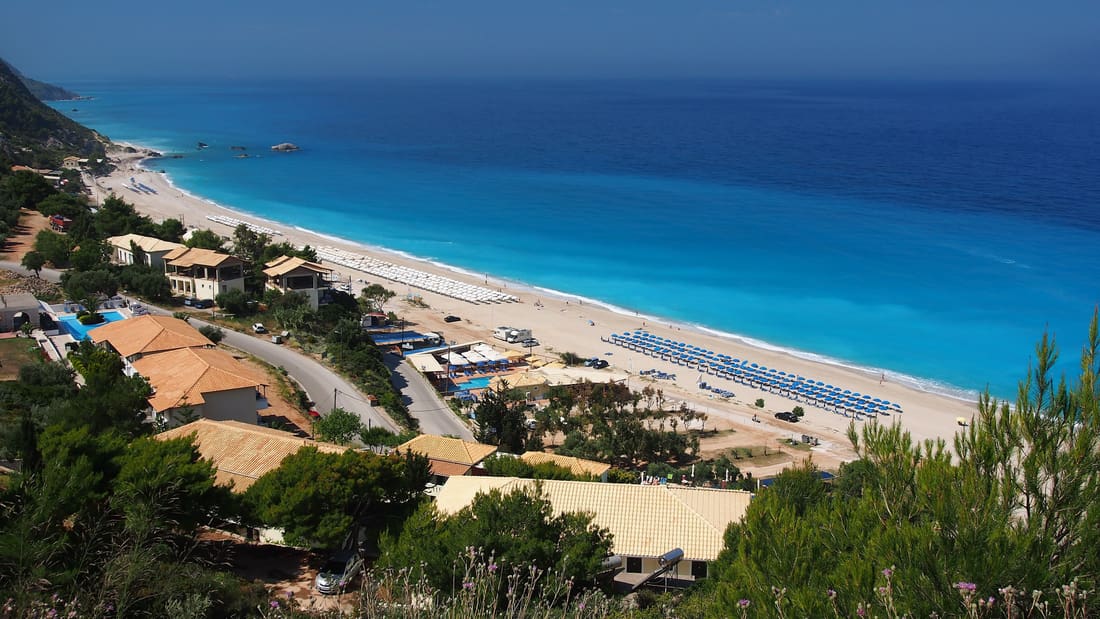
A Lefkada island tour by car or bus reaches the west-coast beaches along the cliff roads: Kathisma, Porto Katsiki and Egremni, where steps lead down to the shore, together with the windy beaches of Agios Ioannis and Myli on the eastern side.
The west coast is the main draw for drivers, and the road above it runs high. Kathisma is the busiest beach on that side, with beach bars and restaurants behind the sand, and paragliders land on the shore in the afternoon. South of it the road passes above Porto Katsiki, where a white cliff rises 100 metres above the water.
A Lefkada island tour reaches Egremni further south, on the south-western coast, where a sealed road built in the mid-1990s opened the beach to traffic. About 400 steps lead from the roadside down to white pebbles. An earthquake in 2015 covered part of the shore with rubble, and geologists expect the beach to recover over time. Porto Katsiki stands 35 kilometres from Lefkada Town, near the village of Athani.
Not every beach needs a long descent. Agios Ioannis and Myli lie close to Lefkada Town and are the windy beaches of the island, used for windsurfing and kitesurfing, while Kastro and Ammoglossa sit just beyond the floating bridge with soft sand and easy access. Vasiliki, in the south, keeps shallow water, and Agios Nikitas lies 10 kilometres southwest of the capital.
- West coast: Kathisma, Porto Katsiki and Egremni are reached by the cliff roads above the shore.
- North and east: Agios Ioannis, Myli, Kastro and Ammoglossa lie close to the town and the bridge.
- Stairways: Porto Katsiki has 100 steps and Egremni about 400, both from roadside parking.
A Lefkada island tour by road works best with an early start, because parking at the cliff-top sites fills quickly and the roads above Porto Katsiki and Egremni carry traffic both ways. Travelers with limited mobility find the soft-sand beaches near the town easier, and beaches on the east coast are fitted with equipment for independent access to the sea.
What does a Lefkada island tour see at Cape Lefkatas?
A Lefkada island tour at Cape Lefkatas finds a stone lighthouse above the sea, cliffs linked with the poet Sappho and with the cult of Apollo Leucatos. The cape forms the southernmost point of the island, also called Cape Dukato.
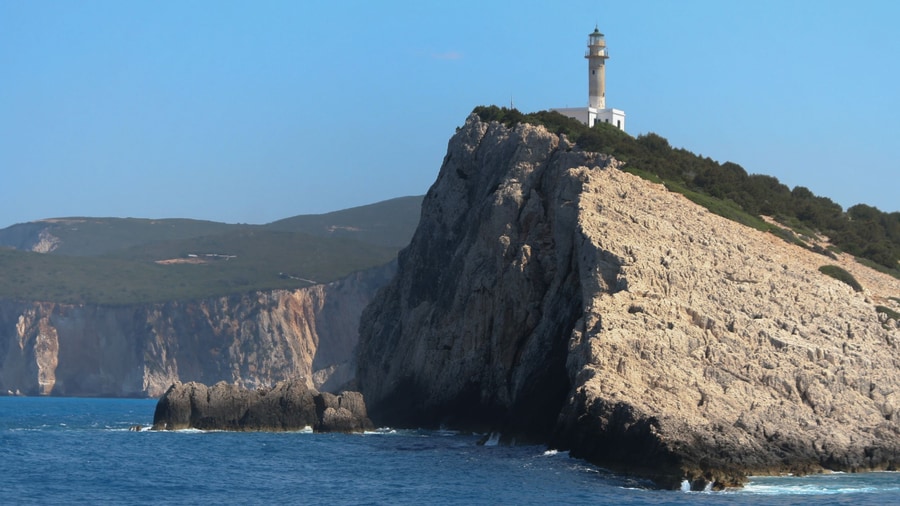
A Lefkada island tour reaches the lighthouse on the headland at the southern tip of the island. It was built in 1890, its tower rises 14 metres, and its focal height is 70 metres above the sea. It went dark during the Second World War and returned to service after 1945, and it has been electrified since 1982. Wind and salt mark the structure, which faces open water.
The cliffs below the cape drop 30 metres to the sea. Ancient sources record a cult of Apollo Leucatos at the south-western cape, where white cliffs stand, and the site was used to judge guilt or innocence by throwing people from the rock, a practice called the Leucadian trial. Tradition links the same headland with Sappho and with Cephalus on separate occasions.
- The lighthouse: Built in 1890, with a tower of 14 metres and a focal height of 70 metres.
- The cliffs: The rock drops 30 metres to the sea below the headland.
- Sappho: Ancient tradition connects the poet with a leap from the cape.
The cape is a short detour from the villages on the southern ridge, and the final stretch of road climbs above the water before ending on the headland. Vegetation is low, the ground is rocky and there is no shade. A Lefkada island tour pairs the stop with the beaches on the same western coast.
Which mountain villages does a Lefkada island tour visit?
A Lefkada island tour climbs into the centre of the island to Karya, Englouvi, Exanthia and Agios Petros. The villages sit on the flanks of Stavrota between 500 and 730 metres, above the olive groves and the coastal roads.
Karya is the best known of the mountain villages. It stands on the slopes of Pyrgos at 500 metres, and its needlework carries the name of the island far beyond it. The Karsani stitch was developed and spread by Maria Stavraka, who worked geometric motifs on white fabric without a hoop, and the National Inventory of Intangible Cultural Heritage of Greece inscribed the craft in 2019.
Englouvi is the highest village on the island at 730 metres. Its houses sit below the plateau of Agios Donatos, where farmers keep a local lentil variety sown in the same fields for more than 400 years. Exanthia lies between 540 and 630 metres and holds 163 residents. Agios Petros stands on a mountain slope 4 kilometres north of Vasiliki.
- Karya: Karsani embroidery, inscribed on the national list of intangible heritage in 2019, keeps the village known.
- Englouvi: The highest village, at 730 metres, above the lentil fields of the plateau.
- Exanthia: A village on the western side of the central ridge, at 540 to 630 metres.
- Agios Petros: A village on a mountain slope 4 kilometres north of Vasiliki.
Mountain roads link the villages to the coast, and the surface changes between wide asphalt and narrow lanes with low walls. The pace slows after the morning, and the squares empty before midday. A Lefkada island tour stops in one village to break the climb, and the height opens views west over the cliff coast and east towards the sheltered water.
What does a Lefkada island tour see in Nydri and on the east coast?
A Lefkada island tour on the east coast centres on Nydri, the largest resort on the island, with the Dimosari gorge behind it, the excavations of Wilhelm Dörpfeld nearby, and the view across the water to the islets and the mainland.
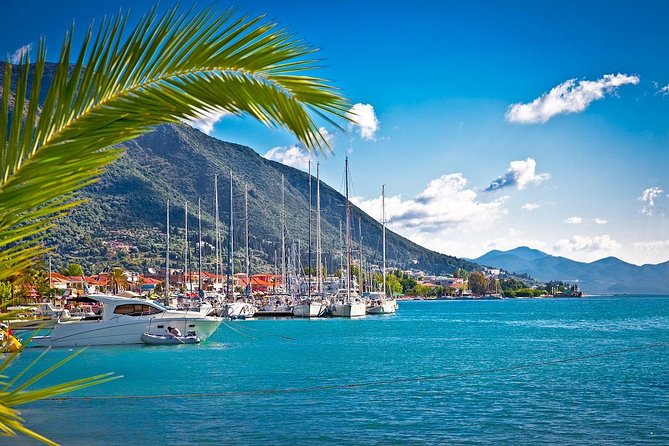
A Lefkada island tour on the east coast finds Nydri on the eastern shore, at the head of a sheltered bay. The Greek National Road 42, which links Vasiliki, Lefkada Town and Amfilochia, passes through the town, and the resorts of Lygia, Nikiana and Perigiali lie north of it. The community counts 1,402 residents, and the view from the waterfront crosses to the islets of Madouri, Skorpios, Skorpidi and Sparti.
Behind the town the land rises into the Dimosari gorge, where a stream drops through rock in a series of small waterfalls. The gorge lies inland from Nydri and is a walking route rather than a road, climbing through vegetation above the coast. Nydri keeps a harbour on the east coast, and the resorts of the east coast face the channel.
Wilhelm Dörpfeld worked at Nydri for years. The German archaeologist argued that Lefkada was Homer’s Ithaca and that the palace of Odysseus stood west of the town, and he uncovered Mycenaean tombs, walls and artefacts in support of the idea. He spent the last years of his life there and is buried at Nydri, and a Lefkada island tour sees the islet of Skorpios offshore, which once belonged to Aristotle Onassis.
- Nydri: The largest resort on the island, with a sheltered bay and a harbour on the east coast.
- The islets: Madouri, Skorpios, Skorpidi and Sparti lie in the water in front of the town.
- The Dimosari gorge: An inland ravine above Nydri carries a stream and small waterfalls.
- Dörpfeld: The archaeologist who placed Homer’s Ithaca on Lefkada spent his last years at Nydri.
The east coast road is the easiest drive on the island, with long sections and little climbing. Evening brings people to the water’s edge, and the harbour fills with small boats. A Lefkada island tour heading south continues to Vasiliki, while one heading north returns through the coastal resorts towards Lefkada Town.
Why does a Lefkada island tour stop at Vasiliki?
A Lefkada island tour stops at Vasiliki for the bay, the afternoon wind and the port. The town sits 25 kilometres southwest of Lefkada Town and 4 kilometres south of Agios Petros, and ferries leave from it for Kefalonia and Ithaca.
A Lefkada island tour reaches Vasiliki on the south coast, at the head of a bay that funnels wind across the water. A local thermal wind, known among windsurfers as Eric, rises in the afternoon as the land around the bay warms, and more than a hundred windsurfers are on the water at a given time in summer. The town is a windsurfing centre.
The bay also shelters small craft. The beach at Vasiliki keeps shallow water, which suits families with young children, and the port links the island with Kefalonia and Ithaca by ferry.
- The wind: A thermal wind known as Eric fills the bay in the afternoon.
- The water: Shallow water along the beach suits children and beginners.
- The port: Ferries run from Vasiliki to Kefalonia and Ithaca.
Vasiliki is a natural end point for a southern circuit, and the road from Nydri follows the coast to reach it. The approach from the north passes Agios Petros before dropping to the bay. A Lefkada island tour with time in hand stops here for the afternoon, when the wind builds and the waterfront fills.
Which monasteries and churches does a Lefkada island tour visit?
A Lefkada island tour visits the Monastery of Faneromeni, the oldest and largest monastery on the island, three kilometres from Lefkada Town, together with the old town churches of Agios Spyridon, Agioi Anargyroi and Panagia ton Xenon, which stand in the capital.
The Monastery of Faneromeni stands three kilometres from the capital, near the village of Fryni. It was established in 1634 and has served as the religious centre of the island for centuries as its oldest and largest monastery. It is dedicated to the Dormition of the Theotokos, the patron of Lefkada, and it holds the rank of a male monastery with an abbot and four monks.
A Lefkada island tour of the monastery finds a central church rebuilt after a fire in 1886, with an iconostasis from 1887. The library holds more than 2,000 titles, among them manuscript gospels from the fifteenth, seventeenth and eighteenth centuries. Its feast falls on the Monday of the Holy Spirit, a movable date, when pilgrims come from the island and the surrounding areas.
- Faneromeni: Established in 1634, three kilometres from Lefkada Town and close to the village of Fryni.
- The monastery church: Rebuilt after a fire in 1886, with a library of more than 2,000 titles.
- Town churches: Agios Spyridon, Agioi Anargyroi and Panagia ton Xenon are the old temples of the capital.
The monastery sits close to the town, so a stop there fits the first or the last hours of a Lefkada island tour on land and leaves the rest of the day free for the mountain villages and the western coast. It is the oldest monastery of the island and remains a working house of monks.
What food does a Lefkada island tour taste?
A Lefkada island tour tastes the lentils of Englouvi, the salami of the island, olive oil pie, liqueur and wine from the Vertzami grape. Village production keeps the flavours of the island distinct from the rest of the Ionian group.
A Lefkada island tour that climbs to Englouvi finds lentils from the plateau of Agios Donatos above the highest village on the island. The seed has been sown there for more than 400 years, and the variety is a local one that has kept its own characteristics rather than being replaced by improved stock. Growers sell the crop directly from the fields on the plateau.
The salami of Lefkada is the best known of the island’s cured meats, and olive oil pie and rosoli liqueur appear on local tables. Wine production centres on the Vertzami grape, a thick, dark-skinned variety best known for single-varietal wines produced on Lefkada, and local wine festivals keep the tradition in view. Travelers who extend the trip to the neighbouring islands add a Kefalonia island tour to the same journey.
- Englouvi lentils: A local variety grown on the plateau of Agios Donatos for more than 400 years.
- Salami: The cured meat linked with the island above all others.
- Olive oil pie and liqueur: Ladopita and rosoli are the savoury and sweet specialities of local tables.
- Wine: The Vertzami grape gives single-varietal wines produced on Lefkada.
The lentils appear as a dish in their own right, and the produce of the villages reaches the tables of the island. Village squares and town streets carry the same goods, and a lunch stop fits the shape of the driving day. A Lefkada island tour in the villages ends with a table of local produce.
What does a Lefkada island tour see in Agios Nikitas?
A Lefkada island tour sees Agios Nikitas, a small beach resort on the northwestern coast of the island. The village lies 4 kilometres northwest of Karya and belongs to the municipal unit of Lefkada. It counted 63 residents in 2021, a fall from 108 in 2011.
Agios Nikitas is a village on the island of Lefkada, in the Ionian Islands region. A Lefkada island tour finds it on the northwestern coast, where it forms one of eight communities of the municipal unit of Lefkada. The other seven are Lefkada City, Alexandros, Apolpaina, Kalamitsi, Kariotes, Katouna and Tsoukalades. Together the unit covers 60.628 square kilometres and held 13,540 residents in 2021.
The population record of the village is short. Agios Nikitas counted 69 residents in 1981 and 112 in 1991. The figure then fell to 66 in 2001, rose to 108 in 2011 and stood at 63 in 2021. A Lefkada island tour therefore reaches a settlement that stays small across four decades of counts, and 1991 gave the highest of the five figures.
Karya lies 4 kilometres to the southeast, in a municipal unit of its own in the central part of the island. That unit has a land area of 30.867 square kilometres. Since the 2011 local government reform, it joins six other former municipalities inside the municipality of Lefkada: Apollonioi, Ellomenos, Kalamos, Kastos, Lefkada and Sfakiotes. A drive from Karya to Agios Nikitas on a Lefkada island tour crosses from one municipal unit into another.
- Church: The village has a church.
- Region: Agios Nikitas lies in the Ionian Islands region and the regional unit of Lefkada.
- Islands: The regional unit holds the islands of Lefkada, Meganisi, Kalamos and Kastos, plus smaller islands.
- Municipalities: The regional unit is split into two municipalities, Lefkada and Meganisi.
The regional unit took its present form in the 2011 Kallikratis reform, when it was created out of the former prefecture of Lefkada. That prefecture was created in 1864, and the regional unit has the same territory. A Lefkada island tour in Agios Nikitas therefore stops in a village inside the borders of that older prefecture. The mountain villages and cliff-top beaches covered elsewhere in this post complete the circuit.
When is the best season for a Lefkada island tour?
A Lefkada island tour works from spring to autumn. Lefkada has a Mediterranean climate with hot summers and cool winters.1 millimetres.
The island has a typical Mediterranean climate, classified as Csa, with hot summers and cool winters. A Lefkada island tour in July meets the driest weeks of the year. January stands at 14 degrees Celsius.
The sea and the wind shape a Lefkada island tour as much as the air temperature does. Windsurfers find the thermal wind at Vasiliki in the afternoon, and Agios Ioannis and Myli near Lefkada Town are the windy beaches of the island. Travelers who prefer calm water stay on the sheltered east coast, where Nydri and its neighbours face the mainland across the channel.
- Summer:
- Winter: December brings 210 millimetres of rain, the highest monthly total of the year.
- The year:
Spring and autumn suit travelers who want to drive and walk without the heat of midsummer, when parking at the cliff-top beaches is hardest. The pattern of the Ionian climate keeps the rain in the cooler months and the summer dry, and a Lefkada island tour in either shoulder season finds the roads quieter.
What do travelers ask about a Lefkada island tour?
A Lefkada island tour raises the same practical questions: whether one day is enough, whether to drive or join a bus, how children fit into the day, how to add a boat trip, and how to reach the island from Preveza or Corfu.
Is one day enough for a Lefkada island tour?
One day covers a single circuit. The island runs 35 kilometres from north to south and 15 kilometres from east to west, so a Lefkada island tour that links Lefkada Town, the mountain villages and the west-coast beach roads is realistic. The cape and the east coast add distance to the same circuit.
Is a car needed for a Lefkada island tour?
A car or a small-group vehicle reaches the cliff roads and the mountain lanes above the coast. The Greek National Road 42 links Lefkada Town with Nydri and Vasiliki, and organised road tours follow the same coast roads. Parking near the beaches is limited in high summer.
Is a Lefkada island tour suitable for children?
Children do well on the soft-sand beaches close to Lefkada Town and in the shallow water at Vasiliki. Long stairways, such as the 100 steps at Porto Katsiki and the 400 at Egremni, are harder with small children. The distances between stops are short, so the driving sections of a Lefkada island tour stay brief.
Can a Lefkada island tour combine with a boat trip?
It can. Land routes cover the villages and the cliff coast, while the water is handled separately. Nydri has a harbour on the east coast, and Vasiliki keeps a working port with ferry links to Kefalonia and Ithaca. A sailing day fits before or after a Lefkada island tour through an Ithaca day trip from the east coast.
How does a Lefkada island tour start from Preveza or Corfu?
From Preveza the road leads to the causeway and the floating bridge at the northern tip of the island. Aktion National Airport, on the Aktion peninsula, serves Preveza and Lefkada and stands on that side of the water. Corfu lies further north in the Ionian group, among the seven principal islands that include Lefkada, Kefalonia and Ithaca.
Featured photo: Alf van Beem, CC0, via Wikimedia Commons.