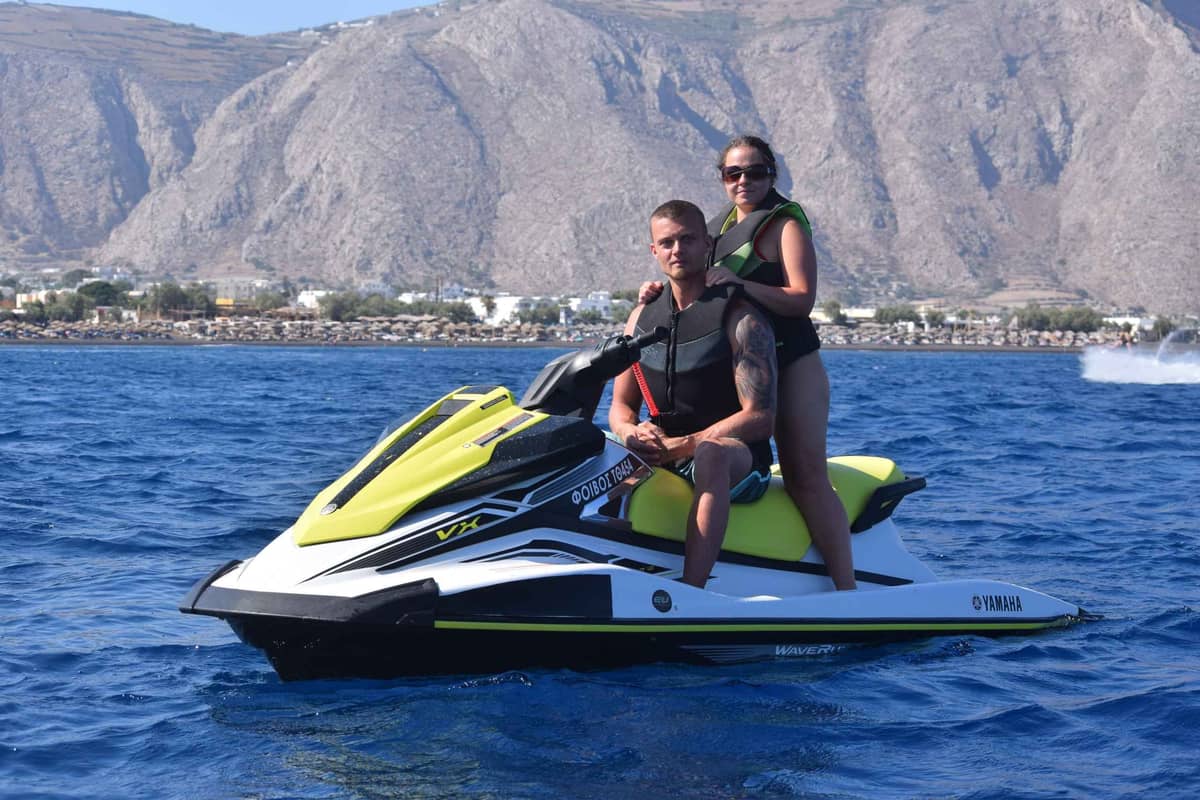
A Santorini jet ski ride takes riders across the sea off Santorini on a fast personal watercraft. Rides start from the long beaches of the south and east coast. It is one of the jet ski trips in Greece on Greece VIP.
This post covers what a Santorini jet ski ride includes, where it starts and the coast it passes. It also covers the volcano, the rules at sea and safety for beginners. What to wear, the best season and common questions come last.
Each section ends with a Santorini jet ski ride or sea trip that can be booked online.
What does a Santorini jet ski ride include?
A Santorini jet ski ride includes time on a personal watercraft, also called a PWC. The compact sit-down runabout is the best-liked style of this craft. Riders sit on it the same way as on an ATV or a snowmobile.
The stand-up style is mainly built for one rider, who stands on it as on a kick scooter. It is used more for tricks, racing and competitions.
A Santorini jet ski moves with a pump-jet. Water enters through an intake, normally under the hull. A pump raises its pressure and forces it backwards through a nozzle.
On a Santorini jet ski, the nozzle also steers. Plates on it act like small rudders, pushing water left or right. A reversing bucket lets it slow down and go backwards without changing gear.
Water scooters first appeared in the United Kingdom and Europe in the mid-1950s. Clayton Jacobson II, an American inventor, had an aluminium stand-up prototype running by 1965.
In 1968, one maker launched its first personal watercraft, designed by Jacobson. Stand-up craft named Jet Ski followed in 1972. They reached the US market in 1973.
- The name: Jet Ski is a registered trademark, but people use the term for any personal watercraft.
- Covered impeller: The first Jet Ski models fully enclosed the impeller, the spinning pump part, for safety.
- Self-circling: Early models circled at idle, so a rider who fell off was able to swim back.
Shallow water suits a Santorini jet ski, as only the pump-jet inlet must stay underwater. Its steering, braking and reverse all come from the same jet of water.
Where does a Santorini jet ski ride start?
A Santorini jet ski ride starts from beaches with water sports, like Kamari and Perissa. Both beaches also have a diving school and volleyball courts. Kamari has a lifeguard. The Greek environment ministry puts its maximum number of bathers at 5,000.
A Santorini jet ski ride from Kamari begins in sheltered water. The beach is protected from the main winds, except the north-easterlies. Those blow with low or medium strength.
Each year, Kamari holds a festival on 9 July at the church of Agios Pagkratios. The date recalls the day of the 1956 earthquake on Santorini.
From Perissa, a Santorini jet ski ride leaves a fully organised beach. It has access for disabled people and room for an estimated 2,000 bathers. Of the main winds, only the westerlies reach it.
The Holy Cross church on the village square is among the island’s largest. First built in 1835-1840, it was destroyed in the same earthquake and rebuilt.
A Santorini jet ski ride from Monolithos starts on an east-facing beach, 35 m wide on average. It has a lifeguard and room for an estimated 300 bathers. For a slower pace, visitors can join kayak tours on Santorini.
- Bathing status: Kamari became an official bathing water in 1990, so officials test its sea.
- Fishing boats: Small fishing boats moor at the north end of Kamari beach.
- Breakwater: At the south end of Monolithos, a breakwater separates a fishing-boat mooring from the beach.
The beach in front of Agios Georgios faces south-east. Its sea floor drops steeply. For a Santorini jet ski, the 5 m depth line lies about 70 m out.
What does a Santorini jet ski safari see along the coast?
A Santorini jet ski safari can pass Cape Exomitis, at the southernmost tip of Santorini. Exomitis, formerly called Exemitis, is both a village and a cape. The village had 513 inhabitants at the 2021 census, the official head count.
A Santorini jet ski safari also passes Vlychada beach, organised only on its eastern part. It holds an estimated 500 bathers. A stream that runs only at times meets the sea at its north end.
The harbour of ancient Eleusis is thought to lie sunk near the cape. Ptolemy named Eleusis as a town on Thera, another name for Santorini. Its site is placed, without certainty, near Vlychada.
Ancient tombs are cut into the rocks beside the road to Exomitis. Above them, a huge viper is carved into the rock. Its name, Ochendra or Echendra, is the ancient Greek word for viper.
Panagia Katefiani chapel sits in a hollow on Mesa Vouno, about 200 m from its foot. Crowds of residents fled there in the 1650 eruption of the Kolumbo undersea volcano.
A Santorini jet ski safari can also reach Kamari, site of a sanctuary of Achilles. It is the only sanctuary identified with his cult. It shows the hero was worshipped outside Thessaly.
- Kylix: An Ionian drinking cup found there carries an inscription naming the donor and the hero.
- Sellada: Mesa Vouno once named the low ridge between Agios Stefanos and Profitis Ilias, now called Sellada.
- Katefiani: The chapel’s name comes from katefio, a word for refuge.
The Early Christian basilica of Agia Irini stands at the foot of Mesa Vouno. It dates from the late 5th century. Its main hall was 25 m long. Found in 1992, its floor lies 2 m below ground.
Can a Santorini jet ski reach the volcano?
A Santorini jet ski can reach the volcano islands in the middle of the sea-filled crater. Greek port rules keep a rented craft within sight of its rental base. A base close to the volcano makes the round trip possible.
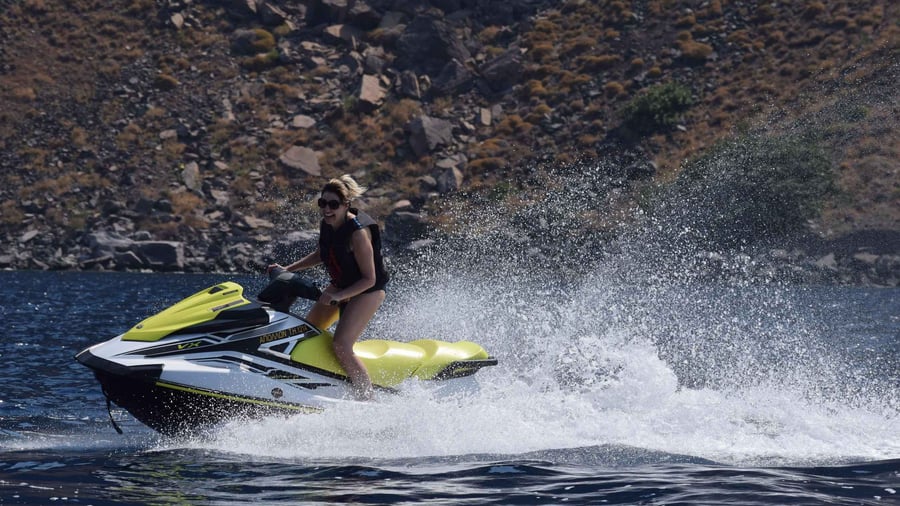
A Santorini jet ski ride toward the volcano heads for Nea Kameni. An eruption that built new land there began in 1707. It stopped on 14 September 1711.
The Kameni islands erupted again on 26 January 1866. That eruption went on until 15 October 1870. It caused deaths and damage and forced people to leave.
Another eruption ran from 11 August 1925 to 17 March 1928. It sent out lava and built a new lava dome, a rounded hill of cooled rock.
The latest eruption ran from 10 January to 2 February 1950. Part of it took place under the sea. Lava flowed on the surface as well.
Palea Kameni sits in the same crater. Strabo, an ancient Greek writer, said flames burst from the sea for four days when it rose. The new island measured 12 stadia, about 1.5 miles, around its edge.
- 46 AD: An eruption that began on 31 December built a new island and set off a tsunami.
- 1570 to 1573: Another eruption formed a new island inside the caldera.
- Minoan eruption: The eruption list dates it to 1610 BC, give or take 14 years.
- Kameni line: Magma has mainly risen along this crack in the crust, from south-west to north-east.
A Santorini jet ski ride near the volcano passes land built by these eruptions. Both volcano islands rose from the sea in times that people wrote about.
What rules apply to a Santorini jet ski ride?
A Santorini jet ski ride follows Greek port rules for personal watercraft. The driver needs a speedboat operator licence, whatever the craft’s type or speed. Everyone on board wears a life jacket. Rides run only from sunrise to sunset.
Under Greek port rules, a personal watercraft is a leisure craft with a hull under 4 metres. A water-jet pump drives it. Riders sit, stand or kneel on top, and one craft carries up to 3 people.
Renting a Santorini jet ski to a person without that licence is banned. The Greek licence goes only to people aged 18 or over. A licence from another country counts if a state body there issued or recognised it.
Floating buoys mark swimming zones. A Santorini jet ski stays at least 200 metres from their outer edge. With no buoys, the gap is 300 metres from the usual edge of the swimming area.
With no swimmers around, a Santorini jet ski keeps to 5 knots within 500 metres of shore. Knots measure speed at sea. Rides are also banned in rocky sea areas.
The Hellenic Coast Guard, founded in 1919, sets these port rules. Harbour masters pick coastal areas with homes for an afternoon ban. There, rides stop from June to September between 14.00 and 17.00.
- Licence exam: It has 20 questions, lasts 40 minutes and needs at least 18 right answers.
- Alcohol: Driving after alcohol, drugs or medicines is banned, and a test follows any injury accident.
- EU rules: The Recreational Craft Directive 2013/53/EU sets minimum standards for craft across Europe.
A Santorini jet ski ride stays legal when the driver holds the licence and keeps clear of swimmers. These rules protect swimmers and the people on board.
How safe is a Santorini jet ski for beginners?
A Santorini jet ski is safest for a beginner who learns the controls and rides slowly. Crash data points at the rider far more than the machine. A kill cord and training lower the risk on a first ride.
A Santorini jet ski for beginners works best with the kill cord in place. This cord ties the rider’s wrist or life jacket to a key on the engine switch.
If the rider falls off, the cord pulls free. The engine then stops or drops to idle. The craft does not race away from a rider in the water.
A fall off the back brings its own danger. The rider can land in the path of the strong water jet. Makers advise wetsuit bottoms or similar cover.
Steering trouble or loss of control played a part in 24 percent of reported crashes. A Santorini jet ski beginner gains from slow practice turns near the base.
A study by the NTSB, a transport safety body, reviewed 814 crashes. Lack of attention, lack of experience or unsuitable speed were factors in 70 percent. Over 90 percent came from errors by the driver.
- Experience: Among drivers in crashes, 32 percent had used a craft ten times or fewer.
- Training: Of 712 drivers asked, 84 percent had received none.
- Rentals: Riders on rented craft were linked to nearly 25 percent of crashes.
A Santorini jet ski suits a beginner who rides slowly and keeps the kill cord attached. Training before the first ride closes the gap that the crash data shows.
What do riders wear on a Santorini jet ski?
A Santorini jet ski rider wears a lifejacket rated for the sea and body weight. A rash guard or thin wetsuit goes underneath, with water shoes on the feet. Close-fitting sunglasses cut the bright glare off the water.
Lifejackets are graded by buoyancy, the upward push of water. Class EN ISO 12402-4 gives at least 100 newtons for sheltered waters. Class 12402-2 gives at least 275 newtons for the open sea.
A 150-newton vest turns a face-down wearer onto the back reliably only over light clothing. Vests from that level up tend to inflate. Lower-rated ones are almost always solid foam, such as polystyrene.
A rash guard is a sports shirt for the water. On a Santorini jet ski, it helps prevent skin irritation from fast hits of waves. Flatlock seams lie flat and add strength.
Still water draws heat from the body about 20 to 25 times faster than still air. Physicist Hugh Bradner of the University of California, Berkeley, invented the modern wetsuit in 1952.
Sunglass lenses work best close to the face, so little stray light reaches the eye. In the 18th century, Venetian women and children wore tinted “gondola glasses” against canal glare.
- Weight range: Each float prints a body weight range, and outside it safe floating is not guaranteed.
- Neoprene: This wetsuit rubber runs up to 10 mm thick, and thicker suits are warmer but stiffer.
- Reef walkers: These ankle-high wetsuit bootees measure about 2 to 3.5 mm thick.
- Water shoes: Tiny holes in the sole can let water drain out fast.
The sun’s rays are strongest between about 10 am and 4 pm daylight saving time. A Santorini jet ski ride at midday calls for covered skin and good lenses.
When is the best season for a Santorini jet ski ride?
A Santorini jet ski ride suits the warm months from late spring to autumn. Air stays warm well into October on the island. Wind matters more than heat, since it shapes the waves near the beaches.
Santorini is the southernmost island of the Cyclades, yet also the coolest. Northeast winds are the main reason. Winters stay mild all the same, at about 12 °C.
A late-season Santorini jet ski ride still meets warm air. September nights hold a mean low of 21.3 °C. October has a mean of 20.2 °C, with a mean low of 17.5 °C.
Wind decides how rough the sea gets. Forecasters now give wind speed in km/h, mph or knots. Shipping forecasts and severe weather warnings still use Beaufort terms, a scale of wind force.
- Force 6: A strong breeze of 22 to 27 knots builds large waves of 3 to 4 m.
- Wave heights: Beaufort figures apply to the open ocean, not to water along the shore.
- November: Highs still average 19.4 °C, with a monthly mean of 17.0 °C.
- Record highs: August has hit 38.6 °C, September 33.9 °C and October 33.1 °C.
On windy days, boat tours of Santorini on larger hulls give a steadier way to see the coast. A Santorini jet ski ride suits calmer water.
What do travelers ask about a Santorini jet ski?
A Santorini jet ski draws questions about its roots, engine, fuel and noise. In 2001, the US National Park Service ran noise tests at Glen Canyon. Personal watercraft proved no louder than other boats, except those with V-8 engines.
Who first built a water scooter like the Santorini jet ski?
A Greek inventor stands early in the story. Dimitrios T. Moraitidis built a water scooter prototype. He filed a patent for it on 5 June 1970, with serial number 40056. A patent is a legal claim to an invention.
When did the Santorini jet ski design first seat three riders?
The first personal watercraft with a three-person seat and reverse came out in 1990. US rules ended a two-stroke stand-up line in 2011. A stand-up model returned in 2016 with a 160 horsepower four-stroke engine.
What engine powers a Santorini jet ski?
Personal watercraft run on two-stroke or four-stroke engines. A two-stroke engine completes its power cycle in one turn of the crankshaft. The crankshaft is the main shaft that the pistons spin. A four-stroke engine needs two turns.
How much fuel does a Santorini jet ski lose to the sea?
A 1991 study by the US Environmental Protection Agency looked at two-stroke engines. They lose roughly 25% of their fuel, unburned, into the water. Four-stroke and direct-injection two-stroke engines release fewer hydrocarbons, though they emit more nitrogen oxide.
How loud is a Santorini jet ski up close?
A craft that reads 76 dBA from 82 feet reads 102 dBA from 4 feet. The dBA unit is a decibel scale for loudness. People hear a drop of 10 dBA as about half as loud.
Featured photo: Santorini jet ski safari to the volcanoes with snorkeling, via GetYourGuide.