

The Imbros gorge hike is a downhill walk through a narrow canyon in Sfakia, southwest Crete, ending near the Libyan Sea. It is one of the tours in Greece listed on Greece VIP.
This post covers the trail, the tours, the drive, the difficulty, the narrows, the village history, the finish, food and reviews. Weather, the best season and common questions come last.
What is the Imbros gorge hike?
The Imbros gorge hike is a downhill walk through a narrow limestone canyon in Sfakia, southwest Crete. It starts at the mountain village of Imbros and ends at Komitades, near the Libyan Sea.
Tour listings put the walk at 7 to 9 km. One calls Imbros the second longest gorge on Crete.
The trail follows an old mule path. Before the road was built, it was the only link between Chania and Chora Sfakion.
The modern road now runs high along the right side of the gorge.
Its exit lies well inland, unlike that of Samaria. Walkers need a short ride to reach the sea.
- Start: Imbros village.
- Finish: Komitades.
- Trail: An old mule path.
The Imbros gorge hike suits walkers who want a gorge day without the scale of Samaria.


Which tours run the Imbros gorge hike?
Day tours run the Imbros gorge hike from Chania, Rethymno and Georgioupoli. They add a swim and lunch on the south coast after the walk.
A Chania tour with 369 reviews scores 4.6 out of 5. It ends at a beach near Chora Sfakion.
Another Chania tour holds 317 reviews and scores 4.7. It adds free time and a swim at Chora Sfakion.
A tour from Georgioupoli holds 135 reviews and scores 4.7. It ends with a swim at Frangokastello and a look at its castle.
Two tours from Rethymno and Chania hold 129 and 98 reviews and score 4.6. On the Chania version, the escort stays with the bus while guests walk on their own.
A smaller tour with 61 reviews sends a licensed escort into the gorge with the group.
- Largest count: 369 reviews.
- Top score: 4.7.
- Escorted walk: On one tour.
The Imbros gorge hike on a tour removes the need for a taxi back to the start.
How do hikers reach the Imbros gorge hike?
Hikers reach the Imbros gorge hike by road from the north coast. Imbros village lies 54.8 km from Chania and 58.3 km from Rethymno.
From Georgioupoli the drive runs 26.4 km, and from Heraklion it runs 138.4 km.
The road climbs through the White Mountains and the Askyfou plain. Imbros lies 6.5 km beyond the plain by road.
Walkers with a car leave it at Imbros and take a taxi back from Komitades. The road between them runs 14.9 km.
- Chania: 54.8 km.
- Rethymno: 58.3 km.
- Georgioupoli: 26.4 km.
Hikers who want other trails near Chania can compare the Chania hiking tours.
How hard is the Imbros gorge hike?
The Imbros gorge hike is mostly downhill and rated easy to moderate. The ground is the hard part, with loose round stones on a dry creek bed for long stretches.
Listings call it family friendly and suitable for children and seniors with basic fitness. One tour advises against it for people with limited mobility.
In Samaria, scree lies above the river bed. In Imbros, walkers cross the round scree of the creek bed itself.
One reviewer found it harder than the easy rating suggests. Boots with ankle protection and a walking pole helped.
Another warned that thin soles tire the feet on the stones. The path can be slippery in places, one listing adds.
- Grade: Easy to moderate.
- Ground: Loose round stones.
- Kit: Boots and a pole.
The Imbros gorge hike rewards walkers who watch every step and wear proper shoes.
What does the Imbros gorge hike pass on the trail?
The Imbros gorge hike passes cypress and oak trees and cliffs up to 300 m high. Its narrows close to 2 m wide. The trail forms part of the E4 European long-distance path.
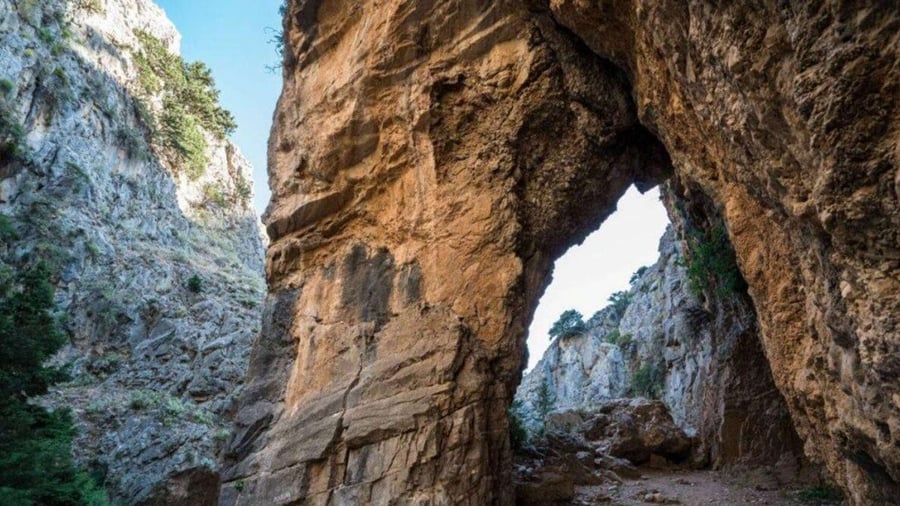
One listing calls the narrowest stretch the Gates, where the towering walls close to just 2 m apart.
A licensed escort on one tour explains the history, plants and geology along the way. Another listing names the Cretan wild goat among the wildlife.
Walkers follow the same path that Allied soldiers used during the Second World War.
- Trees: Cypress and oak.
- Cliffs: Up to 300 m.
- Route: Part of the E4.
The Imbros gorge hike packs a lot of scenery into a short downhill walk.
What history surrounds the Imbros gorge hike?
The Imbros gorge hike starts in a village with a long, hard history. Local tradition says seven brothers from the island of Imvros founded it.
The brothers had been sentenced to death and were spared on condition that they leave. They named the village after their home and took the surname Pattakos.
A Venetian census of 1583 lists the village as Nembros, with 75 residents. Ecumenical Patriarch Bartholomew, born on Imvros, visited in 1996.
The village was destroyed in 1770, 1821, 1824 and 1827. In 1821, Osman Pasha set it on fire.
In 1867, women and children hid in a cave in the gorge. Omer Pasha’s troops found and killed them.
- Founders: Seven brothers.
- 1583: 75 residents.
- 1867: The cave massacre.
Hikers who want the longer gorge next door can compare the Samaria gorge tours.
Where does the Imbros gorge hike end?
The Imbros gorge hike ends at the village of Komitades, where buses and taxis wait. Tours then drive to Chora Sfakion or Frangokastello for a swim.
Chora Sfakion lies 5.9 km from Komitades by road. Its harbour and seaside tavernas face the Libyan Sea.
Frangokastello lies 10.5 km from Komitades. Its Venetian castle stands beside a quiet beach on the south coast.
One Rethymno tour gives free time at a café over the sea in Chora Sfakion. Lunch follows at a beach.
A Georgioupoli tour reviewer found loungers at Frangokastello fairly cheap and the snacks good.
Another reviewer on that tour felt the castle and beach stops added little. No one explained the place.
- Exit: Komitades.
- Swim: Chora Sfakion or Frangokastello.
- Sea: The Libyan Sea.
The Imbros gorge hike ends the day by the sea, a reward after the stones.
What food goes with the Imbros gorge hike?
The Imbros gorge hike pairs well with Sfakian pie before the walk and a seaside lunch after it. Meals cost extra on every tour.
Before entering the gorge, one tour stops in Imbros village for a traditional breakfast at a local café.
The Sfakian pie there is a local honey and cheese pie. One reviewer called it the best pie of the whole trip.
A reviewer on the escorted tour praised a taverna lunch with local beer. A pancake with cheese and thyme honey won praise too.
Chora Sfakion has tavernas and cafés on the water. One tour sets aside time for a seaside meal there.
- Breakfast: Imbros village.
- Must try: Sfakian pie.
- Lunch: By the Libyan Sea.
The Imbros gorge hike leaves room for two good meals in one day.
What do reviewers say about the Imbros gorge hike?
Reviewers praise the scenery, the escorts and the seaside stop on the Imbros gorge hike. Complaints focus on the stony ground and unclear pickup details.
One reviewer called the gorge a lovely walk. Loose rocks near the end needed real care, though.
On the Chania tour with 369 reviews, an escort walked at the back. That way everyone reached the end.
One family said an 11-year-old daughter enjoyed the day. Another reviewer said the heat built up towards midday near the exit.
The review summary asks for clearer pickup details and tighter timing to cut waiting.
- Praise: Scenery and escorts.
- Complaint: Pickup details.
- Tip: Rent a walking stick.
Hikers based further east can compare the Rethymno hiking tours.
How does weather shape the Imbros gorge hike?
The Imbros gorge hike starts high, where summers are warm and winters wet. The Sfakia weather station sits at 784 m near the gorge. It logged a 29.0 °C high average this July and August.
The station peaked at 35.3 °C on 22 July and 35.4 °C on 26 August this year. Neither month brought any rain.
Last July ran hotter, with a 30.3 °C average high and a 37.2 °C peak on 25 July.
Winter rain is heavy. This February logged 304.0 mm, with 72.4 mm on 12 February alone.
Last December brought 209.0 mm of rain, 66.8 mm of it on 5 December.
The gorge can be walked all year except during heavy rain or snow. One listing warns that weather can change quickly.
- Summer: No rain this June to August.
- Wettest month: February, 304.0 mm.
- Gusts: 107.8 km/h last June.
A summer Imbros gorge hike calls for a hat and an early start.
When is the best season for the Imbros gorge hike?
The Imbros gorge hike suits late spring, June, September and October best. June averaged a 25.6 °C high at the Sfakia station this year.
This September averaged 24.5 °C and peaked at 31.8 °C on 13 September, with 30.6 mm of rain.
Last September averaged 23.9 °C with only 6.4 mm of rain. Last October averaged 19.1 °C.
This October has averaged 18.0 °C so far. It logged 106.2 mm of rain, 26.8 mm on 13 October.
April averaged 17.0 °C this year, but a gust of 99.8 km/h hit on 17 April.
- June: 25.6 °C average high.
- September: Warm and mostly dry.
- Winter: Heavy rain.
The Imbros gorge hike in mid summer meets peaks above 35 °C, so morning starts help.
What do travelers ask about the Imbros gorge hike?
Travelers ask about the entry fee, children, water, toilets and getting back to the start. Free cancellation runs up to 24 hours ahead on the main tours.
Is there an entry fee for the Imbros gorge hike?
Yes. Walkers pay a small entrance fee in cash at the start, and children up to 12 enter free.
Are there toilets and water on the trail?
Toilets stand at the entrance and the exit. There are no springs inside, so carry at least 1 litre of water.
Can children walk the Imbros gorge hike?
Yes. Listings call the walk relatively easy and suitable for children with basic fitness.
How do drivers get back to their car?
Drivers leave the car at Imbros and take a taxi back from Komitades. Others walk the gorge back up.
Hikers who want the mountains by vehicle can compare the Chania jeep safaris.