
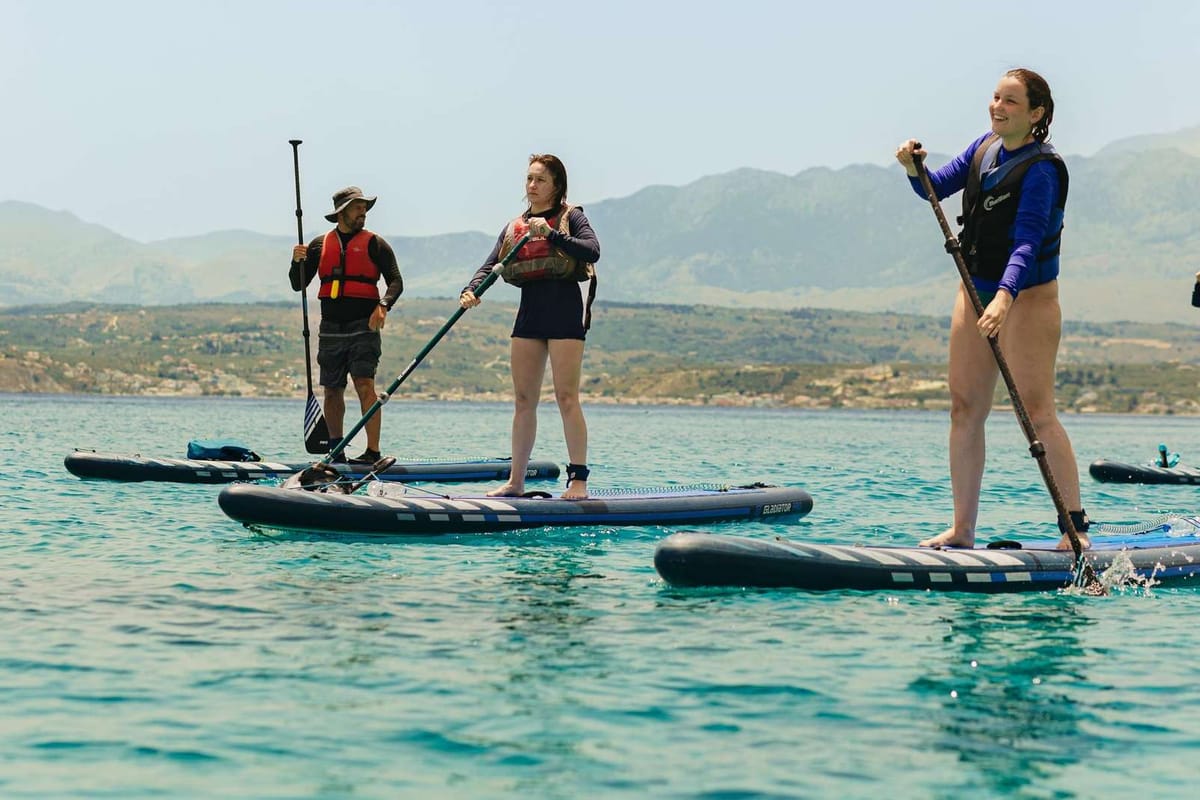
Chania stand up paddle means standing on a long board and paddling the calm bays around Chania, in western Crete. It is one of the Greek tours on Greece VIP.
This post covers what a Chania stand up paddle tour includes, where it starts and the boards it uses. It then covers the bays, the islet of Lazaretta and the sea life. Lessons, rules, safety, weather, the season, the history of the sport, formats, gear and common questions come last.
Each section ends with a Chania stand up paddle tour or a nearby sea trip that can be booked online.
What does a Chania stand up paddle tour include?
A Chania stand up paddle tour includes an instructor, a board, a paddle, a leash and life vest. Rash guards, bottled water and a small energy bar come too. One small-group tour adds a free GoPro video and photos.
That tour takes no more than 8 paddlers. It runs in English and French and covers liability insurance and local taxes. Free transfers serve hotels across the Chania region. Each Chania stand up paddle tour there suits anyone above the age of 15.
Cruise guests get pick-up and drop-off at Souda port, where the driver waits outside the security gate. Four time slots fit different ship arrival times. The operator keeps live access to cruise ship timetables to fit each slot.
The operator’s base offers safe storage for belongings during the tour. A shower and changing rooms wait for guests afterwards. Paddlers can also be dropped in town instead of at the ship.
A second operator on Nea Chora beach runs a Lazaretta SUP trip and a sunset SUP trip. Its team has worked in watersports for over 20 years. Staff clean and disinfect the gear every day. Guests there can also rent surfboards and bodyboards.
- Distance: The Marathi tour covers about 2 km.
- Group: Families, couples and friends share one tour.
- Rentals: Nea Chora boards rent for one hour at a time.
A Chania stand up paddle tour at Marathi leaves time to swim, sunbathe and take pictures.


Where does a Chania stand up paddle tour start?
A Chania stand up paddle tour starts at Marathi Beach on Akrotiri or Nea Chora beach in town. Marathi lies 17 km east of Chania. Its tour area sits within 15 minutes of Souda port.
Marathi lies 5 km east of the naval base in Souda Bay, on the south-east coast of Akrotiri. Its pier serves fishing boats and small ferries.
Pick-ups for the Marathi tour cover Chania, Platanias, Souda, Galatas and Marathi. The exact pick-up point and time arrive by email within 24 hours of booking.
Nea Chora beach lies just past the Kladissos river and its bridges, next to the lifeguard tower. It sits about 1 km from the city centre, a 15-minute walk.
Not every paddle starts from a beach. Boards also travel on boat trips that pair SUP with snorkeling in Chania. A private van tour carries a SUP board from Chania to Elafonissi. One Chania stand up paddle class on Viator mixes the board with Pilates.
- Souda port: Cruise ships dock there for Chania.
- Shuttles: Frequent buses link the city with the port.
- Golden Beach: Chrissi Akti lies 1.2 km from Lazaretta.
Nea Chora beach lies along Akti Papanikoli Street, right opposite Lazaretta islet.
Which boards does a Chania stand up paddle tour use?
A Chania stand up paddle tour uses boards with a paddle, a leash and a single fin. Boards for general use measure 10 to 12 feet, while boards under 10 feet suit surfing. Wider boards feel more stable.
Solid boards wrap a foam core in wood veneer, fibreglass or carbon fibre. Epoxy resin seals a large share of them. Inflatable boards use a drop-stitch core under PVC and fold into a backpack.
A board carries one removable fin in the centre, and surfers add two smaller fins. Board choice depends on the paddler’s weight and height. Surfers with hip or shoulder injuries take up SUP surfing.
A paddle runs 8 to 15 inches taller than its user. Shafts come in plastic, aluminium, fibreglass, carbon fibre or wood. The blade angles forward to add power.
A leash runs about 1 foot longer than the board, in coiled or straight form. Breakaway leashes suit rivers. Racing boards run over 12 feet. On a Chania stand up paddle tour, the leash stays on the ankle or calf. The board then cannot drift away.
- Yoga boards: These add width, a soft grip and paddle holders.
- Touring boards: A displacement hull glides like a canoe.
- First tourers: Touring boards appeared in 2008.
Fishing paddleboards draw little water, so anglers can reach shallow estuaries on them.
Which bays does a Chania stand up paddle tour cross?
A Chania stand up paddle tour crosses the calm water of Marathi Bay and Loutraki. Its small home bay is shielded from the wind. Paddlers pass rock formations and stop at white clay rocks for a natural spa.
The route gives 360-degree views of rock formations along the waterfront of Marathi Bay. Paddlers dive into the clear sea at swim stops. The instructor explains the fragile Mediterranean ecosystem along the way.
Near the Marathi car park lie the ruins of ancient Minoa. The Roman town is thought to be one of the two ports of ancient Aptera. Remains of buildings and baths stand beside an old harbour. Locals call it the Small Palace of Minos, though it is not Minoan. A semicircular wall still shows on the beach.
Marathi Beach has white sand, clear water and hard rocks, as its paddle operator describes it. The view takes in Drapanos Cape and the White Mountains. One local paddler filmed a route from Marathi to Loutraki and the islet of Palaiosouda. The islet’s steep western coast draws scuba divers.
Local paddlers also tour farther along the coast. One filmed a Chania stand up paddle route along the Nea Chora shore. Another paddled a touring leg to Stavros beach.
- White clay: Paddlers use it as a natural spa.
- Snorkel version: One version of the tour adds snorkelling.
- Winter: Local paddlers also train on the Chania coast in winter.
The Marathi tour starts inside that small, wind-shielded bay before heading along the shore.
What does a Chania stand up paddle tour see at Lazaretta?
A Chania stand up paddle tour from Nea Chora circles Lazaretta. The islet measures about 200 m long and 70 m wide. Its small sandy beach suits snorkelling, and the water around it stays shallow.
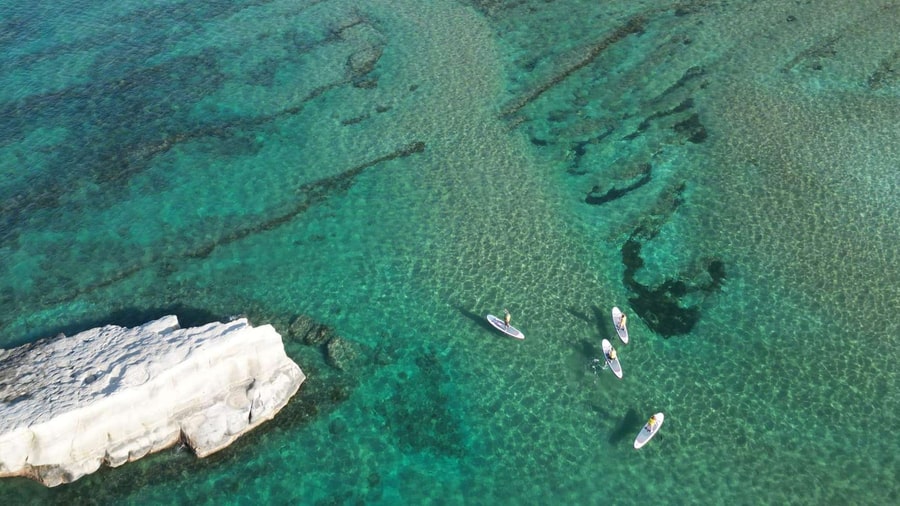
The Venetians used Lazaretta as a leprosarium island for Chania. They used other islets off Cretan cities in the same way. Lazaretta lies 1.8 km from Chania, opposite the beaches of Nea Chora.
In 1645, Turkish forces demolished its buildings to set a large cannon against Chania’s harbour fort. Only foundations remain on the islet today. The Byzantine and Post-Byzantine Collection of Chania, at San Salvatore, ranks among nearby sights.
In the 1950s, long-distance swimmers raced from Lazaretta to the inner harbour of Chania. Excursion boats on boat trips in Chania now stop at the islet.
The Nea Chora operator sells its Lazaretta outing as a Chania stand up paddle trip for everyone. Guests swim around the islet along the way. One local paddler filmed a longer route past Lazaretta to Agioi Apostoloi.
- Distance: Nea Chora beaches lie 0.9 km away.
- Sea: A calm surface is the norm there.
- Diving: Local diving schools also visit the islet.
A Chania stand up paddle trip to Lazaretta pairs the islet’s past with a swim.
What sea life does a Chania stand up paddle tour meet?
A Chania stand up paddle tour meets loggerhead sea turtles, which the Marathi crew frequently spots. Reviews from Nea Chora also mention turtles and octopus. Sea urchins and both native and invasive fish fill the bay at Marathi.
In the coldest months, loggerheads stay down for up to seven hours. They then surface for about seven minutes to breathe. Captive loggerheads sleep with their eyes shut tight and react slowly.
Adult males have longer tails and claws than females, and shorter undershells. A loggerhead’s diet is more varied than that of any other sea turtle.
Females lay about 112 eggs per clutch and about 3.9 clutches a season. After a nesting season, a female skips two to three years before nesting again. Cyprus and Turkey also host common nesting sites.
Sexual maturity comes at about 17 to 33 years, depending on the region. Fishing gear is the biggest open-sea threat, since turtles drown in longlines, gillnets and trawls. Traps and dredges drown them too.
- Big turtles: The largest recorded ones neared 200 kg.
- Weight record: The heaviest reported loggerhead weighed 545 kg.
- Prey: Bivalves and horseshoe crabs feature in the diet.
A resting loggerhead can keep its eyes open, and it wakes easily.
How does a beginner learn Chania stand up paddle?
A beginner learns Chania stand up paddle with a short lesson on shore. It covers balance, turning, stopping and standing up. No paddleboard experience is needed, but every guest must know how to swim.
Practice starts in shallow water, with the board facing away from obstacles. The fin stays clear of the bottom, and the leash goes on first. In choppy water, the nose points into the waves.
A paddler kneels in the middle of the board, with the paddle held across it. Then one foot at a time comes up, knees slightly bent. Eyes stay forward, not on the feet.
Feet stand shoulder-width apart, with weight centred and back straight. The top hand grips the handle, and the lower hand holds the shaft. The core muscles, not the arms alone, drive each stroke.
To turn, a paddler strokes backward on one side or uses a sweeping stroke. Paddling out against the wind leaves an easier return. On a Chania stand up paddle tour at Marathi, experienced paddlers get tips to advance their skills.
- Falling: Fall away from the board, not onto it.
- Paddle: Keep hold of it when that is safe.
- Climbing back: Pull the chest up from the centre first.
One Marathi instructor even got a guest to try a headstand on the board.
What rules apply to Chania stand up paddle?
Chania stand up paddle follows Greek rules set in Government Gazette B 6543 of 21 December 2022. Every rider wears a life jacket. Only one person rides each board, within 500 m of the shore.
Non-swimmers cannot use a SUP board under these rules. Children under 14 are barred too. Riding stops whenever unfavourable weather rules the sea. A Chania stand up paddle rider who breaks these rules faces a fine.
Riders move in a way that does not disturb or endanger swimmers. Where buoys mark a zone, the limit runs up to the buoys. Night riding is banned because visibility drops after sunset.
The Marathi tour sets its own minimum age at 15, above the legal limit. Its listing also bars wheelchair users and visually impaired people. People with mobility impairments are excluded as well.
The president of the Greek Canoe-Kayak Federation has said that life jackets are mandatory but rarely seen. His federation governs canoe and kayak sport, the paddling behind kayak tours in Crete.
- Passengers: Overloading a board breaks the rules.
- Organised beaches: Lifeguards urge riders to stay near them.
- Rescue kit: Greek lifeguards have used jet skis since 2020.
These Greek rules apply on every Chania stand up paddle outing, on tours and rentals alike.
How safe is Chania stand up paddle?
Chania stand up paddle at Marathi runs in a calm, wind-protected bay. A certified instructor, life vests and leashes come with it. Greek lifeguards still run more SUP rescues each summer. None has been fatal, since the board works as a float.
Last summer, the coast guard ran SUP rescues in Lefkada, Xylokastro, Limnos and Halkidiki. In Limnos, winds of 7 to 8 Beaufort swept out nine children on boards. Two riders in Lefkada called 112 from their phones.
An estimated 235,600 people drown around the world each year. It can happen in 20 to 60 seconds. Drowning is fast and silent, and it rarely looks as expected.
World Drowning Prevention Day falls on 25 July each year. The Marathi operator urges adult supervision for children near water. It also tells anyone who lands in the water by surprise to float. The Union of Lifeguards wants a certification system for SUP users.
A flotation vest matters in deeper water, even for strong swimmers. Vests cut for paddleboarding give more freedom of movement. Polarised sunglasses and a hat cut the glare that water adds to sunlight.
- Supervision: Children aged 0 to 4 need an adult within arm’s reach.
- Lifeguards: Swim near one whenever possible.
- Skills: The Marathi operator urges guests to learn CPR.
Swimming lessons alone do not make a child drownproof, the Chania stand up paddle team at Marathi warns.
How do wind and weather shape Chania stand up paddle?
Chania stand up paddle meets very light winds inside Souda Bay. At the Souda station, mean wind stayed between 2.4 and 3.1 km/h from June to September this year. North-west winds led in every month.
The strongest Souda gust this year reached 56.3 km/h on 1 April. Summer gusts stayed lower, with 30.6 km/h in June and July and 25.7 km/h in August.
By mid-October, Souda wind had picked up to a 3.8 km/h mean, the highest monthly figure this year. A gust of 38.6 km/h came on 14 October. For Chania stand up paddle, the wind still blew from the north-west.
September brought 69.2 mm of rain at Souda, with 33.2 mm on 27 September. October added 59.6 mm by the middle of the month.
Last year, Souda’s mean wind never passed 2.8 km/h in any month. The strongest gust, 57.9 km/h, came on 27 March. East winds led in January, and north-west winds from late spring on.
- Drift: Strong wind pushes a board off course.
- Low stance: Experienced paddlers crouch to cut wind resistance.
- Calm ranking: A March report rated Chania calmest at 15.8 km/h.
Last November, a single day brought 61.2 mm of rain to Souda, on 6 November.
When is the best season for Chania stand up paddle?
Chania stand up paddle at Marathi runs from early April to mid-November, Monday to Friday. Souda’s mean temperature peaked at 27.5 °C in July this year. The station hit 40.0 °C on 26 August.
June at Souda averaged 24.4 °C, and September 23.3 °C. No rain fell there from June to August this year. April brought 80.0 mm, with 24.6 mm on 25 April. For Chania stand up paddle in July, the mean daily high at Souda was 32.8 °C.
Chania airport counted 68,705 passengers in January this year, up 7.7%. February rose to 69,699, up 15.3%. Domestic travel made up the bulk of those winter passengers.
International traffic jumped from 12,497 passengers in March to 155,091 in April. Flights at the airport rose from 753 to 1,811 between those two months.
Last year, Souda peaked at 40.2 °C on 22 August. July that year averaged 28.2 °C, a touch warmer than this July. Calm Souda Bay also sees sailing tours from Chania heading east past Souda islet.
- Winter mean: Souda averaged 12.6 °C in January this year.
- December: Last December averaged 13.2 °C there.
- Rain day: 33.4 mm fell on 19 March this year.
Saturdays and Sundays fall outside the Chania stand up paddle schedule at Marathi.
What history lies behind Chania stand up paddle?
Chania stand up paddle grew from Beach Boy Surfing at Waikiki in the 1940s. Instructors there taught tourists to surf. Earlier forms of standing and paddling date to about 3000 BC in Peru, the Levant, Italy and China.
John Ah Choy paddled standing with a canoe paddle once getting on and off his board grew hard. His sons Leroy and Bobby and Duke Kahanamoku copied him.
Laird Hamilton modernised the sport behind Chania stand up paddle in the 1990s. SUP surfing became a category at the 2004 Buffalo Big Board Contest. The first magazine on the sport, Standup Journal, started in June 2007.
In August 2020, the Court of Arbitration for Sport ruled on a dispute. Both the ISA and the ICF can now hold SUP events. The ISA governs Olympic-level events. The shortboard was the only SUP event approved for the Olympic Games. Peru hosted the ISA world championships in 2012 and 2013.
In 2014, 2.8 million Americans paddled, up from 2.0 million in 2013. People aged 25 to 44 made up 47% of them. Teens aged 14 to 17 had the highest participation rate. The median paddler in the 2013 report was 28 years old.
- Record: Cal Major crossed Britain end to end in 59 days.
- Hosts: ISA championships went to Nicaragua, Mexico and Fiji.
- First choice: SUP led first-time outdoor activities in a 2013 report.
Steve West credits outrigger canoeing combined with surfing as the basis of SUP.
Which formats does Chania stand up paddle offer?
Chania stand up paddle comes as a small-group, family, secret bay or Big SUP tour. Nea Chora adds a sunset trip and hourly rentals. One Marathi operator also runs SUP instructor certification.
Group events by that operator include paddleboard yoga, SUP polo, SUP races and Big SUP competitions. Beach games join the mix, and each event serves one group alone.
Inflatable boards suit SUP yoga best. Sessions run on calm water, sometimes with a small anchor on the board. Yoga boards place the carrying handle off-centre.
A Chania stand up paddle race formed part of the Chania Iron Challenge in 2018. The sunset trip from Nea Chora is sold as a sure sunset paddle.
Long-distance touring tests the format to its limit. Dave Chant and Sophie Witter became the first pair to paddle Britain end to end, in 2021. They covered 1,703 km over 64 paddle days. Jordan Wylie’s 2020 attempt to circle Great Britain ended after 149 days and 2,377 km. COVID-19 rules in Scotland stopped it.
- Whitewater: Quick-release belts are advised in rapids.
- Fishing: Certain SUPs are built to carry an engine.
- Gift cards: The Marathi operator sells them for tours.
Swim stops on catamaran cruises from Chania also bring out SUP boards and snorkels.
What do guests wear and bring for Chania stand up paddle?
Guests bring swimwear, a towel and biodegradable sunscreen for Chania stand up paddle. Clothes that move well and can get wet suit the board, with a hat on sunny days.
The Marathi tour hands out UV-protective rash guards to every paddler. A long-sleeve rash guard adds sun protection on the water. Water reflects sunlight, so exposure grows on long sessions.
American rules ask for a flotation device and a whistle outside swim and surf areas. A light helps where night paddling is allowed. Greek rules ban night riding, so a light rarely matters on a Chania stand up paddle tour.
The Marathi tour bans weapons, sharp objects, explosives and littering. Alcohol, drugs and intoxication are banned, and so are drinks in the vehicle.
In the United Kingdom, no flotation device is required in surf, but leashes are always recommended. Two American beach towns, Myrtle Beach and Virginia Beach, require leashes as for surfboards.
- Hydration: Bring water for long paddling sessions.
- Carry: Use the board’s built-in carrying handle.
- Spare clothes: A dry change stays out of the water.
Weather sets the outfit, so guests on the Marathi tour dress for the day.
What do travelers ask about Chania stand up paddle?
Chania stand up paddle tours at Marathi allow free cancellation up to 24 hours ahead. The small-group tour holds a 4.9 rating from 316 reviews. Of its English-speaking guests, 99% gave it a top score.
Do beginners need lessons for Chania stand up paddle?
No separate lesson is needed. At Nea Chora, reviewers say beginners get practice time before each tour starts. The operator says its instruction gets paddlers ready to enjoy the day in minutes. Its staff say SUP suits all ages and levels.
Can older guests try Chania stand up paddle?
Yes. One reviewer and spouse found the Marathi host patient with older, less fit guests. Calm, sheltered water keeps the route gentle. Another reviewer said the host’s humour put guests at ease. A solo traveller called the tour one of the best days in Chania.
Can guests start Chania stand up paddle from a boat?
Yes, on boat trips that carry boards. A paddler sits on the boat’s edge and slides onto the board with the paddle in hand. A swim platform makes an easy launch spot. On the way back, the paddler comes in slowly, grabs the side and steps off with care.
Is Chania stand up paddle good exercise?
Paddleboarding counts among the fastest-growing water sports and gives a full-body workout. Soft knees absorb boat wake and small waves. A rigid stance raises the risk of a fall. Using the whole torso as a lever eases shoulder strain. Advanced paddlers move on to SUP yoga, touring or racing.
How do guests store a board after Chania stand up paddle?
Boards stay out of direct sun for long periods, since UV rays weaken the material. Paddles stay shaded and secured so they cannot roll. Padded straps prevent scratches in transit. Boaters keep paddles in dedicated holders or under bungee cords.