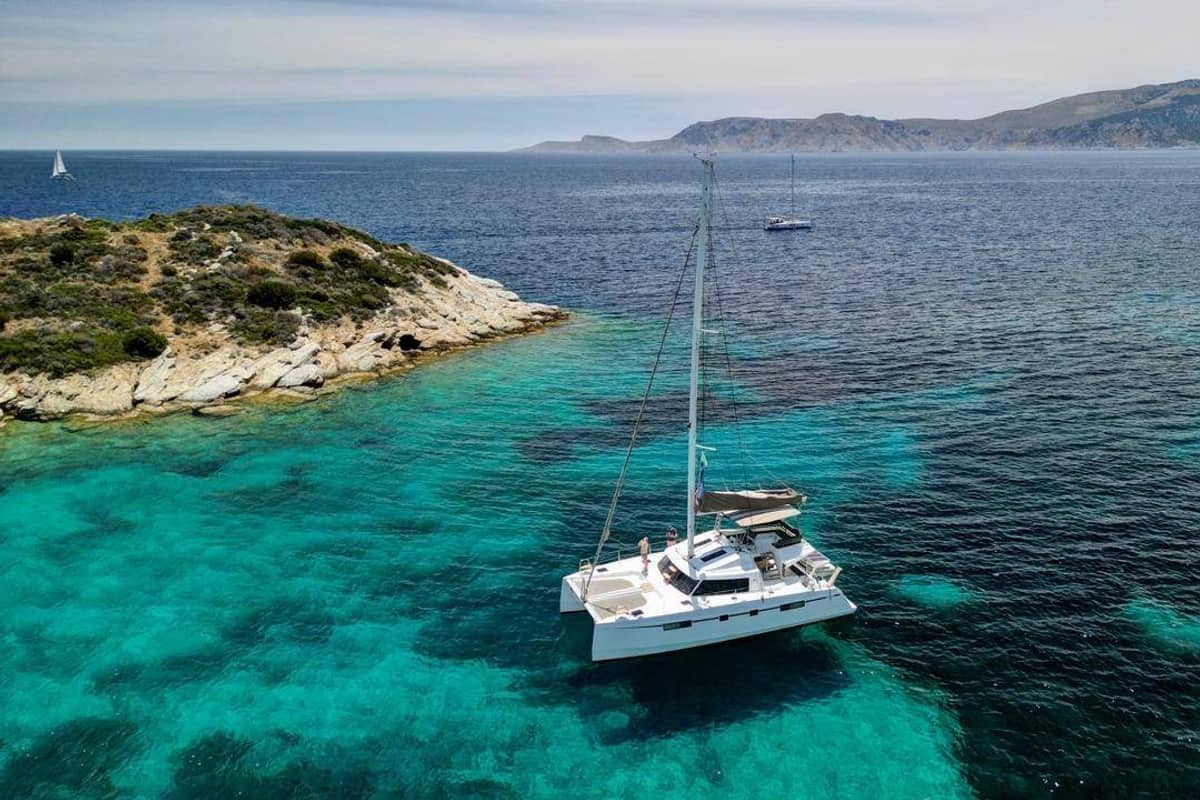
An Athens catamaran cruise sails from the marinas of the Athens Riviera along the coast and across the Saronic Gulf to its islands. It is one of the Greek tours on Greece VIP.
This post covers what an Athens catamaran cruise includes, the marinas it leaves from and the routes it sails. It also covers the Saronic islands, the history of the shore and how clean the water is. Wind and sea, the best season and common questions come last.
Each section ends with an Athens catamaran cruise or a nearby cruise that can be booked online.
What does an Athens catamaran cruise include?
An Athens catamaran cruise runs as a half-day Riviera sail or a full-day Saronic trip. Sunset sails and private charters add two more formats. Listings include a Greek meal, drinks and two swim stops. Hotel pickup comes only with certain listings.
A half-day sail from Alimos, one of the cruises along the Athens Riviera, caps guests at 12. English-speaking crew sail it, and lunch brings a starter, salad, main course and fruit.
One Athens catamaran cruise from Marina Delta Kallithea serves Greek meze, cooked on board, at the Hydroussa stop. Fruit and wine follow on the return, under sail when the weather permits.
An Athens catamaran cruise at sunset heads from Alimos toward Cape Sounion with up to 20 guests. Dinner brings BBQ shrimp, chicken fillets, pasta, vine leaf rolls and dessert, with white wine.
A private full-day Athens catamaran cruise through the Saronic Gulf takes a maximum of six people. Hotel transfers to the port are included, and the boat stops at Aegina or Agistri.
A private Aegina sail accepts guests from one year old. A Riviera listing sets no minimum age and seats infants on an adult’s lap. A Glyfada departure takes guests from age six.
- Pickup: A semi-private sail collects guests in central Athens and Piraeus.
- Open bar: That sail pours beer, cold drinks and Greek wine.
- Swimming: A Glyfada listing advises swimming ability, with no water supervision.
The Alimos half-day sail includes fuel, port fees and taxes in the booking.


Which marinas does an Athens catamaran cruise leave from?
An Athens catamaran cruise in public listings leaves from Alimos marina, 8 km south of Piraeus port. Flisvos, Zea at Piraeus, Vouliagmeni and Lavrio also berth yachts on the Attica coast. Lavrio lies farthest out, on the south-east coast of Attica.
An Athens catamaran cruise from Alimos sails out between breakwaters 1,170 m long. The marina keeps 50 berths for yachts over 25 m and reaches 6.5 m deep.
One Athens catamaran cruise boards at Pier 6 in Alimos marina, and another at Pier 8. The marina lies 30 km from Athens International Airport, and trams and buses serve it.
Flisvos marina, in Palaio Faliro, has a land zone of 90,200 square metres. Its depth runs from 4.5 m to 16 m. Tram stops Parko Flisvou and Trokadero serve it.
Zea marina, on the eastern shore of the Piraiki peninsula, was renovated for the 2004 Olympics. Its 670 berths take yachts up to 150 m, in water up to 12 m deep.
Vouliagmeni marina sits 22 km from Athens International Airport. Its 59 berths take yachts up to 60 m; one extra berth fits yachts beyond 130 m.
- Quays: Lavrio’s commercial quays run 7 to 11 m deep.
- Ferries: Lavrio’s terminal serves Kea, Kythnos, Syros, Tinos and Andros.
- Airport: Lavrio port lies about 35 km from the airport.
Lavrio’s marina offers berths in water 5.5 m deep.
Which routes does an Athens catamaran cruise sail?
An Athens catamaran cruise sails south along the Riviera, southwest to Aegina and Agistri or round to Sounion. From Alimos, Agia Marina on Aegina lies 13.5 nautical miles away. Sounion bay sits 24 nautical miles from the same marina.
A half-day Athens catamaran cruise anchors first in Vouliagmeni Bay, then off Voula. Its last stop is Hydroussa islet, before the boat sails north to Alimos.
Hydroussa lies opposite Voula and covers 5.7 hectares, with a sandy beach and a small snorkelling reef. A semi-private route from Alimos passes Glyfada, Voula, Kavouri and Vouliagmeni.
Past Vouliagmeni, Arsida rock sits opposite Anavyssos, with three small beaches and a cave. Lavrio day charters list Cape Sounion just 5 nautical miles from port.
By ferry route, Aegina lies 15 nautical miles from Piraeus, home of Zea marina.
From Alimos, an Athens catamaran cruise to Perdika or to Megalochori on Agistri covers 21 nautical miles. A private Aegina sail adds a swim stop in the cove of Vagia.
- Hydroussa: The uninhabited islet is reachable only by sea.
- Agia Marina: The port sits 13 nautical miles from Piraeus by ferry.
- Perdika: The village lies 9 to 10 km from Aegina Town.
Sailing routes toward Sounion pass Lagonisi, after the rocky coves between Vouliagmeni and Varkiza.
Which Saronic islands does an Athens catamaran cruise reach?
An Athens catamaran cruise reaches four Saronic islands: Salamina, Aegina, Agistri and Moni. Salamina covers 93 square kilometres, and its municipality counted 37,220 residents at the 2021 census. Agistri lies about 3.5 km southwest of Aegina’s port. Moni sits 6 km from that port.
Paloukia, on northeast Salamina, is the second-busiest passenger port in Greece after Piraeus. Selinia also has a direct link to Piraeus, and Faneromeni links to Nea Peramos.
For an Athens catamaran cruise, Salamina’s landmarks include the 15th-century Faneromeni Monastery. The Cape Lykopoulo lighthouse first operated in 1901, and Kanakia holds a 13th-century BC Mycenaean city.
Ancient Aegina had a war port with trireme slips, which Pausanias called the secret harbour. The old commercial port lies beneath the modern harbour used by boat trips to Aegina.
Agistri, a stop on an Athens catamaran cruise, has a natural harbour at Skala. A second port opened at Megalochori on 1 September 2006 to ease crowding at Skala.
Agistri rises to 294 metres at Kontari, and ancient writers such as Thucydides called it Kekryfaleia. From Moni’s summit, the view reaches the Methana peninsula and Agistri.
- Euripides cave: Digs found a cup inscribed with Euripides’ name.
- Seafront: Conical mounds between two breakwaters shielded ancient Aegina’s seafront.
- Port area: Aegina’s ancient port works covered three times the town’s area.
Megalochori holds the tomb of Mitromaras, a rebel leader who died on Agistri in 1772.
What history lines the shore of an Athens catamaran cruise?
An Athens catamaran cruise passes ancient Phaleron, Halai Aixonides, the temple of Apollo Zoster, Salamis and Thorikos. Phaleron lay 5 km southwest of the Acropolis. Thorikos has a theatre with 21 seat rows.
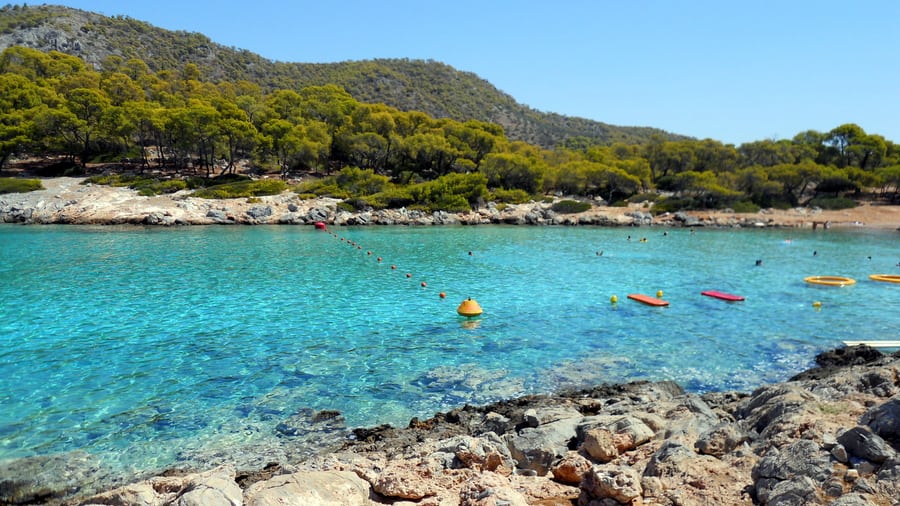
Pausanias wrote that Menestheus sailed from Phaleron to Troy, and Theseus to Crete. Traces of Athens’ first port, with pottery and cart tracks, lie 350 m from today’s shore.
Three bases inside the temple of Apollo Zoster held statues of Leto, Apollo and Artemis. In the 4th century BC, builders added a colonnade of four by six columns.
Halai Aixonides covered southern Voula and all of Vouliagmeni, the coastal third of the Kekropis tribe. Rescue digs found roads, towers and a building thought to be the agora.
An Athens catamaran cruise to Salamina nears the straits where Herodotus counted 378 Greek triremes. Xerxes watched the battle from a throne on the slopes of Mount Aigaleo.
An Athens catamaran cruise near Lavrio passes Thorikos, whose theatre has an unusual elliptical shape. Its orchestra grew in the mid-5th century BC, and an upper tier came a century later.
- Phaleron graves: One mass grave held 79 shackled young men.
- Kavouri road: A 300 m ancient road reached a harbour.
- Thorikos digs: Herman Mussche led 23 Belgian seasons from 1963.
Archaeologists announced in 2017 that the Greek fleet’s partly sunken anchorage lies at Ambelaki.
How clean is the water on an Athens catamaran cruise?
An Athens catamaran cruise stops in waters that Greece tests at 1,734 sampling points. Psyttaleia now treats the sewage of Greater Athens before it reaches the gulf. Saronic Gulf seabed life improved over 12 years of monitoring, from 2000 to 2012.
Water on an Athens catamaran cruise is graded on four years of test results. The environment ministry runs the tests with regional water directorates.
Attica’s water directorate has tested the beaches of an Athens catamaran cruise since 2016. Its online map shows monthly results, and the beach list is reviewed every two years.
Along an Athens catamaran cruise, Vari-Voula-Vouliagmeni has three Blue Flag beaches, among them Voula A. Glyfada also has three, and Zea marina in Piraeus flies the flag too.
The Central Sewer, begun in 1959, poured untreated Athens sewage into the sea at Akrokeramos. Today two outfall pipes from Psyttaleia, each 1,870 m long, carry the treated water out.
Marine scientists measured nutrients on 170 research cruises in the Saronic Gulf from 1987 to 2010. Nutrient levels in the inner gulf fell once secondary sewage treatment was running.
- Sludge plant: Psyttaleia’s drying unit opened in 2007, rated 750 tonnes daily.
- Seabed status: Stations beyond 8,000 m from the outfalls reached good status.
- No-swim zones: The health ministry bans swimming at 13 Attica coastal areas.
Psyttaleia, the main treatment works for Greater Athens, serves about 3.5 million people.
How do wind and sea shape an Athens catamaran cruise?
An Athens catamaran cruise crosses the Saronic Gulf, where a research buoy measures wind and waves. Its average July wind blows at 8 knots from 353 degrees, close to north. Its waves average 0.35 metres in June, the calmest month of the year.
The Hellenic Centre for Marine Research runs this Saronikos buoy, the first station of its POSEIDON network. It floats in 209 metres of water, in front of the Athens metropolitan area.
In August the buoy’s average wind rises to 9.33 knots, blowing from 358 degrees. December brings the strongest monthly average, 10.4 knots, while April is the calmest month at 7.59 knots.
An Athens catamaran cruise in July faces buoy waves averaging 0.41 metres, rising to 0.49 metres in August. Both months bring waves rolling in from about 30 degrees, out of the north-northeast.
February has the highest average wave at the buoy, 0.65 metres. December holds the tallest monthly maximum, 1.9 metres. January waves arrive from the east, at 84 degrees on average.
On land, the Athinai station sits 1.3 kilometres from Alimos. Its August wind averages 6.75 knots, the year’s highest, with average gusts of 16 knots. November is calmest, at 4.44 knots.
- June maximum: June waves at the buoy peak at 0.9 metres.
- Spring shift: Average Athinai winds blow from 300 degrees in April.
- Summer direction: Athinai July and August winds blow from due north.
The buoy statistics draw on observations taken between 2011 and 2019 in the gulf.
When is the best season for an Athens catamaran cruise?
An Athens catamaran cruise runs from April through October. Elliniko, on the coast, records its hottest average highs, 33.5°C, in August. Athens airport traffic peaked at 3,299,333 passengers in July 2023. Attica hotel and rental nights peaked in August 2023, at 1,604,876.
Elliniko sits 28 metres above sea level. Its 1991–2020 normals give April highs of 20.3°C and 27.6 mm of rain. June highs reach 30.4°C, with only 10.0 mm of rain.
An Athens catamaran cruise in August sails in Elliniko’s driest month, with 3.3 mm of rain. September highs ease to 29.0°C, and October highs fall to 23.9°C with 34.2 mm of rain.
Athens airport handled 1,357,990 passengers in February 2023, its quietest month that year. August followed the July peak closely, at 3,295,923 passengers. International travelers made up 2,274,756 of them.
Flights at the airport, where Athens airport transfers start, rose from 12,472 in February to 28,120 in July. That July total topped every month through October 2023, including August at 27,799 flights.
ELSTAT counted 562,815 hotel and short-stay nights in Attica in January 2023, the year’s low. Bed occupancy in July reached 70.2%, the highest that year, against 34.7% in January.
- Wettest month: Elliniko gets 66.6 mm of rain in November.
- Late season: Attica still logged 1,056,041 nights in October 2023.
- July heat: Elliniko highs average 33.2°C in July.
Hotel night totals here cover hotels, similar establishments and short-stay rentals, not campsites.
What do travelers ask about an Athens catamaran cruise?
For an Athens catamaran cruise from Flisvos, Syngrou-Fix is the closest metro station. Two bus stops, Oulen and Apovivasi, sit outside that marina, and bus 550 ends at Apovivasi. Lines B1 and B2 stop at 1st Kalamaki, right outside Alimos marina.
Which tram stops serve the marinas for an Athens catamaran cruise?
The Trocadero stop sits directly outside the main entrance of Flisvos marina. From Trocadero, trams continue to Glyfada and Voula. At Alimos marina, the Pikrodafni stop stands by the main entrance. Toward Voula, the next two stops are Marina Alimou and Kalamaki.
Which buses reach Vouliagmeni and Lavrio for an Athens catamaran cruise?
Line 115 runs from Glyfada through Vouliagmeni to Kitsi. Line 117 also leaves Glyfada and passes Vouliagmeni on its way to Vari. Line 122 links Argyroupoli station with Saronida, stopping at Kavouri crossing and Limanakia. For Lavrio, line 320 runs from Koropi station through Keratea.
Which port office covers the marinas on an Athens catamaran cruise?
The Saronic Port Authority, based at the fourth marina of Glyfada, covers this coast. Its area runs from the Kifisos River mouth to the 44th kilometre of the Athens–Sounio road. It opened in January 2015, and its Second Port Office sits in Vouliagmeni.
Where is the public hospital for an Athens catamaran cruise on the Riviera?
General Hospital Asklepieio Voulas stands at 1 Vasileos Pavlou Avenue, in the seaside area of Voula. It opened in 1921 under the Hellenic Red Cross as a sanatorium for bone and joint tuberculosis. Its grounds form a pine-covered estate of 104 stremmata (10.4 hectares).