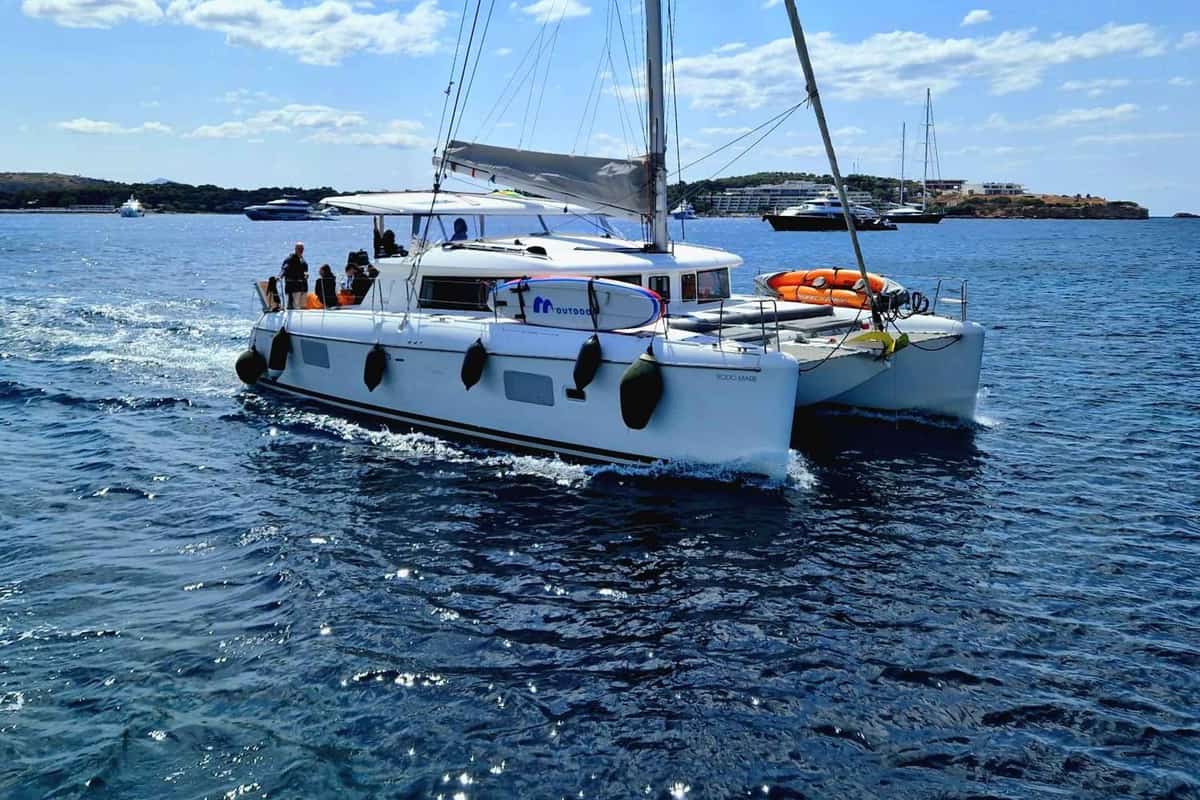
An Athens Riviera cruise takes travelers by boat along the coast south of Athens, where the city meets the Saronic Gulf. Catamarans and yachts stop in quiet bays to swim. It is one of the boat trips from Athens on Greece VIP.
This post covers what an Athens Riviera cruise includes, where it leaves from and the coast it follows. It also covers Cape Sounion from the sea, the islets and the water. Sunset sailing, the best season and common questions come last.
Each section ends with an Athens Riviera cruise or boat trip that can be booked online.
What does an Athens Riviera cruise include?
An Athens Riviera cruise is a boat trip along the coast south of Athens. It runs on a catamaran or a yacht. A skipper and crew handle the boat. The day includes swim stops in bays along the shore and a meal served on board.
A catamaran is a boat with two parallel hulls of equal size. The wide gap between the hulls resists rolling and tipping over. On an Athens Riviera cruise, this gives a steady deck for sitting, eating and sunbathing.
A yacht is a boat made for pleasure, cruising or racing. It moves by sail or by motor. The name comes from the Dutch word jacht, which means hunt. On an Athens Riviera cruise, a sailing yacht uses the wind.
The skipper is the person in command of the boat. The role matches that of a captain on a large ship. On an Athens Riviera cruise, the skipper picks the bays for swim stops.
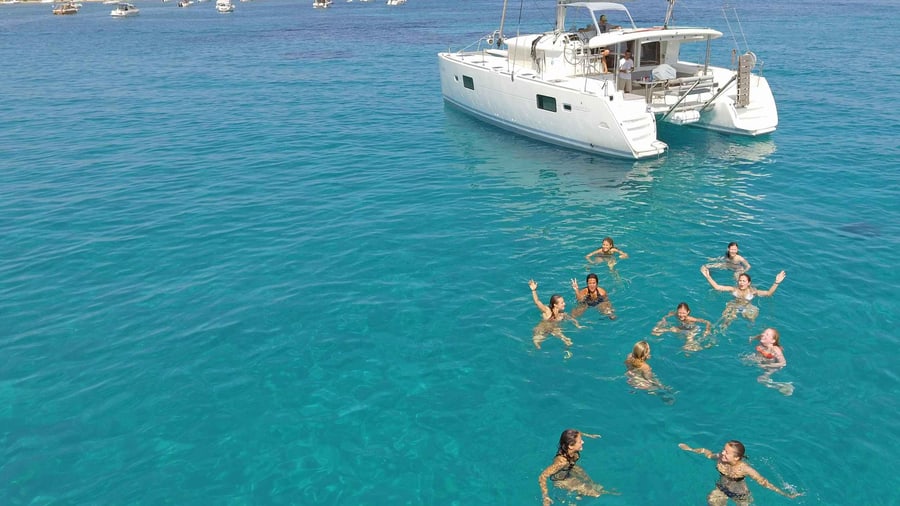
Swim stops form the heart of an Athens Riviera cruise. The boat anchors in a bay, and passengers swim straight from the deck. Snorkelling gear adds a view below the surface. Snorkelling means swimming face-down while breathing through a shaped tube called a snorkel.
The meal on board comes from the galley. A galley is the part of a ship where food is cooked and prepared. On a catamaran or a yacht, the crew serves the meal on deck between swims.
- Stability: A catamaran needs no ballast, or heavy weight low in the hull, to stay upright.
- Power: Motor yachts run mainly on diesel engines.
- Shallow water: Catamarans sit shallower in the water than single-hull boats of the same length.
- Snorkel kit: A diving mask or goggles gives clear sight, and swimfins push the swimmer along.
An Athens Riviera cruise sees the coast from the water. The Athens Riviera tour by road covers the same shore by car. On the boat, swim stops in open bays take the place of beach visits.


Where does an Athens Riviera cruise leave from?
An Athens Riviera cruise leaves from a marina on the southern coast of Athens. Two of the main ones are Flisvos in Palaio Faliro and Alimos. Agios Kosmas, Glyfada and Vouliagmeni have marinas too. Lavrio, further south, has one next to its port.
Flisvos Marina sits on the seafront of Palaio Faliro. It has 310 berths. More than half of them take luxury yachts over 35 metres long. An Athens Riviera cruise from Flisvos starts among these large yachts.
Alimos Marina is the largest marina in Greece and the Balkans, with 1,100 berths. The town calls the marina a main departure point for the Saronic Gulf and the Cyclades.
Agios Kosmas, near the old airport, hosted the Olympic sailing events in 2004. In all, 400 sailors from 61 nations raced there. After the Games, the venue became a marina for more than 1,000 yachts. An Athens Riviera cruise can start from this former Olympic base.
Glyfada Marina is one of the oldest marinas in Attica, with room for 800 boats. Further south, a marina at Vouliagmeni offers 103 mooring posts. A start from either one puts an Athens Riviera cruise closer to the southern bays.
Lavrio sits on a bay south-east of Athens. Its marina lies near the town port and has 680 berths. It takes boats up to 32 metres long. An Athens Riviera cruise from Lavrio starts at the far end of the coast.
- Blue Flag: Flisvos, Alimos and the Lavrio marina all hold the Blue Flag award.
- Winter berths: The Lavrio marina keeps 700 more berths for boats laid up over winter.
- Repairs: Lavrio also has a yard for building and repairing boats.
The starting marina sets the order of an Athens Riviera cruise. A start in the north passes the city suburbs first. A start at Lavrio begins at the opposite end of the coast.
What coast does an Athens Riviera cruise follow?
An Athens Riviera cruise follows the Saronic Gulf shore from Faliro south towards Sounio. From the deck, the coast shows bays, coves, cliffs, caves and beaches of sand or pebbles. Mount Hymettus rises behind Vouliagmeni, and low mountains stand near Palaia Fokaia.
The Greek National Tourism Organisation places the Athens Riviera between Faliro and Sounio. The Region of Attica puts its length at 60 kilometres. It compares the shore to the lacy edge of a doily. An Athens Riviera cruise traces that broken edge from the sea.
South of Faliro, an Athens Riviera cruise passes the cape of Agios Kosmas. Ancient writers called it Cape Colias. Herodotus wrote that Persian wrecks from the Battle of Salamis washed up on its shore.
Further on, Vouliagmeni Bay opens with Mount Hymettus behind its beaches. The highest peak of the range, Evzonas, reaches 1,026 metres. People call the mountain Trellovouno, the crazy mountain, for its long winding line. An Athens Riviera cruise sees the range run from Athens down to the Saronic Gulf.
Beyond Vouliagmeni, the resort of Varkiza looks out on a seascape of coves. Varkiza lies 2 km south of Vari, with the Hymettus range to its north-west.
Further south, Palaia Fokaia sits on the Saronic Gulf coast, 36 km south-east of central Athens. Low mountains rise to the south and east of the town. On this stretch, an Athens Riviera cruise passes a shore with hills close behind the water.
- Colias shrine: The ancient cape held a sanctuary of Aphrodite Colias and the Genetyllides, spirits of childbirth.
- Bronze Age: Digs at Agios Kosmas uncovered remains from the Early Bronze Age.
- Voula: Two beaches line the shore here, about two miles south of Glyfada.
- Hymettus: The range measures 6 to 7 km from east to west.
Seen from the deck, an Athens Riviera cruise turns the coast into one long view. City beaches give way to bays and coves. Cape Sounion closes the line in the south.
What does an Athens Riviera cruise see at Cape Sounion from the sea?
An Athens Riviera cruise sees the Temple of Poseidon from the water. The temple stands high on the headland above the open sea. Greek sailors honoured Poseidon as the protector of seafarers. His temple faced the ships that passed below.
Sailors prayed to Poseidon for a safe voyage. At times they drowned horses in the sea for him. Black and white bulls were also killed or thrown into the waves. An Athens Riviera cruise passes the god’s temple on the same water.
Poseidon also carried the title soter, a Greek word for saviour. On the cape, his temple stood inside its own walled court. A gateway and two covered walkways completed the sacred ground. From an Athens Riviera cruise, the columns show above the cliff edge.
Finds at the temple tell a story about its visitors. The material and size of the gifts point to elite and noble families. An Athens Riviera cruise now carries visitors past the same headland by water.
The cape also marked a turning point in war. After the Battle of Marathon in 490 BC, the Persian fleet rounded Cape Sounion. Its aim was to attack Athens directly. The Athenian army marched home fast, and the Persians turned back to Asia.
Sounion also saw a raid from the sea. During a quarrel with Athens, men from Aegina seized Athenians at a festival there. From an Athens Riviera cruise near the cape, Kea lies 20 km across the water.
- Sea gift: Alexander the Great had a four-horse chariot cast into the waves for Poseidon.
- Ceilings: Historian William Dinsmoor called the temple’s marble side ceilings rare in Greek design.
- Older temple: Excavator Valerios Stais linked the earlier temple’s fall to high winds or an earthquake.
Seen from an Athens Riviera cruise, the cape joins faith, war and travel in one view. Sailors once prayed to the god whose temple stood above them. The same columns still mark the turn of the coast for passing boats.
Which islets can an Athens Riviera cruise reach?
An Athens Riviera cruise can reach small islets along the Attica shore. Fleves lies off Vouliagmeni, and Patroklos lies off Sounion. Neither islet has residents. Each one carries a long record of war and defence on the open sea.
During the Second World War, Fleves fell under the German South Greece Military Command. An Athens Riviera cruise passes an islet that once formed part of that wartime zone.
The command held only isolated points of Athens and Attica. Its list named Kalamaki Airfield and parts of the port of Piraeus. Fleves stood among the offshore islands in that zone.
An Athens Riviera cruise sees Patroklos off the Sounion coast. In ancient times it was called Patroklou Charax, the Camp of Patroclus. Another name was Patroklou Nesos, the Island of Patroclus.
Patroclus was a commander in the service of Ptolemy II. His true title was strategos, which means general. When he fortified the island, nobody lived there. The base points to a plan to check the Sounion fortress, thought to be in rival hands.
Finds on Patroklos show a wider role than old texts describe. Coins, pottery shards and remains of walls point to a Ptolemaic presence. Similar finds come from other fortified sites in Attica.
An Athens Riviera cruise crosses the Saronic Gulf, also called the Gulf of Aegina. Besides Aegina, Salamis and Poros, the gulf holds smaller islands such as Patroklos and Fleves. The gulf takes its name from Saron, a king in Greek myth who drowned in a lake.
- Farther out: Agios Georgios, the largest uninhabited Saronic island, sits at the mouth of the gulf.
- Old name: In ancient times Agios Georgios was called Belbina, a name found in Herodotus.
An Athens Riviera cruise past these islets meets a long record of war. Fleves and Patroklos both served armies in different eras.
What water and sea life does an Athens Riviera cruise meet?
An Athens Riviera cruise meets the waters of the Saronic Gulf. Over 95% of Greek bathing waters reach excellent quality in the latest EU report. Rocky shores and sandy bays line the coast, and the water stays clear for swimming.
The European Environment Agency checks bathing water across Europe. Its latest report covers 22,289 sites. Each site is rated excellent, good, sufficient or poor. The tests look for bacteria from sewage or livestock waste.
The report puts Cyprus, Bulgaria and Austria in the same top band as Greece. Across Europe, 85% of waters reached the excellent class. Coastal sites did better than inland ones, at 87.4%.
Below the surface, Posidonia oceanica, or Neptune grass, forms large underwater meadows. Balls of its fibre, called Neptune balls, wash up on nearby shores. Swimmers on an Athens Riviera cruise sometimes see them on the sand.
Neptune grass grows only in the Mediterranean Sea. Its meadows give food and shelter to sea animals and plants. Young animals use them as a nursery. The grass also takes in carbon dioxide and gives off oxygen.
- Carbon store: Neptune grass soaks up 15 times more carbon dioxide than the same area of Amazon forest.
- Sea fruit: Its floating fruit is known in Italy as the olive of the sea.
- New fish: A 2019 study recorded the nakedband gaper, an Indo-Pacific fish, in the Saronic Gulf.
An Athens Riviera cruise crosses a sea that is tested, ranked and protected. Greece’s first marine research station opened in Palaio Faliro in 1914. Science and swimming have shared this coast for over a century.
How does an Athens Riviera cruise work at sunset?
An Athens Riviera cruise at sunset leaves in the late afternoon and follows the coast. The light turns gold over the water. The sun then sinks behind the islands of the Saronic Gulf to the west. The boat returns to the marina after dark.
The golden hour comes just before the sun goes down. Daylight turns redder and softer than at midday, and shadows grow long. On the boat, this warm light falls on the water and the deck.
Low sunlight crosses far more air on its way to the eye. Blue and green light scatter away on that long path. Orange and red light remain, and they colour the sky above an Athens Riviera cruise.
The spot where the sun sets moves through the year. In spring and summer it goes down to the northwest. In autumn and winter it sets to the southwest, toward Aegina. An Athens Riviera cruise faces a new patch of horizon each season.
Two-thirds of that island is an extinct volcano. Its highest point is Mount Oros, a cone 531 m high. After sunset, the islands turn into dark shapes against the glowing sky.
Civil twilight lasts until the sun is 6 degrees below the horizon. Nautical twilight runs on to 12 degrees. Sailors can still see the horizon then. On the water, this blue light marks the start of the trip back.
- Green flash: A green flash can appear over an open sea horizon at sunset.
- Night rules: International rules require boats to show navigation lights from sunset to sunrise.
- Side lights: Red marks the left side of a boat, and green marks the right side.
The return leg of an Athens Riviera cruise runs in darkness. Land cools faster than water, so the sea breeze fades after sunset. A land breeze can then blow from the shore toward the sea.
When is the best season for an Athens Riviera cruise?
An Athens Riviera cruise suits the months from June to October. In those months, the sea off Athens stays warm enough for a swim. High summer brings long sunshine and dry air. Early autumn keeps the sea warm after the strongest heat has passed.
Sea temperature sets the swim season of an Athens Riviera cruise. The water off Athens drops to its low of 15 °C in February and March. It warms through June and then holds at 24 °C from July to September.
Summer gives an Athens Riviera cruise its clearest skies. The coastal station of the Hellenic National Meteorological Service logs 362.7 hours of sunshine in July. Relative humidity is the share of water vapour in the air. At the station it falls to 46.6 percent in that month.
The summer wind of the Aegean is the meltemi. Its Greek name is thought to come from Italian mal tempo, or bad weather. The wind can rise in clear weather with no warning. Leisure sailors still value its steady push.
Spring and autumn differ more at sea than on land. On the coast, the average air temperature is 16.1 °C in April. It reaches 19.6 °C in October. The sea lags behind, at 16 °C in April and 21 °C in October.
The sirocco is a wind that starts in the Sahara. It blows chiefly in spring and autumn, with peaks in March and November. Over the sea it picks up moisture. It then brings storms at sea and warm, wet weather to southern Europe.
- Midsummer rain: The coastal station counts 1.7 rain days in July and 1.6 in August.
- Winter rain: December is the wettest month on the coast, with 62.0 mm of rain.
- Winter sun: Sunshine drops to 127.1 hours in December, the lowest monthly total.
- Winter air: The average air temperature on the coast falls to 10.3 °C in January.
The right month for an Athens Riviera cruise follows the aim of the trip. Swimmers pick the warm sea of high summer. Travelers who want gentler heat pick late spring or early autumn. The sea is mild then, and the evenings stay long.
What do travelers ask about an Athens Riviera cruise?
An Athens Riviera cruise raises five common questions. They cover the trip from the city centre, children, and private or shared boats. They also cover swimming and pairing the sailing with a sightseeing day. The answers rest on transport data, sea safety advice and water quality ratings.
How do travelers reach an Athens Riviera cruise from the city centre?
Public transport links the city centre with the coast before the cruise. Metro Line 2 runs fully underground from Syntagma south to Elliniko. The tram network has 60 stops and covers the larger part of the city coastline.
Can children join an Athens Riviera cruise?
Children join an Athens Riviera cruise when the booking page allows their age. Seasickness is a form of motion sickness. Keeping the head still and looking at the horizon both help. Sitting below deck, out of sight of the sea, makes it worse.
Is a private Athens Riviera cruise different from a shared one?
A shared Athens Riviera cruise sells places on one boat to separate travelers. A private cruise books the whole boat for one party. A skippered charter adds a professional skipper. A crewed charter adds a captain and a crew that can include a chef.
Can travelers swim during an Athens Riviera cruise?
Swimming fits into an Athens Riviera cruise when the plan includes a stop at anchor. Greek bathing water ranks among the cleanest in Europe.
How does an Athens Riviera cruise pair with a sightseeing day in Athens?
An Athens Riviera cruise shows the coast from the water. A day on land shows the ancient sites. A Cape Sounion tour by road reaches the Temple of Poseidon on the headland. Booking the two on different days leaves room for both.
Featured photo: Athens Riviera catamaran tour with fresh meal, beer and wine, via GetYourGuide.