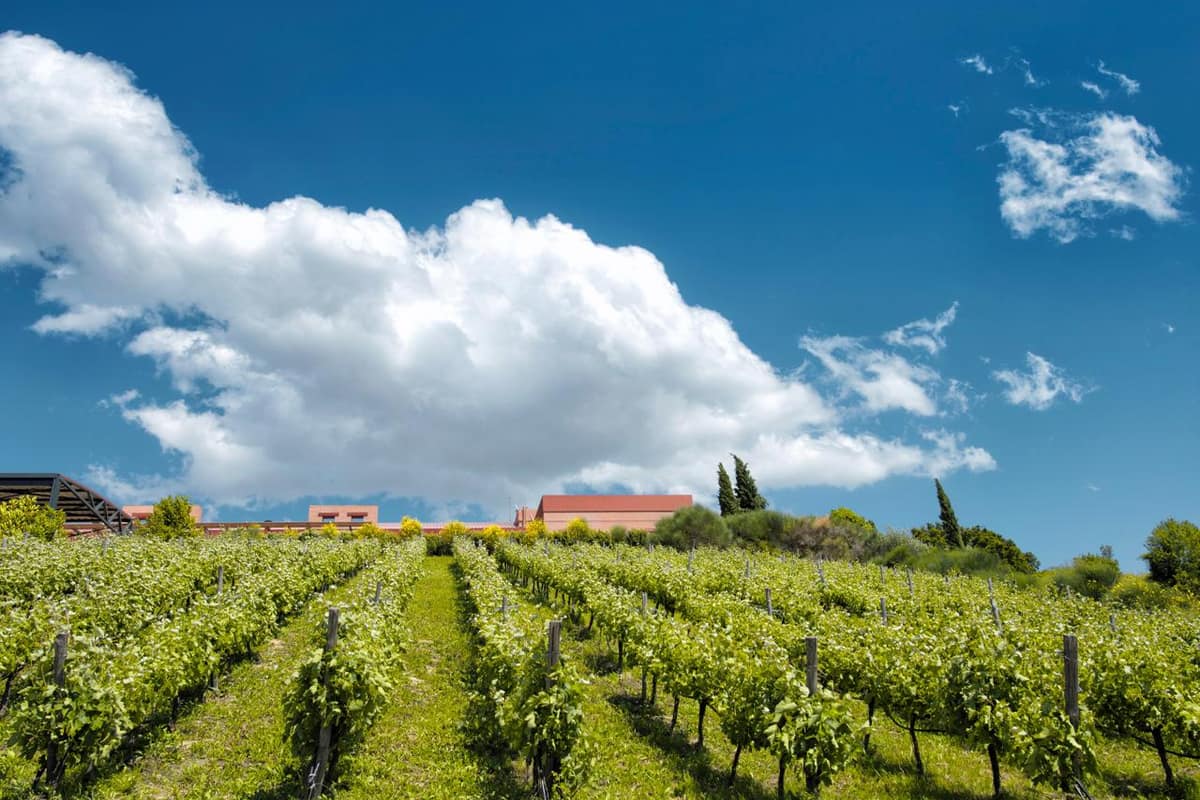
A Nemea wine tour visits wineries in the Nemea valley of the north-east Peloponnese. Guests taste red wines and learn how the local grape grows. It is one of the vineyard tours in Greece on Greece VIP.
This post covers what a Nemea wine tour includes, the Agiorgitiko grape and where the wine zone lies. It also covers the PDO Nemea label, the history of the area and the ancient sites. The Hercules myth, altitude and food pairings follow. The landscape, the best season and common questions come last.
Each section ends with a Nemea wine tour or a nearby day trip that can be booked online.
What does a Nemea wine tour include?
A Nemea wine tour includes visits to wineries in the largest wine-growing zone in Greece. Visitors taste local wines paired with local products. The route crosses vineyards, olive groves and fields of Corinthian currants. A stop at the wine museum in Nemea town also fits the day.
The PDO Nemea zone covers about 2,500 to 3,000 hectares of vines. PDO means Protected Designation of Origin, a legal label for wine from one place. It is the largest PDO zone for red wines in Greece. Nemea is also called the biggest vineyard in the Balkans.
More than 40 wineries operate in Nemea. They range from large modern facilities to small family estates. A Nemea wine tour moves between both kinds of cellars. Wine-making is the main activity of the Municipality of Nemea, which counts hundreds of producers.
Naoussa in the north and Nemea in the Peloponnese hold the two leading red wine designations in Greece. They lead in quality, quantity and number of producers. The Nemea appellation lies about 30 km from Corinth. It is called the top red wine appellation of southern Greece.
Agiorgitiko is the star grape, yet other native grapes grow here too. They include Moschofilero, Roditis, Savatiano, Assyrtiko, Sklava and Fileri. French grapes such as Chardonnay, Cabernet Sauvignon, Merlot and Sauvignon Blanc also grow at Nemea.
A Nemea visit can be combined with the Wine Roads of Corinthia. Travellers can also pair a Nemea wine tour with day trips to Nafplio.
- Harvest: September is grape-harvest time and a suggested month for winery visits.
- Festival: The Great Days of Nemea, or Agiorgitiko Festival, bring open doors, tastings and regional events.
- Dates: The festival takes place every year around the end of August or the start of September.
A Nemea wine tour works well in late summer and early autumn. The vines are full and the cellars are busy. Each winery shows a different side of the same red wine country.


What is the Agiorgitiko grape on a Nemea wine tour?
A Nemea wine tour centres on Agiorgitiko, the red grape of the zone. The grape is fruity and spicy, with notes of plum. Its thick skins give the wine a deep, dark colour after little maceration, or skin contact. It ripens late, after mid-September.
Agiorgitiko is also spelled Aghiorghitiko. In Nemea it has gone by Mavro Nemeas and Mavroudi Nemeas. One theory links the name to the chapel of Saint George in Nemea. Another links it to St George’s Day, kept in November in certain Orthodox churches.
A legend says the wine was a palace favourite of King Agamemnon. He led the Greeks in the Trojan War. As of 2012, Agiorgitiko was planted more widely than any other red grape in Greece, ahead of Xynomavro.
In 2012 the grape covered 5,202 hectares in Attica and 3,204 hectares in the Peloponnese. Producers now also plant it in Macedonia, Attica and the rest of the Peloponnese. Still, a Nemea wine tour shows the grape on its home ground.
The vine gives small clusters of small, thick-skinned berries. It buds late. Growers plant it in dry, poor soil, so the vine gives fewer but more concentrated grapes. It does better in higher, cooler vineyards, and altitude changes how spicy the wine tastes.
The vine is very prone to disease. Wine writer Jancis Robinson notes that virtually all Agiorgitiko vines in Greece carry viruses. New virus-free clones, meaning copies of healthy plants, reached Greek growers in 2012.
- Young wine: A young Agiorgitiko has a purple-red colour, fresh red-fruit aromas, medium acidity and soft tannins.
- Light styles: Light rosés and soft reds come from carbonic maceration, a whole-grape method used for Beaujolais.
- Aged reds: Reds matured in oak for a short time can age in the bottle for five years.
Long-aged Agiorgitiko shows aromas of red fruits, sweet spices and chocolate. Young and old bottles side by side show the grape clearly on a Nemea wine tour.
Where is the Nemea wine zone?
A Nemea wine tour takes place mainly in south-central Korinthia, with a small share in northwestern Argolida. This is the only Greek PDO appellation spread over two prefectures, or regions. Its vineyards climb from around 200 m to 850 m above sea level.
Unofficially, the zone splits into three sub-zones. The low band runs from 230 to 450 m. A semi-mountainous band sits at 450 to 650 m. A mountain zone reaches 850 m.
Low-lying soils come mainly from deposits left by the Asopos River. A mix of clay, loam, gravel and sand holds moisture for the vines. On a Nemea wine tour, semi-mountainous vineyards appear on the western and southwestern foothills around the plain.
The mountain zone covers valleys and plateaus at the foot of Mount Kyllini. On these colder vineyards, grapes ripen in October. Mid-slope vineyards give the best Agiorgitiko. Near the top of the 900 m hills, grapes turn too acidic, while valley-floor grapes turn jammy.
The hills around Koutsi, between 500 and 600 m, give serious Agiorgitiko. Koutsi is a mountain village northeast of Nemea, on the road to Stimanga. Asprokampos lies at 750 m, 11 km northwest of Nemea and 8 km northeast of Lake Stymphalia.
Ancient Nemea sits in a smaller basin east of Nemea town. Each basin drains through its own valley to the Gulf of Corinth. The village of Archaia Nemea, about 27 km southwest of Corinth, was called Iraklion before 1958.
- Villages: Zone villages in Korinthia include Aidonia, Asprokambos, Galatas, Dafni, Kastraki, Kefalari, Bozika, Titani and Psari.
- Communities: The Municipality of Nemea has 10 communities, with Nemea town as the seat.
- Size: The municipality covers 204.7 km² and had 5,713 residents in 2021.
A Nemea wine tour across these heights shows how altitude shapes each glass. Low, middle and mountain vineyards give the same grape a different taste. The land itself explains the wine.
What does the PDO Nemea label mean on a Nemea wine tour?
A Nemea wine tour explains the PDO Nemea label, a legal mark of origin and method. It covers three product types. These are still wine, liqueur wine and wine from sun-dried grapes. Still PDO Nemea is red only, made dry or semi-sweet.
Royal Decree 539 of 4 August 1971 first drew the borders of the Nemea wine zone. Later presidential decrees changed the zone in 1974, 1988 and 1995.
The zone takes in 15 communities of Corinthia, such as Archaia Nemea, Archaies Kleones, Koutsi, Leontio and Petri. Gymno and Malandreni in Argolida also belong. A Nemea wine tour moves between these villages.
A semi-sweet PDO Nemea holds 17.5 to 45.0 grams of sugar per litre. Agiorgitiko is allowed only for red wine here. Rosé styles are banned.
A dry red called Réserve, or Epilegmenos in Greek, needs at least 2 years of ageing. That means 12 months or more in oak and 6 months in bottle. A Grande Réserve needs at least 4 years. It spends 18 months or more in oak and 18 in bottle.
Vines must be trained as goblets, meaning low bush shapes, or in lines along wires. They are pruned short. Dry red PDO Nemea ferments at controlled temperatures below 30 °C.
- Grape cap: Vineyards can give no more than 12000 kg of fresh grapes per hectare.
- Wine cap: Still wine stops at 96 hectolitres per hectare, and sun-dried wine at 75.6.
- Vin Doux: Grape spirit of at least 95% vol goes into the must before fermentation.
- Label words: Traditional terms include Ktima (estate), Orinos Ampelonas (mountain vineyard), Monastiri and Pyrgos.
Each rule on the PDO Nemea label links the wine to its place. Grape limits, ageing times and vine shapes follow written law. These rules make each glass on a Nemea wine tour easier to understand.
What history lies behind a Nemea wine tour?
A Nemea wine tour follows a story that starts in ancient Phliasia. This was the land of the city of Phlius. It was famous for its wine. Later the wine took new names, first Agiorgitiko and then Nemeatiko, as villages changed.
Phliasia is a small valley about 900 feet above sea level. Mountains ring it, and their streams join the river Asopus. The vineyards of 10 communities form the heart of the Nemea zone. In classical times, this was the Phliasian land.
The Phliasian vine gave Phliasian wine. The comic poet Antiphanes praised it in a passage kept by the writer Athenaeus. Phlius also struck coins with symbols of Dionysus, god of the vine and wine.
Apollonius of Rhodes called Phlias, founder of Phlius, rich from vines his father Dionysus gave. Stephanus of Byzantium wrote that Phlius took its name from Dionysus and Chthonophyle.
The sacred valley of Nemea had no residents. Crowds at the Nemean Games drank wine from nearby Phliasia. A Nemea wine tour brings this old link to life.
In the 13th century, raids drove people up Mount Polyfengos. There they built upper and lower Agios Georgios. Frankish, Ottoman and Venetian records list cereals and vines as main crops, with wine as the chief trade.
Phliasian wine became Agiorgitiko, after the village. Travellers of the 18th and 19th centuries called it black, strong and the best wine of the Morea. The church was the main landowner, and monks of Feneos made communion wine.
- 1834: The area split into two municipalities, Phlius and Nemea, with Nemea based at Agios Georgios.
- 1840: Phlius merged into the municipality of Nemea.
- Mid-19th century: The wine became Nemeatiko, while the grape kept the name Agiorgitiko.
- 1923: The village of Agios Georgios took the name Nemea.
Experts think Agiorgitiko is native to Argolis and Corinthia. Still, no historical or genetic proof shows it grew in ancient Greece. A Nemea wine tour keeps legend and evidence apart.
What ancient sites does a Nemea wine tour pass?
A Nemea wine tour passes the ancient sanctuary of Zeus and its stadium. Visitors see the temple, the old running track and a hero shrine. There are also baths and a site museum. Each place shows how the Nemean Games worked.
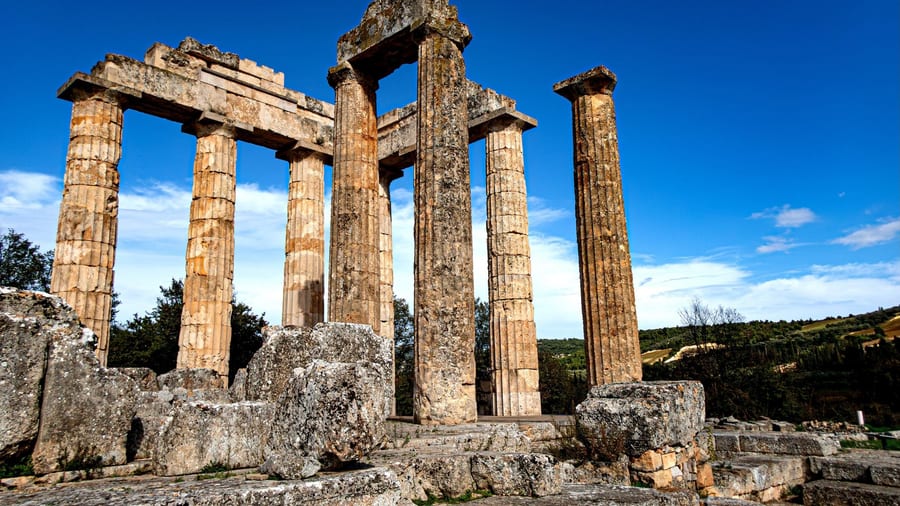
The Temple of Zeus mixed the Doric, Ionic and Corinthian styles of column. Its outer Doric columns are slender. Each stands 6.34 times as tall as its lower width. The finished temple had no carved decoration.
The temple sits on an earlier 6th-century BC temple that burned down. Two columns were raised again in 2002, and four more since then.
Pausanias visited at the end of the 2nd century AD. He saw the temple in a grove of cypress trees. Its roof had fallen in, and no statue of the god stood inside.
The stadion foot race at Nemea covered about 178 metres. The stone starting line keeps grooves for runners’ toes. It also has holes for a hysplex, a device that gave fair starts.
Roof tiles of the changing room carry the stamped name of its architect, Sosikles. The stadium tunnel is the earliest known ancient Greek vault, or curved stone roof. Its graffiti include Telestas, a known Olympic winner.
The Heroön of Opheltes, a hero shrine, is an earth mound 100 m long and 40 m wide. A five-sided wall surrounds it. Digs found seven lead curse tablets with love spells.
- Water channel: A stone channel with basins, first fed by a spring, runs beside the track.
- Baths: The round plunge bath is one of only four in Greece, all at Panhellenic athletic sites.
- Oikoi: Nine buildings line up south of the temple, placed like the treasuries at Olympia.
- Museum: The University of California at Berkeley built it. It passed to the Greek State in 1984.
A society to revive the games formed in 1994. Games have run every four years since 1996. Barefoot runners in tunics race for crowns of palm and wild celery. This gives a Nemea wine tour a living link to the past.
What myth ties Hercules to a Nemea wine tour?
A Nemea wine tour crosses the hills of the Nemean lion myth. Hesiod says Hera raised the lion and sent it to terrorise these hills. Heracles, the Greek name for Hercules, killed the beast. Stories of this fight still shape the local landscape and its names.
Another tale tells it differently. The moon goddess Selene threw the lion down from the Moon. It landed on Mount Apesas, because Hera asked her to. The beast had claws sharper than mortal swords. Those claws cut through any armour.
King Eurystheus, the cousin of Heracles, ordered him to slay the lion. On the way, Heracles stayed with Molorchus, a day labourer at Cleonae. A Nemea wine tour passes through the same countryside today. Roman poets called the Nemean forest “the grove of Molorchus”.
Heracles asked his host to wait thirty days before a sacrifice. If he came back, the offering went to Saviour Zeus. If he died, it went to Heracles as a hero. On the last day, Molorchus was about to sacrifice for him as dead. Heracles suddenly returned.
The fight itself was hard. The first arrow of Heracles bounced harmlessly off the lion’s thigh. The Roman writer Lucius Ampelius says Molorchus gave him the club for the battle. Lovers of old stories can look at wine tours on Crete.
After the kill, Athena told Heracles to skin the lion with one of its own claws. The poet Stesichorus first gave Heracles his lion-skin costume. Zeus set the lion among the stars as the constellation Leo. Guests on a Nemea wine tour stand under that same sky.
- Eurystheus: Terrified, the king banned Heracles from his city and hid in a buried bronze jar.
- Opheltes: The seer Amphiaraus called this baby Archemorus, which means “Beginning of Doom”.
- Wild celery: Hyginus says the nurse Hypsipyle laid Opheltes on wild celery, where the spring’s serpent killed him.
The Nemean Games first gave winners a wreath of olive branches. Each Nemea wine tour moves through land full of these old stories.
How does altitude shape a Nemea wine tour?
A Nemea wine tour climbs through zones at different altitudes. Grapes ripen at a different level and time in each zone. This gives a range of wine styles. The climate is typical Mediterranean, but it changes across the large zone.
Soil changes with height too. In the centre of the plain, the soil is fine, deep and fertile. Near the foot of the mountains, it is coarser, with more gravel. There it is less fertile and keeps less moisture.
On the middle slopes, the soil is shallow and calcareous, which means rich in lime. Agiorgitiko grapes ripen early there. Milder conditions help them along. A Nemea wine tour shows how one grape changes with each slope.
The rivers Asopos and Xerias carved deep ravines. These ravines shaped the land of the zone. Yet the basin floors of Nemea and Ancient Nemea differ in height by only a handful of metres.
Quality differs a lot between Nemea vineyards. Certain producers have looked into a cru system, a way to rank each vineyard. A 1997 study shows why. It compared three unirrigated Agiorgitiko vineyards, meaning fields without added water, on different soils.
On the dry, stony plot, vine growth slowed early in the season. On the plot with the water table, it slowed late. The dry plot gave smaller berries with more sugar and colour pigments. Those berries also held less malic acid, a sharp fruit acid.
- Plot at 350 m: Gravel and stones filled the top 50 cm. The subsoil below was nearly half clay.
- Plot at 300 m: This plot sat on a plain with very loamy soil.
- Plot at 260 m: Clay and loam sat above a permanent water table within reach of the roots.
The wines showed the same split. Wine from the dry, stony plot was rich in alcohol, anthocyanins and tannins, the colour and grip compounds. Wine from the plot with easy water was low in alcohol and polyphenols. These contrasts show up in the glass on a Nemea wine tour.
What food pairs with wine on a Nemea wine tour?
A Nemea wine tour sits in Corinthia, where two products dominate. These are the wines of Nemea and the Corinthian raisin. In the nineteenth century, the raisin was Greece’s “black gold”. Local dishes use both in the kitchen.
In Corinth, cod plaki is salted cod with potatoes, courgettes and tomatoes. Locals add a twist of Corinthian raisins. Wild boar with quince is another Corinth speciality. The local leek pie also mixes raisins with kefalotyri, a hard salty cheese.
Red wine goes into the pot too. Nemean tagliatelle can come with kalkani, or turbot, fried with a splash of red wine. Cuttlefish is stuffed with rice and dill and slow-cooked with red wine.
The red wines of Greece are classic pairings with lamb dishes of the local cuisine. On a Nemea wine tour, lamb called zigouri fits that rule. Braised mutton, known as vergadi, is another local meat dish.
Pork salmi is cooked with olive oil, garlic, wine and tomato puree. Chopped walnuts finish the dish. Corinth’s cheeses include PDO feta from Zireia. PDO means the name is protected and tied to its place.
- August drying: Raisins dry on threshing floors in the hill villages of Corinthia.
- Vostitsa: The PDO Vostitsa raisin, rated the highest quality, grows in Aigialia, in Achaia.
- World share: Greece grows about 80% of the world’s Zante currants.
Pliny the Elder first wrote about the currant grape in 75 AD. Around 1901, the United States Department of Agriculture took currant cuttings from Panariti, a Corinthian village. The cuttings started American crops. A Nemea wine tour crosses that raisin country.
What landscape does a Nemea wine tour drive through?
A Nemea wine tour drives through a land of hills, passes and high mountains. Mount Phoukas, called Apesas in ancient times, towers above Nemea. Rugged hills link it to Acrocorinth, the rock above ancient Corinth. Old battlefields and a wetland lake also belong to this wider area.
Myth links Mount Apesas to the hero Perseus. The story says he was the first person to sacrifice to Zeus Apesantius there. The peak rises above the vineyards seen on a Nemea wine tour.
Ancient Cleonae stood on the old road from Argos to Corinth. It lay 120 stadia from Argos and 80 stadia from Corinth. A stadion was an old Greek distance unit. The town sat in a small plain beside a river.
That river flows into the Gulf of Corinth, a little west of Lechaeum. Today it is called the Longo. Its ancient name appears to have been Langeia. Near Cleonae, the ruins of a Doric temple of Heracles still exist.
A narrow pass called Tretus led from Argos to Cleonae. In 1822 the Ottoman army of Mahmud Dramali passed through the narrow Dervenaki defile, also called Tretos. Greek forces defeated that army at Dervenakia on 6–8 August 1822. This was an important event of the Greek War of Independence.
A Nemea wine tour also crosses an older battlefield. The Battle of Nemea of 394 BC was fought at the dry bed of the Nemea River. Sparta won a decisive victory over Argos, Athens, Corinth and Thebes.
- Mount Kyllini: Also called Mount Ziria, it rises to 2,376 m, the second-highest point of the Peloponnese.
- Summit view: From the top, the Gulf of Corinth and the larger part of Corinthia are visible.
- Lake Stymphalia: This closed karst basin is a hollow in limestone rock, with a wetland that changes size.
Lake Stymphalia is also an important stopover for migratory birds. These birds rest there on long journeys. A Nemea wine tour thus links vineyards with land shaped by myth, war and wild nature.
When is the best season for a Nemea wine tour?
A Nemea wine tour works well across the growing season, from April to October. The Great Days of Nemea festival adds extra life to the region. This three-day wine celebration is the leading wine travel event of the region. Mild warmth shapes the vines.
The festival began in 2004. The Nemea Wine Producers Association runs it with the Municipality of Nemea. More than 30 wineries open to the public with free tours and tastings. Its first event is called the Symposium of Angels.
During a Nemea wine tour at festival time, sommeliers and experts lead masterclasses. Vertical tastings compare aged labels of one wine from different years. Seminars explain winemaking and present other local grapes, such as Kydonitsa.
Music, exhibitions and art events also fill the vineyards. Climate records describe the growing season here. The data came from a Hellenic National Meteorological Service station for 1975-2004. On average, that station stood less than 20 km from the vines.
From April to October, the growing season averaged 18.9 °C. Nemea gathered 1934 growing degree-days, a measure of heat useful for vines. That was among the lowest warmth of the eight wine stations studied. Growing-season rain reached 240 mm, against only 66 mm on Santorini.
Across the wider Nemea wine region, the median growing-season temperature is 19.4 °C. The median elevation is 460 m. Harvest dates at Nemea showed no significant trend. In five of the eight regions studied, harvest came significantly earlier.
- Stadium race: On 21 June 2008, about 600 people raced in the ancient stadium ruins of Nemea.
- Two distances: One race covered 100 m and the other 7.5 km. Runners were aged 10 to 80.
- Winter games: The writer Pausanias wrote of winter Nemean Games, separate from the summer games.
The same study found that areas with late-ripening grapes were less sensitive to climate change. A Nemea wine tour from spring to autumn meets vineyards with a long, steady growing season.
What do travelers ask about a Nemea wine tour?
A Nemea wine tour raises questions about travel, wine and souvenirs. Trains and buses link Athens with Corinth. The A7 motorway runs onward toward Tripoli. Wine questions cover ageing, the local Agiorgitiko grape and rules for taking bottles home.
How do travelers reach Corinth by train before a Nemea wine tour?
The Suburban Railway journey from Athens to Corinth takes about 55 minutes. Line A4 runs between Piraeus and Kiato and stops at Corinth. It offers up to one train per hour. The station lies 5 minutes by car from the city centre, with free parking.
Is there a bus option for a Nemea wine tour from Athens?
Yes. KTEL Korinthias runs intercity buses between cities. They serve the Peloponnese and Athens. They leave from the Isthmos station, southeast of central Corinth. The A7 motorway also runs 74 km from Corinth to Tripoli. Its Corinth–Tripoli section was built between 1984 and 1990.
Does every wine from a Nemea wine tour need long ageing?
No. More than 90 percent of the world’s wines are meant to be drunk within one year. Less than 1 percent are meant to age for more than 5 years. Fruitiness drops markedly after only 6 months in the bottle. Certain authorities say more wine is drunk too old than too young.
Why does Agiorgitiko from a Nemea wine tour age well?
Red wines rich in phenolics, mainly tannins, have better odds of ageing well. Phenolics are natural compounds from grape skins and seeds. Agiorgitiko has small berries and thick skins, giving high phenolic levels. These add tannin and help the wine handle oak barrel ageing.
When does a wine from a Nemea wine tour reach its peak?
Coates’ Law of Maturity offers one rule of thumb. It says a wine stays at its peak for as long as it took to reach that peak. Wine writer Oz Clarke says Nemean Agiorgitiko quality depends heavily on the skill of each winemaker.
How much wine from a Nemea wine tour can a traveler take to Canada?
After 48 hours or more abroad, a traveller can bring up to 1.5 litres of wine into Canada. That equals about two 750 ml bottles. The minimum age is 18 in Alberta, Manitoba and Quebec. It is 19 in the other provinces and territories.
Featured photo: From Nafplio: Nemea, Wine Tasting Tour with Local Flavours, via GetYourGuide.