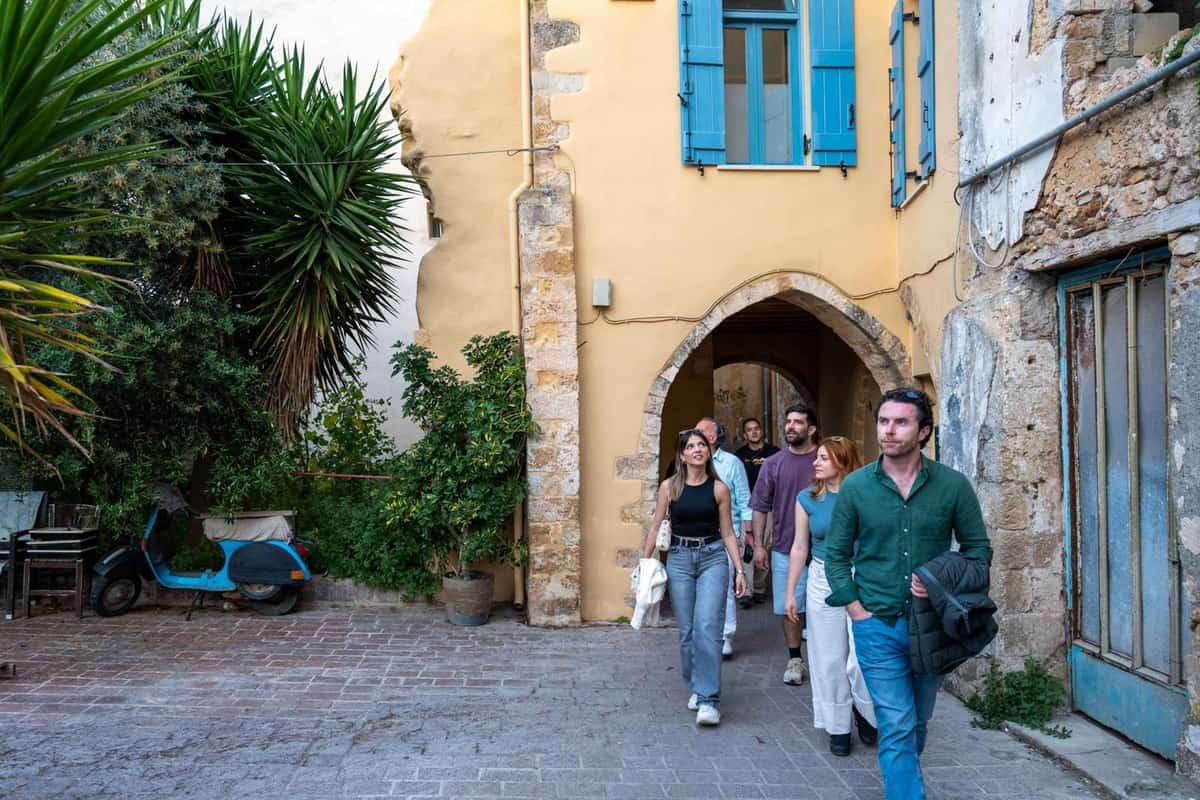
A Chania walking tour explores the old town of Chania, in western Crete, on foot. The route runs from the Venetian harbour to the lanes of Splantzia, Topanas and the Jewish quarter. It is one of the walking tours in Greece on Greece VIP.
This post covers what a Chania walking tour includes and each stop on the way. It also covers the history of the town, the best season and common questions.
Each section ends with a Chania walking tour or day trip that can be booked online.
What does a Chania walking tour include?
A Chania walking tour is an expert-led walk through the old town of Chania in western Crete. Small groups follow one tour leader on foot. They pass lanes, squares, churches and former mosques. The route also reaches the harbour front.
In tourism, the term walking tour means a walk around a historical or cultural site. As a rule, it is set in a town or city. A Chania walking tour fits that pattern.
The tour leader knows each place on the route. At each stop, the leader explains its weight in history, culture and art. The group halts, listens and asks questions, then moves on to the next corner.
The old town sits beside the old harbour. The urban area grew from this core, the cradle of every civilization in the area. The municipality counts 111,375 inhabitants, yet the route keeps to this core.
A Chania walking tour reads those layers. Under Venice, Byzantine, Venetian and Classical Greek elements blended. The Ottoman city then added mosques, bathhouses and fountains.
Churches and former mosques dot the route. A Chania walking tour passes the Orthodox cathedral in Athinagora Square. It began as a soap factory and opened as a church in 1861.
After the war of 1897, the Tsar of Russia paid to repair the cathedral and donated its bell. Under Ottoman rule, the former Venetian Monastery of Saint Francis served as a mosque named after Yussuf Pasha.
- Format: The walk runs on foot in a small group behind one tour leader.
- Stops: Lanes, squares, churches, former mosques and the harbour front fill the route.
- Focus: Each stop links a building to a chapter of local history.
A Chania walking tour joins three parts. An expert explains, and a small group listens. The compact old town rewards a slow pace.
Travellers who want local flavours in the same lanes can add a Chania food tour. It offers tastings of cheese, olive oil and raki, a local spirit.


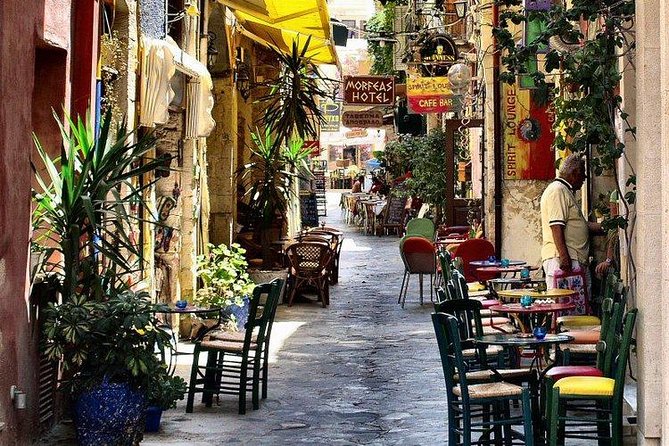
What does a Chania walking tour see along the Venetian harbour?
A Chania walking tour follows the Venetian harbour front past two landmarks of different empires. The first is the Mosque of the Janissaries, the oldest mosque on Crete. The second is the Neoria, the Venetian shipyards. Ships were repaired there during the winter.
The mosque carries three names, and Yali Mosque comes from the Turkish for shore mosque. Küçük Hasan Pasha Mosque honours the first garrison commander of Chania after the Ottoman conquest of 1645.
A Chania walking tour stops outside to read its roofline: one main dome ringed by smaller domes. An Armenian architect designed the building. Its courtyard once held palm trees and the tombs of pashas and janissaries.
Worship ended in 1923, when the last Muslims left Crete in the Greco-Turkish population exchange. The minarets, its tall towers, came down in 1939.
During the Second World War, the building held the Archaeological Museum of Chania. Later it served as a storehouse, a folklore museum and a visitor centre. A Chania walking tour finds it working today as an exhibition hall that also hosts events.
The Neoria rose in stages, and the first two were finished in 1526. Sixteen stood by 1593, and the southern complex was complete in 1599.
In 1607, work on five more began on the eastern side of the port. Only two were finished, and a third stayed half-built.
Under Ottoman rule, the halls became military stores. A Chania walking tour passes the surviving row of seven continuous domes.
- Grand Arsenal: Alvise Grimani began the last shipyard of the row, at the west end, in 1585. It gained a second floor in 1872.
- New use: Restored in 2002, it now houses the Center of Mediterranean Architecture, with exhibitions and symposiums.
- Losses: Nine of the seventeen original shipyards no longer stand.
A Chania walking tour along the waterfront sets two eras side by side. Venetian halls were built to keep a fleet in service. An Ottoman mosque marked the new rule.
Where lost shipyards once stood, the stone customs house now rises between two squares. The harbour walk continues along the water.
Why does a Chania walking tour climb the Kastelli hill?
A Chania walking tour climbs the Kastelli hill because the town began there. This citadel above the harbour holds the excavated remains of Minoan Kydonia and a Byzantine wall. Kydonia is one of the six Minoan Palatial Centres on the UNESCO World Heritage list.
Scarce walls and ground floors survive on the hill. They show that steady settlement began in the Early Minoan II period. In Middle Minoan III, a palace rose and opened the Neo-Palatial period.
A Chania walking tour meets the legends. Diodorus Siculus named King Minos as the founder of the city. The Greeks tied Kydonia to the quince, whose English name comes from the Greek for Kydonian apple.
Digging on the hill has continued since 1966. A Greek-Swedish team worked at Agia Aikaterini Square from 1970 to 1987. A Chania walking tour looks down into these trenches.
Finds include large houses with well-built rooms. Diggers found floors with round holes and walls coated in deep red mortar. An archive of 97 Linear A tablets, the second largest known, recorded farm produce, people and animals.
The Byzantine wall rings the hilltop on an uneven outline. Its two main gates sit on a long east to west line. Straight stretches break at small oblong or polygonal towers.
Builders reused stone from the ancient city to hold off a second Arab invasion. They set the wall on a Hellenistic base. A Chania walking tour finds surviving sections in Sifaka Street and Karaoli Dimitriou Street.
- Linear B: Tablets from Knossos are thought to carry the first mention of the city, as ku-do-ni-ja.
- Trade: In Late Minoan IIIA and IIIB, the town shipped pottery, oil, perfume and wine across the Aegean.
- Sanctuary: Digging in Daskalogiannis Street found a Late Minoan I sanctuary beyond the hill.
A Chania walking tour on the Kastelli hill moves through stacked layers. Minoan houses and archives lie in the trenches. Later walls sit above them, with lived-in lanes on top.
The Municipality of Chania lists the hill among the leading prehistoric sites of Crete. Its medieval ramparts show plainly from the lanes of the old city.
What does a Chania walking tour see in Splantzia?
A Chania walking tour in Splantzia, the old Muslim quarter, sees a square with a plane tree. The church of Agios Nikolaos there has both a minaret and a bell tower. It also sees the Venetian church of Saint Rocco and an underground Ottoman fountain.

A Chania walking tour reaches the square along Daskalogianni Street, the main road into Splantzia. The square forms the core of the quarter. A plane tree stands outside the church.
During Ottoman rule, the Turks hanged the bishop Melchisedek Despotakis from this tree. A memorial named after him now stands east of the trunk. A brass fountain sits in the north-east corner of the square.
On the east side, a Chania walking tour finds the basilica of Agios Nikolaos. Its cross aisle ends in a raised sanctuary in three parts. The sanctuary has no apse, or rounded end wall.
After the Ottoman capture of the town, builders added a mihrab, which is a prayer niche. They also added a minbar, or pulpit, and a minaret on the south side. That minaret stood out for its two balconies and rises about 36 metres.
The first bell tower did not survive and was rebuilt. The mosque kept the sword of a dervish, a Muslim holy man. He first entered the city, climbed the bell tower and called the faithful to prayer.
The Muslim population took that sword with it when it left Crete. Beneath the square lies an 18th-century underground fountain for the ritual washing of worshippers. Restored, it is open to visitors on a Chania walking tour.
- Saint Rocco: This Venetian church at the north-west corner bears an inscription dated 1630.
- Two aisles: The older north aisle is plain; the south one shows Venetian Mannerism, a late Renaissance style.
- Noble graves: The courtyard west of Agios Nikolaos served Venetian and Turkish nobles as a cemetery.
A Chania walking tour reads Splantzia in layers. Agios Nikolaos began as a Dominican basilica and became the central mosque of the city. Saint Rocco takes its name from the protector against plague.
Narrow streets and dead ends surround the square, too tight for fire engines to pass. Minos Street marks the eastern edge of the Splantzia quarter.
What does a Chania walking tour show in the Jewish quarter?
A Chania walking tour in the Jewish quarter, known as Evraiki or Ovraiki, shows Kondylaki Street. There, the Etz Hayyim Synagogue is the last surviving trace of the Greek-speaking Romaniote Jews of Crete. Axis forces destroyed that community in the Second World War.
Kondylaki Street was the main street of the Jewish community. The houses of its leading families lined it. A Chania walking tour finds the synagogue in a side lane, Parodos Kondylaki.
The stone building began as a church and became a synagogue in the 17th century. The town council places it on the site of a former church of Saint Catherine.
In 1944 the German occupiers arrested the Jewish community of Crete. They planned to send it to the Haidari camp and then to Auschwitz. On 9 June, a British submarine torpedoed the cargo ship carrying the prisoners off Heraklion.
The ship sank in 12 seconds. Resistance fighters and Italian prisoners of war died with them. A Chania walking tour marks this loss at the synagogue.
The building was ruined after the deportation and restored in the late 1990s. The synagogue then opened to visitors, along with its mikveh, a ritual bath.
A Chania walking tour meets a living congregation there. Almost all of its members are not Jewish. An international team runs it.
On Yom Kippur, the synagogue still reads the Book of Jonah in Judaeo-Greek, a Jewish form of Greek. This custom is kept from the old local rite.
- Arson: The second of two fires in January 2010 destroyed 2,500 rare books and manuscripts.
- Rite: The congregation now follows mainly the Sephardic custom of Greece, from Jews of Spanish origin.
- Royal visit: Queen Sofía of Spain and King Constantine II came unannounced in March 2006.
Jews once played an important part in the transport trade of Crete. The synagogue keeps that history in view for visitors on a Chania walking tour.
What does a Chania walking tour see in Topanas?
A Chania walking tour in Topanas sees the aristocratic Christian quarter behind the harbour. Venetian mansions line its narrow paved lanes and the uphill Angelou Street. It also sees the former Franciscan church of San Salvatore. Its arched halls now hold a Byzantine collection.
Topanas lies west of Kasteli. A Chania walking tour enters the district that has always housed the city’s Christian upper class. The town council counts it among the finest districts of Chania.
Venetian mansions and Ottoman monuments stand in its lanes. A photograph from 1897 shows a ruined street in the Christian quarter. The damage followed fighting between the town’s Christians and Muslims.
Angelou Street, one of the backstreets of Topanas, climbs uphill. Venetian buildings from the 16th and 17th centuries line it. A Chania walking tour follows such narrow paved lanes between restored houses of different periods.
The quarters inside the walls keep their Venetian character. Stone-built alleys carry bougainvillea, a bright climbing plant, and fountains with Ottoman inscriptions. Under Ottoman rule, public baths and fountains marked the city.
San Salvatore stands on the west side of the walled town. It was the main church of a Franciscan monastery. A Chania walking tour sees how the building grew in stages.
Its small domed east end dates from the 15th century. A western extension with strainer arches, which brace the walls, followed in the 16th century. In the mid-17th century, builders added two cross-vaulted rooms to the north.
Large archways open these rooms to the nave, the main hall of the church. Under Turkish rule, the church became a mosque. Today it serves as a museum.
- Collection: Mosaics, icons, wall paintings and coins span Early Christian times to the Turkish period.
- Gothic touches: The two northern rooms show a limited use of Gothic motifs.
- Cloister: The monks’ cloister, a covered walk round a courtyard, survives with its cells on the south side.
A Chania walking tour through Topanas ends among these streets and buildings. Together, they record the Venetian and Ottoman layers of the western old town.
Which Venetian walls does a Chania walking tour follow?
A Chania walking tour follows the Venetian walls of the sixteenth century. Michele Sanmicheli designed them against the Ottoman threat. The ring formed a rough square with four corner bastions, three gates and a deep ditch. Parts of it remain intact.
The defences set the scale for a Chania walking tour around the old town. The walls rose as high as 20 metres. Around them ran a ditch 60 metres wide and 15 metres deep.
This moat kept attackers well away from the stone. Walls and ditch worked as one belt of defence. Together they fixed the outline of the old town.
Four bastions, or strong points of the wall, held the corners of the square. A Chania walking tour that circles the old town passes the sites of all four.
San Dimitrio, better known as Schiavo, guarded the south-west corner. Santa Lucia held the south-east corner, and Mocenigo held the north-east one. San Salvatore, also known as Gritti, completed the set at the remaining corner of the ring.
Only one gate of the ring survives. A Chania walking tour finds it on the eastern side, built on the shoreline. The Sabbionara gate served as an exit to the shore.
Its Turkish name means the Gate of the Sand. The round Venetian emblem, a badge with the lion of Saint Mark, remains on its front. Its outer side changed during the Turkish period.
- Earlier circuit: In 1336 Venice chose to wall the outer burgs, or suburbs. The work ended within two decades.
- South gate: A Chania walking tour reaches the site of Porta Retimiota on the south side.
- South walls: The Cretan State pulled down parts in the early 20th century to let the city grow.
The wall line gives a Chania walking tour its frame. Bastion sites mark the corners of the old town. The sea gate shows how the defenders reached the shore.
The scale of the ditch shows the effort behind the defence. On foot, the Venetian names turn into a clear plan of the fortified town.
What does a Chania walking tour find on Leather Street?
A Chania walking tour finds the Stivanadika on Leather Street. This is the pedestrian Skridlof street in the centre of the old town. The lane gathers the leather workshops of the city in one place. It keeps an old Cretan trade in daily use.
The name of the lane comes from island footwear. Stivanadika is the Cretan word for leather shoe workshops. It is based on stivania, the tall and tough leather boots worn on Crete for centuries.
A Chania walking tour reads that history in the street itself. Traffic stays out of the lane. The shop fronts face a path kept for walkers.
Skridlof shops sell every kind of leather good. Goods range from a small wallet to a large bag. A Chania walking tour reaches the lane by climbing the main street.
This street rises from the centre of the old harbour. Skridlof opens on the left side, a couple of streets past the Trimartiri Cathedral. The cathedral makes the turn easy to find.
The craft of leather in Chania also has roots in a quarter by the sea. A Chania walking tour that heads east meets Tabakaria. The name means tanneries in Turkish, the places where hides turn into leather.
Between 1830 and 1850, during the Egyptian occupation, skilled tanners settled there. The leather trade thrived until the 1950s, when 80 tanneries were in full operation. Their old buildings still stand on the shore.
- Market site: The covered market rose on the Piatta Forma bastion, the main Venetian defensive wall.
- Market plan: In 1911 the city chose a cross-shaped design with four entrances, based on the Marseille market.
- Market hall: A Chania walking tour finds local goods and souvenirs in small shops of the 4,000-square-metre building.
Leather Street gives a Chania walking tour a link to the old crafts of the town. Boots gave the workshops their name. Tanners by the sea once processed the hides.
The covered market in the same central district trades local goods under one roof. Together these three places show the trading side of the old town.
Why does a Chania walking tour reach the Halepa district?
A Chania walking tour reaches Halepa for its diplomatic and political quarter. It dates from the late nineteenth and early twentieth century. Halepa lies on the north-east outskirts of the city. Former consulates, grand mansions, two large churches and a statesman’s house-museum stand there.
Halepa sits where the road from Akrotiri ends and enters the city. A Chania walking tour reaches the district along a coastal route of 2.3 km. The route heads east from the Venetian harbour.
The district grew east of the walled town and remains a wealthy suburb. Konstantinos Mitsotakis, later Prime Minister of Greece, was born there. Political families kept homes in its streets.
The old consulates, the offices of foreign governments, mark the streets, each with a new use. A Chania walking tour passes the former British, Austro-Hungarian and German consulates, now hotels. The Italian consulate serves as a care home for the elderly.
Villa Blanche, once the French consulate, is being restored. Mansions of the same era line the district. The new Archaeological Museum of Chania also stands there.
A Chania walking tour pauses at the family house of Eleftherios Venizelos, now a museum. It was his home from 1880 to 1910. He also lived there for short periods from 1927 to 1935.
Every room keeps its original interior, with household items, artworks, books and personal objects. The collection holds the official car he rode in during an attempt on his life. The Greek state granted the house for museum use.
- Evangelistria: The largest church in Chania went up between 1908 and 1923.
- Agia Magdalini: A Chania walking tour passes this Russian-style church, built between 1901 and 1903.
- Elena Venizelou Square: The square is named after the second wife of the statesman.
Halepa adds a residential chapter to a Chania walking tour. The old town shows Venetian defences and crafts. This coastal district shows how diplomats and statesmen lived.
Their homes rose here once the city spread beyond its walls. A walk east along the sea links the two, from the harbour edge to the consular streets.
Which eras of history does a Chania walking tour pass through?
A Chania walking tour passes through five eras on foot. They are Venetian rule, the Ottoman conquest and the semi-autonomous Cretan State. Union with Greece and the Battle of Crete follow. Each era left buildings or memorials, and one walk links them in order.
A Chania walking tour opens its timeline with Venice. After the Fourth Crusade of 1204, Crete passed to Bonifacio, Marquess of Montferrat. He sold the island to the Venetians for 1,000 silver marks.
About 10,000 Venetians settled on Crete in the first century of rule. Venice itself then held around 60,000 people. After the fall of Constantinople in 1453, priests, monks and artists fled to the island for safety.
The Ottoman chapter of a Chania walking tour begins with the Cretan War. An Ottoman army took the city after a two-month siege. Under the name Hanya, the town became the base of the pasha, the Ottoman governor of Crete.
Ottoman control held through the Greek War of Independence and two Cretan revolts. The city later became capital of the semi-autonomous, or partly self-ruling, Cretan State. Union with Greece followed the Balkan Wars.
The Battle of Crete in 1941 closes a Chania walking tour. Its code name was Operation Mercury. It was the first invasion in military history to come mainly from the air.
German paratroopers, soldiers who jump by parachute, landed near Maleme Airfield and the town. British artillery on Dexameni hill shelled Maleme without being spotted. The big guns kept firing until their ammunition ran out.
On the Souda–Chania road, Allied troops charged a German block with bayonets, the blades fixed to rifles. The charge cleared the block and is known as the Battle of 42nd Street.
- Own currency: The Cretan State issued its own stamps and money.
- Metaxas era: The only uprising against the regime failed here on 28 July 1938.
- War graves: Allied graves from four German-built burial grounds lie in Souda Bay War Cemetery.
- Capital shift: The capital of Crete moved to Heraklion in 1971.
When is the best season for a Chania walking tour?
A Chania walking tour suits spring and autumn best. Both seasons bring mild highs and light rain. Summer gives long sunny days and dry lanes, so early starts and shade matter. Winter brings the wettest weeks of the year, with frequent rain days.
Summer tests a Chania walking tour with heat and sun. July has an average temperature of 26.6 °C. It also gets 376.7 hours of sunshine on average, the highest total of any month.
Relative humidity, the moisture in the air, falls to 49.3% in July. Rain days drop to 0.2, so the sky gives almost no cloud cover. Early starts, shaded lanes and indoor stops keep a summer walk comfortable for groups.
Spring and autumn give a Chania walking tour milder air. April brings an average daily high of 19.9 °C, a comfortable level for long walks. In autumn, September still reaches 27.5 °C.
October holds 23.4 °C and November eases to 19.0 °C. October counts 9.8 rain days and April 7.8. That leaves the majority of days in both months dry for walking.
Winter keeps a Chania walking tour possible but wetter. January is the rainiest month, with 126.4 mm over 17.0 rain days. December counts 15.8 rain days. Walkers in winter carry a rain layer and plan indoor stops between the showers.
Average lows sit at 8.1 °C in January and 8.0 °C in February. A storm on 13 February 2004 left 25 to 75 cm of snow across the wider region. The temperature at nearby Souda airport fell to −1 °C.
- Station: The figures come from the Hellenic National Meteorological Service at Chania Airport.
- Driest months: July and August each record 1.4 mm of rain.
- Dullest month: December logs the lowest sunshine, 111.7 hours.
- Heat record: The highest temperature recorded from 1958 to 1997 was 42.5 °C.
What do travelers ask about a Chania walking tour?
A Chania walking tour raises five practical questions before booking. They cover the amount of walking and which shoes suit slopes and steps. Others ask whether children can join and whether a night walk works. The last covers pairing the route with a harbour boat trip.
How much walking does a Chania walking tour involve?
A Chania walking tour moves at the pace of its slowest walker. People mainly prefer to walk at 4.0 to 5.9 km/h, and ageing or joint pain slows them further. Stops at sights break the route into short stretches, which suits mixed groups and family parties.
Which shoes suit the steps and slopes of a Chania walking tour?
A Chania walking tour calls for closed shoes with grip and support. Long walks in flip-flops can cause pain in the feet, ankles and lower legs.
Flip-flops can also lead to tendonitis, a sore and swollen tendon, and their straps can raise blisters. Slopes also slow walkers down, so firm soles make the climbs and steps easier.
Can children join a Chania walking tour?
Children can join a Chania walking tour when the route includes breaks. The Public Gardens, known as Kipos, were created in 1870 in the newer part of the city.
The gardens offer a green place to rest. The Garden Clock-Tower, called Roloi, was built between 1924 and 1927. It gives children a landmark to look for.
Does a Chania walking tour work as a night walk?
A Chania walking tour after dark suits summer. July nights average a low of 21.4 °C. One route heads east to Koum Kapi, a district beyond the city walls.
The Venetians named the district Sabbionara, the Gate of the Sand. Today, cafes, bars and restaurants line its beach.
Can a Chania walking tour be combined with a boat trip from the harbour?
A Chania walking tour pairs well with time on the water. The old town grew up around the old harbour. A morning walk before the midday heat can come first.
A Chania boat trip can follow in the afternoon. This plan splits one day between lanes and sea without a transfer across the city.
Featured photo: Local Chania walking storytelling tour, via GetYourGuide.