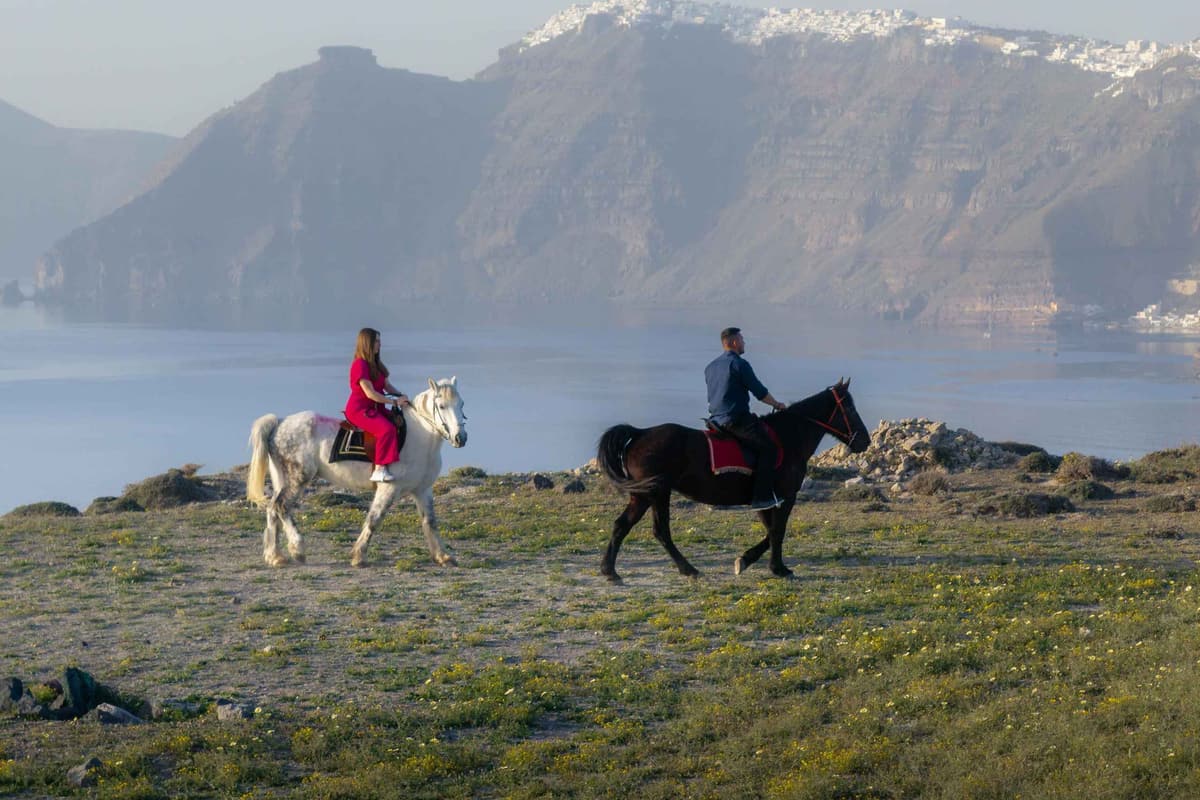
Santorini horse riding takes riders on horseback across the volcanic south of the island. It is one of the adventure tours in Greece on Greece VIP.
Each section ends with a Santorini horse riding tour that can be booked online.
What does Santorini horse riding include?
Santorini horse riding includes time in the saddle on routes across the volcanic landscape of the island. Routes pass vineyards, villages and the black sand beaches of the south coast. Each small group has a tour leader. The pace of each group follows its least experienced rider.
The island covers 75.8 square kilometres. It is the southernmost member of the Cyclades, an island group in the Aegean Sea. Santorini horse riding therefore crosses a small area where the scene changes quickly.
Lava, ash and pumice, a light rock full of air holes, built the ground under the tracks. A route leaves the coast and reaches open farmland within a short distance. Vineyards, villages and beaches sit close together, so one outing passes all three.
Each horse is matched to its rider before the group moves off. A tour leader is the person in charge of the group on the trail. The tour leader reads the ground and the mood of the horses before the pace rises. Before leaving the yard, the leader checks each saddle and its stirrups, the hanging foot rests.
- Terrain: Tracks run over volcanic rock instead of soft pasture, the grass fields where animals graze.
- Sea: Routes reach beaches where the sand is made of hardened lava.
- Groups: Small numbers keep horses and riders together on narrow paths.
Santorini is an active volcanic centre. It lies within the South Aegean Volcanic Arc, a curved chain of volcanoes. In the long history of the earth, the ground under Santorini horse riding is young.
Riders meet that ground directly, with the farmland and the coast in view from the saddle. The ride ends where it started, back at the yard.


Where does Santorini horse riding take place on the island?
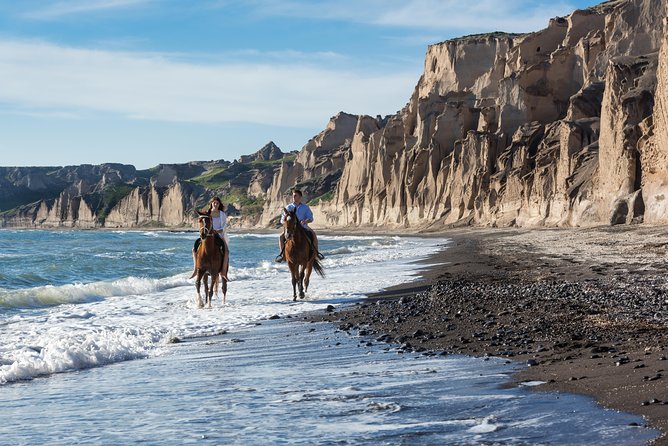
Santorini horse riding takes place in the south and the centre of the island. Tracks cross the countryside around Megalochori, Pyrgos and Akrotiri. These districts hold the volcanic layers of the island close to the surface. Riders cross all of these layers within a single outing.
Pyrgos Kallistis is the full name of the village of Pyrgos. It sits on a hill above the middle of the island.
The ruins of a Venetian castle stand at the top of the village. Santorini horse riding passes below that hill, with wide views across the centre of the island.
The 2021 census, the official count of people, recorded 1,078 residents in the community of Pyrgos. The village keeps its old street plan. Pyrgos is among the villages of Santorini that tourism has changed least.
Akrotiri is the site of a Cycladic town from the Bronze Age, an age of bronze tools. Volcanic ash buried the town in the 16th century BC. Archaeologists have been digging it out since 1967. Archaeologists are scientists who study the past through old buildings and objects.
An eruption is when a volcano throws out hot rock and ash. The eruption that buried the town also laid down the ash and pumice of the south. Santorini horse riding moves across ground with that same geology, the same make-up of rock.
At Pyrgos, rock not made by a volcano reaches the surface. So a rider crosses two rock types on one route.
- Ash layers: The Minoan eruption left deposits hundreds of metres deep.
- Cliffs: The wall of the caldera, the sea-filled crater, drops more than 300 metres at its highest point.
- Villages: Megalochori, Pyrgos and Akrotiri are local districts within the municipality of the island.
The land around these villages is farmed. Santorini horse riding uses the field edges and the old lanes that connect them. Routes stay inland, away from the steep caldera rim.
The routes turn back toward the centre of the island before the ground turns rough. Old walls and field gates mark the way. The horses pass them at a walking pace.
What does Santorini horse riding see on the black sand beaches?
Santorini horse riding sees beaches made of hardened lava, the rock that once flowed hot from the volcano. The sand and pebbles there are black or dark grey. Routes on the south coast follow this dark shoreline before turning inland again.
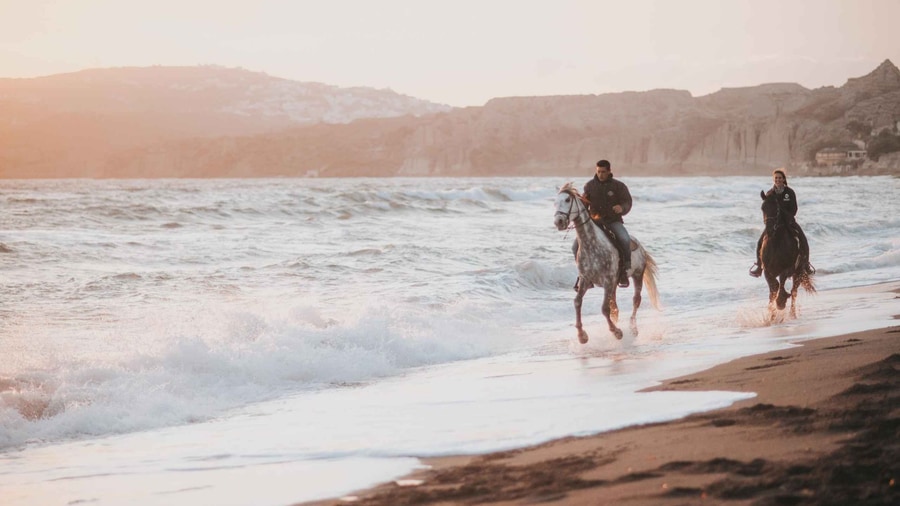
Perissa, Perivolos and Agios Georgios form a stretch of black sand about five kilometres long. Perissa lies close to 13 kilometres southeast of Fira. Santorini horse riding reaches that shoreline on tracks that stay above the waterline.
The sea breaks lava down into sand, so the dark colour runs the length of the beach. The sand and the pebbles differ in size along the shore. That changes the footing under the horses.
Vlychada sits beside a marina, a harbour for small boats. White rocks rise behind its beach.
Kamari holds the longest beach on the island, a line of black pebbles. Residents of a nearby settlement built Kamari village after the 1956 earthquake.
Santorini horse riding passes the pale rock wall at Vlychada and the pebble shore at Kamari. These routes link the coast to the villages behind it.
- Colour: Beach sand and pebbles come from hardened lava of different colours.
- Warmth: The darker beaches hold more heat, because lava absorbs it.
- Sunset: Oia, on the northwest of the island, looks west over the caldera at sunset.
An evening Santorini horse riding route along the water gives riders the last light of the day. The shore is quiet once the beach has emptied.
Santorini horse riding keeps to the firm ground behind the sand. The horses walk on packed lava rather than loose shingle, a bed of small loose stones. The sea stays in sight across the bay.
What does Santorini horse riding see in the vineyards and villages?
Santorini horse riding passes vineyards where the vines are woven into low basket shapes called kouloura. The grapes hang inside the ring of leaves. Rides also cross the old villages of the south. Houses there stand close to plots of the white Assyrtiko grape.
Assyrtiko began on Santorini, and about 1,200 hectares of the island carry vines. Santorini horse riding follows the paths between these plots.
Growers train the plants into kouloura. This lets wind and sun reach the vine without stripping the fruit.
A Santorini wine tour covers the same farmland for visitors who prefer to travel by road. Emporio is another of the old villages on the island. The harvest starts in mid-August.
Assyrtiko grapes make dry white wine. Dry means the wine holds little sugar. Growers also dry them in the sun for 12 to 14 days. This makes Vinsanto, a sweet dessert wine.
At harvest time, the plots are busy with picking. Santorini horse riding passes the field edges in that season. Carts then share the tracks with the horses.
- Kouloura: The Greek word means a ring or coil, the shape each vine takes.
- Roots: The phylloxera root pest never reached this volcanic soil, so the old vines keep their own roots.
- Vinsanto: The sweet wine blends Assyrtiko with Athiri and Aidani grapes.
Viticulture, the growing of grapes, is the leading type of farming on the island. The vineyards sit between the villages rather than in one block.
Santorini horse riding crosses that working land on field edges. Riders see the vines and lanes at close range rather than from a main road. They also pass dry stone walls, built without mortar. Mortar is the paste that binds stones or bricks together.
Which riding levels suit Santorini horse riding?
Santorini horse riding suits beginners and experienced riders alike. Beginners ride quiet horses at the walk, behind an instructor. Riders with a steady seat add the trot on longer tracks. The canter, the fastest of the three paces, is kept for open ground with good footing.
A short lesson comes before the ride. It covers stopping, turning and holding the reins, the straps used to steer. After it, a rider who has never been on a horse can control the mount.
Young riders on Santorini horse riding outings get horses that match their size. An adult walks beside the horse. The pace of the group holds until every rider is settled.
Helmets built to a set safety standard form part of the Santorini horse riding kit. Riders who want more can join a longer route later in their stay. The same company also arranges horse riding in Crete for travellers who visit another island.
- Walk: A four-beat gait, or way of moving, that averages about 7 kilometres per hour.
- Trot: A two-beat gait used to cover ground at a regular rhythm.
- Canter: A controlled three-beat gait that runs between 16 and 27 kilometres per hour.
- Helmets: In Europe, riding helmets follow standards such as EN 1384.
Horses can hold a canter for short periods only and need time to recover. So the faster pace comes in short bursts. Each beat in a gait is the moment one or more hooves strike the ground.
Longer stretches at the walk and the trot lie between these bursts. Santorini horse riding uses that rhythm to protect the horses on hard, hot and uneven ground.
How does Santorini horse riding differ from the donkey rides of Fira?
Santorini horse riding follows open trails away from the town. The donkey rides of Fira climb a narrow zigzag footpath instead. That path links the Old Port with the caldera rim. Greek rules cover the welfare and the loads of the island’s working donkeys and mules.
Fira sits on the western rim of the caldera, about 400 metres above the sea. The path from the Old Port climbs roughly 600 steep steps. Santorini horse riding stays clear of that staircase. The Old Port is the harbour at the foot of the cliff below Fira.
A cable car opened in 1982 and carries 1,200 passengers an hour up the 220-metre climb. Part of its ticket income supports the traditional drivers of mules, a horse and donkey cross.
The harbour route carries people and goods. Its zigzag shape turns back and forth to make the steep climb easier. In 1954, the island’s donkeys and mules were its traditional transport, alongside one jeep and a small bus.
Greek veterinary rules, the rules on animal health, set a load limit for each working animal. It must not carry over 100 kilograms or one fifth of its own weight. Sick, injured or heavily pregnant animals stay out of work, and so do animals with neglected hooves.
- Route: The donkey path is short and vertical, while horse trails cross open ground.
- Work: Riding horses carry riders rather than goods.
- Access: The cable car lifts visitors from the harbour in gondolas, hanging cabins that hold six each.
The two activities answer different needs. Santorini horse riding covers ground at a steady pace across the interior. A ride leaves the harbour crowds behind and shows the caldera from a distance.
When is the best time for Santorini horse riding?
Santorini horse riding works best in spring and autumn, when daytime temperatures stay mild. In summer, the early morning and sunset slots suit it best. The meltemi winds blow across the Aegean from late spring to early autumn. They are strongest in the afternoon.
Santorini has a hot semi-arid climate, which means dry summers and wetter winters. The average yearly temperature is near 19 degrees Celsius. About 270 millimetres of rain falls in a year.
August days average 30.2 degrees at their warmest, and the July record stands at 39.4 degrees. On such days Santorini horse riding starts before the ground and the air heat up.
Average daily highs reach 23.3 degrees in late spring and 22.8 degrees in October. April sits at 19.6 degrees.
Greek rules keep working animals out of the hottest hours. This ban covers 13:00 to 17:00 on days above 35 degrees in the shade.
April and October also fall outside the etesian wind season, the months of the meltemi. Those weeks form the safest window for Santorini horse riding, with lighter crowds.
- Sunset: Sunset viewing is a special event each evening in Oia, and the village fills with people.
- Wind: The etesian wind can reach force 7 or 8 in clear weather, and it drops after dark.
- Planning: A ride can end with an evening sunset tour when the light leaves the caldera.
The shoulder months, the quieter weeks before and after high summer, bring steadier temperatures. Riders who start at first light find the same. July and August still work for Santorini horse riding.
What do riders wear and bring for Santorini horse riding?
Santorini horse riding calls for long trousers, closed shoes with a small heel and a fastened riding helmet. Riders also bring sun protection, water and a phone or camera in a secure bag. Loose clothing and sandals leave skin exposed to rubbing leather and hot stirrups.
A riding boot has a clear heel that stops the foot from sliding through the stirrup. Its smooth sole does not catch on the tread, the flat base of the stirrup. Heavy soles are made for other work and do not belong on a horse.
Long riding trousers, such as jodhpurs, cover the calf. They stop the calf from rubbing against the side of the horse. They also shield it from the stirrup leathers, the straps that hold the stirrups.
A helmet protects the head when its harness is fastened. The harness is the set of straps that holds the helmet under the chin. A helmet takes a knock only once, so a damaged shell is replaced. The shell is the hard outer layer of the helmet.
Santorini horse riding also happens under strong sun. The UV index measures the strength of the burning rays of the sun.
When the UV index reaches 8 to 10, unprotected skin is at very high risk. Exposure to the sun is best reduced between 10 a.m. and 4 p.m.
- Sunscreen: A broad-spectrum product of SPF 30 or higher goes on before the ride, including ears and nose.
- Water: Riders carry more water than expected, because the air stays warm long after midday.
- Bag: A bag that closes keeps both hands free for the reins.
Riders who arrive dressed this way spend the ride on the horse rather than on adjustments. Anything else stays in the vehicle. Loose items drop, and a dropped item spooks a horse. A spooked horse takes fright and jumps aside or runs off.
What do travelers ask about Santorini horse riding?
Santorini horse riding draws questions about ages, first rides and weight limits. Riders also ask about the condition of the animals and about combining a ride with photography. The answers below follow Greek animal welfare rules and general riding practice, not one operator’s policy.
Is Santorini horse riding suitable for children?
Children join rides when the pace holds at a walk. A German comparison looked at riding and cycling. Riding carried an injury risk nine times higher for teenagers and 5.6 times higher for younger children.
Helmets are gaining acceptance as required headgear for children and young teens.
Can a beginner try Santorini horse riding?
Trail riding is pleasure riding along country paths. Enjoyment and time outdoors count for more than speed and technique.
Santorini horse riding works best for a beginner in a small group or with an instructor. In that format, one person watches the position of the rider and keeps a hand on the rein.
Are there weight limits for Santorini horse riding?
An average horse carries up to about 30 percent of its own body weight. The saddle counts in that total. Providers of Santorini horse riding pair riders and horses with this figure in mind.
Balance and fitness matter as much as weight on a climb. A rider who is unsure asks before booking rather than after mounting.
How are horses kept for Santorini horse riding?
Greek rules cover working equines, meaning horses, donkeys and mules. The rules require fresh drinking water and suitable food every day. They also require shelter from bad weather and at least 30 minutes of movement each day.
An average 450-kilogram horse drinks 38 to 45 litres a day, and more in hot weather. Access to water is not withheld for longer than four hours.
Can Santorini horse riding be combined with a photo tour?
Rides can be planned around viewpoints. Fira looks across an 18-kilometre caldera. Oia runs almost two kilometres along the caldera edge, at heights of 70 to 100 metres.
The ruined castle above Oia serves as a lookout with a full circle view. A photo tour pairs well with an early Santorini horse riding slot.
Featured photo: Santorini horse riding tour, via GetYourGuide.