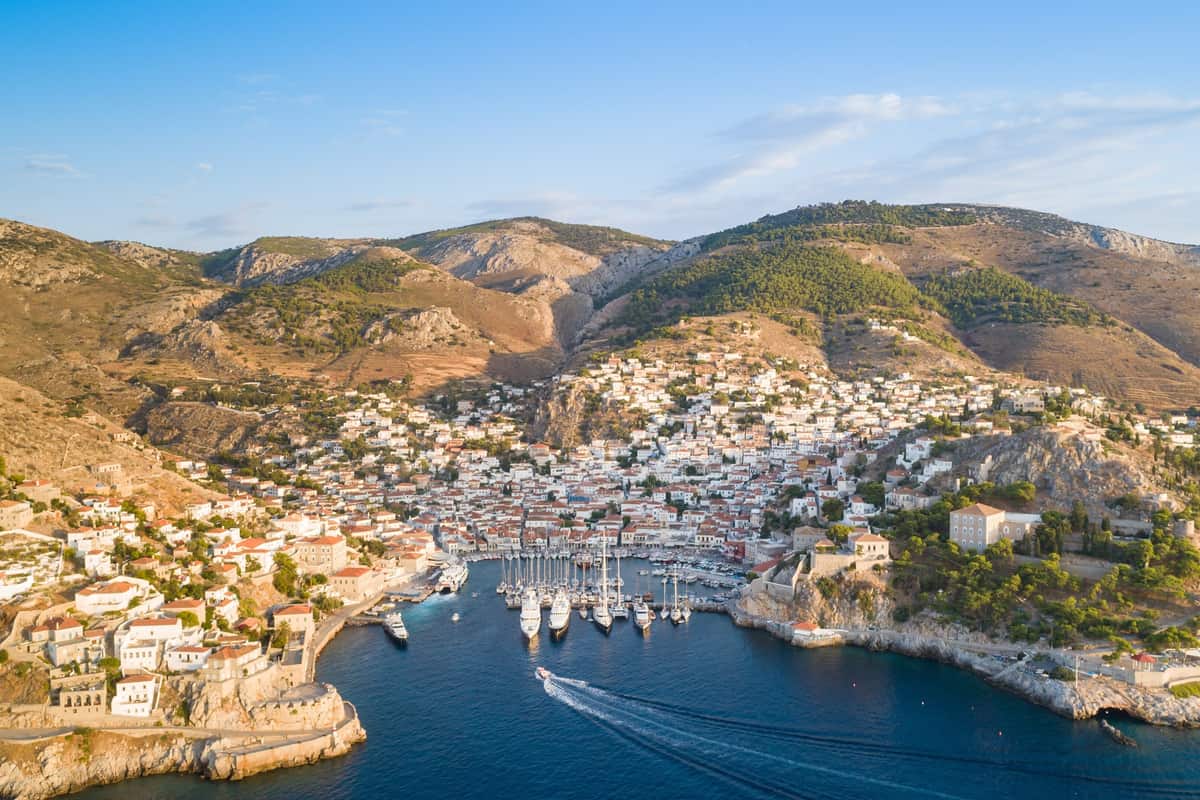
A Hydra day trip crosses the Saronic Gulf from the Athens area to a car-free island, where stone mansions rise around a horseshoe harbour and donkeys carry loads up the steps. This post covers what a Hydra day trip includes, the ferry, the island, the harbour and town, its seafaring history, the mansions and museums, the churches and monasteries, getting around without cars, Kamini and Vlychos, swimming, art, festivals, food, the other Saronic islands and the best season. It is one of the island day trips from Athens on Greece VIP.
Each section ends with a Hydra day trip or Saronic cruise that can be booked online.
What does a Hydra day trip include?
A Hydra day trip includes a boat crossing from the Athens area to a car-free island, a walk through a port town of stone mansions, time beside the sea, a meal, and the return to the mainland on the same evening.
A Hydra day trip starts at the quay. Vehicles are prohibited on the island, so nothing meets the boat except donkeys and hand carts. Everybody walks, from the landing point to the upper lanes, and the compact town keeps the distances short. A first swim from the rocks beside the harbour fills the middle of the morning, and the waterfront tables fill again at lunchtime, when plates of seafood arrive with bread, oil and lemon. The shallows beside the steps suit a short dip before lunch.
The island’s nature trails give a Hydra day trip its exercise. Routes leave the town and follow the coast, passing low walls, pine trees and small coves, with open sea views on the longer stretches. Sturdy shoes help on the stepped lanes and the gravel paths, and a hat and a bottle of water make the climb comfortable. A second swim cools the hours after noon, and the walk back leads down to the harbour for a late meal. The paths stay open through the warm months.
Afternoon brings the return. Boats head back towards the mainland as the light drops, and the crossing ends where the day began. Travellers who prefer the arrangements settled in advance book a Hydra day trip by boat, while independent visitors use the scheduled services and buy a ticket at the quay. The last boats leave the harbour full, and the town shrinks against the hillside as the water widens between the hull and the shore. Sea air and steps tire the legs, and the crossing back is quiet.
- Crossing: a Hydra day trip begins and ends with a boat from the mainland coast, taken in the morning and again in the evening.
- Car-free lanes: walking only, with donkeys for the luggage.
- Water time: a swim from the rocks beside the town.
- Meal: seafood at a table on the waterfront.
Nothing about a Hydra day trip calls for a fixed plan. The island asks for legs rather than wheels, and the timetable of the return crossing shapes the afternoon. Visitors gain the sea crossing, a walk through a port town of stone houses, a swim beside the rocks, and a meal at the water’s edge, all inside one stretch of daylight.


How does a Hydra day trip get there?
A Hydra day trip gets there by sea. Fast boats and ferries leave Piraeus, the chief port of Greece, and cross the Saronic Gulf to the island’s harbour. Services stop first at Poros, and a small ferry links the town with Metochi on the mainland coast.
Piraeus sits inside the Athens urban area and is the largest port in the country. Its central quays serve ferry routes to almost every island in the eastern part of Greece, so a traveller on a Hydra day trip reaches the departure point without leaving the city. From the quay, the route runs south across the Saronic Gulf, leaving the coast of Attica behind before the boat swings into the island harbour.
Two kinds of vessel cover the route. Fast craft shorten the crossing for passengers who value time, and the older ferries carry a slower sort of journey, with deck space and shade. Motor vehicles stay on the mainland, because the island takes none of them, so drivers park at Metochi and cross the narrow channel on foot with their bags. The water between Piraeus and the island measures about 37 nautical miles, a stretch of sheltered sea that a Hydra day trip covers in comfort.
For a Hydra day trip, arrival is simple. The boat slips into a harbour small enough to cross on foot, and the gangway drops beside the quay, a short step from the waterfront tables. Return boats leave through the afternoon and the early evening, and the last crossing empties the quay as the light fades. The harbour takes boats one at a time, so the landing is orderly and quick, and the quay fills again before each departure.
- The boats: high-speed hydrofoils and catamarans serve the island, alongside slower ferries.
- The route: a Hydra day trip crosses the Saronic Gulf from Piraeus, with a first stop at Poros.
- The mainland link: a small ferry between the town harbour and Metochi.
- The distance: about 37 nautical miles of water separate Piraeus from the island.
A Hydra day trip by sea depends on one timetable, and that timetable belongs to the boats. Morning departures leave the city early, and the last return crossing sets a hard limit on the afternoon, so the day ends when the gangways lift. Anyone who stays ashore past that hour keeps the island for the night, and the quay goes quiet.
What is Hydra island on a Hydra day trip?
A Hydra day trip lands on one of the Saronic Islands, in the Aegean Sea between the Myrtoan Sea and the Argolic Gulf. The island covers 49.6 square kilometres and sits close to the Peloponnese, from which a narrow strip of water separates it.
The municipality of a Hydra day trip reaches beyond the single island. Dokos and a scatter of uninhabited islets fall inside the same boundary, bringing the total area to 64.4 square kilometres. The census of 2021 counted 2,070 residents across that area, nearly all of them in the port town, where the streets run straight from the water to the hillside. Dokos carries a small resident population of its own, and the islets stay without houses.
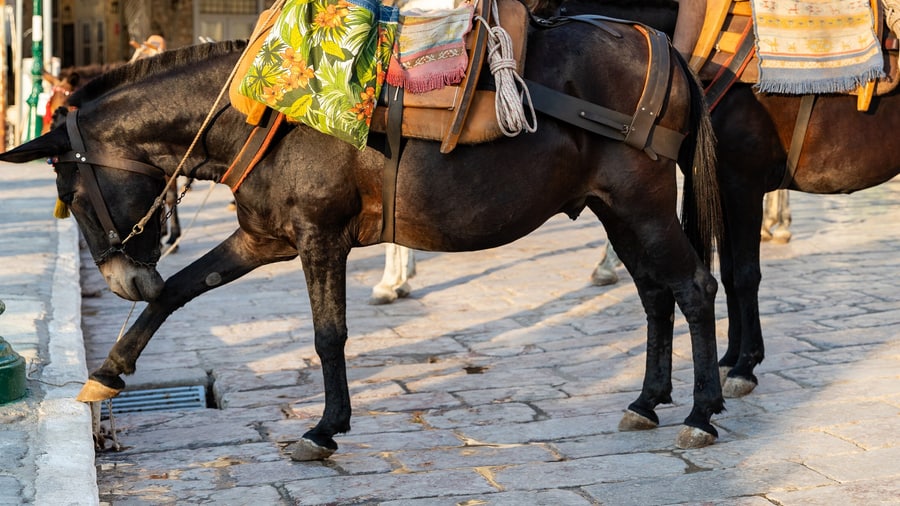
Vehicles are the loudest exception on a Hydra day trip. Wheeled transport is not permitted, and the rule covers cars, motorcycles, scooters, bicycles and e-bikes. Refuse trucks are the only motor vehicles allowed, and horses, mules, donkeys and water taxis carry people and goods along the quay and up the steps. The built area is compact enough for walking, which keeps the lanes quiet, the air clear and the pace slow. Nobody needs a bus, a taxi or a scooter to cross the town.
The landscape of a Hydra day trip is rocky and dry. Bare hillsides fall towards pine-forested valleys, and terraces of olives and cypress break the slopes. Rainfall stays low, around 390 millimetres a year, and the average annual temperature sits near 20.4 degrees Celsius, which gives the island a hot semi-arid climate. Fresh water arrives by boat from the mainland, and a desalination plant has supplied the town since 2014. Cisterns under the houses store the winter rain.
- The name: Hydra comes from the ancient Greek word for water, after the springs once found on the island.
- An older name: writers of antiquity knew the island as Hydrea, long before any Hydra day trip.
- Dokos: the second island of the municipality covers 13.5 square kilometres.
A Hydra day trip passes through an island group rather than one rock. The main island carries the town, the harbour and the trails, while Dokos and the islets stay empty and quiet. The dry hills, the pine valleys and the absence of traffic give the land a character that walkers notice soon after the landing, and the group takes its place among the Saronic Islands.
What does a Hydra day trip see at the harbour and town?
A Hydra day trip sees a town built in an amphitheatre around a crescent-shaped harbour, with stone houses rising above the quay. Cannons on the waterfront point out to sea. Tables, shops and galleries line the water’s edge, and steep stone streets climb from the quay.
For a Hydra day trip by water, the approach starts before the boat docks. Boats enter a harbour that curves like a hemicycle, and the town wraps the water in two arms. The amphitheatre effect comes from the slope: rows of houses stack upwards, and the higher windows look down on the masts. From the quay, the whole bowl is visible at once, with the open sea behind the arriving boat and the hillside in front of it.
Cannons remain in place along the waterfront and on the bastion above it. The old guns still point out to sea, a reminder of the years when the harbour needed defending. The quayside carries the life of the town: tables under awnings, small shops, markets and galleries, with fishing boats and yachts moored along the stone edge. Gangways and mooring lines cross the view on a Hydra day trip, and the air smells of salt, rope and diesel.
The streets of a Hydra day trip do the work of roads here. Stone lanes climb from the quay in steps, and the houses sit above each other in shelves, so the town reads as one wall of masonry above the water. Doors open straight onto the steps, and the upper lanes stay quiet through the day. Waterfront activity thins after a short walk, and the harbour, the moored craft and the hillside fill the view behind.
- On the map: the town is written simply as the port of Hydra.
- Residents: 1,900 people lived in the town at the census of 2011.
- The lanes: steep stone streets lead up and outward from the harbour, and every Hydra day trip uses them.
The harbour of a Hydra day trip holds the shape of the island in one view. Water, quay, steps and stone houses press together in a small space, and the land rises immediately behind the town. The cannons, the crescent of water and the rows of houses above the quay give the arrival its setting before any walk begins.
What history does a Hydra day trip pass?
A Hydra day trip passes the story of a merchant island. The town’s seafarers built a trading fleet, and their ships gave the Greek War of Independence its first navy, led by Andreas Miaoulis, an admiral born on the island.
Shipping made the town that a Hydra day trip walks through. The island’s naval and commercial development began in the 17th century, and a school for mariners opened as early as 1645. The first vessel built on the island was launched in 1657, and the trade it began turned a poor and rocky place into a port with a merchant fleet of its own. Warehouses, quays and captains’ houses followed the ships.
Growth came in measured steps, and each one left a mark on the harbour that a Hydra day trip still enters. In 1757 the islanders launched a vessel of 250 tons, large for its day. By 1771 up to 50 ships from across Greece lay in the roads, and ten years later the island had fitted out 100 vessels. At the outbreak of the independence struggle the island held 16,000 inhabitants.
In April 1821, Antonis Oikonomou expelled the Ottoman governor and declared the island’s support for the uprising. Opposition among the leading families delayed the decision, but the island joined the cause and contributed about 150 ships, a force whose fire ships damaged the Ottoman navy. The war spent the profits of trade, and a long decline followed. A Hydra day trip still walks the harbour that those ships left behind.
- The fleet in numbers: in the 19th century the island had about 125 boats and 10,000 sailors working for the trade that a Hydra day trip remembers.
- The admiral: Andreas Miaoulis, born in 1765 and dead in 1835, took command of the fleet in 1822 and won the Battle of Nauplia that September.
- Allies at sea: the ships of Psara and Spetses joined the island’s fleet and helped to take control of the eastern Aegean.
The history of a Hydra day trip sits in the water rather than behind glass. The harbour that receives the boat once launched fire ships, and the hillside houses belonged to families who paid for the war. A walk along the quay passes that inheritance without a single label, because the town itself is the record of it.
Which mansions does a Hydra day trip see?
A Hydra day trip sees stone mansions built by the shipowners who ran the island’s merchant fleet. The houses of the Kountouriotis, Boudouris, Kriezis, Voulgaris and Sachinis families hold collections of 18th-century island furniture, and the Lazaros Kountouriotis mansion is a museum.
The grand houses that a Hydra day trip sees ring the harbour and climb the slope behind it, a testament to the prosperity that shipping brought to the island. Built from local stone, with thick walls and small windows against the sun, they were made for families who owned ships and warehouses. The largest stand on the waterfront and above it, facing the sea that paid for them. The houses of the Boudouris, Kriezis, Voulgaris and Sachinis families stand nearby.
Lazaros Kountouriotis, the man whose house a Hydra day trip visits, was the richest sea captain on the island. Born on Hydra in April 1769, he ran the family’s trading interests after his father died and grew them further. His fortune was estimated at 800,000 reals when the uprising began, and he spent three-quarters of it on the war. He died on 12 June 1852. He lived to see the creation of the Greek state.
His house, above the waterfront, is the best known of the mansion museums that a Hydra day trip reaches. The house came to the public through the family, whose descendants donated it to the Historic-Ethnologic Institute of Greece, and it now runs as an extension branch of the National Museum of History. The rooms hold furniture, portraits and papers from the years when the island’s ships carried the war effort. The house stands a short walk from the landing place.
- The fleet’s reach: island vessels traded as far as France, Spain and the Americas.
- The brother: Georgios Kountouriotis, younger than Lazaros, became a shipowner and a leading politician.
- The mourning: a five-day period of national mourning followed the death of Lazaros Kountouriotis, and a Hydra day trip still passes his name.
For a Hydra day trip, the mansions matter as more than architecture. They show where the money came from, who spent it on the war, and how a small harbour town kept its standing after the fleet declined. Two of the houses now serve as museums, and both keep the family names above their doors.
What does a Hydra day trip see at the Historical Archive-Museum?
A Hydra day trip sees the Historical Archive-Museum on the eastern side of the harbour, where the silver urn holding the embalmed heart of the admiral Andreas Miaoulis stands beside weapons, figureheads and flags from the Greek Revolution.
The museum was founded in 1918 in a building near the Harbour Authority, paid for by the Hydriot shipowner and benefactor Gikas N. Koulouras. In 1952 Koulouras gave the property to the state, and the collection has run as a public service supervised by the General State Archives ever since. The first building came down in 1972, and the present one opened in July 1996, so a Hydra day trip sees the archive in a later and larger home.
The rooms hold the papers of the island community, a run of records stretching from 1708 to 1865 in original documents, manuscripts, codes and ledgers. Files from schools, offices and churches continue the sequence from the middle of the 19th century onwards. A Hydra day trip through the building therefore follows the public business of the island across two centuries of local government. The service stays open every day of the week, weekends included.
The museum department fills a ground floor and an upper floor. The ground floor shows relics of the Balkan Wars and of the two world wars, while the upper rooms form a picture gallery of oils and watercolours of ships from the Revolution. Portraits of Hydriot fighters, painted by artists such as Panayiotis Tetsis and Demosthenes Kokkinidis, line the staircase. A Hydra day trip here reads the island through its own images, and the painted ships and faces keep the rooms company.
- Antonios D. Lignos: the doctor who served as Mayor of Hydra for 40 consecutive years classified and transcribed the papers of the community.
- Upper vestibule: Hydriot costumes, ship figureheads and stern ornaments, weapons, engravings and nautical charts fill the room.
- Charta of Rigas Feraios: a Hydra day trip sees an original copy of the map drawn by Rigas Feraios among the exhibits.
- Library: old editions fill the shelves on the ground floor.
Papers, ships’ ornaments and paintings sit in one building, so a Hydra day trip covers trade, war and art within a short walk of the quay. The archive service keeps the material safe for historians, while the display rooms put the same records in front of the public. The two halves of the collection support each other, and the building holds them together for a single visit.
Which churches and monasteries does a Hydra day trip see?
A Hydra day trip sees the cathedral of the Dormition on the quayside, six Orthodox monasteries on the hills above the town, and more than 300 churches and chapels across the island. The cathedral carries a clock in its later bell tower.
The cathedral began in the middle of the 17th century as a monastery founded by a nun who came to Hydra from Kythnos. It became a men’s house later, and a decree of 1833 turned the community into a parish church. The building now serves as the seat of the Metropolitan of Hydra, Spetses and Aegina, and a Hydra day trip finds two marble bell towers in its yard, raised in 1806 and 1874. In local speech the old name of monastery has never left the place.
The monastery of Prophet Elias was founded by monks from Mount Athos in 1813 on the highest point of the island, at about 500 metres. Its church, a domed basilica, was inaugurated on 21 November 1815. A mosaic of the prophet decorates the gate, the katholikon holds a carved wooden icon screen and old portable icons, and the library keeps printed books and manuscript codes. The monastery sheltered Kolokotronis as a prisoner, and his cell survives. A Hydra day trip reaches it on foot or with a pack animal.
The monastery of Agia Efpraxia was founded in 1819 close to Prophet Elias and at a similar height, and its small church was built in 1829. It has been a women’s house from the start. In the town itself, the church of Agios Dimitrios was built in 1815 and is dedicated to three saints. A Hydra day trip that walks the upper lanes also passes the church of Saint Constantine the Hydriot, the patron of the island, which stands in the Kiafa area.
- The Dormition: the tomb of Lazaros Kountouriotis lies in the courtyard of the cathedral, among busts of the heroes of 1821.
- Prophet Elias in wartime: the monastery served as a prison during the Greek War of Independence.
- Access: both hill monasteries are reached on foot or with a pack animal over stony ground.
- Saint Constantine the Hydriot: a Hydra day trip finds the relic of the patron saint in his church, built near the family home.
Church bells, painted icon screens and monastery courtyards give the island a religious layer that sits beside its maritime past. A Hydra day trip can pass chapels on the shoreline in the morning and reach a monastery above the treeline later, because the buildings spread from the quay to the ridges. Each foundation keeps its own record of local devotion, and the walk between them is part of the visit.
How does a Hydra day trip get around without cars?
A Hydra day trip gets around on foot, because wheeled vehicles are banned, while donkeys and mules move loads and rubbish trucks remain the only motor vehicles on the island. The harbour town is compact enough to cross in a short stretch of lanes.
Cars, motorcycles, scooters, bicycles and e-bikes are all excluded, and the law that keeps the town clear of engines applies to every lane. Steep stone streets lead up and outward from the harbour, and the houses stand above the quay in terraces linked by flights of steps. A Hydra day trip therefore climbs instead of riding, and the shape of the town turns every errand into a walk. The lanes were laid out for feet and for hooves rather than for engines.
Horses, mules and donkeys, together with water taxis, provide the public transport of the island. Loads land at the quay and travel onward on pack animals, and the same animals carry supplies to houses that stand above the last stepped lane. A Hydra day trip that brings heavy bags learns quickly which part of the journey is done by animal and which is done by hand. Mule tracks reach corners where a wheeled cart never passes.
Water taxis cover the coast and reach coves that have no path at all. The beaches around the island are accessible on foot, by donkey, or only by sea, so the boats fill the gaps in the walking network. A Hydra day trip can plan a morning on the rocks near the port and an afternoon in a bay beyond the houses, with a boat carrying the group along the shore.
- Banned wheels: cars, motorcycles, scooters, bicycles and e-bikes stay off the island by law.
- Walking town: lanes, steps and paved passages do the work of streets.
- Animal porters: donkeys and mules carry goods to the upper houses.
- Boats: water taxis ferry swimmers to coves without paths.
Movement on the island follows the sea and the stairways, and engines play no part in either. A Hydra day trip measures the distance in steps, in harbour crossings and in the patience of a laden mule, so plans stay small and close. That rhythm keeps the waterfront calm and leaves the lanes free of traffic and fumes.
What does a Hydra day trip see at Kamini and Vlychos?
A Hydra day trip sees Kamini and Vlychos, two hamlets on the coast, where a small fishing harbour, pebbled coves and a walking route beside the water follow one another along the shore. The inlet at Kamini holds the boats of working fishermen.
Kaminia is a fishing harbour with a pebbled beach beside it, and the buildings around the inlet sit close to the moorings. Small boats lie at anchor in calm water, and the walls of the harbour take the swell before it reaches the beach. The approach follows the coast on foot, and a Hydra day trip keeps the sea on one side and low houses on the other for the whole route.
Vlychos and its neighbour Plakes lie a short distance further along the same shore, and their beaches are made of small pebbles that suit families. The hamlet itself is a cluster of low houses set almost at the waterline, with the beach running below the doors. The beach and the houses sit on the same level, so a Hydra day trip steps from the path straight onto the pebbles of the cove.
A fire in 2007 burned the pine forest east of the main town, yet the trees above Kamini survived, so the slope behind the hamlet still carries shade. The hamlets of the island continue beyond these two coves, and Palamidas, Episkopi and Molos complete the string of small settlements along the shore. A Hydra day trip that walks the coast meets each one in turn.
- Fishing harbour: nets, mooring lines and small boats give Kamini the look of a working inlet.
- Pebble coves: the beaches at both settlements are pebbled rather than sandy.
- Coastal path: a Hydra day trip follows a route that runs beside the water between the two bays.
- Quiet water: the coves face away from the open sea and stay calm through the afternoon.
These two hamlets show the island at walking pace, with boats, pebbles and walls of dressed stone. A Hydra day trip that follows the coast finds the same pattern repeated at every inlet, because the houses were built where the water was easiest to reach. The path links the coves, and the coves explain where the houses stand.
Where can a Hydra day trip swim?
A Hydra day trip swims from Spilia, Hydroneta and Avlaki on the rocks near the port, or from bays such as Mandraki, Bisti and Agios Nikolaos further along the coast. Steps cut into the rock carry swimmers down to deep water.
Spilia, Hydroneta and Avlaki lie a short way from the port, on the eastern side, where platforms have been built onto the rock and steps lead down to the sea. Beach bars serve the platforms, and arranged areas for sunbathing sit above the water. The rocks there suit long swims, and a Hydra day trip can enter the sea beside the harbour without boarding a boat.
Mandraki is the only beach on the island without pebbles, since sand covers the shore of the old military harbour. The coastline of Hydra shifts between rocky shores and pebble banks, and this bay is the one place where the ground underfoot stays soft at the water’s edge. A Hydra day trip that wants a sandy entry and space for children finds it at this harbour.
Bisti and Agios Nikolaos stand at the southern end of the island. Pines cover Bisti, which is sheltered from the wind, and the chapel of Agios Georgios stands nearby. The cove of Agios Nikolaos stretches below the chapel of the same name, and an ancient waterworks structure lies close by. The two bays give swimmers shade on one shore and a landmark on the other, and a Hydra day trip reaches both of them by sea.
- Rock platforms: the bathing spots near the port are cut into the stone above deep water.
- Sand: Mandraki is the one sandy beach on the island.
- Pines: trees at Bisti give shade and break the wind.
- Chapels: small churches stand above the beaches at Bisti and Agios Nikolaos.
Swimming on the island divides between the rocks beside the town and the bays along the coast, and each suits a different part of the day. A Hydra day trip can start with a dip at the harbour rocks and finish in a sheltered cove reached by boat. The sea stays the common thread between the two, and the choice of shore sets the mood of the afternoon.
Which art and culture does a Hydra day trip find?
A Hydra day trip finds the traces of writers and painters who settled on the island, the house where Leonard Cohen wrote his early songs, and exhibitions of contemporary art staged each summer in a former slaughterhouse, beside settings used by film crews from abroad.
Hydra was the adopted home of an expatriate community of artists in the 1950s and 1960s. The group included the Norwegian novelist Axel Jensen and the Australian writers Charmian Clift and George Johnston, who wrote about island life while living on the slopes above the harbour. The colony gave the harbour a second life after the shipping trade declined. A Hydra day trip walks the same lanes that this circle used and passes the houses they occupied.
Leonard Cohen, the Canadian singer-songwriter, bought a house on Hydra in September 1960 with money inherited from his grandmother. He wrote “Bird on the Wire” and “So Long, Marianne” on the island while living there with Marianne Ihlen, and the period was later depicted in the documentary film Marianne & Leonard: Words of Love. A Hydra day trip still passes the house.
Contemporary art arrived through the Deste Foundation, which has organised exhibitions on the island every summer since the 1980s and shows work in a former slaughterhouse. In June 2009 the collector Dakis Joannou opened a Hydra branch of a private art museum for the work of young artists. A Hydra day trip can therefore move from a captain’s house to a gallery in an afternoon.
- Boy on a Dolphin: the 1957 Hollywood film was set on Hydra, gave Sophia Loren her English-language debut and was the first Hollywood production shot in Greece.
- A Girl in Black: a Greek film of 1956 used the island as its setting.
- Phaedra: the 1962 production was also filmed on Hydra.
- Documentary: Marianne & Leonard: Words of Love revisited the island years of Cohen and Ihlen.
Painters, poets and film crews have all worked on the island, and their presence left a cultural layer above the maritime one. A Hydra day trip meets it in houses, in exhibition rooms and in the scenery that appears on screen. The artistic history of the place runs beside its shipping history without replacing it, and new work keeps arriving.
Which festivals can a Hydra day trip catch?
A Hydra day trip in late June can catch the Miaoulia festival, when the island remembers Admiral Miaouli and the naval victories of the Greek War of Independence. The festival closes with a re-enactment at sea of a burning Ottoman fleet and a firework display above the water.
Spring brings the Orthodox Easter, and a Hydra day trip in that week meets the island’s church calendar. On Good Friday a decorated kouvouklion, holding flowers, candles and an embroidered cloth that shows the dead body of Christ, is carried through the streets in a funeral procession. The Epitaphios procession moves around local towns in the Greek Orthodox tradition, and Hydra follows the custom. The Lamentation at the Tomb is sung on the Friday night, around the tomb in the centre of the nave.
Easter night is the second gathering for a Hydra day trip. The church stands darkened, the priest lights a candle at midnight for the resurrection, and altar servers light further candles in a procession that moves three times around the church, one turn for each day in the tomb. Candles pass from the altar to the congregation as the light spreads through the building. The service continues into Sunday morning, and a feast closes the fast of Great Lent.
Summer adds a performing arts festival with free theatre and dance productions, staged on the island every year since 2001. The island’s public calendar therefore runs from spring into the warm months, with the church days first, the June commemoration next, and the stage programme after that. A Hydra day trip that lands on one of those dates joins a local occasion rather than an ordinary harbour day.
- Miaoulia: Cultural events fill the last week of June and end with a sea re-enactment and fireworks.
- Good Friday: A flower-decorated kouvouklion is carried through the town in a funeral procession for Christ.
- Easter night: The midnight service starts in a darkened church, where the priest lights the first candle.
- Summer stage: Free theatre and dance productions have been part of the island’s summers since 2001.
Festivals give a Hydra day trip a reason beyond the water. Spring belongs to the church, with the funeral procession and the midnight lighting of candles. Early summer belongs to the naval commemoration and its fireworks, and the warm months carry theatre and dance. Travellers who match a date to one of these occasions see the island’s own calendar at work.
What food does a Hydra day trip taste?
A Hydra day trip tastes almond sweets, grilled fish and seafood, and the wider cooking of the Saronic islands. Amygdalota are small almond cookies made from ground almonds, sugar and flower water, and the harbour restaurants serve the coastal dishes of Greek cuisine.
Almond sweets give a Hydra day trip its first sweet note. Versions of amygdalota use almonds, sugar and flower water, shaped as small pears or balls and sized for one bite. Honey sweetens them in places, and orange flower water or rose water scents the paste. Outside Greece the same cookies are called Greek macaroons, although no coconut goes into them. Similar almond cookies appear throughout the eastern Mediterranean, where ground nuts, sugar and scented water meet in the same combination.
Fish and seafood carry the meal. Greek cuisine treats fish dishes as standard in coastal regions and on the islands, and dining out is common, with the taverna and the estiatorio serving home cooking to local people and visitors. On a Hydra day trip the table fills with grilled octopus, fried anchovies, cuttlefish or swordfish, and a kakavia soup built from fish, onions, potatoes, olive oil and vegetables. Roasted sardines and small plates of olives and cheese fill the gaps.
The Saronic group adds its own produce. Pistachios grown in the gulf hold a protected designation of origin granted in 1996, and the dry, volcanic soil shapes their quality. Olive oil remains the ancient and characteristic element of Greek cooking, and Greek honey comes from the nectar of fruit and citrus trees, along with thyme honey and pine honey. A Hydra day trip that eats on the island meets that larder at the table.
- Almond sweets: Amygdalota are one-bite almond cookies made with sugar and flower water, scented with rose water or orange flower water.
- Grilled catch: Octopus, anchovies, cuttlefish and swordfish appear grilled or fried on island menus.
- Fish soup: Kakavia combines fish with onions, potatoes, olive oil and vegetables.
- Island produce: Pistachios from the gulf carry a protected designation of origin, and olive oil and honey complete the table.
Food anchors a Hydra day trip in the place. Almond sweets travel well, the grilled catch and the fish soup belong at a table by the water, and the oil, honey and pistachios of the gulf tie the meal to the soil around it. Travellers who eat once on the island leave with a clear taste of the Saronic group.
How does a Hydra day trip compare with Aegina, Poros and Spetses?
A Hydra day trip lies furthest of the four from Athens: 37 nautical miles from Piraeus, against 58 km for Poros and 27 km for Aegina, while Spetses covers 27.121 square kilometres. Each island keeps its own character.
For a Hydra day trip, Aegina is the closest and the largest of the four, with an area of 87.41 square kilometres and 12,911 residents recorded in 2021. The temple of Aphaia stands on its hill, the shrine of Saint Nektarios draws pilgrims, and neoclassical houses from the 19th century line the town. Its size and its short crossing suit travellers who want an island with a full town and archaeological ground.
Poros covers about 31 square kilometres and recorded 3,261 residents in 2021. Two islands form it: a bridge joins the northern half to the southern half, and a channel 200 metres wide separates the pair from the Peloponnese. Old pine forest covers the centre and the south, and Athenian travellers treat the place as a weekend destination. The highest point is the Vigla, at 358 metres in the west-central part, and the landscape around it is hilly and mountainous.
Spetses keeps 3,748 residents, recorded in 2021, and trails encircle the island over a distance of about 25 to 30 kilometres. The town itself is a pedestrian place, with walking, horse-drawn carriages, bicycles and mopeds as the usual ways to move. Because fast boats from Piraeus call at Poros first and then continue to Spetses, a Hydra day trip can be stretched into a two-island route.
- Aegina: The temple of Aphaia and the shrine of Saint Nektarios sit above a town of 19th-century neoclassical houses.
- Poros: A bridge joins its two halves, and old pine forest covers the centre and the south.
- Spetses: Private automobiles are barred inside the town limits, so carriages, bicycles and mopeds take over.
- Combining: Catamarans from Piraeus call at Poros before continuing to Spetses, so one route reaches two islands.
The four islands share one gulf and differ in scale and character. Aegina carries the largest town and the deepest archaeology, Poros the closest link to the mainland shore, and Spetses the strongest car ban. Travellers weighing a Hydra day trip against the alternatives can look at an Aegina day trip for a shorter crossing and a different island.
Which types of Hydra day trip exist?
A Hydra day trip takes three shapes: an independent crossing on a scheduled boat, an organised cruise on a set route, and a private yacht or speedboat charter with a flexible plan. The first follows a timetable, the second a fixed itinerary, the third a private arrangement.
Independent travel uses the public network. High-speed hydrofoils and catamarans from Piraeus serve Hydra, and the Saronic islands are regularly served by ferries from the same port and from the Peloponnese. The whole group belongs to the Attica region, so the routes share one administration and one departure point. The gulf forms between two peninsulas, and the capital’s urban area lies on its northern coast. A Hydra day trip on this pattern leaves the timetable in the traveller’s hands.
Organised cruises sell a single day with a fixed route and a set programme, which suits a Hydra day trip for travellers who prefer the planning done in advance. Because the islands sit in one gulf just off the mainland, a boat can call at more than one of them in a single sailing. Hydra depends on tourism, and Athenians make up a sizable share of its visitors, which keeps both scheduled and organised crossings busy through the season.
A private yacht or speedboat is the third shape of Hydra day trip. Charter boats moor in the same water as the scheduled vessels, and the plan is decided on board, so a group can linger in a bay or add a second island. Sailing is popular in the gulf, which the Attic mainland partly shelters from the summer wind that blows harder further east.
- Scheduled: High-speed hydrofoils and catamarans from Piraeus carry independent travellers to the island.
- Organised: A fixed route and programme cover the crossing and the time ashore.
- Private: A yacht or speedboat follows the group’s own plan and reaches bays off the usual route.
- Region: The Saronic group belongs to Attica, so the routes share one port of departure.
Choosing among the three shapes comes down to time and company. Scheduled boats suit travellers who want a simple crossing and free time ashore. Organised cruises suit those who prefer a set programme and a fixed route. Private boats suit groups that value flexibility above all. Any of the three supports a Hydra day trip, and an Athens day trip can add the city before or after the water.
When is the best season for a Hydra day trip, and is it accessible?
A Hydra day trip works best in late spring and early autumn, outside the strong summer winds. The island’s climate is hot and semi-arid, and the middle months bring the fiercest sun and the strongest afternoon gusts. Access is by boat, and the town’s layout asks for walking.
Hydra has a hot semi-arid climate in the Köppen classification, with an average annual temperature around 20.4 °C and average annual precipitation around 390 mm. The dominant geographic features are bare rocky hillsides and pine-forested valleys, and the dry pattern keeps the light strong across the year. Summer heat in the region is fierce, and it holds through the middle months. The island falls in hardiness zone 11a, which reflects the mild winters.
Wind decides the season for a Hydra day trip. The etesian winds, known in Greek as meltemia, are the strong, dry north winds of the Aegean, and they blow from late spring to mid-September. They are strongest in the afternoon and can reach force 7 to 8 on the Beaufort scale, conditions in which yachts and inter-island ferries stay in port. Spring and autumn fall outside that window.
Accessibility rests on the town’s shape and on the sea for a Hydra day trip. Steep stone streets lead up and outward from the harbour area, and the houses and small hostelries stand along them, so the walk from the waterfront climbs. Hydra is separated from the mainland by a narrow strip of water, and boats remain the way in and out. Shoes made for stone help.
- Climate: The island records a hot semi-arid climate and an average annual temperature around 20.4 °C.
- Rainfall: Average annual precipitation is around 390 mm.
- Wind: The etesian winds blow from late spring to mid-September and peak in the afternoon.
- Steps: Steep stone streets climb from the harbour area to the houses above.
Season choice shapes a Hydra day trip more than any other decision. Late spring and early autumn keep the wind and the heat within easier limits, while the middle of summer delivers the strongest sun and the strongest afternoon gusts. The crossing stays a boat crossing, and the town stays a town of steps. Travellers who plan for both find the island open from spring through autumn.
What do travelers ask about a Hydra day trip?
A Hydra day trip raises practical questions about children, luggage and walking, swimming without a towel, the last boat back, and adding Cape Sounion to the same outing. The answers depend on the island’s car-free town, its rocky shoreline and the ferry links to the mainland coast.
Can children join a Hydra day trip?
Children travel on the same boats as everyone else, and the island suits a Hydra day trip once they are ashore. The inhabited area is compact, and residents walk everywhere, so the day passes on foot rather than in traffic. Horses, mules and donkeys provide public transportation, which turns the steep lanes into part of the entertainment.
What about luggage and walking on a Hydra day trip?
Wheeled vehicles are not permitted on the island, including cars, motorcycles, scooters, bicycles and e-bikes, and rubbish trucks are the only motor vehicles allowed. Luggage therefore moves on animals or on people. Day travellers who leave bags on the boat, or carry a light pack, manage the lanes better than those who pull a suitcase over the stone.
Can a Hydra day trip swim without a beach towel?
The island’s terrain is rocky, with bare hillsides and pine-forested valleys, so the swim on a Hydra day trip is a short dip rather than a beach day. Water taxis provide public transportation along the coast and reach coves outside the town. A towel still helps on the rocks.
When does the last boat back leave on a Hydra day trip?
The return depends on the scheduled boats. Besides the scheduled services from the mainland, a passenger ferry runs between Hydra Harbour and Metochi on the Peloponnese coast, and Athenians drive to Metochi, leave the car in a secure car park and cross to the island. Day travellers confirm the final sailing before they settle into the harbour.
Can a Hydra day trip combine with Cape Sounion?
Cape Sounion is the promontory at the southernmost tip of the mainland peninsula, 69.5 km southeast of the capital and 8 km south of Lavrio, and its Temple of Poseidon was built between 444 and 440 BC. Fifteen of the original thirty-four Doric columns still stand above the sea. A Cape Sounion tour pairs the temple with the island.
Can a Hydra day trip include Poros and Aegina?
A Hydra day trip can form part of a Saronic cruise that also calls at Poros and Aegina before it returns to the Athens area in the evening. The cruise trades time on Hydra for a look at three islands, while a ferry trip keeps the whole day for the harbour, the mansions and a swim. Travelers who want only Hydra pick a ferry or a private boat, and those who want a taste of the Saronic Gulf pick the cruise.
Does a Hydra day trip need booking ahead?
A Hydra day trip in summer meets busy boats, because ferries, cruises and private boats all serve the same high season. Booking the crossing or the cruise ahead fixes the departure and the return, and it leaves the day on the island free for walking, museums and swimming rather than waiting at the port.
Featured photo: dronepicr, CC BY 2.0, via Wikimedia Commons.