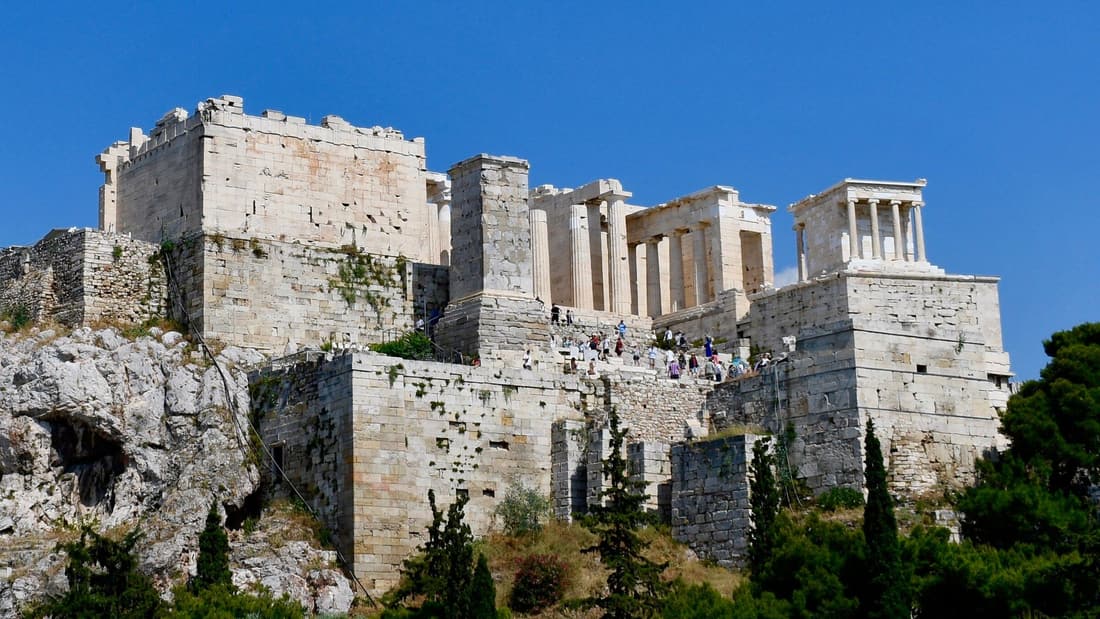
An Athens walking tour follows the streets of the historic centre on foot, from Syntagma Square through Plaka and Anafiotika to the Ancient Agora, Monastiraki and the hills that face the Acropolis. This post covers what an Athens walking tour includes, where walks start, the lanes of Plaka, the Ancient Agora, Monastiraki and the Roman Agora, the Areopagus, the Pnyx and Philopappos Hill, the monuments east of Plaka and the best season. It is one of the day tours in Greece on Greece VIP.
Each section ends with an Athens walking tour that can be booked online.
What does an Athens walking tour include?
An Athens walking tour includes the historic centre seen on foot: the old streets under the Acropolis, the pedestrian walkway that links the archaeological sites, and stops in the old neighbourhoods. The walks follow history, mythology or the lanes of the old town.
Athens is one of the oldest cities in the world, with a recorded history of over 3,400 years. Its founding myth pits Athena against Poseidon, with Cecrops as judge. Poseidon struck the ground with his trident and a salt water spring welled up, while Athena offered the first domesticated olive tree. A mythology Athens walking tour starts from this contest.
The history walk covers the Golden Age of the Athenian democracy. The playwrights Aeschylus, Sophocles and Euripides flourished then, as did the historians Herodotus and Thucydides and the philosophers Socrates and Plato. Under Pericles, Athens began a building programme that raised the Acropolis. A third kind of Athens walking tour follows old neighbourhoods such as Plaka, Anafiotika, Koukaki and Kolonaki, each with its own history.
The pedestrian walkway links the archaeological sites. The route along Dionysiou Areopagitou Street starts at the Temple of Olympian Zeus, passes the southern slopes of the Acropolis and ends beyond the Temple of Hephaestus in Thiseio. This route sets an Athens walking tour apart from a visit inside the Acropolis site: the walk stays on public streets, while an Acropolis tour climbs to the monuments on top.
- Masterplan: The Unification of Archeological Sites of Athens redeveloped parts of the centre.
- Height limits: Strict laws keep the Acropolis hill visible across the city.
- City plan: The first plan formed a triangle of the Acropolis, Kerameikos and the palace.
An Athens walking tour therefore combines three layers: the myths told about the city, the history of its Golden Age and the old neighbourhoods that grew around the rock. The pedestrian walkway joins the layers on foot, and the height limits keep the Acropolis in view from the lanes below.



Where does an Athens walking tour start?
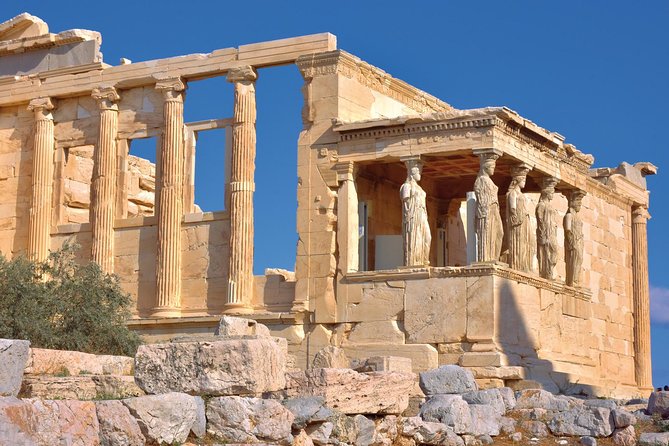
An Athens walking tour starts at Syntagma Square, the central square of Athens, in front of the Hellenic Parliament. The Tomb of the Unknown Soldier and its Evzones stand between the two, and Ermou Street leaves the square for Monastiraki.
Syntagma Square was laid out after King Otto moved the capital from Nafplio to Athens in 1834. Its first name was Palace Square. On 3 September 1843, soldiers under Dimitrios Kallergis gathered in front of the palace and demanded a constitution, and the square was renamed in memory of that day. An Athens walking tour begins where this story took place.
The Tomb of the Unknown Soldier stands in front of the palace. Fokion Rok sculpted a dead warrior with a round shield. A phrase from Thucydides says that the whole earth is the sepulchre of famous men. A torch from the monastery of Agia Lavra lit the eternal flame. Evzones of the Presidential Guard watch the tomb, and their name comes from Homer’s Iliad, meaning well-girt.
Ermou Street, a main axis of the 1833 town plan by Kleanthis and Schaubert, runs one and a half kilometres from Syntagma Square through Monastiraki, Psiri and Thiseio to the Kerameikos site. The eastern section is a pedestrian zone, and the Byzantine Church of Panagia Kapnikarea stands in a small square along it. An Athens walking tour can follow the street west.
- Borders: Amalia Avenue, Otto Street and King George I Street border three sides.
- Parliament: The Old Royal Palace has housed the Greek Parliament since 1934.
- Transport: An airport bus line and metro line 3 link the square with the airport.
Everything on this first stretch sits within walking distance of Syntagma Square: Plaka, Monastiraki, Psiri and Kolonaki, with the Acropolis beyond. For that reason an Athens walking tour in the centre begins at the square, then moves toward the old streets, and the same square also serves as the transport hub.
Which streets of Plaka does an Athens walking tour cover?
An Athens walking tour in Plaka covers Adrianou Street, Tripodon Street and the lanes of Anafiotika, with the Choragic Monument of Lysicrates on the way. Plaka is the old neighbourhood on the northern and eastern slopes of the Acropolis, built over the ancient town.
The name Plaka first appears in the second half of the 17th century. Until the reign of Otto it meant only the area around the Choragic Monument of Lysicrates, and after 1834 it grew to cover the ground between Makrygianni Street and the Ancient Agora. One theory links Plaka to an Albanian word for old, another to a plaque that marked its central intersection.
An Athens walking tour enters Anafiotika, which lies northeast of the Acropolis hill. The first houses went up when workers from Anafi came to refurbish King Otto’s palace. Refugees from Asia Minor settled there in 1922, and the state began buying the houses in 1970. The small cubic houses have white walls, and lanes end in ladders or dead ends at terraces.
The Choragic Monument of Lysicrates stands on Tripodon Street, the Street of the Tripods, and an Athens walking tour passes it. The wealthy patron Lysicrates raised it to mark a prize in the dithyramb contest of the City Dionysia in 335/334 BCE. It is the first Greek monument in the Corinthian order on its exterior, and its frieze is thought to show Dionysus and Tyrrhenian pirates.
- Albanian quarter: Plaka had a sizable Albanian community until the late 19th century.
- Preservation: A plan of the 1980s restored the area, with utilities underground.
- Tomatoes: In 1818 a friar planted the first tomato plants in Greece.
An Athens walking tour in Plaka therefore reads the district in layers: ancient streets such as Tripodon, Ottoman-era settlers, the Cycladic lanes of Anafiotika and a monument restored under the French government. Adrianou Street, Tripodon Street and the lanes of Anafiotika give the route its shape on the northeast slope of the Acropolis.
What does an Athens walking tour show at the Ancient Agora?
An Athens walking tour shows the Ancient Agora, the market and civic centre of classical Athens. Its route passes the Temple of Hephaestus on the western edge and the reconstructed Stoa of Attalos on the eastern edge, with ruins of public buildings between them.
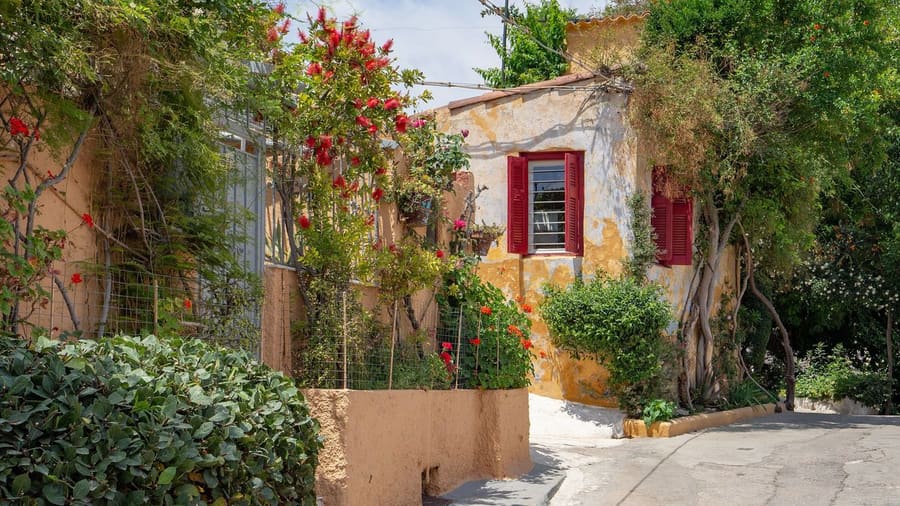
Commerce, public assemblies and housing all shared the Agora at the start. The north side held the Stoa Poikile, a 5th-century BC hall used purely for socialising. The Bouleuterion, the city’s assembly building, and the Tholos stood on the west side. The east side held shops and the Mint, which struck bronze coins in the 2nd and 3rd centuries BC.
New legislation, public events and military call-ups were posted at the Eponymous Heroes monument, which honoured the ten heroes of the Athenian tribes. A speakers’ platform, the Bema, stood near the Stoa of Attalos at the eastern side of the Agora. An Athens walking tour pauses at these two spots to show how law and public speech worked in plain public view.
An Athens walking tour stops at the Temple of Hephaestus, which honours the god of metalworking, craftsmanship and fire; potters’ and metal workers’ shops filled its neighbourhood. The Doric temple has six columns on its short sides and thirteen on its long sides. Its east pediment shows the Birth of Athena, and its west pediment shows the Return of Hephaistos to Olympos.
- Stoa of Attalos: The two-storey hall measures 115 by 20 metres.
- Rebuilding: American archaeologists rebuilt it from 1952 to 1956.
- Museum: The museum inside the stoa holds coins, sculptures and inscriptions.
During the 1800s the Temple of Hephaestus held the graves of non-Orthodox Europeans, among them philhellenes who gave their lives for Greek independence. A slab from the grave of George Watson carries a Latin epitaph by Lord Byron. King Otto made the temple a museum until 1934. An Athens walking tour reads these later layers beside classical ones.
Which sights of Monastiraki does an Athens walking tour pass?
An Athens walking tour passes Monastiraki Square, the Tzistarakis Mosque, Hadrian’s Library, the Roman Agora and the Tower of the Winds. Together these sites stack Roman, Byzantine and Ottoman layers in one small quarter of old Athens, north of the Acropolis.
Mustapha Agha Tzistarakis, the Ottoman governor of Athens, built the Tzistarakis Mosque in Monastiraki Square in 1759. Tradition says the lime came from a pillar taken from the temple to Olympian Zeus, though a column of Hadrian’s Library is the more probable source. The deed cost him his post, and an Athens walking tour tells the story in the square.
Emperor Hadrian built the library in AD 132. Its entrance was a stoa with columns of Karystian marble, and a propylon of Corinthian order opened onto a courtyard with an oblong pool. The library lay on the eastern side, where cupboards held papyrus rolls, and adjoining halls served as reading rooms. The ceilings were gilded wood and the walls marble.
An Athens walking tour reaches the Roman Agora, east of the Ancient Agora. Augustus paid, keeping a promise first made by Julius Caesar in 51 BC, and Eucles of Marathon built the square from 27 BC to 17 BC. Shops lay behind a marble colonnade on the west. Public toilets called vespasianae stood at the Ionic eastern gate, alongside the Tower of the Winds.
- Tower of the Winds: The octagonal marble tower carries eight reliefs of wind gods.
- Clock: It is the only surviving clock tower of classical antiquity.
- Tzistarakis Mosque today: It is an annex of the Museum of Greek Folk Art.
A tasting walk and a history walk cover the same lanes in different ways. A tasting walk such as an Athens food tour halts at counters and stalls, while an Athens walking tour halts at columns, inscriptions and walls. The Herulian invasion of 267 damaged Hadrian’s Library, and three Byzantine churches later rose on the site.
Which hills does an Athens walking tour climb around the Acropolis?
An Athens walking tour climbs the Areopagus, the Pnyx and Philopappos Hill, also called the Hill of the Muses. Together the three rises hold the ancient murder court, the open-air assembly and a Roman monument to a Commagene prince.
The Areopagus is the Hill of Ares, a rocky knoll lying northwest of the Acropolis. Myth held that the gods put Ares on trial on this rock after he killed a son of Poseidon. Ancient authors report that reforms of 462/461 BC left the council mainly a murder tribunal. An Athens walking tour recalls the trial of Orestes that Aeschylus set here in 458 BC.
The Pnyx lies less than 1 kilometre west of the Acropolis and looks down on the ancient Agora. The Athenian assembly met there from 507 BC, and an Athens walking tour stands where Pericles, Aristides and Alcibiades spoke from the bema, the speakers’ platform. Demosthenes attacked Philip II of Macedon from the same hill. The name means tightly packed together.
Julia Balbilla and the citizens of Athens raised the monument on Muses Hill after her brother Philopappos died in 116 AD. The same spot was held to be the burial place of Musaeus, a 6th-century BC poet. The two-storey monument measures 9.80 by 9.30 metres. Its lower frieze shows Philopappos as a consul on a chariot led by lictors.
- Meton’s observatory: The Pnyx holds the foundations of the oldest known astronomical observatory.
- Zeus Hypsistos: About 50 niches in the Pnyx rock held votive plaques.
- Saint Dionysius: A mid-19th-century cathedral near the Areopagus honours Dionysius the Areopagite.
Only two-thirds of the monument’s facade remains today. The traveller Ciriaco de’ Pizzicolli found it still intact in 1436. Excavations began in 1898, and conservation followed in 1899. Architectural parts of the monument went into the minaret built in the Parthenon under the Ottomans. An Athens walking tour that climbs all three hills passes from law to debate to memory.
Which monuments east of Plaka does an Athens walking tour reach?
An Athens walking tour east of Plaka reaches Hadrian’s Arch, the Temple of Olympian Zeus, the National Garden with the Zappeion, and the Panathenaic Stadium. Their builders include the emperor Hadrian, the senator Herodes Atticus and the Danish architect Theophil Hansen.
On an Athens walking tour, Hadrian’s Arch stands about 20 metres from the boundary wall of the Olympian Zeus sanctuary. It is 13.5 metres wide and 2.3 metres deep, and it faces the Choragic Monument of Lysicrates, 207 metres to the north-west. Stuart and Revett made the earliest and only complete study of it in 1751–53, when its base lay buried to around three feet.
The Olympieion behind the arch stood unfinished for 336 years. Peisistratus built an earlier temple around 550 BC, and his sons Hippias and Hipparchos began a larger one around 520 BC, but work stopped when Hippias was expelled in 510 BC. In 1759 the Turkish governor of Athens pulled down one column with gunpowder to make plaster for a mosque in Monastiraki.
The National Garden continues south to the area of the Zappeion. Its main entrance on Amalias Avenue sits at the 12 palms planted by Queen Amalia, and busts inside honour Ioannis Kapodistrias, the first governor of Greece, and Dionysios Solomos, author of the Greek National Anthem. Theophil Hansen designed the Zappeion, which opened on 20 October 1888 as the first building erected for the revival of the Olympic Games.
- Zeus statue: A colossal ivory and gold statue of Zeus once stood inside the Olympieion.
- Racecourse: The stadium began as a racecourse that hosted the Panathenaic Games, held every four years for Athena.
- Owls: Herodes Atticus replaced it with a marble stadium, and owls for Athena decorate its seats.
An Athens walking tour that ends at the stadium finds a site with a long modern record. Ernst Ziller excavated it in 1869–70, the Zappas Olympics took place there in 1870 and 1875, and it staged four of the nine sports of the 1896 Games. Harvard Stadium was modelled on it.
When is the best season for an Athens walking tour?
An Athens walking tour suits spring and autumn best, when downtown highs are mild and rainfall is low. Summer is hot, dry and sunny, with a strong urban heat island, while winter brings the highest rainfall and the coolest days.
Spring warms the downtown mean from 13.1 °C in March to 21.8 °C by late spring, while rainfall falls from 45.6 mm to 20.7 mm. The UV index climbs from 5 in March to 7 in April and 9 by late spring. An Athens walking tour in these months meets mild air on the open streets.
Autumn cools the downtown mean from 25.0 °C in September to 15.6 °C in November. The UV index falls from 6 in September to 4 in October and 2 in November. Elliniko, on the coast, counts 4.7 rain days in September and 10.9 in November, and its sunshine drops from 276.0 hours to 153.0 hours.
Summer runs hot, dry and bright. The downtown mean reaches 26.6 °C in June, 29.3 °C in July and 29.4 °C in August, while rainfall falls to 11.6 mm in June and 10.7 mm in July. Elliniko counts only 1.7 rain days in July and 1.6 in August, with 362.7 hours of sunshine in July.
- January: The downtown mean is 10.2 °C, and the record low is −6.5 °C.
- February: Downtown rainfall totals 44.4 mm, and the high averages 14.2 °C.
- December: Elliniko counts 13.5 rain days and 127.1 hours of sunshine.
Spring and autumn give an Athens walking tour its widest window. From September to late spring, the downtown mean stays under 26 °C and the UV index stays at 9 or below. June, July and August lift the mean to 26.6 °C and above, so the shoulder months balance temperature and sunshine best.
What do travelers ask about an Athens walking tour?
An Athens walking tour prompts five practical questions: what footwear to wear, whether children can come, whether the walk enters the Acropolis, how to handle summer heat and how to add a museum visit. Official sources answer each one.
What footwear suits an Athens walking tour?
The Ministry of Culture recommends footwear suitable for walking at archaeological sites. An Athens walking tour reaches the Panathenaic Stadium, a marble stadium set in a natural ravine. Small backpacks and handbags are allowed on the Acropolis site, while its cloakroom refuses large luggage.
Can children join an Athens walking tour?
Families find places set up for children along the route. The National Garden holds a duck pond, a botanical museum, a children’s library and a playground. The Acropolis Museum lends strollers at its cloakroom and offers family trails and family backpacks.
Does an Athens walking tour enter the Acropolis site?
Entry to the Acropolis site is a separate step from a walk through the streets below. The Ministry lists the Acropolis metro station with Dionysiou Areopagitou Street as one access route, and Monastiraki station with a path through the Ancient Agora or Plaka as another.
Is an Athens walking tour practical in summer heat?
Downtown records stand at 44.8 °C in June, 42.8 °C in July and 43.9 °C in August. The UV index reaches 10 in June, and the strong urban heat island adds to the summer heat. An Athens walking tour in a heat wave meets the hottest conditions of the year.
Can an Athens walking tour include a museum visit?
The Acropolis Museum takes group bookings for 16 to 40 persons with a bus drop-off point on Hatzichristou Street and a group entrance on Mitseon Street. Every visitor passes the ticket validation machines, and the museum recommends avoiding large bags.
Featured photo: Trajan 117 CE, CC0, via Wikimedia Commons.