A Delphi Meteora tour links two of the great sites of central Greece in one journey from Athens: the sanctuary of Apollo at Delphi on the slopes of Mount Parnassus, and the monasteries of Meteora on their rock pillars above Kalambaka. This post covers what a Delphi Meteora tour includes, the route and the stops on the way, the sanctuary, the theatre and the Tholos, the Delphi museum, Arachova, Hosios Loukas, the oracle, Kalambaka, the monasteries, the geology and monastic life of Meteora, the history, the choice of rail or road and the best season. It is one of the Greece tours on Greece VIP.
Each section ends with a Delphi Meteora tour that can be booked online.
What does a Delphi Meteora tour include?
A Delphi Meteora tour links two UNESCO World Heritage Sites in central Greece: the ancient sacred precinct of Delphi on Mount Parnassus and the rock monasteries of Meteora in Thessaly. One itinerary joins the oracle’s sanctuary to the monastery pillars above Kalambaka.
Delphi was an ancient sacred precinct and the home of the Pythia, the major oracle consulted about important decisions throughout the classical world. Wikipedia links the name Delphi to the Greek word for womb, delphys, and the serpent name Python to a verb meaning to rot. A Delphi Meteora tour counts the sanctuary as one of two UNESCO sites, listed because the monuments of the leading city-states show their shared Hellenic unity.
Meteora is a rock formation in the regional unit of Trikala, in Thessaly. Builders set monasteries on its pillars and rounded boulders, chiefly in the later 14th century. Four are occupied today and open to visitors, and the six extant houses entered the UNESCO list in 1988 for outstanding architecture and beauty joined to religious and cultural significance, so a Delphi Meteora tour pairs two different grounds for listing.
The two sites also share a history. The Amphictyonic Council that controlled Delphi and the Pythian Games drew its representatives of six Greek tribes from Thessaly and central Greece. Those are the two regions that a Delphi Meteora tour joins today. Delphi stands beside Greek National Road 48, while Meteora stands in the north-west corner of the Plain of Thessaly, close to the Pineios river and the Pindus range.
A single-site outing such as the Delphi day trip from Athens centres on the sanctuary alone. A Delphi Meteora tour keeps the sanctuary and then carries on north to the monasteries, so the road itself becomes part of the tour. Lamia, the capital of Central Greece, and Trikala, the capital of its own regional unit, sit between the two sites.
- Coach: A coach Delphi Meteora tour moves by road, and KTEL intercity buses already link Trikala with Athens and Thessaloniki.
- Private car: A private-car Delphi Meteora tour follows the A1 motorway, which bypasses Lamia to the south-east, and the A3 motorway, which branches off near Anthili.
- Rail: A rail Delphi Meteora tour relies on the Kalabaka line, which marks the north-west end of the old Thessaly Railways network.
Three regional units frame the route. Boeotia belongs to the Central Greece region, Phthiotis has Lamia as its capital, and Trikala belongs to Thessaly. A Delphi Meteora tour therefore leaves Central Greece for Thessaly within one itinerary. The two sites also differ in age: the first temple at Delphi that archaeology can attest dates from the seventh century BC, while the monasteries date from the 14th century.


Which route does a Delphi Meteora tour take from Athens?
A Delphi Meteora tour leaves Athens on the road north-west through Boeotia, past Thebes and Livadeia, and reaches Delphi on National Road 48. It runs on through central Greece, by way of Lamia and the A3 motorway past Trikala, to Kalambaka at the foot of Meteora.
Boeotia is the first regional unit on a Delphi Meteora tour. It lies north of the eastern part of the Gulf of Corinth and has a short coastline on the Gulf of Euboea. Mount Parnassus rises in the west, Mount Helicon in the south-west, Cithaeron in the south and Parnitha in the east. The Cephissus is its longest river, and Lake Copais, a large lake at the centre, was drained in the 19th century.
Thebes is the largest city of Boeotia. In 395 BC Thebes supplied four Boeotarchs to the Boeotian League, while Orchomenus, Hysiae and Tanagra supplied one each, and the federal council sat in the city. Legend says Cadmus founded Thebes and brought the alphabet to Greece, and Sophocles built Oedipus Rex and Antigone on Theban myth. A Delphi Meteora tour passes the city on the way north-west.
Livadeia is the capital of Boeotia and the next named town on the road. It lies 44 km east-south-east of Amfissa and 63 km south-east of Lamia, and National Road 48 links it to National Road 3. The area is mountainous, and the town is traditionally tied to cotton, tobacco, cereal crops and livestock. Pausanias recorded a statue by Praxiteles in the temple of the hero Trophonios, and the cathedral of St George holds a relic head returned in 1999.
Delphi stands on National Road 48 between Amfissa in the west and Livadeia in the east. North of Livadeia lies Lamia in Phthiotis, and beyond it the city of Trikala, which is close to both Meteora and Kalambaka. Meteora municipality has its seat at Kalabaka, which had a population of 11,492 at the 2021 census. The province of Kalabaka had the same territory as that municipality and was abolished in 2006.
- Delphi road: National Road 48 joins Amfissa in the west to Livadeia in the east and passes the ancient precinct and the modern town of Delphi.
- Highway north: On a Delphi Meteora tour the A1 motorway bypasses Lamia to the south-east, while the A3 motorway bypasses the city to the south-west.
- Final approach: Kalabaka occupies the south-west base of the Meteora massif, and the massif lies wholly inside the Kalabaka municipal unit.
Boeotia counted Pindar, Hesiod, Epaminondas, Pelopidas and Plutarch among its great men, and Hesiod’s Works and Days describes its early economy. Meteora, by contrast, appears in neither classical Greek myth nor ancient Greek literature. A Delphi Meteora tour therefore moves from a region crowded with ancient legend to a rock formation that entered the record through hermit monks.
Which stops lie between Delphi and Meteora on a Delphi Meteora tour?
A Delphi Meteora tour passes three named places between its two sites: Thermopylae, the narrow pass with the Leonidas monument; Lamia, the capital of Central Greece; and Trikala, the city on the Lithaios river that lies close to Meteora, each on the road north.
Thermopylae means hot gates, a name from hot sulphur springs that still lie close to the foot of the hill. The pass and modern town lie in Lamia, in Phthiotis. The A1 motorway follows the ancient shoreline and splits the pass, and a modern monument to King Leonidas I of Sparta stands on the east side of the highway, across from the hill where the epitaph of Simonides is cut in stone. A Delphi Meteora tour crosses this ground.
The battle of 480 BC took place on ground that now lies under 20 metres of soil. Sediment from the Spercheios river and travertine from the hot springs pushed the shoreline out by as much as 9 km, and the narrowest point on the plain measured under 100 metres across. A Greek force of about 7,000, including 300 Spartans, held this route against the Persians under Xerxes until a goat path, the Anopaea Pass, let the invaders outflank it.
Lamia is the capital of the Phthiotis regional unit and of the Central Greece region. The city had 47,529 inhabitants at the 2021 census and sits on the lower slopes of Mount Othrys, near the river Spercheios. In antiquity its position controlled the narrow coastal plain above Thermopylae that joined southern Greece with Thessaly, the same link that a Delphi Meteora tour follows today. Antipatros took refuge behind its walls when the Lamian War began in 323 BC.
Trikala is a city in north-western Thessaly that straddles the Lithaios river and had 62,064 inhabitants at the 2021 census. The city is considered the birthplace of Asclepius, and Strabo ranked its Asklepieion first in both significance and age among such sites in Greece. A Byzantine castle built by Justinian in the 6th century crowns the old acropolis, and a clock tower from 1936 is the trademark of Trikala, the last city on a Delphi Meteora tour before the rocks.
- Amphictyony: The first known Amphictyony, a religious group of Greek tribes, centred on the cult of Demeter at Anthela, near the stop at Thermopylae on a Delphi Meteora tour.
- Sacred War: In the Third Sacred War the forces of the Delphic Amphictyonic League, led by Thebes and later by Philip II of Macedon, fought the Phocians.
- Gallic raid: In 279 BC a Gallic army led by Brennus engaged the Aetolians at Thermopylae, and the Gallic invasion under Brennus was repelled at Delphi.
Trikala also ties the road to the monasteries. Symeon Uroš set up his court there in 1359, and in 1366/7 he founded the Meteora monasteries nearby. The same ruler sponsored the monastic community at Meteora from Trikala, so the last named stop on a Delphi Meteora tour already belongs to the story of the rocks. The city lies next to the A3 motorway.
What does a Delphi Meteora tour see at the sanctuary of Apollo?
A Delphi Meteora tour sees the Sacred Way, the treasuries built by Greek city-states, the Athenian Treasury and the Temple of Apollo. These stand on the southwestern slope of Mount Parnassus, in the sacred precinct that served as the seat of the Pythia.
The Sacred Way is the main path of the sanctuary, and a Delphi Meteora tour climbs it toward the Temple of Apollo. In antiquity, visitors started at the Castalian Spring, where they purified themselves before they entered. The road then rose past votive statues and treasuries. In late antiquity, the same road stayed the main street of the settlement, but it served trade and workshops instead of pilgrims.
The treasuries held offerings from major Greek states, and Athens, Corinth, Boeotia and Thebes are among the states that built them. The people of Siphnos gave a tithe of their silver yield until the sea flooded the workings and ended the mines. The treasury of Argos, completed in 380 BC, was one of the largest. A Delphi Meteora tour passes the sites of these buildings on the way up.
The Athenian Treasury was the first building that Athens dedicated at a Panhellenic sanctuary. Its thirty metopes show the labors of Theseus and Heracles, and each one is 67 cm tall. They form the earliest surviving pairing of the two heroes. Scholars date the building between 510 and 480 BCE, although Pausanias tied it to the Battle of Marathon. A Delphi Meteora tour sees the stoa beside it, built in the Ionic order to house war trophies.
The Amphictyonic council met before the fifth temple of Apollo was built and set the budget at 300 talents. The people of Delphi paid a quarter, and donations from other states covered the rest. The contract named Spintharius of Corinth as architect and called for limestone, but a rise in the budget is said to have allowed columns of white Parian marble. The temple was Doric, with a six-by-fifteen column peristyle, and a Delphi Meteora tour stands before its ruins.
- Pediments: The east pediment showed Apollo, Artemis and Leto, and the west pediment showed Dionysus among the Thyiades.
- Shields: Persian shields from Marathon and Gallic shields from the invasion of 279 BC were attached to the outside.
- Cella: Its floor of blue-grey limestone slabs was at times washed with water from the Castalian Spring.
The wealth stored in these buildings shaped the history of the site. Croesus, king of Lydia, dedicated wealth to the temple. In the Third Sacred War, the Phocians seized the temple goods in 357 BC, and they are estimated to have spent 10,000 talents. A Delphi Meteora tour stands where this wealth once lay, before Theodosius I ordered the temple destroyed in 390.
What does a Delphi Meteora tour see at the theatre, the stadium and Athena Pronaia?
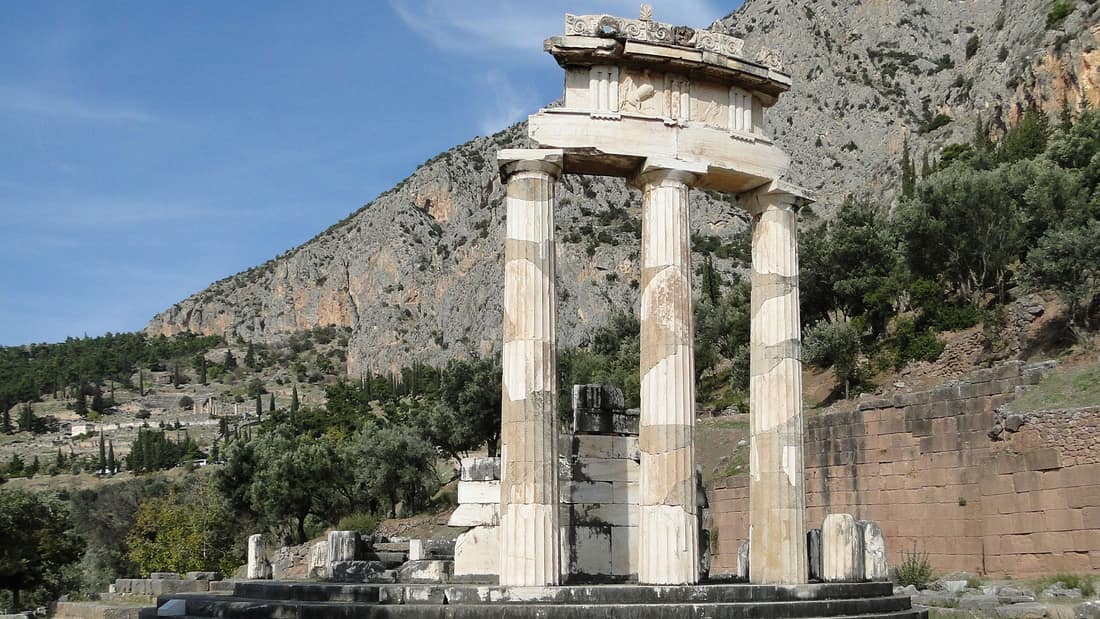
A Delphi Meteora tour sees the theatre and the stadium on the hillside above the temple, then the sanctuary of Athena Pronaia and its Tholos. The Tholos is a round building of the fourth century BC, set in a sanctuary that travelers from the east met first.
The seating area of the theatre leans against the natural slope of the mountain, and a Delphi Meteora tour climbs to it above the temple. Its orchestra began as a full circle seven meters across. The stage building ended in two arched openings, and their foundations survive. Side corridors called parodoi led to the seats, and their walls carry large numbers of inscriptions that record fictitious sales of slaves to the god.
In the late Hellenistic and Roman period, the theatre hosted the vocal and musical contests of the Pythian Games. Nero visited Greece in 67 AD, and the orchestra was then paved and fenced with a stone parapet. A low pedestal called the pulpitum replaced the proscenium, and its front showed scenes from myths about Hercules. A Delphi Meteora tour sees the theatre where the Delphic Festivals of 1927 and 1930 staged plays. Landslides later threatened its stability, so it has been restored again.
A Delphi Meteora tour reaches the stadium farther up the hill, beyond the Sacred Way and the theatre. The last major remodelling came in the second century AD, with Herodes Atticus as patron, when the stone seating and an arched entrance were built. The chariot races of the Pythian Games took place in a separate hippodrome. Archaeologists sought it for over two centuries before traces came to light at Gonia, on the plain of Krisa.
The sanctuary of Athena Pronaia was the first one that a visitor reached on foot by the eastern road, and its name means “the one before” the temple of Apollo. Excavations show an older cult site on the spot, possibly dedicated to Gaia. Mycenaean figurines now in the museum, including a seated figure on a tripod, were found here. A Delphi Meteora tour adds this sanctuary to the visit of the main ruins.
- Temple B: Built around 510 BC, it measured 13.25 by 27.46 meters, and fifteen of its columns still stood in 1905.
- Temple C: A Delphi Meteora tour sees only the foundations of this limestone temple, built around 360 BC, and scholars debate whether it served Athena or Artemis.
- Tholos: Eight female statues decorated its marble roof, and later builders reused its smoothed reliefs as tomb covers.
Pausanias described the row of temples in the second century AD. He called the fourth the temple of Athena Pronoia, with two images, and one of them was a bronze offering of the Massiliots. He also wrote that the Delphians said Philomelos had stolen the gold shield of Croesus. A Delphi Meteora tour sees what remains of this row, which stopped working when pagan shrines were closed.
What does a Delphi Meteora tour see in the Delphi museum?
A Delphi Meteora tour sees the Charioteer of Delphi, the Sphinx of Naxos and the Omphalos in the Delphi Archaeological Museum, which holds finds from the sanctuary dating from the Late Helladic, or Mycenaean, period to the early Byzantine era.
The museum that a Delphi Meteora tour enters began as a small building inaugurated in 1903, to mark the end of the first great campaign of French excavations. A trust set up by the Greek banker Andreas Syngros paid for it. The first display used plaster restorations of the main monuments, and Pierre de La Coste-Messelière later discarded them. In 1998 the museum received more than 300,200 visitors, close behind the 325,000 of the National Archaeological Museum of Athens.
The Charioteer of Delphi, also called Heniokhos, the rein-holder, has a room of its own, Room 13. The figure shows a young man after the race, during the victory parade, wearing the champion’s headband. His fingers curve around the reins. On discovery, the figure had a blue surface, and a century indoors turned it green. A Delphi Meteora tour sees in this statue the shift from the Archaic kouros to the Early Classical Severe style.
The Charioteer wears a long tunic called the xystis that reaches the ankles. A wide belt holds it high above the waist, and two bands cross on the back like suspenders. This arrangement, the analavos, keeps the garment from billowing during the race. The deep pleats of the lower tunic resemble the fluting of an Ionic column. On a Delphi Meteora tour, the Charioteer stands out as clothed from head to foot, since athletes were shown nude, and one suggestion is that he was a household slave.
The first fragments of the Sphinx of Naxos came out of the sanctuary in 1860, and the rest was found in 1893. Naxos, one of the richest Cycladic islands, set it up as an offering. The sculptor carved it from Naxian marble and shaped it in the round, an early example, rather than in relief. It stood on a tall Ionic column close to the Halos. A Delphi Meteora tour sees a guardian figure of the kind that flanked temple entrances.
- Inscription: The limestone base of the Charioteer carries a hexameter text that begins with the words “Polyzalus dedicated me.”
- Omphalos: Room 11 shows it, and Parke described the stone as egg-shaped and kept in the innermost sanctuary of the temple.
- Exit: A Delphi Meteora tour passes the inscription that names the Roman proconsul Gallio next to the way out.
The Omphalos links the museum to the myth of the oracle. Erwin Rohde wrote that the Python was an earth spirit, conquered by Apollo and buried under the omphalos. The museum also holds the earliest known notation of a melody. A Delphi Meteora tour that includes the museum matches each object with its place in the ruins outside.
Why does a Delphi Meteora tour stop at Arachova and Mount Parnassus?
A Delphi Meteora tour stops at Arachova and Mount Parnassus because the town lies close to Delphi and the range was sacred ground. The Oracle of Delphi sits on the southern slopes of Parnassus, and Arachova draws visitors for its mountain setting and traditions.
The Delphi Meteora tour reaches Arachova high on the south side of Mount Parnassus, in western Boeotia. The municipal unit covers 139.448 square kilometres. The town lies 9 km northwest of Distomo, the town near Hosios Loukas, and 18 km southeast of Amfissa. A map search can mislead, since Caryae, a town in the southern Peloponnese, once carried the name Arachova too.
A traveller on a Delphi Meteora tour meets a temperate climate here. Snow falls in winter, but the sheltered position brings less than the north side of Parnassus gets at similar heights. Summers are warm, with pleasant nights. A large clock, 10 m in height, tops the ivy-covered Bell Tower on the cliff in the town centre. Loukas Papaioannou, a medical doctor and professor who lived from 1831 to 1890, appears among the notable people of the town.
A Delphi Meteora tour follows a long line of travellers. A report dated 17 March 1889 describes one of them, Paul Lefaivre, who published memoirs of an excursion to Delphi in the Revues des Deux Mondes. He wrote that in Arachova the Greek type was kept intact and that the men looked more like athletes than farmers, with builds suited to running and wrestling. He also praised an old woman who reset a companion’s dislocated arm.
Mount Parnassus is a limestone range that also holds bauxite ore, mined since the end of the 1930s at a cost to part of the mountain. It joins Mount Giona to the northwest and Mount Kirphi to the south. The valley of the Boeotian Cephissus bounds it on the east, and the valley of Amfissa on the west. Homer’s Iliad cites its ancient communities, so a Delphi Meteora tour crosses ground known to the earliest Greek poetry.
- Flood myth: Survivors of Deucalion’s flood followed howling wolves up the slope and founded Lycoreia.
- Orpheus: Apollo gave the young Orpheus a golden lyre on the mountain and taught him to play it.
- Odysseus: The Odyssey has Odysseus recall a boar hunt on Parnassus, where he was gored in the thigh.
- Montparnasse: A Delphi Meteora tour visits the range whose name the Paris quarter of Montparnasse borrowed.
A Delphi Meteora tour that stops here links the sanctuary to its setting. The oracle was sacred to Apollo, and the mountain became linked with him. Greek tradition also made Parnassus the home of the Muses, so the range stood for poetry, music and learning. In Arachova, the same stop shows a living town with its own customs, climate and history.
What is Hosios Loukas on a Delphi Meteora tour?
A Delphi Meteora tour that calls at Hosios Loukas visits a walled Byzantine monastery near Distomo in Boeotia, founded in the 10th century. UNESCO has listed it since 1990, and its main church keeps the best preserved set of Macedonian Renaissance mosaics.
The monastery takes its name from Hosios Loukas, Venerable Luke, a hermit from Steiris. He died on 7 February 953 and is a different Luke from the Evangelist. The hermit became known for predicting the conquest of Crete by an emperor named Romanos. Nicephorus Phocas retook the island under Romanos II. The Church of the Theotokos, a stop on a Delphi Meteora tour, is believed to date from that reign, between 959 and 963.
The tomb of the saint is the chief shrine, first set in the vault and later moved between the two churches. The community grew wealthy because the relics were said to give off myron, a perfumed oil that healed the sick. Pilgrims slept beside the tomb to seek healing, a practice called incubation. On a Delphi Meteora tour, the mosaics around the tomb show the saint and the abbot Philotheos, who offers him a likeness of the new church.
On a Delphi Meteora tour, the oldest church in the complex is the only one in mainland Greece known with certainty to date from the tenth century on its site. Its walls mix brick, stone and marble, and they carry pseudo-kufic patterns. The larger Katholikon stands on eight piers around the nave. A dome without a drum rests on four squinches, and galleries and chapels surround the main cube on all four sides.
Hosios Loukas is the largest of three Middle Byzantine monasteries that survive in Greece, beside Daphnion and Nea Moni, and UNESCO lists all three. It differs from the other two because it honours one military saint. The mosaics a Delphi Meteora tour sees are the best preserved of the Macedonian Renaissance, though the image of Christ Pantocrator in the dome and the archangels between the upper windows are lost.
- Burial crypt: Stairs on the southern side lead down to nine groin-vaulted bays and forty medallion portraits.
- Crypt cleaning: A Delphi Meteora tour reaches a crypt cleaned in the 1960s, when the Greek Archaeological Service found its frescoes well preserved.
- Latin rule: In 1206, under the Latin Empire, a legate gave the monastery to the canons of the Holy Sepulchre.
The monastery was known across Byzantium for lavish decoration. Carving, gold and silver plate, murals, icons, chandeliers, silk curtains and altar cloths filled the interior, and only a fraction survives, notably coloured marble facings and window grilles. A Delphi Meteora tour therefore reaches a church that one assessment calls the best available impression of a church interior from the first centuries after Iconoclasm.
What does a Delphi Meteora tour tell of the oracle and the Pythia?
A Delphi Meteora tour tells of the Pythia, priestess of the Temple of Apollo and voice of the Oracle of Delphi from the 8th century BC at the latest. Priests turned her words into verse, and consultations lasted until Theodosius I destroyed the temple.
The name Pythia comes from a Greek phrase for priestess of the Pythian Apollo and links to Python, the serpent Apollo killed near the site. A Delphi Meteora tour hears the earliest account of the oracle’s start in the Homeric Hymn to Delphic Apollo, dated to about 580 to 570 BC. In it, Apollo leaps aboard a ship of Cretans from Knossos in the form of a dolphin and leads them to Delphi as his first priests.
A Delphi Meteora tour starts the priestess story with a gap, since little is known about how a Pythia was chosen. Scholars think a guild of temple priestesses supplied her, all natives of Delphi who led a sober life. On taking office, she gave up family duties, marital relations and her own identity. The archaeologist John Hale reports that Pythias were sometimes noble and sometimes peasants, so aptitude counted more than status. The post brought freedom from taxation, a salary and housing.
Petitioners carried laurel branches up the Sacred Way with a young goat and a fee. At the hearth of Hestia, the goat was sprinkled with water, and a goat that shook it off gave a good omen. A Delphi Meteora tour recounts that the Pythia then sat on a tripod in the adyton, with laurel leaves in hand and a dish of water from the Kassotis spring, near the omphalos and its two gold eagles.
The trance is a question a Delphi Meteora tour cannot settle. Ancient writers linked it to vapours, and Plutarch tied them to the Kerna spring beneath the temple. French excavators who began work in 1892 found no fissure, and Adolphe Paul Oppé argued in 1904 that no chasm had ever existed. Later, an interdisciplinary team found two faults, the Kerna and the Delphic, crossing below the probable site of the adyton. Lehoux argues that ethylene is impossible.
- Homer: In the Odyssey, Agamemnon walks across a stone floor at Pytho to hear a prophecy from Apollo.
- Hesiod: Late in the eighth century, the poet visited Parnassus and was shown the omphalos.
- Plutarch: A session with bad omens went ahead anyway, and the priestess died days later.
- Oreibasius: The doctor asked about the fate of paganism and heard that Apollo had no home, laurel or speaking fountain left.
Details of how the Pythia worked are scarce, because writers of the sixth to fourth centuries BC treated the process as common knowledge. The accounts that survive in detail date from the first century BC to the fourth century AD and conflict. A Delphi Meteora tour therefore pairs firm sources with open questions. Cicero noted that no expedition set out and no colony was sent without the sanction of the oracle.
Where does a Delphi Meteora tour stay near Meteora?
A Delphi Meteora tour stays in Kalambaka, the town, or in Kastraki, the village, which stand on either side of the Meteora rocks. Kalambaka sits at the foot of the massif on its south-west side, and Kastraki occupies a small valley leading into that same side.
Kalambaka is the town base. The 2021 census counted 11,492 people for Kalabaka, and 8,573 of them lived in the town proper. A reform in 2018 renamed the municipality Meteora and made Kalabaka its seat. The medieval name of the town was Stagoi, first mentioned in the Diatyposis of Leo VI the Wise, who reigned from 886 to 912. A reference of 1163 mentions its castle. A Delphi Meteora tour that stays here sleeps in a town older than the monasteries above it.
A Delphi Meteora tour in Kalambaka stays in a town that changed rulers repeatedly. Stagoi fell under the Despotate of Epirus in 1204 and under the Duchy of Neopatria at the end of the 13th century. John II Orsini retook it in 1334, and the Byzantine Empire regained it soon afterwards. The Serbs of Stephen Dushan conquered it in 1348, and it reached its peak under King Simeon Uroš. The Ottomans later placed it under the Pasha of Larisa and then the Sanjak of Trikala.
Kastraki offers the other base, set inside the rocks. The cliffs around the village hold the sites of historic monasteries and hermitages. Modi was the site of the Monastery of St. Modestus, and Alysos held the Monastery of the Apostle Peter’s Chains. Pyxari carried the hermitages of Saint Gregory the Theologian, St. Anthony and Chrysostomos, and Badovas the hermitage of St. Nicholas of Badovas. A Delphi Meteora tour that stays in Kastraki sleeps among these named rocks.
The evening belongs to the rocks from either base. The entire Meteora massif belongs to the single municipal unit of Kalabaka, and the seven other municipal units around it lie outside the massif. Both Kalambaka and Kastraki are communities of that unit. A Meteora sunset tour is the natural way to spend that evening after the day of a Delphi Meteora tour.
- Spellings: English texts write the town as Kalabaka, Kalambaka, Kalampaka or Kalabaki.
- Bishopric: The see of Stagoi lasted until 1900, when it merged with Tricca, and returned in 1991.
- Twin towns: Kalambaka is twinned with Schwabach in Germany, Le Haillan in France and Mioveni in Romania.
- Delphi Meteora tour base: Kastraki lies 275 metres above sea level, and the first Meteora MTB Race took place in the village in 2016.
A Delphi Meteora tour therefore has two bases below the same rocks. Kalambaka offers a medieval town with a bishop’s seat, and Kastraki offers a valley village ringed by the sites of lost hermitages. Either base keeps the next monasteries close, since Varlaam stands in the Pineios valley to the northeast of Kalambaka.
What does a Delphi Meteora tour see at Great Meteoron and Varlaam?
A Delphi Meteora tour sees the two largest monasteries of Meteora at Great Meteoron and Varlaam. Great Meteoron is the oldest and largest and holds the biggest manuscript collection, while Varlaam is the second largest and keeps a museum of relics and church treasures.
Great Meteoron has the clearest founder. Athanasios Koinovitis came from Mount Athos, was later called Athanasios the Meteorite, and arrived with followers in 1344. Between 1356 and 1372 he built the monastery on the Broad Rock. The site kept the monks safe and gave them control of the entry, because the only way up was a long ladder that was drawn up when a threat appeared. A Delphi Meteora tour now reaches the same rock by steps that were cut into the stone in the 1920s.
The first building was a church dedicated to the Virgin Mary, and small cells for the monks followed. The second church, dedicated to the Transfiguration, gave the monastery its second name. The library holds the largest manuscript collection at Meteora. N. Veis catalogued 1,124 codices at the six monasteries, and 610 of them were recorded at Great Meteoron, more than half of the total. A Delphi Meteora tour meets that collection in the oldest house of the group.
A Delphi Meteora tour reaches Varlaam, named for a monk who scaled the rocks in 1350 and built three churches, hoisting the materials up the cliff. The monastery then stood abandoned for two hundred years. In October 1517 two brothers from Ioannina, Theophanes and Nektarios Apsarades, began to rebuild the churches. The hoisting took them twenty-two years, yet the building itself is said to have taken around twenty days. Varlaam is also known as Agion Panton, or All Saints.
The Varlaam museum on a Delphi Meteora tour is open to travellers and holds a wide array of relics and ecclesiastical treasures. Tradition holds that the monastery kept the finger of St. John and the shoulder blade of St. Andrew. A series of ladders on the north side of the rock now gives access. UNESCO calls the net that once hoisted pilgrims up the 373-metre cliff a symbol of a fragile traditional way of life.
- John the Baptist: The chapel of Saint John the Baptist lies next to the katholikon sanctuary of Great Meteoron.
- Constantine and Helen: This chapel at Great Meteoron is an aisle-less church with a large vault.
- Heights: On a Delphi Meteora tour, Great Meteoron stands 613 metres above sea level and Varlaam 595 metres.
- Dragon Cave: The Dragon Cave lies south of Varlaam, below the monastery.
At Great Meteoron the Delphi Meteora tour meets a monastery with a named founder, a dated start and the largest library of the six. At Varlaam it meets a house that was rebuilt after two centuries of emptiness and now keeps a museum. The two are the largest houses of Meteora.
Which other monasteries does a Delphi Meteora tour pass?
A Delphi Meteora tour passes four other monasteries beyond the two largest: Rousanou, St Stephen, Holy Trinity and St Nicholas Anapausas. Together with Great Meteoron and Varlaam they make up the six monasteries of the Meteora World Heritage Site, inscribed by UNESCO in 1988.
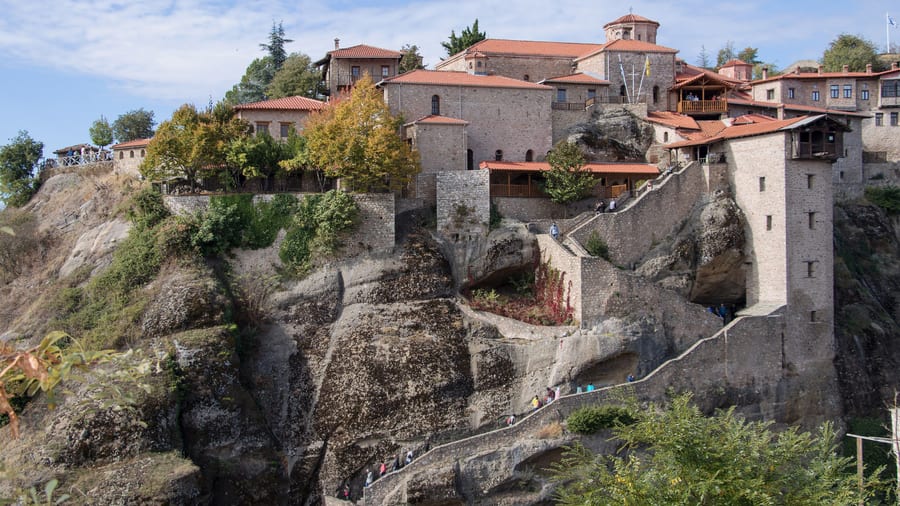
Rousanou stands in the middle of the site. Its name is believed to come from the first monks on the rock, who came from Russia, and Arsanou is a second name. Tradition places its start in the 14th century, and the cathedral received its decoration in 1540. A Delphi Meteora tour that stops here looks across to the neighbouring houses and to the ruins of two more, Saint John the Baptist and the Pantokrator. The Psaropetra viewpoint lies to the south-east, beside a main road.
St Stephen sits on a plateau-like rock below Kukulas peak and, with Holy Trinity, stands apart from the main group. The church interior received frescoes for a short period after 1545. A new katholikon followed in 1798, and the monastery became a nunnery in 1961. The world wars brought heavy bombing and ransacking to the monasteries, in the belief that the monks were holding refugees. A Delphi Meteora tour passes the newest structure of Meteora here.
On a Delphi Meteora tour, Holy Trinity names its own benefactors. Damascene, Jonah and Parthenios took part in its restorations, and their names grace the monastery walls. A fresco of St Sisois and the skeleton of Alexander the Great adorns the walls. At one time fifty monks lived at Holy Trinity, but by the early twentieth century only five remained. The monastery features in a 1981 James Bond film.
A Delphi Meteora tour passes St Nicholas Anapausas, which pilgrims encounter before any other house on the road to Meteora, on a narrow rock about eighty metres high. It was founded in the late 14th century and served as a resting place, which gave it the name Anapausas. The floors are joined by an interior staircase, and St Nicholas is honoured on the second floor, where the katholikon stands. The third floor holds the Holy Table and walls with 14th-century frescoes.
- Rousanou: The rock rises to 484 metres above sea level, at the centre of the site.
- St Stephen: Its workrooms serve painting, embroidery, incense-making and needlework.
- Holy Trinity: A road runs to the rear of the cliff, and tunnels with 130 stone steps lead to the entrance.
- St Nicholas Anapausas: The monastery was restored in the 16th century and again in the 1960s.
The four smaller monasteries add detail to a Delphi Meteora tour. Rousanou gives the central view, St Stephen and Holy Trinity stand apart on their own rocks, and St Nicholas Anapausas greets pilgrims first. Each house adds its own dates, frescoes and rooms, and together with Great Meteoron and Varlaam they complete the six that UNESCO protects.
How did the rocks form on a Delphi Meteora tour?
A Delphi Meteora tour reaches rock pillars of sandstone and conglomerate, not volcanic stone. Streams piled up gravel, sand and mud at a lake-edge delta, earth movements lifted the beds about 60 million years ago, and weathering along vertical faults cut the towers.
Conglomerate is a sedimentary rock that packs rounded gravel from older rock into a finer sediment of sand, silt or clay. Geologists call the large pieces clasts and the fine filling the matrix. Calcium carbonate, iron oxide, silica or hardened clay cements the two together. A rock needs at least 30 percent clasts wider than 2 millimetres to count as conglomerate. A Delphi Meteora tour meets this rock at Meteora, where the pillars mix sandstone and conglomerate.
The shape of the clasts names the rock. Largely rounded or subrounded gravel makes a conglomerate, while largely angular gravel makes a breccia. The way the clasts sit also matters. Orthoconglomerates have touching clasts, tend to be well cemented and link to water currents. Paraconglomerates hold clasts that float apart in the matrix and form as glacial till or debris-flow deposits. The Meteora account credits streams and a delta, so a Delphi Meteora tour looks at the water-laid kind.
Clasts deposited in rivers are well rounded and poorly sorted, and flowing water carries them as bedload only at times of high flow. The largest clast shrinks with distance through attrition, so conglomerates belong more to immature river systems. The conglomerate article estimates that conglomerates make up under 1 percent by weight of all sedimentary rocks, so a Delphi Meteora tour crosses an uncommon stone.
Other conglomerate landscapes show how erosion treats this rock. Montserrat near Barcelona has vertical channels cut by erosion, and they give the mountain its jagged outline. At Meteora, rock falls pose a constant threat to pilgrims and tourists. A magnitude 7 earthquake struck in 1954 and left the thin pillars standing, and a massive rock fall in 2005 shut the access road to Meteora. A Delphi Meteora tour therefore passes a stone that is still moving.
- Plants: A Delphi Meteora tour sees vegetation growing thickly from the vertical walls, fed by water in the cracks.
- Kata Tjuta: The domed hills of Kata Tjuta in Australia’s Northern Territory are conglomerate.
- Mars: A rover on Mars found conglomerate slabs laid down by a stream that flowed at walking pace.
A Delphi Meteora tour therefore reads as a short lesson in sedimentary rock. Water built the pillars from rounded gravel, sand and mud, natural cement bound the pieces, uplift split the mass, and weathering along vertical faults carved the separate columns. Meteora stands out because the weathering cut sharply downward within a small area.
What monastic life does a Delphi Meteora tour see?
A Delphi Meteora tour sees monks and nuns who live and pray in working Eastern Orthodox houses on the Meteora rocks. Four of the original monasteries are occupied and open to visitors, and rock-cut steps now replace the ladders, nets and baskets of earlier centuries.
Monks and nuns still occupy four houses: the Great Meteoron, Varlaam, Holy Trinity and Saint Stephen. Saint Stephen has been a nunnery since 1961, and it keeps workrooms for painting, embroidery, incense-making and needlework. Its older refectory now serves as a museum. Byzantine monasteries worked as studios of religious art, where monks made miniatures, manuscripts, paintings and goldsmith work, so a Delphi Meteora tour sees craft as well as prayer.
Orthodox monastic life rests on written rules. Saint Basil the Great founded a monastery about 356 on the banks of the Iris river in Cappadocia and composed the Asketikon for it. Around the year 800, Theodore the Studite drew up constitutions for the Studium monastery in Constantinople. Basil’s Asketikon, Theodore’s Constitutions and the canons of the Councils form the chief part of the Greek tradition that a Delphi Meteora tour meets at Meteora.
The Great Meteoron stands on the Broad Rock, where the only way up was a long ladder that the monks drew up whenever a threat appeared. Other houses hauled up goods and people in large nets, and baskets and ropes carried loads until the 1600s. A Delphi Meteora tour no longer rides a net, yet UNESCO calls the net that lifted pilgrims along the Varlaam cliff a symbol of the fragility of a traditional way of life.
Visitors enter working places of worship, and modest dress follows from that: covered shoulders and knees, in keeping with the custom of Orthodox churches. Steps cut into the rock in the 1920s, together with a bridge from the nearby plateau, now give access where ladders and nets once did. A Delphi Meteora tour stays on the cut steps and paths, since rock falls remain a constant threat.
- Cenobite: Cenobites live the common life in a single place under one abbot, a form that Saint Pachomius began at Tabennisi in Egypt.
- Skete: A skete is a set of individual dwellings around a common church, where the monks meet only on Sundays and feast days.
- Meteora: The first monks lived in hollows of the rock towers and met on Sundays and special days at a chapel below Dupiani, as in a skete.
Monastic life at Meteora therefore combines old monastic forms, a written rule, a craft tradition and a way up that changed from nets to steps. A Delphi Meteora tour meets four occupied houses, one of them a convent, and a tradition that began in the Egyptian desert. Dress and conduct at the gate follow from one fact: these are homes of prayer.
What Byzantine and later history lies behind a Delphi Meteora tour?
A Delphi Meteora tour joins two post-classical stories. Delphi lost its oracle in the late Roman Empire, shrank into a village, and French archaeologists uncovered it from 1893, while Meteora gained its monasteries from the 14th century as monks looked for refuge from Turkish raids.
Delphi changed under Christian emperors. Constantine the Great moved the bronze Serpent Column from the sanctuary to Constantinople in 324 AD, and it still stands, broken, in Istanbul. Julian’s attempt to revive the old religion ended with his reign, and Theodosius I shut the oracle in 381 AD. The Southeastern Mansion served as a private house until 580 before it became a potter’s workshop, and the site was abandoned in the sixth or seventh century. A Delphi Meteora tour therefore visits the ruins of a fallen oracle.
After the Ottomans completed their rule in about 1410, Delphi stood almost empty. The village of Kastri formed over the ruins from the late fifteenth or the sixteenth century. Bernard Haussoullier dug briefly for the French School at Athens in 1880. An earthquake later damaged Kastri, and the villagers of Kastri swapped the old site for a new village. In 1893 the French Archaeological School cleared the landslides and revealed the sanctuary of Apollo, so every Delphi Meteora tour owes its ruins to that excavation.
Hermits reached Meteora long before any monastery. Monks lived in the caverns from the 11th century. Around the late 11th century and the early 1100s the Skete of Stagoi grew into a simple monastic state centred on the church of Theotokos. In 1344 the Athos monk Athanasios Koinovitis led a group of followers to the rocks. From 1356 to 1372 he founded the Great Meteoron on the Broad Rock, where the monks were safe from political upheaval.
The growth of the houses followed the threat. Turkish raiders wanted Thessaly’s fertile plain and finally secured it in the second half of the 15th century, so the monks found the rock pillars an ideal refuge from the expanding Ottoman Empire. Holy Trinity is believed to date from 1475 and 1476. Twenty-four monasteries stood at Meteora at the peak in the 16th century. Thessaly joined the Kingdom of Greece in 1881, and a Delphi Meteora tour now visits the survivors.
- Cyriacus: In March 1436 Cyriacus of Ancona, the first Westerner to describe the remains, recorded the stadium and theatre that a Delphi Meteora tour still shows.
- Byron: In 1809 Lord Byron visited Delphi and carved his name on a gymnasium column beside that of Lord Aberdeen.
- Queen Marie: Queen Marie of Romania visited in 1921 and was the first woman allowed to enter the Great Meteoron.
Byzantine and later history gives a Delphi Meteora tour two opposite stories. Delphi emptied, was built over by a village and was dug out again, while Meteora filled, first with hermits and then with monasteries. Both survive as protected places, since UNESCO lists the sacred precinct of Delphi and the six extant monasteries of Meteora as World Heritage Sites.
Does a Delphi Meteora tour go by rail or by road?
A Delphi Meteora tour from Athens uses the road for Delphi, because the Piraeus–Platy station list names no stop there. The railway serves the Meteora side through a branch from Palaiofarsalos to Kalambaka, while Delphi sits on National Road 48.
The railway to Kalambaka starts on the Piraeus–Platy line, an electrified double-track route that connects Athens to northern Greece. The line passes through Thebes and Larissa, and its station list includes Livadeia and Tithorea. At Palaiofarsalos a branch of 80.44 km leaves the main line, runs through Karditsa and Trikala and ends at Kalambaka. That branch is the former Thessaly Railways route.
Kalambaka station opened on 16 June 1886 as the first terminal of the Thessaly Railways, and the Italian Evaristo de Chirico designed the original building and the line. In 2001 the branch changed from narrow gauge to standard gauge, which allowed direct services from Athens. The station article now reports that no trains call there and that a rail-replacement bus links Kalambaka and Palaiofarsalos after the Storm Daniel floods of 2023.
Delphi has its own road link. The sacred precinct and the modern town beside it stand on Greek National Road 48, which runs between Amfissa in the west and Livadeia, the capital of Boeotia, in the east. The road follows the northern slope of a pass between Mount Parnassus and the mountains of the Desfina Peninsula. The river Pleistos runs through that pass from east to west and gives an easy route across the peninsula.
Livadeia ties the two options together. The town stands east of Delphi on the same road and also appears as a station on the Piraeus–Platy railway. A Delphi Meteora tour that mixes modes therefore meets the railway only on the northern leg, where the rocks of Meteora surround the village of Kastraki and border the north side of Kalabaka.
- Rail: The Piraeus–Platy line and its Palaiofarsalos branch reach Kalambaka, the town at the foot of the Meteora massif.
- Road: Greek National Road 48 passes through Delphi between Amfissa and Livadeia.
- Replacement bus: The Kalambaka station article describes a rail-replacement bus between Kalambaka and Palaiofarsalos.
The sources give rail a clear role only on the Meteora side. Delphi has a road link and no rail stop in the station lists, so every Delphi Meteora tour that includes the sanctuary uses the road for that leg. The Athens–Kalampaka service and the replacement bus show that rail and road meet at Palaiofarsalos, and the choice between them follows the state of the branch line.
When is the best season for a Delphi Meteora tour?
A Delphi Meteora tour meets mountain weather at both ends. Mount Parnassus, which carries the Delphi precinct on its slope, has very cold winters and cool summers, with hiking trails in the three warm seasons. Meteora draws hikers, trail runners and rock climbers particularly during the summer.
The Delphi precinct occupies the southwestern slope of Mount Parnassus, and the oracle stood on the southern slopes in a rift valley north of the Gulf of Corinth. The mountain reaches 2,457 metres at its highest peak, Liakoura, and counts among the highest in Greece. The sanctuary has formed part of Parnassos National Park since 1938, and the mountain entry describes very cold winters on the range.
Winter turns Parnassus into a ski mountain. The whole range is open to skiing, especially from the resorts of Arachova, and the Kellaria and Fterolakka sections together make up the largest ski center in Greece. The first drag lifts began operating in 1976. Melting snows also supply municipal water to the communities around the mountain, so a Delphi Meteora tour in winter passes below slopes that carry snow.
Kalabaka lies at the foot of the Meteora massif on its southwest side, in the foothills of the Chasia Mountains. The rocks stand at the northwestern edge of the Plain of Thessaly, near the Pindus Mountains and the Pineios river. Water, wind and extremes of temperature shaped the sandstone pillars along vertical faults, and vegetation grows out of the cliff walls where water collects in the cracks.
Spring and autumn belong to the three warm seasons in which the Parnassus entry records hiking trails. Spring also holds an ancient festival date, the Theophania, an annual spring festival at Delphi that celebrated the return of Apollo from his winter quarters in Hyperborea. The theoxenia followed each summer, centred on a feast for gods and ambassadors from other states.
- Winter: Parnassus has very cold winters, and the range is open to skiing from the resorts of Arachova.
- Spring: Parnassus offers hiking trails, and Delphi held the Theophania festival in this season.
- Summer: Parnassus has cool summers, and Meteora draws hikers, climbers and mountain bikers particularly in summer.
- Autumn: Parnassus keeps its hiking trails in autumn, the last of the three warm seasons.
The sources give no month-by-month weather for Kalabaka or Delphi, so the season rests on the mountain facts above. Winter brings snow and skiing to Parnassus, while spring, summer and autumn carry the hiking trails. Meteora records hiking and climbing particularly in summer, and each Delphi Meteora tour therefore meets a cold mountain in winter and trail weather in the other three seasons.
What do travelers ask about a Delphi Meteora tour?
A Delphi Meteora tour raises practical questions about reaching both sites, the nearest towns, the monasteries open to visitors, the stairs and the rock terrain. The eight answers below take each point in turn, with short facts about Delphi in central Greece and Meteora in Thessaly.
Can one Delphi Meteora tour include both sites?
A Delphi Meteora tour crosses between regions. Delphi lies in central Greece on the southwestern slope of Mount Parnassus, while Meteora lies in the Trikala regional unit of Thessaly. Since 2018 the municipality around the rocks has carried the name Meteora, with its seat in Kalabaka, so the Meteora stop falls inside that municipality.
Which towns host the overnight stop on a Delphi Meteora tour?
An overnight stop on a Delphi Meteora tour has towns beside both sites. Delphi has a small modern town next to the ancient precinct. On the Meteora side, the Kalabaka entry gives a population of 11,492 at the 2021 census, with 8,573 in the town proper.
Which monasteries are open on a Delphi Meteora tour?
On a Delphi Meteora tour, four monasteries are occupied and open to visitors: Great Meteoron, Varlaam, Holy Trinity and Saint Stephen. Saint Stephen became a convent run by nuns in 1961. Saint Nicholas Anapausas and Rousanou still stand but no longer serve as active monasteries, from an original total of twenty-four.
Does a Delphi Meteora tour involve walking and stairs?
A Delphi Meteora tour reaches the monasteries by staircases and pathways cut into the rock. Steps were carved into the rock in the 1920s, replacing the removable ladders and hoisting ropes of earlier centuries. At Kalambaka station, a footbridge links the two platforms by stairs or by lift.
Do rock falls affect a Delphi Meteora tour?
A Delphi Meteora tour passes rock pillars that the Meteora source describes as a constant threat of rock falls. An earthquake of magnitude 7 shook the pillars in 1954, and the thin pillars still stand. In 2005 a massive rock fell and closed the access road leading up to Meteora.
Does a Delphi Meteora tour include the Delphi museum?
A Delphi Meteora tour at Delphi can pair the ruins with the Delphi Archaeological Museum, which the Ministry of Culture operates through the Ephorate of Antiquities of Phocis. The museum, founded in 1903, houses finds from the Panhellenic sanctuary that date from the Late Helladic period to the early Byzantine era.
Why are both stops on a Delphi Meteora tour World Heritage sites?
The Delphi precinct has UNESCO World Heritage status for its great influence in the ancient world, shown by monuments from city-states across ancient Greece. Meteora joined the list in 1988 for its outstanding architecture, combined with religious and cultural significance. A Delphi Meteora tour therefore links two listed places.
What do the place names on a Delphi Meteora tour mean?
On a Delphi Meteora tour, each name carries a meaning. Meteora means lofty or elevated and relates to the word meteor. Kalabaka comes from a Turkish word for a powerful fortress, and Delphi shares a root with the Greek word for womb, delphys. Pytho, an older name, relates to the serpent Python.
Featured photo: Bernard Gagnon, CC BY-SA 4.0, via Wikimedia Commons.