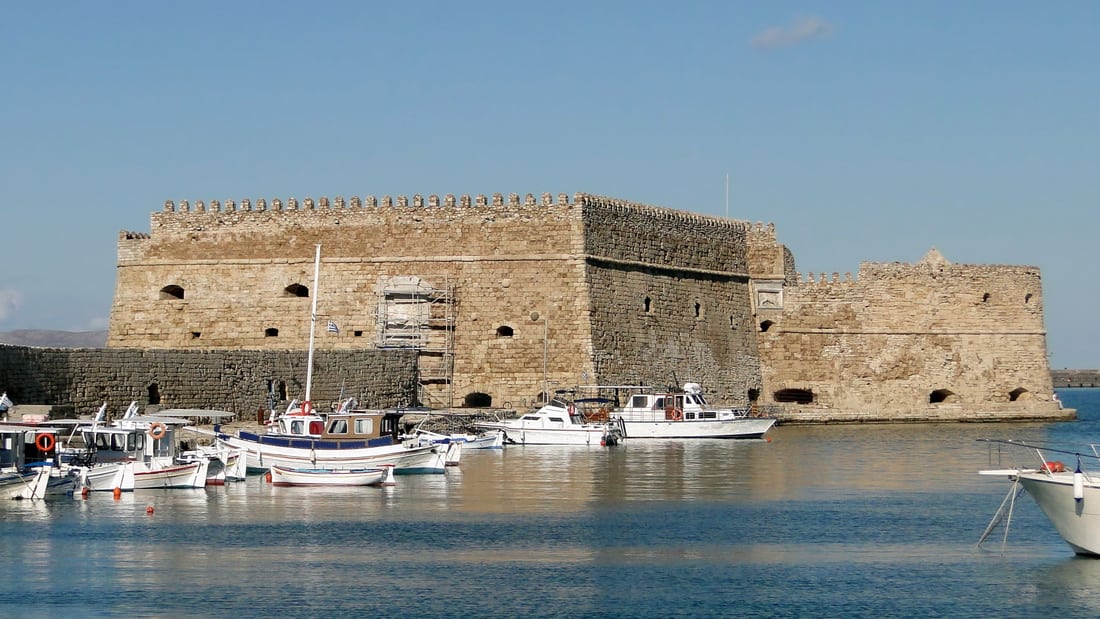
A Heraklion tour explores the capital of Crete, from the Venetian sea fortress at the old harbour and the walls around the old town to Lions Square, the churches, the museums and the market streets. This post covers what a Heraklion tour includes, the Koules fortress, the Venetian walls, Lions Square, the churches, the Archaeological Museum and the other museums, the market, the day trips from the city, the history and the best season. It is one of the best tours in Greece on Greece VIP.
Each section ends with a Heraklion tour that can be booked online.
What does a Heraklion tour include?
A Heraklion tour covers the old centre of the capital of Crete: the harbour, the Koules fortress, the Venetian walls, the main squares and the museums. It runs on foot, by bus, as a food tour or as a private tour with a licensed tour leader.
As the biggest city on Crete, Heraklion also serves as the seat of its regional government. It ranks fourth among Greek cities and first among the cities on the Greek islands, with 179,302 residents in the 2021 count. A Heraklion tour therefore treats a working city, not a single monument, and the route has to choose between the harbour, the fortifications, the squares and the museums.
The name Heraklion comes from Heracleium, an ancient port that served as the harbour of Knossos, and the site of that port lies within the modern city. Under Venice the city was Candia, and the Venetians rebuilt its defences with a giant wall and a fortress in the harbour. Much of that work is still in place, so the harbour front and the walls give a Heraklion tour its main stops.
The palace of Knossos lies on the southern edge of the city, but a Heraklion tour of the town stays inside the old centre. The palace visit is a separate trip with its own entry, and the page on Knossos tickets covers it. The city route reads the later layers in stone, from Venetian Candia to Ottoman Kandiye, along the harbour and the walls.
- Walking tour: A Heraklion tour on foot links the harbour, the fortress and the walls.
- Food tour: The route follows the old streets and adds tasting stops.
- Bus tour: The coach joins the sights that stand far apart.
- Private tour: A private Heraklion tour fixes the route and the pace for one group.
A Heraklion tour suits a first visit to Crete because the old centre packs the harbour, the fortress and the walls into one city. The next two sections take the Koules fortress and the Venetian walls in turn, with the facts that a tour leader points out at each stop.


What does a Heraklion tour see at the Koules fortress?
A Heraklion tour sees the Koules fortress, the Venetian sea fortress at the entrance of the old harbour. Venice built it in the early 16th century and named it Castello a Mare, “Fort on the Sea”. It is still in good condition today.
The Koules belongs to a group of Venetian works around the port. The fortress, the ramparts and the arsenal dominate the port area, and the Koules stands at the harbour entrance. The site has older layers. A Byzantine tower named Castellum Comunis stood there, and an earthquake destroyed it in 1303 before it was repaired. The tower was demolished in 1523, and work on the Castello a Mare began in its place.
The builders worked with the sea. Old ships were filled with stone and sunk to form a breakwater, and that widened the platform that carries the fortress. The Venetians finished the work in 1540. The plan has a high rectangular section and a slightly lower semi-elliptical section, and the walls reach 8.7m thick in places. A Heraklion tour enters through one of three entrances.
The fort has two stories with 26 rooms. The rooms first served as barracks, a prison, storage rooms, a water reservoir, a church, a mill and a bakery. In 1630 the fort carried 18 cannons on the ground floor and 25 on the pathway to the roof. In the 21-year Siege of Candia the Ottoman batteries neutralised that firepower, and the Ottomans took the fort in 1669.
- Names: Koules is the Greek name, and Castello a Mare and Rocca al Mare are the Venetian names.
- Lighthouse: A lighthouse tower stands on the northern part of the fort.
- Little Koules: The Ottomans built a small fort of that name on the landward side, demolished in 1936.
The Koules closes the Venetian story of Heraklion on the water. The fortress has been restored, and it is open to the public. The fort hosts art exhibitions and cultural events from time to time, so a Heraklion tour meets it as a living cultural site as well as a monument. The walls on the landward side come next.
Why does a Heraklion tour walk the Venetian walls?
A Heraklion tour walks the Venetian walls because they surround the city and are among the best preserved Venetian fortifications in Europe. The walls carry seven bastions, and the Martinengo bastion holds the grave of the writer Nikos Kazantzakis.
At first the Byzantine walls stayed in use, with modifications. After the fall of Constantinople in 1453 the Ottoman Empire became a major threat, and the discovery of gunpowder had changed warfare. The Venetians decided to build new fortifications around Candia. Work began in 1462 and took over a century, to designs by the military architects Michele Sanmicheli and Giulio Savorgnan.
The walls proved their worth in the Siege of Candia. The Venetian garrison held out for 21 years, and the siege remains the second longest in history. The city surrendered in 1669, and the Venetians were allowed to leave peacefully, which spared the city from a sack. The Ottomans repaired the walls after the surrender and gave the bastions Turkish names.
A Heraklion tour stops at the Martinengo bastion because Nikos Kazantzakis is buried there. The novelist, best known for Zorba the Greek, was born in Kandiye, now Heraklion, and died in Freiburg in 1957. His grave lies at the highest point of the walls, with a view over the mountains and the sea of Crete. His epitaph reads “I hope for nothing. I fear nothing. I am free.”
- Bastions: The land front has seven bastions: St. Andrew, Pantocrator, Bethlehem, Martinengo, Jesus, Vitturi and Sampionara.
- Gates: The walls had four main gates and three military gates, and two of the main gates remain intact.
- Turkish name: The Ottomans renamed the Martinengo bastion Giouksek Tabia.
A Heraklion tour of the walls reads the Venetian plan from the land side, while the Koules fortress shows it from the sea. After the war, suggestions to demolish the entire circuit were never carried out, and the walls remain largely intact. The land front is intact today, but the outworks were destroyed.
What does a Heraklion tour see at Lions Square?
A Heraklion tour sees the Morosini Fountain with its four lions, the Venetian Loggia next to it and the Basilica of Saint Mark on the same square. All three belong to the Venetian period, when the city was called Candia.
The square has two names. Its official name, Eleftheriou Venizelou Square, honours the Cretan statesman Eleftherios Venizelos. Its common name, Lions Square, comes from the Venetian-era Morosini Fountain, which locals call “the Lions” because four lions support the main basin. A Heraklion tour gathers the fountain, the loggia and the basilica into one stop, since all three stand on or beside the square.
The fountain dates to 1628 and belongs to a group of Venetian fountains that survive in the old city. The Renaissance loggia beside the square went up between 1626 and 1628, so it is almost as old as the fountain. Both stand in a city that the Ottomans took in 1669. A Heraklion tour reads the two monuments as work of the Venetian period.
The Basilica of Saint Mark is older than both. The Venetians built it in 1239 in the Gothic style, across from the palace of the Duke of Candia, and ducal decrees were announced at its entrance. After 1669 the Ottomans turned it into a mosque, which stayed in use until 1915. Restoration ended in 1960, and the building has served as a municipal art gallery since then.
- Morosini Fountain: Four lions carry the main basin, and the fountain dates to 1628.
- Venetian Loggia: On a Heraklion tour, the Renaissance loggia next to the square was built between 1626 and 1628.
- Basilica columns: Each colonnade has five green granite columns, and every column differs in height.
- Saint Mark’s Loggia: Merchants once sold grain from counters under the western portico of the basilica.
The basilica passed from ducal church to mosque to art gallery, and the Ottoman traveller Evliya Çelebi wrote in 1669 that its façade faced the fountain square. The gallery held a Cretan School exhibition in 1998. A Heraklion tour at the square therefore covers Venetian rule, Ottoman rule and the modern city.
Which churches does a Heraklion tour visit?
A Heraklion tour visits the Church of Saint Titus, the Cathedral of Saint Minas and the Church of Saint Catherine of Sinai. The Saint Titus building began as a mosque, Saint Minas is the largest cathedral in Crete, and the Sinai church holds Cretan icons.
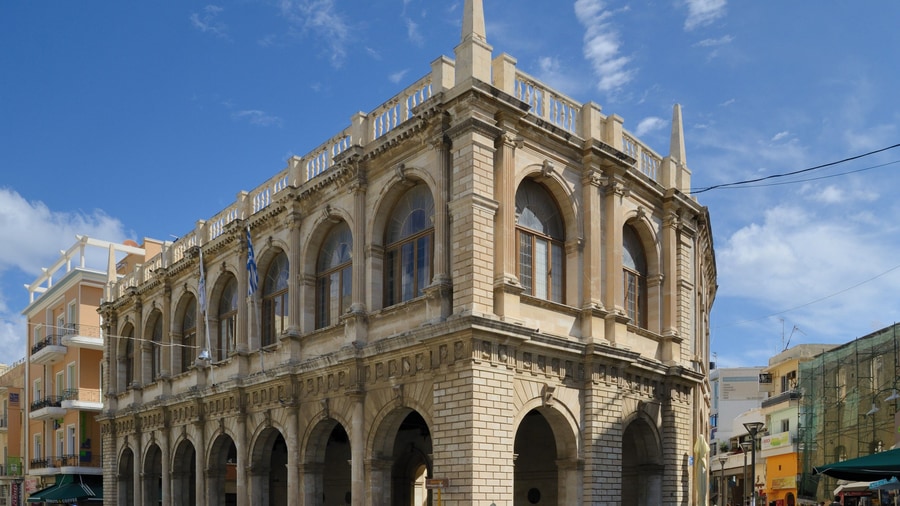
The present Church of Saint Titus was built in 1869 as the Yeni Cami mosque after the earthquake of 1856 destroyed the building before it. The Church of Crete repaired it and dedicated it to Orthodox worship in 1925, and the minaret came down. On a Heraklion tour the church stands out as a square, domed temple in an eclectic style. In 2013 it became a cathedral of the archdiocese of Crete.
The Cathedral of Saint Minas is the seat of the Archbishop of Crete and honours Saint Menas, the patron saint of Heraklion. Its foundation stone was laid in 1862, the Cretan Revolution interrupted the work, and the cathedral was finished in 1895. It has a cross-shaped plan, a central dome and two bell towers. The small church of Agios Minas, built in 1735, stands nearby.
The name of the Church of Saint Catherine of Sinai points to the monastery on Mount Sinai in Egypt, which kept a dependency in Heraklion. Michael Damaskinos, born in Candia, was a leading painter of the Cretan School, and his Last Supper is now in the Monastery of Agia Aikaterini in Heraklion. A Heraklion tour sees this post-Byzantine tradition in egg tempera on wood.
- Saint Titus relics: The head of Saint Titus returned from Venice in 1966.
- Saint Minas size: The outer plan measures 43.2 metres by 29.5 metres.
- Saint Minas aisles: The right aisle honours the Apostle Titos and the left the Ten Martyrs of Crete.
- Sinai icons: Damaskinos painted the Last Supper towards the end of the 16th century.
Damaskinos set his Last Supper in a courtyard, with Doric columns behind Christ and Minoan symbols on the tablecloth. Ieremias Palladas painted Saint Catherine with the wheel of her torture, and his version became the framework for later Cretan paintings of the saint. A Heraklion tour adds this painting history to the two cathedral stops.
What does a Heraklion tour see at the Archaeological Museum?
A Heraklion tour sees the Minoan collections at the Archaeological Museum: the Phaistos Disc, the snake goddess figurines and the frescoes. The galleries follow time, so the disc and the figurines come early on the route and the frescoes come near the end.
The Phaistos Disc raises questions about its age and meaning. One study dates it between 1850 and 1600 BC, and early doubters suspected a forgery, but archaeologists now accept it as authentic. Each sign was pressed into the clay with its own stamp, so the text counts as an early example of movable-type printing. A Heraklion tour sees a clay dish with a spiral text.
A Heraklion tour sees two faience snake goddess figurines that came from the palace at Knossos in 1903 and date to around 1600 BCE. The larger one stands about 34 cm tall as restored, with snakes crawling over her arms and crown. The smaller one, about 29 cm tall, holds two snakes and wears a cat or panther on her headdress.
Rooms XIV to XVI hold frescoes of Knossos and Hagia Triada, and Room XIV is the Hall of the Frescoes. The building echoes them in its colours and materials, since its veined polychrome marbles recall Minoan wall paintings that imitate marble revetment. A Heraklion tour therefore meets painted walls twice, as marble colours in the building and as the Minoan originals in the galleries.
- Early rooms: Room I covers finds from 6000 BCE to the pre-Palatial period.
- Town Mosaic: Glazed plaques of Minoan houses sit in Room II.
- Room IV: A bull’s head rhyton from Knossos stands near the snake goddess figurines.
- Harvester Vase: The vase stands in Room VII with bronze double axes.
Arthur Evans named the larger figure the Snake Goddess and the smaller one the Snake Priestess, and scholars still debate which title fits. The route runs from the Neolithic fertility goddess of Room I to the frescoes. A Heraklion tour that follows the numbers sees the Minoan story in order.
Which other museums does a Heraklion tour include?
A Heraklion tour adds two museums beyond the archaeological collection: the Historical Museum of Crete, which holds El Greco paintings and the Kazantzakis study, and the Natural History Museum of Crete, which covers the flora, fauna and geology of the eastern Mediterranean.
The Historical Museum of Crete was founded by the Society of Cretan Historical Studies in 1953. It first occupied the former home of Minos Kalokairinos and later gained a modern wing. Its permanent rooms follow the history of the island from the 4th century AD through the Second World War. A Heraklion tour that enters these rooms meets ceramics, coins, jewelry, wall paintings, portable icons and manuscripts.
A Heraklion tour that visits the museum sees two paintings by El Greco: View of Mount Sinai and Baptism of Christ. They are his only works in Crete, where he was born as Domenikos Theotokopoulos. A mock-up shows Chandax, as the museum calls the city, at its mid-17th-century peak under Venetian rule. The Nikos Kazantzakis Collection displays the study and library from the author’s home in Antibes, France.
The Natural History Museum of Crete works under the University of Crete and sits in a restored industrial building that used to house an electricity power plant. Its aim is the study and protection of the flora and fauna of the Eastern Mediterranean. Research covers biodiversity, geology and paleontology. This stop suits a Heraklion tour with an interest in science.
- Historical Museum: Two El Greco paintings, the only works by the painter in Crete.
- Kazantzakis Collection: The writer’s study and library, with manuscripts and first editions.
- Natural History Museum: Mediterranean plants and animals in a former power plant.
These two museums add depth to the city’s story without repeating the archaeological material. The Historical Museum covers the centuries from the 4th century AD onward, while the Natural History Museum looks at living and geological Crete. Together they show that a Heraklion tour can move from art and literature to science within the same city.
What does a Heraklion tour taste at the market?
A Heraklion tour tastes the staples of Cretan cuisine at the market: wild herbs, local cheeses, olive oil, honey pastries and bougatsa. Traditional Cretan food is built on seasonal plants from the local area, with olive oil as the main fat.
The core of Cretan cuisine is food from plants. Traditionally, people ate seasonal products from the wider local area, with minimal processing. Fresh and dried fruit, pulses, wild herbs, aromatic plants and rough cereals formed the base of the diet. A Heraklion tour with a market stop gives a close look at these ingredients and at how the island cooks with them.
Cheese is a main attraction on a Heraklion tour of the market. The traditional list of Cretan cheeses includes graviera, xynomizithra, xygalo and pichtogalo, along with amarino, seliano, tirozouli and tiromalama. Dairy products were eaten daily in low to moderate quantities. Mizithra also fills a flatbread called mizithropita, and a cheese pie called sarikopita is shaped to resemble the sariki, a type of traditional Cretan headwear.
Bougatsa is a Greek breakfast food, sweet or savoury, that also works as a mid-morning snack. Phyllo is wrapped around a filling, baked and served hot in small pieces. The cream version holds semolina custard and is dusted with powdered sugar or cinnamon. Its modern form began in Northern Greece, but in Chania the cheese version is made with local mizithra, which is not sweet, and sprinkled with sugar and cinnamon.
- Herbs: Wild herbs and aromatic plants form the base of the traditional diet.
- Cheese: Graviera, xynomizithra, xygalo and pichtogalo sit on the traditional list.
- Bougatsa: A breakfast pastry with a custard, cheese or spinach filling.
- Appetizers: Dakos, paximadi and stamnagathi salad are traditional starters.
The market works as a short lesson in how Crete eats. Plants, herbs, olive oil and cheese come first, bougatsa fills the breakfast slot, and honey-based pastry adds the sweet note. Tsikoudia, rakomelo and Cretan wine are the traditional drinks, and red wine was the one that accompanied meals. A Heraklion tour with a food stop turns history into taste.
Which day trips can follow a Heraklion tour?
A Heraklion tour connects easily with day trips to Fodele, Dia island, Mount Juktas and the wine villages. Each stop adds a different side of Crete: an El Greco village, a protected island, a Minoan peak sanctuary and vineyards.
A Heraklion tour that heads out to Fodele reaches the former municipality of Gazi, which lies west of Heraklion on the north coast. The village is claimed as the birthplace of the painter El Greco, although that claim is disputed. His family came from the area, and a museum dedicated to him stands in the village. The same municipal unit holds Fodele beach and the Agios Panteleimon Monastery.
Dia is an uninhabited island off the northern coast of Crete, about 13 km north of Heraklion, and it measures 5 km by 3 km. Seen from the city, it looks like a giant lizard, and myth says Zeus turned a lizard that threatened Crete into stone with a thunderbolt. Dia is part of the Natura 2000 network, and day trips are allowed, but camping is not. On a Heraklion tour that adds Dia, swimming, snorkeling and beach walks are the popular activities.
Mount Juktas rises to 811 m above the town of Archanes, south of Heraklion. A Heraklion tour that turns south finds the mountain a short distance from the palaces of Knossos and Fourni and the megaron at Vathypetro. Its summit held an important peak sanctuary of the Minoan world, first excavated by Sir Arthur Evans in 1909. Excavations turned up clay figurines, stone horns, stone altars and bronze double axes.
- Fodele: A village in the Gazi area with a museum of El Greco.
- Dia: A protected, uninhabited island with four south-coast coves.
- Mount Juktas: A Minoan peak sanctuary with a Greek Orthodox chapel on the ridge.
- Wine villages: Vineyard stops that carry the Cretan wine tradition.
In traditional Cretan cooking, red wine was the drink that accompanied meals, so a Crete wine tour is a natural next step after the city. Fodele, Dia and Mount Juktas each add a different layer to what a Heraklion tour shows in town, from painters and myths to ancient rituals on the ridge.
What history lies behind a Heraklion tour?
A Heraklion tour follows a city that began as an Arab castle in 824, returned to Byzantine rule in 961, passed to Venice in 1204, endured a 21-year Ottoman siege until 1669, and became the capital of Crete again in 1971.
Arab exiles from al-Andalus took Crete and moved its capital from Gortyna in 824. They built a moat around a new castle named rabḍ al-ḫandaq, “Castle of the Moat”, which Greek speakers turned into Chandax. Nikephoros Phokas landed in 960, and the city fell in March 961. Byzantine forces looted and burned it, then rebuilt it, and it stayed Byzantine for 243 years.
Venice bought the city in 1204 in a political deal tied to the Fourth Crusade. Chandax became Candia, the seat of a Duke, and the Venetians added enormous fortifications and a fortress in the harbour. From 1212 they settled families from Venice on Crete, and the meeting of two cultures fed the Cretan Renaissance in letters and the arts.
The Ottoman siege of Candia began in 1648. The attackers cut the water supply and bombarded the city for 16 years with little effect. The final 22 months cost 70,000 Turks, 38,000 Cretans and slaves, and 29,088 Christian defenders their lives. Francesco Morosini, left with 3,600 fit men, surrendered on 27 September 1669, and Christians were allowed to leave with their belongings.
Kandiye stayed the capital of Crete until 1849, when Chania took over, and the silted harbour sent shipping west. An earthquake in 1856 left only 18 of over 3,600 homes intact. The name Heraklion returned between 1898 and 1908, and the city joined Greece in 1913. Bombing in 1941 damaged it during the Battle of Crete, and in 1971 it replaced Chania as capital.
- Chandax: The Greek form of the Arabic castle name.
- Candia: The Latinized form, which Venetians used for the city and for all of Crete.
- Megalo Kastro: A Greek name meaning Big Castle, used after the Byzantine reconquest.
- Heraklion: The name of the ancient port that served Knossos.
These layers explain what a Heraklion tour shows. Arab Chandax gave the moat, Venice gave Candia and its fortifications, the Ottomans gave Kandiye, and the twentieth century gave the modern capital. Read in that order, the names, walls and museums of the city form one timeline.
When is the best season for a Heraklion tour?
A Heraklion tour suits April, October and November best, when the mean daily maximum sits between 20.1 and 24.0 °C. Summer brings dry, clear-sky heat above 30 °C at the airport station, while winter brings moderate rain and short days.
The city has a hot-summer Mediterranean climate, and its summers are warm to hot and dry under clear skies. At the airport weather station, the mean daily maximum reaches 30.3 °C in July. Walking the old town in that heat means long stretches under open sky. Seasonal breezes ease the hottest days, and the Aegean Sea keeps summer cooler than in Athens.
In April the mean daily maximum is 20.1 °C, with rain on 5.8 days. October averages 24.0 °C and November 20.1 °C, while rainy days rise from 6.7 to 9.1. The ultraviolet index falls from 7 in April to 4 in October, so a Heraklion tour in autumn meets weaker sun. These months sit between the dry summer and the wet winter.
Winters are mild, with moderate rain. January has a mean daily maximum of 15.2 °C, 81.3 mm of rain and 13.6 rainy days. December brings 9.7 hours of daylight on average, against 14.8 hours in June. Snowfalls are rare, and the last significant one with measurable depth on the ground came in February 2004. The airport record low is -0.8 °C.
- Summer: The record high at the city station is 44.5 °C, and the sea reaches 26.1 °C in August.
- Spring and autumn: Sunshine totals 228.0 hours in April and 220.1 hours in October.
- Winter: The sea cools to 16.4 °C in February.
Heat and daylight set the pace of a Heraklion tour more than rain or snow do. The milder months sit between the two extremes, with moderate maxima and plenty of sunshine. Because snow is rare and winters are mild, a winter Heraklion tour meets rain rather than cold, but short days leave fewer outdoor hours.
What do travelers ask about a Heraklion tour?
A Heraklion tour raises practical questions about Knossos, the harbour, transport, museums and the size of the city. The answers below rest on facts about the city: where its sights stand, how its buses run and which museums it holds.
Can a Heraklion tour include Knossos?
A Heraklion tour can include Knossos, because the palace lies in the southern periphery of the city. The site belongs to the Heraklion municipality and ranks second only to the Parthenon among Greek archaeological sites by visitor numbers. In Minoan times, Knossos was the largest centre of population on Crete.
Can a Heraklion tour start at the port?
A Heraklion tour can start at the port, where the Koules Fortress, the ramparts and the arsenal dominate the harbour area. The ancient harbour of Heracleium, which served Knossos, stood near today’s port area. The port is also an important ferry dock.
Does a Heraklion tour run on foot or by bus?
A Heraklion tour runs both ways. The historic centre is ringed by walls and bastions, with the loggia standing next to Lions Square, so a walking route stays inside the old town. Urban buses serve the city on 39 routes, and a bus covers the longer distance to Knossos on the southern edge.
Which museum fits a Heraklion tour?
A Heraklion tour has eight museums to choose from, according to the listing for the city. They include the Archaeological Museum, the Historical Museum of Crete, the Natural History Museum, the Nikos Kazantzakis Museum and the Battle of Crete and National Resistance Museum.
How large is the city behind a Heraklion tour?
A Heraklion tour covers the largest city on Crete and the fourth largest in Greece. The municipal population was 179,302 in 2021, and the wider metropolitan area held 211,370 people in the 2011 census. The municipality has an area of 244.613 square kilometres.
Featured photo: Bernard Gagnon, CC BY-SA 3.0, via Wikimedia Commons.