
A Santorini private tour takes a small group around Santorini in its own car with a local driver, on a route the travellers choose, from the cliff-top towns of the caldera to the old villages and ancient sites inland. This post covers what a Santorini private tour includes, getting around, Fira, Firostefani and Imerovigli, the museums, Ancient Thera, Akrotiri, the churches, Emporio and the fortified villages, cruise visits, the island on screen, its names and legends, and the best season. It is one of the best tours in Greece on Greece VIP.
Each section ends with a Santorini private tour that can be booked online.
What does a Santorini private tour include?
A Santorini private tour includes a private car or minibus, a driver or a local escort, and an itinerary set by the traveller. The vehicle carries one party only, and the route can link the capital, the cliff villages and the south of the island in any order.
A Santorini private tour belongs to one booking, so no other travellers share the vehicle. The party names the stops it wants, such as villages, ruins and viewpoints, and the driver or escort builds the route around them. The order can change on the day if the party wants longer in one place. The escort or tour leader also answers questions about the volcanic history and the way the villages were built.
The size of the island keeps those plans realistic. Santorini covers about 73 square kilometres, and the municipality, with its neighbouring islets, holds 90 square kilometres of land. The island lies in the southern Aegean Sea, about 200 kilometres southeast of the mainland, and it is the southernmost member of the Cyclades. The 2021 census counted 15,480 residents. A Santorini private tour therefore reaches every main village by car in a single outing.
The shape of the island also sets the order of the route. Santorini is the largest island of a small, circular archipelago formed by the caldera. The municipality of Thera counts twelve local subdivisions on the island besides Oia, among them Akrotiri, Emporio, Imerovigli, Megalohori and Pyrgos Kallistis. The driver links these places by road, so a Santorini private tour moves between the rim, the south and the interior without a change of vehicle.
- Vehicle: A private car or minibus carries the party between stops, with a driver at the wheel.
- Escort: A local escort names each place and explains the volcanic and village history on the way.
- Itinerary: The traveller picks the villages, ruins and viewpoints, and the stops follow that choice.
- Island size: The island covers about 73 square kilometres, so a Santorini private tour reaches every main village on one route.
In short, a Santorini private tour trades a fixed schedule for a plan built around one party. The vehicle, the driver or escort and the route all serve that plan. The next sections follow the route stop by stop, starting with the airport, the ports and the roads that connect the island, and then moving to Fira, the capital, where the island’s bus routes meet.


How does a Santorini private tour get around the island?
A Santorini private tour gets around the island by road. The vehicle meets travellers at the airport or at the ferry port of Athinios, and it waits in Fira for those who rise from the old port below the capital by cable car, on foot or by mule.
The airport lies about 6 kilometres southeast of the centre of Thira, north of the village of Kamari. It began operating in 1972 and serves both military and civil flights. Arriving passengers can leave the terminal by bus, taxi, hotel car pick-up or hired car. A Santorini private tour replaces that choice with a pre-arranged vehicle, and the driver takes the party straight to the first stop on the route.
Athinios is the primary ferry port of Santorini, about 10 kilometres south of Fira. It is the only port on the island with regular passenger ferry services to Piraeus, the Cyclades, Crete and Rhodes. Steep, multi-coloured volcanic cliffs surround the port, and a road zigzags up them to the top. On a Santorini private tour the driver takes that road, so the party climbs by vehicle and not on foot.
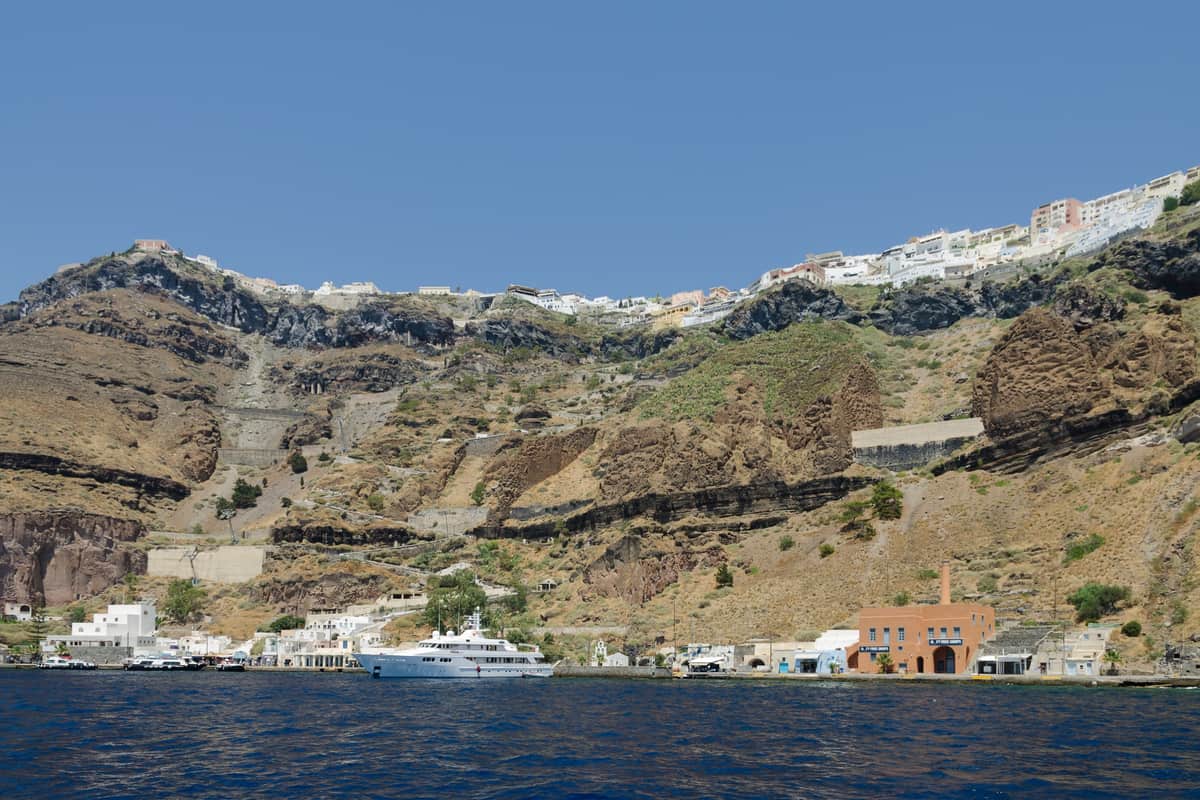
The second port, Skala, is the old port, and it lies below Fira. Boatmen bring passengers ashore there, and Fira is reached by cable car, on foot or by donkey and mule. The cable car is a pulsed gondola lift, built between 1980 and 1982, with a vertical rise of about 220 metres. The alternative is the climb of about 600 steep steps.
Fira holds the central bus station of the island, and bus services link the capital to almost all places around the island. The town itself is reached mainly by roads on its eastern side. In 1954 the island had a jeep, a small bus and the traditional donkeys and mules as its only transport. A Santorini private tour uses the same road network, but it follows one party’s plan and not a timetable.
- Airport: A Santorini private tour starts here when a driver meets the party at arrivals.
- Athinios: The ferry port serves passenger ferries to Piraeus, Crete and Rhodes, and a road winds up the cliffs from it.
- Skala: The old port below Fira connects to the capital by cable car, steps or mule.
- Fira bus station: Public buses reach almost all places on the island from the capital.
A Santorini private tour therefore treats the arrival point as the start of the route, not as a separate task. The airport, Athinios and Skala each lead into the same road network, and the cable car and the steps lead up into Fira from the cliff below. After the transfer, the capital is the natural first stop, and the next section turns to it.
Why does a Santorini private tour stop in Fira?
A Santorini private tour stops in Fira because it is the modern capital, built on the caldera rim, with the central bus station, an Orthodox and a Catholic cathedral and a history shaped by the 1956 earthquake. The stop also opens the caldera view.
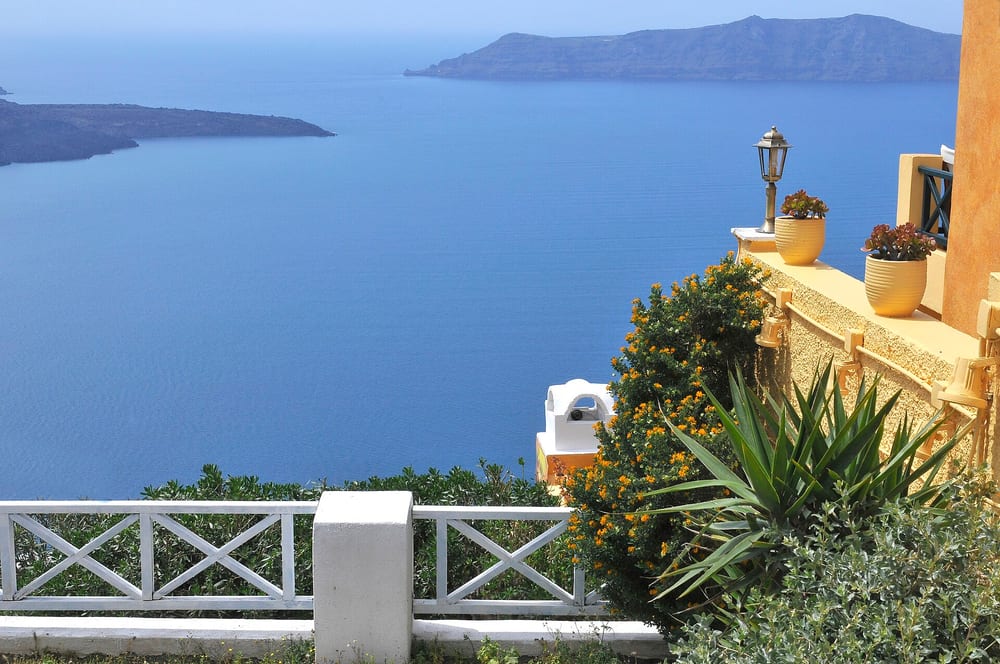
Fira is the modern capital of Santorini. Its name comes from an alternative pronunciation of Thira, the ancient name of the island. The town stands on the edge of the caldera, a rim 400 metres high on the western side of the semi-circular island. From there the caldera stretches 18 kilometres, from Cape Akrotiri in the south to Cape Ag. Nikolaos in the north, with Nea Kameni at the centre and Thirassia beside it. A Santorini private tour uses that view to explain the island.
The 1956 Amorgos earthquake reshaped the capital. The shock struck about 50 kilometres from Santorini and destroyed almost all public buildings on the island. Camps for homeless people went up on the outskirts of Fira, and the Greek military dropped food, tents and supplies from the air because the island had no airport. The tour leader on a Santorini private tour names the two cathedrals that the town built or rebuilt after the earthquake.
Two cathedrals show the two Christian traditions of the island. The white Orthodox Cathedral of Ypapanti stands on the site of an earlier church that the earthquake destroyed. The Catholic Cathedral of St John the Baptist is the seat of the Bishop of Santorini, and it was built in 1823 and rebuilt in 1970. The diocese dates from 1204, and Venetian rule later left a sizable Catholic community on the island.
- Central square: Plateia Theotokopoulou holds the bus and taxi station, banks and pharmacies.
- Cable car: The Fira station stands near the Archaeological Museum, and the Orthodox Metropolitan Cathedral is signposted from it.
- Churches: The Three Bells of Fira stands among the town’s churches beside the two cathedrals.
- Access: A Santorini private tour reaches the capital by the roads on its eastern side.
For these reasons a Santorini private tour treats Fira as a base for the first hours of the route. The capital joins the transport links, the caldera view and the two cathedrals in one place, and the cathedrals record the effect of the 1956 earthquake. The next section follows the route on to the villages beyond the capital.
What does a Santorini private tour see in Firostefani and Imerovigli?
A Santorini private tour follows the caldera rim north of Fira through Firostefani and Imerovigli, two villages of narrow lanes, Cycladic churches and wide views of the volcano. The route reaches Skaros rock, where a Venetian fortress town once stood.
Firostefani is an old village just north of Fira, the capital of Santorini. It later merged with the capital and now forms a neighbourhood of it. The name means “crown of Fira” and points to the height of the village above the rest of the town. On a Santorini private tour, the stop at Firostefani shows traditional houses, narrow alleys and a view toward the volcano.
Imerovigli also lies north of Fira, built on the rim of the Santorini caldera. Narrow paved paths cross the village, and its churches follow the Cycladic style. They include Ai-Stratis in the centre of the village and the Monastery of Saint Nikolaos on the path that links Imerovigli with Fira. A Santorini private tour can walk that path between the two villages.
A Santorini private tour views Skaros rock, which stands near Imerovigli. Volcanic activity formed the promontory, and erosion and earthquakes have reshaped it since. A fortress named La Roka was completed there in 1207, and a town grew around it. By 1336 the settlement held over 200 homes, a small harbour and the chapel of Panagia Theoskepasti at its base. As the largest settlement on the island, it became the de facto capital of Venetian Santorini.
- Firostefani: Traditional houses, narrow alleys and a view toward the volcano mark the old village north of Fira.
- Imerovigli: Cycladic churches and narrow paved paths stand on the rim of the caldera.
- Skaros rock: A Venetian fortress town grew here after 1207 and held hundreds of residents by 1336.
Ottoman rule from 1566 shifted importance to Fira and Oia. The eruption of 1650 then dropped part of the town into the sea, and the eruptions of 1701 to 1711 sent the majority of residents to Fira or Imerovigli. By the early 19th century only weathered ruins remained. Today a Santorini private tour reaches the promontory from Imerovigli, as hikers and photographers do, while the chapel of Panagia Theoskepasti stays in use on the cliffs below.
Which museums does a Santorini private tour include?
A Santorini private tour can include four museums: the Museum of Prehistoric Thera and the Archaeological Museum of Thera in Fira, the maritime museum in Oia, and the tomato industrial museum at Vlychada. Together they cover prehistory, antiquity, seafaring and farming industry.
The Museum of Prehistoric Thera stands in Fira on the site of the old Ypapanti Church, which the 1956 Amorgos earthquake destroyed. Its halls hold finds from Akrotiri and the Potamos site, arranged in order from the Late Neolithic to the Late Cycladic I period. Wall paintings, jewellery, ritual objects and bird jugs decorated with swallows fill the cases. The history of Akrotiri goes back to 3300 B.C., and the town flourished in the 17th century B.C.
The Archaeological Museum of Thera stands in Fira too, 30 metres east of the cable car entrance. It was built in 1960 to replace an older building that the 1956 earthquake brought down. Its collection runs from the Archaic to the Roman periods. On a Santorini private tour, the pottery and amphorae of the Geometric and Archaic periods draw attention, as does a krater with Attic black figures from grave no. 1.
In Oia, a Santorini private tour finds the maritime museum in a restored 19th-century mansion a block from the cliff-top. It records the maritime history of Thira. Its rooms hold figureheads, old nautical charts with English labels, seamen’s chests, ship models and historic photographs. The collection suits the village, because the merchant fleet of Oia traded between Alexandria and Russia, and in 1890 the village counted about 130 sailing ships.
At Vlychada, a Santorini private tour reaches the Tomato Industrial Museum “D. Nomikos”, which began as a tomato paste factory in 1945. The factory closed in 1981, and the site reopened as a museum in 2014. The oldest machinery on display dates to 1890, and the exhibits cover the growing of the tomato and the making of the paste. Santorini was known as “tomato island”, and nine factories worked there until the late 1950s.
- Prehistoric Thera: A Santorini private tour sees Akrotiri finds, Cycladic marble figurines and wall paintings in order of date.
- Archaeological Museum: The collection runs from the Archaic to the Roman periods, with pottery from the ancient cemetery of Thera.
- Maritime museum: Figureheads, seamen’s chests and ship models record the seafaring past of Oia.
- Tomato museum: Machinery from 1890 and digital displays record the tomato paste industry of the island.
The first excavations on Santorini took place in 1867, when the French geologist F. Fouque studied a quarry where local people had found old objects. Fira holds two of the four museums, Oia holds one and Vlychada holds one, so a Santorini private tour spreads the museum stops across the island instead of keeping them in one town.
What does a Santorini private tour see at Ancient Thera?
A Santorini private tour sees Ancient Thera, a city of limestone ruins on Mesa Vouno above Kamari and Perissa. Doric colonists from Sparta founded it, and the visit covers its main street, agora, theatre, sacred area and Ptolemaic houses.
On a Santorini private tour, the story starts with Doric colonists from Sparta, who founded the city as a small settlement on the southern edge of the Cyclades. Herodotus and Pausanias name a ruler called Theras as the founder, and the island took its name from him. Archaeological evidence for the city dates from the 9th century BCE. Herodotus writes that a seven-year drought around 630 BCE forced the inhabitants to send colonists to Cyrenaica, so Thera became known as the mother city of Cyrene.
The city took its final shape in the second half of the 3rd century BCE, when the Ptolemaic war fleet for the Aegean was stationed in its harbour. The city was rebuilt for the officers on a regular street grid. The main street runs almost 800 m, between two and four metres wide, and after about 200 m it opens onto a plateau. A Santorini private tour walks this street past the agora.
A winding road starts at Kamari, and footpaths climb to the site from both sides of the mountain. Friedrich Hiller von Gaertringen investigated the city from 1895 until 1904. N. Zapheiropoulos later excavated the necropolis in Sellada between 1961 and 1982. In the year 726, a layer of pumice covered the city, and its people soon gave it up. A Santorini private tour reaches the ruins by the road from Kamari.
- Agora: The main square is about 110 m long, and the Basilike Stoa beside it carried ten Doric pillars.
- Theatre: A Santorini private tour sees it cut into the slope in the 2nd century, with seating for about 1,500.
- Sacred area: The spur of the ridge holds a grotto for Hermes and Heracles and the temple of Apollo Pythios.
- Inscriptions: Texts from the 9th to the 8th century BC are among the oldest known uses of the Greek alphabet.
The city had two seaports, named Oia and Elefsina, at present-day Kamari and Perissa, and its necropolis lay at the foot of the mountain. The kouroi found in the burial grounds, statues of youths from the 7th century BC, came in Naxian marble and style. A Santorini private tour links the site with the Archaeological Museum of Thera in Fira, which shows finds from the necropolis excavations.
How does a Santorini private tour visit Akrotiri?
A Santorini private tour visits Akrotiri as a Bronze Age town that excavators dug out of volcanic ash. Visitors walk between multi-storey houses under a protective roof, while the finds and artworks from the digs are shown in a museum away from the site.
Akrotiri is a Cycladic Bronze Age settlement site, and the modern village of Akrotiri gave it the name it carries today. Its name in antiquity is unknown. Only the southern tip of a large town has been uncovered, yet that tip holds streets, squares and multi-level buildings, with walls standing as high as eight metres. A Santorini private tour therefore moves through a town of upright buildings, and stone staircases are still intact in the houses.
A roof covers the excavation, and its history shapes the visit. A new roof structure, built to protect the site, collapsed just before its completion in 2005, and the antiquities took no damage. The site then stayed closed to visitors until April 2012, while a new canopy was built, and a Santorini private tour today enters the site under that canopy. In October 2018 excavators found a small shrine with a marble figurine of a woman in the House of the Thrania.
The wall paintings made Akrotiri known, and the artists used mineral pigments in white, yellow, red, brown, blue and black. The Spring Fresco, uncovered in Room Delta 2 in 1970, was the first found perfectly preserved and still standing in its original position. Its supporting wall was weak, so restorers removed it at once. Excavated artifacts are now installed in the Museum of Prehistoric Thera, which stands away from the site, so a Santorini private tour joins the town and its paintings in two stops.
- Houses: Huge ceramic storage jars called pithoi, mills and pottery stand in the rooms on a Santorini private tour of the site.
- Furniture: Volcanic dust kept the shapes of wooden beds, tables and stools, and restorers poured plaster into those hollows to make casts.
- Water: The pipes of the town run in twin systems, which shows that hot and cold water were both in use.
- Horns: The House of the Benches held between 300 and 500 horns painted in ochre, and their religious use is unknown.
Akrotiri suits a Santorini private tour because the buried town can be read from its streets, stairs and storage rooms. The eruption that sealed it is the main subject of a Santorini volcano tour, which treats the volcano as the centre of the day. A Santorini private tour spends its time on the town that the eruption ended. Excavators found only a single gold object there, hidden beneath flooring.
Which churches and monasteries does a Santorini private tour visit?
A Santorini private tour visits the Monastery of Profitis Ilias on the highest mountain, the Byzantine church of Panagia Episkopi and the churches of the Catholic community. Together they show Orthodox and Catholic worship that shared one island and, in one church, one chancel.
Profitis Ilias is the highest mountain on Santorini. In 1614 the grounds of the Panagia Episkopi were separated between the two confessions, and the upper part, with the peak and two small chapels, went to two brothers. They founded the monastery of the Prophet Elijah, which stands there today. In the last years of Ottoman rule, the Monastery of Profitis Ilias was an important monastic centre in the Cyclades, and a Santorini private tour reaches that history on the mountain.
Panagia Episkopi is a middle-Byzantine former cathedral, now a church, with a floor plan in the shape of a Greek cross and a dome on the crossing. Coloured glass bricks in red, green, yellow and blue light the chancel through the apse windows, and a narrow bell-gable carries four bells. A Santorini private tour reaches a church that holds a 12th-century icon of the Panagia Glykofilousa, the sweetly kissing Madonna, and an iconostasis with marble inlay.
The inner room was painted with frescoes when the church was built, and an expert dated them to 1100. Plaster covered them in the Ottoman era and moisture destroyed the larger share, but restorers freed part of them. The Festival of Herod II shows Herodias presenting the head of John the Baptist on a platter. The walls also reuse stone from ancient Thera, including Doric pillars and carved bull heads, which a Santorini private tour can match to the ancient site.
- Catholic community: Venetian rule gave Santorini a sizable Catholic community, and the island is still the seat of a Catholic bishopric.
- Latin altar: After 1207 the Latin bishop took a seat in Skaros at the edge of the crater, and a Latin altar was erected next to the Orthodox one at Panagia Episkopi.
- Annex: A small barrel-vaulted room built in 1767 opens into the chancel and serves as a chapel for the Roman Catholics.
The two traditions meet at Panagia Episkopi, and a Santorini private tour reads both in one building. On the 15th of August the church is the centre of the feast of the Assumption of the Virgin, and its icons are carried around the building in procession. After the service, a dish with a puree of sweet peas and beans is presented to all the faithful, in memory of the former estates of the church.
What does a Santorini private tour see in Emporio and the fortified villages?
A Santorini private tour sees in Emporio the old Goulas Castle and churches such as Saint Nicholas Marmaritis, and in the other castle villages the defences that islanders built against pirates. Five kasteli and four goulas towers turned the settlements into refuges.
Emporio, also called Nimborios, is a village on Santorini near the Profitis Ilias mountains, 12 km from Fira. At the 2021 census the community of Emporio had 3,704 permanent inhabitants, and it consists of four villages: Emporeio, Perissa, Agios Georgios and Exomytis. A Santorini private tour that stops in the village sees the old Goulas Castle and its churches, among them Saint Nicholas Marmaritis.
The defences answer the pirates of the 15th and 16th centuries, who plundered harvests and took men and women to the slave markets. The small bays of the island gave the raiders hideouts. On the coast, small garrisoned watchtowers called viglio kept a permanent watch and raised the alarm when a pirate ship came into sight. A Santorini private tour reads the island as a system of lookouts and refuges.
The five kasteli of the island that a Santorini private tour can name stood at Oia (Agios Nikolaos), Akrotiri, Emborio, Pyrgos and Skaros. A church of Agia Theodosia, the protector saint of castles, stood at the entrance of every kasteli. The goulas took its name from the Turkish word kule, meaning tower, and it was a rectangular, multi-storey tower. Four goulas stood on the island, and islanders used them as observatories and as places of refuge.
- Emporio: The village keeps the old Goulas Castle, and the church of Saint Nicholas Marmaritis is one of its churches.
- Kasteli: Each of the five castle villages had a church of Agia Theodosia at its entrance, which a Santorini private tour can look for.
- Goulas: The towers had thick walls with parapets, iron gates, murder holes and embrasures.
- Viglio: The coastal watchtowers raised the alarm when a pirate ship was sighted.
Emporio and the other castle villages show how islanders answered a threat from the sea with stone. The goulas gave a place to watch and a place to shelter, and the viglio gave warning along the coast. A Santorini private tour that links Emporio with the other kasteli follows that system from the shore to the villages.
How does a Santorini private tour suit cruise passengers?
A Santorini private tour suits cruise passengers because the ships anchor off Skala, the old port below Fira, and local boatmen carry passengers to the pier. From there, the cable car, a stepped path or a mule ride climbs the cliff to Fira.
Santorini has two ports. Athinios serves the ferries, and Skala, the old port, serves the cruise ships. Cruise ships anchor off Skala, and local boatmen carry the passengers ashore to the pier. For a cruise passenger, a Santorini private tour therefore starts at the foot of the cliff. The capital, Fira, stands above the pier, and every route to it climbs the caldera wall.
The ascent has three forms. The cable car is a pulsed gondola lift between the old port and Fira. Each gondola holds six passengers in two rows of three, and the lift rises about 220 meters. The alternatives are a path of about 600 steps and a ride on a mule. A Santorini private tour for cruise passengers can use the cable car and skip the 600 steps.
The cable car was funded by a donation from the Loula and Evangelos Nomikos Foundation. Construction began in 1980 and finished in 1982. Ticket revenue is shared among the 14 communities of Santorini, and part of it supports the traditional mule drivers. The Fira station stands near the Archaeological Museum, so a Santorini private tour can link the arrival with a museum stop.
Cruise passengers join a large flow of visitors. An estimated 2 million tourists visit each year, while the 2021 census counted 15,480 residents. In the early 1950s the island saw small numbers of wealthy tourists on yacht cruises, and children lit small lanterns along the steps from Fira to the port to bid them farewell. In 1954 the only transport was a jeep, a small bus and the traditional donkeys and mules.
- Old port: The lift station there serves the passengers landed at Scala Pier.
- Cable car: The gondola lift takes wheelchair users, and a Santorini private tour can use it to reach Fira.
- Steps and mules: The older way up is a path of about 600 steps.
- Past incident: In 2007 a cruise ship ran aground and sank inside the caldera.
A cruise passenger who wants to see the caldera from the water can add a Santorini catamaran cruise on another day, since those boats sail inside the same flooded crater where the ships anchor. A Santorini private tour covers the land side, from the pier up to Fira and the villages on the rim.
Which films and shows were made on a Santorini private tour route?
A Santorini private tour route crosses an island used as a film location for Summer Lovers, shot in 1981, and for The Sisterhood of the Traveling Pants, shot in 2004, with Oia featured in its sequel. Games, music videos and a film festival add more.
Summer Lovers is an American romantic comedy-drama directed by Randal Kleiser, with Peter Gallagher, Daryl Hannah and Valerie Quennessen in the cast. The film was shot from August to October 1981, mainly on Santorini, with scenes also filmed on Crete, Delos and Mykonos. Its story follows a young American couple in a rented hillside villa on the island. Critics received it poorly.
The production secured permission to film at Akrotiri, the Bronze Age town buried by the Minoan eruption. In the plot, Lina is a French archaeologist on assignment at the Akrotiri excavation. Quennessen, who played her, worked in front of the cameras under the supervision of an archaeologist. A Santorini private tour route that includes Akrotiri reaches the site where the film places its story.
The Sisterhood of the Traveling Pants is a 2005 American comedy-drama based on a 2001 novel by Ann Brashares. One of its four friends, Lena, spends the summer with her grandparents on Santorini, where a local boy saves her from drowning. Principal photography began on the island in 2004 and then moved to Mexico. A Santorini private tour route gives this Greek chapter a real place to match.
The sequel, The Sisterhood of the Traveling Pants 2, was released in 2008. Its principal photography began on 3 June 2007 on Santorini, in Oia, and continued in Connecticut. In the plot, the pants are lost in Greece, and Lena travels there to look for them. A Santorini private tour route that stops at Oia stands in the village where the sequel began shooting.
- Festival: The Santorini Film Festival is held every year at the open-air cinema in Kamari, which a Santorini private tour route can include.
- Music video: A hip hop video released in 2017 was shot on the island.
- Games: A 2014 game has a mission in the streets, and a 2018 game sets a gateway to Atlantis under Thera.
Santorini on screen mixes real places with invented plots. The films used the coast, Oia and Akrotiri as settings, and the games borrow its streets and ruins. A Santorini private tour route that links Oia, Akrotiri and Kamari lets travelers match a scene to a real place. The stories are fiction, but the locations are real.
What names and legends does a Santorini private tour explain?
A Santorini private tour explains four names: Kallisti and Strongyle from the earliest traditions, Thera after the leader Theras, and Santorini after Saint Irene. It also explains the Atlantis theory, which links the Minoan eruption to a story told by Plato.
The name Santorini is a contraction of Saint Irene, after an old church in the village of Perissa. The name shows Venetian influence, and the geographer Muhammad al-Idrisi recorded it as Santurin around 1154. He tied it to the island’s patron saint, Saint Irene of Thessalonica. A Santorini private tour that visits Perissa meets the church behind the everyday name.
Before Thera, ancient writers called the island Kallisti, a name that praises its looks. A modern tradition adds Strongyle, meaning the circular one, which matches the ring of islands around the caldera. Herodotus reports that Phoenicians called the island Callista and lived on it for eight generations. A Santorini private tour reads these names against the shape of the flooded crater.
The ancient name Thera comes from Theras, the leader of the Spartans who colonized the island. A poem by Apollonius Rhodius from the third century BC tells another origin: Triton gives a clod of earth to the Argonaut Euphemus, and it grows into an island named after Theras. The name Thera was revived in the nineteenth century as the official name, while Santorini stays in everyday use. A Santorini private tour hears both.
Atlantis comes from two dialogues by Plato, Timaeus and Critias, which are its only primary sources. Plato wrote it as an allegory on the pride of nations and set it more than 9,000 years before his own time. Scholars suggest that he drew on Egyptian records of the Thera eruption, which is dated to the seventeenth or sixteenth century BC. Others call the story pure fiction, and a Santorini private tour presents the link as a theory.
- Santorini: A contraction of Saint Irene, first recorded around 1154.
- Thera: The ancient and official name, after the leader Theras.
- Kallisti and Strongyle: The older names, the second from a modern tradition.
- Atlantis: Santorini is one proposed site among Crete, Sicily, Cyprus and Malta.
A Santorini private tour treats names and legends as history, not as proof. The names trace a saint, a leader and early settlers, and they are written in sources. The Atlantis link remains a theory, and current archaeological research does not support the content of the story. What the island offers is a real eruption, a real ring of islands and a long record of names.
When is the best season for a Santorini private tour?
A Santorini private tour has a best season that depends on what the day is built around. Summer is dry, windy and busy. Spring and autumn sit outside the main tourist peak. Winter is the wetter part of the year, on an island with a hot dry climate.
Summer is the peak season for a Santorini private tour. Tourism is the main industry of the island, and trade peaks through the summer months. The Mediterranean climate of Greece brings mostly sunny, dry summer weather, with any rain falling as showers or thunderstorms. Sea breezes soften the heat on the coast, while the Cyclades still see very windy days. A private route in these months places shaded and indoor stops around the hottest part of the day, so the group keeps a steady pace from one stop to the next.
The etesian winds, called meltemia in Greek, blow from late spring into October, and their peak comes in July and August. The name points to the Greek word étos, meaning year. Climate records credit them with holding temperatures in the Aegean lower than in the Ionian Sea or on the mainland, with a smaller gap between day and night readings. A Santorini private tour that includes a boat leg therefore checks the wind first, while a route by road holds its plan more easily on a windy day, because the stops stay on land.
Spring and autumn sit at the edges of the tourist peak. Because tourism centres on the summer months, the shoulder seasons bring fewer visitors to the same viewpoints, towns and ancient sites. The etesian season still reaches both ends, so wind remains part of the daily plan. Dark lava beaches add one benefit: the lava absorbs heat, so the sea beside them is significantly warmer. Sand and pebble colour follows the geological layer that lies exposed, which gives red, black and white shores for a Santorini private tour to reach.
Rain belongs to winter in the Mediterranean zone. Snow melts quickly on the south-facing slopes, and winter rain can set in and persist. The Cyclades fall in plant hardiness zone 11a, at the warm end of a national scale that runs from 6a to 11a, so winter cold is milder than in the mountains of the mainland. A Santorini private tour in winter keeps covered stops ready, since rain is the main risk of the season, and the tour leader reorders the whole day around the weather.
- Summer: Dry weather and the main tourist season overlap, and the etesian winds reach their highest frequency in July and August.
- Spring: Visitor numbers sit below the summer peak, while the etesian winds start to blow late in the season.
- Autumn: The etesian season runs into October, and the tourist trade eases once the summer months have passed.
- Winter: Rain is the main risk, and any snow that does fall melts fast.
- Water: No rivers cross the island and a single spring supplies water, so cisterns stored the rain and the old vines lived on morning dew.
The best season is a trade between weather, wind and crowds. Summer gives the driest skies and the busiest sites, spring and autumn give lighter crowds with the wind still blowing, and winter gives quiet streets with a risk of rain. A Santorini private tour adapts to each of these, because the route and the order of stops are set for one group. The choice rests on which of the three factors carries the greatest weight for that one group.
What do travelers ask about a Santorini private tour?
A Santorini private tour raises four common questions: the size of the island, the islands in the group, the ferry from Piraeus and a sunset ending. The replies below take each one in turn, using facts about the island, its islands, its ports and the caldera rim.
How large is the island on a Santorini private tour?
The island covers an area of about 73 km2, and the full municipality reaches 90 km2 of land once the smaller islands are counted. The 2021 census recorded a population of 15,480. Santorini sits 200 km out from the mainland, to the southeast, in the southern Aegean Sea, so a Santorini private tour covers a compact island with a small local population.
Which islands make up the group on a Santorini private tour?
Santorini and Therasia are the only two inhabited islands. The municipality also includes five uninhabited ones: Christiana, Anydros, Aspronisi, Palaia Kameni and Nea Kameni. Nea Kameni became the current centre of volcanic activity in 1707, when an undersea volcano broke the sea surface. Together they form a small, circular archipelago around the caldera, the setting for a Santorini private tour.
How does the ferry from Piraeus fit a Santorini private tour?
Ferries link Piraeus with Santorini on every day of the year, and the summer timetable raises the count to up to five direct crossings. The ferry port is Athinios, separate from Skala. Travelers who prefer to fly can use the airport, set 6 km southeast of the centre of Thera. A Santorini private tour is planned around the arrival time of either route.
Can a Santorini private tour end at a sunset viewpoint?
Yes, a Santorini private tour can finish at a viewpoint. The route is set for one group, so the last stop can be a point on the caldera rim, where the main towns perch on the crest of a cliff that drops more than 300 m at its highest. The Santorini sunset tour page sets out a full evening plan.
Featured photo: Norbert Nagel, CC BY-SA 3.0, via Wikimedia Commons.