
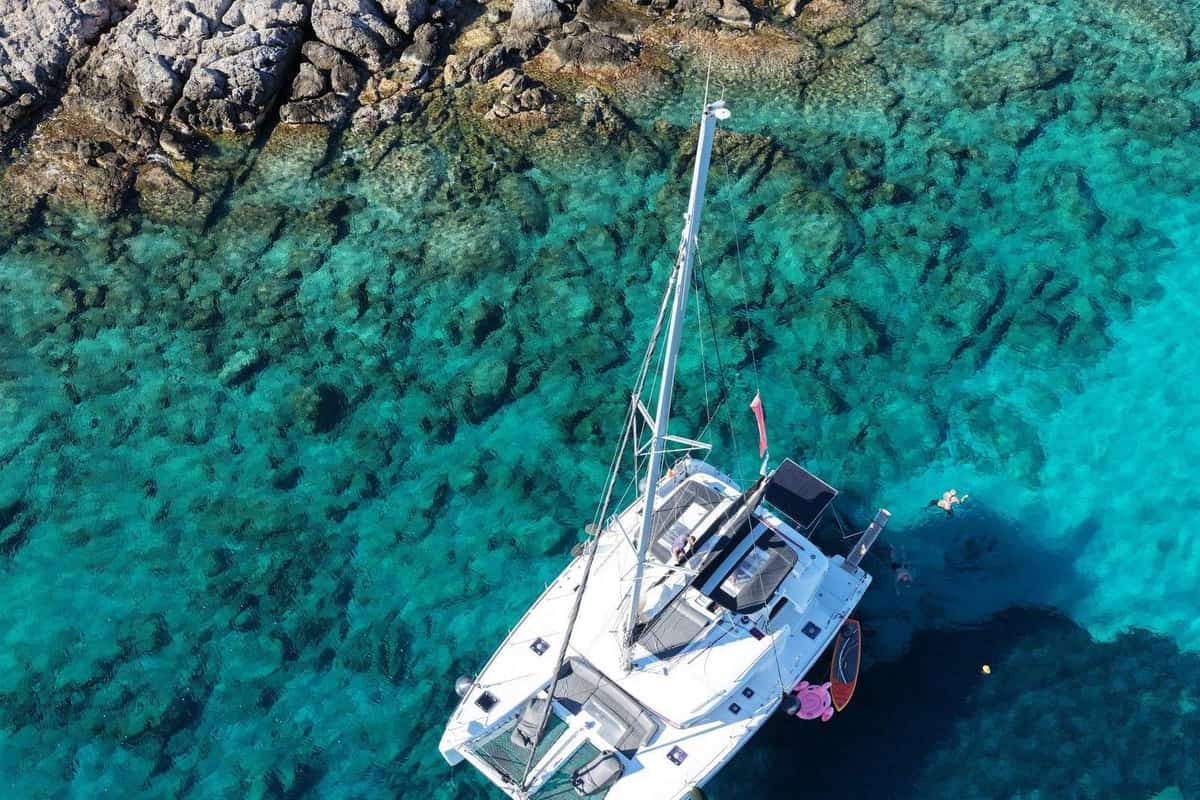
A Dia island boat trip sails from Heraklion to the uninhabited island of Dia for a swim in its sheltered southern bays. It features among the tours in Greece listed on Greece VIP.
This post covers trip types, ports, the crossing, the island and its bays, snorkeling, wildlife, protection, history, what is included and reviews. Weather, the best time and common questions come last.
What is a Dia island boat trip?
A Dia island boat trip is a day cruise from the Heraklion area to Dia. This uninhabited island lies off north Crete. Boats anchor in a quiet bay for a swim and a meal.
Dia lies 13.0 km in a straight line from the port of Heraklion, or 7 nautical miles. From Hersonissos harbour the distance grows to 20.1 km.
The bays can be reached only by sea. Operators sell a mix of sailing, swimming, snorkeling, paddleboarding and lunch. The day is not a sightseeing tour of the island.
A typical day runs in four steps. Guests board at the harbour, cross, stop at anchor and sail back.
A welcome drink or a light snack and a safety briefing come before the boat leaves. Crews tell the legends and history of Dia on the way across.
One listing calls Dia “the Island of Zeus”. A guest says the captain told island stories before the anchor went down.
The busiest Dia listing shows 3,130 reviews at 4.8 out of 5. Another shows 1,295 reviews at 4.9, with 4.9 for its crews.
A parliamentary question calls Dia a symbol of biodiversity and historical identity for the Heraklion area. It adds that the island is state-owned public land.
- Distance: 13.0 km.
- Stop: One bay at anchor.
- Top listing: 4.8 from 3,130.
A Dia island boat trip suits travellers who want clear water without a crowded beach.


Which types of Dia island boat trip run?
Dia island boat trip types range from small sailing yachts to large catamarans, by day or at sunset. Private charters run the same route for one group.
Shared sailing yachts are the standard product. One popular listing caps the group at 10 guests, and another at 14.
A sunset sail for no more than 6 guests feels close to private. Catamarans carry more, with caps of 16, 20, 22 and 25 guests.
Morning and sunset cruises run side by side. The sunset sail home is sold as a feature in itself.
Themed catamarans add a fishing lesson, a Cretan wine tasting or a Tai Chi session.
One catamaran adds an underwater sea scooter and an inflatable water slide. A family catamaran carries a kayak, noodles and a flamingo float.
A chef-led catamaran cooks a fine-dining menu on board. It offers meat, vegetarian and children’s dishes and a floating sea pool.
Private charters range from sailboats for 6 guests to catamarans for larger parties.
One listing sells a short coastal sail from Heraklion on the same page. That option does not go to Dia.
- Sailing: 6 to 14 guests.
- Catamaran: Up to 25.
- Private: One group.
A Dia island boat trip on a sailing yacht trades space for a smaller, quieter group.
Where does a Dia island boat trip leave from?
A Dia island boat trip leaves from the Old Venetian Harbour of Heraklion on the busiest listings. Hersonissos and Gouves have their own departures.
Guests look for a sign reading “Daily Cruises to Dia Island” at the Heraklion marina. Boats leave on time, and late arrivals count as no-shows.
Port police need every passenger’s identity details before departure. Operators collect names, birth dates, nationalities and passport or ID numbers at booking.
One listing does not accept a driving licence as ID for that check.
The Hersonissos catamaran sells a semi-private morning cruise. It picks up from Kokkini Hani, Malia, Stalida, Gouves and Gournes.
A small-group catamaran leaves Gouves port with free hotel transfers along the coast. Gouves lies 18.0 km by road from Heraklion port.
Heraklion trips pick up as far as Agia Pelagia, 21.7 km away, and Malia, 35.2 km away.
Boats leaving Heraklion pass the Koules fortress at the harbour mouth. Catamaran crews use it as the first photo stop.
- Main port: Heraklion.
- Others: Hersonissos, Gouves.
- Bring: Passport or ID.
Visitors who want a classic yacht day can compare the Heraklion sailing tours.
What happens on the crossing of a Dia island boat trip?
The crossing of a Dia island boat trip runs partly under sail when the wind allows. On calm days the boats use the engine.
One guest says the skipper paired the motor with the sails in a weak wind.
Skippers invite guests to help with the sails. On a good wind, the crossing doubles as a short lesson.
Guests like to sit on the bow or the netted front of a catamaran. Spray cools them on the way over.
Windy days bring rough crossings, but the bay at Dia stays calm once the boat anchors. Crews hand out seasickness tablets or anti-nausea gum on rough days.
Dolphins appeared on at least one October sailing. The captain turned the boat so the group got a good look.
The sailing yachts measure 15 to 16 m, one operator says. One catamaran is 50 feet long, and larger yachts have electric toilets.
Catamarans add shaded lounges, sun nets at the bow and free Wi-Fi on board.
A University of Crete archaeologist calls Dia a giant natural windbreak for the port of Heraklion.
- Power: Sail or engine.
- Rough days: Seasick tablets.
- Wildlife: Dolphins by chance.
A Dia island boat trip at sunset ends with the Venetian fortress lit up at the harbour mouth.
What is the island like on a Dia island boat trip?
The island on a Dia island boat trip is a stony, almost treeless triangle of about 12 km². Census figures for 2011 and 2021 show nobody living there.
Dia measures about 5 km from east to west and 3 km from north to south. Its highest point is the Vardia ridge in the east.
Scientists believe forest and springs covered the island about 5,000 years ago. The wood went into shipbuilding, and the springs later dried up.
Decades of overgrazing by goats have left the island’s low scrub badly degraded. A handful of wild olives, carobs and figs mark old fields.
Dry-stone walls of local grey dolomite cross the island, and the longest run 100 to 300 m. Fishermen grew a small plot of vines there until 1937.
The walls survive up to about 1.2 m high and once marked fields, pastures or beehives. A stone-paved path links the port with the forestry shelter in the north.
The blue-roofed Church of the Ascension stands on Cape Korakia. Built in the late 1950s, it sits beside the foundations of an old basilica.
Every year on the feast of the Ascension, boats bring worshippers from Crete to the church.
The Forestry Directorate keeps a permanent guard post on the island. The refuge there has no electricity.
- Area: About 12 km².
- People: None.
- Landmark: Blue-roofed chapel.
A Dia island boat trip shows the island mainly from the water. Its paths and buildings are basic and worn.
Which bays does a Dia island boat trip visit?
A Dia island boat trip anchors on the sheltered south coast, above all in Agios Georgios bay. Panagia bay is the other common anchorage.

A Cretan beach website calls the water at Agios Georgios turquoise. The bay escapes the frequent north winds.
One jetty lies below the chapel of the Ascension. The other sits where the island’s only taverna once stood, now abandoned.
Panagia bay is the best sheltered, ringed by rocky slopes full of oregano and Cretan herbs.
A pebble beach forms where the island’s only canyon meets the sea. A small cave chapel of the Panagia gives the bay its name.
Excursion boats mainly visit Agios Georgios. Panagia is easier to reach on a private or rented yacht.
Kapari, Agrilia and Aginara hold old wreck sites and lime kilns. Off Kapari, the coast drops as a cliff to about 15 m.
One yacht adds a second bay in good weather. When the weather turns, it stays longer in the first bay.
- Main bay: Agios Georgios.
- Quieter: Panagia.
- Wrecks: Kapari, Aginara.
Visitors who want more boat routes can compare the Heraklion boat trips.
What can snorkelers see on a Dia island boat trip?
Snorkelers on a Dia island boat trip find crystal-clear water with fish, starfish and the odd octopus. Results vary, and jellyfish can appear in September.
One guest spotted an octopus from the jetty because the water was so clear.
Another swam and snorkeled three times on one cruise and saw plenty of fish.
Not everyone is impressed. One catamaran guest found hardly any fish. A Spanish traveller felt the trip was not worth it for snorkeling alone.
Guests who spot ancient pottery shards on the seabed can photograph them. Crews ask them to put the pieces back into the sea.
One skipper anchors in a bay without jellyfish, which not every boat does.
Local fishermen see Mediterranean monk seals around the island, the official Natura record notes.
The wreck sites lie at about 18 to 33 m, deeper than a snorkeler reaches. At Korakia the cliffs drop almost straight down to about 39 m.
Off Kapari, rocky slopes with sandy pockets fall away to about 40 m below the cliff.
A guest on a private trip advises bringing a personal mask for a better fit.
- Seen: Fish, starfish, octopus.
- Rare: Monk seals.
- Watch for: Jellyfish.
A Dia island boat trip with a sea scooter lets guests cruise underwater without diving experience.
Which wildlife lives on Dia on a Dia island boat trip?
A Dia island boat trip passes an island of falcons, rabbits, lizards and rare plants. The wild goats released there in the past are being removed.
The Cretan wild goat came to Dia after 1955. It overpopulated the island, the official Natura record says.
Since 1988 a hunting programme has almost eliminated the goats because of cross-breeding. Foresters plan to bring back the pure wild type once the plants recover.
Wild rabbits jump out of the bushes along the paths. Archaeologists note that rats and rabbits have overpopulated the island.
Dia has its own lizard, Podarcis erhardii schiebeli, and an endemic land snail, Albinaria retusa.
The Natura record names Eleonora’s falcon, Bonelli’s eagle, the peregrine and the Alpine swift among its birds. The island is also a station for migrating birds.
Eleonora’s falcons raise their chicks in late summer, when songbirds cross the Mediterranean. A recent census counted 13,262 breeding pairs in Greece.
Rare plants include Carlina diae, named after the island, and Allium tardans. That plant grows only on Crete and Karpathos.
The European free-tailed bat appears among the island’s notable mammals. Two strictly endemic plants make Dia an important biotope for the southern Aegean.
- Birds: Eleonora’s falcon.
- Reptile: Endemic lizard.
- Goats: Being removed.
A Dia island boat trip promises no goat sighting, since the herd is being replaced.
Is Dia protected on a Dia island boat trip?
Dia is both a Natura 2000 site and a declared archaeological site. A Dia island boat trip therefore visits protected ground of 1,188.02 hectares.
A parliamentary question names it a Special Area of Conservation under the EU Habitats Directive. Its management plan was still unfinished when the question was tabled.
The Ministry of Culture declared the whole island an archaeological site on 9 February 1988. A sea zone around it is included.
The decision lists a prehistoric wall, two caves, rock carvings and obsidian. It also names a jetty in Agios Georgios bay.
Any work on the island needs approval from the Ministry of Culture.
Operators say landing is forbidden or restricted, and boats stay at anchor. Guests report different rules, so each operator confirms on the day.
The Natura record warns of growing tourist interest on the south coast. University researchers list plastic waste and uncontrolled visits as threats.
The island has no management body, a member of parliament notes. Illegal fishing remains a risk.
- Nature: Natura 2000.
- Heritage: Archaeological site.
- Landing: Restricted.
Visitors who prefer to swim off the Crete coast can compare the Heraklion snorkeling trips.
What history lies under a Dia island boat trip?
A Dia island boat trip anchors over a seabed full of ancient wrecks. Jacques Cousteau’s team dug there in the mid-1970s, with the main dig in 1976.
All 357 finds of the 1976 mission sit in the Koules fortress at Heraklion port. They were mostly Rhodian amphorae.
Cousteau found squared blocks on the seabed. He suggested that a great Cretan port once stood at Dia.
Results of that work remain unpublished. An archaeologist kept two volumes of diaries of the 1976 dig.
In autumn 2011, a joint survey used an underwater robot to map about 30 km² of seabed. Divers covered 11 km of the island’s coast.
The team found four unknown ancient wrecks, one known from 1976 and three modern ones. A Late Roman amphora cargo lies off Kapari.
A submerged breakwater of about 100 by 60 m shelters part of Agios Georgios bay. Its pottery dates it to the middle Byzantine period at the latest.
Melian obsidian and a massive wall point to Early Bronze Age activity. Dia is the only stepping-stone island between central Crete and the Cyclades.
A British archaeologist visited Dia in 1935 and helped build its basic chronology. Finds on land include 17th-century coins, Turkish pipes and wartime shrapnel.
Myth says Zeus turned a sea monster into Dia. Two rusks he threw became the islets of Paximadi and Petalidi.
- Finds: 357 in Koules.
- Wrecks: Roman to modern.
- Myth: Zeus’s monster.
A Dia island boat trip crew tells these stories on the way across. The history comes with the swim.
What does a Dia island boat trip include?
A Dia island boat trip includes the crossing, swim gear, a meal and drinks on board. Lifejackets, insurance and a safety briefing come with the ticket.
A typical sailing lunch is pasta with shrimp in tomato sauce, a Greek salad, bread and fruit.
One Cretan menu serves skioufichta with apaki. This local pasta comes with smoked pork, dried tomatoes and graviera cheese.
A family catamaran adds quinoa salad, local cheeses, calamarata pasta and barbecue chicken. Vegetarian, vegan and gluten-free versions come on request.
Unlimited drinks mean water, soft drinks, local white wine and beer. The meal ends with seasonal fruit and a glass of Cretan raki.
Snorkeling gear, paddleboards and fishing gear come with almost every Dia ticket. Towels come on sailing listings, but a handful of catamarans sell them.
Hotel pickup is an option on a number of listings, and it is sometimes included.
One catamaran gives each guest two cocktails with the ticket.
- Food: Lunch on board.
- Gear: Snorkel, paddleboard.
- Safety: Lifejackets, insurance.
A Dia island boat trip menu changes for allergies when guests tell the crew at booking.
What do reviewers say about a Dia island boat trip?
Reviewers of a Dia island boat trip love the crews, the fresh food and the clear water. Complaints focus on crowded boats, pickup delays and unclear lunch details.
The busiest listing, at 4.8 from 3,130 reviews, praises freshly cooked food. Its guests want clearer notes on boat changes and group size.
A sailboat listing scores 4.8 from 1,495 reviews for smooth sailing and swim time.
A luxury catamaran scores 5.0 from 508 reviews. Its guests asked for a short walk or simple activity for non-swimmers.
A day and sunset listing scores 4.7 from 1,080 reviews. A share of its guests found the boat crowded.
Guests on sunset trips call the sail home the highlight. One celebrated a mother’s 60th birthday and rated every part 10 out of 10.
One guest did the sailing twice in a single holiday. Another found the bay crowded with anchored boats at sunset.
A crew sent a driver back to a hotel to return a forgotten item. One sailboat guest found plenty of shade on board.
- Praise: Crews and food.
- Complaint: Crowded boats.
- Tip: Small groups.
Travellers who want a catamaran day elsewhere can compare the Crete catamaran cruises.
How does weather shape a Dia island boat trip?
Wind and waves decide how smooth a Dia island boat trip feels. Model data for the Dia area logged an 87.8 km/h gust on 18 February.
That same day, waves off Dia reached 3.80 m, the highest of the series. Cruises move to another date in bad weather.
Summers stay dry. Last July brought no rain at all and peaked at 29.7 °C on 25 July.
A 60.5 km/h gust blew on 28 July last year. This July averaged a 27.2 °C high in the model cell beside the island.
Waves off Dia averaged 0.67 m last July and 0.73 m this August. The highest that August reached 1.82 m on 14 August.
The sea warmed to a 26.4 °C mean this September, with a top reading of 27.4 °C.
Autumn rain arrived hard this year: 159.8 mm by mid-October, with 56.8 mm on 3 October alone.
This April brought 63.8 mm of rain, with 37.1 mm on 25 April. Last September’s highest wave reached 2.36 m on 19 September.
Paddleboards stay on deck on rough, windy days, for the safety of guests.
- Top gust: 87.8 km/h.
- Top wave: 3.80 m.
- Sea: 26.4 °C in September.
A Dia island boat trip on a windy day can still find calm water. The south coves face away from the north wind.
When is the best time for a Dia island boat trip?
A Dia island boat trip fits summer and early autumn best, with a warm sea and dry days. Peak-season departures sell out, so early booking helps.
Last June averaged a 24.6 °C high, and its only rain, 1.8 mm, fell on 1 June.
The sea held a 25.8 °C mean last September. Last November it still averaged 21.9 °C, with waves averaging 0.46 m.
A guest in October found the sea surprisingly warm. Another, in early October, found it a little chilly but still fine for swimming.
Winter brings rougher water. Waves off Dia reached 2.72 m on 9 December last year. This March logged 117.6 mm of rain.
Last December the sea averaged 19.8 °C, and rain on the island totalled 68.9 mm.
Reviews from mid-September mention jellyfish in the water near Dia, so swimmers keep watch.
Sunset sails suit travellers who want cooler air and the light on the mountains of Crete.
Guests who book apart from their group can ask the operator to place everyone on one boat.
- Warm sea: August, September.
- Driest: July.
- Book: Early in summer.
A Dia island boat trip in late summer meets the warmest sea of the year.
What do travelers ask about a Dia island boat trip?
Travelers ask about landing, children, access, seasickness and what to bring. Answers differ by operator, so each listing needs a check.
Can guests go ashore on Dia?
Landing is restricted, and boats stay at anchor. One guest swam about 8 m to shore and walked. Others were told the island is off limits.
Can children join?
Yes, on the bulk of boats. One sailboat sets a minimum age of 4 on shared cruises, while private trips welcome infants.
Is a Dia island boat trip wheelchair friendly?
No. Listings exclude wheelchair users and people with mobility impairments.
Does it suit people prone to seasickness?
Not ideally. A number of listings advise against it, and guests take tablets before sailing.
Can guests fish?
Yes. Fishing gear comes on a number of trips, and one themed catamaran teaches fishing.
Is there a toilet on board?
Yes. Larger sailing yachts have electric toilets, and catamarans list a WC and an outdoor shower.
What happens in bad weather?
Operators move the cruise to another date or refund the ticket when the sea turns rough.
What do guests bring?
A passport or ID, swimwear, a towel and sunscreen. A hat, sunglasses and a light jacket help on the sail home.
Are there facilities on Dia?
No. The island has no facilities beyond the small port area at Agios Georgios. Guests take their rubbish back to the boat.
Travellers based on the north coast can compare the Crete boat trips.