
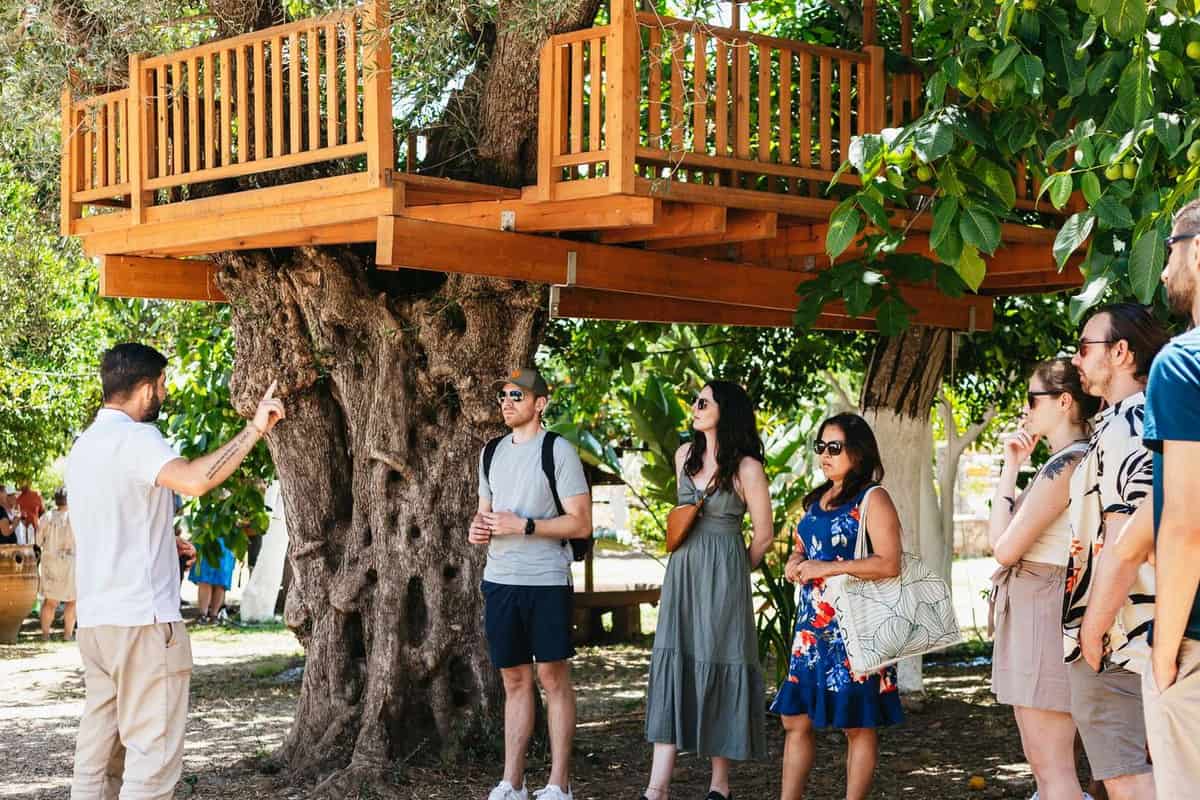
A Chania olive oil tour leads from the city into the groves, mills and villages of west Crete, where the island’s oil is pressed and tasted. It features among the Greek tours listed on Greece VIP.
This post covers tour types, inclusions, routes, the Vouves tree, the mill, the tasting, other local flavours and reviews. Weather, the best time and common questions come last.
What is a Chania olive oil tour?
A Chania olive oil tour takes visitors from Chania into the olive country of west Crete. It joins an olive grove, a mill and a tasting. Bigger tours add an ancient tree and a winery.
The busiest listing covers five stops in one day. It visits an ancient olive tree, a bakery, an olive mill, a cheese factory and a winery.
That tour scores 4.6 out of 5 from 1,186 reviews, with 4.8 for its escorts. It was booked 11 times in a single day in the latest sweep.
One listing calls Cretan olive oil the island’s world-famous “green gold”. Its road trip runs through the western countryside from Platanias.
Smaller tours focus on the oil alone. One walks ancient groves, tastes premium extra virgin oils and ends with a three-course Cretan meal.
- Stops: Grove, mill, tasting.
- Extras: Bakery, cheese, wine.
- Top rating: 4.6 from 1,186.
A Chania olive oil tour turns the island’s main crop into a full countryside day.


Which types of Chania olive oil tour run?
Chania olive oil tour types range from big tasting days to small private visits and active trips. Each mixes oil with other local products.
Full-day tasting tours pair oil with wine, cheese and honey and carry groups in an air-conditioned bus.
A small-group version takes no more than 8 guests, and one private tasting no more than 5.
A mountain tour ends with lunch in a restored 17th-century settlement above the Topolia Gorge. It scores 4.9 from 102 reviews.
A quad safari crosses the Apokoronas hills and stops at a local olive mill. Drivers must be over 20 and hold a car licence.
A White Mountains safari with lunch and tastings scores 4.9 from 62 reviews.
A short trip from Souda cruise port visits the ancient tree, a family-run mill and its grove.
- Group: Bus or small van.
- Active: Quad and mill.
- Cruise: From Souda.
A Chania olive oil tour from the cruise port fits the oil into a short shore day.
What does a Chania olive oil tour include?
A Chania olive oil tour includes hotel pickup, transport, an escort and the tastings on the plan. Personal purchases and extra food stay outside the deal.
The busiest tour lets guests store local purchases safely on the bus. Small producers on the route can accept cash only.
Pickup reaches hotels across the Chania coast, and remote pickups can cost extra.
Guests receive the exact pickup time and point through the booking account or by email the day before.
A hat, sunglasses and high-factor sunscreen help on the open farms, along with comfortable walking shoes.
Wine stays off the table for guests under 18, who get water or fresh orange juice. One olive tour lets children under 12 join free.
Tours run in all weather, so guests dress for sun or rain on the day.
- Included: Pickup, tastings.
- Bring: Hat, cash.
- Children: Juice, not wine.
Travellers who want the island-wide picture can compare the Crete olive oil tours.
Where does a Chania olive oil tour go?
A Chania olive oil tour heads west to Kolymvari and the Kissamos hills, or east into Apokoronas. Ano Vouves lies 27.9 km by road from the old harbour of Chania.
Kolymvari sits 25.4 km from Chania by road. It lies at the south-eastern end of the Rodopou peninsula.
The village first appears in the census of 1900. It was renamed from Kolympari to Kolymvari in 1940.
Its sandy beach saw the Ottoman landing of 1645, which began the long war for Crete. Greek troops under Timoleon Vassos landed at the same spot in 1897.
Two busy tours reach Perivolakia village for a family bakery and an olive grove. Others climb into the Kissamos mountains, 37.9 km from Chania by road.
Platanias lies 15.4 km away and Vamos, in Apokoronas, 27.1 km. A road trip from Platanias adds Kolymvari and the monastery of Gonia to its tastings.
- West: Kolymvari, Vouves.
- Hills: Kissamos.
- East: Apokoronas.
A Chania olive oil tour spends more time in villages than in town.
What does the olive tree of Vouves add to a Chania olive oil tour?
The olive tree of Vouves gives a Chania olive oil tour its oldest stop. It still bears fruit, because growers grafted it with the Tsounati variety.
Its heartwood has rotted away, which rules out dating with radioisotopes.
Researchers now debate the old age estimates for olive trees in Crete and abroad. No agreed scientific method exists yet.
It can turn out younger than earlier figures. It can also prove older than the ancient tree at Finix in Sfakia.
Vouves belongs to the Kolymvari municipal unit, along with villages such as Spilia, Episkopi, Nochia and Drakona.
One tour lets visitors touch the tree. Another leaves free time for photos and a walk around the site.
- Variety: Tsounati graft.
- Age: Still debated.
- Village: Ano Vouves.
A Chania olive oil tour treats the tree as living proof of how long olives grow here.
What happens at the mill on a Chania olive oil tour?
The mill on a Chania olive oil tour shows how olives become oil, from crushing to separation. Tours visit both modern mills and old stone presses.
Old mills crushed the fruit under grindstones. That method breaks up the pulp while barely touching the pit and the skin.
The paste was spread on discs and stacked under a hydraulic press. Pressure up to 400 atmospheres squeezed out the oil and the vegetation water.
Modern decanters spin at around 3,000 revolutions a minute to split the phases by weight. A vertical centrifuge near 6,000 then cleans the oil.
Two-phase decanters use less added water. That washes fewer polyphenols out of the oil than the three-phase kind.
In Gavalochori, in Apokoronas, a restored 17th-century olive mill stands beside a folklore museum.
The Ministry of Culture protects Gavalochori as a village of popular architecture. Olive groves remain its farming base, and it counted 612 residents in 2021.
- Old way: Stones and press.
- New way: Decanter.
- Museum: Gavalochori.
Visitors who pair oil with vineyards can compare the Chania wine tours.
How does the tasting work on a Chania olive oil tour?
The tasting on a Chania olive oil tour compares oils by fruitiness, bitterness, pungency and aroma. Bread, cheese and honey sit beside the samples.
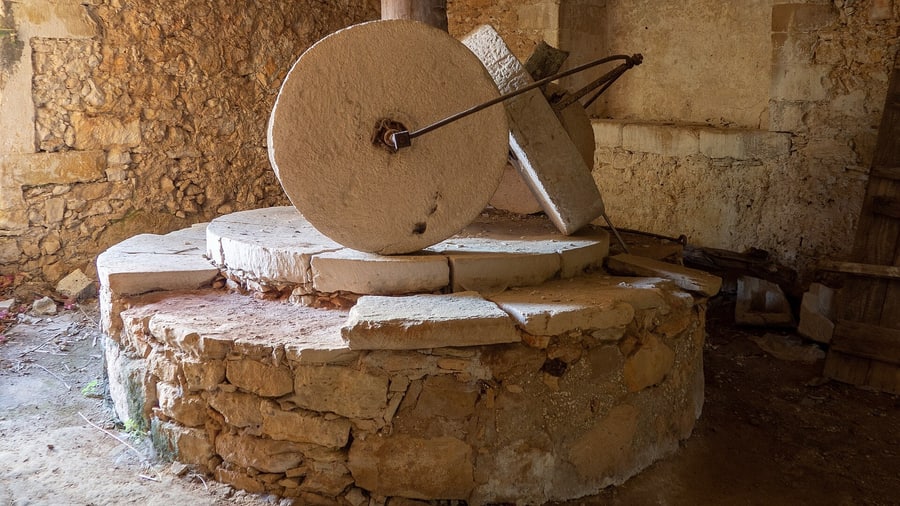
One mill tour pours four extra virgin oils and teaches visitors to recognise quality oil.
At a mountain mill, guests taste organic extra virgin oil on warm bread with oregano.
A tasting platter on the busiest tour adds fresh tomatoes, olives, cheese and honey to the oil.
A smaller farm tour poured only one oil, but a reviewer called it outstanding. Bruschetta and a sweet wine followed.
The same farm welcomes guests with raki and local snacks before the walk through the trees.
One honey tasting paired a range of honeys with oils, bread and cheese. A reviewer loved the match.
- Judged: Fruit, bite, aroma.
- With: Bread and honey.
- Welcome: Raki.
A Chania olive oil tour tasting teaches the palate before the shopping starts.
What else does a Chania olive oil tour taste?
A Chania olive oil tour also tastes bread, cheese, honey and wine on the same day. The busiest tour stops at a bakery, a cheese factory and a family winery.
The bakery uses a wood-fired oven for Cretan bread, rusks and savoury pastries. Visitors can buy any of them.
At the cheese factory, guests see cheese being made in season. Out of season, the escort explains each step.
Beekeeping follows the honey from the hives to extraction and bottling.
A Kissamos winery founded in 1993 pours Vidiano, Muscat of Spina and international grapes. A second winery adds a white blend of Vilana, Vidiano and Assyrtiko.
Another tour pours 6 to 7 wines at a family winery. Children on these trips get a separate tasting of their own.
- Bakery: Wood-fired oven.
- Cheese: Seasonal making.
- Wine: Up to 7 labels.
A Chania olive oil tour with all these stops works as a full taste of Chania farm life.
What do reviewers say about a Chania olive oil tour?
Reviewers of a Chania olive oil tour praise knowledgeable escorts, generous tastings and country views. Complaints focus on large groups that make tastings crowded and hard to hear.
The busiest tour’s review summary repeats that split. It praises the range of tastings but calls for smaller groups.
A wine and oil tour from Chania scores 4.8 from 385 reviews. One reviewer’s escort was a local sommelier from a village near the route.
On the mountain tour, reviewers recall the best orange juice and mountain tea of their trip. One escort was a beekeeper who kept the drives lively.
A tasting tour with 34 reviews scores 4.4. A reviewer expected a smaller group, yet found the large one worked well.
The quad and mill trip scores 4.8 from 57 reviews, with 5.0 for its escorts. One large-group reviewer still found every tasting leisurely and interesting.
- Praise: Escorts, tastings.
- Complaint: Large groups.
- Tip: Pick small groups.
Travellers who want more Cretan flavours can compare the Chania food tours.
How does weather shape a Chania olive oil tour?
A Chania olive oil tour spends hours outdoors in groves with patchy shade. Model data for the Kolymvari area put last July’s mean high at 31.3 °C.
Last July peaked at 36.1 °C on 27 July. This year, August reached 34.1 °C on 26 August.
Autumn rain arrived hard this year. September logged 101.7 mm, and October brought 153.0 mm by mid-month.
February was wet too, with 117.8 mm, and its gusts reached 100.1 km/h on 18 February.
The strongest gust of the year so far hit 117 km/h on 1 April. January brought 61.6 mm of rain, and March 103.1 mm.
Rain falls in heavy bursts on the wettest days. February logged 36.6 mm on 12 February alone.
Last November logged 47.2 mm and last December 77.8 mm, during the olive picking months.
- Hottest: 36.1 °C last July.
- Wettest: October, 153.0 mm.
- Top gust: 117 km/h.
A Chania olive oil tour in summer goes best with sun protection and water.
When is the best time for a Chania olive oil tour?
A Chania olive oil tour suits spring and autumn, when the groves stay mild. Late autumn and winter add the harvest and pressing.
Model data put this June’s mean high at 28.2 °C, still pleasant in the morning groves.
September stayed warm this year, peaking at 32.4 °C on 13 September, before the rain arrived.
One farm tour shows visitors up close how olives are harvested and pressed.
The cheese stop on the busiest tour depends on the season. Out of season, visitors hear the steps without seeing them.
Time schedules shift with group size and weather, one operator notes.
Last September was dry, with 5.6 mm of rain. Last October logged 20.1 mm, far less than this one.
- Mild: Spring, autumn.
- Harvest: Late autumn.
- Summer: Hot groves.
A Chania olive oil tour in autumn can meet both fresh oil and the first heavy rain.
What do travelers ask about a Chania olive oil tour?
Common questions cover the airport, cruise ports, access, children and buying oil. Pickup covers hotels across the Chania area.
How far is the airport from the olive villages?
Chania airport lies 16.1 km from the old harbour, and Kolymvari 25.4 km to the west. Rethymno, for travellers based farther east, lies 72.8 km from Chania.
Can cruise passengers join?
Yes. One tour picks up at Souda cruise port and drops guests back there. Souda lies 8.3 km from the old harbour by road.
Is a Chania olive oil tour wheelchair friendly?
Not always. Mills and the ancient tree site have uneven ground, and one private tour excludes wheelchair users.
Can children join?
Yes. Children get juice or water instead of wine, and one quad trip takes passengers from age 6.
How far are the south-west olive villages?
Kandanos, in the Selino district, lies 56.4 km from Chania by road, and Paleochora 71.3 km.
Can guests with allergies join?
Yes. Operators adapt tastings and menus for food allergies and vegetarian diets with advance notice.
Can visitors buy oil?
Yes. Producers sell oil and other goods on site, and small ones can take cash only.
Travellers who want to cook with the oil can compare the Chania cooking classes.