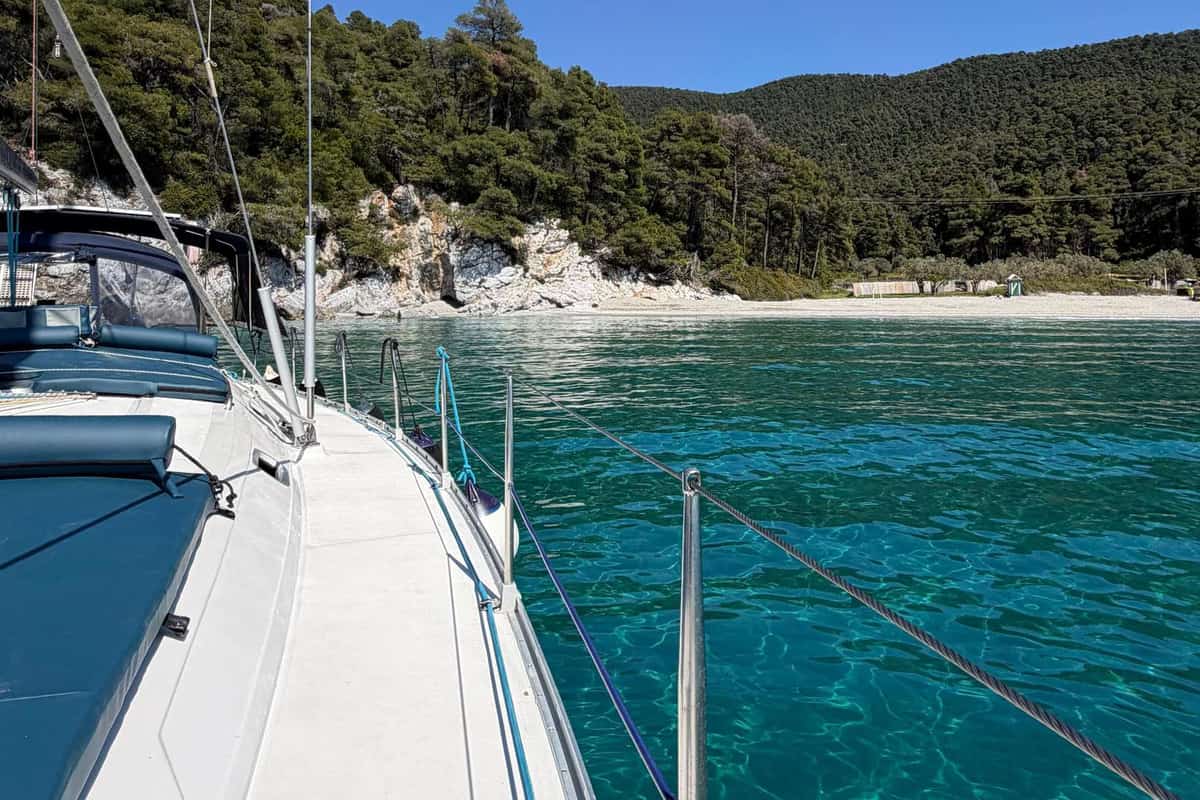
A Skopelos sailing tour crosses the pine-covered Northern Sporades, from Skopelos to Alonissos, its marine park and Skiathos. It is one of the Sporades sailing trips in Greece on Greece VIP.
This post covers what a Skopelos sailing tour includes, where it starts and the beaches it passes. It also covers the marine park, the islets, Alonissos, Skiathos, sea life, shipwrecks, sea history, winds and lighthouses. Sea depth, the best season and common questions come last.
Each section ends with a Skopelos sailing tour or a nearby cruise that can be booked online.
What does a Skopelos sailing tour include?
A Skopelos sailing tour leaves the town harbour in three listed formats. They are a marine park day, a barbecue day and a sunset sail. Crews serve breakfast, lunch and drinks on board. Group limits run from 8 to 12 guests.
One Skopelos sailing tour heads from the town harbour toward Alonissos and the marine park. Its swim stops are secluded beaches that only boats reach. Another route adds the island of Peristera.
The small-group Skopelos sailing tour takes up to 8 guests. They board a boat flying a large white flag in the town harbour. The plan stays flexible for guest ideas.
Breakfast there is freshly made and includes Skopelos pie. The menu also lists yogurt with honey, Greek salad and fresh fruit. Coffee, tea and alcoholic drinks are served all day.
A barbecue Skopelos sailing tour follows the same Alonissos and marine park route. Lunch is steak, sausages and chicken grilled on the boat, served with wine, ouzo or raki.
On the barbecue trip, children become part of the crew. Their families can sit back or learn how to sail the boat. Guests also swim at remote, boat-only beaches.
A Skopelos sailing tour on a traditional wooden sailboat takes up to 12 guests. Breakfast, lunch and snacks use local ingredients and come with wine, beer and soft drinks.
The wooden sailboat also runs sunset sails. A glass-bottom boat on the marine park route belongs to the boat trips around Skopelos. It also runs sunset trips to Alonissos.
- Cheese pie: Skopelos cheese pie is a deep-fried spiral of cheese-filled phyllo.
- Wine: A vine pest destroyed the island vineyards in the 1940s.
- Fishing: Skopelos supports a small fishing fleet in local waters.
Sailing lessons for all ages run at Panormos.


Where does a Skopelos sailing tour start?
A Skopelos sailing tour starts from the town harbour, where 80 boats fit along the long breakwater. Loutraki, the harbour of Glossa, and Agnontas also take yachts. Panormos bay is a deep anchorage, and Neo Klima offers about 15 berths.
The town harbour has a mud bottom that holds anchors well. A heavy mooring chain lies 30 metres off the north breakwater, parallel to it. Mooring lines there are scarce.
The listed depth for a Skopelos sailing tour berth here is 4.4 metres. Water and electricity cost a small fee. Crews buy the access card at a street kiosk.
Hydrofoil swell leads one harbour listing to advise against the pier’s first third. A sailing site marks red quay berths as dangerous in storms. The harbour has no showers.
A Skopelos sailing tour calling at Loutraki uses a summer-only floating pontoon. It fits 5 to 7 yachts per side, with 2.5 metres of depth on the north side.
Ferries need a turning area at Loutraki, which boats keep clear. Weeds and soft mud make anchoring in the basin poor in windy weather. A new tree-lined path climbs to Glossa.
A Skopelos sailing tour at Agnontas finds depths of 1 to 6 metres. The water shallows fast toward the beach. Fast-ferry swell has damaged yachts tied at the quay.
Panormos bay is deep, so crews tie long lines to the western bank. Buoys keep boats off the swimming area by the beach. Strong northerly gusts sweep the bay.
- Neo Klima: Its harbour is 1.5 to 2.8 metres deep.
- Panormos wreck: It lies 1.5 metres deep in the southern arm.
- Ancient harbour: Alexander of Pherae occupied Panormus around 361 BC.
For a Skopelos sailing tour, the town harbour authority answers on 24240 22180.
Which beaches does a Skopelos sailing tour pass?
A Skopelos sailing tour passes pebble and sand beaches on the west and south coasts. Milia stretches 750 metres and Panormos 650 metres. Kastani and Hovolo both face west. Glysteri sits on the east coast in a 110-metre bay.
The south side holds the bulk of the island’s beaches, while the north and east coasts are rocky. Stafylos is a 400-metre pebble beach inside a Natura 2000 area.
A Skopelos sailing tour near Stafylos reaches Velanio, a 650-metre pebble beach facing southwest. Walkers reach it from Stafylos. Aleppo pine forest backs it, partly burned and regrowing.
Agnontas has only 70 metres of pebbles facing west. A large mulberry tree shades part of the beach. A 200-metre pier for small boats stands about 50 metres away.
A Skopelos sailing tour finds Limnonari in a closed bay 220 metres long. Its white sand mixes with pebbles, backed by pine and tamarisk. It lies open to southerly winds.
Panormos beach fills its whole bay with pebbles and faces southwest. The seabed drops to 5 metres just 40 metres out. The village behind it counts 39 permanent residents.
A Skopelos sailing tour off the west coast passes Milia, which faces northwest. Its southwest part is sand, while the northeast part mixes pebbles and sand. A reed marsh lies nearby.
A Skopelos sailing tour also reaches Kastani, 150 metres of sand with small pebble patches. The seabed slopes gently there and hits 5 metres about 80 metres out.
- Glysteri: Regular caïques reach this pebble cove from the town.
- Hovolo: Depth reaches 5 metres just 35 metres off this beach.
- Milia: A lifeguard and a food kiosk serve the beach.
Small boats anchor in the swimming waters at Milia, Hovolo and Agnontas.
What does a Skopelos sailing tour see in the Alonissos marine park?
A Skopelos sailing tour crosses a park where 94 percent of the area is sea. Zone A covers 1,587 square kilometres of strictly protected islands and sea. Zone B holds the villages of Alonissos. Each zone has its own rules.
The founding decree appeared in Government Gazette issue 519/D. Joint Ministerial Decision 23537/2003 updated it and set up a management body. Both texts bind every Skopelos sailing tour.
A Skopelos sailing tour needs permission to enter Zone A. Visit tickets began in October 2021. Speedboats cannot exceed 10 knots within 0.5 nautical miles of its islands.
Zone A bans scuba diving, speargun fishing, and shellfish or sponge fishing. Hunting is banned, except on Gioura by permit. Tankers carrying over 500 tonnes of oil are barred.
Park rules split Zone A into nine sub-zones, A1 to A9. Piperi forms A1, and Psathoura forms A2. A Skopelos sailing tour meets different anchoring rules in each.
Zone B takes in Patitiri, Palia Alonissos, Votsi and Steni Vala. Professional boats there can set up to 100 traps each. Zone B1 sets a 10-knot limit near the coast.
The state agency NECCA runs the park through its Sporades National Park unit. Six staff work at its Patitiri headquarters.
The unit runs an 11.28-metre speedboat and a 4-metre inflatable. Park rules name yachts and professional tourist vessels. They cover each Skopelos sailing tour and boat trips from Skiathos.
- Natura code: Site GR1430004 also takes in eastern Skopelos.
- Neighbour site: GR1430009 covers 204.80 square kilometres between Skiathos and Skopelos.
- B1 strip: It runs 200 metres out, from Cape Kalamos to Cape Amoni.
The park’s marine mammals include fin whales and Cuvier’s beaked whales.
Which islets does a Skopelos sailing tour pass?
A Skopelos sailing tour can pass two Skopelos islets, Dasia and Agios Georgios. Dasia faces the west coast, and Agios Georgios lies east of the island. Peristera stretches east of Alonissos. Kyra Panagia, Gioura, Psathoura and Piperi lie further northeast.
Dasia is a wooded islet of 0.33 square kilometres, facing Milia beach. It is also called Daxia or Desa. Legend places a hidden treasure in one of its caves.
Agios Georgios sits on the side a Skopelos sailing tour crosses toward Alonissos. The islet covers 0.417 square kilometres. Natura 2000 sites GR1430004 and GR1430005 both cover it.
Peristera lies inside Zone B and also goes by Xero and Aspro. The 2021 census counted 18 residents. The island has no electricity, running water, port or roads.
Kyra Panagia covers 25 square kilometres. Emperor Nikephoros II Phokas granted it to Megisti Lavra on Mount Athos in 963. Its monastery on the east coast was renovated in 2017.
Gioura rises to 570 metres, the park’s highest point. Its Cyclops Cave is the largest in the Sporades. A Skopelos sailing tour anchors there only when cave visits are allowed.
Psathoura lies furthest north of the park islands. Rock dating puts the volcanic island at 700,000 years old. A Skopelos sailing tour can moor only at its Mandraki beach.
Piperi covers 4.3 square kilometres and rises to 354 metres. Pine forest and kermes oak cover it. Its name means pepper. Up to 33 bird species live there.
- Skantzoura: Its low hills end on white marble shores.
- Gioura goats: They are Capra aegagrus var. dorcas, similar to the Cretan kri-kri.
- Kyra Panagia: A Skopelos sailing tour can anchor at Monastiri beach by day.
Psathoura also holds the sea daffodil, unknown on the other park islands.
What does a Skopelos sailing tour see on Alonissos?
A Skopelos sailing tour reaches Patitiri, the administrative centre of Alonissos. Patitiri once served as the port of the old mountain village, Chora. Votsi and Steni Vala have small natural harbours. The Kokkinokastro peninsula keeps a section of Classical wall.
Patitiri takes its name from the winepresses locals once used for red wine. All public services on Alonissos sit there. The 2021 census counted 1,387 residents in the town.
Alonissos lies about 8 nautical miles from Skopelos town. From Glossa, it lies 15 nautical miles away. A Skopelos sailing tour from Glossa covers nearly twice the distance.
Palia Alonissos, the old Chora, keeps the 17th-century Church of Christ. Agios Athanasios and Agios Georgios churches stand in its Kastro. A Classical cemetery lies nearby, at Agios Ioannis.
The 1965 earthquake struck at 9:30 pm, under the North Euboean Gulf. Five days later, a second shock hit Skopelos too, the starting island of a Skopelos sailing tour.
Kokkinokastro is a peninsula with red rocks. In 1969-1970, Dimitris Theocharis excavated Vrachos, the islet opposite. His digs revealed Middle Neolithic remains. Scholars place a Mycenaean city at the site.
Votsi, 1.5 kilometres from Patitiri, was first settled after the 1965 earthquake. A Skopelos sailing tour finds a shingle beach and pine forest. Fishing caiques moor in its natural harbour.
Steni Vala lies roughly 11 kilometres north of Patitiri. Its small natural port gives a Skopelos sailing tour shelter beside fishing boats. MOm runs a seal pup rescue centre nearby.
- Earthquake toll: Two elderly women died when their houses fell.
- Oldest finds: Middle Palaeolithic material came from the islet opposite Kokkinokastro.
- Ferries: Boats from Patitiri also sail to Mantoudi, on Evia.
About 2,000 people lived on Alonissos when the 1965 earthquake struck.
What does a Skopelos sailing tour see near Skiathos?
A Skopelos sailing tour reaches Skiathos, six nautical miles west of Skopelos. It passes Repi lighthouse, the islet of Tsougria and the Bourtzi peninsula. On the north coast wait the Kastro cliffs and the white pebbles of Lalaria.
In Greek, the water east of Skiathos is the Skopelos Channel. The water on the west side is the Skiathos Channel. A Skopelos sailing tour crosses the eastern one.
Repi lighthouse stands on an empty islet on the channel’s western shore. Its stone tower rises 15.1 m and dates from 1914. Solar power has run it since 1995.
Since 2017, a 204.80 km² bird protection zone has covered the Skiathos coast. It also takes in the islets and the sea crossed by a Skopelos sailing tour.
Tsougria, the largest islet east of Skiathos, covers 1.14 km². It has pine trees and golden sand. A Skopelos sailing tour passes it across from the old port.
On the Bourtzi peninsula, a school paid for by Andreas Syggros opened in 1906. Today it holds a cultural centre, a summer stage and a museum of naval tradition.
Lalaria takes its name from a local word for round, white pebbles. No road reaches the cove, so tours of Skiathos island arrive by boat. Local rules forbid taking pebbles.
A Skopelos sailing tour passing Koukounaries meets a protected site of 88.82 ha. Half of it is sea, out to the 20 m depth line, over Posidonia and Cymodocea seagrass.
- Kastro: A stepped path drops to a grey sand beach.
- Airport: It sits just 16 m above sea level.
- Strofilia: This 9.5 ha lake meets the sea through a narrow canal.
A Skopelos sailing tour finds clear, deep water at the small beach below Kastro.
What sea life does a Skopelos sailing tour meet?
A Skopelos sailing tour crosses waters where a record 21 monk seal pups were photo-identified in one season. Common dolphins and deep-water whales use the area too. Cliffs hold Eleonora’s falcons, and gorgonian coral grows from 40 m down.
The record pups were born mainly on Piperi and along southeastern Skopelos. Births peak from September to November. No season in about 40 years of monitoring had more.
Long-term watch by MOm and park staff put the park at 52 adult seals in 2009. From 1990 to 2004, researchers tracked births in 34 of its coastal caves.
Seals chose caves by seclusion, floor type and shelter from wind and waves. Nine or ten seal caves line southeastern Skopelos, home island of a Skopelos sailing tour.
A Skopelos sailing tour crosses one of five Aegean areas where short-beaked common dolphins are frequent. Across Greek seas, striped dolphins top offshore counts and bottlenose dolphins coastal ones.
Depressions between the Northern Sporades and Chalkidiki hold sperm whales and Cuvier’s beaked whales. The only Greek minke whale record up to 2002 was a carcass off Skiathos.
A 2021 boat survey counted 329 active Eleonora’s falcon nests on 13 of 29 park islands. The species also lives on the Skopelos coast, where a Skopelos sailing tour starts.
Skantzoura and its neighbouring islets Stroggylo and Polemika shelter Audouin’s gulls and Eleonora’s falcons. Military activity emptied an Audouin’s gull colony on Northern Sporades islets in 1996 and 1997.
- Seagrass: Besides Posidonia, the park holds Cymodocea seagrass too.
- Coral: Dives found gorgonians 40 to 80 m deep at three Sporades sites.
- Alien fish: Thessaly and Sporades catches held four non-native fish species.
Near a Skopelos sailing tour, the alien fish Stephanolepis diaspros turns up in catches.
Which shipwrecks lie near a Skopelos sailing tour?
Off Peristera, near a Skopelos sailing tour, lies a cargo ship lost between 425 and 415 BC. It carried over 3,000 wine amphorae from Mende and ancient Skopelos. Byzantine wrecks also rest off Kyra Panagia, northeast of Alonissos.
Alonissos fisherman Dimitris Mavrikis found the wreck in 1985, off the rocky west coast of Peristera. Its amphorae lie 21 to 28 m deep, in a pile 25 m long.
When digging began in 1992, it was the largest known cargo ship of its period. Its hull measured 25 to 30 m, and its cargo weighed about 126 tonnes.
Divers first mapped the site with a photomosaic shot 7 m above the wreck. A rope grid of 24 by 12 m split it into 2 m squares.
A Skopelos sailing tour passes near the first underwater museum Greece opened to divers, on 1 August 2020. Non-divers take virtual dives at a centre in Chora, Alonissos.
In 1970, Greek archaeologists began work on a Byzantine wreck, another site near a Skopelos sailing tour. It lay off Pelagonisi, or Kyra Panagia, with over 1,500 ceramic pieces.
Its glazed plates carry engraved birds, animals and Kufic letters. This style dates the wreck to the mid-12th century. Six large millstones also lay among its cargo of pottery.
In autumn 2010, an underwater robot scanned about 8 km² between Alonissos and Kyra Panagia. Working 40 to 85 m deep, it found three known ancient wrecks again.
- New find: A Middle Byzantine wreck lies there, 17 to 42 m deep.
- Agios Petros: This bay on Kyra Panagia holds a Byzantine wreck.
- Dive rules: Escorted dives at visitable wrecks stop at 40 m.
Fishing and seabed work are banned there, even for a Skopelos sailing tour.
What sea history does a Skopelos sailing tour recall?
A Skopelos sailing tour recalls wine ships, sieges and sea battles. Ancient Peparethos sent wine by sea and put wine jars on its coins. Later came a Byzantine siege, Ottoman rule and a British frigate victory in 1808.
Diodorus Siculus calls Staphylus one of the generals of Rhadamanthys. Apollodorus counts him and his brother Phanus among the Argonauts. Local legend names the Staphylos area after him.
On a Skopelos sailing tour, the Staphylos headland marks where Professor N. Platon found a tomb. Its finds include a Mycenaean gold sword hilt from the 15th century BCE.
Peparethos minted its own coins, and these showed Dionysos and wine amphorae. Its wine jars also fill the Peristera wreck, which a Skopelos sailing tour passes near Alonissos.
Around 361 BC, Alexander of Pherae besieged Peparethos, home island of a Skopelos sailing tour. He also surprised the Athenian admiral Leosthenes. Athens lost five triremes and 600 men.
Byzantine commander Licario knew the Skopelos fortress lacked water. He attacked in a hot, dry summer and forced its surrender. Its captured lord, Filippo Ghisi, was sent to Constantinople.
In Byzantine times, pirates raided the island or used it as a base at will. Under Ottoman rule, Skopelos kept its Venetian-era privileges and had no permanent Turkish population.
The Battle of Skopelos ran over 5 and 6 July 1808. The British frigate HMS Seahorse won it, capturing a 52-gun Ottoman frigate. A Skopelos sailing tour now sails that sea.
- Sword: The gold hilt now rests in the National Archaeological Museum in Athens.
- 1821: Skopelos backed the rebels with battleships and cargo boats.
- Consuls: England, France and Venice kept 18th-century consuls on Skopelos.
A 1911 encyclopedia said nearly every householder there owned or skippered a sailing ship.
How do the winds shape a Skopelos sailing tour?
A Skopelos sailing tour meets light winds that blow mainly from the north. Wind records at Skiathos airport show a 6-knot mean speed and 14-knot gusts. The steep north-east coast has no notable anchorage apart from the Bay of Skopelos.
Skiathos airport wind records begin in June 2001. Every monthly mean direction there lies between 345 and 11 degrees. A Skopelos sailing tour thus meets northerly air all year.
January is the windiest month there, with a 7-knot mean and 17.9-knot gusts. November is the calmest, at 5.2 knots. July gusts average 12.7 knots, well under that peak.
For a Skopelos sailing tour, a station on the island logs a north-north-east mean wind. Its records start in September 2011, with a 6-knot mean and 11-knot gusts.
The town harbour’s north mole runs over 400 metres. A pilot site rates its wind protection at 52 percent. Strong north-easterlies can build a dangerous sea in its shallows.
At Panormos, Dasia islet gives a Skopelos sailing tour extra shelter from northerlies. Even in a sheltered bay, katabatic winds can blow from the north at night.
On a Skopelos sailing tour, Limnonari anchorage lies fully open to southerlies. Gusts from the south-east to south-west trouble the small harbour at Neo Klima on the west coast.
The Hellenic Centre for Marine Research lists wave buoy sites at Skiathos and Skyros. Its records run from 1999. For a Skopelos sailing tour, the Skiathos site lies closest.
- Skyros buoy: A buoy north of Skyros logged a 0.8-metre mean wave in 2011.
- 2015 storm: Rain on 22 September washed at least five cars into Skopelos harbour.
- Boats lost: The same storm swamped and sank two small fishing boats.
Heavy rain fell for over five hours that night.
Which lighthouses mark a Skopelos sailing tour?
Lights mark a Skopelos sailing tour from Gourouni, on Skopelos, to Psathoura at the chain’s north-east end. Gourouni flashes white three times every 30 seconds. Psathoura’s 25-metre stone tower dates from 1895. Harbour lights flash red and green at Loutraki and Agnontas.
A Skopelos sailing tour rounding the north-west tip passes Gourouni, about 4 km from Glossa. Its square stone tower stands 14 metres. Two lighthouse lists date it to 1884.
One official list of lights gives it a 69-metre focal height and a 20-nautical-mile range. A Skopelos sailing tour toward Skiathos crosses the deep-water passage that it frames.
The light was electrified in 1984 and automated in 1989. It became a listed historic monument in 1996. Its white walls carry unpainted stone trim.
Psathoura light rose after a Danish ship was wrecked nearby. Skopelos stonemasons built it from French engineers’ designs, using local island stone. Its marble steps came from elsewhere.
Its beam flashes white every 10 seconds from 41 metres up, reaching 17 nautical miles. The first fixed light reached 19. It leads Thessaloniki-bound ships around the island chain.
Repi light, met earlier near Skiathos, shows two flashes every 10 seconds. Its beam turns white or red by sector for a Skopelos sailing tour in the channel.
Cape Telion, on the south-west tip of Alonissos, flashes white three times every 12 seconds. The same list of lights also covers the Cyclades, home waters of sailing tours from Naxos.
- Skopelos town: The north breakwater flashes green every 2 seconds.
- Loutraki: Glossa’s north mole flashes red every 3 seconds.
- Agnontas: The bay’s west side flashes red every 2 seconds.
Agnontas Bay’s east side flashes green from 10 metres up.
How deep is the sea around a Skopelos sailing tour?
Depth around a Skopelos sailing tour changes fast. On direct crossings between the islands, EMODnet depths peak at 90 to 145 m. Just 6 km north of Skopelos, the seabed passes 1,000 m. The Sporades Basin reaches 1,468 m.
The Sporades Basin is the western of three North Aegean Trough depressions. The trough follows the North Anatolian Fault. Its eastern depression, from Limnos to Saros, reaches 1,500 m.
A 2006 study mapped a 160 km fault from Skopelos to Limnos. One side has dropped over 2 km against the other. The authors suggest it extends the North Anatolian Fault.
That study splits the seabed into three zones. A platform borders the basin at about 200 m. Slopes fall from 400 to 900 m, and basin floors reach 1,650 m.
EMODnet survey data log 1,138 m at a point 7 km off the north coast of Skopelos. A marine review lists a Skopelos Basin close to 1,000 m deep.
A Skopelos sailing tour from Skiathos crosses a channel about 7 km wide. Mid-channel off Glossa, depths peak near 145 m. Farther south, the channel widens and passes 180 m.
On a Skopelos sailing tour to Alonissos, depths between the island tips top out near 92 m. The Pelion–Skiathos strait holds under 40 m at its northern end.
Western Aegean shelves stay narrow, at 1 to 10 km wide. Across the whole sea, from the Sporades down to sailing tours on Santorini, depth averages 362 m.
- Sediment: Up to 10 km of sediment fills the basin.
- Crust: Mainland crust of 34 km thins to 22 km under the basin.
- Quake risk: An offshore Pelion fault rates up to magnitude 6.7.
A 2016 study tied peak modelled shaking to the North Sporades area.
When is the best season for a Skopelos sailing tour?
Data for 2023 point to June through September for a Skopelos sailing tour. Skiathos arrivals peaked in July. Skopelos port handled about 96,000 passengers from July to September. Hydrofoils from Volos sailed daily from 4 June to 6 October.
Hellenic Civil Aviation Authority data show 72,202 arrivals at Skiathos airport in July 2023, the yearly high. August counted 146,829 passenger movements and 1,237 aircraft movements, both yearly highs.
February was the quietest month, with 605 arrivals. From November to March, every airline arrival came on a domestic flight. In all, international flights carried 238,689 of 267,965 arrivals.
April brought only 2,072 arrivals. June reached 53,992, over 26 times the April figure. September tilted outward, with 47,424 departures against 35,138 arrivals. October arrivals fell to 2,827.
Eurostat counts about 12,000 passengers at Skopelos port in January to March 2023. A Skopelos sailing tour in July to September meets eight times that traffic. April to June reached 44,000.
In 2023, Volos hydrofoils called at Glossa and Skopelos town. Before 4 June and from 7 to 31 October, they skipped Saturdays. Thessaloniki and Mantoudi lines start in June.
Glossa port handled about 47,000 passengers from July to September 2023, against 3,000 in January to March. Volos boats sail all year, with 7 to 9 daily summer sailings.
A study of 1958 to 2001 found Aegean summer waves travel southward. Spring and autumn act as transition seasons. A Skopelos sailing tour in summer meets waves from the north.
- Wave height: One North Aegean buoy averaged 0.56 m.
- Wave period: Its mean wave period was 4.17 seconds.
- Wave power: Its mean wave power was 1.01 kW per metre.
Skiathos had only 172 aircraft movements in October 2023, a quiet month for a Skopelos sailing tour.
What do travelers ask about a Skopelos sailing tour?
Travelers reach a Skopelos sailing tour by boat from Skiathos, Volos or Agios Konstantinos. A bus links Skopelos town with Loutraki. The coast guard office sits in Skopelos town. Zone A of the marine park requires an online ticket.
How does a traveler fly in for a Skopelos sailing tour?
Air travelers land on Skiathos and continue by boat. Skiathos port lies about 12 nautical miles, or 22 km, from the Skopelos town port. Boats also call at Glossa. Up to 6 daily ferries link the two islands in peak season.
Which mainland ports serve a Skopelos sailing tour?
Volos lies about 38 nautical miles, or 71 km, west of Skopelos. Agios Konstantinos lies about 46 nautical miles, or 85 km, away by sea. That line runs only in the summer months, with up to 7 crossings a week, via Skiathos.
Which bus links Skopelos town and Loutraki for a Skopelos sailing tour?
One line runs both ways between Skopelos town and Loutraki. Stops include Stafylos, Agnontas, Limnonari, Panormos, Milia, Kastani, Hovolo, Elios and Glossa. Passengers can buy tickets on board. The bus station stands on Doulidou Street, under 200 m from the port.
Which coast guard office covers a Skopelos sailing tour?
The Hellenic Coast Guard runs a port section in Skopelos town. Its phone is +30 24240 22180, and its email is skopelos@hcg.gr. The nearby Alonissos port station answers on +30 24240 65595. The Skiathos port authority answers on +30 24270 22017.
What visitor rules apply when a Skopelos sailing tour enters the marine park?
Park rules ask visitors to watch wildlife only from a safe distance and to keep noise down. Yachts call the Alonissos port authority on VHF channel 12. Greece’s nature agency sells the Zone A ticket online, through the park’s management unit.
What happens if a Skopelos sailing tour meets a monk seal?
A Greek monk seal group advises staying calm and never approaching a seal in water. On land, people keep at least 30 m away and never feed it. Sightings go to the nearest port police and the hotline, +30 210 5222888.