
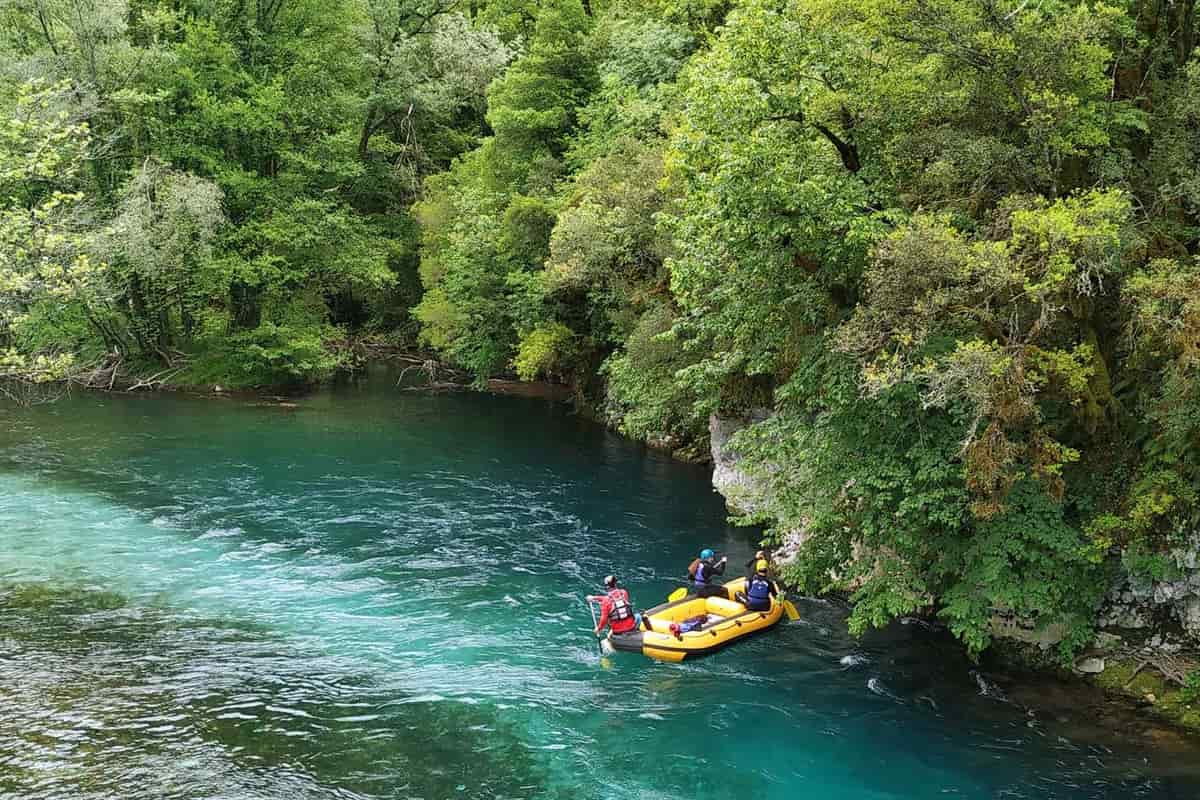
Voidomatis rafting is an easy river run through the Zagori hills of Epirus, in Greece’s far north-west. Among the Greek tours that leave the coast behind, this one is built around clear water and stone bridges.
Read on for where the river runs, why its water is clear, how a trip starts and what happens on the rapids. Difficulty, season, who can join and packing come next, then safety, how booking works and short answers.
What is voidomatis rafting?
Voidomatis rafting is a trip down the Voidomatis River in Epirus, north-west Greece, in an inflatable raft. A river instructor leads each group. Listings call the trip easy and kid-friendly, and one listing says it suits beginners and families.
Rafting means travelling down a river in an inflatable raft, on whitewater or other rough water. Guests on commercial trips normally paddle themselves, because paddling is seen as a more engaging way to enjoy the river trip.
Three listings name an instructor who speaks English and Greek. The listings use the words easy, kid-friendly and family-friendly, and one adds that the trip suits beginners. Voidomatis rafting is therefore sold as an outing for families.
One listing sets a maximum of eight people for each raft. Rafting on certain river sections counts as an extreme sport, while other sections are not so difficult. The Voidomatis trip sits at the gentle end, and all three listings include photos.
- Craft: Inflatable raft
- Led by: Instructor
- Level: Easy
- Fits: Families
Voidomatis rafting is an easy raft trip with a river instructor on the Voidomatis River in Epirus.


Where does voidomatis rafting take place?
Voidomatis rafting takes place on the Voidomatis River in the Ioannina regional unit of Epirus. Listings place the trip inside the Vikos–Aoös National Park, with the rafting base in the village of Klidonia, on the main road between Aristi and Papingo.
Epirus is a region in north-western Greece that borders Albania to the north. Its four regional units are Thesprotia, Ioannina, Arta and Preveza. Ioannina is the regional capital, and one listing places the meeting point within reach of Ioannina by car.
The Voidomatis is a tributary of the Aoös and ends close to Konitsa. There, on the northern boundary of Zagori, the Voidomatis, the Aoös and the Sarantaporos come together. Near Konitsa the Aoös also runs through the Aoös Gorge, a canyon ten kilometres long.
Voidomatis rafting has no single meeting point, so listings differ. One names a rafting base in Klidonia, on the main road from Aristi to Papingo. Another names the Papingo bridge near Aristi, and a third spells the village Kleidonia.
- Region: Epirus
- Unit: Ioannina
- Park: Vikos–Aoös
- Base: Klidonia
Voidomatis rafting runs on a river in Epirus, within the Vikos–Aoös National Park near Konitsa and Aristi.
What makes the river right for voidomatis rafting?
Voidomatis rafting runs on a river with clear water, a flow that lasts all year and a protected mountain setting. Listings call the water crystal-clear and the route family-friendly, and place the whole route inside a national park.

The main current sources of the Voidomatis lie in the village of Vikos. One listing mentions a stop on the route to drink from a natural spring. The same listing calls the river one of the coldest and cleanest in Europe.
Rapids form from four factors: gradient, constriction, obstruction and flow rate. Flow rate depends on seasonal rain and snowmelt. Shallow gradients give gentle, slow rivers. The Voidomatis is a seasonal river with year-round flow, so water is always moving through it.
Stone bridges span the river, and one listing has rafts pass beneath the arched stone bridge at Klidonia. Streams from the Vikos Gorge join the river, and the Vikos Gorge hike covers that limestone canyon on foot.
- Water: Clear
- Flow: All year
- Setting: National park
- Bridges: Stone arches
Voidomatis rafting suits a river that stays clear, keeps its flow and runs through protected land.
How does a voidomatis rafting trip start?
Voidomatis rafting starts at a rafting base in Klidonia, on the main road from Aristi to Papigo. The listing describes a team welcome, safety equipment, a minibus ride to the Aristi-Papigo bridge, then a safety briefing and river practice.
Travellers meet the team at the base. The listing says the base is reachable by car from Ioannina and the western Zagori villages. Hotel pickup and transport to the base are not included, so travellers arrange their own way there.
At the base, the rafting team welcomes the group and hands out safety equipment. The listing names a neoprene suit and boots, a waterproof jacket, a helmet, a lifejacket and a paddle. Changing rooms, lockers, toilets and WiFi are included.
Voidomatis rafting then moves by minibus, with views of Mount Tymphi, the Astraka towers and the Papigo villages. A safety briefing and river practice follow. Commercial trips tend to open with a safety presentation about problems that can arise.
- Meeting: Rafting base
- Ride: Minibus
- Start: Aristi bridge
- Safety: Briefing, practice
Voidomatis rafting opens at the Klidonia base with equipment, a minibus ride and a safety briefing.
What happens on the water during voidomatis rafting?
Voidomatis rafting puts the group in an inflatable raft, and guests paddle the descent together. The listing says the river instructors teach rafting basics, lead the descent and stop for optional dives. The final stretch runs under the Klidonia stone bridge.
On a Voidomatis rafting trip, guests paddle the raft themselves. A rafting paddle has a single blade, a shaft and a T-grip. Commercial trips tend to give guests paddles, since paddling is seen as a more engaging way to enjoy the river.
Rafting happens on whitewater or other degrees of rough water. A graded river section can hold harder and easier water than its overall grade, so rapids and calmer stretches can share one run. The listing calls this trip relaxing and kid-friendly.
The listing says the group stops for optional dives in the clear water and names jumping and swimming among the highlights. For a paddle on the Ionian coast of Epirus, travellers can join the Parga kayak tour.
- Craft: Inflatable raft
- Drive: Group paddling
- Leaders: River instructors
- Pause: Optional dives
Voidomatis rafting combines group paddling, optional dives and a finish under the Klidonia bridge.
How hard is voidomatis rafting?
Voidomatis rafting is a relaxing, kid-friendly trip in the words of the listing. River grades run from Class 1 to Class 6, and the easiest classes ask only for basic skill. The listing names no class number for the river.
Six grades exist, each a class with a number. Class 1 means very small rough areas and very basic skill. Class 2 has rough water, possibly rocks, and asks for basic paddling skill. Class 3 has small waves and asks for rafting experience.
The listing sets the level of difficulty at low. A reviewer calls the trip easy and not for extreme seekers. Rafting references note that class ratings vary widely with the skill and experience of the paddlers who rated the river.
The grade of a river changes with the level of its flow. High water tends to make rapids harder and more dangerous, while low water can make other rapids easier. The Voidomatis is largely seasonal, with year-round flow.
- Scale: Six classes
- Listing: Low difficulty
- Easiest: Class 1
- Flow: Changes grade
Voidomatis rafting carries a low difficulty level in the listing, though any river’s grade shifts with its water level.
Which season suits voidomatis rafting?
Voidomatis rafting has no single season in the listings. One listing calls the trip family friendly all the year, and the other two name no season. The river is cold, and the water level changes with rain and snowmelt.
An encyclopedia entry on whitewater says flow rate depends on seasonal variation in rain and snowmelt. A marked rise or fall in flow can create a rapid or wash one out. The same stretch of river can feel different between seasons.
The Vikos-Aoos National Park holds the river. Its rain is high in the winter months, and a dry spell of two to three months follows in summer. The park belongs to the humid zone with cold winters, and the river level follows that rhythm.
Listings prepare rafters for cold water. One listing calls the river one of the coldest and cleanest in Europe. Another listing supplies neoprene uniforms and anoraks if required, and it lists heated changing rooms for winter.
- Listings: All year
- Flow: Rain, snowmelt
- Water: Cold
- Winter: Heated rooms
Rain, snowmelt and cold water shape voidomatis rafting in every season that listings offer.
Who can join voidomatis rafting?
Voidomatis rafting suits families, beginners and young children, and listings differ on the minimum age. One listing sets the limit at over 6 years with basic swimming skill, while the others exclude only younger children. All three listings exclude pregnant women.
The first listing calls the trip suitable for people over 6 years old. The second excludes children under 2 years. The third excludes children under 3 years and calls the trip ideal for families with children as young as 3 years old.
The first listing asks for basic swimming capability and rates the difficulty low. It says the trip does not suit people with mobility limitations. The other two name no swimming rule. The third excludes people over 80 years.
Voidomatis rafting runs as a group trip with a river instructor. The third listing sets a maximum of 8 persons per raft. The first calls the trip kid-friendly, and its instructors teach rafting basics. All three listings offer English and Greek.
- Age: Listings differ
- Swimming: Basic skill
- Excluded: Pregnant women
- Raft: 8 persons
Voidomatis rafting welcomes families and beginners, while age limits and health exclusions differ by listing.
What do travellers bring to voidomatis rafting?
Voidomatis rafting calls for swimwear, a towel and a change of clothes, as two listings state. The rafting base supplies the gear, from neoprene boots and a helmet to a life jacket and a paddle. A third listing names only swimwear.
Two listings name the same three items: swimwear, a change of clothes and a towel. The third lists swimwear alone. One listing does not allow tight clothing, smoking, alcohol or drugs. Another does not allow plastic bottles or littering.
Gear comes with the trip. The first listing supplies a neoprene suit and boots, a waterproof jacket, a helmet, a life jacket and a paddle. The second supplies neoprene shoes, helmets, life jackets and paddles, with neoprene uniforms and anoraks if required.
A voidomatis rafting base adds comforts. One listing offers changing rooms, lockers and toilets. Another offers changing rooms, showers, toilets, a small cafe and parking. All three listings include photos from the river, taken by the team.
- Wear: Swimwear
- Pack: Towel
- Extra: Clothes
- Supplied: Helmet, jacket
Voidomatis rafting needs little luggage, because the base supplies safety gear and travellers bring swimwear and a towel.
How safe is voidomatis rafting?
Voidomatis rafting is rated low in difficulty, and the listed trip runs with certified river instructors and supplied safety equipment. The listing provides a helmet, a lifejacket, a neoprene suit and boots. A safety briefing and river practice come before the descent.
The listing for voidomatis rafting adds a waterproof jacket and a paddle to that kit. A personal flotation device keeps the wearer afloat with head and mouth above the surface. Whitewater safety lists also name throw ropes and other people as spotters.
Certified river instructors teach the basics and lead the descent. The listing ties their certificates to the worldwide body that oversees the sport. Safety talks are a common start to commercial rafting, and they explain problems that can arise.
Sources state that the overall risk level of a rafting trip with proper precautions is low. Training and safety equipment reduce river dangers but do not remove them. High water makes rapids harder and more dangerous.
- Head: Helmet
- Body: Lifejacket
- Start: Safety briefing
- Lead: River instructors
Voidomatis rafting pairs a low difficulty rating with a helmet, a lifejacket, river instructors and a briefing.
How do travellers book voidomatis rafting?
Voidomatis rafting is booked ahead through an online listing, where travellers check availability to see starting times. The listing offers a reserve-now, pay-later option and free cancellation with a full refund. Travellers then drive to the rafting base.
The listing tells travellers to check availability to see starting times. The Epirus listing page offers filters for rafting, canyoning, kayaking, river walks and caves. Other filters on that same page include gorges and swimming holes.
The listing lets travellers reserve now and pay later, so a booking holds a spot and nothing is paid at that moment. Free cancellation brings a full refund when travellers cancel before the cut-off written in the listing.
The meeting point is the rafting base in Klidonia, on the main road from Aristi to Papigo. Instructors speak English and Greek. Travellers drive there from Ioannina or the western Zagori villages, as the listing describes.
- Book: Online listing
- Pay: Later
- Refund: Before cut-off
- Languages: English, Greek
Voidomatis rafting is booked ahead through a listing, with pay-later booking and a refund before the cut-off.
How does voidomatis rafting fit a stay in Zagori?
Voidomatis rafting fits a stay in Zagori because the rafting base stands on the main road between Aristi and Papigo. Ioannina borders Zagori to the south, and Konitsa lies to the north-east, so the river outing links a city, a town and village stops.
Papigo holds a school built in 1897 that also houses the library of its founder. In Megalo Papigo, the church of Saint Blaise dates from 1852 and stands on the foundations of an older church from 912. Both make a village stop.
Aristi sits in Central Zagori, and an Epirus listing offers a private walk along the river path from the village. At the river’s end, Konitsa overlooks the valley where the Aoos meets the Voidomatis. The town has shops, schools and a public medical centre.
Ioannina is the capital of Epirus and a city base for voidomatis rafting. An inhabited island on Lake Pamvotis is a short ferry ride from the mainland. For another inland day out, see the Meteora hiking tour.
- South: Ioannina
- North-east: Konitsa
- Village: Papigo
- Road: Aristi, Papigo
Voidomatis rafting fits a Zagori stay as a river outing between village stops, Konitsa and the city of Ioannina.
What do travellers ask about voidomatis rafting?
Voidomatis rafting prompts five plain questions from travellers. They cover the difficulty of the river, the age of children, swimming ability, clothing and the water level. The answers below come from one listing read for format and from Wikipedia pages on the Voidomatis, rafting and river difficulty.
How hard is voidomatis rafting for a first-time paddler on the river?
The listing read here rates the difficulty as low, and a river instructor teaches rafting basics and leads the descent. Wikipedia describes Class 1 as very small rough areas needing very basic skill, and Class 2 as needing basic paddling skill. The listing names no class number.
Can children join voidomatis rafting, and is there a minimum age?
The listing calls the trip kid-friendly and states that it suits people aged over 6 years with basic swimming capability. The page also lists children under 6 years and pregnant women, and says it is not suitable for people with mobility limitations. Travellers read the age line first.
Do travellers need swimming skill or rafting experience for voidomatis rafting?
The listing asks for basic swimming capability and names no rafting experience. River instructors teach the rafting basics. A lifejacket and a helmet are supplied, and the stops for diving into the clear water are optional. One reviewer called the trip easy and not meant for extreme seekers.
What do travellers wear and bring to the river for voidomatis rafting?
The listing asks travellers to bring swimwear, a change of clothes and a towel. The operator supplies a neoprene suit, boots, a waterproof jacket, a helmet, a lifejacket and a paddle. Access to changing rooms, lockers and a toilet is included. Plastic bottles and littering are not allowed.
What happens to voidomatis rafting when the water is too low or too high?
The listing states no rule for low or high water, and its itinerary is subject to change. Wikipedia says the Voidomatis has year-round flow. It adds that a river’s grade can change with the water level, and as a rule high water makes rapids more difficult and dangerous.