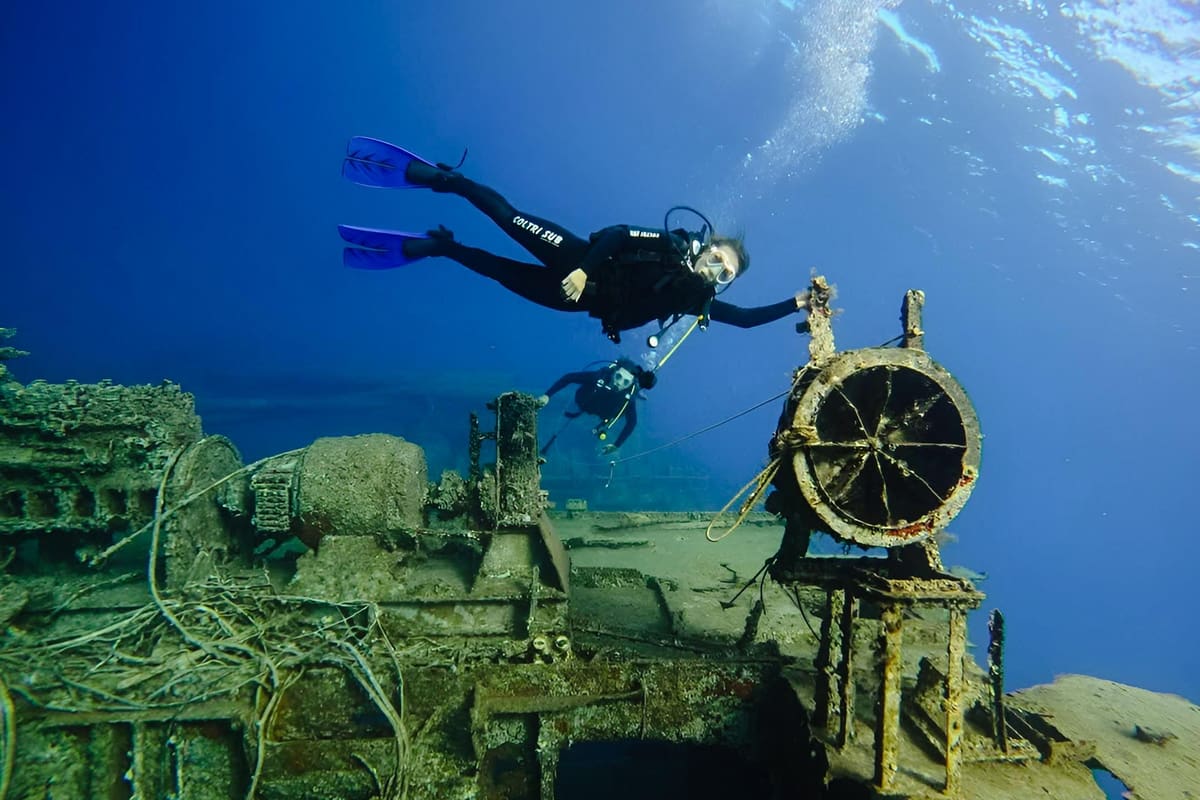
A Rhodes scuba diving trip takes divers under the clear sea around Rhodes, with tanks of air on their backs. Dives reach reefs, wrecks and sea caves close to the coast. It is one of the underwater tours in Greece on Greece VIP.
This post covers what a Rhodes scuba diving trip includes, the dive sites and the wrecks. It also covers sea life, the history under the sea and safety. Dive gear, the best season and common questions come last.
Each section ends with a Rhodes scuba diving trip or a nearby sea tour that can be booked online.
What does a Rhodes scuba diving trip include?
A Rhodes scuba diving trip includes caves, shipwrecks and sea habitats. Calm, warm water surrounds them all. Until recently, set spots limited diving to stop the illegal trade in antiquities. Today diving is allowed almost everywhere around Rhodes.
Deep water lies off the coast. The Rhodes Basin sits in the Levantine Sea, where the Hellenic Trench ends. This trench system holds the deepest basins and troughs of the Mediterranean.
The Greek agency NECCA protects nature here from Karpathos, with a branch office in Rhodes. It looks after 22 Natura 2000 sites in the Dodecanese. Natura 2000 sites are protected nature areas.
Posidonia seagrass meadows grow around the coasts of Rhodes. They count as priority habitat 1120. They shelter the shellfish Pinna nobilis and Arca noae. Site GR4210005 on west Rhodes covers the sea from Karavola to Glyfada bay.
Rhodes scuba diving boats share the sea with jet ski rides off Rhodes. The water on the east side rates Good for ecological status. Town beaches fall in a separate water body.
- Stride entry: The diver steps forward from a standing spot. The fins hit the water first.
- Seated entry: The diver sits facing the water on a large boat’s swim platform.
- Shot line: Divers follow a weighted line with a buoy and hold it at stops.
Every Rhodes scuba diving trip starts with one of these entries. Calm water makes each step simple. Below the surface, seagrass, caves and wrecks wait for divers around the island.


Where are the dive sites around Rhodes?
Rhodes scuba diving sites spread along the north and east coasts. Caves lie at Kallithea and Lindos. Sandy and rocky bays near Rhodes town offer shallow water. The far south-east coast holds the wide, open bay of Plimmiri.
Kallithea cove is known for thermal springs from the Italian occupation, first opened in 1929. Its shore and seabed are sand and rock. Limpets, bivalves and large seaweeds lead the sea life.
Anthony Quinn beach lies in Ladiko bay and faces north. Its shore and seabed are pebbles with large rocks. Green, brown and red algae grow there. The water reaches about 5 m deep 175 m out.
Lindos links Rhodes scuba diving with history. Mikros Gialos sits in St Paul’s bay, south of the Acropolis of Lindos. This closed cove is 90 m long. Depths of about 5 m start 70 m out.
Plimmiri is a natural bay on the south-east coast, left of the road from Lachania to Kattavia. Its beach is 1,700 m long. Loggerhead turtles, Caretta caretta, nest there. Rhodes scuba diving here meets limpets, bivalves and crabs.
- Rhodes town: Enydriou 1 on the west shore is 900 m long. Depths of about 5 m start 85 m out.
- Mavros Kavos–Agkali: This bay about 11 km from Rhodes town is 660 m long.
- Eastern Rhodes: Site GR4210029 covers the Lindos peninsula and the Pentanisa and Tetrapolis islets.
Each bay gives Rhodes scuba diving a different seabed. Sand, pebbles and rock change from site to site. Algae, shellfish and turtles add life to every shallow corner of the island.
What wrecks can a Rhodes scuba diving trip see?
A Rhodes scuba diving trip can reach the Giannoula K, a cargo ship off the south coast. A German war plane also rests near the island. Old warships add more history. Plimmiri and Kamiros are key wreck sites.
The Giannoula K is also called the Plimmiri Wreck. This Dutch cargo ship is 110 m long. It sank off the south coast in 1981. It lies at an angle, with its upper deck at 15 m.
The deepest point of the wreck sits at 21 m. The mast rises above the surface. A buoy marks the site for Rhodes scuba diving, 5 minutes by boat from Plimmiri harbour.
Scuba divers found an almost intact Junkers Ju 52 off Rhodes. It was a German transport plane from the Second World War. After more than 70 years underwater, only the engine and cockpit window were missing. Its doors are locked, and its windows are too small to see inside.
The plane’s nickname was Tante Ju. It entered service in 1930 as a civilian airliner. Later it carried troops and cargo for the Luftwaffe, the German air force. The main version had three radial engines.
- TA.10: This former French torpedo boat was sunk on purpose in Prassas Bay.
- MAS 537: This 20-ton Italian torpedo boat sank off Rhodes on 4 September 1940.
- Pierre Gibault: This Liberty ship hit a mine on 22 June 1945.
- Pytheas: This Greek Liberty ship sprang a leak and was beached in 1966.
The Nour M, a cargo ship from Sierra Leone, capsized and sank at Rhodes in 2013. Such wrecks give Rhodes scuba diving a strong link to the island’s past at sea.
Which sea life does a Rhodes scuba diving trip meet?
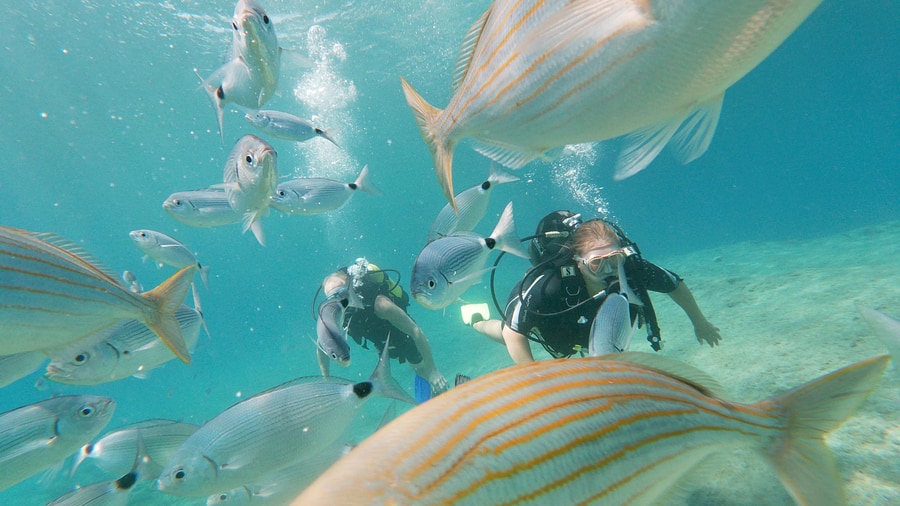
Rhodes scuba diving meets a mix of native Mediterranean life and newcomers from the Red Sea. These fish arrived through the Suez Canal. Lionfish, rabbitfish and toadfish now swim in this sea. Slipper lobsters still hide in caves and reefs.
The island sits on a border line at sea. The International Hydrographic Organization sets the southern limit of the Aegean through Rhodes. The line runs from its north-east tip to Cape Prasonisi.
The Red Sea surface sits slightly higher than the Mediterranean, so its water pours north through the canal. By about 2010, over 1,000 Red Sea species had been found in the Mediterranean.
Rhodes scuba diving trips can meet two Red Sea rabbitfish. The marbled spinefoot swims in schools of 50 to hundreds of fish. The dusky spinefoot reaches 30 cm. It grazes on algae by day and hides in holes at night.
The common lionfish is also called the devil firefish. It grows up to 35 cm. Moray eels resist its spines and eat it. The silver-cheeked toadfish, up to 40 cm long, has been caught off Rhodes.
- Cornetfish: The bluespotted cornetfish appeared off Israel in 2000 and reached the Gulf of Lions by 2007.
- Leatherjacket: The reticulated leatherjacket, another Red Sea migrant, grows to 25 cm.
- Slipper lobster: This clawless lobster shelters by day on cave ceilings at 4 to 100 m.
The slipper lobster can reach 45 cm and 1.5 kg. Overfishing has made it rare over much of its range. Spotting one during Rhodes scuba diving is a special moment.
What history lies under the sea off Rhodes?
Rhodes scuba diving sits above deep layers of sea history. A 12th-century shipwreck rests inside the commercial port. Old trade jars and ancient warships tie the island to the sea. Strict rules protect these remains under water today.
The wreck lies about 70 m west of the north side of the Mole of Angels. It rests at a depth of 13 m. Sand stirred up by boat traffic buried it. So the wooden hull survived in rather good condition.
A lab dated one hull frame to between 1020 and 1155 AD. The cargo held amphorae, which are clay jars, from the 12th and 13th centuries AD. The first dig in 2013 covered only 1/6 of the site.
Rhodes scuba diving history also includes wine. Rhodian amphora types became popular in the Aegean from the 3rd century BC. They led to the Camulodunum 184 jar. That jar carried Rhodian wine across the Roman empire.
Sponge divers from Symi found the Antikythera wreck in 1900. The ship carried vases in the Rhodian style. One theory says the Antikythera mechanism was built on Rhodes. It uses the Moon theory of Hipparchus, an astronomer from Rhodes.
- Colossus: Arab raiders sold its remains in 653, and 900 camels carried the bronze away.
- Fortress of St Nicholas: A circle of sandstone blocks on its floor is a possible Colossus foundation.
- Navy: The quadrireme was the main Rhodian warship until Gaius Cassius Longinus abolished the navy in 46 BC.
A UNESCO convention from 2 November 2001 protects remains under water for at least 100 years. It fully bans commercial exploitation. Preservation in place comes first, so Rhodes scuba diving visitors leave old objects where they lie.
How safe is a Rhodes scuba diving trip?
Rhodes scuba diving stays safe through firm habits on every dive. Plans check the current before each dive. Buoys and boat crews keep divers visible at the surface. Basic first aid knowledge helps with stings from jellyfish and fish.
Water tends to flow slower in hollows and faster over ridges. Its speed can change with depth. Drift dive plans check the current’s direction and strength. This keeps divers away from shipping lanes.
Drift divers enter the water at the same time. This stops the flow from splitting the group. A diver who must surface early climbs the leader’s buoy line. The boat crew watches that spot.
Live-boating means diving from a boat that is not moored. Running engines raise the propeller risk. Yet the boat can follow drifting divers on a Rhodes scuba diving trip. A floating trail line from the stern helps divers behind.
The nomad jellyfish came through the Suez Canal in the 1970s. Its light blue bell is commonly 40–60 cm across. Its stinging cells cause very painful injuries. Large swarms form in summer.
- Rabbitfish sting: Heat breaks down the venom, so hot water at 43–46 °C treats it.
- Fireworm bristles: Adhesive tape pressed on and pulled off removes them.
- Flying home: DAN rules from 1989 advised waiting 24–48 hours to fly after dives with decompression stops.
Decompression stops are safety pauses on the way up. Long flights leave travellers tired and slightly dehydrated, which raises decompression sickness risk. In Greece, the Athens Naval Hospital runs a Diving and Hyperbaric Medicine Unit. Good habits keep Rhodes scuba diving relaxed.
What do divers wear on a Rhodes scuba diving trip?
Rhodes scuba diving gear starts with a wetsuit or a thin dive skin. Divers add weights on a belt or in jacket pockets. A knife or line cutter frees them from nets. Divers also carry a marker buoy.
A dive skin, also called a stinger suit, is a thin suit. A 1 mm suit gives very little warmth. Divers can wear one under a wetsuit to slide in easily.
Dry suit seals sit at the wrists and neck. Latex seals need a wash after use and a change every two years. Silicone seals clip on without glue and cause no allergy.
Dressing in a dry suit takes longer than a wetsuit. A long wait on a warm boat deck can overheat the diver. The same suit choice applies to scuba diving on Paros.
For Rhodes scuba diving, a weight belt of tough nylon webbing is the common choice. Integrated weights sit in jacket pockets instead. A pull on each pouch handle drops the weight in an emergency.
Divers set weight with a buoyancy check in shallow water. They wear full kit, a nearly empty tank and an empty jacket. They add or remove weight until they float level.
- Gas use: A dive burns 2 to 3 kg of gas, so divers get lighter.
- Tools: A dive knife cuts lines, and a line cutter holds a scalpel blade.
- Marker buoy: Taller buoys of up to 2 metres show better in rough water.
Rhodes scuba diving safety rests on correct weight. Buoyancy and weight problems appear in a fairly high share of scuba deaths. Recovered bodies have shown every weight still in place.
When is the best season for a Rhodes scuba diving trip?
Rhodes scuba diving works all year, but the sea is warmest in late summer months. Northern Hemisphere seas peak in August and September. Clear, low-nutrient water helps underwater visibility. Sheltered coastal bays give calmer water on windy days.
Weather Atlas gives the sea around Rhodes 17.9 °C in January. March averages 17.1 °C. December holds 18.8 °C. Northern seas reach their low in February and March.
HNMS, the Greek weather service, gives Rodos a mean wind of 7.3 knots in January. It rises to 8.3 knots in February and 8.4 in March. December is calmer at 6.9 knots.
For Rhodes scuba diving, Kallithea beach is sheltered from winds by its shape and direction. Its official profile records no strong currents or tides. Anthony Quinn Bay is also sheltered, with no strong currents.
Plimmyri, on the south-east coast, is sheltered except from south-westerlies. Beaufort is a scale for wind strength. Prasonisi keeps a wind of about 4 to 5 Beaufort. This happens even when the Aegean is almost calm.
The eastern Mediterranean is called ultraoligotrophic, meaning very poor in nutrients.
- Clear water: In very clear water, visibility can reach about 80 m.
- Limited view: DAN Southern Africa calls visibility limited when a buddy vanishes beyond 3 metres.
- Summer layers: Warm surface water is cut off from deeper layers.
Rhodes scuba diving plans match the month to sea warmth and wind. A sheltered site keeps a windy day useful. Comfort matters too.
What do travelers ask about a Rhodes scuba diving trip?
Rhodes scuba diving questions cover health, age and records. A medical statement is needed mainly for courses, while ordinary dives are at the diver’s own risk. Asthma and diabetes have clear rules. Children have their own training programmes too.
Do Rhodes scuba diving visitors need a medical exam?
France, Norway, Portugal and Israel require a medical exam for recreational divers by law. Where a fitness certificate is issued, it lasts a year or less. A past lung collapse with no injury behind it is widely listed as a permanent bar.
Can people with asthma join Rhodes scuba diving?
The UK Diving Medical Committee agrees carefully selected asthmatics can dive safely. As of 2016, no evidence showed higher risk for divers with mild asthma. They check peak flow, a breath strength test, twice a day for at least three days.
What does the inhaler rule mean for Rhodes scuba diving?
Peak flow can drop 15% below a diver’s best. Then diving stops until flow is normal for 48 hours. The same wait follows any use of a reliever inhaler. At 30 m, denser air means breathing uses about half of a diver’s exercise capacity.
How old must children be for Rhodes scuba diving?
The UK Diving Medical Committee sets no top age for medical checks. Each training body sets its own minimum age. SSI runs SSI Explorers for children aged 8–12. Teens with childhood asthma tend to pass fitness rules only as adults.
Can divers with diabetes try Rhodes scuba diving?
DAN advises divers with diabetes to stay above 30 m. It also sets a limit of one hour underwater. Young divers with diabetes under 18 face tighter limits than adults. They can be kept to pool diving under close supervision.
How do seasickness tablets affect Rhodes scuba diving?
Certain seasickness tablets cause drowsiness. This sleepiness adds to nitrogen narcosis, a drunk feeling at depth. Divers take a test dose on a day without diving. A dive log also helps after an accident, since it shows a diver’s past experience.